● 7 Trillion Wiped Into Samsung-Hynix Leverage ETF Shock, Regulators Move to Curb KOSPI Volatility
Samsung Electronics and SK Hynix Leveraged ETFs Absorb KRW 7 Trillion in One Month: Can Financial Regulator Measures Reduce KOSPI Volatility?
The key issue is not simply that leveraged ETFs are risky.
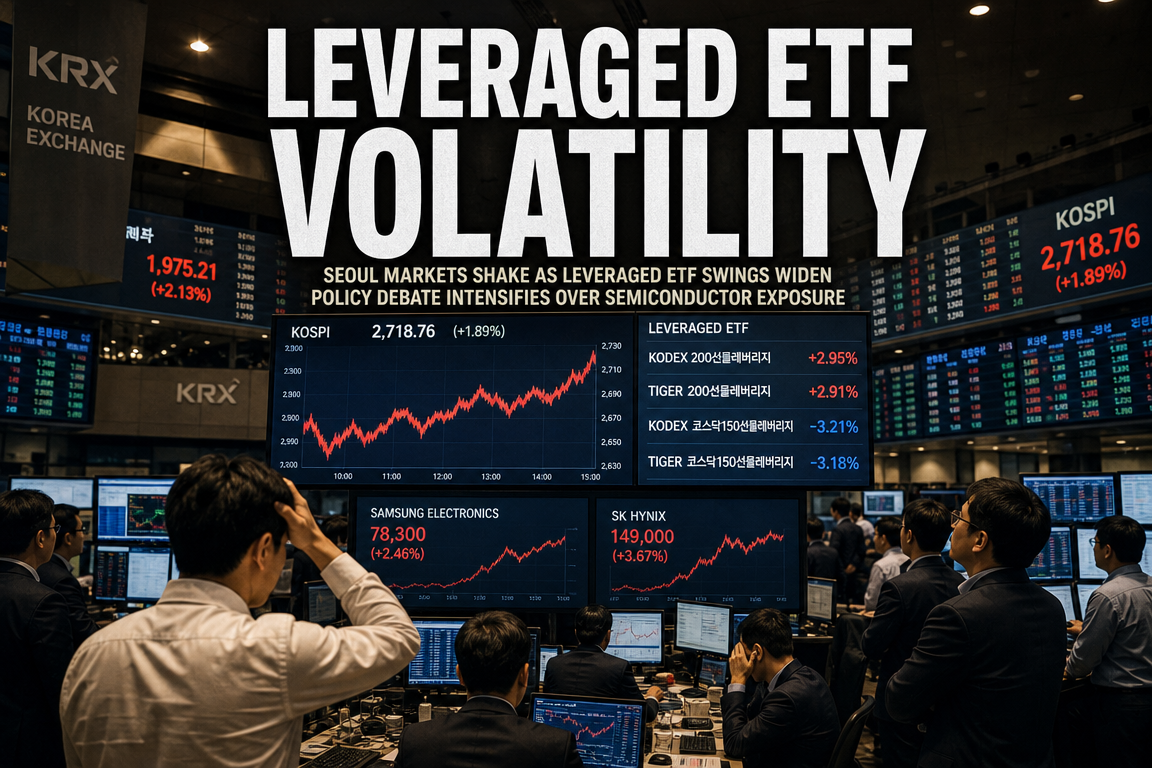
Single-stock leveraged products linked to Samsung Electronics and SK Hynix attracted more than KRW 7 trillion in net inflows in one month, affecting KOSPI volatility, semiconductor ETF flows, retail investor losses, and financial regulatory policy simultaneously.
This report covers not only the widely cited rules such as the KRW 30 million basic deposit requirement, 20-share trading units, and marketing restrictions, but also the structural factors that are more relevant to market stability.
The central point is straightforward.
Leveraged ETFs do not create price direction. They amplify an existing direction more rapidly and more sharply.
When leverage is applied to high-weight KOSPI names such as Samsung Electronics and SK Hynix, the issue extends beyond a single product and becomes a market-wide volatility concern.
1. News Summary: More Than KRW 7 Trillion Flowed into “Samjeon-Nix” Leveraged Products in One Month
According to market data, from June 16 to July 15, a total of KRW 7.3364 trillion in net inflows went into 16 single-stock leveraged and inverse products linked to Samsung Electronics and SK Hynix.
“Samjeon-Nix” is a market term combining Samsung Electronics and SK Hynix.
The issue is that during the same period, the underlying stocks fell sharply.
- Samsung Electronics share price: down approximately 24.33%
- SK Hynix share price: down approximately 19.49%
- Net inflows into 16 single-stock leveraged/inverse products: approximately KRW 7.3364 trillion
- Combined market capitalization of single-stock leveraged products: expanded to around KRW 12 trillion
In other words, retail capital continued to flow into leveraged ETFs even as the underlying shares declined.
This reflects a combination of averaging down in a falling market, expectations of a rebound, and preference for high-risk leverage.
In a typical market downturn, selling pressure tends to increase. In this case, however, inflows into leveraged products added to volatility.
2. Why Single-Stock Leveraged ETFs Affected the Broader KOSPI
Single-stock leveraged ETFs are designed to track roughly 2x the daily return of a specific stock.
If Samsung Electronics rises 3% in a day, the leveraged ETF is theoretically expected to rise about 6%.
Conversely, if Samsung Electronics falls 3%, the ETF is expected to fall about 6%.
The main issue is not the 2x exposure itself, but the daily rebalancing mechanism.
This creates negative compounding effects over time.
3. The Key Concept Retail Investors Often Miss: Negative Compounding
The main trap in leveraged ETFs is the assumption that if the underlying stock returns to its original level, the ETF will also recover to its original level.
That is not how the structure works in practice.
For example, assume an investment of KRW 10,000 in a regular stock.
- After a 20% decline on day 1, the value falls to KRW 8,000.
- After a 25% gain on day 2, it returns to KRW 10,000.
A 20% loss requires a 25% gain to recover principal.
The same principle applies to leveraged ETFs, but with stronger decay.
- If the underlying stock falls 20%, the leveraged ETF may fall about 40%.
- If the underlying stock rises 25% the next day, the leveraged ETF may rise about 50%.
At first glance, this may appear to restore the original value.
However, KRW 10,000 falling 40% becomes KRW 6,000, and a subsequent 50% gain brings it only to KRW 9,000.
The original principal is not recovered.
In a volatile market, leveraged ETFs can deteriorate much faster than the underlying stock.
This is the negative compounding effect.
In the current environment, where semiconductor shares move sharply up and down, leveraged ETF investors can incur losses larger than expected.
4. Market Data Showed Leveraged ETF Losses Far Exceeded Those of the Underlying Stocks
Based on the reported trend, losses in single-stock leveraged ETFs were significantly larger than losses in Samsung Electronics and SK Hynix shares themselves.
- When Samsung Electronics fell about 8.96%, related leveraged ETFs fell more than 30%
- When SK Hynix fell about 7%, related leveraged ETFs fell around 34%
This gap is not explained by 2x leverage alone.
It reflects daily reset mechanics, volatility expansion, negative compounding, and rebalancing effects at the close and during the trading session.
Samsung Electronics and SK Hynix account for a large share of the KOSPI.
When these two stocks move, semiconductor ETFs and the broader KOSPI index are affected.
For that reason, this issue is not only about individual investor losses, but also about market stability in Korea.
5. Regulatory Response: Higher Entry Barriers
The financial authorities responded to concerns that single-stock leveraged products were increasing market volatility.
The policy direction is clear.
The products will not be eliminated, but access will be made significantly more difficult.
In other words, the approach is tighter entry control rather than delisting.
6. Basic Deposit Requirement Raised from KRW 10 Million to KRW 30 Million
The most visible measure is the increase in the basic deposit requirement.
Previously, investors needed KRW 10 million to access single-stock leveraged products.
From next month the requirement will rise to KRW 30 million.
Another important change is that the previous practice of easing deposit requirements based on trading experience will be prohibited.
In other words, arrangements such as lowering the requirement after several months of trading will no longer be allowed.
In addition, the use of substitute collateral such as existing stock holdings will be restricted.
Previously, holding Samsung Electronics shares could partially count toward the deposit requirement.
Going forward, the standard will shift toward cash-based qualification.
This measure is scheduled to take effect on August 19.
The authorities are effectively reorganizing access to leveraged ETF trading around investors with actual cash capacity.
7. Trading Unit Expanded to 20 Shares
The second major measure is the expansion of the minimum trading unit.
Currently, single-stock leveraged ETFs can be traded in one-share units, allowing easy access for small investors.
For example, if the ETF price is KRW 15,000, an investor can buy one share with KRW 15,000.
Under the new rule, trading will be moved to 20-share units on a temporary basis.
If the ETF price is KRW 15,000, a minimum of KRW 300,000 will be required.
This may exceed the entry cost of a Samsung Electronics share.
The measure is expected to take effect around November.
The objective is to reduce speculative demand from small-scale investors using high leverage.
8. Pre-Investment Education Expanded from 2 Hours to 3 Hours
The mandatory education requirement for single-stock leveraged investing will also be strengthened.
The previous requirement was 2 hours.
It will now increase to 3 hours.
More important than the duration is the need for stronger assessment.
Investors should demonstrate a clear understanding of the structure of leveraged ETFs, negative compounding, tracking error, price deviation, and forced rebalancing.
This is one of the most important points.
Many investors focus only on the phrase “2x return,” while failing to understand that losses can also accelerate at roughly twice the pace.
9. Suspension of New Listings and Ban on Advertising and Marketing
The authorities also decided to temporarily suspend new listings of single-stock leveraged products until market conditions stabilize.
Advertising and marketing for existing products will also be prohibited.
This is an important measure.
Leveraged products are more likely to contribute to market concentration when sold aggressively.
In the current environment, where AI semiconductor optimism, expectations of a semiconductor supercycle, and broader KOSPI upside sentiment are present, the narrative of “buy before it is too late” can easily intensify.
The advertising ban is intended to reduce such overheated sentiment.
10. Tighter Premium/Discount Control: From 3% to 2%
One area often overlooked by retail investors is premium/discount control.
ETFs have a NAV, or net asset value.
NAV is the theoretical price based on the value of the assets held by the ETF.
However, the ETF’s market price may trade above or below NAV depending on supply and demand.
This difference is referred to as premium or discount, and the rate is called the premium/discount ratio.
For example, if an ETF’s fair value is KRW 10,000 but the market price is KRW 12,000, the premium is 20%.
Previously, brokers and liquidity providers were required to keep the premium/discount within 3%.
The standard will now be tightened to 2%.
In addition, repeated breaches may lead to faster investor alert procedures.
Previously, the process involved identification, warning notice, and designation in three stages. Going forward, investor alerts may be issued more quickly.
This measure is intended to prevent investors from buying ETFs at prices materially above fair value.
11. Summary of the Regulatory Timeline
| Category | Main Measure | Effective Date |
|---|---|---|
| New listings | Temporary suspension of new single-stock leveraged ETF listings | Immediate |
| Advertising and marketing | Ban on advertising and marketing for existing products | Immediate |
| Pre-investment education | Expanded from 2 hours to 3 hours, with stronger assessment | Phased from July |
| Basic deposit requirement | Raised from KRW 10 million to KRW 30 million | August 5 |
| Substitute collateral recognition | Restriction on recognizing stocks and other substitute assets as deposit | August 19 |
| Premium/discount control | Tightened from 3% to 2% | From August |
| Trading unit | Expanded to 20-share units | Around November |
12. Will the Measures Be Effective?
The measures are likely to have some effect.
Raising the basic deposit requirement to KRW 30 million will significantly reduce access for small investors.
Expanding the trading unit to 20 shares may also reduce impulsive trading.
The advertising ban and suspension of new listings should help ease market overheating.
Authorities estimate that once these measures are implemented, the market capitalization of single-stock leveraged products, currently around KRW 12 trillion, could decline to approximately KRW 4 trillion to KRW 5 trillion.
In other words, the authorities expect the market to shrink to roughly one-third of its current size.
However, timing remains a concern.
Many measures will not take effect until August or later, and the trading-unit change is expected only in November.
This means the policy response may arrive after much of the volatility has already occurred.
13. Risks Highlighted by the Securities Industry
The securities industry generally agrees with the goal of reducing speculative trading, but has raised several concerns.
The first concern is market contraction.
Excessive restrictions on leveraged ETFs could remove legitimate hedging tools as well.
The second concern is a displacement effect.
If domestic single-stock leveraged products are restricted, some investors may move to overseas leveraged ETFs or derivatives.
The U.S. market already offers a wide range of leveraged ETFs and options.
As domestic rules tighten, some retail investors may shift abroad.
The third concern is distortion in domestic fund flows.
Investors may sell other stocks to raise cash in order to meet the deposit requirement.
This could further distort flows in the KOSDAQ and small-cap stocks.
The fourth concern is backlash from existing investors.
If the new rules are applied broadly to current holders, questions may arise over the restriction of already acquired positions.
14. The Core Point Often Missed: Leverage Changes Speed, Not Direction
The most important point in this issue is that leveraged ETFs are not the sole cause of semiconductor share declines.
They are closer to an accelerator than a directional engine.
When Samsung Electronics and SK Hynix rise, leverage magnifies gains; when they fall, it magnifies losses.
Underlying factors such as semiconductor cycle weakness, valuation concerns in AI-related stocks, National Pension Service rebalancing, possible Bank of Korea rate hikes, and global liquidity shifts shape the direction first.
Leveraged ETFs then amplify that movement.
Missing this distinction can distort investment judgment.
It is risky to assume that regulation alone will drive a rebound.
While regulation may help reduce volatility, the true direction of semiconductor shares will continue to be determined by earnings, flows, rates, exchange rates, and the global AI investment cycle.
15. A More Important Structural Issue: A Small Tail Moving the Whole Market
Samsung Electronics and SK Hynix represent a significant share of the KOSPI.
When trading volumes in ETFs linked to these two names expand sharply, a derivative product can begin to move the underlying stocks and the broader index.
This is often described as “the tail wagging the dog.”
ETFs are supposed to follow the underlying assets.
However, if ETF assets grow too large, rebalancing activity can trigger trading in the underlying stocks.
In particular, around market close, ETF managers may need to buy or sell Samsung Electronics and SK Hynix to maintain target leverage ratios.
This trading can then affect the underlying stock prices, which in turn affect the ETF again.
This feedback loop is a market-system issue, not merely an individual investor issue.
16. Why This Should Be Viewed in Connection with the AI Semiconductor Cycle
Semiconductor stocks are no longer simple cyclical names.
They are now linked to AI data center investment, HBM demand, global big-tech capital expenditure, U.S. technology trends, exchange rates, and interest rate expectations.
SK Hynix in particular has benefited from HBM expectations, while Samsung Electronics has reflected both memory-cycle recovery and foundry competitiveness expectations.
In this environment, leveraged ETFs can cause investors to confuse the long-term growth story of AI semiconductors with short-term speculative leverage.
The long-term growth case for AI remains important.
However, leveraged ETFs are not a long-term investment vehicle for the theme. They are instruments for short-term price exposure.
Failing to distinguish between the two can lead to losses despite choosing a strong industry theme.
17. Five Items Investors Should Check Now
First, do not treat leveraged ETFs as long-term investments.
Longer holding periods increase exposure to negative compounding.
Second, do not assume the ETF will recover in line with the underlying stock.
Even if the underlying stock returns to its prior level, the ETF may not recover principal.
Third, high trading volume does not mean low risk.
High volume may indicate liquidity, but it may also reflect speculative concentration.
Fourth, monitor changes around regulatory implementation dates.
Funding and trading patterns may shift around August 5, August 19, and the expected November change in trading units.
Fifth, track both semiconductor fundamentals and interest-rate conditions.
Market direction is not determined by leveraged ETFs alone.
Semiconductor earnings, global AI investment, U.S. interest rates, Bank of Korea policy, exchange rates, and National Pension Service rebalancing all matter.
18. Market Outlook: Volatility in June to July, Potential Stabilization After August
From the original perspective, June and July were viewed as a period of elevated volatility.
Concentrated flows into leveraged ETFs, National Pension Service rebalancing, and semiconductor share corrections were seen as factors increasing KOSPI volatility.
After August, volatility may ease somewhat as regulatory effects begin to filter through.
However, volatility is unlikely to disappear entirely.
The key issue is where liquidity flows next if risk appetite returns.
If expectations around the U.S. political cycle, global stimulus, rate changes, and the AI investment cycle align, capital may return to growth stocks and semiconductors.
Even then, direct exposure to underlying stocks, diversified semiconductor ETFs, and earnings-based positions would likely remain more stable than leveraged products.
19. Final Assessment of the Regulatory Package
The direction of the policy response is appropriate.
Raising entry barriers, banning advertising, tightening premium/discount controls, and expanding education should support market stability.
However, several limitations remain.
First, implementation is not immediate.
Many measures arrive after volatility has already increased, with key steps spread across August and November.
Second, it is debatable whether the barriers are high enough.
KRW 30 million is a meaningful amount, but some argue it may still be insufficient to fully deter speculative capital.
Third, if education is only procedural, the impact will be limited.
Investors must understand the product structure. Simply completing an online module may not materially improve protection.
Fourth, the possibility of capital moving overseas must be considered.
If domestic rules tighten while overseas access remains easy, risk may shift rather than decline.
20. The Most Practical Response for Investors
In the current environment, the key question is not how much can be gained, but how much risk can be absorbed.
Leveraged ETFs may appear attractive in a rising market, but in a volatile market they can make recovery much harder.
If the long-term semiconductor theme remains compelling, direct shares, diversified ETFs, and disciplined cash management are more practical than leverage.
The AI semiconductor theme remains intact, but short-term prices remain highly sensitive to rates, exchange rates, flows, and policy changes.
From a macro perspective, risk management is more important than aggressive leverage at this stage.
Even for short-term trading, leveraged positions without a clear stop-loss, holding period, or target return should be avoided.
Leveraged ETFs are not products that turn poor timing into double profits. They are products that can accelerate losses when the call is wrong.
< Summary >
Approximately KRW 7.3364 trillion flowed into single-stock leveraged products linked to Samsung Electronics and SK Hynix in one month.
Despite sharp declines in the underlying stocks, retail capital continued to move into leveraged ETFs, increasing KOSPI volatility.
The financial authorities introduced measures including raising the basic deposit requirement from KRW 10 million to KRW 30 million, expanding trading to 20-share units, strengthening education, suspending new listings, banning advertising, and tightening premium/discount management.
The measures may support market stability, but the timing is delayed and there is a risk of capital shifting to overseas products.
The key point is that leveraged ETFs do not determine price direction. They amplify both gains and losses.
The long-term AI semiconductor theme and short-term leverage speculation must be clearly distinguished.
At this stage, risk control, cash allocation, and exposure to underlying shares or diversified ETFs are more practical than aggressive leverage.
[Related Articles…]
*Source: [ 경제 읽어주는 남자(김광석TV) ]
– ‘삼전닉스’ 레버리지 한달간 7조원 흡수…보완대책 통할까 [즉시분석]
● Japan-Turmoil-Risk
Summary of Japan Economic Risks: Dual Pricing, Overtourism, Heatwaves, Card Payment Disruptions, and Immigration Screening Controversies
The core issue is not simply that Japan is becoming noisy.
Japan’s tourism industry is benefiting from a weak yen and attracting more foreign visitors, while local resentment, dual pricing for foreign visitors, heatwave-driven power costs, payment infrastructure fragility, and reputational risks are all emerging at the same time.
These developments are also linked to Korea’s tourism demand spillover, Chinese consumer sentiment, competition between Korea and Japan, and broader supply-chain issues involving Samsung Electronics and AI semiconductors, making them relevant from a global economic outlook perspective.
The key point is not whether Japan can attract more tourists, but how the tourism boom is affecting domestic demand, prices, the exchange rate, interest rates, and inflation pressures.
1. Key Issues Covered in the Source Video
-
Trump-related remarks controversy: The statement that “Japan is an Islamic republic” was cited as a provocative expression, but the original context and factual basis require separate verification.
-
Rising public dissatisfaction in Japan: Rapid growth in foreign tourism, higher living costs, and social tensions are increasing fatigue among Japanese residents.
-
Record-breaking heat: Temperatures approaching 40 degrees Celsius were reported even in Hokkaido, highlighting Japan’s climate risk and rising power costs.
-
Difficulty using air conditioning: High electricity bills, frugal habits among older households, and aging housing stock are worsening heat-related risks.
-
Dual pricing controversy: Some Japanese regions and businesses are considering higher prices for foreign tourists, prompting backlash and allegations of targeting Chinese visitors.
-
Card payment processor bankruptcy: The source says a Japanese card payment processor went bankrupt with liabilities of roughly JPY 126 billion, causing payment disruptions.
-
Immigration screening controversy involving Japanese women: The phrase “ban on Japanese women entering” has circulated, but the issue is better understood as stricter screening tied to prostitution and illegal employment enforcement.
-
Dokdo-related tensions: Japan’s diplomatic response over the Dokdo issue and the reaction in Korea have again drawn attention.
-
Korea’s economic position: The text argues that Korea is building a different growth path through semiconductors, batteries, content, defense, and AI.
2. Japan’s Dual Pricing Debate: A Side Effect of Tourism Expansion
One of the most sensitive issues in Japan is the push to charge foreign tourists more than Japanese residents.
On the surface, the rationale is to ease overtourism and protect local communities.
In practice, however, the measure is being interpreted as a response to the influx of foreign visitors under a weak yen, especially Chinese group tourists.
From Japan’s perspective, more tourists are positive, but local residents are increasingly experiencing lower quality of life.
Popular destinations face higher hotel prices, longer restaurant waiting times, and more congestion, leading residents to feel that tourism is making daily life more difficult.
This environment is creating support for higher charges on foreign visitors.
However, dual pricing carries significant risks.
Tourists may perceive that they are not welcome, and the policy could damage Japan’s national image.
Chinese consumers in particular are sensitive to price discrimination, raising the possibility that some demand could shift from Japan to Korea, Taiwan, or Southeast Asia.
3. Implications for Korea’s Tourism Sector: Opportunity, but Not a Model to Copy
Japan’s overtourism fatigue is clearly an opportunity for Korea’s tourism sector.
If foreign visitors view Japan as too crowded and expensive, demand may shift to Seoul, Busan, Jeju, and Gangneung.
For younger travelers seeking K-pop, K-food, K-beauty, and K-drama experiences, Korea is increasingly becoming a distinct destination rather than merely an alternative to Japan.
However, Korea should not be complacent.
Districts such as Myeongdong, Seongsu, Hongdae, and Jeju are already facing higher rents, distorted commercial activity, and resident discomfort.
Japan’s dual pricing debate is a warning that managing tourism is more important than simply increasing visitor numbers.
Korea’s approach should focus on data-driven tourism dispersion rather than simple price increases.
Using AI to predict tourist flows and distribute demand toward regional cities can help increase tourism revenue while reducing resident backlash.
4. Card Payment Processor Bankruptcy: A Weak Link in Japan’s Financial Infrastructure
The source states that a Japanese card payment processor filed for bankruptcy with liabilities of around JPY 126 billion, disrupting some card payment services.
The importance of this issue goes beyond the failure of a single company.
In a country seeking to expand tourism, instability in payment infrastructure can quickly suppress foreign consumer spending.
Foreign tourists are accustomed to card, mobile, and contactless payments rather than cash.
If payment processing slows or stops, the result can be lost sales, refund issues, canceled bookings, and consumer distrust.
Small and medium-sized businesses are especially vulnerable because they often bear the direct impact of such disruptions.
This issue should not be dismissed as a minor operational problem.
It may indicate that Japan’s digital transformation remains less stable than expected.
As Japan moves from a cash-based culture to a cashless society, weak settlement systems, processing networks, and guarantee structures could turn tourism growth into financial risk.
5. Japan’s Heatwave and Electricity Costs: Climate Risk Is Pressuring Domestic Demand
As noted in the source, Japan has been facing significant pressure from abnormal weather patterns.
The appearance of high temperatures even in Hokkaido, long considered relatively cool, underscores rising climate risk across the country.
The issue is not only the heat itself, but the cost of coping with it.
Households need air conditioning, but electricity costs are a burden, and many older residents avoid using cooling to save money.
Aging housing and poor insulation further reduce cooling efficiency.
This trend is also linked to inflation in Japan.
Higher electricity consumption raises energy costs and increases operating expenses for businesses.
It affects food distribution, logistics, refrigeration, and data center operations.
In short, heatwaves are not just weather events; they can become an economic variable that contributes to weaker consumption, higher medical costs, lower productivity, and rising prices.
6. Immigration Screening Controversy: The Structural Issue Matters More Than Provocative Language
The source includes phrases such as “ban on Japanese women entering” and “being labeled a prostitution country.”
Such language should be treated carefully, as it risks generalizing by nationality and gender.
The core issue is that some countries have tightened immigration screening for Japanese nationals in connection with prostitution, illegal employment, and false tourism purposes.
The important question is not individual blame, but the broader socioeconomic background.
Japan’s prolonged low growth, stagnant youth incomes, changes in effective overseas purchasing power under a weak yen, and the expansion of platform-based entertainment and hospitality industries may all be contributing factors.
Reputational risk can affect tourism, education, employment, and diplomatic relations.
This is not unique to Japan.
Any country with prolonged economic stagnation and limited stable income opportunities for young people can see growth in informal labor and gray-zone industries.
Accordingly, this issue should be viewed through the lens of youth employment, real wages, and social safety nets rather than sensationalized narratives.
7. Chinese Tourist Backlash: Japan’s Pricing Policy Could Become a Consumer Diplomacy Issue
The source also refers to backlash in China over perceptions such as “Korea is free, why are we not?”
While the exact policy details require verification, the key point is that country-based differential treatment can quickly become a consumer sentiment issue.
Chinese tourists remain an important spending group for Japan’s tourism industry.
Demand from Chinese visitors remains significant across cosmetics, pharmaceuticals, luxury goods, electronics, hotels, and dining.
If consumers in a major market feel discriminated against, the outcome can include boycotts, canceled trips, and negative online campaigns.
If Japan expands dual pricing, short-term revenue at tourist sites may rise.
However, in the long term, brand trust could weaken and some tourists may shift to Korea or Southeast Asia.
Exchange rates and consumer sentiment are therefore critical.
Even if the weak yen supports tourism, price competitiveness alone may not be enough if visitor experience deteriorates.
8. Dokdo and Korea-Japan Tensions: Economic and National Sentiment Are Closely Connected
The source also refers to the Dokdo issue.
While Dokdo is a recurring diplomatic dispute between Korea and Japan, it also has economic implications.
Political tensions can affect tourism, consumer goods, content, retail, and airline demand.
In the past, heightened Korea-Japan tensions have coincided with boycotts of Japanese products, travel cancellations, and reduced airline routes.
When relations improve, tourism and consumption between the two countries tend to recover quickly.
For this reason, Korea-Japan economic ties should be viewed as competitive but interdependent.
For investors, Korea-Japan tensions should not be treated as mere political noise.
They can affect the performance of airlines, travel, duty-free retail, cosmetics, entertainment, and food companies.
9. Korea’s Real Area of Outperformance: AI Semiconductors and Industrial Supply Chains
The source also suggests that Korea is rising while Japan is weakening.
This is somewhat exaggerated, but Korea does have clear strengths in specific industrial areas.
These include memory semiconductors led by Samsung Electronics and SK hynix, HBM, and AI server-related semiconductor supply chains.
As AI adoption expands, demand for data centers, GPUs, HBM, and high-performance storage devices increases.
In this environment, Korea occupies a strategically important position in the global supply chain.
Japan retains strengths in semiconductor materials, equipment, precision chemicals, and manufacturing technology.
However, leadership in the AI era depends not only on manufacturing, but also on data centers, semiconductor packaging, power efficiency, and software ecosystems.
Korea has the potential to build a new growth narrative by combining semiconductors, batteries, content, and defense.
10. The Core Issue Often Overlooked Elsewhere: Japan’s Tourism Boom Has Not Improved Domestic Sentiment
The key point is not that Japan is declining or that Korea is automatically gaining.
The real issue is the gap between tourism growth and household sentiment in Japan.
A weak yen makes Japan cheaper for foreign visitors.
For Japanese households, however, it means higher import prices, higher energy costs, weaker overseas purchasing power, and pressure on real wages.
Tourists experience Japan as inexpensive, while Japanese residents increasingly feel that daily life is becoming more expensive.
When this gap widens, policies such as dual pricing emerge.
However, such measures are usually a temporary response rather than a structural solution.
Japan’s current challenge is the disconnect between a country that receives spending from foreign visitors and a country where residents do not feel improvements in living standards.
As this disconnect widens, more pricing discrimination measures are likely to appear.
But these policies are more of a stopgap than a long-term fix.
11. Key Points for Korean Companies and Investors
-
Exchange rates: Continued yen weakness supports Japanese travel demand but may reduce Japanese consumer purchasing power.
-
Interest rates: Bank of Japan policy changes could affect the yen, Japanese equities, and capital flows in Asia.
-
Inflation: Rising energy and food costs could weigh on Japanese domestic consumption.
-
Tourism demand: Fatigue with Japan as a destination could benefit Korea’s travel, duty-free, cosmetics, airline, and hotel sectors.
-
Supply chains: Competition and cooperation between Korean and Japanese firms may intensify in AI semiconductors, batteries, and materials.
-
Climate risk: Heatwaves are a key driver of higher costs in power, insurance, healthcare, logistics, and data centers.
-
Payment infrastructure: As tourism expands, the stability of card payments, digital wallets, and settlement systems becomes more important.
12. AI Trend Perspective: How Japan’s Tourism Risks Could Be Addressed
Japan’s overtourism problem can be mitigated to a significant extent with AI.
For example, tourist mobility data can be analyzed to forecast congestion and recommend alternative destinations in real time.
Linking hotel prices, transport demand, restaurant waiting times, and local event data can improve visitor dispersion.
However, AI-based pricing policies must be designed carefully.
If dynamic pricing is poorly structured, it may intensify accusations of discrimination against foreign visitors.
For that reason, transparent criteria based on time, congestion, reservation levels, and local contribution are safer than nationality-based pricing.
Korea also has an opportunity in this area.
AI tourism platforms, foreign payment solutions, multilingual reservation systems, congestion forecasting services, and local commerce data analytics are all areas with growth potential.
[Related Articles…]
*Source: [ 달란트투자 ]
– “일본 여자 입국 금지” 성매매 국가로 낙인 찍힌 일본 일본 여자들 난리난 진짜 이유 | 신작가 풀버전