● Quantum Self-Correcting Breakthrough
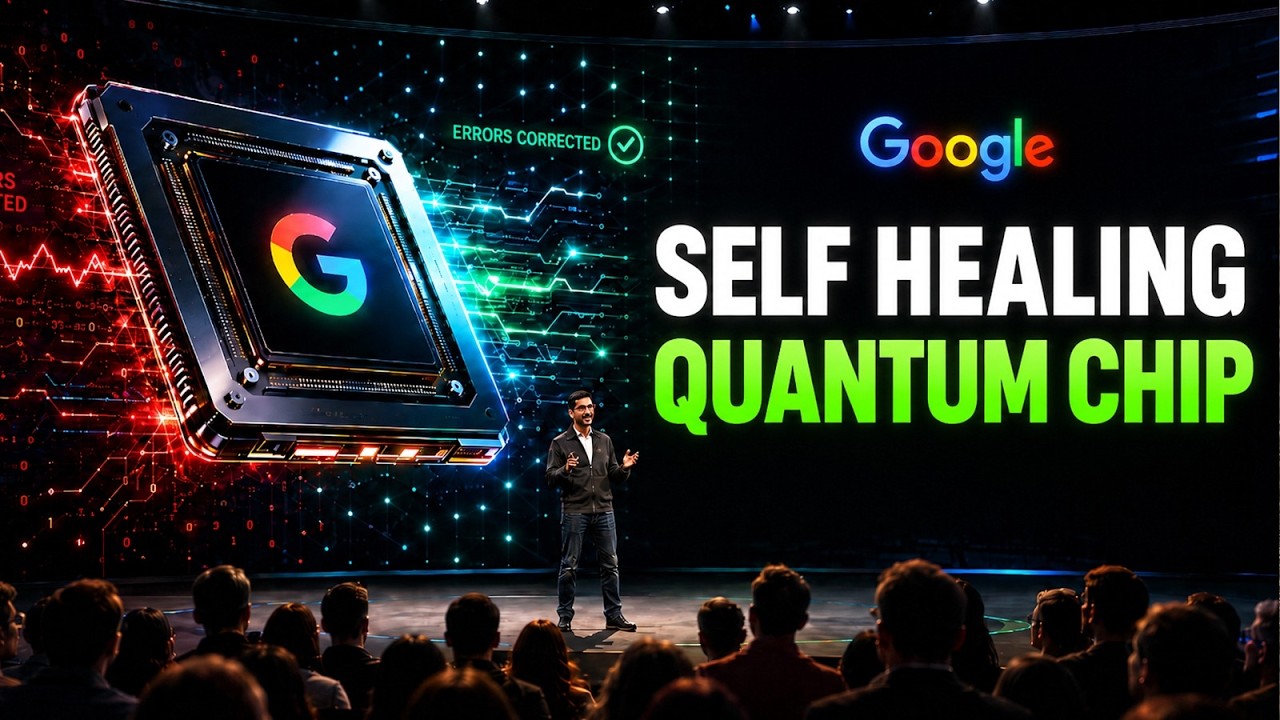
Google Quantum Computing Breakthrough Key Takeaway: A Quantum Computer That Reads Its Own Errors and Retunes Itself During Execution Has Emerged
The truly important point in Google’s latest quantum computing announcement is not simply that “the error rate went down.”
It is that the quantum computer began running without stopping, turning its own error data into a learning signal, and automatically adjusting thousands of control parameters.
This directly tackles one of the biggest bottlenecks in quantum computer commercialization: the problem of “stopping computation and then recalibrating.”
Especially when useful quantum computers may need to keep computing for days, weeks, or even months, this result carries significant implications for the global economic outlook, tech stock investment, AI semiconductors, cloud computing, and digital transformation trends.
1. News Core Point: What Is the Quantum Computing Breakthrough Google Announced?
Google has unveiled a new quantum control system.
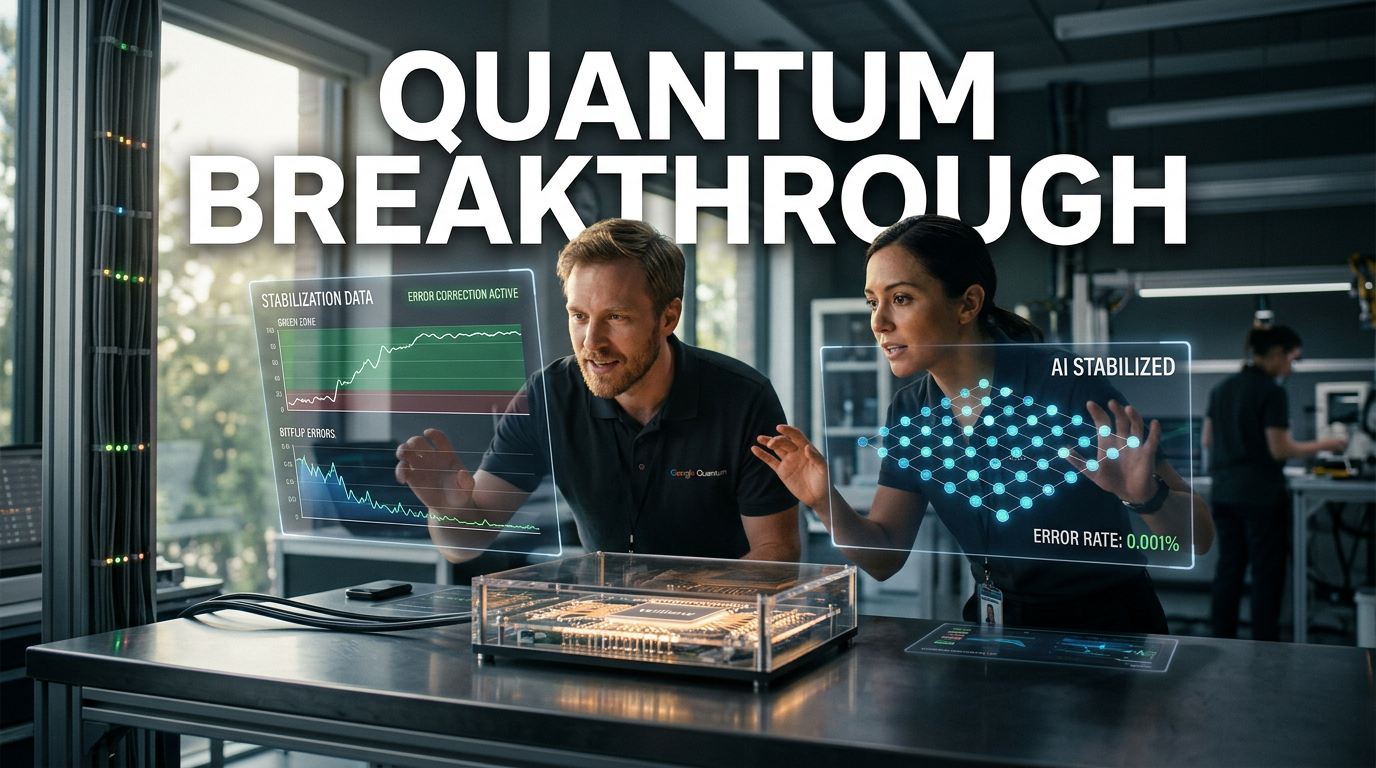
The core point is that the quantum computer uses error detection data generated during execution as a real-time learning signal.
Previously, when a quantum computer’s control values drifted, computation had to be stopped and separate correction work had to be performed.
But this new approach adjusts control parameters while computation continues.
- Collects quantum error detection data in real time
- A reinforcement learning AI infers which control values are problematic
- Readjusts microwave signal frequency, amplitude, phase, and more
- Improves quantum hardware stability without stopping computation
- Further reduces logical error rates by about 20% even after expert calibration
In simple terms, the quantum computer has become closer to something that keeps “listening to where I’m slipping” and retuning itself like a musical instrument.
2. Why This Matters: The Real Problem With Quantum Computers Is Not Just “Fragile Qubits”
Many people understand quantum computers’ problem as “qubits are too fragile.”
That is, of course, true.
But from an operational perspective, the more troublesome issue is that quantum computers are extremely sensitive analog devices.
Regular computers are digital.
0s and 1s are relatively clear, and small electrical noise can be ignored to some extent by the system.
By contrast, quantum processors control qubits with microwave signals.
These signals have values such as frequency, amplitude, and phase, and they must be matched with extreme precision.
The problem is that these values keep changing over time.
- The temperature of the control electronics shifts slightly.
- Material defects around the chip move.
- The qubits’ own physical characteristics fluctuate over time.
- Control values that were perfect an hour ago become inaccurate now.
In the end, quantum computers need continuous tuning even during computation.
Until now, however, calibration and computation were separate.
If computation drifted, you had to stop, recalibrate, and start again.
For short experiments, this approach is fine.
But drug discovery, materials simulation, cryptanalysis, and financial risk modeling are not second-long calculations.
Useful quantum algorithms will likely need to run for days or months.
If you have to stop every time the hardware drifts slightly during a month-long calculation, practical deployment is essentially impossible.
3. The Core Structure of This Technology: AI Reuses Quantum Error Correction Data
The core idea in Google’s announcement is simple yet powerful.
It uses the data already generated during quantum error correction not only for fixing errors, but also for improving hardware control.
In a quantum computer, directly measuring a qubit can collapse the quantum state.
So instead of directly inspecting the actual information, the system indirectly detects whether an error occurred by using nearby ancilla qubits and parity checks.
The resulting data are error detection events.
Previously, a decoder would receive these error detection events and estimate “which error is most likely to have occurred.”
Google added a second role to this process.
- First role: The decoder corrects logical qubit errors.
- Second role: A reinforcement learning agent observes error patterns and adjusts control values.
In other words, the same data are used twice.
Once to preserve the computation, and once more to tune the hardware better.
4. What Reinforcement Learning Actually Did: It Investigated the Cause While Tuning Thousands of Control Values at Once
Google’s system operates on a reinforcement learning basis.
The AI agent makes small changes to control parameters.
Then it observes which changes reduced error detection events.
By repeating this process, it searches for a better control policy.
The important point is that it was not designed to adjust one by one, but to handle thousands of control values simultaneously.
As quantum chips grow larger, it becomes difficult for people or traditional physical models alone to manage every control value perfectly.
This is where AI shows its strength.
This approach can be understood in roughly the following structure:
- The AI samples multiple candidate control policies.
- It compares how much each policy reduces error detection events when applied.
- It updates the probability distribution toward better-performing policies.
- It uses reinforcement learning techniques to continue exploring while maintaining stability.
More specifically, policy gradient methods, PPO-style stabilization techniques, entropy regularization for exploration, and replay buffers to improve sample efficiency are described as being used.
Simply put, modern AI training methods have been directly connected to superconducting quantum hardware control.
5. Result Numbers: Error Rates Were Further Reduced Even After Expert Calibration
The most striking result is that additional improvement was achieved on Google’s already highly refined Willow chip.
The previous calibration was a high-level approach combining automated physical models and human expert tuning.
Yet the reinforcement learning agent further reduced logical error rates by about 20% on top of that.
- Distance-7 surface code: Logical error rate recorded at 7.72 × 10^-4 per cycle
- AlphaQubit 2 decoder applied: Logical error level below 1 per 1,000 calibration cycles
- Distance-5 color code: Logical error rate recorded at 8.19 × 10^-3
- Tesseract decoder applied: About 1 per 100 calibration cycles
These numbers are not just lab improvements; they can be seen as practically meaningful performance gains in quantum error correction systems.
What matters especially is that “AI found another 20% on a device that was already tuned to a top-tier level.”
That means there are still areas overlooked by existing physical models and expert intuition.
6. Artificial Drift Experiment: Even After Deliberate Damage, AI Realigned It
To verify that the system worked not only under ideal conditions, Google deliberately distorted the control values.
They introduced artificial changes to CZ coupling strength, XY pulse amplitude, pulse frequency, and more.
As expected, error rates worsened under a fixed control policy.
But the reinforcement learning agent tracked the drift and kept the error detection rate low.
In particular, when a sudden step change was introduced in pulse amplitude, the system recovered after about 130 learning epochs.
In this experiment, logical error rates fell by about 24%, and stability improved 2.4 times.
When the AI was also allowed to adjust the decoder parameters, the results improved even more.
Error rate improvement rose to about 31%, and stability improved by 3.5 times.
The effect was also confirmed against the chip’s naturally occurring low-frequency drift.
The analysis describes the AI control as functioning like a filter, reducing low-frequency fluctuations by about 4 decibels.
7. Even More Interesting: Performance Was Restored Even From Completely Scrambled Control Values
For me, the most impressive part of this announcement is the stress test.
Google intentionally randomized the control policy to the point that the quantum logical observables were completely broken.
Yet the AI agent found its way back to a high-performance state.
This means more than simple fine-tuning.
In the long term, it suggests the possibility that AI could replace parts of the existing complex quantum calibration stack.
For now, human-made physical models and calibration sequence graphs are still needed, but in the future, AI may be able to learn a substantial part of the control policy using only error detection data.
Google’s earlier magic state cultivation work reportedly used similar techniques, and there were major improvements in cultivation errors and post-selection rates.
This trend shows that quantum computing and AI are not just developing in parallel; they are entering a stage where they directly accelerate one another.
8. Scalability Issue: It May Also Work on Larger Quantum Computers
The question that always comes up in quantum computing is, “Will this still work when it scales?”
If it only works in small systems, its commercial value is limited.
Google simulated a distance-15 surface code.
At that scale, about 40,000 control parameters are included.
As a result, an interesting conclusion emerged: the number of epochs needed for learning was independent of system size.
The reason this is possible is that error detection events are local.
Each detector is not observing the whole system, but only a nearby region of gates.
So as qubits increase, the number of small problems grows, but each individual small problem does not suddenly become much harder.
This is a very important point in terms of quantum computer scalability.
It helps ease concerns that calibration difficulty will explode as hardware grows larger.
9. The Limitations Are Clear Too: AI Exploration Itself Can Harm Computation
This technology is not a cure-all.
Reinforcement learning requires exploration.
Exploration means that, at times, it tries control policies that are worse than the current one.
In experiments, this was not a major issue because the quantum state could be re-prepared every time.
But the situation changes if a real long-duration quantum algorithm is running.
The moment a bad policy is tried, it could damage the quantum state being computed.
In Google’s simulations, real-time adjustment was better than a fixed policy below a certain drift speed.
But if the drift becomes too fast, AI cannot keep up.
For example, sudden and unpredictable events such as spacecraft particle collisions or high-energy particle impacts still require hardware-level defenses.
In short, this technology is powerful for slowly changing control drift, but it does not solve every instantaneous physical shock.
10. The Real Core Point That Other News Often Misses: Quantum Computer Commercialization Is Not Just a Hardware Battle
The most important message in this announcement is not “let’s make better qubits,” but that “the way quantum computers are operated is itself shifting toward an AI-centered model.”
Until now, quantum computing competition has been described mainly in hardware terms.
Cleaner materials, more stable qubits, more qubits, lower temperatures, and more precise manufacturing processes seemed to be the core factors.
Of course, they are still important.
But this result shows that control software and AI operating systems may become as important as hardware on the path toward practical quantum computers.
This also has major implications from an investment perspective.
The quantum computing value chain may not remain limited to chip manufacturers or cryogenic equipment companies.
Going forward, quantum control software, AI-based calibration systems, real-time decoders, high-speed data transfer infrastructure, and cloud quantum services must all be considered together.
In other words, the next competitive advantage in quantum computing is shifting from just “more qubits” to “how long, how stably, and how autonomously can those qubits be operated?”
11. Economic Meaning: Which Industries Will Be Shaken First If Quantum Computing Becomes Real?
This quantum computing breakthrough from Google does not mean commercial quantum computers will appear tomorrow.
But because it reduces the bottleneck of long-duration stable computation, its economic ripple effects deserve attention.
- Pharmaceutical and biotech industries:
If complex molecular structures and chemical reactions can be simulated more accurately, drug development costs and time may fall.
- Materials and battery industries:
Demand for quantum simulation may grow in next-generation batteries, superconducting materials, and semiconductor material discovery.
- Financial industry:
Demand for high-performance computing may expand in portfolio optimization, derivatives pricing, and risk analysis.
- Cybersecurity industry:
Long-term risks to public-key cryptography such as RSA may increase, accelerating the transition to post-quantum cryptography.
- Cloud computing industry:
Early quantum computers are more likely to be offered via cloud-based services than owned directly by individual companies.
This trend is an important technological variable in the global economic outlook.
If the AI infrastructure race has been driven by GPUs and data centers, the next stage could expand into a new high-value infrastructure competition combining quantum computing and AI control systems.
12. What to Watch From an Investment Perspective: The Signal Google’s Announcement Sends to Tech Stock Investment
This announcement is not an issue that ends with Alphabet’s stock price alone.
We need to look at which companies and industries across the quantum computing ecosystem may benefit.
- AI semiconductors: Quantum control and real-time decoding require fast classical computing operations.
- High-speed networks: Data transfer speed between chips and classical controllers becomes important.
- Cryogenic equipment: Cryogenic infrastructure is essential for superconducting quantum chip operation.
- Control software: AI-based calibration, decoding, and real-time optimization become core competitive advantages.
- Cloud platforms: Quantum computing is likely to spread first in the form of cloud services.
From a tech stock investment perspective, quantum computing should not be viewed only as a long-term theme, but as a next-generation computing layer linked to AI infrastructure.
In particular, large companies pursuing digital transformation are likely to eventually consider quantum simulation, quantum security, and quantum optimization solutions.
13. Future Direction: Faster Data Loops and Deep Learning-Based Quantum Control
The current Google system is described as using a relatively simple Gaussian policy.
The reason is that the data transfer speed between the quantum chip and the classical controller is not yet fast enough.
If this loop becomes faster, the situation could change.
- More complex deep learning models could be used for real-time control.
- More sophisticated policies could be built using detector patterns as conditions.
- AI could discover hidden correlations in the hardware on its own.
- It may become possible to learn calibration for quantum error correction from scratch without a physical model.
In the long term, the field may move away from human-made calibration graphs, expert tuning, and physics-model-centered operations toward quantum computers finding their own stable state.
This is not just automation; it is closer to the concept of an autonomously operating quantum computer.
14. Conclusion: Google’s Announcement Is the Starting Signal for an Era in Which Quantum Computers Operate Themselves
This quantum computing breakthrough from Google is not a declaration that commercial quantum computers are finished.
But it has made major progress on one crucial condition needed for practical quantum computers.
That condition is the ability to keep tuning hardware without stopping computation.
Previously, if a quantum computer drifted even slightly, it had to stop and be realigned.
Now, it has been confirmed that AI can use error detection data to readjust control values during execution.
This change could alter the center of gravity in quantum computing competition.
Going forward, the key will not just be more qubits, but smarter control systems, faster decoders, and stronger AI operating infrastructure.
As quantum computing converges with AI, the next-generation competition for computing dominance is entering a far more complex and interesting phase.
< Summary >
Google has unveiled a technology that uses error detection data generated during quantum computer execution as a learning signal, allowing the system to automatically adjust its own control values.
This approach can retune quantum hardware without stopping computation, reducing a core bottleneck in long-duration quantum calculations.
On the Willow chip, it further lowered logical error rates by about 20% even after expert calibration, and in some experiments improved stability by as much as 3.5 times.
The core takeaway is that quantum computer commercialization is expanding beyond hardware competition into AI-based control software competition.
Long-term ripple effects are expected across the pharmaceutical, materials, financial, cybersecurity, and cloud computing industries.
[Related Articles…]
- Why Quantum Computing Commercialization Could Reshape Global Tech Dominance
- How AI Semiconductors Are Driving the Next Wave of Computing Infrastructure Investment
*Source: [ AI Revolution ]
– Google Just Made a Massive Quantum Breakthrough