● Agentic AI Turns Enterprise Data Into Real Competitive Advantage
Snowflake Summit 26 Key Takeaway: When Agentic AI Meets Enterprise Data, It Becomes a True Competitive Edge
The most important message from Snowflake Summit 26 was simple.
AI models themselves can no longer be a company’s moat, and the real battleground ahead is how well a company connects its proprietary data with agentic AI.
In particular, this announcement was less about introducing a new product and more like a declaration that data analytics platforms are evolving into enterprise operating platforms where AI can think, remember, and act directly.
Examples from companies such as Samsung Electronics, ICE, which operates the New York Stock Exchange, Sanofi, Thomson Reuters, Under Armour, and Vercel make it even more important that this shift has already begun on the ground.
In future global economic outlooks, corporate productivity, AI infrastructure, data governance, digital transformation, and cloud data platforms are likely to appear more often as key keywords.
1. The main news from this announcement: “Data, not AI models, is the moat”
Snowflake CEO Sridhar Ramaswamy made a very important statement at this summit.
“AI models cannot be a competitive advantage.”
The reason is simple.
Competitors can use the same models too.
Large AI models such as GPT, Claude, Gemini, and Llama are becoming more powerful, but at the same time they are also becoming tools that anyone can access.
In other words, it is becoming difficult for companies to differentiate themselves based on model performance alone.
By contrast, customer data, transaction data, production data, sales data, work records, and market response data accumulated by each company over years or decades cannot be easily replicated from the outside.
The real moat CEO Ramaswamy emphasized is exactly this point.
If AI models are tools open to everyone, then a company’s proprietary data is an asset only that company owns.
And agentic AI goes beyond analyzing that data; it connects it to actual work actions.
2. Why traditional data analytics has not worked well in the field
Companies have long championed data-driven decision-making.
But in practice, data still has not been fully used on the ground.
Snowflake Summit 26 accurately pinpointed this problem.
2-1. Data was always one step behind
Enterprise data is mostly a record of the past.
By the time the data is collected, cleaned, analyzed, and turned into a report, the market situation has often already changed.
In industries that move quickly, such as financial markets, consumer goods, semiconductors, and healthcare, this time lag can lead to major losses.
There was a structure with lots of data but slow decision-making.
2-2. Only specialists could use the data
To view data, frontline employees usually had to go through the data analytics team or IT team.
That was because there were technical barriers such as SQL, Python, data pipelines, and permission settings.
Sales representatives, marketers, executives, and operations staff had many questions, but it was difficult for them to pull data and analyze it directly.
As a result, requests piled up in the data team, the data team became a bottleneck, and the frontline kept waiting.
2-3. The data was too scattered
Enterprise data is not stored in one place.
Some is in the cloud, some is on internal servers, and some is inside work applications such as CRM, ERP, email, Slack, Jira, Salesforce, SAP, and Workday.
Some data even remains on employees’ personal PCs or in department document folders.
The problem is that many ordinary employees do not even know where the data is.
The more data there was, the harder it became to find it, creating a paradox.
2-4. Insights did not lead to real action
Dashboards were beautifully made, but they did not send emails to customers on their own.
Reports showed problems, but people still had to decide what action to take.
There was a big gap between data analysis and actual execution.
That is exactly why agentic AI is getting attention: it reduces this gap.
3. The four core elements of an agentic enterprise
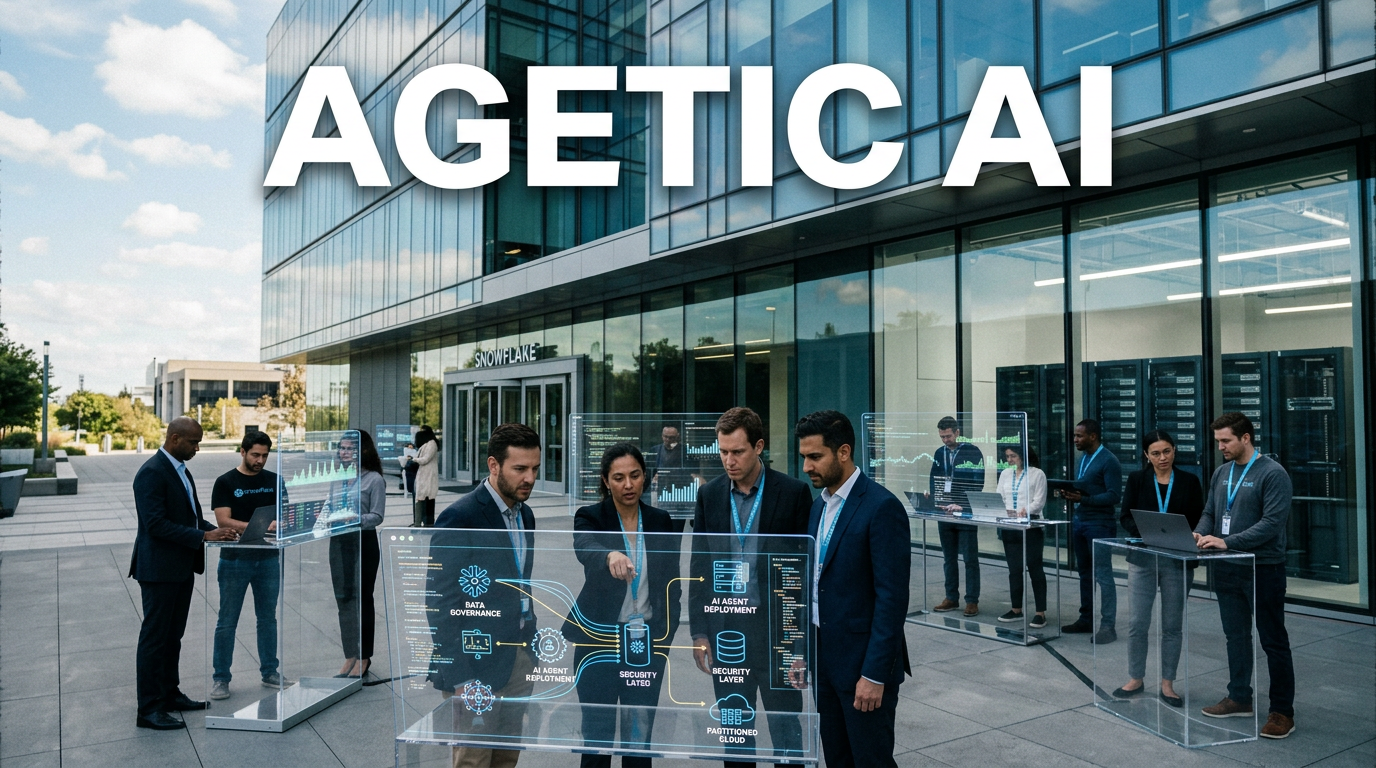
At this event, Snowflake presented four components needed to become an agentic enterprise, meaning a company that properly uses agentic AI.
3-1. First element: Proprietary company data
The most important starting point is data.
The key is not public data available on the internet, but proprietary data accumulated inside the company.
This includes customer purchase history, support records, sales meeting notes, production quality data, inventory flow, price changes, contract terms, and project progress.
Competitors cannot easily obtain this data.
Therefore, corporate competitiveness in the AI era depends less on which model you use and more on how safely you connect high-quality internal data.
3-2. Second element: AI models
AI models are tools for handling data.
However, as in the past, the model itself is unlikely to remain the overwhelming differentiator.
Models are becoming more generalized, and companies are moving toward selecting and using multiple models depending on the situation.
Ultimately, what matters is which data the model is connected to and within what workflow it operates.
This perspective also affects the direction of AI infrastructure investment.
Beyond simply adopting a model, investments that create a structure connected to internal company data are likely to become more important.
3-3. Third element: Work applications
Companies already use a vast number of work apps.
Representative examples include email, Outlook, Slack, Jira, SAP, Salesforce, ServiceNow, and Workday.
These apps are not just work tools.
They are places where real-time work data accumulates and channels through which AI can take action.
For example, AI can send work instructions in Slack based on analysis results, create tickets in Jira, draft emails, and update CRM customer information.
They become both a data collection point and an execution point.
3-4. Fourth element: Agentic AI
The final element is agentic AI.
Agentic AI is different from a simple chatbot.
It goes beyond answering a user’s question; it understands goals, finds the necessary data, analyzes it, and even takes action.
CEO Ramaswamy described this as something close to an agentic control tower.
Its role is to coordinate multiple AI agents and manage them so they operate safely within predefined permissions and data governance.
4. Snowflake’s key new products: COWORK and COCO
The most attention-grabbing products at this summit were Snowflake COWORK and Snowflake COCO.
These two products were introduced as core tools for connecting agentic AI and enterprise data to real work.
4-1. Snowflake COWORK: A personal work agent that ordinary employees can use
Snowflake COWORK is a tool that lets users ask questions in natural language without SQL or code, and then have an AI agent find and analyze the data while also suggesting the needed actions.
The biggest feature is that ordinary employees, not just data specialists, can use it.
Sales representatives can receive the information they need before a customer meeting.
Marketers can instantly analyze campaign performance and customer responses.
Executives can check business unit performance and risks in real time.
COWORK remembers a user’s work patterns and preferences and performs deep research across multiple data sources.
For example, if a user always checks competitor trends before meetings, the AI can remember that and automatically prepare related materials before the next meeting.
4-2. Snowflake COCO: An AI data work tool for developers and analysts
Snowflake COCO is a tool that helps developers and data analysts build skills with AI, create data pipelines, and deploy apps.
In simple terms, it is close to an AI coding partner for data work.
Just as Claude Code or Codex helps developers, COCO speeds up data engineering and analytics work inside the Snowflake environment.
At the event, a case was introduced in which a database migration task that would have taken six months was completed in just one day using COCO.
This is significant from a corporate productivity perspective.
When time-consuming tasks such as data migration, cleanup, and pipeline building are reduced, the speed of digital transformation itself can increase.
5. Samsung Electronics case: Cutting analysis time from hours to seconds
Samsung Electronics said that about 1,000 executives, sales, and marketing employees are already using Snowflake COWORK.
The key point is that frontline leaders can ask questions and get answers directly without going through the data team.
When asked in natural language, AI agents gather and analyze the necessary data across multiple data silos.
And they only access data within the user’s permissions.
Samsung Electronics MX Division Vice President Seo Jeong-ah explained that “we have shifted from an era in which the data team was the bottleneck to an era in which every leader becomes an analyst.”
In particular, a case was shared in which analysis that used to take hours in tracking the launch performance of the Galaxy S26 was reduced to just a few seconds.
The meaning of this case is not just workflow automation.
It is a signal that even in large, complex organizations like major enterprises, AI agents are actually changing the speed of decision-making.
6. ICE and New York Stock Exchange case: Making 12 petabytes of data available to every employee
The case of Intercontinental Exchange, or ICE, which operates the New York Stock Exchange, is also very important.
ICE operates 13 exchanges and 6 clearing houses around the world.
The market capitalization of companies listed on the New York Stock Exchange was mentioned as being about $40 trillion.
Every day, around 10 million trades occur across 2 million listed securities and contracts.
The data scale is also overwhelming.
12 petabytes of data are distributed across 3 clouds and 21 regions, and more than 200 million queries scan 20 petabytes each month.
At this scale, security, permissions, regulatory compliance, and data governance are far more important than simply collecting data.
ICE explained that it used Snowflake COCO to handle scattered data in a single governance environment and analyze it quickly while following security rules.
In the past, employees had to check multiple tools and request help from the data team in order to get the latest data.
Now, they can directly build apps or screens and explore the data they need in real time.
The fact that this kind of change is possible in an industry dealing with sensitive data like financial markets is a major signal for other industries as well.
7. Sanofi case: AI creates reports like a concierge before customer meetings
The Sanofi case was an interesting example of how agentic AI changes frontline work.
Before meeting a certain gastroenterologist, Sanofi’s chief digital officer called an AI concierge and requested a pre-meeting report.
The AI recommended the doctor’s specialty, recent research interests, good discussion topics, and even icebreaker ideas.
After the questions and answers were finished, it said it would create a report based on the conversation and send it by email.
This scene matters because the AI did not simply search internal documents; it provided action-oriented information that could be used directly at the customer touchpoint.
In particular, in industries where customer understanding is critical, such as healthcare, pharmaceuticals, finance, and B2B sales, this kind of AI use can spread quickly.
8. Other company cases: Industry-specific change where data becomes competitiveness
At this event, in addition to Samsung Electronics, ICE, and Sanofi, many other companies appeared.
Canva, Nestlé, Accenture, Thomson Reuters, Under Armour, the German travel company TUI, medical device company Medtronic, and AI development platform company Vercel shared their cases.
The common point is one thing.
Each company is connecting its proprietary data with agentic AI to improve work speed and the quality of decision-making.
For companies like Thomson Reuters, where specialized information is crucial, knowledge data becomes a core asset.
For consumer goods companies like Under Armour, customer response and product sales data matter most.
For AI development platform companies like Vercel, developer experience and deployment data are the competitive edge.
In other words, the type of data differs by industry, but the direction remains the same: agentic AI turns that data into work actions.
9. The most important point that is easy to miss in other news
The real important point from this announcement is not that “AI analyzes data.”
The real key takeaway is that “AI has started to work inside organizations like an employee with permissions.”
9-1. The competitiveness of AI agents comes more from permission design than model performance
The biggest reason companies have struggled to adopt AI is security and trust.
If AI can access any data, sensitive information such as customer information, salary information, contract information, and undisclosed performance data could be exposed.
An important design choice in Snowflake COWORK is that AI agents have the same level of data access permissions as the user.
If a CFO can see certain data, the CFO’s AI agent can see it too.
If a marketer can see customer purchase pattern data, the marketer’s AI agent can see it too.
Conversely, it cannot access data without permission.
Without this structure, enterprise AI is likely to stop at the experimental stage.
9-2. Enterprise work apps will become AI’s hands and feet
Many people think of AI only inside a chatbot screen.
But in companies, what really matters is where AI takes action.
Work apps like Slack, Jira, Salesforce, SAP, and Outlook will become execution channels for AI agents.
AI will analyze, then send notifications in Slack, create Jira tickets, draft customer emails, and update CRM records.
This change could transform not just simple automation but the organization’s operating model itself.
9-3. The role of the data team does not disappear; it becomes more advanced
If COWORK and COCO spread, ordinary employees will be able to analyze data directly.
That does not mean the data team disappears.
Rather, the data team will take on a more important role.
Data quality management, permission policy design, AI agent operating standards, and building data governance frameworks will become core tasks.
In other words, the data team will shift from a report-making department to the control tower for AI data operations.
9-4. Agentic AI can directly change corporate productivity metrics
The most important question in AI trends is, “So does it make money?”
These cases show that agentic AI can affect both cost reduction and revenue growth.
If analysis time drops from hours to seconds, decision-making speeds up.
If a six-month migration becomes a one-day task, IT costs and opportunity costs fall.
If you receive a customized report before a customer meeting, the chance of expanding a contract can increase.
Ultimately, agentic AI is becoming not just a technology trend but an investment area directly linked to corporate productivity and profitability.
10. The change to watch from an economic perspective: AI investment is shifting from models to data
In recent years, the center of AI investment has been large models and GPU infrastructure.
But in the future, how companies organize, connect, protect, and enable AI agents to use internal data may become even more important.
This is likely to have a positive impact on the cloud data platform, data security, AI governance, and work automation software markets.
From a global economic outlook perspective, this trend is significant.
In an environment of high interest rates and continuing cost pressure, companies are more likely to favor AI adoption that improves real productivity rather than simple AI experiments.
The combination of agentic AI and data that Snowflake emphasized aligns directly with this demand.
From a company’s perspective, it can improve the analytical ability and execution speed of existing employees without massively increasing headcount.
This could become an important differentiator in the next AI investment cycle.
11. Checklist companies should prepare for going forward
The message from Snowflake Summit 26 is clear.
If you want to use AI agents, the data must be ready first.
-
You need to identify where the company’s internal data is stored.
-
You need a way to connect data silos scattered across departments.
-
You need to clearly design data access permissions by employee and by role.
-
You need to set standards for which work apps AI agents can act in.
-
You need to build a data governance framework to protect sensitive data and customer information.
-
The goal should not be simply adopting a chatbot, but improving actual work processes.
Ultimately, the success or failure of agentic AI adoption depends more on operating design than on technology.
Companies that use AI well are likely not the ones that use the most models, but the ones that organize their data and workflows well.
12. Conclusion: In the AI era, corporate competitiveness is “internal data × execution power”
Snowflake Summit 26 showed that the center of gravity in the AI market is shifting.
Now companies need to think less about “which AI model should we use?” and more about “what should we make AI do with our company’s data?”
AI models are becoming more generalized.
But proprietary company data, business processes, customer relationships, and permission structures cannot be easily replicated.
Agentic AI is a tool that turns these unique assets into real action.
Samsung Electronics’ reduced analysis time, ICE’s use of massive financial data, and Sanofi’s AI concierge case all point in the same direction.
In the future, AI competitiveness is likely to be determined not by model usage skill, but by how safely and quickly data can be connected to execution.
< Summary >
The core message of Snowflake Summit 26 is that a company’s proprietary data, rather than AI models, is the real competitive edge.
Through COWORK and COCO, Snowflake presented an agentic AI environment that allows ordinary employees and developers to analyze data and take action more easily.
Samsung Electronics reduced analysis that took hours to seconds, ICE is safely using financial data at the 12-petabyte scale, and Sanofi showed a case in which AI creates customized reports before customer meetings.
Going forward, a company’s AI competitiveness will depend less on which model it uses and more on how it organizes internal data, manages permissions, and connects it to work apps so it can become real action.
[Related Articles…]
- How Agentic AI Is Reshaping Enterprise Productivity
- The Future of Data Governance and Cloud Data Platforms
*Source: [ 티타임즈TV ]
– ‘스노우플레이크 서밋 26’이 보여준 ‘에이전틱AI × 데이터’의 파괴력