● Zoox Shock, Tesla Surge
The first paid permit for a driverless robotaxi does not change the core story: the real focus is Tesla’s Cybercab, not Zoox
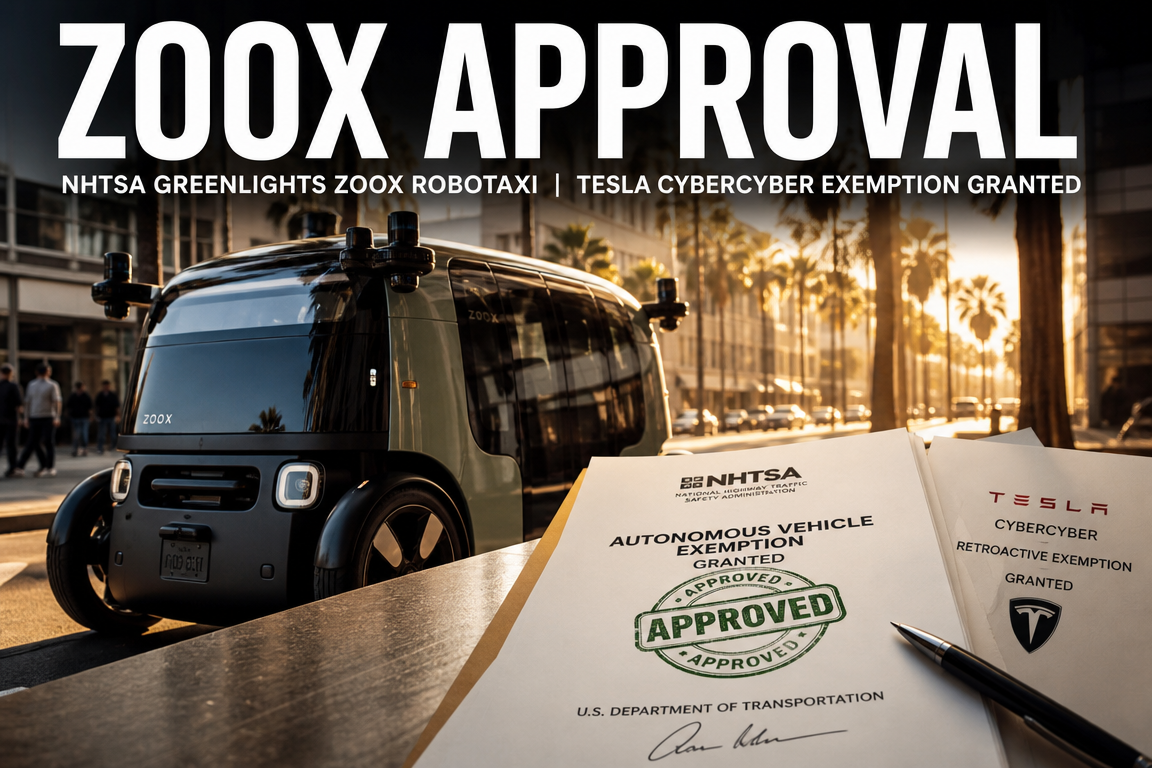
The key point in this development is not simply that Zoox, an Amazon subsidiary, received the first U.S. permit for paid operations of a driverless robotaxi.
The more important issue is that U.S. autonomous driving regulation is beginning to shift from a framework built around human-driven vehicles to one designed for vehicles with no driver from the outset.
This change connects directly to Tesla’s robotaxi plans, Cybercab production strategy, Tesla’s stock, the broader U.S. AI investment cycle, and Elon Musk’s political activity.
Of particular importance is the possibility that, if the current framework changes from requiring only vehicles produced after approval to allowing retroactive recognition, Tesla’s existing Cybercab inventory could suddenly become revenue-generating assets.
While the headline appears to favor Zoox, the company most likely to benefit from an opening regulatory framework may be Tesla, given its mass production capability.
1. Market backdrop: Big Tech earnings lifted U.S. equities
In the source material, Tesla closed at $308.85, recovering above the $300 level.
The stock rose 3.53% on the day.
SpaceX-related pricing was cited at $112.2, with a slight decline.
Broader U.S. markets posted a strong rebound.
- Nasdaq: +2.78%
- S&P 500: +1.67%
- Dow Jones: +1.19%
Microsoft was the primary driver of the move.
The stock surged more than 15% after earnings.
The key catalyst was Azure growth.
Azure revenue growth of 43% year over year was interpreted as evidence that AI spending and cloud demand remain strong.
Amazon and Apple also reported earnings above consensus, easing concerns around the Big Tech earnings cycle.
Amazon in particular drew renewed attention to AWS momentum.
The market interpreted these results as evidence that AI infrastructure spending is continuing to translate into cloud revenue.
As a result, U.S. equities shifted back toward expectations of an AI-led growth rally.
Still, the most important development on the day came not from the market screen but from the road.
2. Zoox receives the first U.S. permit for paid driverless robotaxi service
The U.S. National Highway Traffic Safety Administration granted Zoox, an Amazon subsidiary, a special approval.
Zoox has been developing a fully autonomous robotaxi with no steering wheel, no pedals, and no conventional driver’s seat.
The vehicle interior is structurally different from a traditional passenger car.
It uses two rows of seats facing each other.
The vehicle is designed for bidirectional movement without a traditional front or rear operating orientation.
Zoox has emphasized that the vehicle should be understood as a purpose-built autonomous transport system rather than a conventional automobile.
The challenge was that existing U.S. vehicle safety rules were not written for this configuration.
The Federal Motor Vehicle Safety Standards are based on the assumption that vehicles include a steering wheel, brake pedal, driver’s seat, and the possibility of human intervention.
Zoox’s vehicle could not meet those standards directly, which is why an exemption was required.
3. What NHTSA approved: not a declaration of full safety, but recognition of an alternative compliance path
NHTSA granted Zoox a temporary exemption from several federal safety standards.
The source material referenced exemptions related to defogging and defrosting systems, braking requirements, and several other safety criteria.
The key point is that the approval does not mean the vehicle has been declared fully safe.
More precisely, NHTSA determined that Zoox had met an alternative compliance pathway even without physical human controls.
In practical terms, the government has allowed a driverless vehicle to begin paid operations under limited conditions.
The approval includes an annual cap of 2,500 vehicles and a two-year restriction period.
Even so, the symbolic importance is substantial.
It marks the first time the federal government has formally recognized that a vehicle without a steering wheel can carry paying passengers.
4. Waymo versus Zoox: both operate in robotaxi, but the regulatory significance is different
Many observers may ask whether Waymo has already been operating robotaxis.
That is correct.
Waymo already provides autonomous ride-hailing services in several U.S. markets.
However, Waymo uses modified Jaguar EVs that still retain steering wheels and pedals.
The vehicle retains a physical structure that allows human intervention in an emergency.
Zoox, by contrast, has built a vehicle designed from the outset without a human driver.
For that reason, this approval is not simply a service expansion; it establishes a new regulatory precedent.
At present, Zoox is effectively the leading example of a fully driverless, purpose-built robotaxi operating on a paid-service regulatory track.
5. Zoox commercialization plan: Las Vegas first
Zoox began testing its proprietary vehicle on public roads near California in early 2023.
It later expanded testing to Las Vegas and San Francisco.
Until now, the service was closer to a free pilot than a paid commercial product.
Following the approval, Zoox plans to launch paid app-based robotaxi service in Las Vegas next month.
California will likely require a separate state-level approval, which may delay broader commercialization.
Zoox is also conducting pilot operations in 10 U.S. cities, including Washington, DC.
Washington, DC has been a politically sensitive market for autonomous vehicle policy, including debates around Waymo’s market access.
6. The second key development: NHTSA also introduced a broader autonomous vehicle regulatory package
Media coverage focused on the Zoox approval, but the more consequential development was NHTSA’s simultaneous announcement of a broader regulatory package.
This package could affect the pace of commercialization for Tesla Cybercab, Waymo, Zoox, GM Cruise, and other autonomous vehicle developers.
The package has four core elements.
6-1. A standardized autonomous vehicle performance testing framework with SAE
NHTSA plans to work with SAE on the ASCEND consortium, a three-year initiative with a budget of $5 million.
Until now, each company has had to prove autonomous vehicle safety using its own methodology.
Simulation standards, road testing criteria, and safety reporting formats have varied by company.
Going forward, autonomous vehicles may be required to pass a standardized performance test similar to a common licensing exam.
This would materially change the industry.
A common framework would clarify what companies need to satisfy.
For investors, it would make it easier to compare which autonomous technologies are closer to commercialization.
6-2. A potential rule allowing vehicles produced before approval to be recognized retroactively
This is the most important element in the current discussion.
Under the existing approach, only vehicles produced after a government exemption is granted are clearly recognized.
Under the proposed interim final rule, vehicles already produced before approval could later be recognized once the authorization is granted.
This matters directly for Tesla’s Cybercab strategy.
If Tesla has been producing Cybercabs before approval, those vehicles could otherwise be treated as regulatory inventory without clear commercial use.
If retroactive recognition becomes possible, that inventory could immediately become deployable fleet assets once approval is received.
In other words, what the market may view as idle capital could become revenue-generating robotaxi inventory.
6-3. The first revision process for AV safety guidance since 2017
NHTSA has also initiated the first revision process for autonomous vehicle safety guidance since 2017.
The key topics include emergency response, remote assistance, post-crash behavior, vehicle immobilization, and retrieval procedures.
These issues are essential for commercial deployment.
When a robotaxi stops on the road, there must be a clear protocol for who intervenes.
Data logging and crash reporting rules are also critical.
Autonomous vehicles must properly identify and yield to emergency vehicles such as police cars, fire trucks, and ambulances.
These standards are necessary for city-level scaling.
6-4. Simplification of the Part 555 exemption process
The exemption process commonly known as Part 555 may also be simplified.
This procedure allows limited production and operation of innovative vehicles that do not yet fully comply with federal safety standards.
Zoox also went through this process.
The issue is that the process has traditionally been slow.
Zoox itself required significant time from application to paid-service approval.
If the process becomes more efficient, commercialization of fully driverless purpose-built vehicles such as Tesla’s Cybercab could accelerate.
7. Where Tesla robotaxi stands now
As described in the source material, Tesla’s current robotaxi service is based on Model Y vehicles operating in Austin and the Bay Area.
These vehicles still have steering wheels and pedals.
Some operations reportedly include a safety monitor in the front passenger seat.
In other words, Tesla’s current robotaxi service is not yet a fully driverless vehicle in the Zoox sense.
Tesla’s real objective is not the Model Y robotaxi, but Cybercab.
Cybercab is designed as a two-seat, purpose-built robotaxi without a steering wheel or pedals.
Accordingly, Zoox’s approval may appear negative for Tesla in the short term, but in the long term it could establish a precedent that benefits Cybercab’s regulatory path.
8. The market may be missing a key point: Tesla may be building Cybercab inventory before approval
The most notable part of the source material is the increase in Cybercab inventory at Gigafactory Texas.
Drone footage reportedly shows a rapid increase in inventory.
- Mid-April: about 50 units
- Mid-June: more than 100 units
- July: about 245 units
Tesla has also indicated that Gigafactory Texas alone may have annual Cybercab production capacity of 125,000 units.
This raises an obvious question.
Why would Tesla continue producing a vehicle that has not yet received full regulatory approval?
Is the company simply building prototypes?
Or is it preparing to deploy volume quickly once regulatory conditions change?
The importance of the proposed retroactive recognition rule lies here.
If pre-approval production can later be recognized, Tesla’s existing Cybercab inventory could become immediately usable as a commercial fleet.
In that case, Tesla would not be pursuing a gradual rollout strategy like Zoox or Waymo, but a rapid scale-up strategy based on volume.
9. The most important point not emphasized in most coverage
Most reports focus on the fact that Zoox became the first company to receive paid-service approval for a driverless vehicle without a steering wheel or pedals.
For investors, however, the more important issue is that the regulatory environment is moving toward one that enables large-scale commercialization.
Three elements matter most.
- First, a vehicle without a steering wheel or pedals can now be approved for paid operation.
- Second, vehicles produced before approval may be recognized retroactively under a new rule.
- Third, standardized autonomous vehicle performance testing should reduce regulatory uncertainty.
If all three move together, Tesla’s Cybercab strategy must be interpreted differently.
Until now, the question was why Tesla would produce vehicles before approval.
Going forward, the more relevant question is whether Tesla is producing ahead of approval in order to deploy immediately once authorization is granted.
This is highly relevant to Tesla’s valuation.
Focusing only on electric vehicle sales can miss the optionality embedded in Cybercab.
At the same time, excessive optimism about Cybercab would understate the risk of regulatory delay.
The key issue is not whether Tesla is a technology company or a car company, but how quickly it can convert regulatory approval into asset turnover.
10. Why Elon Musk’s political return matters
The source material also references Elon Musk’s Super PAC activity.
According to a New York Times report, America PAC, the Super PAC associated with Musk, may deploy between $100 million and $120 million ahead of the November midterm elections.
The report also cites the possibility that Musk personally could contribute more than $85 million.
This follows Musk’s highly visible political spending during the 2024 presidential election cycle.
This is not merely a political story.
Tesla and SpaceX are both deeply connected to U.S. regulatory and government-contract ecosystems.
SpaceX has substantial business exposure to the Department of Defense, the U.S. Space Force, and NASA.
Tesla’s Cybercab and FSD commercialization are directly tied to federal autonomous vehicle regulation.
For that reason, Musk’s political activity is relevant to the pace of Tesla’s robotaxi rollout.
11. Why the midterm election matters for autonomous vehicle regulation
Autonomous vehicle regulation is not determined by technology alone.
City governments, state governments, federal agencies, the insurance industry, and consumer groups all play a role.
Driverless vehicles, in particular, require political judgment because they alter established automotive and transportation rules.
If the political environment remains favorable to deregulation, Tesla’s Cybercab approval timeline could accelerate.
If, after the midterm election, political pressure on autonomous vehicle safety increases, commercialization could be delayed.
That is why Musk’s renewed political spending is a variable Tesla investors should monitor closely.
What matters more than short-term stock movement is whether Cybercab can become a revenue-generating vehicle on public roads.
12. What Tesla shareholders should monitor now
Tesla shareholders should look beyond the recovery above $300.
The key variables are the following:
- How quickly NHTSA expands exemptions for vehicles without steering wheels
- Whether the Part 555 exemption process is materially simplified
- How the retroactive recognition rule is ultimately finalized
- Whether Tesla continues to increase Cybercab production
- Whether Model Y robotaxi service data from Austin and the Bay Area remains stable
- Whether the regulatory tone in Washington remains supportive after the midterm election
- Whether Tesla can demonstrate cost advantages relative to Waymo and Zoox
Tesla’s advantage is not limited to software.
The economics of robotaxi depend on manufacturing scale, cost reduction, battery supply, vehicle operations data, and the FSD update architecture.
Zoox may have established the regulatory precedent, but Tesla may be able to use that precedent to pursue scale and network effects.
13. Is the Zoox approval a negative or a positive for Tesla?
In the short term, it may look negative.
Zoox, not Tesla, received the title of first paid driverless robotaxi approval in the United States.
Media coverage is also likely to center on Zoox.
However, in the medium to long term, the development could support Tesla as well.
The reason is straightforward.
Once a regulator opens the door, subsequent companies find it easier to build a case for entering through that door.
If Zoox has broken the first regulatory barrier, Tesla can use the precedent to support approval for a dedicated driverless vehicle.
Ultimately, the competition is not only about who gets approved first.
The real competition is who can manufacture at lower cost, deploy more vehicles, and maintain higher utilization.
14. Investment conclusion: Tesla is increasingly becoming a regulatory leverage company
This development is difficult to understand if Tesla is viewed only as an electric vehicle manufacturer.
Tesla’s value proposition is increasingly shifting toward a structure in which regulatory approval allows existing manufacturing capacity to be converted into service revenue.
An electric vehicle generates one-time revenue when sold.
A robotaxi, by contrast, can generate recurring revenue through continuous operation.
Cybercab is designed to maximize this structure.
For that reason, autonomous vehicle regulation has a direct impact on Tesla’s valuation.
AI investment, robotaxi development, U.S. equity markets, Big Tech earnings, and autonomous vehicle regulation are not separate themes.
They are all part of a broader trend centered on how AI can reshape productivity and transportation.
Zoox’s approval is an important regulatory signal within that trend.
For Tesla investors, the critical issue is to focus on the details of the rule changes rather than the headline itself.
[Related Articles…]
- Tesla Cybercab and the Next Phase of Robotaxi Scaling
- Azure Growth and the Current AI Infrastructure Investment Cycle
*Source: [ 오늘의 테슬라 뉴스 ]
– 핸들없는 로보택시 첫 허가 난 날, 테슬라는 완전히 다른 판을 짰습니다 — $308 주주는?
● KOSPI Surge, AI Chip Rally, Samsung, SK Hynix, Amazon Sparks Buyout Fear
Kospi Surges on Record Gains: A Bottom Signal, or a Short-Covering Rally? Key Takeaways on Samsung Electronics, SK Hynix, and the AI Semiconductor Rally
The most important point in today’s market was not simply that the Kospi rose sharply.
The key drivers were a margin call in a U.S. semiconductor-focused fund, Amazon’s comments on expanding AI investment, record foreign buying, and unusual trading in SK Hynix’s local shares versus its ADR.
This rally appears to reflect a market reassessment that the global AI investment cycle is still intact, rather than a rebound driven only by cheap valuations.
That said, it remains necessary to distinguish between a confirmed market bottom, a short-covering move, and a renewed semiconductor supercycle.
1. Key Drivers Behind Today’s Kospi Surge
In today’s domestic market, the Kospi rebounded sharply, with semiconductor large caps led by Samsung Electronics and SK Hynix driving the advance.
SK Hynix posted an exceptional gain, while SK Square also moved close to its upper limit.
This move cannot be explained by domestic factors alone.
It was driven by simultaneous developments in U.S. semiconductor-related positioning and Amazon’s earnings commentary on AI demand.
- Margin call in a U.S. semiconductor-focused fund
- Market interpretation that forced liquidation was approaching exhaustion
- Confirmation of continued AI infrastructure investment from Amazon’s earnings call
- Assessment that cloud demand remains resilient despite rising memory prices
- Strong foreign net buying concentrated in Korean semiconductor large caps
Overall, today’s Kospi rebound appears to reflect a global investor re-rating of AI semiconductor demand rather than a purely technical bounce.
2. Why the U.S. Semiconductor Fund Margin Call Was Viewed as a Bottom Signal
Overnight, reports emerged that a U.S. fund concentrated in semiconductors faced a margin call.
A margin call occurs when an investor using borrowed capital suffers losses large enough to require additional collateral or forced liquidation.
Such news is usually treated as negative.
However, the market interpreted this event as a possible bottom signal for several reasons.
- Highly leveraged positions may have been forcibly unwound
- The market may have already seen much of the panic selling
- The event may mark the final stage of indiscriminate liquidation
- Potential for short covering within the semiconductor sector
In effect, the market appears to believe that most sellers have already exited.
In such conditions, even modest positive catalysts can trigger outsized price moves.
This is particularly relevant for Samsung Electronics and SK Hynix, which are directly tied to global memory semiconductor demand and AI server demand.
3. The Most Important Message from Amazon’s Earnings Call
The most powerful catalyst for the semiconductor rally was Amazon’s earnings announcement.
Amazon delivered the message investors had been waiting to hear regarding cloud and AI infrastructure spending.
- It indicated that rising memory prices do not necessarily prevent cloud profitability
- It raised AI-related capital expenditure guidance to around $220 billion
- It stated that even at that level of spending, demand through 2026 may still not be fully met
- It suggested that AI infrastructure shortages could continue into 2027
The key message was not a reduction in AI spending, but rather that spending is increasing and still not sufficient.
This is a strongly positive signal for AI semiconductors, HBM, server DRAM, and data center infrastructure companies.
That is also why SK Hynix reacted so strongly.
SK Hynix is viewed as a leading global player in the HBM market and a direct beneficiary of rising AI server investment.
4. What It Means That Cloud Companies Can Absorb Higher Memory Prices
One of the market’s major concerns recently has been the rapid rise in memory prices.
There was concern that higher DRAM and HBM prices would pressure cloud companies’ costs and eventually slow AI spending.
Amazon’s message has significantly reduced that concern.
If cloud businesses can still reach profitability despite higher memory costs, it implies that AI infrastructure spending is becoming part of a monetized business model rather than a pure cost burden.
This point is important.
If AI investment were only a trend, semiconductor stocks could reverse at any time.
However, if cloud companies are expanding spending while still modeling profitability, the semiconductor cycle could be extended materially.
5. Why Foreign Buying Was Especially Significant Today
Another notable feature of today’s domestic market was the scale of foreign investor buying.
Foreign investors are a key force in determining short-term direction in Korean equities.
When foreign capital flows into Kospi large caps, especially Samsung Electronics and SK Hynix, market sentiment can shift quickly.
- A signal that foreign investors are re-entering Korean semiconductors
- Potential short-term improvement in demand for KRW assets
- Re-rating of Korean companies within the AI semiconductor supply chain
- Possible overlap of passive and active fund flows
From a global investor perspective, Korea remains a relatively inexpensive way to gain exposure to the AI semiconductor cycle.
When valuations of U.S. AI semiconductor names such as Nvidia, AMD, and Broadcom become demanding, Samsung Electronics and SK Hynix can emerge as alternative exposure.
6. SK Hynix’s Local Shares Outperformed Its ADR
One particularly notable detail was that SK Hynix’s local shares outperformed its ADR.
In many cases, overseas investors first express their views through the U.S.-listed ADR.
That the local shares were stronger suggests exceptionally strong domestic market demand.
This is more important than a simple price move.
It implies that capital was flowing directly into the Korean cash market, not just reacting through overseas listings.
In other words, today’s rally may reflect a direct re-rating of Korean semiconductor large caps rather than merely following ADR pricing.
7. How Higher Margin Requirements on Samsung and Hynix Leveraged ETFs Changed the Flow
Another unusual development today was that higher margin requirements for leveraged ETFs linked to Samsung Electronics and SK Hynix reduced their presence among the most actively traded names.
When margin requirements rise to around KRW 30 million, access to short-term leveraged trading becomes more limited for retail investors.
In that case, speculative turnover may decline, while direct trading in cash equities becomes relatively more prominent.
This is important for interpreting market quality.
Markets dominated by leveraged ETF trading are often seen as overextended in the short term.
By contrast, a rally driven directly by Samsung Electronics and SK Hynix cash shares can be viewed as a healthier move.
8. The Most Important Point That Other Reports Often Miss
The key issue today was not simply that semiconductors rose.
What mattered most was that doubts about the AI investment cycle eased materially.
- The margin call may signal the end of forced selling
- Amazon’s comments suggest AI data center investment is still insufficient
- Rising memory prices may not yet be causing demand destruction
- Foreign investors appear to be reclassifying Korean semiconductors as core AI infrastructure assets
- SK Hynix’s stronger local share performance suggests healthy domestic cash-market demand
In particular, the statement that $220 billion of spending may still not fully cover 2026 demand is highly significant.
It suggests that AI semiconductor shortages may be structural rather than temporary.
If so, the investment universe broadens to HBM, high-performance DRAM, foundry services, power infrastructure, data center cooling, and server-related supply chains.
9. Can This Be Considered a Bottom Signal?
In short, the probability of a bottom signal has increased, but it would be premature to call it a confirmed bottom.
Markets often rebound sharply after margin-call events, but volatility can return quickly afterward.
Accordingly, today’s surge is better viewed as a potential bottom candidate rather than a confirmed bottom.
Several conditions are still needed to confirm a true bottom.
- Foreign net buying must continue for several days
- Trading value in Samsung Electronics and SK Hynix must remain stable
- The Nasdaq and Philadelphia Semiconductor Index must continue to rise
- KRW/USD volatility must remain contained
- AI investment expansion must be echoed by other major technology companies
If rates, FX, or global recession concerns re-intensify, the Kospi rally could quickly lose momentum.
Even if the semiconductor cycle improves, macro instability can still keep volatility elevated.
10. Investment Profile Differences Between Samsung Electronics and SK Hynix
Although both are leading Korean semiconductor companies, the market views them differently.
SK Hynix is seen as the most direct beneficiary of HBM and AI server memory demand.
It tends to be the most sensitive name when news points to stronger AI semiconductor demand.
Samsung Electronics is a diversified semiconductor company spanning memory, foundry, smartphones, consumer electronics, and system semiconductors.
Its short-term upside may be less pronounced than SK Hynix, but if the broader semiconductor recovery expands, Samsung’s influence on the Kospi is much larger.
In other words, SK Hynix is the more concentrated AI semiconductor beneficiary, while Samsung Electronics is closer to a benchmark for the overall Korean equity market.
11. Key Variables to Watch Going Forward
Whether this rebound becomes a short-lived event or a new uptrend will depend on the following factors.
- AI investment commentary from Microsoft, Google, and Meta following Amazon
- Whether HBM supply tightness translates into higher earnings forecasts
- Persistence of foreign net buying into the Kospi
- Stability in KRW/USD exchange rates
- Changes in U.S. rate-cut expectations
- Further upside in the Philadelphia Semiconductor Index
- Upward revisions to consensus estimates for Samsung Electronics and SK Hynix
The most important issue is whether AI spending translates into actual revenue and profit growth.
Equity markets price in expectations first, but sustained rallies require earnings confirmation.
12. Practical Positioning for Investors
In a sharp rally like today’s, the temptation to chase performance is strong.
However, after a strong one-day move, it is more important to confirm whether the flow is sustainable.
- Short-term investors should focus on trading volume and foreign buying continuity
- Medium- to long-term investors should monitor earnings revisions tied to AI semiconductors
- Use phased accumulation to manage volatility risk
- Cash equities are generally more stable than leveraged ETFs
- Track both FX and U.S. technology stock trends
If the Kospi has truly bottomed, additional entry opportunities are likely to emerge over time.
If the move is mainly short covering, a sharp pullback may follow.
For now, the market should be viewed as a confirmation phase rather than a conviction phase.
13. One-Sentence Summary of the Current Market
Today’s Kospi surge was driven by a possible exhaustion of forced selling after a margin call in a U.S. semiconductor fund, while Amazon confirmed continued AI infrastructure investment, prompting foreign capital to flow into Korean semiconductor large caps.
In effect, the market is again pricing in the view that AI demand remains intact.
However, a bottom signal is not the same as a confirmed bottom.
Over the next several days, foreign flows, U.S. semiconductor indices, and additional large-cap technology investment commentary will likely determine whether this rally has lasting strength.
< Summary >
Today’s Kospi rally was led by semiconductors, especially Samsung Electronics and SK Hynix.
A margin call in a U.S. semiconductor fund was interpreted as a possible sign that forced selling is nearing exhaustion.
Amazon raised its AI capital expenditure outlook to around $220 billion and said demand through 2026 may still exceed supply.
This was taken as a signal that demand for AI semiconductors and HBM remains strong.
Strong foreign buying and unusually strong performance in SK Hynix’s local shares were also positive flow indicators.
However, the move should be viewed as an increased probability of a bottom rather than a confirmed bottom.
Investors should continue to monitor foreign flows, U.S. semiconductor indices, and further AI investment expansion by major technology companies.
[Related Articles…]
- AI Semiconductor Supercycle and Global Investment Trends
- Foreign Flows and the Outlook for Korean Equities
*Source: [ 내일은 투자왕 – 김단테 ]
– 코스피 역대급 폭등? 바닥의 신호? #코스피 #하이닉스 #삼성전자