● China CXMT Surge Replaces Korean DRAM Gap
Korean memory leaves the mainstream DRAM space empty, and China’s CXMT filled it
The core point of this issue is not simply that “Chinese memory semiconductors are being sold cheaply.”
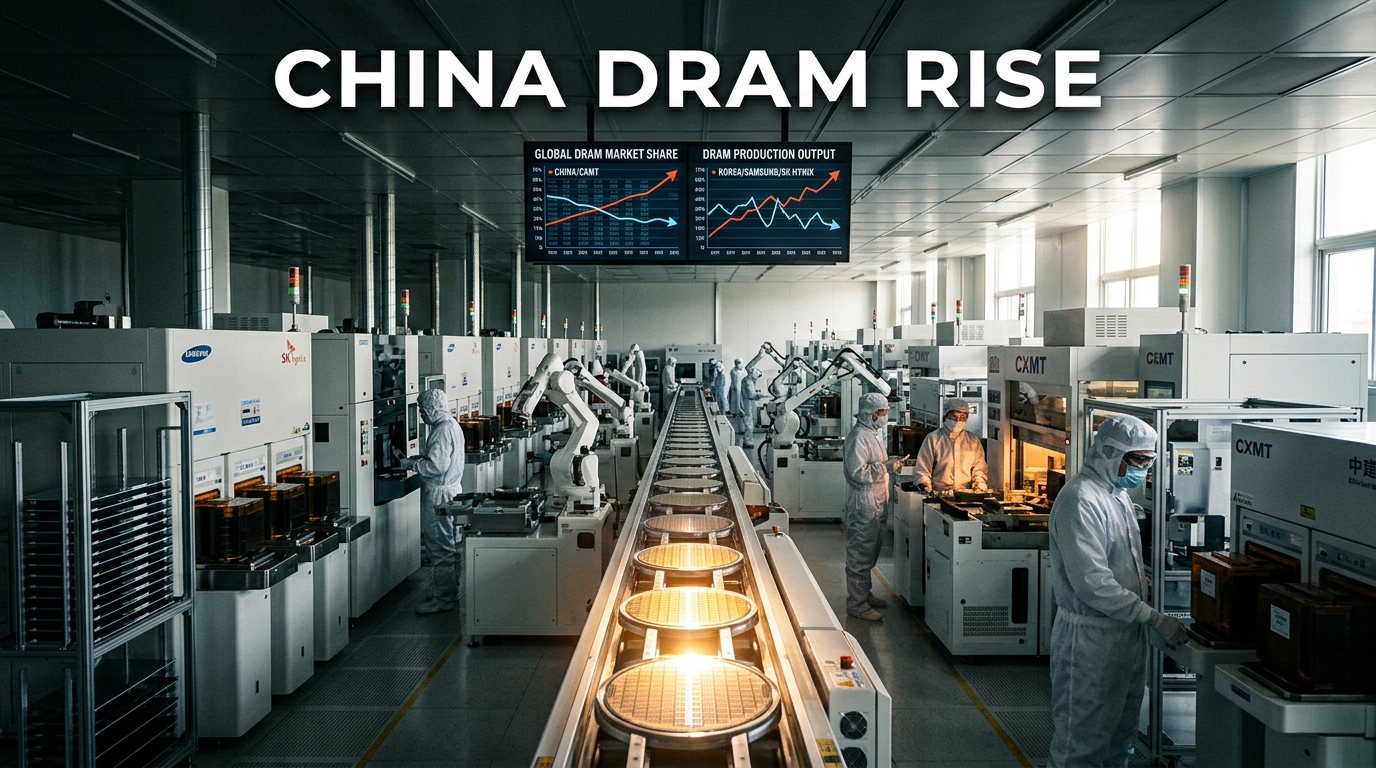
The truly important point is that while Samsung Electronics and SK Hynix moved toward HBM and high-value server DRAM, China’s CXMT has been quickly filling the supply gap in mainstream memory semiconductors.
In particular, the fact that CXMT’s capacity has effectively sold out through the end of 2027, and that global companies such as Apple, Dell, HP, and Lenovo are in the purchase queue, is a major signal for the entire semiconductor market.
In this article, we will look at what kind of company CXMT is, why it suddenly entered the global supply chain, how threatening it is to Samsung Electronics and SK Hynix, and what investment strategy points to consider from the perspective of AI semiconductors and the memory cycle.
1. The starting point of the event: CXMT’s listing and the shock to the global semiconductor market
China’s memory semiconductor company CXMT, or ChangXin Memory Technologies, is drawing attention in the global semiconductor market.
Based on the original text, CXMT’s post-listing market capitalization was mentioned at around 487 billion dollars.
That scale is considered very large, ranking among the top listed companies in mainland China.
Compared with semiconductor companies, it was described as exceeding half of SK Hynix’s market capitalization and surpassing Intel’s market capitalization.
For this reason, stock prices of semiconductor companies in Korea and the United States fluctuated.
The market reacted not merely to the fact that a Chinese company was listed, but to the fact that CXMT has begun to play a real role in the global memory semiconductor supply chain.
- Signing large supply contracts with major Chinese tech companies.
- Entering supply chains of global PC manufacturers and smartphone makers.
- Possibility of selling out production volume through the end of 2027.
- Rapidly replacing the gap left by Korean companies in the mainstream DRAM market.
The important thing here is that CXMT is not yet an advanced memory company like Samsung Electronics or SK Hynix.
Even so, the market was surprised because CXMT has begun to be recognized not as a “technology leader,” but as a company that can supply the needed volume.
2. What kind of company is CXMT: a blend of Chinese state capital and private management
CXMT is a memory semiconductor company founded in 2016 around Hefei, China.
The company’s growth model clearly reflects China’s industrial development approach.
Initial capital is provided by the local government, and losses are absorbed by the government.
Once the company grows to a certain extent, the government recoups its investment through a public listing.
This is often called the Hefei model.
Just before its listing, Hefei was reported to hold more than 30% of CXMT’s shares.
In addition, funding from China’s national semiconductor fund was also reportedly invested at more than 8%.
However, the management was handled not by bureaucrats but by a private-sector professional executive.
CXMT Chairman Zhu Yiming is a person who previously founded and successfully built a semiconductor company called GigaDevice.
In other words, CXMT can be seen as a Chinese public-private semiconductor project in which the state provides the money and time, and a proven private-sector executive carries out the execution.
3. The seed of the technology: absorption of Qimonda personnel and patents
CXMT did not start entirely from scratch.
Its initial technological base was influenced by the German memory company Qimonda.
Qimonda was a DRAM company spun off from Infineon, but it went bankrupt in 2009.
CXMT laid the foundation for memory semiconductor technology by absorbing some of Qimonda’s patents and engineers.
This is important.
It means the Chinese semiconductor company did not grow solely through government subsidies, but learned quickly by absorbing overseas technology assets and talent.
4. What CXMT actually makes: mainstream DRAM product lines are already in practical use
CXMT’s current products can be broadly grouped into four categories.
- DDR5 for PCs and servers.
- Low-power memory LPDDR5 for smartphones.
- Previous-generation DDR4 for PCs.
- Previous-generation LPDDR4 for mobile devices.
In other words, CXMT is already making most mainstream DRAM products.
In particular, the key point is that major memory products used in PCs, smartphones, and servers are actually being installed in finished products.
From the consumer’s perspective, the performance difference can be considered difficult to feel.
Of course, this is a different story from HBM, which is needed for cutting-edge AI semiconductors.
However, in ordinary PCs, entry-level servers, smartphones, and some data-center DRAM, it means CXMT can be a sufficiently viable alternative supply source.
5. Sharp rise in server DRAM share: a shift aligned with AI infrastructure demand
One especially notable part of CXMT’s revenue structure is the share of server products.
Based on the original text, the share of server-type product revenue surged from 8.4% in 2024 to 26.5% last year.
That means it more than tripled in just one year.
This change is also tied to AI infrastructure investment.
As generative AI, cloud data centers, and enterprise server expansion continued, memory demand increased significantly.
Samsung Electronics, SK Hynix, and Micron focused on high-margin HBM and high-capacity server DRAM.
As a result, supply of relatively mainstream server DRAM tightened, and CXMT stepped into that gap.
In the global supply chain, “best performance” matters, but so do “delivery time and volume.”
During periods of memory shortage like now, the amount of volume that can be secured itself becomes bargaining power.
6. The biggest misunderstanding: CXMT is not selling well just because it is cheap
Many people tend to think of CXMT as a cheap Chinese dump product.
But the core point emphasized in the original text is a little different.
CXMT products were described as being priced about 5% to 10% lower than Korean or U.S. products.
That is far from the simple low-price strategy of the past, when products were pushed at more than 30% cheaper.
In some server modules, there were even cases where they sold at higher prices than Samsung Electronics’ products.
This means CXMT did not grow solely on price competitiveness.
The reason CXMT is drawing attention now is not that it is cheap, but that it has volume.
In the memory semiconductor market, a company holding supply during a shortage gains power.
For global PC manufacturers and server companies in particular, securing additional suppliers beyond Samsung Electronics, SK Hynix, and Micron is important from a risk-management perspective as well.
7. HBM is still difficult: CXMT’s real technological limits
While CXMT is growing quickly in mainstream DRAM, it still lags far behind the leaders in HBM.
Based on the original text, CXMT’s HBM technology was described as being about two generations behind the leading companies.
As Samsung Electronics and SK Hynix move to HBM4, CXMT is being evaluated as not yet able to mass-produce HBM3 stably.
According to Reuters, CXMT’s yield for its 8-stack HBM3 product was mentioned at around 25%.
That means if 100 units are made, 75 are discarded.
By contrast, general DRAM yield is known to exceed 80%.
So for CXMT, mass-producing mainstream DRAM in volume is far more economical than pushing HBM production prematurely.
For Samsung Electronics and SK Hynix, this remains a defensive line.
Korean companies are still ahead in HBM, the key profit source of the AI semiconductor era.
8. How did it make chips without EUV: DUV and multi-patterning strategy
There is a point many people wonder about.
With U.S. semiconductor equipment sanctions in place, how can China still make the latest memory products?
The key is that CXMT does not have EUV equipment, but it does have DUV equipment.
EUV is a cutting-edge lithography tool produced exclusively by ASML.
Its export to China is restricted.
By contrast, DUV includes quantities introduced before sanctions, and some specifications are reportedly allowed conditionally.
CXMT is using this DUV equipment to approach fine-pattern processes through multi-patterning.
Simply put, EUV is like drawing an intricate line in one shot with a very thin pen.
DUV is relatively like a thicker pen, making it hard to create fine lines in one pass.
So multi-patterning means drawing, cutting, and overlapping in multiple steps to ultimately create what looks like a fine line.
It is technically possible.
But the number of process steps increases, time gets longer, and the chance of defects rises.
In the end, costs go up.
Based on the original text, CXMT’s cost per bit for DDR5 was mentioned as being more than 30% higher than Samsung Electronics, SK Hynix, and Micron.
So CXMT’s biggest limitation is not simply a technology gap, but economic efficiency.
9. Use of IPO proceeds: expanding existing DRAM production capacity rather than HBM
The IPO prospectus for CXMT also provides an important hint.
Based on the original text, the stated project size for the funds raised is 29.5 billion yuan.
About 70% of that was said to be allocated to already operating wafer lines and DRAM process upgrades.
What stands out is that there is no dedicated HBM project.
This means CXMT chose to expand market share in mainstream DRAM and server DRAM rather than directly chasing Samsung Electronics and SK Hynix in HBM right away.
In other words, CXMT is less a company aiming immediately for the “throne of AI semiconductors” and more one trying to dominate the gaps in the general memory supply chain made scarce by the spread of AI infrastructure.
10. Speed of capacity expansion: this is where the real threat begins
The most alarming part of the CXMT issue is not its current technology level, but the speed of capacity expansion.
Based on the original text, this year’s newly added DRAM wafer output was described as follows.
- CXMT: 85,000 wafers per month.
- SK Hynix: 60,000 wafers per month.
- Micron: 30,000 wafers per month.
- Samsung Electronics: 15,000 wafers per month.
This means CXMT alone is increasing at a level similar to the combined expansion scale of Samsung Electronics, SK Hynix, and Micron.
By the end of this year, CXMT’s total production capacity is expected to reach around 350,000 wafers per month.
That is analyzed as being effectively comparable to Micron’s 385,000 wafers per month.
More important is what happens after next year.
CXMT is preparing for mass production at its Shanghai fab, which is said to be two to three times larger than its Hefei headquarters.
By the end of 2028, forecasts suggest it could expand to 560,000 wafers per month.
If that happens, CXMT’s share of global DRAM wafer production capacity could rise from the current 8% to around 18%.
If these numbers materialize, the competitive landscape of the global memory semiconductor market will clearly change.
11. The space Korean companies left open: the mainstream DRAM gap created by HBM focus
The most painful part of this issue is that the space CXMT has taken was not originally an empty market.
That space was strategically left open by Korean memory companies.
When making the same capacity, HBM uses about three times more wafer area than ordinary DRAM.
The more Samsung Electronics, SK Hynix, and Micron focus their lines on HBM production, the fewer total DRAM bits reach the market.
Over the past two years, HBM and high-capacity server DRAM have commanded far higher prices than mainstream DRAM.
There were periods when the price per bit differed by five to ten times.
From the perspective of Korean companies, moving toward HBM was naturally the rational choice.
The problem is the result.
A supply gap opened in the mainstream DRAM market, and CXMT moved into that exact space.
In the end, CXMT’s rise is not just the success of a Chinese company, but also a structural result created by Korean memory companies’ focus on high-margin products.
12. What Apple, Dell, and HP mean: not a low-end product, but entry into the global supply chain
The fact that CXMT’s production volume has sold out through the end of 2027 is important, but more important is the buyer list.
The original text mentioned global companies such as Dell, HP, Lenovo, and Apple near the front of the queue.
This is not simply sales within China’s domestic market.
It means CXMT is beginning to enter the supply chains of global PC and smartphone manufacturers.
Entering the component supply chain of a global company has a bigger meaning than people might think.
That is because it must pass quality verification, delivery verification, price negotiation, and long-term supply stability evaluations.
Once a supplier is approved, expanding into additional product lines becomes much easier afterward.
So CXMT’s threat is not that it will “steal HBM today.”
The real threat is that global customers have begun to recognize CXMT as a reliable second vendor.
13. Is CXMT’s earnings surge overhyped? Looking only at the numbers can be misleading
We should be careful not to over-interpret CXMT’s growth based solely on its earnings increase.
Based on the original text, this year’s first-quarter revenue was 50.8 billion yuan, up more than 700% year over year.
Margins were also mentioned as rising to around 70%.
On the surface, that looks like tremendous growth.
But looking into it, a significant portion of the improvement came from rising memory prices.
Over the same period, bit shipments increased only 11%.
By contrast, average selling prices rose 57%.
In other words, CXMT did not suddenly create explosive growth through technological innovation; it benefited greatly from the cycle effect of a favorable memory upturn and supply shortage.
This is important from an investment strategy perspective.
A semiconductor company’s performance is heavily influenced not only by technology but also by the memory price cycle.
It can be risky to overestimate long-term competitiveness based only on current earnings.
14. Why it is still a real threat: it can pressure Korean companies’ profitability in the downcycle
CXMT is unlikely to replace Samsung Electronics and SK Hynix immediately.
However, it could become a burden in the next memory downcycle.
If demand for HBM and high-capacity server DRAM remains strong, Korean companies can maintain high profitability.
But if investment in AI infrastructure temporarily slows, or if HBM supply turns excessive, the situation changes.
Then profits must be made in mainstream DRAM.
But if CXMT has already secured global customers and raised its market share in the mainstream DRAM market, Korean companies’ pricing power could weaken.
That is the essence of the CXMT risk.
More important than today’s technological catch-up is the possibility that it acts as a supplier pushing down the market floor price in the next downcycle.
15. Three conditions global analysts see as making CXMT a real threat
The original text summarized three conditions under which CXMT becomes a real threat.
- Priority 1: Commercialization of HBM.
- Priority 2: Western buyers recognizing CXMT as a credible supply source.
- Priority 3: Expansion of low-price volume.
Currently, CXMT has not yet reached the first priority, HBM commercialization.
However, the second and third priorities are already partially becoming reality.
Western buyers are considering CXMT as a supply-chain candidate.
And through capacity expansion, it is rapidly increasing mainstream DRAM volume.
That is why the CXMT issue is difficult to dismiss as simple hype.
It is not a technology leader, but it is growing into a player that can change market structure.
16. News about China’s localization of DUV equipment: still a variable, but worth watching long term
The original text also mentioned that the day after CXMT’s listing, a company in Shanghai, China, began mass production of immersion DUV equipment, and that the first five units would go to SMIC, Huahong Semiconductor, and CXMT.
Of course, this part still needs to be viewed cautiously.
The identity and technological level of the company are unclear, and production volume appears to be very small.
Also, many of the key components of DUV equipment are still likely to depend on Japanese and German suppliers.
Still, the direction matters.
China is pushing localization of equipment, materials, and components as a long-term task.
Although it is difficult to create ASML-level EUV immediately, greater self-sufficiency in DUV-based processes could strengthen production capacity for mainstream semiconductors and memory semiconductors.
17. The core point many other reports miss: CXMT’s real weapon is not technology, but the ability to read the supply-chain gap
Many reports focus on CXMT in terms of China’s semiconductor catch-up or low-price offensive.
But there is a more important point.
CXMT’s real weapon is not cutting-edge technology, but its execution power in precisely reading and entering the gaps in the global supply chain.
Samsung Electronics and SK Hynix concentrated on HBM and high-value DRAM for AI servers.
This choice was highly rational from the standpoint of short-term profitability.
But it created a supply gap in mainstream DRAM.
CXMT moved straight into that space.
And instead of reckless dumping by lowering prices 30%, it secured profit by trading at 5% to 10% lower prices in shortage markets, or even higher prices for some products.
This is not just manufacturing competition.
It is a battle of industrial strategy.
In areas where “top-tier cutting-edge” is difficult, China is not forcing a direct showdown; instead, it is moving by first taking control of the weak points in the global supply chain.
This pattern has repeated in electric vehicle batteries, solar power, rare earths, and displays.
Now a similar trend is appearing in memory semiconductors as well.
18. What this means for Samsung Electronics and SK Hynix
It is hard to say that Samsung Electronics and SK Hynix are immediately losing ground to CXMT.
Korean companies remain strong in HBM, high-performance server DRAM, advanced processes, and custom high-value memory.
However, in mainstream DRAM, price competition and pressure on market share could intensify.
Especially if CXMT expands global customer certifications and production capacity, the bargaining power of Korean companies’ mainstream products could weaken.
The three core tasks Korean memory companies must watch going forward are:
- Can they continue to maintain HBM leadership?
- Can they defend at least a minimum share and customer base in the mainstream DRAM market?
- Do they have a product portfolio that can maintain profitability even if AI semiconductor demand slows?
In the end, Korean companies must concentrate on HBM, but they should not leave mainstream DRAM completely unattended.
Balancing the high-value market and the mainstream market is likely to become even more important in the future.
19. Investor perspective: indicators to watch when evaluating the CXMT issue
Investors should not simply view the CXMT issue as “China has caught up.”
The following indicators should be tracked together.
- HBM price trends.
- The memory price cycle for mainstream DRAM.
- Samsung Electronics and SK Hynix’s progress in securing HBM customers.
- Whether CXMT expands global customer certifications.
- The pace of CXMT’s monthly wafer capacity growth.
- Progress in localizing Chinese semiconductor equipment.
- Whether U.S. restrictions on Chinese semiconductors are tightened further.
In particular, memory semiconductor investment must be viewed alongside the industry cycle.
There is no guarantee that strong current earnings will be sustained in the next cycle.
Conversely, it is also important to see who can survive a downturn with cost competitiveness.
CXMT has high costs, but it also has long-term government support and a domestic market base in China.
Korean companies are strong in technology and customer trust, but they may face pressure from expanding Chinese volume in the mainstream market.
20. Looking at the AI trend: the era of watching only HBM may be ending
In the recent AI semiconductor market, HBM has been the hottest keyword.
NVIDIA GPUs, AI servers, and data center investments all boosted HBM demand.
But AI infrastructure does not run on HBM alone.
It also needs ordinary server DRAM, SSDs, power semiconductors, networking equipment, and cooling systems.
As AI spreads across industries, demand may grow not only for high-performance HBM but also for mainstream memory.
At that point, if a company like CXMT strengthens its influence in the mainstream memory supply chain, it could also affect the cost structure of AI infrastructure.
The same applies to companies’ AX, or AI transformation strategies.
Going forward, what matters is less “how much AI was adopted” and more “how much value AI created and how ROI is measured.”
As AI infrastructure costs remain high, stability in the memory supply chain becomes a direct variable in a company’s AI investment strategy.
21. Conclusion: CXMT is not a company that will topple Korean memory firms immediately, but it is one that cannot be ignored
CXMT is unlikely to replace Samsung Electronics and SK Hynix right away.
Its cost remains more than 30% higher, and its HBM is still about two generations behind.
Its current strong earnings are also heavily driven by the cycle effect of rising memory prices.
However, CXMT’s rise is a clear warning to the Korean memory industry.
The fact that mainstream DRAM volume has sold out through 2027 cannot be brushed aside.
The fact that global companies like Apple, Dell, HP, and Lenovo are in the queue is even more important.
Chinese memory is no longer just a low-cost product.
It is moving into a stage of being integrated into the global supply chain.
While Korean companies win in the high-value HBM market, we must keep watching who is filling the gap in mainstream DRAM.
The next competition in the memory semiconductor market is likely to be not just a battle of technology, but a complex struggle combining supply chain, production capacity, cost structure, customer certification, and the business cycle.
< Summary >
CXMT is a memory semiconductor company combining Chinese government capital and private-sector management.
Mainstream DRAM products such as DDR5 and LPDDR5 are already being installed in global finished products.
It lags far behind Samsung Electronics and SK Hynix in HBM, but its mainstream DRAM production capacity is expanding very quickly.
The reason CXMT is drawing attention is not cheap dumping, but the fact that it secured volume in a shortage market.
CXMT is filling the mainstream DRAM space left open by Samsung Electronics and SK Hynix as they focused on HBM.
It cannot replace Korean companies immediately, but in the next memory downcycle, it could become a factor pressuring prices and market share.
The key points to watch going forward are CXMT’s global customer certifications, capacity expansion, HBM commercialization, and the localization of Chinese semiconductor equipment.
[Related Articles…]
- HBM Supercycle and Samsung Electronics and SK Hynix Investment Strategy
- AI Semiconductor Supply Chain Reshaping and Global Memory Market Outlook
*Source: [ 티타임즈TV ]
– 한국 메모리가 비운 자리를 중국이 채웠다