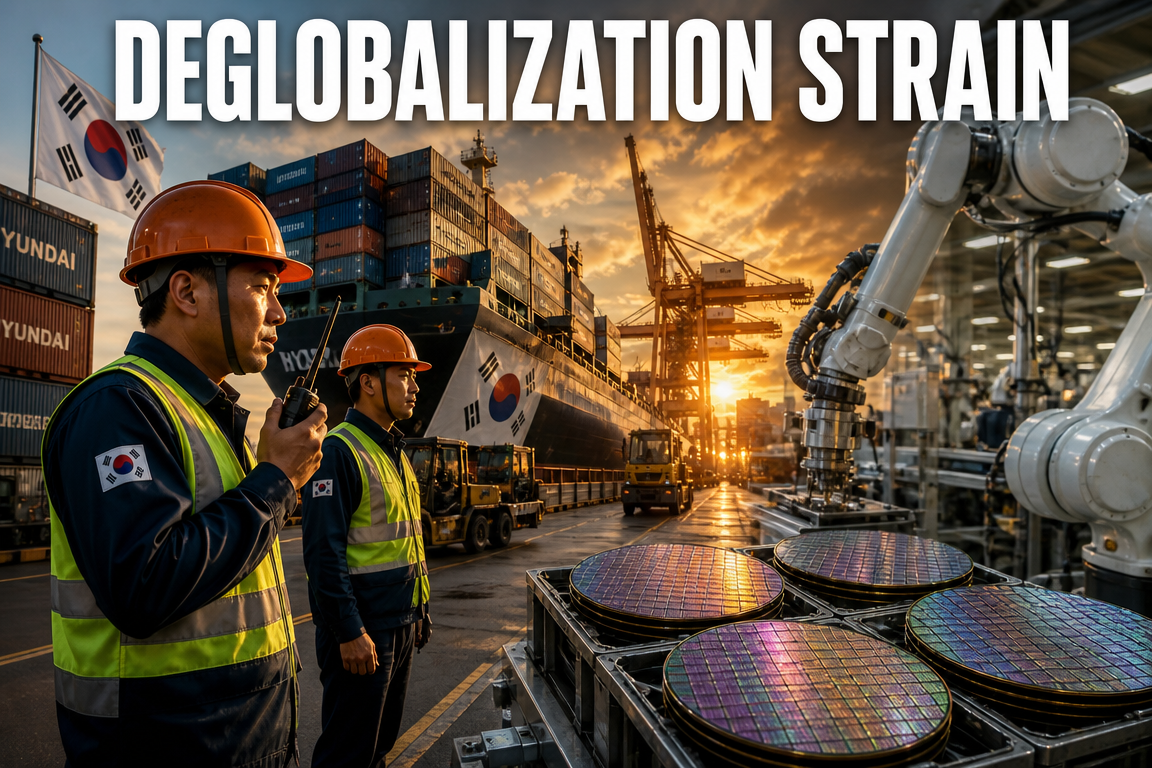
● De-Globalization, AI War, Power Crisis, China Challenge, Korea Survival
Globalization Is Not Over, But Supply Chains Are: De-globalization, the AI Arms Race, Power Constraints, U.S.-China Rivalry, and Korea’s Economic Survival Strategy
The central issue in this debate is not simply that globalization has failed.
The more important point is that, even as globalization weakens, wars, AI, drones, data centers, and semiconductor supply chains still depend on global networks.
Ukraine and Russia continue to source drone components from China while fighting each other, and the United States cannot complete AI leadership without semiconductors, materials, and equipment from allied countries.
For Korea, the more important question is whether an economy that benefited most from the past 30 years of globalization can also emerge as a winner in the de-globalization era.
This article summarizes globalization’s failure, geopolitical risk, AI warfare, data center power shortages, U.S.-China competition, Chinese overcapacity, Europe’s manufacturing crisis, and Korea’s strategic response.
1. Why globalization is now seen as having failed
For Korea, globalization was another name for success.
After China joined the WTO, global trade expanded rapidly, and Korea rode China’s growth to generate substantial export gains in semiconductors, displays, shipbuilding, petrochemicals, auto parts, and related industries.
In practical terms, Korea grew alongside China by plugging into a large and expanding growth engine.
However, this success had a cost for others.
Manufacturing workers in the U.S. Midwest lost jobs as factories moved to China and Mexico.
Countries such as Malaysia and Indonesia, which in the mid-1990s appeared likely to catch up with Korea, also failed to clear the threshold to industrial upgrading.
Globalization expanded total GDP, but the benefits were not distributed evenly.
As a result, political resentment grew in the United States around the perception that America was making the world richer while its own workers were sacrificed.
This resentment helped drive Trump’s protectionism, tariff policy, and America First agenda.
2. Korea was a winner in the globalization era, but will it remain one in the next era?
Korea was a clear winner in the globalization era.
As China’s market expanded, Korean exports grew, and Korean firms established themselves as key suppliers of intermediate goods within global supply chains.
That environment has now changed materially.
In the past, Korean firms transferred technology and know-how to China. Today, Chinese companies are pressuring Korean firms on price and speed.
Technicians who helped set up Chinese factories 15 or 20 years ago are now seeing those same Chinese firms catch up and are returning home as plants shut down.
This is not merely an emotional issue.
It signals a structural change in Korea’s growth model.
The old model relied on benefiting from China’s growth; the new one is direct competition with China.
Korea can no longer view China only as a market.
China is both a customer and a competitor, and at the same time a supply chain partner and one of the most significant pressures on Korean manufacturing.
3. Does war end globalization, or does it make globalization more necessary?
The Russia-Ukraine war appears to be a symbol of de-globalization.
War, sanctions, energy weaponization, grain supply disruptions, and defense competition have all destabilized the global economy.
Yet what happens on the ground is more complex.
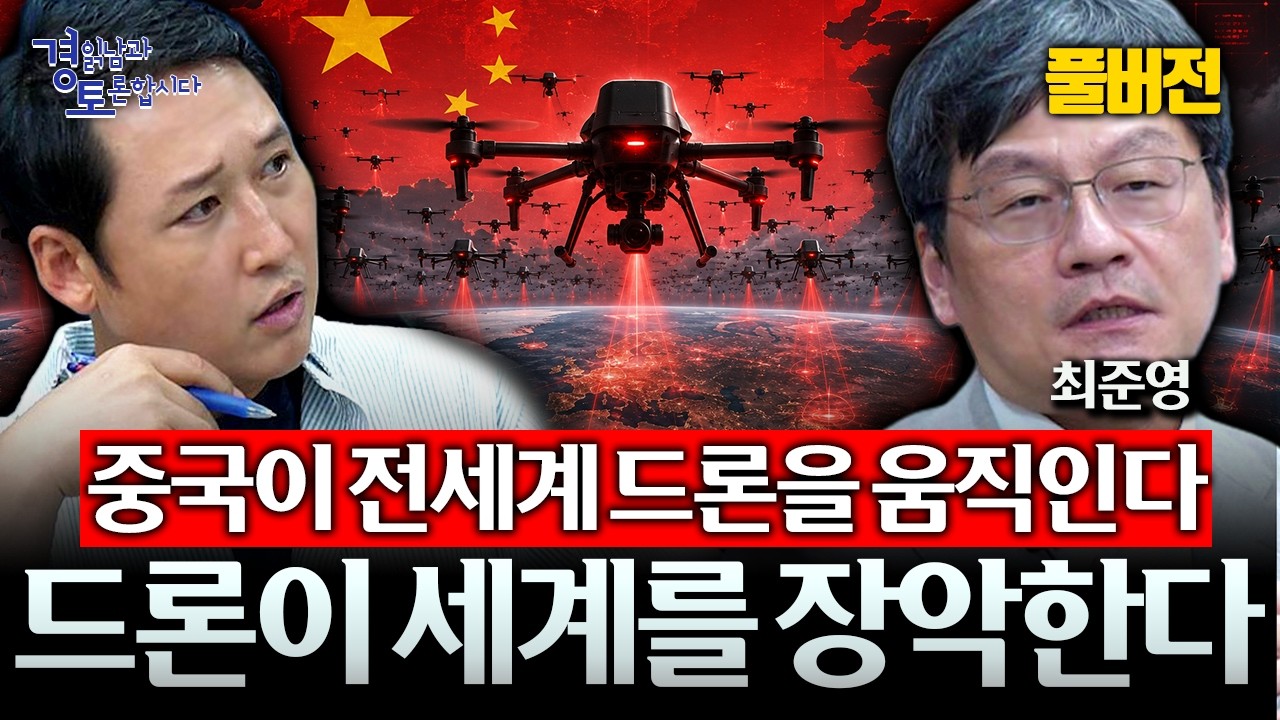
Many drone components used by Ukraine are made in China.
Many drone components used by Russia are also made in China.
In effect, both sides must secure more Chinese components, faster, in order to fight the war more effectively.
War weakens globalization, but it also increases reliance on global supply chains to sustain military operations.
This is a critical point.
Globalization is not ending in full; it is being reorganized around security and industrial policy.
The next phase of globalization is unlikely to be about cheap goods freely traded across borders.
It is more likely to be an security-oriented globalization centered on semiconductors, batteries, rare earths, drone components, AI servers, and power infrastructure.
4. AI-drone warfare has lowered the threshold for conflict
In the past, war required enormous human casualties and political cost.
With the combination of drones and AI, the cost structure of war is changing.
Even without sending people directly into combat, low-cost drones, suicide drones, reconnaissance drones, and AI-based target recognition systems enable continuous attacks.
Low-cost drones, in particular, can be produced and consumed at scale, unlike expensive missiles.
This makes war more frequent, easier to launch, and more routine.
Chinese drone technology, such as DJI, originally developed for photography, logistics, and industrial uses.
However, a drone’s follow-me function can also be adapted into military target-tracking capability.
The key point is that technology itself is neutral, but humanity has consistently applied new technologies to warfare as quickly as possible.
Dynamite did so. The internet did so. AI drones are following the same path.
5. AI competition is putting pressure on the energy transition
As the AI industry expands, the first binding constraint is power supply.
Training and operating large AI models requires massive amounts of electricity.
Data centers are not just buildings; they are power-intensive industrial infrastructure.
The problem is that electricity demand is rising too quickly.
Countries that have long advocated a green transition are now being forced to reconsider nuclear power, natural gas, coal, and transmission expansion in the face of competition for AI data centers.
AI has not fully revived fossil fuels, but it has clearly changed policy priorities in the energy sector.
Europe has long emphasized green energy and decarbonization.
However, recent heat waves have increased air-conditioning demand, and data center demand is adding further strain to power systems.
For African countries, the issue is even more contentious.
Developed economies used coal and oil extensively during their own growth phases, yet now ask developing countries not to build coal-fired power.
In the end, the AI economy cannot be managed through green rhetoric alone.
A new framework is needed that incorporates power generation, transmission networks, electricity pricing, local opposition, data center siting, and industrial power allocation.
6. The United States no longer wants to act as the world’s firefighter
The core of the Trump era is not simply one politician’s personal style.
What matters is that American society as a whole is asking why the United States should continue bearing the cost of maintaining the global order.
Trump believes that the world has exploited the United States for decades.
America provided security, maintained the dollar-based order, protected sea lanes, and deployed troops during crises.
Yet the perception grew that domestic workers lost factories and the middle class deteriorated.
That is the essence of America First.
It also resembles U.S. isolationism in the 1930s.
At that time, public sentiment was also strongly opposed to intervening in European wars.
Charles Lindbergh’s slogan was also America First.
Today, the United States is again moving toward a posture that is less willing to automatically resolve problems around the world.
For Korea, this is a major geopolitical risk.
In the future, U.S. aircraft carriers, strategic bombers, the nuclear umbrella, and intelligence assets may no longer be treated as free public goods.
Put bluntly, security services could shift from a free subscription model to a paid one.
7. Trump and Biden differed in method, but not in direction
Trump pushed America First through tariffs.
Biden pursued the same broad direction through the Inflation Reduction Act, the CHIPS Act, and subsidy policy.
Superficially, the methods were different, but the direction was the same.
The objective is to bring critical industries back to the United States, reduce dependence on China, and attract allied investment into the U.S.
Accordingly, it is risky to assume that protectionism ends when Trump leaves office.
The policy direction in the United States has already shifted structurally.
Whether through tariffs, subsidies, or investment pressure, the goal is to rebuild a U.S.-centered value chain.
This affects semiconductors, batteries, AI data centers, electric vehicles, critical minerals, and defense industries.
8. The world is being reorganized around pragmatism rather than ideology
During the globalization era, the global standards set by the United States effectively served as the world’s rules.
Democracy, market economics, free trade, human rights, and rule of law functioned as the default framework for the global economy.
Today, however, countries are placing pragmatism ahead of ideology.
The United States no longer wants to make unlimited sacrifices.
Europe can no longer separate security from industrial policy.
China is expanding its influence through market access and manufacturing strength.
Middle powers are increasingly pursuing issue-by-issue strategies rather than fully aligning with either the United States or China.
This is the fragmentation described by international organizations.
However, whether an alliance order without the United States can function effectively is a separate question.
Europe can talk about a NATO without the United States, but it is difficult to independently match U.S. military power, intelligence capabilities, and nuclear deterrence.
Ideas such as a middle-power coalition involving Canada, Korea, Japan, Australia, and Europe exist, but the division of cost and sacrifice remains unclear.
9. Even in a G2 era, China cannot fully replace the United States
China is already one of the two largest powers in the world, often described alongside the United States as part of a G2 structure.
It has strong positions in manufacturing, batteries, electric vehicles, solar power, rare earths, drones, shipbuilding, and steel.
But whether China can fully replace the United States is another matter.
The United States has borne significant costs for 80 years to maintain the world order.
It secured sea lanes, provided the financial system, deployed troops to crisis regions, and sent aircraft carriers and relief personnel when disasters occurred.
It remains unclear whether China has the will to assume those responsibilities.
China’s influence is based more on markets and manufacturing than on an attractive lifestyle or universal values.
In simple terms, China wants access to markets that will buy its goods.
By contrast, many countries want to trade with China but are hesitant to enter fully into a Chinese-led order.
The Russia-China gas pipeline negotiation is illustrative.
Russia reportedly offered gas to China at a price, but China pressed for a very low price.
From China’s perspective, this is pragmatic bargaining. From other countries’ perspective, it raises doubts about whether China would provide meaningful support in a crisis.
10. Chinese overcapacity is pressuring Europe’s manufacturing sector
China describes its expansion as the result of scale and efficiency.
The United States and Europe, by contrast, view it as overcapacity.
The most visible sectors are electric vehicles, solar power, and batteries.
Chinese EVs are pressuring European automakers on both price and speed.
For firms such as Volkswagen, plant closures and restructuring are no longer merely automotive issues.
An automobile contains a large number of components, and the small and medium-sized suppliers that produce them are the foundation of German manufacturing.
If finished-vehicle plants weaken, the broader manufacturing ecosystem weakens as well.
China is responding with considerable flexibility.
If Europe imposes tariffs and subsidy restrictions, Chinese firms can respond by acquiring local factories or expanding local production.
For example, if a Chinese EV company acquires a closing European plant and continues production with the existing workforce under a European manufacturing label, European governments would find it difficult to reject.
This is the strength of Chinese manufacturing.
It can do more than sell low-cost products. It can enter a market by adapting to the other side’s rules and still capture share.
11. China is not earning stable profits across all industries
However, China’s expansion does not automatically translate into stable profitability.
Chinese solar companies dominate global market share, but many leading firms are under significant profit pressure.
EV companies are also facing declining margins as domestic competition intensifies.
Chinese firms are pursuing market share by lowering prices and expanding exports to secure cash flow.
This strategy could ultimately eliminate competitors and establish long-term dominance.
Alternatively, it could become a mutual-loss price war.
The turning point has not yet arrived.
Therefore, China should not be viewed through an extreme binary of either total victory or imminent collapse.
China is strong, but the cost of that strength is also increasing.
12. The most important points that are often omitted in other coverage
First, de-globalization is not the end of globalization but its militarization and securitization.
The key issue is not simply that trade is declining.
The real shift is that the 기준 for trade is moving from price and efficiency to security and control.
Future supply chains will be judged less by whether goods are cheap and more by whether they remain intact during crises.
Second, AI leadership is not only a semiconductor competition; it is also a power competition.
Much of the coverage focuses on AI models, GPUs, and semiconductors.
In reality, the binding constraints are power grids, transmission lines, data center siting, cooling systems, electricity pricing, and local opposition.
AI competitiveness is ultimately energy policy competitiveness.
Third, the U.S. policy shift is not just about Trump as an individual.
Even if Trump disappears, America First and protectionism are likely to remain.
Biden pursued the same direction through subsidies, while Trump did so through tariffs.
Korean firms should not base strategy solely on the outcome of the U.S. presidential election.
Fourth, China wants markets more than it wants to rule the world.
It remains unclear whether China wants, or is willing, to bear the costs of managing a global order the way the United States has.
China’s influence is powerful, but its ability to attract allies through trust and values is weaker than that of the United States.
Fifth, Korea is the advanced economy that understands China best.
The United States and Europe are only now experiencing the full force of Chinese manufacturing competition.
Korea has spent more than 20 years competing, cooperating, learning, and being pressured by China.
This experience can be treated not as a weakness but as a strategic asset.
13. Korea’s survival strategy
1) China should be viewed as a competitive system, not merely a market.
China is not a single company but a large competitive system combining the state, finance, local governments, supply chains, the domestic market, and export policy.
Korean firms cannot respond effectively through product-level competition alone.
Industrial policy, financial support, talent development, and energy policy must move together.
2) Semiconductors and AI must be evaluated together with power infrastructure.
AI data centers, semiconductor clusters, and advanced manufacturing are all electricity-intensive industries.
If Korea wants to become an AI powerhouse, it must design nuclear power, renewable energy, transmission networks, electricity pricing, and data center location strategy in one framework.
3) Korea should participate in U.S.-centered supply chains, but with a full cost assessment.
The United States is asking allied economies to invest heavily.
To maintain access to the U.S. market, Korean semiconductor, battery, and auto firms will have to invest on a large scale.
However, if investment leads to technology, profits, and employment all shifting to the United States, Korea’s industrial base may weaken.
4) Europe’s manufacturing crisis should be viewed as both a risk and an opportunity.
The weakness in Germany’s auto industry and broader European manufacturing is a risk for Korean firms, but also an opportunity.
Korean companies can expand their role in electric components, batteries, power equipment, defense, shipbuilding, and green infrastructure.
5) Rising security costs must be reflected in economic forecasts.
Korea may no longer be able to treat security as effectively free.
Defense spending, defense exports, cybersecurity, space and satellite capabilities, drone defense systems, and energy security will all become key variables in the economic outlook.
14. The bottom line
Globalization has not ended. It is shifting from a model based on low-cost efficiency to one centered on security, power, technology, and supply chains.
Korea was a beneficiary of the old globalization model.
To remain a winner in the next phase, it must view China more soberly, respond more realistically to the United States’ changing posture, and place AI and energy infrastructure at the center of national strategy.
Economic forecasting is no longer only about interest rates and exchange rates.
Geopolitical risk, global supply chains, protectionism, AI warfare, and data center power shortages must all be considered to understand Korea’s next direction.
< Summary >
Globalization has not ended, but it is being reorganized around security.
The Russia-Ukraine war illustrates de-globalization, but it also highlights the paradox of a global supply chain still dependent on Chinese drone components.
AI competition is making data center power shortages and energy policy central variables, beyond semiconductors alone.
U.S. protectionism is not unique to Trump; it reflects a broader structural shift in American policy.
China has formidable manufacturing strength, but its willingness and ability to bear the cost of maintaining world order remain uncertain.
Korea should treat China as a competitive system, not merely a market, and build a survival strategy that integrates AI, semiconductors, power, and security.
[Related Articles…]
- Supply Chain Strategy for Korea in the De-globalization Era
- AI Data Center Power Constraints and the Global Energy Race
*Source: [ 경제 읽어주는 남자(김광석TV) ]
– [풀버전] 세계화는 끝났다… 한국은 다음 시대에도 살아남을 수 있을까? | 경읽남과 토론합시다 | 최준영 박사님