● Market Shock, JPY Surge, Foreign Selloff
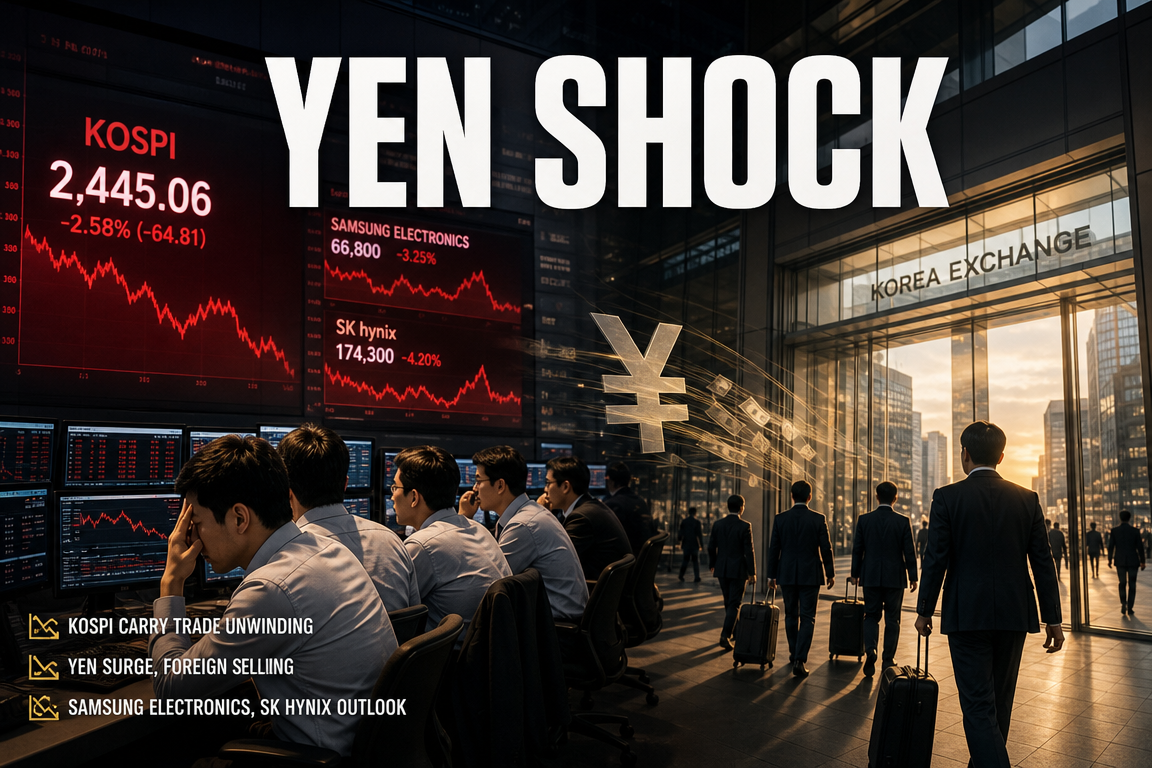
Why Samsung Electronics and SK hynix surged and then retreated: carry-trade unwinding and foreign selling that shook the KOSPI
The key driver behind Friday’s sharp move in Samsung Electronics and SK hynix was not simply profit-taking.
The more important issue is global capital flow, the yen, foreign net selling, and the divergent performance of Japan’s memory chip company Kioxia.
The market is overlooking a crucial point: earnings expectations remain intact, but the cost of funding has changed abruptly.
In other words, the decline was not driven solely by weaker company fundamentals. It reflected a structure in which global investors had to reduce risk and repay borrowed funding, making large-cap KOSPI names the first sell targets.
1. Why selling emerged immediately after Friday’s rally
The first factor is straightforward.
As Samsung Electronics and SK hynix rose sharply on Friday, holders sitting on losses for an extended period began to sell into strength.
In market terms, this is often described as an overhang of supply from trapped positions.
When prices recover toward breakeven or modest profit levels, investors who have been underwater tend to exit.
As a result, selling can intensify as prices rise.
This effect is especially pronounced in Samsung Electronics and SK hynix, which are among the largest KOSPI constituents and are traded by retail investors, institutions, foreign investors, and program trading systems simultaneously.
Once the trend turns lower, the decline can feel disproportionately large.
2. The more important variable than profit-taking: the yen surge
The second key factor is the yen.
As the yen weakened excessively, market participants interpreted recent moves by the Japanese government and the U.S. Treasury as a coordinated effort to support the currency.
For domestic investors, a stronger yen may look like a simple FX headline.
In global markets, however, it is material.
For decades, Japan has maintained ultra-low interest rates, enabling investors to borrow yen at low cost and allocate the proceeds into higher-yielding assets.
This is known as the yen carry trade.
In simple terms, investors borrow cheaply in yen and invest in assets such as U.S. equities, Korean equities, emerging market assets, and semiconductor stocks.
The problem is that when the yen strengthens abruptly, the funding cost of this strategy rises.
Borrowers must eventually repay in yen, and a stronger yen increases that repayment burden.
As a result, investors may sell risk assets and cover their yen liabilities.
That process can create selling pressure on the KOSPI, especially on Samsung Electronics and SK hynix, where foreign ownership is significant.
3. The actual market driver today: foreign net selling
The key flow to watch in this decline is foreign net selling.
When the KOSPI falls sharply, retail investors often ask why Korean equities are under pressure.
In practice, when foreign capital exits, index-heavy names such as Samsung Electronics, SK hynix, Hyundai Motor, battery stocks, and financials are typically sold first.
Semiconductors had already attracted substantial foreign inflows on expectations of an AI cycle, HBM demand, and a memory upturn.
Stocks that have risen sharply are usually the first to be sold when global investors reduce risk.
From this perspective, the move is better explained as foreign investors reducing exposure to large-cap Korean semiconductors rather than a sudden deterioration in fundamentals.
4. Why Samsung Electronics and SK hynix were hit hardest
Samsung Electronics and SK hynix are the flagship semiconductor names in Korea.
They are also among the first stocks foreign investors buy when entering the Korean market.
Conversely, they are often the first to be sold when foreign exposure to Korea is reduced.
That is both the advantage and the weakness of KOSPI large caps.
When liquidity is abundant, they rise quickly.
When global rates, FX conditions, or liquidity change, they can be sold regardless of fundamentals.
More recently, both names had attracted strong attention due to expectations around the AI semiconductor cycle.
When yen strength and foreign net selling coincide, profit-taking can amplify the downside.
5. The unusual part: why Kioxia rose instead
The most notable feature of this move was Kioxia in Japan.
Unlike Samsung Electronics and SK hynix, which are usually linked to the broader memory cycle, Kioxia showed relative strength.
In normal conditions, improving memory fundamentals often lift Samsung Electronics, SK hynix, and Kioxia together.
This time, however, the Korean leaders weakened while Kioxia held up.
The explanation appears to lie in earnings results and expectations for shareholder returns.
The market is increasingly focused not only on whether the memory cycle is improving, but also on how those profits are returned to shareholders.
Signals such as share buybacks, higher dividends, balance-sheet improvements, and stronger shareholder returns can move stock prices beyond pure fundamentals.
By contrast, Samsung Electronics and SK hynix still face investor demand for a clearer message on capital allocation and shareholder return policy.
6. What the market is really looking for: not just stronger earnings, but capital returns
Investors in semiconductors are no longer focused only on cyclical recovery.
The market already understands the direction of HBM demand, DDR5, data center investment, and AI server demand.
The key question now is how much of that earnings improvement is translated into shareholder value.
To achieve a higher valuation, Samsung Electronics and SK hynix need not only stronger earnings, but also a clearer capital allocation framework.
Even if capex remains necessary, the market wants visibility on dividends, buybacks, cash flow management, and a shareholder return roadmap.
Global investors have long pointed to Korea’s valuation discount.
Strong earnings alone may not be enough if shareholder returns remain limited.
By contrast, stronger return policies can support a higher valuation for the same earnings base.
7. The key point often missed: this correction is more about liquidity than earnings risk
It is a mistake to interpret this decline only as a debate over peak semiconductor earnings.
The more important issue is the change in global liquidity conditions.
If yen weakness stops and the currency strengthens, carry-trade capital may leave risk assets.
Because Korea sits between emerging-market sensitivity and developed-market supply-chain exposure, it tends to react quickly to shifts in foreign capital.
In other words, the KOSPI is both an AI-beneficiary market and a market that is often sold first when global risk appetite weakens.
That dual structure creates confusion for investors.
Earnings can improve while stock prices fall, and the 업황 can recover while flows deteriorate.
For that reason, investors should monitor not only company news but also FX, rates, foreign flows, and yen trends.
8. Key indicators to watch
First, determine whether yen strength is temporary or sustained.
If the yen continues to strengthen, pressure from carry-trade unwinding may persist.
In that case, foreign flows into the KOSPI could remain unstable.
Second, check whether foreign net selling is concentrated in Samsung Electronics and SK hynix.
One or two days of selling is not necessarily a major concern.
However, if foreign investors continue to sell large-cap semiconductors for several sessions, the market may remain defensive.
Third, monitor both USD/KRW and JPY/KRW.
Korean investors usually focus on USD/KRW, but the yen trend is also important in this case.
What matters is whether yen strength triggers a broader reduction in global risk exposure.
Fourth, watch Samsung Electronics and SK hynix for clearer shareholder return messaging.
AI semiconductors and HBM competitiveness alone may not be sufficient to sustain further upside.
The market will continue to look for how earnings improvement translates into dividends, buybacks, and shareholder value creation.
Fifth, compare the stock performance of overseas peers such as Kioxia.
If Korean memory names underperform while the broader sector remains firm, the issue may be more about flows, policy, and valuation than about the memory cycle itself.
9. Investment interpretation
This decline should not be viewed solely as panic, nor should it be treated automatically as a buying opportunity.
The medium-term semiconductor cycle for Samsung Electronics and SK hynix remains supported by AI investment and data center demand.
However, in the short term, foreign flows and the yen can move share prices more than fundamentals.
After a rapid rally, the subsequent correction can appear severe, but it reflects a mix of profit-taking and global portfolio rebalancing.
Investors should therefore ask not whether the business has deteriorated, but whether capital flows have changed.
The semiconductor cycle may be improving, but equity markets react first to liquidity and sentiment.
10. Bottom line
The post-rally decline in Samsung Electronics and SK hynix was driven by trapped-position selling, concerns over carry-trade unwinding due to yen strength, foreign net selling, and differences in shareholder return expectations.
Kioxia’s strength suggests that the market is now focusing not only on semiconductor fundamentals, but also on shareholder value creation.
[Related Articles…]
AI Semiconductor Cycle: Key Investment Points for Samsung Electronics and SK hynix
How Yen Movements Shape Global Capital Flows and KOSPI Performance
*Source: [ 내일은 투자왕 – 김단테 ]
– 삼전닉스 상한가 이후 폭락한 이유 #삼성전자 #하이닉스 #코스피
● Semiconductor Shock, Korea Economy on Edge
Will Korea’s Economy Slow If Semiconductor Prices Reverse? Key Takeaways from the 2026 Second-Half Economic Policy Direction
The single most important issue in the 2026 second-half economic policy direction is whether Korea’s improved macro outlook reflects underlying economic resilience or is mainly driven by a semiconductor price surge.
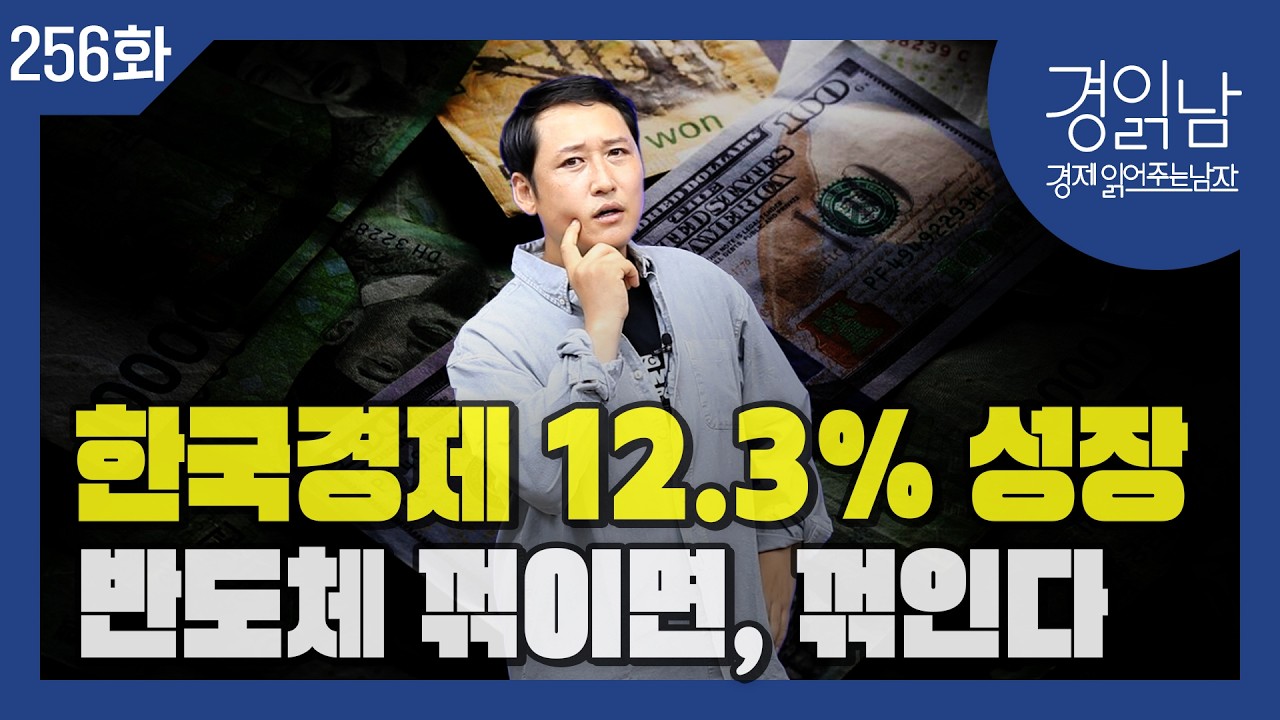
The government projects nominal GDP growth of 12.3% and real GDP growth of 3.0% for 2026.
On the surface, these figures indicate a strong recovery. However, a closer look shows that the outlook is shaped by semiconductor export prices, base effects, the AI investment cycle, and supply chain risks.
In particular, if semiconductor export volumes decline while prices rise, export value may increase. In that case, any reversal in semiconductor prices could quickly weaken the broader economic outlook.
The government has also announced expanded memory semiconductor capacity, development of seven physical AI sectors, a K-supply chain strategy, and youth employment measures.
On paper, this is a growth strategy. In practice, it is also a test of whether Korea can reduce its dependence on semiconductors.
1. Key message: where Korea’s economy stands in 2026
The government’s assessment is relatively clear.
Korea’s economy is rebounding more strongly than expected.
However, the rebound is driven more by higher semiconductor export prices than by broad-based domestic demand recovery.
In other words, the economy appears stronger because of a leading industry, especially memory semiconductors, rather than because the entire economy has become structurally stronger.
- 2026 nominal GDP growth forecast: 12.3%
- 2026 real GDP growth forecast: 3.0%
- 1Q 2026 nominal GDP growth: 17.1%
- 1Q 2026 real GDP growth: 3.8%
- Exports, trade balance, and current account trends in H1 were historically strong
The distinction between nominal and real growth is important.
Nominal growth includes price increases.
Real growth strips out inflation and captures changes in actual output.
The government’s emphasis on 12.3% nominal growth delivers a stronger headline figure, but 3.0% real growth is the more relevant indicator of underlying economic strength.
2. Why the outlook improved: D-RAM and semiconductor prices
The main reason for the upward revision in Korea’s outlook is the continued increase in global D-RAM revenue projections.
As of December 2025, the global D-RAM market was expected to follow a more typical semiconductor cycle.
However, projections were revised up in March 2026 and revised higher again in June 2026.
Demand for AI servers, data centers, HBM, and high-performance memory has remained stronger than expected, preventing a downturn in the semiconductor cycle.
The issue is that Korea’s export gains have come largely from higher prices rather than higher shipment volumes.
DDR4 and DDR5 prices rose sharply in both 1Q and 2Q 2026.
In some periods, the increase in semiconductor export prices has exceeded the increase in export value.
This implies that export volume may be flat or declining while higher prices lift total export receipts.
As a result, Korea’s current recovery is highly sensitive to semiconductor prices.
If prices remain elevated, exports and the current account should stay resilient.
If prices weaken, export momentum, corporate earnings, and growth forecasts could all be revised down.
3. Why the numbers look strong but need caution: the 2025 base effect
Another reason 2026 growth appears strong is the weak performance of the economy in 2025.
1Q 2026 growth is measured against 1Q 2025.
As noted in the source text, 1Q 2025 real GDP growth was close to zero.
When the comparison base is low, the rebound rate can appear unusually high.
This is known as the base effect.
In simple terms, if last year was very weak, even a modest improvement this year can produce a large percentage increase.
For that reason, the key question for Korea is not whether growth looks strong, but whether it is sustainable.
Nominal GDP growth of 12.3% also includes price effects.
When semiconductor prices rise, GDP can increase even if the number of units sold does not materially change.
For example, if a product that cost 1,000 last year sells for 1,500 this year, nominal value rises by 50% even if output is unchanged.
A similar dynamic is visible to some extent in Korea’s semiconductor-led economy.
4. The main weakness in the government outlook: why nominal growth was emphasized
The most controversial aspect of the government’s announcement is the prominent use of 12.3% nominal growth.
Nominal growth is an important metric.
It matters for corporate revenue, tax receipts, household income, and market size.
However, when assessing the true condition of the economy, real GDP growth is generally the more important indicator.
Real growth of 3.0% is still a positive outcome.
In a low-growth environment, 3.0% represents a meaningful recovery.
However, placing 12.3% nominal growth at the center of the message may create an impression of a much stronger recovery than the underlying economy actually supports.
The issue is not whether the government acted well or poorly.
The key point is that semiconductor price gains and base effects should be removed before concluding that Korea’s economy has structurally improved.
From that perspective, the policy direction contains both strengths and areas that require further clarification.
5. The warning from IMF and OECD: if semiconductors weaken, Korea weakens
The IMF and OECD have expressed a similar concern.
Korea remains too dependent on semiconductors.
AI infrastructure investment has boosted demand for memory semiconductors, but there is no guarantee that this demand will remain elevated.
The United States is strengthening its domestic semiconductor supply chain.
China is also moving to complete its own semiconductor value chain.
As more countries shift toward domestic sourcing, the long-term growth outlook for Korea’s semiconductor exports could come under pressure.
In addition, if global memory producers expand capacity at the same time, oversupply risk may emerge.
Semiconductors are inherently cyclical.
They are currently supported by AI trends and HBM demand, but prices can fall rapidly if supply outpaces demand.
Lower semiconductor prices would directly affect Korean exports, corporate earnings, KOSPI profit expectations, and the current account balance.
6. Three pillars of the 2026 second-half economic growth strategy
The government’s second-half policy direction can be summarized in three pillars.
First, macroeconomic stability in response to Middle East risk and global uncertainty.
Second, industrial strategy to raise potential growth through semiconductors and AI.
Third, structural reform to address polarization and jobless growth.
- Macroeconomic stability: managing energy and raw material supply risks after the Middle East conflict
- K-supply chain: reducing dependence on crude oil, naphtha, urea, bromine, helium, and other critical inputs
- Growth industries: expanding semiconductors, physical AI, and next-generation industrial projects
- Regional-led growth: developing industrial hubs outside the Seoul metropolitan area
- Structural reform: addressing inequality, youth employment, and jobless growth
The government’s long-term targets are 3% potential growth, the world’s fourth-largest export position, and per capita income of 50,000.
The targets are ambitious.
To achieve them, Korea must move beyond simply benefiting from the semiconductor cycle.
Capital and time generated by the semiconductor upswing must be redirected into the next growth industries.
7. Expanding memory semiconductor capacity: the near-term focal point
The government plans to expand memory semiconductor capacity significantly.
In the Seoul metropolitan area, the plan includes early completion of semiconductor fabs centered on Yongin and Pyeongtaek.
The government also aims to double memory semiconductor capacity within five years.
Regional strategies were also outlined.
- Seoul metropolitan area: early development of advanced semiconductor production hubs in Yongin and Pyeongtaek
- Southwest region: development of a fab ecosystem and large-scale investment attraction
- Central region: development of HBM and packaging hubs centered on Onyang and Cheonan
- Yeongnam region: strengthening next-generation semiconductor and materials components hubs in Busan and Gumi
The source text refers to approximately 800 trillion won in investment mobilization and 156 trillion won in investment for the packaging hub in the central region.
At that scale, the policy goes beyond industrial support and amounts to a redraw of the national industrial map.
There are, however, risks.
If memory capacity expands too quickly, oversupply may occur later.
If AI server demand continues to grow, this may not be a problem. But if global data center investment slows or HBM competition intensifies, profitability could deteriorate quickly.
8. Physical AI across seven sectors: the next growth engine
One of the most notable elements in the policy package is the emphasis on physical AI.
Physical AI refers not to chatbots or software-only AI, but to the integration of AI into machines, factories, vehicles, ships, and robots in the physical economy.
In other words, AI moves from screens into industrial operations.
The government’s seven priority sectors for physical AI are as follows.
- AI factory
- AI robots
- AI automobiles
- AI ships
- AI appliances
- AI drones
- AI semiconductors
AI factories are a key driver of manufacturing productivity.
AI robots may help address labor shortages and population aging.
AI automobiles and AI ships combine Korea’s existing manufacturing strengths with AI.
AI appliances align with sectors where Korean firms already have global competitiveness.
AI drones can expand into logistics, defense, agriculture, and disaster response.
AI semiconductors are the core infrastructure of the AI era.
The government plans to support core technologies for AI factories, expand humanoid pilot deployments, and promote industry-specific AI adoption.
This is an important step toward reducing Korea’s dependence on semiconductors alone.
9. Other strategic sectors beyond semiconductors: graphene, SMR, smart agriculture, K-content
A positive feature of the policy direction is that it is not limited to semiconductors and AI.
It includes next-generation power semiconductors, graphene, SMRs, smart agriculture, K-content, beauty, and food.
- Next-generation power semiconductors: linked to EVs, renewable energy, and data center power efficiency
- Graphene: a candidate core material for future advanced materials industries
- SMR: small modular reactors for energy security and power demand management
- Smart agriculture: food security and productivity gains through AI
- K-content: higher value-added exports in global media and entertainment
- K-beauty and food: commercialization of brand power and consumer demand
This direction is appropriate.
If Korea relies only on semiconductors, any downturn in the semiconductor cycle would be difficult to absorb.
Accordingly, the current semiconductor upswing should be used to develop the next generation of growth sectors.
That said, one weakness remains.
The semiconductor and AI factory areas have relatively clear investment plans, but many of the other projects are less specific in terms of budget, private investment scale, execution timeline, and performance targets.
Industrial policy requires more than direction.
It needs clarity on which ministry will lead, how much will be spent, which companies will participate, the implementation period, and the target metrics.
10. Middle East risk and the K-supply chain: a hidden vulnerability in Korea’s economy
Many headlines focus on semiconductors and AI, but one of Korea’s key structural vulnerabilities is its supply chain.
Korea remains highly dependent on the Middle East for crude oil, naphtha, urea, bromine, helium, and other critical inputs.
Rising geopolitical tensions in the region can drive up energy prices and disrupt input supply.
This is not limited to higher oil prices.
It affects petrochemicals, semiconductor processing, batteries, transportation, power costs, and logistics.
Ultimately, supply chain stress feeds into higher corporate costs and inflationary pressure.
This is why the government is emphasizing the K-supply chain and energy self-reliance.
Korea needs to reduce dependence on Middle Eastern inputs, diversify suppliers, expand strategic stockpiles, and secure substitute technologies.
This is not a headline-grabbing policy, but it is important for reducing downside risk in the economy.
11. Jobless growth: the most practical problem in the AI era
Youth employment is one of the most important issues in the policy direction.
Overall employment rates have improved, but youth employment has declined.
According to the source text, the employment rate for the working-age population aged 15 to 64 has risen to around 70%.
By contrast, the youth employment rate for those aged 15 to 29 has fallen from 47% to around 43%.
This is linked to the structural effects of the AI era.
Firms increasingly prefer experienced workers over entry-level hires.
As AI adoption expands, demand for junior workers performing routine tasks is declining.
Yet young workers need a first job in order to gain experience.
If firms do not hire young workers, they cannot build experience. Without experience, they remain less employable. This creates a negative cycle.
This is jobless growth.
GDP rises and corporate earnings improve, but youth employment does not keep pace.
12. The overlooked point: wage support for employed youth may be more effective than youth allowances
The most important point in the youth policy discussion is the direction of support.
Many current youth policies focus on safety nets for unemployed young people.
Youth allowances and job-seeking support are necessary.
They help prevent hardship during periods of unemployment.
However, over the long term, a policy mix focused only on non-employment may weaken the incentive to enter the labor market.
By contrast, wage subsidies for employed youth can have a different effect.
- Young workers can more realistically choose jobs at smaller firms.
- Small and medium-sized enterprises can hire despite labor cost constraints.
- Young workers can build experience and move to better jobs later.
- Firms can use young talent to advance AI transition and digital projects.
- Within 10 years, today’s young workers can become team leaders and managers.
For example, if the government were to subsidize wages for employed youth rather than paying 1 million per month to unemployed youth, the incentives would change.
If a small or medium-sized company can only afford to pay 3 million per month, a 1 million subsidy could reduce the gap.
That would make employment at smaller firms more attractive for young workers and easier for firms to offer.
This is not just welfare policy. It is a labor market entry policy that also supports growth.
In the AI era, helping young people gain real work experience may be the most important talent policy.
13. What investors and companies should focus on in H2 2026
The government’s economic policy direction is not just a forecast document.
Unlike private-sector forecasts, which mainly provide numbers, the government’s outlook signals policy and budget priorities.
Investors and companies should therefore identify business opportunities and industry trends from the package.
- Semiconductors: memory, HBM, packaging, materials and components, and power semiconductors
- AI: AI factories, humanoids, industrial robots, and rising AI semiconductor demand
- Energy: SMRs, power grids, data center efficiency, and energy security-related industries
- Supply chain: opportunities in critical material localization, supplier diversification, and strategic stockpiling
- Regional industries: industrial shifts in Yongin, Pyeongtaek, Cheonan, Onyang, Busan, and Gumi
- Employment policy: youth hiring subsidies, AI reskilling, and SME digital transition support
In particular, semiconductor price trends should be monitored first in the second half of 2026.
If prices remain elevated, Korea’s exports and corporate earnings should remain resilient.
If prices reverse, the government’s growth forecast will likely face downward pressure.
14. Conclusion: Korea is improving, but the semiconductor effect should still be treated with caution
Korea’s economy is clearly stronger in 2026 than it was in 2025.
Exports are strong, the current account is healthy, and corporate earnings expectations have improved.
The projected 3.0% real GDP growth rate is a positive signal.
However, it is too early to conclude that the recovery is broad-based.
The key issue is whether the recovery is driven by semiconductor prices or by structural improvement across industries.
Supply chain risk in the Middle East remains a concern, and youth employment has not yet been resolved.
AI may support growth while also intensifying jobless growth.
The government’s overall direction is broadly appropriate.
Expanding semiconductor capacity, developing physical AI, restructuring supply chains, and diversifying growth sectors are necessary steps.
At the same time, each project needs clearer budgets, private-sector participation, implementation schedules, and performance metrics.
Youth policy should also move beyond passive support for the unemployed and toward wage support for employed youth and career formation.
The central question for Korea’s economy in the second half of 2026 is this.
Can Korea continue to grow if the semiconductor boom fades?
Only if that question can be answered affirmatively will the recovery be considered truly sustainable.
< Summary >
Korea’s 2026 outlook shows strong recovery, with nominal GDP growth forecast at 12.3% and real GDP growth at 3.0%.
However, the rebound is driven primarily by higher semiconductor prices and the 2025 base effect.
Because export value is rising more from price than volume, any reversal in semiconductor prices could weaken the broader economic outlook.
The government is pushing memory semiconductor capacity expansion, seven physical AI sectors, K-supply chain strengthening, and industrial diversification.
However, non-semiconductor projects require more specific execution plans and budgets.
Youth employment remains a key risk in the AI era, and wage support for employed youth may be more effective than direct allowances for unemployed youth.
In the second half of 2026, investors should monitor semiconductor prices, the AI investment cycle, supply chain risk, and youth employment policy together.
[Related Articles…]
*Source: [ 경제 읽어주는 남자(김광석TV) ]
– 반도체 가격, 꺾일까? 2026년 하반기 경제정책 방향 [경읽남 256화]