● AI, Oil, Surge
U.S. Stocks Hit Record Highs: Easing Strait of Hormuz Risk and AI Data Center Demand Surge at the Same Time
The key point in this latest U.S. market rally is not simply that the Nasdaq rose.
Falling crude prices, lower Treasury yields, expanding AI data center investment, Palantir’s earnings surprise, and the complex computing arrangements among Google, Broadcom, and Anthropic all aligned to push the market back into a risk-on regime.
This rally also differs from prior large-cap technology advances.
AI demand is no longer limited to Nvidia GPU purchases. It is extending into data center leasing, power procurement, diesel engines, TPUs, cloud infrastructure, and financial guarantee structures.
This trend is relevant not only for U.S. equities, but also for Korean investors focused on KOSPI, semiconductors, SK Hynix, and Micron.
1. Today’s Market Setup: Nasdaq Surges, S&P 500 Hits Record High
According to the original video, the Nasdaq rose by about 2%.
The S&P 500 gained about 1.45% and reached a record high.
As U.S. equities moved sharply higher again, global investor sentiment also improved quickly.
In contrast, the Korean stock market had recently shown a weaker tone relative to U.S. equities.
However, the KOSPI night futures rising about 4.48% may support a positive opening in the next session.
- Nasdaq: up about 2%
- S&P 500: up about 1.45%, record high
- KOSPI night futures: up about 4.48%
- Micron: up about 6%
- SK Hynix ADR: up about 6%
Overall, this move was driven not only by AI optimism, but also by a simultaneous easing in Middle East risk and a continued AI investment cycle.
2. First Driver of the Rally: Easing Risk Around the Strait of Hormuz
The first major factor was the Strait of Hormuz issue.
Expectations that geopolitical risk in the Middle East may ease helped push crude oil prices lower.
U.S. Treasury Secretary Scott Bessent said in a CNBC interview that there could be an agreement to reopen the Strait of Hormuz today or tomorrow, which supported market sentiment.
While this is not yet an official confirmed deal, the market interpreted it as progress in negotiations.
Bessent’s comments are often closely watched by the market in connection with Trump-related policy shifts and diplomatic signals.
- WTI crude: down about 4.54%
- Brent crude: down about 4%
- Major crude benchmarks: generally down 4% to 5%
Lower crude prices ease inflation pressure.
Lower inflation pressure may help stabilize U.S. Treasury yields.
Lower yields reduce valuation pressure on growth and technology stocks.
As a result, falling oil prices can be positive for the Nasdaq, the S&P 500, and AI-related equities at the same time.
3. The Issue Is Not Fully Resolved: Qatar and Iran Remain Key Variables
That said, the Hormuz issue should not yet be considered fully resolved.
Qatari officials reportedly said that a draft to ease tensions is still being coordinated.
In other words, there is no finalized agreement yet.
The decisive variable remains Iran’s formal position.
Because there has been limited clear official commentary from Iran, the market is reacting to expectations that are close to official but not yet confirmed.
There was also a positive report that Iran is considering allowing European countries to remove mines from the Strait of Hormuz.
If mines in the strait can be cleared, oil transport risk would decline further.
However, this too appears to be based on private consultations, so it should be viewed as a sign of easing risk rather than a fully confirmed development.
4. Second Driver of the Rally: AI Demand Has Been Confirmed in Earnings and Contracts
The second pillar of the rally is AI.
Most importantly, AI demand is now being confirmed not just through expectations, but through actual earnings and contracts.
Four AI-related developments were especially influential:
- Palantir’s earnings beat and strong guidance
- Caterpillar’s rising demand for diesel engines used in data centers
- Anthropic’s additional compute contract
- Google, Broadcom, and Anthropic contracts tied to TPUs and data center infrastructure
Together, these developments reinforced the view that AI demand remains intact.
AI capital spending is now spreading across semiconductors, power, data centers, industrial equipment, and cloud infrastructure.
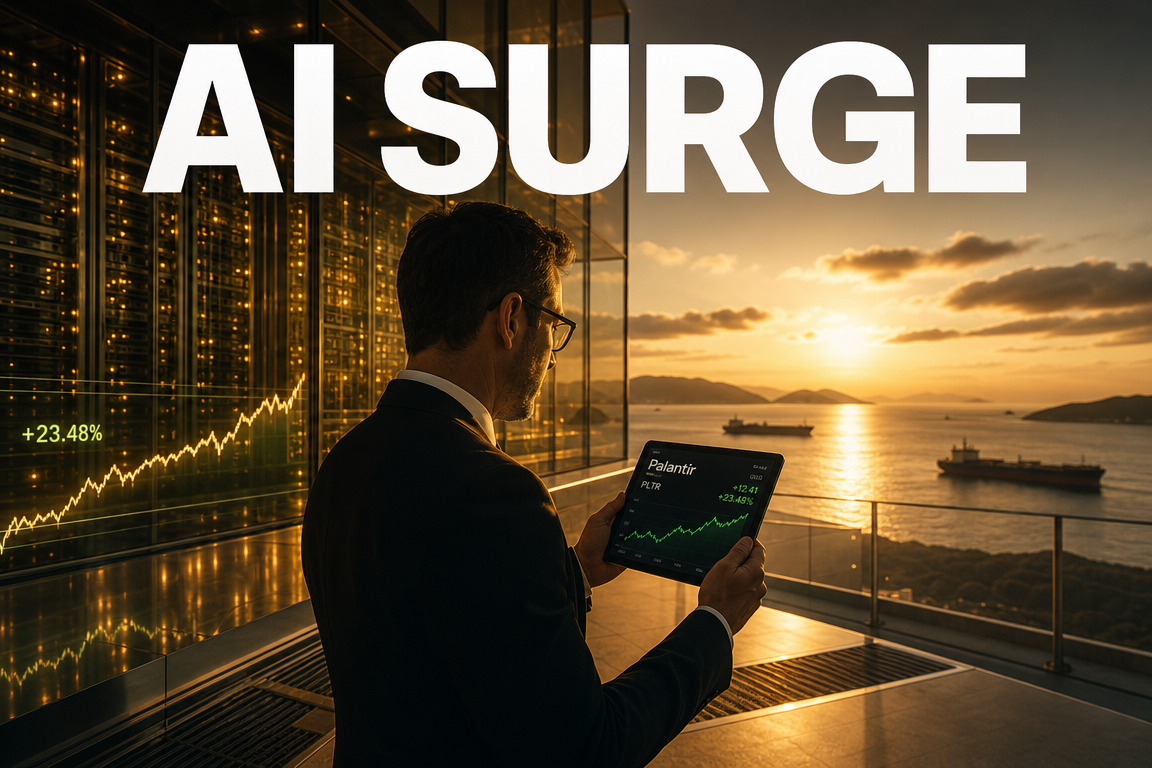
5. Palantir Up 26%: Repricing From Government Contractor to Commercial AI Platform
Palantir rose by about 26% on the day.
The main reason was a significant earnings beat.
Revenue grew about 93% year over year.
Guidance was also interpreted as roughly 10% above market expectations.
A key point was U.S. commercial revenue.
Palantir’s U.S. commercial revenue grew about 149% year over year.
Historically, Palantir was viewed mainly as a government-contract company.
This result showed that the company is also expanding rapidly in the private-sector AI market.
CEO Alex Karp expressed strong confidence and dismissed consensus-based expectations.
He also indicated that the company expects strong growth to continue for at least the next 18 months.
For the market, this supported the view that Palantir is not simply a software company, but a platform that helps enterprises operationalize AI.
6. Open-Weight Model Expansion May Support Palantir
Palantir does not build its own frontier large language model.
For that reason, some investors previously questioned whether it could be disadvantaged in the model race.
However, the market may now view broader adoption of open-weight models as a positive for Palantir.
Open-weight models are AI models that can be downloaded, installed, and operated by users.
The rapid spread of Chinese open-weight models has lowered AI model costs.
Lower model costs reduce enterprise adoption costs.
For Palantir, cheaper models may allow it to deliver solutions more efficiently, which could support margin improvement.
In simple terms, Palantir is less a model-builder and more a company that integrates AI into enterprise workflows.
As model prices decline, its use cases may expand further.
7. Why Caterpillar’s Results Matter for AI Data Centers
Caterpillar was another notable name in this move.
It is generally known for excavators, bulldozers, and industrial machinery.
Recently, however, it has also been revalued in connection with data center power demand.
AI data centers require substantial electricity.
When grid power is insufficient, data centers need backup and supplemental power solutions.
That can increase demand for diesel engines and large industrial power equipment.
Caterpillar’s data center-related engine demand improved, and its guidance was raised, leading the market to conclude that AI data center investment remains active.
This is an important point.
The AI investment cycle is no longer only about GPUs.
It now includes power, cooling, generators, industrial equipment, real estate, leasing structures, and semiconductor design.
8. Anthropic’s Compute Contract: Demand Is Strong Enough to Require More Infrastructure
Anthropic has become one of the most closely watched companies in the AI sector.
User growth and enterprise demand for Claude have been increasing rapidly.
The issue is that stronger model usage requires more compute resources and more data center capacity.
Anthropic secured additional compute contracts to expand infrastructure access.
The original report mentioned a contract with a startup called Volta.
The key point is that Anthropic is using external contracts to meet compute demand that may be too large to fund internally.
This reflects not weak demand, but demand that is strong enough to force continued infrastructure expansion.
9. Google, Broadcom, and Anthropic: TPU and Leasing Guarantees in a Complex Structure
One of the most complex but important developments involves the data center and compute arrangement among Google, Broadcom, and Anthropic.
In simple terms, Anthropic needs data center capacity and chips to run its AI services.
But data centers and AI chips are expensive.
If Anthropic cannot buy all the necessary infrastructure outright, it needs a leasing structure.
That creates a financing question.
If Anthropic cannot meet lease obligations, who bears the risk?
This is where Google and Broadcom reportedly step in as guarantors.
Google’s role is linked to TPUs.
Google needs to expand the TPU ecosystem by selling or deploying its own AI chips.
If Anthropic uses Google TPUs, that supports the TPU platform.
Broadcom is involved because it works with Google on TPU development and supply.
In that sense, Broadcom is a key partner in Google’s TPU supply chain.
That is why it is interpreted as participating in guarantees related to data center leasing or chip usage.
10. Why the Market Views This Contract Positively
From a positive perspective, the arrangement signals that AI demand remains very strong.
Anthropic’s use of such a complex structure to secure compute resources suggests robust demand.
Google can benefit from TPU adoption and ecosystem expansion.
Broadcom may benefit from TPU-related design and supply-chain exposure.
Broadcom’s shares rose about 5%.
Google also moved modestly higher.
The market reaction was initially constructive.
If AI infrastructure spending continues, the beneficiaries could expand to Broadcom, Micron, SK Hynix, data center equipment suppliers, and power infrastructure companies.
11. The Hidden Risk: Circular Structures and Balance Sheet Exposure
There are also risks.
A structure in which Google and Broadcom guarantee Anthropic’s lease obligations can be viewed as a complex financial linkage.
It may imply that AI expansion is not being funded solely through direct cash generation, but also through supplier and partner support.
If such arrangements become excessive, they can create risks that are not immediately visible on the balance sheet.
In other words, investors should distinguish between genuine end demand and demand supported by supplier financing.
AI growth is real, but not every contract reflects healthy cash-flow-driven demand.
Long-term investors should pay close attention to this point.
12. The Most Important Point Not Emphasized in Other Coverage
The true significance of this U.S. record high is that AI has moved from software-driven expectations to an infrastructure-driven competition.
Many market participants still view AI primarily through names such as Nvidia, ChatGPT, Claude, and Palantir.
In reality, capital is moving across a much wider set of assets and industries.
- AI semiconductors: rising demand for GPUs, TPUs, ASICs, and HBM
- Data centers: higher demand for land, servers, cooling, and power contracts
- Power infrastructure: generators, transformers, transmission grids, and backup power
- Financial structures: leasing, guarantees, long-term contracts, and supplier financing
- Enterprise AI platforms: companies like Palantir that connect AI to real business workflows
The key question is whether AI companies’ revenue growth can keep pace with the speed of AI infrastructure investment.
At present, the market is betting that demand remains strong.
Over time, investors are likely to ask whether end users are truly bearing the cost of these data centers and chips, or whether suppliers are effectively creating the demand.
For that reason, this rally should not be assessed only through stock price performance.
Investors should also monitor AI data center structures, cash flow, guarantee exposure, power bottlenecks, and Treasury yield trends.
13. Implications for Korean Equities and KOSPI
Strength in U.S. equities could continue to support Korean markets.
This is particularly important in KOSPI, where semiconductors carry a large weighting.
Micron’s 6% gain and SK Hynix ADR’s 6% gain are constructive for Korean semiconductor sentiment.
If AI data center investment continues, HBM, memory semiconductors, server DRAM, and high-performance SSD demand may also draw attention.
For SK Hynix, the ADR listing had reportedly limited certain shareholder-return comments for a period.
According to the original report, those restrictions may be lifted after 1:00 p.m. Korea time on August 5.
As a result, the market may also focus on future commentary related to shareholder returns.
That said, semiconductor shares often discount expectations in advance.
Investors should continue to track earnings, HBM supply agreements, customer demand, memory pricing, exchange rates, and U.S. Treasury yields.
14. Variables Investors Should Monitor Now
- Formalization of a Strait of Hormuz agreement: whether an official deal is announced.
- Potential rebound in crude prices: higher oil could raise inflation and yield pressure.
- U.S. Treasury yield trends: directly affect technology valuations.
- Durability of Palantir’s growth: whether U.S. commercial revenue momentum continues.
- Quality of AI data center contracts: whether leasing and guarantee structures remain manageable.
- Broadcom and Google’s TPU ecosystem: whether alternatives to Nvidia continue to expand.
- Korean semiconductor benefit: whether SK Hynix, Samsung Electronics, and the HBM supply chain translate demand into earnings.
15. Caution on Impersonation Accounts and Investment Spam
The original report also warned about impersonation accounts and investment spam.
Fake accounts are increasingly using the names and images of well-known investment creators and financial YouTubers to send direct messages offering hot stock tips, free chat rooms, or private investment information.
Because profile pictures and usernames are often made to look similar, investors should be especially cautious.
Legitimate investors do not sell hot stock tips or pressure users into paid groups through direct messages.
Suspicious accounts should be reported immediately, and no funds or personal information should be shared.
Scams tend to increase when themes such as U.S. equities, KOSPI, and AI semiconductors become more volatile.
< Summary >
U.S. equities recorded strong gains, with the Nasdaq rising sharply and the S&P 500 reaching a record high.
The first driver was easing Strait of Hormuz risk and the resulting decline in crude oil prices.
Lower oil prices reduced inflation pressure and supported technology stocks through lower Treasury yields.
The second driver was confirmation of AI demand through Palantir’s results, Caterpillar’s data center-related demand, Anthropic’s compute contract, and Google-Broadcom-TPU arrangements.
The most important point is that AI investment is expanding beyond semiconductors into data centers, power, industrial equipment, and lease-guarantee structures.
For Korean equities, investors should watch KOSPI, SK Hynix, Micron, and the HBM-related semiconductor cycle.
However, because AI data center contracts are increasingly structured through complex financing arrangements, investors should also monitor cash flow and guarantee risk.
[Related Articles…]
- AI Semiconductor Cycle and Data Center Demand Outlook
- Crude Oil Decline and the Link to U.S. Stock Record Highs
*Source: [ 내일은 투자왕 – 김단테 ]
– 미국증시 신고가의 비밀
● AI-Driven, Market-Shock, Palantir-Surges, AMD-Earnings, Oil-Drops
Palantir raises guidance by a record margin; AMD, SpaceX earnings ahead… key variables for the AI chip rally and U.S. equities
Today’s market focus is not simply that semiconductors advanced.
The key items to connect are Palantir’s record guidance increase, Caterpillar’s AI data-center power exposure, the AI chip rally ahead of AMD earnings, the lockup overhang at SpaceX, and the reported draft framework for a U.S.-Iran agreement referenced by Qatar.
A point that can be overlooked in other coverage is that AI investment is expanding beyond software into construction equipment, power generation, networking hardware, and energy infrastructure.
This trend could affect U.S. equities, the Nasdaq, crude oil, interest rates, and inflation expectations at the same time.
1. New York market trend: semiconductors regained leadership
U.S. equities opened with strong semiconductor-led gains.
Unlike the previous session, when large-cap tech led the market, names such as Nvidia, Broadcom, Micron, AMD, Intel, and Texas Instruments all moved higher.
AMD was especially strong ahead of its post-close earnings release, as expectations built around its results.
The market is viewing AMD’s report as a gauge of whether AI chip demand remains intact.
- Nvidia: renewed strength as the leading AI chip stock
- Broadcom: supported by AI networking and custom chip expectations
- Micron: recovery expectations in memory demand
- AMD: key focus ahead of post-close earnings
- Intel: benefited from broader improvement in semiconductor sentiment
By contrast, some large-cap tech names that had rallied the previous day, including Alphabet, Meta, Amazon, Microsoft, and Apple, saw profit-taking.
Overall sentiment remained constructive, with a pattern that could be supportive for Korean equities, given their heavy semiconductor exposure.
2. Major indices: Nasdaq strength, Dow near record levels
Index performance was broadly firm.
S&P 500 futures traded higher, while Nasdaq 100 futures showed stronger momentum, reflecting technology and semiconductor strength.
Dow Jones futures also advanced, with the possibility of another record high after the prior session’s all-time peak.
| Category | Market tone | Key interpretation |
|---|---|---|
| S&P 500 | Higher | Improved risk appetite |
| Nasdaq 100 | Strong | Better sentiment for AI chips and technology |
| Dow Jones | Higher | Support from industrials and cyclicals |
| Russell 2000 | Higher | Some improvement in small-cap sentiment |
The market is currently showing both an “AI growth stock rally” and a “cyclical recovery” pattern.
That combination typically appears when risk appetite is improving.
3. Crude oil falls sharply after Qatar cites a draft U.S.-Iran understanding
Crude oil declined sharply during the session.
WTI fell into the $77 range per barrel, while Brent slipped below $80.
The main catalyst was Qatar’s comment that a draft short-term understanding between the United States and Iran had been prepared and was under review by both sides.
This is not a final agreement.
However, markets reacted to the possibility of reduced geopolitical tension in the Middle East.
- Renewed attention on the possibility of U.S.-Iran dialogue
- Qatar referred to a draft understanding
- Normalcy in the Strait of Hormuz remains unresolved
- Expectations of reduced Middle East risk weighed on oil
- Lower oil prices supported expectations for easing inflation
Lower crude prices can support U.S. equities by reducing inflation pressure and easing policy constraints on the Federal Reserve.
The key variable remains the Strait of Hormuz.
If conditions there do not normalize, oil prices could rebound quickly.
4. Palantir results: the key issue is 149% growth in commercial revenue
Palantir significantly exceeded expectations in its earnings release.
The stock rose sharply not only because revenue was strong.
The most important point was the company’s record increase in full-year revenue guidance.
Palantir raised its annual revenue outlook to about $8.15 billion, up by roughly $500 million from prior guidance.
This was the largest upward revision since the company went public.
| Item | Details | Market interpretation |
|---|---|---|
| Q2 revenue | $1.94 billion | Up 93% year over year |
| Full-year revenue outlook | Around $8.15 billion | Record guidance increase |
| U.S. government revenue | Up 90% | Core strength remains intact |
| Commercial revenue | Up 149% | Re-rating as an AI platform company |
Palantir initially grew as a data analytics company serving the U.S. government and defense agencies.
The more important point in this report is the rapid expansion in revenue from commercial customers.
Companies are increasingly building generative AI systems on top of their own data.
Palantir is increasingly positioned as an enterprise AI platform within that transition.
CEO Alex Karp said the company has delivered in 90 days what other firms would take more than a year to accomplish.
He also indicated that the current growth trajectory could continue for another 18 months.
5. Caterpillar earnings surprise: AI data centers are lifting industrial demand
Caterpillar reported results well above expectations.
Second-quarter revenue reached $20.5 billion, above the consensus estimate of $19.3 billion.
This was the first time quarterly revenue exceeded $20 billion.
The most notable areas were construction equipment and power and energy.
- North America construction equipment revenue: up 50%
- Overall construction segment revenue: up 35%
- Construction segment operating profit: up 57%
- Power and energy revenue: up 17%
- Higher demand for large generators and gas turbines for AI data centers
The key point is that Caterpillar may increasingly be viewed as an AI beneficiary.
AI data centers require more than chips.
They also require power systems, generators, cooling equipment, construction machinery, transformers, and transmission infrastructure.
Caterpillar’s results indicate that AI investment is moving beyond digital infrastructure into physical infrastructure spending.
6. McDonald’s results: consumer recovery remains limited in a high-cost environment
McDonald’s reported second-quarter earnings that were better than expected.
Adjusted EPS came in at $3.38, above the consensus estimate of $3.32.
Revenue reached $7.1 billion, up 3.7% year over year, but slightly below the $7.13 billion estimate.
The main area of focus was comparable sales.
- Global comparable sales: up 1.3%
- U.S. comparable sales: up 0.8%
- Discount menu and value strategy showed some effect
- Concerns remain about weaker spending among lower-income consumers
McDonald’s faced customer attrition among lower-income households in 2024 and early 2025 due to higher menu prices.
The company has been leaning more heavily on discounts and value offers to support traffic.
This report is positive, but it is still too early to call it a broad consumer recovery signal.
7. Toyota results: weaker yen and hybrid demand offset tariff pressure
Toyota also reported results ahead of expectations.
The company raised its full-year operating profit forecast to 3.4 trillion yen.
It also announced a share buyback plan of up to 1 trillion yen.
| Item | Details | Interpretation |
|---|---|---|
| Q1 revenue | 13.5 trillion yen | Above expectations |
| Net income | 1.48 trillion yen | About 40% above consensus |
| Operating profit | Down 9% year over year | Reflects tariff and logistics pressure |
| Share buyback | Up to 1 trillion yen | Stronger shareholder returns |
Toyota managed to offset U.S. tariff pressure and higher Middle East logistics costs through a weaker yen and strong hybrid sales.
A weaker yen supports the pricing competitiveness of Japanese exporters.
However, the impact of the Kumamoto earthquake has not yet been incorporated into the outlook, leaving some downside risk.
8. Pfizer results: post-COVID growth drivers are oncology and cardiovascular drugs
Pfizer reported second-quarter results that exceeded expectations.
Adjusted EPS was 77 cents, above the consensus estimate of 68 cents.
Revenue also exceeded expectations at $15 billion.
The company raised its full-year revenue outlook as well.
After heavy dependence on COVID-19 products in the past, growth is now being led by oncology and cardiovascular treatments.
- Strong sales of blood thinner Eliquis
- Growth in oncology revenue
- Growth in a treatment for a nerve-related condition
- Plan to cut costs by $9.7 billion through 2029
Healthcare can act as a defensive sector during periods of growth uncertainty.
Pfizer’s improvement is meaningful as it reflects progress in the company’s post-COVID portfolio transition.
9. AMD earnings ahead: the real test for the AI chip rally
Today’s most important event is AMD’s post-close earnings release.
AMD produces both CPUs and GPUs.
The market expects quarterly revenue of about $11.3 billion and EPS of $1.62.
The key focus is the AI data-center business.
The market is looking for a more than doubling in AI data-center revenue.
- Expanded AI data-center investment from Microsoft, Amazon, and Google
- Higher demand for server CPUs
- Higher demand for AI GPUs
- Launch of the Helios next-generation AI data-center platform
- Management commentary on competition with Nvidia will be important
By contrast, PC chips and gaming may have remained relatively weak.
For investors, the main issue is not the quarter itself, but the outlook for AI chip demand.
A strong AI demand outlook from AMD could provide additional support for the broader semiconductor sector.
A weaker outlook could trigger short-term profit-taking.
10. SpaceX earnings: AI, Starlink, and the lockup matter more than the numbers
SpaceX is also set to report earnings after the close.
This is described as the company’s first earnings release since listing, which has drawn considerable attention.
Although SpaceX is an aerospace company, it is drawing interest alongside the semiconductor market because of Elon Musk’s AI ecosystem.
xAI, the Grok AI chatbot, and large-scale AI data-center plans are all linked to demand for AI chips.
As AI data centers expand, benefits may extend beyond Nvidia, AMD, Broadcom, and Micron to networking hardware, power equipment, and cooling infrastructure companies.
11. Three things SpaceX investors should watch
Bloomberg highlighted three main points.
- First, the initial earnings release may raise more questions than it answers.
SpaceX continues to invest heavily in AI data centers, Starlink, and rockets, making it difficult to value the business on near-term profitability alone. - Second, a major lockup expiration is scheduled two days after the earnings release.
On August 6, about 910 million shares, worth more than $100 billion, could become eligible for sale. - Third, the market may care more about management’s growth roadmap than the earnings figures.
The key issue is how quickly AI, Starlink, and rocket businesses can be monetized.
SpaceX shares rose sharply after the IPO but have since declined materially.
The issue price was $135, the stock once reached $225, and it is now cited around $114.
The key question is whether the earnings release can support a rebound or whether the lockup overhang will weigh more heavily.
12. SpaceX lockup expiration: the main source of short-term pressure
A lockup prevents early investors and employees from selling shares immediately after listing.
A 180-day lockup is standard in many U.S. IPOs.
SpaceX is also described as having a phased lockup expiration structure.
| Timing | Details | Market impact |
|---|---|---|
| August 6 | About 910 million shares may be released | Short-term supply pressure |
| After Q3 earnings | Additional shares, about 28%, may be released | Ongoing supply pressure |
| 180 days after listing | Most remaining lockup shares may be released | Expanded float through year-end |
Elon Musk’s stake is not included in this lockup expiration, according to the report.
Musk is said to hold about 42% of the company, with a separate 366-day lockup period.
He also holds roughly 80% of voting power through Class B shares.
In the near term, the focus is not on Musk selling, but on the amount of shares from early investors and employees that may enter the market.
13. Arista Networks: a key indicator of AI data-center investment
Arista Networks is another important company for assessing AI infrastructure spending.
Arista provides high-speed networking equipment that connects servers and GPUs inside AI data centers.
If Nvidia and AMD supply the AI chips, Arista provides the network layer that enables those chips to exchange data efficiently.
Arista’s earnings therefore serve as a measure of whether Big Tech’s AI data-center investment continues to expand.
When evaluating the AI chip rally, chips alone do not tell the full story.
Investors also need to watch networking, power, cooling, and construction infrastructure companies to understand the depth of the cycle.
14. Coupang earnings: growth recovery matters more than the loss
Coupang, as a U.S.-listed company, also reports in line with the New York earnings calendar.
The market already expects a loss this quarter.
There is also an expectation that losses could widen because of a roughly KRW 620 billion penalty related to a data breach.
However, the real issue for investors is whether growth is reaccelerating.
- Q1 revenue growth slowed to 8%
- First single-digit growth rate since the IPO
- Q2 constant-currency growth may improve to 9% to 10%
- Recovery in active customer spending per user is important
- Need to confirm whether customer trust is recovering after the data breach
For Coupang, the larger concern is growth deceleration rather than the reported loss itself.
The key question is whether revenue growth can return close to double digits.
15. Renewed yen weakness: monetary policy matters more than FX intervention
The Japanese yen strengthened briefly on expectations of coordinated intervention by the United States and Japan, but returned to a weaker trend the next day.
Markets increasingly believe that intervention alone cannot prevent yen weakness over the long term.
The weak outcome of Japan’s 10-year government bond auction was especially important.
The government issued bonds, but investor demand was weaker than expected.
- The bid-to-cover ratio for Japan’s 10-year bonds was only 2.56x
- Well below the usual level of around 3.3x
- Seen as the weakest level since last year
- Bond prices fell and yields rose
- The yen weakened again
ZeroHedge described the auction as extremely poor.
In simple terms, the government offered bonds and the market did not absorb them strongly.
Weak demand for Japanese government bonds indicates that investors have less confidence in Japanese rates and the yen.
16. Wall Street Journal analysis: sustaining the yen will require action by the Bank of Japan
The Wall Street Journal also argued that a joint currency intervention alone is unlikely to sustain a stronger yen.
The key variable is the Bank of Japan’s rate policy.
Current short-term U.S. rates are about 2.5 percentage points above Japan’s.
For investors, holding higher-yielding U.S. assets is more attractive.
Without confidence that the Bank of Japan will raise rates, there is limited reason to hold yen over the long term.
In effect, yen weakness and the weak bond auction point to the same conclusion.
Government intervention alone is insufficient; the Bank of Japan must use rate policy to restore credibility.
17. The most important underlying theme in today’s market
The headline items are “Palantir’s surge, Caterpillar’s strong results, AMD expectations, and lower oil prices.”
The deeper theme is that the AI investment cycle is broadening.
It began with AI chip leaders such as Nvidia.
It then expanded to software names such as Palantir.
It is now extending to construction equipment and power infrastructure companies such as Caterpillar.
The AI cycle may expand in the following sequence:
- AI semiconductors: Nvidia, AMD, Broadcom, Micron
- AI servers and networking: Arista Networks and others
- AI software platforms: Palantir and others
- AI data-center power infrastructure: generators, gas turbines, transformers
- AI data-center construction infrastructure: Caterpillar and other industrials
- Energy and materials: longer-term benefit from rising power demand
In other words, the current AI rally is evolving from a theme into a capital expenditure cycle.
If this continues, market leadership in U.S. equities could broaden from semiconductors to industrials, energy infrastructure, and power equipment.
18. Key variables for investors to monitor
- AMD guidance
AI data-center growth and forward demand expectations could determine the direction of the semiconductor rally. - SpaceX conference call
The growth roadmap for AI, Starlink, and rockets may matter more than reported earnings. - SpaceX lockup expiration
A large increase in float could weigh on the stock. - Crude oil
U.S.-Iran negotiations and the Strait of Hormuz remain important for inflation and rates. - Japanese yen and bond market
Changes in Bank of Japan policy could influence global capital flows. - Palantir commercial growth
A key indicator of whether enterprise AI adoption is converting into revenue.
< Summary >
U.S. equities were led higher by semiconductors.
Palantir surged after record guidance increases and 149% growth in commercial revenue.
Caterpillar posted an earnings beat supported by construction equipment demand and AI data-center power needs.
AMD’s earnings are the key event for determining whether the AI chip rally can continue.
For SpaceX, the outlook for AI, Starlink, and the lockup overhang matter more than the first earnings release.
Crude oil declined after Qatar referred to a draft U.S.-Iran understanding, easing inflation and rate concerns.
The Japanese yen weakened again, and the weak bond auction reinforced the view that Bank of Japan policy matters more than FX intervention.
The most important conclusion is that AI investment is broadening beyond chips into software, networking, power, and construction equipment.
[Related Articles…]
- AI Semiconductor Cycle and Data Center Infrastructure Outlook
- Yen Weakness and the Impact of Japan’s Monetary Policy on Global Markets
*Source: [ Maeil Business Newspaper ]
– 팔란티어, 역대 최대 전망 상향…주가 15% 급등ㅣ캐터필러 어닝 서프라이즈ㅣ카타르 “미·이란 합의 초안 마련”ㅣ엔화 다시 약세…日 국채 입찰도 부진ㅣ홍혜진의 뉴욕브리핑