● Starlink Shakes Telecoms, SpaceX Spends Big, Tesla Eyes Boost
SpaceX Earnings Call Key Takeaways: Starlink Mobile Toward 2027 Commercialization, AI Infrastructure Capex Pressure, and the Real Implications for Tesla Shareholders
The key issue here is not simply that SpaceX reported strong earnings.
The core points are the potential expansion of Starlink Mobile into a standalone telecommunications service in 2027, the heavy capital expenditure burden tied to AI infrastructure investment, and how this may connect to Tesla’s stock performance and autonomous driving ecosystem.
According to the source material, SpaceX posted a double beat on both revenue and losses, yet the stock weakened in after-hours trading.
This aligns with a broader pattern in U.S. markets, where investors are focusing less on what companies earned today and more on how much they may need to spend going forward.
1. U.S. Market Backdrop: Lower Oil Prices and Rate-Cut Expectations Supported Risk Assets
According to the source, all three major U.S. indices advanced on the day.
The S&P 500 rose 1.79%, the Nasdaq gained 2.59%, and the Dow Jones Industrial Average increased 1.71%.
Tesla closed at $327.35, up 1.64%.
The market tone was supported by two main factors.
Oil Price Decline Improved Sentiment
First, crude oil prices fell sharply.
The U.S. Treasury Secretary’s comments on a potential agreement with Iran eased some supply concerns, leading to a broad decline in WTI and Brent prices.
Lower oil prices can reduce inflation pressure.
That can revive expectations for Federal Reserve rate cuts and support growth and technology stocks.
However, reports of attacks on vessels near the Strait of Hormuz indicate that geopolitical risk has not fully disappeared.
Signs of Cooling Labor Demand Reinforced Rate-Cut Expectations
Second, labor market data showed some moderation.
June job openings were reported at 7.359 million, below the consensus estimate of 7.454 million.
A decline in job openings suggests the labor market may be less overheated than expected.
For the Federal Reserve, that can indicate easing wage pressure and softer service-sector inflation.
As a result, lower oil prices, stronger rate-cut expectations, and a rebound in technology stocks combined to support risk appetite on the day.
2. SpaceX Results: Rapid Revenue Growth and a Much Smaller Loss Than Expected
According to the source, SpaceX reported its first quarterly results since going public.
That said, any investment decision should rely on official confirmation of SpaceX’s public status, filings, and reported figures.
The following is a structural analysis based on the provided source.
Key 2Q Results
Second-quarter revenue was reported at $7.814 billion.
That represented roughly 92% growth from $4.071 billion in the same period a year earlier.
The figure exceeded Wall Street consensus of $6.93 billion.
Net loss was reported at $541 million, improving sharply from a loss of $1.008 billion a year earlier.
Loss per share also came in better than market expectations.
Revenue beat estimates, while losses were smaller than expected, making the report clearly positive on a headline basis.
Starlink Business: Subscriber Growth and Enterprise and Government Revenue Are the Main Drivers
Connectivity revenue, or Starlink revenue, was reported at $4.291 billion.
That was up 66% year over year.
Starlink subscriber count reached 12.2 million, roughly doubling over the past year.
Average revenue per user remained around $66 per month.
The key point is that enterprise and government revenue is growing much faster than consumer revenue.
Enterprise and government revenue was described as up 108% year over year.
With more contracts from airlines, telecom operators, and government agencies, Starlink is expanding beyond consumer satellite internet into a broader B2B infrastructure business.
3. Starlink Mobile in 2027: Why It Is Pressuring Telecom Operators
The most closely watched item from the earnings call was Starlink Mobile.
SpaceX COO Gwynne Shotwell said the combined annual market size of Verizon, AT&T, and T-Mobile is about $600 billion.
She added that Starlink Mobile could capture part of that market.
This was not simply a product update, but a signal that could affect the economics of the incumbent telecom industry.
Why Telecom Stocks Reacted First
Although the earnings call was about SpaceX, the first market reaction was seen in telecom stocks.
According to the source, AT&T and Verizon both declined in after-hours trading.
The reason is clear.
If Starlink Mobile succeeds, it could weaken the exclusivity of terrestrial cell tower networks, which remain the main competitive advantage of traditional telecom operators.
In underserved areas such as mountains, oceans, deserts, and disaster zones, satellite-based connectivity can be a more effective alternative.
Starlink Mobile Is Not Yet a Full Substitute for Traditional Carriers
At present, Starlink Mobile is not yet in a position to fully replace Verizon, AT&T, or T-Mobile.
The current model is closer to a complementary service in partnership with T-Mobile.
It automatically switches to satellite connectivity when terrestrial signal is unavailable.
Speed was described at around 4 Mbps per user.
That is useful for messaging, location sharing, and emergency communication, but it remains limited relative to 5G data service.
Why 2027 Matters
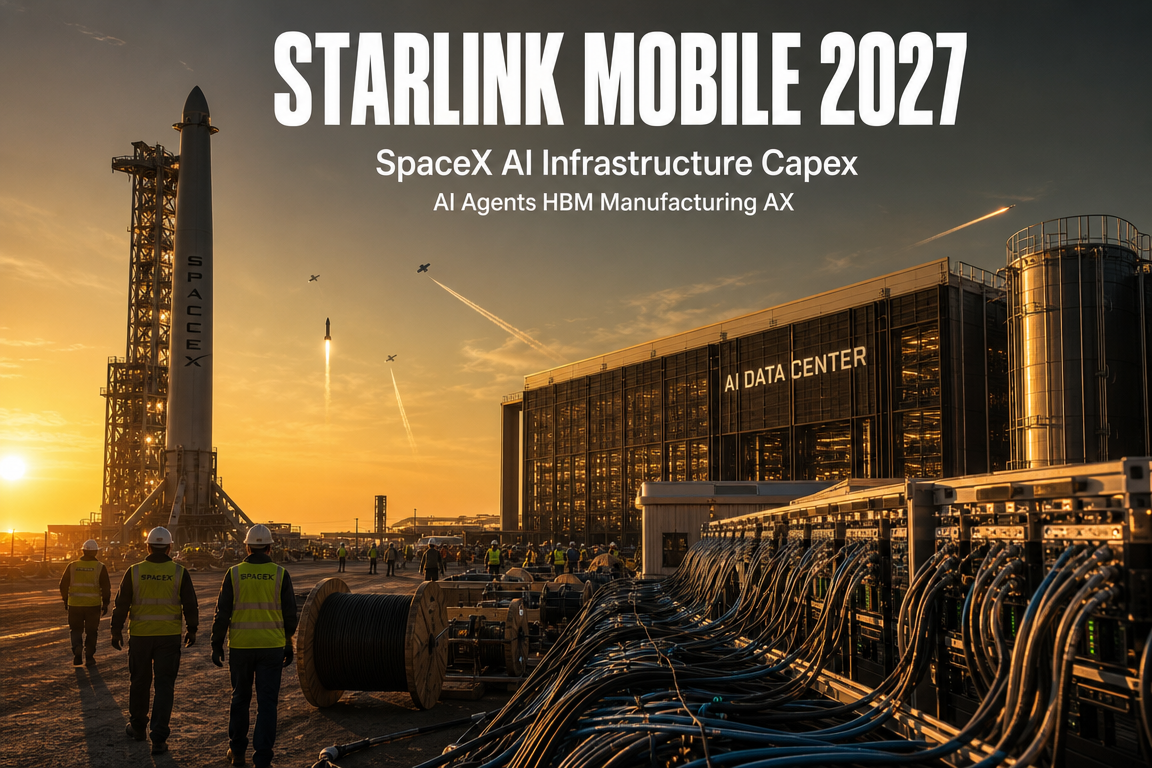
Shotwell said the company aims to provide the first customers with Starlink Mobile service by the end of next year and to launch satellites for a standalone service in 2027.
The key is the combination of next-generation satellites, Starship, spectrum access, and proprietary ground infrastructure.
The source also mentioned a target download speed of up to 150 Mbps.
If that performance can be achieved reliably, Starlink Mobile could become a genuine competitor in the mobile data market rather than only an emergency connectivity solution.
4. Could Starlink Mobile Become a Fourth Carrier in Korea?
The situation in Korea is different.
Even if Starlink Mobile challenges incumbent carriers in the United States, a similar model is less likely to develop in Korea.
Korea places significant restrictions on foreign carriers operating core telecom networks on a standalone basis.
Current Starlink satellite internet services in Korea are also more likely to enter through cooperation with local telecom operators.
As a result, if Starlink Mobile enters Korea, it is more likely to be a partnership-based service than an independent carrier competing directly with SK Telecom, KT, and LG Uplus.
For Korean Users, Roaming and Emergency Connectivity Are the More Realistic Implications
For Korean consumers, the more practical changes may come in roaming and emergency communications.
For frequent travelers, satellite-based connectivity could reduce reliance on country-specific SIM cards or roaming plans.
Satellite connectivity could also serve as a strong backup in mountain regions, at sea, or during emergencies when terrestrial networks fail.
In Korea, the more relevant impact is likely to be expanded coverage, improved roaming convenience, and stronger emergency communication infrastructure rather than disruption of local carriers.
5. Why the Stock Fell After Hours Despite Strong Results: The Issue Is AI Infrastructure Spending
SpaceX’s reported numbers were strong.
Yet the stock declined after hours.
The reason is that investors are focusing more on rising expenditures than on revenue growth.
Capex Is Far Larger Than Revenue
According to the source, SpaceX’s total second-quarter capital expenditure was $18.4 billion.
Of that amount, $15.828 billion was allocated to AI computer infrastructure.
That means the company is spending nearly twice its quarterly revenue on AI infrastructure alone.
That structure naturally raises several questions for investors.
When will this investment translate into revenue?
Can cash flow support this pace of spending?
Is AI infrastructure investment expanding too quickly?
Three Drivers Behind the AI Infrastructure Expansion
The first is the expansion of the Colossus AI infrastructure project.
This indicates a rapid buildout of data-center-scale infrastructure for large-scale AI computation.
The second is the cost tied to the acquisition of AI coding company Cursor.
The source referred to a $6 billion acquisition cost.
The third is the StarMind partnership with Nvidia.
The concept is to use Nvidia’s next-generation GPUs and CPUs to run data-center-class computation in orbit rather than on the ground.
What StarMind Represents: Moving Data Centers into Space
StarMind is essentially a plan to move server infrastructure into space.
Terrestrial data centers face constraints related to power, cooling, land, and regulation.
SpaceX is trying to bypass these limitations by combining its own rockets, satellites, AI chips, and space infrastructure.
If successful, this could create a fundamentally different competitive position in the AI infrastructure market.
For investors, however, the immediate issue is that the expense appears first in the financial statements.
The bill arrives now, while revenue may not scale meaningfully for several years.
6. AMD and SpaceX Share a Similar Pattern: Expectations Matter More Than Results
The source also referenced AMD.
AMD beat second-quarter revenue and EPS estimates and gave strong third-quarter guidance.
Even so, its stock declined in after-hours trading.
The reason was valuation pressure in AI-related stocks.
In the current market, strong results alone are not enough for AI names.
Because the market has already priced in significant growth, it is difficult to exceed investor expectations by a wide margin.
SpaceX faces a similar dynamic.
The story around Starlink growth, AI expansion, government contracts, and satellite infrastructure remains compelling, but if expectations are already very high, profit-taking after the announcement is possible.
7. Lockup Expiration Risk: Supply Pressure Can Move the Stock More Than Earnings
Another important variable in the source is the lockup expiration.
When a lockup period ends, pre-existing shareholders who were restricted from selling may be allowed to bring shares to market, potentially creating large supply pressure.
According to the source, about 20% of outstanding shares were subject to lockup expiration.
At that scale, even strong earnings may not be enough to offset near-term supply concerns.
Why Thursday’s Trading Matters
There are three things to watch when the lockup expires.
First, whether meaningful selling pressure actually appears.
Second, whether short sellers maintain positions or take profits.
Third, whether the company announces any additional large-scale capital spending plans.
If AI infrastructure spending and lockup supply pressure coincide, short-term volatility is likely to increase.
8. Why Tesla Shareholders Should Pay Attention to SpaceX News
For Tesla shareholders, SpaceX matters not only because Elon Musk leads both companies.
The two companies are becoming more closely linked at the technology ecosystem level.
Potential Link Between Starlink and Tesla Autonomous Driving
The source noted that recent Cybercab interiors appear to include Starlink satellite technology.
As robotaxis, autonomous driving, and in-vehicle AI services become more advanced, stable connectivity becomes increasingly important.
In urban areas, 5G or Wi-Fi-based connectivity is available, but Starlink can serve as a backup infrastructure in suburban or low-coverage regions.
Over the long term, if Tesla vehicles offer Starlink-based connectivity as an option, this could also affect Tesla’s service revenue model.
There Is Also a Link on the AI Infrastructure Side
Tesla needs substantial AI compute capacity for FSD, Optimus, and robotaxi development.
If SpaceX expands AI infrastructure and satellite-based computing, the broader Musk ecosystem could become stronger in AI capabilities over time.
That said, Tesla and SpaceX remain separate companies with distinct financial structures.
Still, investors often assess both companies together when evaluating the broader technology narrative.
This is especially true when Tesla is trading more on autonomous driving, AI, and robotics expectations than on vehicle sales alone.
9. The Real Point That Is Often Overlooked in Other Coverage
Many reports will likely summarize this event as either “Starlink is challenging telecom operators” or “SpaceX delivered strong earnings.”
However, the more important points are different.
Key Point 1. Starlink Mobile Is Primarily a Bundling Strategy, Not Just a Telecom Product
The reason Starlink Mobile matters is not simply a phone plan.
The key is the ability to bundle home internet, aircraft connectivity, maritime communications, military communications, and mobile connectivity into one network.
Traditional telecom operators are built around regional spectrum and cell tower assets.
By contrast, Starlink can use a global satellite network to bundle internet and mobile services on a much broader scale.
If this model matures, it could change the way telecom pricing and competition work.
Key Point 2. AI Infrastructure Spending May Be a Barrier to Entry, Not Just a Cost
In the short term, AI infrastructure spending weighs on the stock.
But over the long term, it may become a barrier that late entrants cannot easily match.
Few companies can simultaneously manage rocket launch capability, satellite manufacturing, spectrum access, Nvidia chip procurement, and AI data-center operations.
If these investments eventually translate into revenue, today’s costs could become the foundation of future market power.
Key Point 3. The Main Constraint Is Regulation and Spectrum, Not Technology Alone
For Starlink Mobile to become a global telecom platform, technology alone is not enough.
The company must still navigate telecom regulation, spectrum approvals, security reviews, and the interests of incumbent carriers in each market.
In Korea, Europe, and India, where telecom regulation is relatively strict, partnership with local operators is more realistic than independent market entry.
As a result, investors should pay as much attention to regulatory approvals as to technical announcements.
Key Point 4. For Tesla, the Long-Term Ecosystem Effect Matters More Than Short-Term Stock Moves
When Tesla shareholders look at SpaceX news, they should avoid focusing only on near-term stock correlation.
The more important issue is whether Tesla can secure stable connectivity infrastructure for autonomous driving, robotaxi operations, and in-vehicle AI services.
If Starlink improves vehicle connectivity, Tesla could evolve from a vehicle manufacturer into a mobile AI platform.
10. Key Items Investors Should Monitor
The first item to watch is the actual commercialization timeline for Starlink Mobile.
Investors should verify whether the 2027 standalone service plan is supported by satellite launches, spectrum access, and carrier partnerships.
The second item is the pace of revenue recovery relative to AI infrastructure spending.
As capex continues to rise, the key question is how quickly ARR and cloud-related revenue can catch up.
The third item is dependence on Nvidia.
Large-scale adoption of Nvidia GPUs and CPUs improves performance, but it also increases cost and supply-chain risk.
The fourth item is post-lockup market supply.
If actual selling is limited, the stock may stabilize, but large-scale selling could increase short-term volatility.
The fifth item is the technological connection with Tesla.
Investors should monitor how Starlink may be used in Cybercab, robotaxi, FSD, and vehicle connectivity.
[Related Articles…]
- Starlink Satellite Internet and the Reshaping of Global Telecom Markets
- Tesla Autonomous Driving and AI Infrastructure Outlook
*Source: [ 오늘의 테슬라 뉴스 ]
– SpaceX 어닝콜, 스타링크 모바일 2027 시작! — 시간외 주가는 딴 이유로 빠졌나? $327 테슬라 주주는?
● AI Agents Supercharge Samsung SK Hynix HBM War
AI Agents Reshape the Future of Samsung Electronics and SK Hynix: HBM, Semiconductor Design, and Manufacturing AX Strategy
The future competition in semiconductors will no longer be decided only by who has the better factory.
The key question is increasingly who can secure more capable AI agents and automate design, process control, supply chain, finance, and HR.
For memory semiconductor companies such as Samsung Electronics and SK Hynix, the rise in HBM demand creates an opportunity, but it also places them in a broader competition around AI-enabled design automation and manufacturing AX transformation.
The central issue is not a chatbot.
It is an AI agent that can plan, analyze data, execute tools, and improve results once given a goal.
This report summarizes why this shift matters from the perspective of HBM, AI agents, the semiconductor industry, manufacturing automation, and the global economic outlook.
1. Key Development: Semiconductor Competitiveness Is Increasingly Determined by AI Agent Capability
- First, AI agents are becoming the operational core of manufacturing AX.
Traditional AI answered questions. AI agents receive objectives and perform tasks autonomously.
They can be applied across semiconductor design, process optimization, testing, supply chain management, and financial operations. - Second, the industry is moving from human task division to agent task division.
In the past, work was distributed across large teams. Going forward, companies with 100 AI agents may operate with far greater speed.
Human roles are likely to shift from direct execution of repetitive tasks to managing and validating agents. - Third, HBM competition is shifting from production volume to design automation.
Starting with HBM4, custom HBM competition will intensify as base die designs differ by GPU vendor.
As customers expand beyond Nvidia to Google TPU, AMD, and in-house AI chip developers, HBM design complexity will rise sharply. - Fourth, AI agents can directly affect semiconductor yield and development cycle time.
Semiconductor manufacturing consists of hundreds to thousands of process steps.
If AI agents analyze and optimize this data, productivity, yield, and cost structure can change materially.
2. What an AI Agent Is: Industrial AI That Differs Fundamentally from a Chatbot
An AI agent is not simply a question-answering chatbot.
When a user says, “Design the semiconductor,” “Optimize the process conditions,” or “Identify the production line issue,” the agent creates its own plan.
It then runs the necessary software tools, reads data, performs simulations, organizes results, and reports back to the human operator.
- Planning
The AI agent determines the task sequence after receiving a goal. - Memory retention
It stores prior work experience, design data, process logs, and failure cases. - Tool use
It can operate semiconductor design software, simulation engines, factory automation equipment, robots, and databases. - Autonomous execution
It can continue work and make intermediate judgments without constant human direction. - Iterative learning
It improves subsequent work based on prior results.
The key point is autonomy.
In manufacturing AX, AI transformation is not about attaching a chatbot to a factory.
It requires AI agents to connect sensors, equipment, data, software, and robots and perform actual operational tasks.
3. Why the Semiconductor Industry Is Particularly Suitable for AI Agent Adoption
The semiconductor industry is one of the sectors where AI agents can be most effective.
The reason is the exceptionally high data density.
- Semiconductor manufacturing produces large volumes of data.
Etching, lithography, deposition, CMP, packaging, and testing are all supported by sensors and logging systems.
Equipment temperature, pressure, current, time, defect rates, and process conditions are continuously recorded. - The data is relatively structured.
Manufacturing data is stored in consistent formats, which makes it suitable for AI learning.
Compared with financial or consumer behavior data, process data has clearer variables and outcomes. - The optimization impact is significant.
In semiconductors, a 1% change in yield can materially affect earnings.
Even small process improvements from AI agents can influence operating margin and global competitiveness. - Complexity is already beyond human limits.
HBM, 3D packaging, AI chips, and advanced foundry processes involve intertwined electrical, thermal, power, and mechanical factors.
AI agents can explore these problems faster than multiple doctoral-level engineers working sequentially.
4. Why It Matters for Samsung Electronics and SK Hynix: The Next Stage of HBM Competition
HBM is currently one of the most important products in the AI investment cycle.
Nvidia GPUs, Google TPUs, and AMD AI accelerators require very high memory bandwidth.
As a result, HBM competition between SK Hynix and Samsung Electronics has become a key variable in the global economic outlook.
- HBM is a core bottleneck in AI infrastructure.
As large-scale AI models expand, GPU compute alone is insufficient.
Memory capacity and speed have become equally important as model size, input tokens, and KV cache expand. - Custom competition intensifies starting with HBM4.
In HBM4, base die designs vary according to GPU vendor requirements.
As the market expands beyond Nvidia to Google, AMD, and custom AI chip developers, customer-specific HBM design becomes a core competitive factor. - With HBM5, the boundary between memory and compute may narrow further.
If some compute functions move into the HBM stack, it may become more than a memory device.
In that case, power, heat, cooling, and signal quality become significantly more complex. - Companies that reduce design cycle time will gain market share.
AI semiconductor markets are speed-driven.
Firms that can design, verify, and produce customized HBM faster will be better positioned in supply negotiations.
For Samsung Electronics and SK Hynix, the future is no longer defined only by how well they produce HBM.
The more important variable may be how quickly they automate HBM design and manufacturing through AI agents.
5. Why HBM Design Is Difficult: Five Interdependent Factors Must Be Solved at Once
HBM design is not simply a matter of stacking DRAM layers.
Electrical signaling, power delivery, grounding stability, thermal management, and AI optimization must all be considered simultaneously.
- Signal Integrity
Data signals must travel quickly without degradation.
Since HBM moves data vertically through TSV channels, signal quality management is critical. - Power Integrity
Stable power delivery is required for high-speed computing and data movement.
If the power network becomes unstable, noise can rise and performance may deteriorate. - Ground Integrity
Weak grounding reduces circuit reliability.
In high-performance semiconductors, even small instability can create major issues. - Thermal Integrity
HBM is difficult to cool because of its stacked structure.
This becomes even more important if HBM5 incorporates additional compute functions. - Artificial Intelligence
AI agents must analyze and optimize the complex mix of design variables and simulation results.
Tasks that once required repeated manual work can now be performed continuously.
Solving these five factors simultaneously requires expertise in electrical engineering, mechanical engineering, computer science, and semiconductor process technology.
This is why AI agents are becoming important in semiconductor design.
6. Practical Application: Entering an Era Where Semiconductor Design Can Be Directed Through Telegram
A notable example from Professor Kim Jung-ho’s research lab is the connection of AI agents to actual semiconductor design workflows.
When a user requests through Telegram, “Calculate PDN impedance,” “Evaluate the simulation results,” or “Show the eye diagram,” the AI agent executes the design tools.
- PDN impedance analysis
It evaluates the stability of the HBM power network by frequency.
A high peak in the graph indicates greater noise, while a lower profile suggests more stable power delivery. - Eye diagram analysis
It visually assesses signal quality.
A wider opening in the center indicates cleaner signal transmission. - Thermal pathway optimization
The AI can place and simulate structures that remove heat, not only TSVs.
Multiple agents can perform work in parallel that would take a human team days. - Report generation
It can organize design and simulation results into formal reports.
This can be extended to topic selection for research, report writing, and data analysis.
The key point is that the AI agent does not merely answer questions; it executes design software.
In other words, AI is moving from talking to doing.
7. The True Scope of Manufacturing AX: Factory Automation Is Only Part of the Picture
Many discussions of manufacturing AX focus only on factory automation.
However, from a company-wide perspective, AI agents can be applied much more broadly.
- Design automation
Applies to circuit design, packaging design, thermal analysis, power network analysis, and simulation automation. - Manufacturing process automation
Enables optimization of etching, lithography, deposition, CMP, testing, and packaging conditions. - Supply chain management
AI can coordinate raw material procurement, equipment parts, inventory, and logistics planning.
This is increasingly important in a global economy shaped by supply chain restructuring. - Financial management
AI can support investment priorities, capex payback analysis, cost structure review, and currency risk management. - Human resource management
AI can support workforce allocation, training plans, and expert matching by project. - Enterprise optimization
Multiple AI agents can manage separate functions, while top management oversees strategy and KPI governance.
In practical terms, future manufacturing competitiveness will not depend only on a smarter factory.
The stronger firms will be those that connect design, production, logistics, finance, HR, and strategy through a single AI operating structure.
8. The Seven Infrastructure Layers Required for AI Agent Deployment
To apply AI agents effectively in manufacturing, a strong model alone is not sufficient.
Companies need to build at least seven layers together.
- Physical infrastructure
Factory equipment, sensors, robots, autonomous vehicles, and production systems must be connected to AI. - Computing infrastructure
Cloud, local servers, data centers, GPUs, and memory infrastructure are required.
In time-sensitive environments, local AI servers near the factory may be necessary. - Data and memory
Semiconductor process, design, and test data must be structured.
As AI agents handle large data volumes, demand for HBM and high-performance memory will also rise. - AI models
Companies must decide whether to use LLMs, transformer models, reinforcement learning, world models, or physical AI models. - Application domain
Firms must prioritize whether to start with testing, design, or front-end process control. - Operating organization
AI specialists alone are not enough.
Process experts, design experts, manufacturing experts, and economic analysis specialists must work together. - Business strategy
Companies need clear KPIs for yield improvement, cycle-time reduction, and investment payback.
A common mistake is assuming that deploying an AI model alone will complete manufacturing AX.
In practice, physical infrastructure, data, organization, and strategy must all align to produce results.
9. The Most Important Issues Rarely Addressed in Other Coverage
First, the real bottleneck may be data security rather than the AI model.
Process data at Samsung Electronics and SK Hynix is a core asset that cannot easily be exposed externally.
As a result, it is more likely that these companies will need to build internal AI agent systems rather than rely on outside AI firms.
Second, AI agent competition is also a memory cost competition.
As large AI models and physical AI enter manufacturing, KV cache, sensor data, and simulation data will drive memory usage higher.
GPUs are important, but HBM, DRAM, high-speed storage, and data center costs also need to be considered.
Third, a factory-side data center may become a new capital expenditure category.
For robots, autonomous equipment, and process control that require real-time operation, cloud-only systems have limits.
Where low latency is critical, companies may need AI data centers inside or near the factory.
Future manufacturing investment may therefore include computing infrastructure in addition to production equipment.
Fourth, domain specialists with AI capability may become more important than pure AI specialists.
AI developers without semiconductor knowledge will struggle to solve many practical problems.
By contrast, semiconductor experts who can assemble and use AI agents may deliver results much faster.
Building such talent from a forward deployment engineering perspective may be central to manufacturing AX.
Fifth, the more important skill may be AI agent orchestration rather than building everything from scratch.
Companies will increasingly combine open-source models, commercial APIs, internal data, and existing design tools to build operational systems.
The competition will shift from traditional software coding to AI agent orchestration.
10. Economic Significance: AI Agents Could Extend the Semiconductor Investment Cycle
As AI agents spread into manufacturing, semiconductor demand may remain structurally strong for longer.
At present, HBM and GPU demand are being driven by generative AI training and inference.
The next phase is the expansion of AI agents into manufacturing, logistics, autonomous driving, robotics, defense, and medical equipment.
- HBM demand expansion
As AI models scale up, memory bandwidth and capacity become more important.
This is a key medium-term growth variable for SK Hynix, Samsung Electronics, and Micron. - Higher valuation for EDA software companies
Semiconductor design automation firms such as Synopsys, Cadence, and Ansys may become more important as they integrate with AI agents. - Greater investment in AI data centers
As AI moves into manufacturing sites, demand for local data centers may rise alongside cloud infrastructure. - Accelerated supply chain restructuring
Competition may intensify across AI chips, HBM, advanced packaging, equipment, and materials. - Widening productivity gaps
Companies that use AI agents effectively may gain major advantages in cost, yield, and development speed.
Even with uncertainty around interest rates and inflation, AI infrastructure and semiconductor investment are likely to remain structural growth themes.
However, the key issue is not short-term share price performance but whether companies can demonstrate real productivity gains through AI agents.
11. Strategic Priorities for Samsung Electronics and SK Hynix
- Build HBM design automation capability
In the custom HBM era, fast design and verification are essential.
AI agents should be used to shorten design cycles and improve customer responsiveness. - Internalize process data as AI assets
Sensitive manufacturing data should be trained into internal AI models and agents.
The goal is to improve productivity while maintaining data security. - Start with testing operations
Testing is one of the most practical early use cases for AI agents in semiconductors.
Automating test selection and feedback into upstream processes can help improve yield. - Integrate AI data centers with manufacturing assets
Future factories may combine production equipment and AI servers.
Capital spending plans should include computing infrastructure. - Build domain-led AI organizations
Semiconductor experts must learn AI, and AI specialists must learn semiconductors.
The organization should be execution-oriented rather than merely a digital transformation unit.
12. Investor Checklist
AI agents and manufacturing AX are not only technology issues but also investment issues.
When evaluating semiconductor equities, investors should consider AI automation capability alongside shipments, ASP, and capital expenditure.
- Is HBM revenue share increasing?
This is a direct indicator of exposure to AI semiconductor demand. - Does the company have customer-specific HBM capability?
Investors should assess whether it can diversify beyond Nvidia. - Is there investment in design and process automation?
The key question is whether AI agents are reducing development time and improving yield. - Can the company support AI infrastructure costs?
GPU, HBM, data center, power, and cooling expenses may rise. - Is supply chain risk being managed?
U.S.-China technology competition, equipment restrictions, and advanced packaging bottlenecks remain important variables.
13. Conclusion Over the Next 10 Years: The Market May Split Between Semiconductor Companies That Have AI Agents and Those That Do Not
Over the next decade, the competitiveness of semiconductor design firms, fabless companies, design houses, memory companies, and foundries may increasingly depend on whether they have AI agents.
The issue is not merely using AI, but redesigning internal workflows around AI agents.
For Samsung Electronics and SK Hynix, capturing HBM growth remains important.
However, it is equally important to build the design automation, process automation, data infrastructure, and organizational capabilities needed for a more complex AI semiconductor era.
Ultimately, the next stage of competition in semiconductors is not only about output volume.
It is about how many design and manufacturing decisions AI agents can absorb and how quickly they can improve yield and productivity.
< Summary >
AI agents are not simple chatbots; they are industrial AI systems that plan, execute, analyze, and improve once given a goal.
The future competitiveness of Samsung Electronics and SK Hynix depends not only on HBM production capacity but also on their ability to automate design and manufacturing through AI agents.
Starting with HBM4, customer-specific design will become more important, and with HBM5, the boundary between memory and compute may narrow further.
The semiconductor manufacturing industry is highly data-intensive and highly optimized, making it particularly suitable for AI agent adoption.
The real bottlenecks are more likely to be data security, memory cost, local data centers, and the ability of domain experts to use AI effectively.
Over time, manufacturing AX is likely to expand beyond factory automation to connect design, supply chain, finance, HR, and strategy through AI agents.
[Related Articles…]
- HBM and the Next Phase of AI Semiconductor Competition
- AI Agents and Manufacturing AX Investment Strategy
*Source: [ 경제 읽어주는 남자(김광석TV) ]
– “삼성전자·SK하이닉스의 미래가 바뀝니다” AI 에이전트가 반도체 기업의 생존을 결정한다 | 경읽남과 토론합시다 | 김정호 교수님