● KOSPI, AI, SURGE, SIDECAR
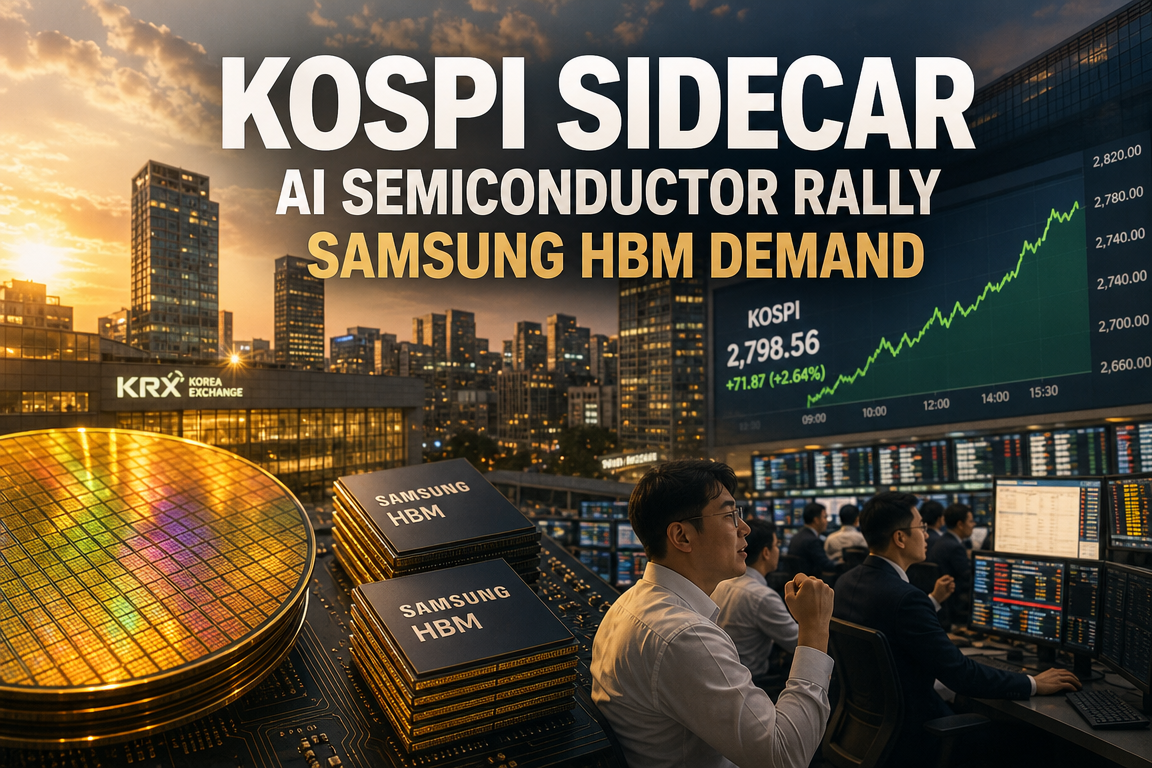
KOSPI Sidecar Reinstatement? The Key Drivers Are Easing Geopolitical Risk, Confirmed AI Demand, and the Semiconductor Rally
The key point in this KOSPI surge is not simply that prices rose sharply.
The market reacted to a combination of easing Middle East geopolitical risk, expectations for the reopening of the Strait of Hormuz, strong Palantir earnings, Caterpillar results indicating data center demand, and large computing contracts involving Anthropic, Google, and Broadcom.
This move suggests that the AI semiconductor rally led by Samsung Electronics and SK Hynix is not a short-term theme, but part of a broader global data center investment cycle.
In other words, when assessing the KOSPI outlook, investors should now monitor not only rate-cut expectations, but also AI infrastructure investment, global growth conditions, and changes in the geopolitical risk premium.
1. KOSPI Sidecar: Why Did the Market React So Strongly?
The core reference point is the phrase “KOSPI sidecar again today.”
The important issue is not just the rise itself, but the fact that the market moved aggressively in one direction.
A sidecar is a mechanism that temporarily restricts program trading when futures markets move sharply.
It is generally triggered when KOSPI 200 futures rise or fall beyond a certain threshold.
An upward sidecar indicates strong buying pressure in the market.
That said, sidecar activation does not guarantee a sustained bull market.
However, it does signal a broad return to risk assets.
The current surge was driven by three main factors.
- Easing tensions in the Middle East and lower geopolitical risk
- Reaffirmation of AI demand through corporate earnings and major contracts
- Improved conditions for concentrated inflows into large-cap semiconductor names such as Samsung Electronics and SK Hynix
2. First Catalyst: Easing Middle East Risk and Expectations for Strait of Hormuz Reopening
The first catalyst was the easing of tensions in the Middle East.
In particular, expectations for the reopening of the Strait of Hormuz were viewed as supportive for markets.
The Strait of Hormuz is a critical route for global crude oil shipments.
Heightened tension in the region tends to push up oil prices, raise logistics costs, and revive inflation concerns.
When tensions ease, markets typically price in greater stability in energy prices.
This matters because equities are not driven by earnings alone.
Stable oil prices can reduce pressure on central banks.
Lower rate pressure can, in turn, support valuations for growth and technology stocks.
Accordingly, the Strait of Hormuz issue is not merely a geopolitical headline, but a variable directly linked to global equities and the KOSPI outlook.
3. Second Catalyst: AI Demand Confirmed by Palantir Earnings
The second major factor was Palantir’s earnings.
Palantir is a leading AI and data analytics company serving both enterprise and government clients.
The report noted that earnings were strong and that many corporations want Palantir’s AI solutions.
This is a meaningful signal for the AI market.
Until recently, markets focused primarily on who was supplying AI hardware.
Companies such as Nvidia, AMD, Broadcom, SK Hynix, and Samsung Electronics were at the center of attention.
However, strong Palantir earnings indicate that AI is moving beyond experimentation and into commercial deployment.
In other words, AI demand is increasingly translating into actual budget spending by companies.
This trend also feeds back into demand for AI semiconductors.
Greater AI adoption requires more servers, more GPUs, more HBM, and more data center power.
For that reason, Palantir’s results can be viewed not only as a positive for one U.S. software company, but also as an indirect positive for SK Hynix and Samsung Electronics.
4. Third Catalyst: Why Caterpillar Earnings Matter for Data Center Demand
One of the more important interpretations in the source material concerns Caterpillar’s earnings.
Many investors view Caterpillar only as a construction equipment company.
It is often associated with excavators, bulldozers, and mining equipment.
However, the report noted that Caterpillar engines are widely used in on-site power generation for data centers.
This is a key point that is often overlooked in other coverage.
AI data centers consume very large amounts of electricity.
The problem is that power grids often cannot keep pace with that demand.
As a result, data center operators seek on-site generation, backup power, and distributed power solutions.
Caterpillar can supply diesel generators, gas generators, and industrial engines for these applications.
Accordingly, stronger Caterpillar earnings may reflect more than just healthier construction activity.
They can also be interpreted as an indirect signal of strong AI data center investment and power infrastructure demand.
This is an important lens for understanding the AI investment cycle.
AI does not run on semiconductors alone.
Power, cooling, transformers, generators, cables, server racks, and network equipment must also scale.
For that reason, AI-related investing should extend beyond Nvidia or SK Hynix to include power infrastructure and industrial equipment.
5. Fourth Catalyst: Large-Scale Computing Contracts Involving Anthropic, Google, and Broadcom
The source also referenced a large computing contract involving Anthropic, Google, and Broadcom.
The significance lies less in the headline amount than in the message that AI companies continue to require substantial computing resources.
Anthropic is one of the leading generative AI companies operating Claude.
A large computing agreement of this type indicates that competition in AI models is still ongoing.
Faster inference, lower costs, and greater reliability all require larger infrastructure investments.
Google provides cloud and AI infrastructure.
Broadcom is strong in custom semiconductors and networking chips.
Together, these companies illustrate that the AI infrastructure market is likely expanding beyond GPUs into ASICs, networking, memory, and cloud services.
This is directly relevant for Korea’s market.
As AI server deployment expands, demand for HBM memory increases.
SK Hynix already has a strong position in the HBM market.
Samsung Electronics is also working to rebuild momentum across HBM, foundry, and memory businesses.
As a result, major AI computing contracts can influence Korean semiconductor exports and KOSPI large-cap flows.
6. The Structure of the Current KOSPI Move: Lower Risk, Confirmed Demand, and a Reset Base
The most important line in the source is the idea that prices can rise when the market has already corrected, risk is removed, and demand is confirmed.
This describes the market structure well.
When valuations are already elevated, even good news may have a limited effect.
But when the market has corrected, negative catalysts fade, and demand is validated, rebound momentum can become stronger.
The current KOSPI move can be understood in that context.
- Lower geopolitical risk after easing Middle East tensions
- Improved growth expectations after strong AI earnings
- Stronger semiconductor outlook after data center demand confirmation
- Potential foreign inflows concentrated in large-cap semiconductor stocks
- Improved sentiment across both KOSPI and KOSDAQ
Korea’s equity market has a high weighting in semiconductors.
Therefore, when the global AI investment cycle strengthens, the KOSPI can respond quickly.
Conversely, any doubt about AI demand can also pressure the market sharply.
At present, the center of gravity for the KOSPI outlook remains AI semiconductors.
7. Why Samsung Electronics and SK Hynix Are Back in Focus
In this environment, investors are paying closest attention to Samsung Electronics and SK Hynix.
SK Hynix remains highly competitive in the HBM market.
Rising demand for AI server memory could further support its earnings outlook.
Samsung Electronics is drawing attention from multiple angles, including memory recovery, HBM qualification and supply expansion, and potential improvement in foundry operations.
Samsung Electronics is not only a core retail investor holding in Korea, but also a key barometer of the global semiconductor cycle.
Foreign investors also tend to focus on Samsung Electronics and SK Hynix when allocating capital to Korea.
Accordingly, on days when the KOSPI rises sharply, flows into these two names should be closely monitored.
In the short term, strong gains can trigger profit-taking.
In the medium term, the more important issue is whether AI infrastructure investment and memory price recovery continue.
8. Can the Rally Extend to KOSDAQ? The Key Is Spillover
The source ends with optimism that August could be a strong month for both KOSPI and KOSDAQ.
It is common for KOSDAQ to follow KOSPI after large-cap stocks move first.
Typically, improved sentiment begins with large-cap equities and then spreads to small and mid-cap growth names.
In KOSDAQ, AI software, semiconductor equipment, power equipment, data center, robotics, and some secondary battery stocks could also move higher.
However, KOSDAQ is significantly more volatile.
Investors should distinguish between companies with real earnings and those driven only by themes.
A label such as AI alone does not imply equal value.
Actual revenue, customers, orders, and operating profit improvement should be the deciding factors.
9. The Key Point Often Missed Elsewhere: The Bottleneck in the AI Rally May Be Power, Not Semiconductors
The most important hidden point in the source is the interpretation of Caterpillar’s earnings.
Most AI coverage focuses on Nvidia, HBM, GPUs, and cloud services.
But actual AI data center operations require electricity.
And power constraints can become a major bottleneck.
AI servers consume far more power than conventional servers.
As data centers expand, they need grid upgrades, transformers, generators, cooling systems, and power management solutions.
That is why earnings from industrial companies such as Caterpillar can serve as an indirect indicator of AI data center demand.
This perspective is important for future investment strategy.
AI should not be viewed only as a semiconductor story.
It should be assessed as a value chain that includes semiconductors, power infrastructure, data center operations, cloud services, and AI software.
As AI investment becomes a larger part of global growth, power shortages are likely to emerge more frequently as a market issue.
10. Key Indicators Investors Should Monitor Now
To determine whether the current move is a short-term spike or the start of a broader trend, several indicators should be monitored.
- Whether foreign investors continue net buying in Samsung Electronics and SK Hynix
- Whether the KRW/USD exchange rate remains stable
- Whether crude oil prices avoid another sharp increase
- Whether guidance from major U.S. AI companies remains intact
- Whether HBM pricing and memory industry conditions continue to improve
- Whether orders increase for companies tied to data center power infrastructure
- Whether the rally broadens beyond large-cap semiconductors into other sectors
The KRW/USD exchange rate is especially important for Korea’s equity market.
A stable won makes foreign inflows easier.
By contrast, a weaker won raises currency risk for foreign investors and can reduce their willingness to buy Korean equities.
Crude oil is another key variable.
Even if Middle East risk eases, a renewed surge in oil prices could revive inflation concerns.
That would weaken rate-cut expectations and pressure growth valuations again.
11. One-Sentence Summary of the Current Market
The current KOSPI sidecar-driven rally reflects a combination of stronger evidence that AI demand is real, lower geopolitical risk, and renewed buying in Korea’s semiconductor market after a correction.
In the short term, the market may face overbought conditions.
In the medium to long term, the key question is whether AI data center investment, HBM demand, power infrastructure expansion, and cloud competition continue.
Accordingly, this should be viewed not as a simple rebound, but as a phase in which the AI infrastructure cycle is being repriced into Korean equities.
< Summary >
The KOSPI sidecar rally was driven by easing Middle East geopolitical risk and renewed AI demand.
Expectations for the reopening of the Strait of Hormuz support oil stability and market sentiment.
Strong Palantir earnings indicate that AI adoption is translating into real corporate demand.
Caterpillar’s results provide an indirect read on AI data center power infrastructure demand.
Large computing contracts involving Anthropic, Google, and Broadcom suggest continued expansion in AI infrastructure investment.
Samsung Electronics and SK Hynix are once again key beneficiaries of AI semiconductor and HBM demand.
Going forward, investors should monitor semiconductors together with data centers, power infrastructure, the exchange rate, and crude oil.
[Related Articles…]
- AI Semiconductor Cycle and Global Equity Outlook
- Semiconductor Recovery and Key Variables for Samsung Electronics and SK Hynix
*Source: [ 내일은 투자왕 – 김단테 ]
– 코스피 또 사이드카? #코스피 #하이닉스 #삼성전자
● Samsung AI-Rocket to Global No.1
How Samsung Electronics Can Regain the Top Spot: AI Semiconductors, HBM, Foundry, and Manufacturing AX as Drivers of the Next Cycle in the Korean Economy
The key issue is not simply whether Samsung Electronics’ share price will rise.
The more important point is the structural link between Samsung Electronics, SK hynix, HBM, foundry, and AI semiconductors.
In particular, M·AX, or Manufacturing AI Transformation, as emphasized by Professor Kim Jeong-ho, may represent one of the last major windows for Korea to rebuild its growth engine.
This article examines why a 10% improvement in semiconductor yield could translate into an economic impact on the order of KRW 100 trillion, why Samsung Electronics may be positioned more favorably than Google and Apple in certain respects, and the core strategic asset Samsung cannot afford to miss.
1. Key Takeaway: The Next Front in AI Is the Factory, Not the Office
Professor Kim’s core message is clear.
AI is moving beyond writing and image generation toward integration with manufacturing operations.
Where AI industry expectations once centered on ChatGPT, generative AI, and AI agents, the next phase is Manufacturing AX.
AX refers to AI Transformation, the process of redesigning companies and industries around AI.
- Phase 1: Classification AI
Decision-making AI that plays Go or classifies images.
The AlphaGo era is a representative example. - Phase 2: Generative AI
AI that generates text, images, code, and video.
ChatGPT and image-generation tools fall into this category. - Phase 3: Agentic AI
AI that can execute multi-step tasks based on human instructions.
This goes beyond answering questions and begins to automate work. - Phase 4: Autonomous AI Agent
AI that understands objectives, makes decisions, and executes actions autonomously.
This could significantly reshape enterprise operations. - Phase 5: AI Agent for Manufacturing
AI agents directly connected to production processes, equipment, quality control, logistics, and yield management.
This is the core of M·AX as defined by Professor Kim. - Phase 6: AI Agent for Humanoid Robot
AI agents combined with humanoid robots.
This could materially change labor structures across manufacturing, logistics, defense, shipbuilding, and services.
In short, the next century of AI is likely to be a contest not only in software, but in its integration with real industrial operations.
That makes this transition especially important for Korea as a manufacturing economy.
2. Why M·AX Matters for Korea: Manufacturing Remains the Core of the Economy
Korea remains a manufacturing-led economy.
Semiconductors, automobiles, shipbuilding, batteries, displays, defense, electronics components, and materials, parts, and equipment industries remain central to exports and employment.
Services and platform businesses are important, but the country’s real cash flow still comes largely from manufacturing.
Professor Kim outlined three main reasons why manufacturing AX is necessary.
- First, the historical trajectory of AI is shifting toward manufacturing.
AI agents are moving beyond office tasks and toward factories and equipment.
The countries and companies that capture this transition early are likely to shape the next industrial order. - Second, Korea has a strong manufacturing base.
The United States leads in software and cloud, while Korea has real industrial operations.
This means AI can translate quickly into productivity and profitability when deployed in Korean factories. - Third, semiconductor manufacturing is one of the sectors where AI can have the largest effect.
In semiconductors, yield, process optimization, equipment control, defect analysis, and design verification all directly affect economic value.
In the AI semiconductor era, production quality is as important as design capability.
From this perspective, M·AX is not a narrow smart-factory initiative.
It is an industrial strategy that could affect Korea’s growth rate, export competitiveness, corporate earnings, and employment structure.
3. The Meaning of a 10% Improvement in Semiconductor Yield: The Scale Is Material
One of Professor Kim’s most notable points concerns semiconductor yield.
In memory semiconductors alone, Korean companies could generate hundreds of trillions of won in net profit this year, with even larger earnings possible in the coming years if conditions improve further.
The key variable is not simply output volume.
It is yield.
In semiconductors, yield refers to the proportion of functional chips obtained from a wafer.
Higher yield means more saleable product from the same equipment, the same plant, and the same workforce.
As a result, yield has a stronger impact on margins than on revenue.
- 1% yield improvement
In large semiconductor fabs, this can translate into a difference of hundreds of billions of won to trillions of won in profit. - 10% yield improvement
Professor Kim stated that a 10% yield increase through AI-driven manufacturing innovation could create additional economic value on the order of KRW 100 trillion.
This would affect not only corporate earnings but also tax revenue, pension capacity, healthcare financing, and industrial investment. - HBM yield improvement
HBM is essential for AI servers and GPUs.
Its stacked architecture is complex, making yield management difficult and increasing the value of AI-based defect analysis and process optimization.
AI semiconductor competition is therefore not only a design contest.
Going forward, it will also depend on who can manufacture more reliably at higher yield.
4. Why Semiconductor Booms Are Not Felt Equally: The Economy Is Becoming More Uneven
Semiconductors account for an increasingly large share of Korean exports.
Based on figures cited in the source, semiconductors represented around 38% of first-half exports, and in some months more than 50%.
This indicates that the Korean economy is becoming more tightly tied to the semiconductor cycle.
The challenge is that this does not always translate into broad-based consumer sentiment.
Companies linked to Samsung Electronics, SK hynix, and the HBM value chain may experience a strong upswing.
By contrast, workers in non-semiconductor sectors, self-employed operators, and smaller manufacturers may see little improvement.
- Inside semiconductor companies
AI server demand and HBM growth can lift earnings expectations.
Bonuses, investment, and hiring sentiment may improve. - Non-semiconductor manufacturing
Firms may continue to face cost pressure, labor costs, weak demand, and supply-chain restructuring risks.
Delayed AI adoption could widen productivity gaps. - Households
The transmission from corporate profits to taxes, wages, investment, and supplier income takes time.
As a result, a gap can emerge between equity markets and perceived economic conditions.
For the semiconductor boom to become a broader recovery in Korea, AI adoption must expand across manufacturing.
That is the real meaning of M·AX.
5. M·AX Is Not Just Factory Automation: It Must Extend to Finance, HR, Logistics, and Marketing
Many people associate manufacturing AI transformation only with robotic arms, automated equipment, and inspection cameras.
However, Professor Kim’s view is much broader.
M·AX means reorganizing the entire manufacturing enterprise around AI.
Manufacturing companies are not limited to production.
They also include design, procurement, inventory, logistics, accounting, finance, HR, sales, marketing, customer support, and quality control.
These functions must be AI-optimized for true manufacturing AX.
- Finance and accounting AI
Can be used for cost analysis, capital allocation, FX risk management, and cash flow forecasting. - HR AI
Can support workforce allocation, skill analysis, training recommendations, performance management, and productivity improvement. - Logistics and inventory AI
Can automate demand forecasting, procurement, inventory optimization, and delivery risk management. - Design AI
Can accelerate semiconductor design verification, simulation, architecture optimization, and error detection. - Marketing and sales AI
Can support customer demand forecasting, pricing strategy, contract analysis, and global market response.
In particular, finance, HR, logistics, and inventory management can begin generating value within months if data are properly structured.
By contrast, process-level manufacturing optimization usually takes longer because of equipment, sensor quality, process know-how, and security constraints.
For this reason, policymakers should avoid treating M·AX as a narrow factory-automation program.
6. The Outlook for Materials, Parts, and Equipment Firms: Survival Will Depend on AI-Enabled Products
Materials, parts, and equipment suppliers also have significant opportunity in the M·AX cycle.
In future semiconductor procurement, hardware performance alone may not be enough.
Equipment will increasingly need built-in AI agents.
- AI-based real-time equipment monitoring
Can detect anomalies early and reduce downtime. - AI-based process optimization
Can adjust temperature, pressure, chemical concentration, lithography conditions, and etching parameters using data. - AI-based defect tracing
Can identify whether yield loss comes from a specific tool, process step, or material issue. - AI-based customer feedback loops
Can enable continuous improvement using equipment and process data after delivery.
In other words, suppliers must evolve from hardware vendors to providers of AI-enabled productivity solutions.
Firms that achieve this transition are likely to gain higher value within Samsung Electronics, SK hynix, and the broader foundry ecosystem.
7. Samsung Electronics Foundry: The Gap with TSMC Is Not Only About Market Share
Samsung Electronics remains highly competitive in memory semiconductors.
However, in foundry and some non-memory segments, the gap with TSMC has widened.
At one point, Samsung Electronics’ foundry market share exceeded 20%, but recent concerns suggest it has fallen into single digits.
The key issue is not only market share, but customer trust and yield.
Foundry customers outsource chip production to a third party.
For customers, stable yield and long-term reliability matter more than price or even raw performance in many cases.
- TSMC’s strengths
Customer-centric ecosystem, process stability, high yield, design support tools, and strong trust with global technology companies. - Samsung Electronics foundry challenges
Stable yield at advanced nodes, customer trust recovery, ecosystem expansion, and sustained long-term investment. - Potential role of AI
AI agents can be applied to process data analysis, defect prediction, equipment control, design verification, and customer-specific process optimization.
Professor Kim argues that Samsung Electronics foundry also needs AI-agent-based innovation.
His point that each engineer should be able to deploy 10 or 100 AI agents is especially notable.
This implies that foundry competitiveness will not be determined solely by capital expenditure.
Going forward, organizational productivity created by the combination of engineering expertise and AI agents will be a critical source of competitiveness.
8. Why Samsung Electronics Could Regain Global Leadership: It Has the Conditions for a Vertical Stack
One of Professor Kim’s more important observations is Samsung Electronics’ structural potential.
Samsung Electronics currently operates multiple divisions, some of which face lower profitability or operational difficulties.
However, viewed differently, Samsung may be one of the few companies after Google and Apple with the potential to build a true vertical stack.
A vertical stack means a vertically integrated ecosystem connecting products, services, semiconductors, software, data, AI, and infrastructure.
Google is a useful reference point.
- Google’s vertical stack
Search, YouTube, advertising, cloud, Android, TPU, AI models, and data centers are all integrated.
Revenue from YouTube and advertising funds AI and infrastructure investment.
Those investments, in turn, reinforce competitiveness in search, advertising, YouTube, and cloud. - Apple’s vertical stack
iPhone, Mac, Apple Watch, the App Store, custom chips, operating systems, and service ecosystems are tightly connected.
While Apple has been viewed as lagging in generative AI, its device ecosystem provides a base for recovery. - Samsung Electronics’ vertical-stack potential
Memory, HBM, foundry, mobile, home appliances, displays, sensors, network equipment, and manufacturing capabilities are already in place.
If AI software and AI-agent ecosystems are properly connected, the resulting leverage could be substantial.
Samsung Electronics’ weakness lies in AI.
However, it has exceptionally broad hardware touchpoints where AI can be deployed.
Smartphones, TVs, refrigerators, washing machines, robot vacuums, semiconductor fabs, foundries, and HBM production lines are all potential AI application points.
This gives Samsung Electronics the potential to evolve from a semiconductor company into an AI manufacturing platform company.
9. Samsung Electronics’ Real Challenge: Prioritize Ecosystem Contribution Over Short-Term Business-Unit Profitability
Professor Kim also addressed Samsung Electronics’ incentive structure.
The memory division may perform strongly, while foundry, home appliances, and some mobile segments may remain less profitable.
However, compensation systems based only on business-unit profit can weaken long-term competitiveness.
In the AI era, competition is about ecosystems, not isolated divisions.
- Limits of short-term profit-based incentives
Compensation may become concentrated in currently profitable businesses.
Teams preparing future technologies may be relatively under-supported. - Need for long-term contribution-based incentives
AI, foundry, design, software, and data infrastructure units with high strategic value should be evaluated accordingly.
Organizations that may operate at a short-term loss but have strong long-term strategic importance need appropriate autonomy and rewards. - Equity-based compensation
Longer-term incentive structures can align employee interests with enterprise value creation.
For Samsung Electronics to regain global leadership, success in memory alone will not be sufficient.
HBM, foundry, mobile, home appliances, AI software, data, and manufacturing AI must be connected into a single ecosystem.
10. The Core Point Often Missed Elsewhere: M·AX Is Not Just AI Adoption, but an Operating-System Change
This is the central issue.
Most coverage separates AI semiconductors, HBM, Samsung Electronics earnings, SK hynix share performance, and foundry competition.
The real issue is different.
M·AX is not simply a project to install AI in factories.
It is a change in the operating system of the enterprise.
- First, data ownership and data connectivity are essential.
AI cannot function without data.
Manufacturing firms must connect equipment data, quality data, inventory data, customer data, and workforce data.
If data remain siloed by department, AI will have limited impact. - Second, AI agents are augmentation tools, not merely replacement tools.
Professor Kim’s comment that one engineer should be able to use 10 or 100 AI agents is not a statement about layoffs.
It is a directive to create a structure in which one engineer can work like 10 or 100. - Third, yield improvement is a financial strategy.
Semiconductor yield may appear to be a technical metric, but it is directly tied to margins, cash flow, investment capacity, and shareholder value.
Manufacturing AI innovation is therefore a core decision area for the CFO and CEO, not only for technical teams. - Fourth, Samsung Electronics’ weakness may be less about technology and more about connectivity.
Samsung already has memory, foundry, mobile, home appliances, and displays.
The issue is how effectively these assets are connected into a single AI ecosystem. - Fifth, materials, parts, and equipment firms must make AI part of product competitiveness, not just internal efficiency.
Equipment, materials, and components should include predictive and AI-driven features.
That is how suppliers can move from price competition to technology premiums in global supply chains.
Ultimately, Samsung Electronics’ future does not depend only on how much HBM it sells.
The real question is whether it can connect all of its manufacturing assets through AI-agent-based systems.
11. Implications for the Korean Economy: Turning the Semiconductor Boom into Structural Growth
The semiconductor boom is a major opportunity for Korea.
However, if this opportunity ends with improved earnings at only a handful of large companies, the broader economy will benefit less than expected.
To lift the entire economy, semiconductor-generated cash flow must be reinvested into AI transformation across manufacturing.
- Government policy
Support for M·AX should extend beyond factory automation to finance, HR, logistics, inventory, design, and marketing.
SMEs and mid-sized manufacturers need practical AI-agent adoption support. - Large-company strategy
Semiconductor profits should be reinvested into AI infrastructure, data platforms, software talent, and manufacturing AI.
Long-term vertical-stack building should take priority over short-term earnings. - Supplier strategy
Materials, parts, and equipment firms should move beyond simple procurement competition and provide AI-enabled solutions.
Companies that improve customer yield are likely to command higher valuations. - Career strategy
AI is unavoidable even in manufacturing roles.
Skills related to AI agents will matter across equipment, quality, production management, logistics, finance, procurement, and sales.
From a global economic perspective, AI semiconductors and manufacturing AX are among Korea’s most important growth variables.
If U.S. technology companies dominate AI models and cloud infrastructure, Korea must compete through manufacturing AI, high-performance memory, HBM, advanced packaging, and foundry yield improvement.
12. Investment Monitoring Points
This is not a recommendation to buy or sell any specific security, but a framework for understanding the industry cycle.
When assessing Samsung Electronics’ share price, SK hynix earnings, the HBM value chain, and the foundry landscape, several indicators will matter.
- HBM demand durability
Whether AI infrastructure spending by Nvidia, AMD, Google, Amazon, Meta, and others continues. - Samsung Electronics HBM customer qualification
Whether it can supply major AI accelerator customers consistently. - Foundry yield improvement
Whether it can regain customer trust at advanced nodes. - Manufacturing AI investment
The extent of investment in process AI, equipment AI, design AI, and data platforms. - AI integration among materials, parts, and equipment firms
Whether suppliers are converting AI into product-level competitiveness.
Future semiconductor market analysis must go beyond memory price cycles.
AI manufacturing innovation, yield improvement, vertical-stack integration, and global supply-chain restructuring must all be considered.
< Summary >
The next stage of AI is moving beyond generative AI toward Manufacturing AX, or M·AX.
Korea has a strong manufacturing base, so linking AI to factories and enterprise operations could deliver the greatest economic impact.
A 10% improvement in semiconductor yield could have an economic effect on the order of KRW 100 trillion.
Samsung Electronics has the potential to build a vertical stack across memory, HBM, foundry, mobile, and home appliances, giving it a position that could be favorable relative to Google and Apple in certain respects.
The main weakness remains AI software and internal connectivity.
For Samsung Electronics to regain global leadership, it must move beyond reliance on the memory cycle and connect all divisions into an AI-agent-based ecosystem.
Materials, parts, and equipment firms must also evolve from simple suppliers into providers of AI-enabled equipment and solutions.
Ultimately, the essence of M·AX is not factory automation, but a transformation of the enterprise operating system around AI.
[Related Articles…]
- AI Semiconductor Market Outlook and the Next Growth Cycle for Korean Manufacturing
- Key Strategies for Restoring Samsung Electronics’ Foundry Competitiveness
*Source: [ 경제 읽어주는 남자(김광석TV) ]
– “삼성전자가 다시 세계 1등 되는 방법” 김정호 교수가 말한 AI 반도체의 미래 | 경읽남과 토론합시다 | 김정호 교수님 [2편]