● Data Center Empire
“AI Bubble Collapse?” is not the point; what Big Tech is targeting is a data center infrastructure monopoly, even at the cost of hundreds of trillions in losses
The real point to watch in this Big Tech earnings season is not whether stock prices rose or fell for a day or two.
The core point is why Amazon, Microsoft, Google, and Meta are increasing AI investment even while knowing free cash flow is falling negative.
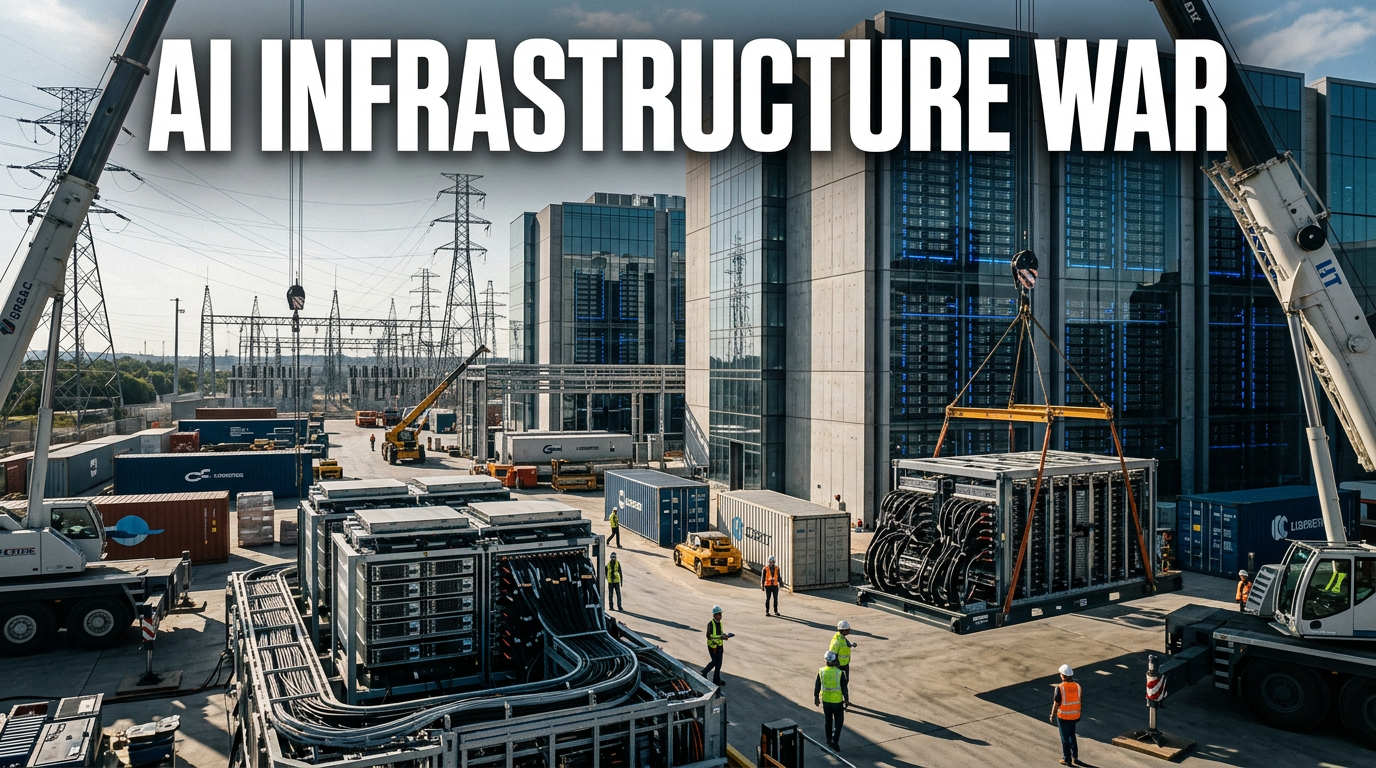
On the surface, it looks like “hundreds of trillions in losses,” “AI bubble collapse,” or “overinvestment,” but if you look inside, it is closer to a move to seize data center infrastructure, GPUs, memory, power, and networks in order to control the tollgate of the AI era.
In particular, this article will organize why Amazon and Microsoft rebounded strongly after their earnings announcements, while Google and Meta lagged relatively, and the core bottlenecks in the AI investment cycle that the market is missing right now.
1. Why stock prices diverged after Big Tech earnings
The market reaction after recent Big Tech earnings was quite clearly divided.
Amazon and Microsoft showed strong rebounds of roughly 15%, while Google and Meta corrected by about 7% to 8%.
On the surface, all of them are spending huge sums on AI, so why were the stock reactions so different?
The answer comes down to three main reasons.
- First, whether cloud growth is being proven through actual revenue.
- Second, whether higher AI capex can be connected to profitability.
- Third, whether the investment payback period is within a range investors can wait for.
The most important metric here is cloud.
In the AI era, earnings are ultimately revealed first in cloud businesses.
That is because companies do not usually buy and use AI models directly; instead, most of them rent GPU computing, APIs, and AI services on the cloud.
So when looking at Big Tech earnings, it is far more important to look at cloud growth first than ad revenue or e-commerce.
2. Cloud growth is closer to proof that “AI demand is real”
Based on the criteria presented in the original text, Google Cloud posted the strongest growth, with a growth rate of 82%.
Microsoft Azure was at 43%, and Amazon AWS showed an accelerating trend again at around 36.8% to 37%.
In particular, AWS had previously seen growth fall into the high teens, so the fact that it climbed back into the mid-to-high 30% range is important.
This is not just a one-off recovery; it means AI cloud demand is pulling up the growth curve of the existing cloud business again.
| Company | Core cloud | Growth rate based on original text | Market interpretation |
|---|---|---|---|
| Google Cloud | About 82% | Strongest growth, but concerns over capex burden | |
| Microsoft | Azure | About 43% | Expansion of AI services and the Copilot ecosystem |
| Amazon | AWS | About 36.8% to 37% | Profitability proven through high operating margins |
| Meta | No official cloud business | Not disclosed | Centered on ad recommendation algorithms and its own AI infrastructure |
The important question here is the answer to “Are they making money from AI?”
Based on the current trend, at least from the perspective of cloud providers, AI is already being monetized.
Cloud businesses are an industry that had already entered a certain mature phase after about 8 to 9 years since launch.
But with AI demand attached, growth has accelerated again.
That has fairly large implications from a global economic outlook perspective.
That is because the AI investment cycle is not just a theme; it is driving a structural change that is lifting IT budgets and infrastructure spending across companies again.
3. AI capex could grow to $750 billion in 2026 and $1.3 trillion in 2027
The biggest change after this earnings release is the outlook for AI capex.
Based on the original text, AI-related investment for 2026 was presented at around $750 billion.
Converted into won, that is well over roughly KRW 1,000 trillion.
Even more surprising is the 2027 outlook.
Based on Morgan Stanley estimates, AI capex in 2027 could expand to around $1.3 trillion.
That is an enormous amount, roughly equivalent to KRW 1,800 trillion to KRW 2,000 trillion.
- 2025 AI capex estimate: about $476 billion
- 2026 AI capex estimate: about $750 billion
- 2027 AI capex estimate: about $1.3 trillion
- Including sovereign AI and enterprise demand: potential above $1.5 trillion
This includes not only hyperscalers, but also Oracle, neoclouds, China’s Alibaba and Tencent, and companies building large-scale data centers.
When sovereign AI investments from governments in the U.S., Japan, Korea, China, and others are added, the scale can grow even larger.
Sovereign AI refers to the trend of countries building their own AI infrastructure and data centers.
Going forward, not only private Big Tech firms but also governments, telecom companies, large conglomerates, and financial institutions are likely to seek their own AI computing infrastructure.
At this point, the reason semiconductor supply chains, power infrastructure, data center infrastructure, HBM memory, and network equipment companies are drawing attention becomes clear.
Rising AI investment means money ultimately flows into GPUs, HBM memory, switches, optical modules, cooling equipment, transformers, and power equipment.
4. Why Big Tech can generate money while free cash flow turns negative
This is where many investors get confused.
They ask, “If Big Tech is making money, why is free cash flow negative?”
Free cash flow, or FCF, is simply operating cash flow minus capex.
FCF = Operating cash flow – capex
For example, if a company earns 100 from its business but invests 130 in data centers and GPUs, free cash flow becomes -30.
That is the situation hyperscalers are facing right now.
The issue is not that they are losing money because they cannot make money; rather, they are investing more than they earn in order to get ahead of future AI demand.
Based on the original text, hyperscalers are likely to see free cash flow move negative during 2026 and 2027.
But the interpretation is that from 2028 onward, cash flow will recover as completed data centers begin to come online sequentially, and from 2029 onward they may enter the payback phase.
In other words, today’s negative FCF is less a simple warning signal and more a “front-loaded investment to create cash flow three years ahead.”
Of course, if AI demand weakens more than expected, this logic can break down.
But based on current cloud growth and backlog, Big Tech at least believes demand is sufficient.
5. How capex turns into token economics
AI data center investment is not simply a business of building buildings.
It is a structure that injects power to produce tokens, and those tokens create productivity and revenue for enterprise customers.
The original text explains this as token economics.
- Big Tech executes capex.
- It secures land for data centers and connects to the power grid.
- It installs servers, GPUs, memory, network equipment, and cooling systems.
- Once the data center begins operating, electricity is turned into computing resources.
- Computing resources produce AI tokens.
- Those tokens are used for business automation, search, advertising, coding, analysis, and content generation.
- Customers pay AI usage fees, and cloud providers secure revenue and margins.
In simple terms, if the data centers of the past were factories that stored and processed data, then data centers in the AI era are closer to factories that produce intelligence.
That is the biggest difference between conventional cloud investment and AI data center investment.
6. Why is the data center break-even point discussed as roughly three years?
AI data centers are not a structure that starts generating money immediately.
It usually takes 2 to 3 years to secure land, sign power contracts, build, and install servers.
Recently, that period has often become even longer because of power shortages.
So companies that secure data center infrastructure early are at a much greater advantage.
Summarizing the structure presented in the original text, building a 1GW data center could require roughly more than $20 billion to $40 billion.
If it is built around the latest Nvidia GPUs, costs can rise further, and if in-house chips are used, the cost structure can change.
But once the data center is operating, it can generate substantial annual revenue.
- Estimated 1GW data center revenue: about $23 billion annually
- Estimated operating profit after operating expenses: about $15 billion
- After-tax return on capital for GPU rental model: about 31%
- Return when combined with proprietary AI service packages: about 46%
- Return for external API or neocloud-style rental revenue: about 25%
The reason these numbers matter is that the comparison with interest rates makes it obvious.
If Big Tech can issue corporate bonds at around 5% cost and use that money to build AI infrastructure capable of 25% to 46% returns, management will find it hard to stop investing.
In other words, expanding capex may not be mere waste; it may be a project that expects returns far above the cost of capital.
7. Google: strongest growth, but the market first focused on capex burden
Google showed the strongest cloud growth in this earnings release.
Based on the original text, Google Cloud revenue growth was presented at about 82%, and backlog was mentioned at around $514 billion.
Converted into won, that means orders worth nearly KRW 700 trillion have piled up.
But that backlog does not immediately become revenue.
According to the original text, only about half can be recognized as revenue within 24 months.
The reason is simple.
There is not enough computing power.
Customers want to use Google Cloud, but Google does not have enough GPUs and data center capacity to provide immediately.
So Google indicated that if necessary, it would even borrow infrastructure from external neocloud providers such as Iren, CoreWeave, and Nebius to meet customer demand.
Google also raised its 2026 capex outlook from the previous roughly $180 billion to $190 billion range to around $195 billion to $205 billion.
Growth is good, but as investment burden increased, the market felt short-term pressure.
That is why the stock corrected despite strong earnings.
8. Amazon: AWS re-acceleration and high margins pushed the stock higher
For Amazon, the key point is that AWS has strengthened again.
AWS growth was presented in the original text at about 36.8%.
That may look lower than Google’s growth rate, but AWS is already the No. 1 player in global cloud market share.
A much larger business growing in the high-30% range is a very strong number.
More important is the operating margin.
AWS operating margin was mentioned at around 39%.
This signals that AI cloud is not just expanding revenue, but is actually translating into profit.
Amazon also showed a trend of increasing capex from the previous roughly $200 billion to around $220 billion.
Even so, the reason the stock reacted positively is that profitability proof mattered more than the expansion of investment.
From the market’s perspective, it looked like, “They are spending a lot, but they can earn a lot too.”
9. Microsoft: It looked like capex was shrinking, but in reality it was closer to an accounting classification change
Microsoft showed continued strong cloud demand with Azure growth of about 43%.
The AI service Copilot was also mentioned as having more than 30 million paid seats.
This means Microsoft is no longer just a company that rents out GPUs; it is attaching AI to Office, Windows, GitHub, and Azure ecosystems to lock in customers.
In this earnings release, some investors interpreted Microsoft as having cut 2026 capex.
But the original text explains that this was closer to a lease accounting classification change than an actual investment reduction.
Some items previously recorded as finance leases were shifted to operating leases, making capex appear as if it had moved into opex, or operating expenses.
This is a point the market can easily miss.
Just because the visible capex number goes down does not mean actual AI investment has decreased.
When making investment judgments, one must look at capex, leases, opex, and data center contract structures together.
10. Meta: why invest so much when it does not even sell cloud services?
Meta is not an official cloud provider.
Even so, it is keeping 2026 capex at a high level of roughly $130 billion to $145 billion.
The original text explains that Meta is pursuing a strategy to secure AI capacity first in 2026 and 2027.
From Mark Zuckerberg’s perspective, there is inevitably a strong fixation on platform control.
That is because Instagram and Facebook were heavily affected by Apple’s changes to privacy policy in the past.
So in the AI era, Meta is moving not to ride on someone else’s platform, but to secure its own infrastructure and its own models.
Meta could also lend the GPUs it secures to external users like a cloud service.
But according to the original text, Meta believes using them for internal services produces a higher return on investment.
The main use case is ad recommendation algorithms.
If Meta improves the recommendation accuracy of Instagram, Facebook, and Threads feeds, ad efficiency rises, which directly translates into revenue growth.
Ultimately, Meta’s AI investment is recovered not through “cloud revenue” but through “qualitative improvement in ad revenue.”
That is the biggest difference from Amazon, Microsoft, and Google.
11. Why AI bottleneck stocks can benefit before Big Tech
This is where the core point from an investment strategy perspective appears.
Big Tech may see free cash flow pressured by massive capex during 2026 to 2027.
By contrast, companies receiving that capex see revenue right away.
Representative AI bottleneck areas are as follows.
- GPUs and AI accelerators
- HBM and high-performance memory
- High-speed network switches and optical communication equipment
- Data center power equipment and transformers
- Immersion cooling and liquid cooling systems
- On-site power generation, fuel cells, and SMR-related infrastructure
- Server manufacturing and rack systems
In particular, the memory share is likely to become even larger in the future.
The original text also mentioned a forecast that by 2027 to 2028, memory could account for nearly 70% of the cost structure of data centers.
As AI models grow and inference demand explodes, demand for HBM, DRAM, high-performance SSDs, and network bandwidth also rises.
That is why, in the short term, AI bottleneck technology stocks may show faster earnings reactions than Big Tech.
Big Tech’s cash flow becomes meaningful 2 to 3 years after data centers are completed, but equipment suppliers record earnings first at the time of orders and deliveries.
12. Power bottlenecks are the real core of AI infrastructure monopoly
Many people talk about AI infrastructure and only look at GPUs.
But the real bottleneck is power.
Even if you have GPUs, you cannot run data centers without power.
Even if you have data center land, you cannot install servers without transmission lines.
Recently, delays in power grid connections have increased demand for on-site power generation.
On-site power generation is a method of producing and supplying power right next to the data center.
Technologies such as fuel cells, gas turbines, and SMRs can be included here.
This is the most important part of the Big Tech infrastructure monopoly scenario.
That is because Big Tech is not only buying GPUs, but also securing power contracts, land, transmission networks, cooling systems, and long-term supply chains ahead of others.
By the time smaller AI companies or ordinary conglomerates try to secure AI infrastructure later, the good power and land may already have been taken by Big Tech.
Ultimately, the real barrier to entry in the AI era is not just model performance, but data center infrastructure and access to power.
13. The most important points that other news rarely explains well
First, negative FCF is not necessarily bad.
If an ordinary company has negative free cash flow, it can be a warning sign.
But Big Tech is different.
With cloud growth and backlog already confirmed, it may be a structure that deliberately suppresses cash flow in order to get ahead of future demand.
Second, looking only at accounting capex numbers creates an illusion.
As in Microsoft’s case, if lease classifications change, capex may appear to have decreased.
But whether actual AI investment has fallen must be checked separately.
Going forward, when looking at Big Tech earnings, one must consider operating leases, finance leases, opex, and long-term purchase agreements together, not just capex.
Third, the return on AI infrastructure is being designed far above interest rates.
If corporate bond yields are around 5% and AI data center projects can generate 25% to 46% returns, Big Tech has an incentive to invest even if it has to borrow.
That is the most realistic answer to the question, “Why spend so much money?”
Fourth, the core of the AI bubble debate is not demand but supply bottlenecks.
Right now, the problem is not a lack of customers; it is that services cannot be sold because computing is insufficient.
That is also why Google’s backlog cannot be recognized as revenue immediately.
So what matters right now is not whether AI users exist, but who secures GPUs, power, and data centers first.
Fifth, the ultimate winner may not be the model company but the platform that owns the infrastructure.
AI models may continue to improve and prices may fall.
But large-scale data centers, power grids, cloud distribution channels, and customer lock-in ecosystems are not easy to replicate.
That is why Big Tech is now taking on the burden of hundreds of trillions in cash flow in order to build a position close to infrastructure monopoly.
14. The second-half AI investment strategy from an investment perspective
From an investment perspective, Big Tech and AI bottleneck stocks should be viewed separately.
Big Tech is a great company in the long term, but in the short term, capex burden and declining free cash flow can create stock volatility.
By contrast, AI bottleneck stocks can see Big Tech’s investment amounts translate into revenue first.
So in the current range, the following flow is reasonable.
- 2025 to 2027: potential beneficiaries among AI bottleneck technology stocks, semiconductor supply chains, power infrastructure, and data center equipment
- After 2027: confirmation of Big Tech data center completion and full-scale AI service revenue
- 2028 to 2029: the key issue becomes whether hyperscaler free cash flow recovers
Of course, it is difficult to time everything precisely.
But the direction is relatively clear.
At the early stage of the AI investment cycle, equipment and infrastructure suppliers are likely to benefit first, and later Big Tech may move into a phase of recovering cash flow through completed data centers.
That said, the risks are also clear.
AI demand could weaken more than expected, GPU prices could fall quickly, and improvements in model efficiency could slow the pace of computing demand growth.
In addition, power regulation, environmental regulation, interest rate changes, and geopolitical risks can all affect data center infrastructure investment.
Therefore, an AI investment strategy should not simply assume “AI means it goes up,” but should also look at revenue recognition timing and cash flow conversion timing.
15. Conclusion on the AI bubble collapse theory
Based on current data, it is difficult to conclude that the AI bubble is collapsing.
Rather, Big Tech earnings are closer to showing that AI cloud demand really exists and is translating into revenue and margins.
That said, the market’s concerns are not entirely wrong either.
Because the investment scale is so large, free cash flow may be pressured during 2026 to 2027, and investors’ patience may be tested.
In the end, this is not a question of whether AI works or not, but of who secures the infrastructure first and who recovers it at the highest return.
Big Tech is now deploying historic amounts of capital to dominate AI-era cloud, data centers, power, and semiconductor supply chains.
If you understand this trend properly, you can move beyond a simple interpretation of Big Tech earnings and see more clearly the broader global economic outlook and the core direction of the AI investment cycle.
< Summary >
The core of Big Tech earnings is cloud growth.
The cloud growth of Google, Amazon, and Microsoft shows that AI demand is being connected to real revenue.
AI capex in 2026 could reach about $750 billion, and by 2027 it could grow to about $1.3 trillion.
Big Tech’s free cash flow may turn negative in 2026 to 2027, but this is largely front-loaded investment to secure data center infrastructure ahead of time.
AI data centers turn electricity into tokens, and tokens into intelligence and revenue.
If returns are higher than the cost of capital, Big Tech is likely to keep investing.
In the short term, AI bottleneck stocks such as GPUs, HBM, networks, power, and cooling may benefit first.
In the long term, the key issue is whether Big Tech’s cash flow recovers after 2028 to 2029.
More important than the AI bubble debate is the competition for data center infrastructure and power monopoly.
[Related Articles…]
- AI Infrastructure Investment Cycle and Semiconductor Bottleneck Stocks Outlook
- Data Center Power Demand and Changes in the Global Economic Outlook
*Source: [ 월텍남 – 월스트리트 테크남 ]
– “수백조 적자, AI 버블 붕괴?” 빅테크 3대장이 숨기고 있는 역대급 인프라 독점 시나리오