● AMD Selloff After Blowout Earnings, HBM Margin Squeeze, Musk Boosts Nvidia
Why AMD Fell Despite Strong Earnings: AI Chips, HBM Margins, and Musk’s Remarks
Today’s key point is not simply that AMD delivered an earnings beat.
The real issue is why the stock weakened even as AMD’s data center revenue reached record levels.
At the same time, Eli Lilly’s obesity-drug growth, Disney’s recovery in streaming and theme parks, Sandisk’s pending earnings, and softer U.S. private payrolls added complexity to the direction of U.S. equities.
In AMD’s latest earnings call, the most important topics were HBM supply, AI GPU margins, data center investment, and the semiconductor-cycle implications for Samsung Electronics and SK Hynix.
More important than the visible move in U.S. equities is where companies are actually deploying capital.
1. Pre-market tone in New York: indexes higher, semiconductors mixed
U.S. futures traded higher overall.
Dow futures rose about 0.4%, and S&P 500 futures gained roughly 0.5%.
Nasdaq futures also edged higher, indicating that sentiment toward large-cap tech remained stable.
Semiconductor stocks were weaker early in the session.
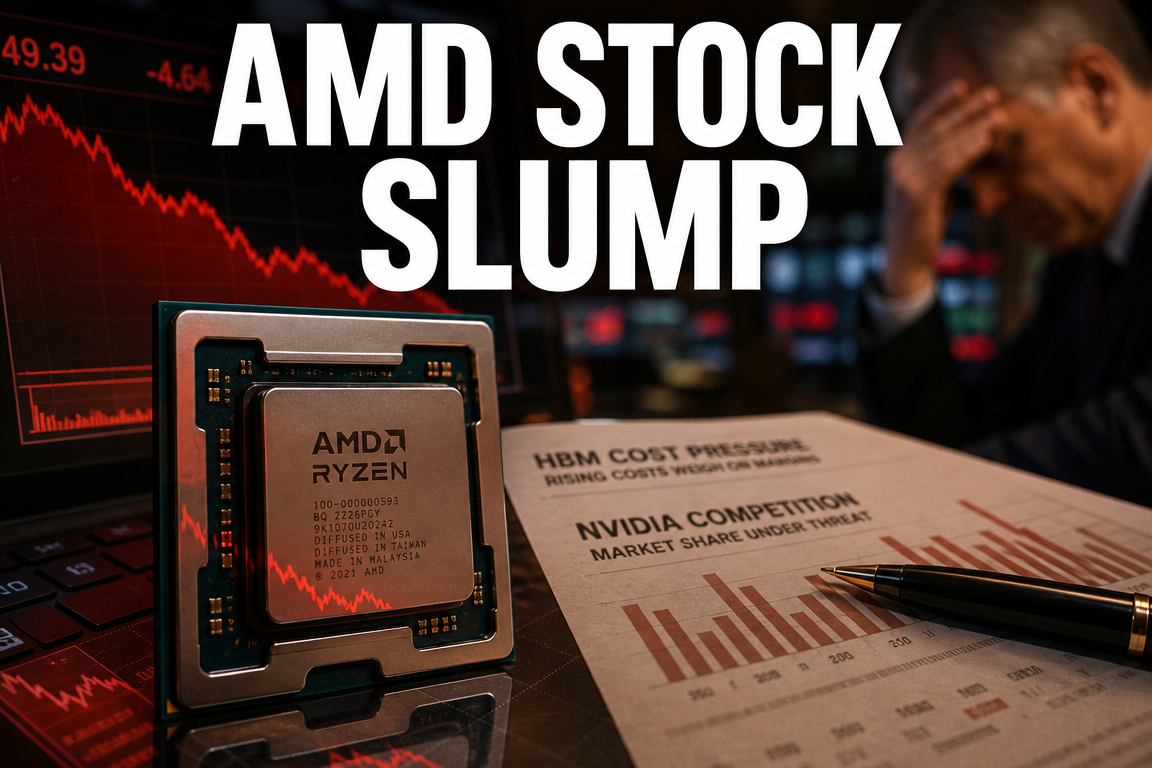
AMD fell more than 8% at one point in pre-market trading after earnings.
Micron, Broadcom, and others also weakened, reflecting a pause in AI-related semiconductor names.
Nvidia, by contrast, held onto gains.
This is the key market signal of the day.
It suggests that investor confidence remains more firmly with Nvidia even after a strong AMD report.
Healthcare was supported by Eli Lilly’s earnings strength.
In communications services, Google and Meta advanced, while Amazon also traded firmer.
2. Eli Lilly earnings beat: obesity-drug growth drove results
Eli Lilly reported second-quarter results that exceeded market expectations.
Revenue rose about 48% year over year.
The main driver was strong sales of its GLP-1 obesity and diabetes treatments.
The obesity-drug market is evolving into a major industry that is reshaping global consumer trends and healthcare spending patterns.
Eli Lilly’s shares rose about 4% to 5% in pre-market trading for this reason.
In addition, Eli Lilly announced the acquisition of Atai Bionics, a psychiatric-drug developer, for about $2.8 billion.
The deal signals an expansion beyond obesity therapies into neuropsychiatric pipelines.
In short, Eli Lilly delivered both near-term earnings strength and a stronger long-term growth narrative.
That is why healthcare stocks are receiving renewed attention during the U.S. earnings season.
3. Disney earnings: streaming and theme parks both recovered
Disney also posted results that beat expectations in pre-market trading.
Adjusted EPS for the third quarter increased about 28% year over year to $2.06.
The most notable area was the Experiences segment.
Revenue from Disney parks, theme parks, and cruises rose about 10%.
The streaming business also improved.
Revenue from Disney+ and other streaming operations increased about 11%.
The key point for Disney is that both major growth engines advanced at the same time.
If post-pandemic recovery in theme parks continues alongside improved streaming profitability, Disney could see a stronger valuation re-rating.
Disney also said it will move its consumer products business into the entertainment segment starting in fiscal 2027.
The goal is to strengthen IP monetization by linking films, characters, merchandise, and streaming more tightly.
4. Sandisk earnings ahead: a barometer for the memory cycle
Sandisk is scheduled to report earnings after the U.S. market close.
The market expects EPS and revenue to exceed consensus estimates.
Still, investors remained cautious ahead of the release.
That caution reflects concern that even strong earnings, like AMD’s, may not be enough to support the share price.
Sandisk’s results are important for assessing the memory semiconductor cycle.
They provide insight into NAND demand, data center storage investment, and actual storage demand from AI server expansion.
For Korean investors, Sandisk is a useful reference point for the memory cycle at Samsung Electronics and SK Hynix.
It also helps gauge whether AI server investment is lifting not only GPU and HBM demand, but also SSD and high-performance storage demand.
5. U.S. July ADP private payrolls: weaker than expected, but limited market impact
U.S. July ADP private payrolls increased by 44,000.
That was below the market forecast of 70,000.
The previous month’s figure was also revised down to 95,000.
This points to a slowdown in private hiring.
Employment gains came from education and healthcare.
By contrast, leisure, hospitality, and transportation lost jobs.
Normally, softer hiring would raise expectations for rate cuts.
However, inflation remains the more important variable for the Federal Reserve.
As a result, this ADP report alone is unlikely to materially change the rate outlook.
The market is more likely to focus on the official U.S. jobs report due Friday and the next inflation releases.
6. AMD earnings highlights: the numbers were nearly flawless
AMD’s second-quarter results were exceptionally strong on a headline basis.
Revenue exceeded $11.5 billion, setting a new record.
Revenue increased about 95% year over year and about 14% sequentially.
Operating income rose about 245% year over year.
Net income increased about 253%, reflecting significant margin improvement.
Gross margin reached 56%.
That was a substantial increase from 43% in the same period last year.
Adjusted EPS was $1.66.
That was about 21% higher than the prior quarter’s $1.37.
In other words, AMD sold more, sold at higher margins, and expanded net profit significantly.
On the numbers alone, the report did not justify the stock decline.
7. AMD income structure: how $11.5 billion in revenue became $2.76 billion in net income
AMD generated about $11.5 billion in revenue in the second quarter.
That revenue came from server CPUs, AI GPUs, notebook CPUs, gaming chips, and related products.
However, not all revenue becomes profit.
As a fabless company, AMD designs chips in-house but relies on foundries such as TSMC for manufacturing.
After wafer costs, packaging, testing, and manufacturing expenses, gross profit is left.
AMD’s gross profit in the second quarter was about $6.4 billion.
R&D, sales and marketing, and general and administrative expenses are then deducted.
That produced operating income of roughly $3.9 billion.
After interest expense and taxes, net income was about $2.76 billion.
Finally, dividing net income by the share count produces adjusted EPS.
This quarter’s adjusted EPS was $1.66.
8. AMD by segment: data center dominated
The most important segment in AMD’s report was clearly data center.
Data center revenue increased about 107% year over year.
Revenue for the quarter was about $6.7 billion.
Since AMD’s total revenue was about $11.5 billion, more than half came from data centers.
Operating income from the data center segment was about $2.1 billion.
Client and gaming revenue grew about 7%.
Embedded revenue grew about 12%.
Given both growth rate and profit contribution, AMD’s valuation is now being driven primarily by expectations for data center and AI chips.
9. AMD guidance: second-half AI demand appears stronger
AMD guided third-quarter revenue to about $13.0 billion.
That is roughly $1.5 billion above second-quarter revenue.
The guidance also came in above market expectations.
AMD said shipments of its next-generation AI system, Helios, are expected to ramp in the second half of the year.
AMD sees AI demand remaining strong through 2027.
The market also focused on possible collaboration with major customers such as Microsoft and Anthropic.
This matters for Korean investors as well.
Higher AI GPU shipments at AMD imply higher demand for HBM.
The key suppliers in the HBM market are Samsung Electronics and SK Hynix.
10. AMD earnings-call question 1: what does it mean that Helios is ahead of plan?
A TD Cowen analyst asked whether Helios being ahead of expectations referred to improved yields or stronger customer orders.
CEO Lisa Su said it referred to total orders and customer demand, not yields.
She said customer demand for Helios in 2027 is stronger than AMD internally expected.
This was an important answer.
It indicates not just product execution, but actual demand from large customers.
11. AMD earnings-call question 2: is CPU supply tight?
Morgan Stanley asked whether current CPU supply is constrained.
CEO Lisa Su acknowledged that supply is tight.
She said demand had been stronger than expected throughout the first half of the year.
However, supply conditions should improve gradually in the second half.
This suggests that the data center investment cycle has not yet weakened.
It also indicates that demand remains solid not only for AI servers but for general server CPUs as well.
12. AMD earnings-call question 3: when will Helios revenue begin to contribute materially?
Helios did not contribute meaningfully to second-quarter results.
Production and shipment are still at an early stage.
AMD’s CFO said Helios will begin shipments at the end of the third quarter, ramp in the fourth quarter, and scale more materially in the first quarter of next year.
In other words, the more important issue is future revenue rather than current results.
The market will be watching how much of AMD’s AI demand outlook translates into actual sales.
13. AMD earnings-call question 4: when can GPUs overtake CPUs?
Barclays asked when GPU business could surpass CPU business.
AMD does not disclose separate GPU and CPU results within data center.
CEO Lisa Su did not give a direct timeline.
Instead, she said the AI data center market is much larger than the server CPU market.
The message was cautious, but the direction was clear.
AMD sees AI GPUs as the larger long-term opportunity.
For now, however, the company intends to grow both CPUs and GPUs.
14. AMD earnings-call question 5: does heavier HBM usage pressure margins?
Bank of America noted that Helios appears to use more HBM than competing products.
Because HBM is expensive, greater usage can raise costs.
CEO Lisa Su said AMD has worked closely with memory suppliers.
She added that the company expects sufficient HBM supply for 2027 requirements.
Still, she did not deny that Helios is HBM-intensive.
Instead, she emphasized that more HBM improves performance.
Put simply, AMD’s response was that heavier HBM use is deliberate because it supports higher performance, and the configuration can be adjusted based on customer requirements.
15. What others are missing: AI GPU sales may rise without a proportional margin benefit
One of the most important but less discussed points in AMD’s report is that higher AI GPU sales do not automatically translate into sharply higher profitability.
AMD’s CFO said the data center AI business has lower margins than the company average.
By contrast, server CPU business carries relatively higher margins.
This is a critical point.
Markets often assume that stronger AI GPU sales are unambiguously positive.
But HBM, advanced packaging, and foundry costs add significant pressure to the cost structure.
As a result, even if AMD gains share in AI GPUs, actual profitability will depend on its cost structure and pricing power.
That may be one of the key differences between Nvidia and AMD.
16. Why AMD shares fell: 1) expectations were already high
AMD delivered strong earnings.
The guidance was also strong.
Data center revenue was robust.
Even so, the stock fell.
The main reason is that market expectations were already elevated.
Investors had already priced in a strong report from AMD.
Beating consensus by itself was not enough to lift the stock further.
During earnings season, expectations matter as much as the numbers.
This is a classic case of good results not being enough to support the share price.
17. Why AMD shares fell: 2) rising capex created concern
AMD’s capital expenditure in the quarter was about $808 million.
That was roughly 2.8 times higher than the $282 million recorded in the same period last year.
Expanding AI infrastructure requires investment.
However, investors want to know whether such spending will eventually generate returns.
AMD still has more than $13 billion in cash and liquid assets.
Its financial capacity for AI investment appears sufficient.
Even so, near-term cash flow pressure and payback timing may weigh on the stock.
18. Why AMD shares fell: 3) Elon Musk’s endorsement of Nvidia
Elon Musk’s remarks also added pressure to AMD shares.
Musk said that SpaceX would use Nvidia GPUs exclusively, or to that effect.
He also described Nvidia’s Vera Rubin architecture as best-in-class.
For AMD, the timing was unfavorable.
The comments came immediately after a strong earnings release and amounted to a public endorsement of Nvidia by a major AI infrastructure customer.
That does not change AMD’s fundamentals.
But it can clearly affect investor sentiment.
In AI semiconductors, share-price premiums are shaped not only by technology but also by the choices of major customers.
In that respect, Nvidia’s brand power and customer lock-in remain highly significant.
19. What Korean investors should watch: the Samsung Electronics and SK Hynix link
AMD’s results are not just a U.S. semiconductor story.
For Korean investors, they are an important reference for HBM demand at Samsung Electronics and SK Hynix.
HBM is essential in AMD’s AI GPUs and the Helios platform.
As AI GPU shipments increase, HBM demand should also rise.
Analysts repeatedly asked about HBM supply and pricing during the earnings call for this reason.
HBM is now a core component that influences both performance and cost in AI semiconductors.
SK Hynix has a strong position in HBM, and Samsung Electronics is also expanding into higher-value memory products.
AMD’s AI GPU expansion is therefore a positive medium-term signal for Korean memory manufacturers.
At the same time, if HBM prices become too high, AMD’s margin pressure will increase.
HBM suppliers must therefore prove both competitive pricing and consistent quality.
20. Most important investment takeaway for today
First, AMD’s earnings were not merely good; they were very strong.
However, the market is no longer in a phase where good earnings alone guarantee a higher share price.
Second, AI semiconductor investment remains strong, but margin structure matters.
More important than revenue growth are HBM costs, packaging expenses, and customer pricing power.
Third, the difference between Nvidia and AMD is not only product performance.
The key issues are which large customers choose which platform, and how strong the ecosystem is.
Fourth, Eli Lilly and Disney both showed that consumer demand and healthcare spending remain resilient.
That helps ease recession concerns.
Fifth, softer ADP payrolls may support rate-cut expectations, but the Federal Reserve is still likely to prioritize inflation.
Accordingly, the rate outlook should be judged after upcoming inflation data, not on employment data alone.
21. Conclusion: AMD’s decline reflects a reset in expectations, not a fundamental setback
AMD’s share-price decline should not be read as an earnings miss.
The company delivered strong results in data center revenue, total sales, earnings, and guidance.
However, the market had already priced in a higher bar.
Rising capex, AI GPU margin pressure, and Musk’s Nvidia comments combined to trigger a short-term pullback.
Over the medium term, the key question is how much Helios shipments translate into actual revenue.
Another important issue is whether AMD can increase AI GPU share while managing HBM-related cost pressure.
This episode should be viewed not simply as “AMD fell,” but as a sign that the AI investment cycle is moving into its next phase.
The market is now scrutinizing profitability, customer wins, and supply-chain stability more closely than growth alone.
< Summary >
AMD reported second-quarter revenue above $11.5 billion and adjusted EPS of $1.66, both well above expectations.
Data center revenue reached $6.7 billion and accounted for more than half of total revenue.
However, the stock declined as investors weighed AI GPU margin pressure, rising capex, elevated expectations, and Elon Musk’s endorsement of Nvidia.
Eli Lilly delivered an earnings beat on obesity-drug growth, while Disney showed simultaneous gains in streaming and theme parks.
Sandisk’s results will be an important test for the memory semiconductor cycle.
U.S. ADP private payrolls were weaker than expected, but inflation remains the Federal Reserve’s main focus.
Korean investors should monitor how AMD’s Helios ramp and HBM demand affect Samsung Electronics and SK Hynix.
[Related Articles…]
- AMD AI Chip Earnings and Data Center Growth Analysis
- HBM Memory Cycle and Korean Semiconductor Investment Strategy
*Source: [ Maeil Business Newspaper ]
– AMD 날았다 머스크가 찬물?ㅣ일라이릴리 어닝 서프라이즈…비만약 질주ㅣ디즈니 호실적…스트리밍·테마파크 동반 성장ㅣ샌디스크, 4분기 실적 발표…메모리 업황 주목ㅣ홍혜진의 뉴욕브리핑