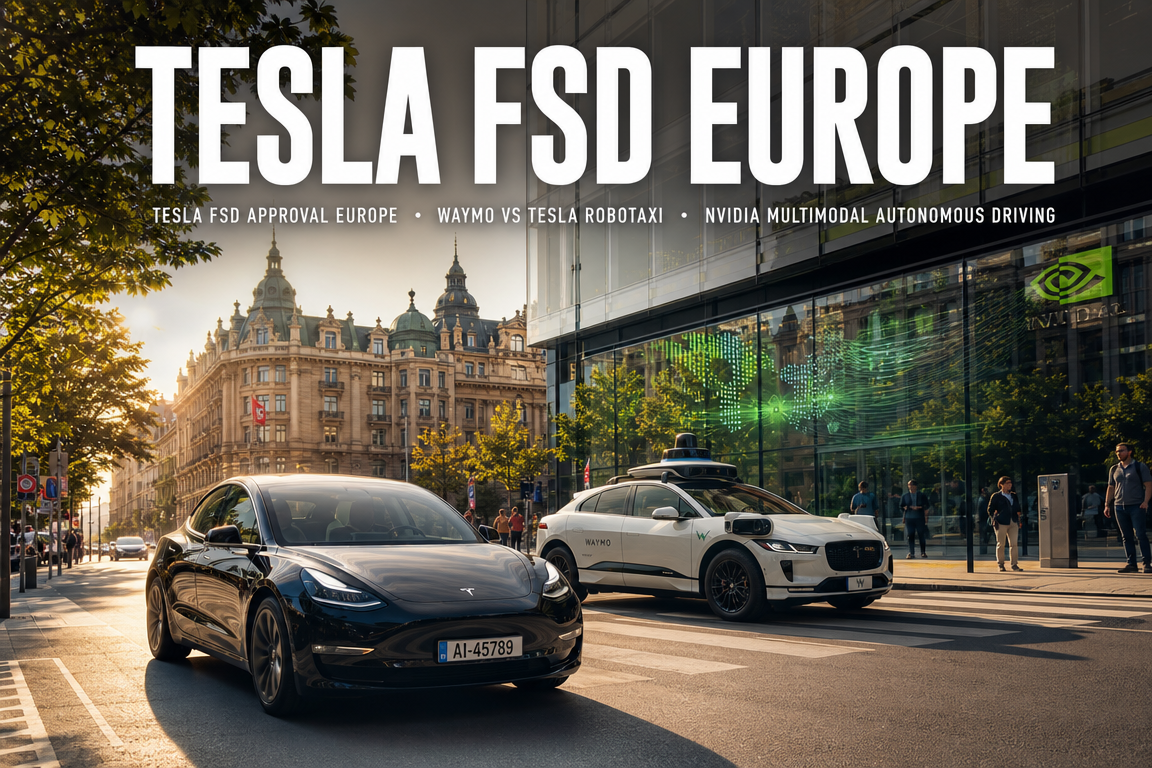
● Tesla, Waymo, Nvidia, FSD, Robotaxi, Clash
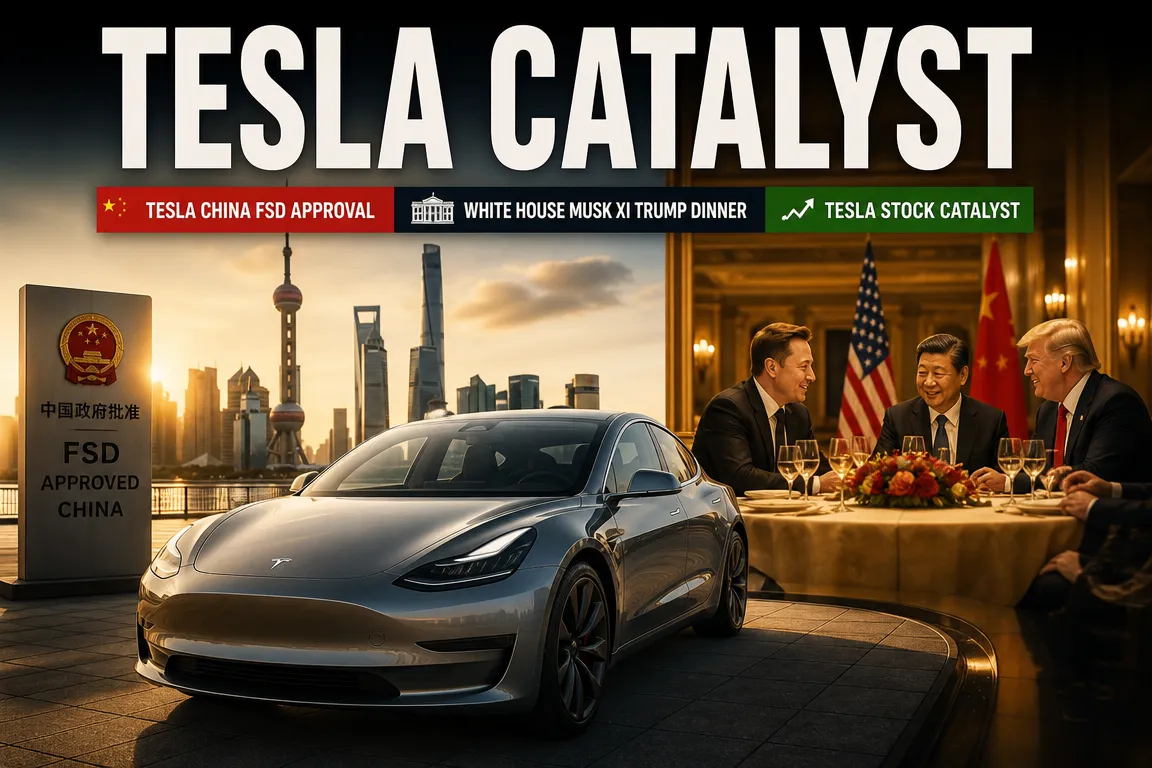
Tesla FSD vs. Waymo and Nvidia in the Autonomous Driving Race: What $321 Tesla Shareholders Should Watch Now
The core issue is not simply “camera versus lidar.”
On the day Tesla closed at $321.55, down 1.77%, the autonomous driving industry received a set of messages that directly challenged Tesla’s core strategy.
Waymo argued that camera-only systems eventually reach a plateau in safety improvement, while Nvidia introduced a multimodal autonomous driving model that effectively reinforced the non-Tesla camp.
At the same time, Tesla expanded its free FSD trial in Europe and recorded its sixth consecutive month as the top imported car brand in South Korea.
In other words, while the technology debate appears to be moving against Tesla, market adoption and data accumulation continue to favor Tesla.
This report summarizes the implications from the perspectives of Tesla stock, autonomous driving, FSD, robotaxi, AI semiconductors, and the U.S. equity market.
1. Market backdrop: why Tesla fell despite a strong U.S. market
According to the source text, Tesla closed at $321.55.
That represents a 1.77% decline from the prior day.
The broader U.S. market was relatively strong.
The S&P 500 and the Dow Jones Industrial Average were trading near record highs, while AI-related technology stocks were rebounding after a weak July.
Tesla, however, did not follow the broader market advance.
The reason is clear.
Tesla stock is now driven less by electric vehicle deliveries and more by whether FSD and robotaxi can translate into a viable business.
As soon as Waymo and Nvidia both reinforced the message that camera-only systems are insufficient, the market began to reprice Tesla’s autonomous driving risk.
2. Alphabet shock: why AI talent outflows moved the market
The source text states that Alphabet shares fell as much as 5.4% intraday.
The trigger was the departure of key Google AI research personnel.
In particular, Jeff Dean, a senior scientist who spent 27 years at Google, was among four core employees leaving to found a new AI company.
Although the company was described as an amicable separation with Google as an investor, the market interpreted it differently.
In AI competition, the most important asset is not only the model, servers, or data centers, but ultimately top-tier research talent.
As a result, the market viewed the departure of key AI personnel as a signal of potential long-term erosion in Alphabet’s competitive position.
This is also relevant to Tesla.
Tesla’s FSD is not simply an automotive feature; it is effectively a competition in AI models that interpret the physical world.
Autonomous driving is therefore both an EV competition and a global AI industry competition.
3. The SpaceX-related issue: strong numbers, but a section that requires verification
The source text states that SpaceX closed at $108.27, down 13.61%.
It also references an IPO, first quarterly results, revenue of $7.81 billion, a large lockup expiry, and 915.0 million shares of supply.
Investors should treat this section with caution.
SpaceX is generally not a publicly listed company, so references to share price, lockup expiration, and post-IPO results may reflect confusion with another company or with private-market trading data.
Accordingly, this information should not be used directly for investment decisions without verification through official filings or reliable financial data sources.
The broader takeaway is separate.
Even when results are strong, a sudden increase in supply from lockup expiration can pressure a stock in the short term.
The same principle applies to Tesla.
Even if Tesla strengthens FSD expectations, short-term share performance can still be affected by liquidity, rates, institutional flows, and options positioning.
4. Waymo’s challenge: “Camera-only systems eventually hit a limit”
Waymo Co-CEO Dmitri Dolgov directly challenged Tesla’s approach at a YC Startup School event.
The central message was straightforward.
Camera-only autonomous driving can improve quickly at first, but safety gains eventually flatten beyond a certain level.
Waymo relies on a multimodal system using high-resolution cameras, lidar, and radar.
The rationale is that each sensor compensates for the weaknesses of the others.
- Camera: strong for lane markings, traffic lights, signs, and color recognition.
- Lidar: directly measures 3D spatial structure regardless of lighting conditions.
- Radar: useful for detecting object speed and motion in rain, snow, and fog.
Waymo’s logic is redundancy for safety.
For example, if debris partially blocks a camera lens, a camera-based system may lose information in that direction.
But if lidar and radar are observing the same area, baseline perception can still be maintained.
From Waymo’s perspective, commercializing fully driverless robotaxi services requires more than “drives well”; it requires proof that the system can remain safe when conditions deteriorate.
That is why Waymo sees sensor redundancy as a minimum condition for commercial service.
5. Nvidia’s entry: autonomous driving is also a semiconductor and platform competition
Nvidia delivered a similar message on the same day.
According to the source text, Nvidia unveiled a robotaxi and autonomous driving model with 360-degree perception, higher-order driving judgment, and automated labeling capabilities.
The key point is that Nvidia is not trying to become a robotaxi operator.
Nvidia sells chips, software, and autonomous driving development platforms.
In other words, the more companies adopt multimodal systems using cameras, lidar, and radar, the more favorable the environment becomes for Nvidia.
Multimodal autonomous driving generates significantly more data.
In addition to camera footage, systems must process lidar point clouds, radar signals, and vehicle sensor data in real time.
That increases demand for high-performance AI semiconductors, data centers, and training infrastructure.
In this structure, Nvidia is a natural beneficiary.
Nvidia’s emphasis on multimodal autonomous driving is therefore both a technical position and a business strategy.
If Tesla succeeds with camera-only autonomy, some of the autonomous driving infrastructure market available to Nvidia would shrink.
Conversely, if the industry standard shifts toward multimodal systems, Nvidia’s influence would expand further.
6. Tesla’s counterargument: “The problem is not sensors, but data”
Tesla is pursuing a fundamentally different path from Waymo and Nvidia.
Tesla previously removed even radar from its vehicles and moved toward a camera-based vision system.
Elon Musk’s argument is simple.
Humans drive with eyes and brain, not with lidar or radar.
By that logic, autonomous driving should also be possible with cameras and neural networks.
Tesla’s strength is hardware cost.
Adding lidar and radar increases vehicle cost.
By contrast, a camera-centered architecture is lower cost and can be deployed more quickly across millions of mass-market vehicles.
Tesla’s strategy is not to operate a small number of highly equipped test vehicles.
Its strategy is to turn millions of vehicles on public roads into a data collection network.
That is the key difference from Waymo.
7. Sensor conflict: why Musk opposes lidar and radar
Many investors assume that more sensors automatically mean greater safety.
That intuition is understandable.
But Tesla’s concern is different.
Elon Musk has long argued that sensor conflict is a real problem.
A camera may indicate that no object is present ahead, while radar detects an object.
In that case, the system must choose between conflicting inputs.
A vehicle traveling at 100 km/h moves about 28 meters per second.
If camera and radar diverge within that short interval, the system may brake suddenly or make the wrong decision.
Tesla has previously stated that mismatches between radar and camera inputs can lead to malfunction or unnecessary braking.
In other words, Tesla is not arguing that more sensors are bad.
The point is that more sensors make data integration more complex.
Tesla has chosen to reduce that complexity and dramatically improve the quality of camera-based neural networks.
8. Waymo’s rebuttal: “Sensor conflict can be solved through design”
Waymo is not unaware of this issue.
Waymo believes sensor conflict can be managed by probabilistically determining which sensor to trust in different conditions.
For example, camera weighting can be increased during daylight, while radar and lidar confidence can be increased in fog or heavy rain.
From Waymo’s perspective, sensor conflict is not something to avoid but something to manage.
If managed effectively, multimodal systems can be safer than camera-only systems.
The debate is ultimately one of philosophy.
Tesla seeks to solve the problem through simpler hardware and larger-scale data accumulation.
Waymo seeks to prove safety through expensive hardware and redundant design.
9. Tesla’s European FSD free trial expansion: not just marketing
According to the source text, Tesla is expanding a two-month free trial of FSD Supervised for European owners.
Some owners in the Netherlands reportedly received an additional two-month trial after an initial one-month offer, bringing the total to three months.
Similar cases were mentioned in Denmark.
This is not merely a promotional campaign.
For Tesla, the free trial is also a data acquisition strategy.
The more vehicles that activate FSD on public roads, the more data Tesla can collect.
That data is then used to train its neural networks.
Tesla’s approach in Europe is also shaped by regulation.
The Netherlands has become an important reference point for local approval of FSD Supervised in Europe.
The source text notes that, based on RDW certification, countries such as Lithuania, Estonia, Denmark, and Belgium may follow the Dutch approval framework.
As the number of approved countries expands, Tesla gains a larger market for free trials.
That in turn expands data collection.
Tesla appears to be building the evidence base needed for future approval discussions by accumulating real-world driving data before regulations fully open.
10. Tesla’s safety data: 65 million km in Europe and a 5.2x figure
The source text states that Tesla presented data showing FSD as 5.2 times safer than human driving based on 65 million km of accumulated European driving data.
This is Tesla’s central message to regulators and consumers.
The claim is not that the system is theoretically safe, but that actual road data is demonstrating its safety.
The text also states that Tesla has 1.48 million paid FSD subscribers globally.
This is important because it suggests that FSD is evolving beyond a beta feature into a recurring revenue model.
As margins in EV sales compress, FSD subscription revenue could have a significant impact on Tesla’s valuation.
Investors should evaluate these figures in two ways.
First, they should examine the methodology behind Tesla’s safety data.
Second, they should assess how much regulators in each market are willing to recognize that data.
Large data volume does not necessarily translate into rapid monetization if regulation remains restrictive.
11. France and Sweden: regulatory hurdles for Tesla’s robotaxi ambitions
The source text says France and Sweden are refusing to approve Tesla FSD on safety grounds.
It also notes that the European Commission is expected to vote on approval this autumn.
This is highly relevant for Tesla shareholders.
Tesla’s FSD strategy is not limited to the United States.
Meaningful scale requires expansion into Europe, China, and South Korea.
Europe is especially important because regulation is stringent and competitive interests among automakers are complex.
If Europe broadly approves Tesla FSD, Tesla can expand both data collection and subscription revenue.
If Europe tightens safety standards around multimodal systems, Tesla’s camera-based strategy will face greater scrutiny.
12. South Korea: what Tesla’s sixth consecutive month at No. 1 means
According to the source text, Tesla registered 1,237 vehicles in July, based on Korea Automobile Importers & Distributors Association data.
That represented 33.1% of the imported car market and marked Tesla’s sixth consecutive month in first place.
Tesla also dominated the top-selling model rankings.
- Model Y Premium
- Model Y Premium Long Range
- Model 3 Premium Long Range
Tesla’s strength in South Korea is clear.
The brand offers competitive pricing and strong product appeal.
It is also supported by expectations that FSD will eventually become available.
However, there is an important limitation.
Many of the Model Y and Model 3 vehicles sold in South Korea are produced at Tesla’s Shanghai Gigafactory.
According to the source text, these vehicles are currently unable to use supervised FSD.
U.S.-made models, including Model S, Model X, Cybertruck, and some older U.S.-built Model 3 and Model Y vehicles, are said to be the initial eligible set.
Therefore, strong Tesla sales in South Korea do not automatically imply an immediate FSD revenue catalyst.
Approval in Korea is likely to be linked to regulatory developments in Europe.
European decisions may help clarify the direction of Korean regulation as well.
13. Comparison with BYD: Tesla still retains brand and software premium
The source text states that BYD remained highly ranked even in a month when it was excluded from government subsidy eligibility, but its sales fell 38.8% month over month.
This is relevant for understanding the Korean EV market.
BYD is a strong price-competitive brand.
However, Tesla still leads in subsidies, brand trust, charging experience, and software ecosystem.
More importantly, Tesla is not just selling cars; it is selling charging access, OTA updates, and FSD expectations as part of an integrated platform.
If the EV market becomes purely a price competition, Tesla’s margins would face pressure.
But if autonomous driving and software subscriptions begin to scale, Tesla can be valued differently from BYD.
14. The most important point often missed in the broader news flow
The key point is not which technology is “right,” but which company can first produce the data needed to persuade regulators.
Waymo has chosen a structure that makes safety easier to prove.
Because it uses lidar and radar, it is easier to explain to regulators.
The message that redundancy lowers failure risk is intuitive.
Tesla, by contrast, has chosen a structure that is harder to explain but faster to scale.
It can accumulate real-world data from millions of vehicles.
The fact that FSD cumulative driving exceeds 10 billion miles is central to that strategy.
Autonomous driving is therefore not just a technical debate; it is a three-way competition.
- Regulatory credibility: which approach governments will recognize as safer
- Data scale: how many edge cases have been learned from real roads
- Business scalability: whether the model relies on expensive robotaxi-only vehicles or can be deployed across mass-market cars
Viewed through these three lenses, the strategic differences between Tesla and Waymo become much clearer.
15. What $321 Tesla shareholders should watch now
Tesla shareholders should focus less on short-term price movement and more on strategic milestones.
At around $321, Tesla’s share price may already reflect a substantial portion of FSD and robotaxi expectations.
As a result, validation metrics are more important than expectations from here.
First, watch the progress of FSD approval in Europe.
Expansion from the Netherlands, Denmark, and Belgium into broader European approval is critical.
Second, watch the conversion rate from free FSD trials to paid subscriptions.
Free trials are useful for data collection, but enterprise value depends on paid adoption.
Third, watch for delays in the robotaxi commercialization timeline.
For Tesla’s autonomous driving valuation to be fully reflected in the stock, the market needs visibility beyond supervised FSD and toward unsupervised operations.
Fourth, compare Waymo and Tesla through measurable safety data.
The next phase is not rhetoric but data.
Cumulative miles, intervention frequency, accident rates, and insurance data are the key indicators.
Fifth, monitor the pace of Nvidia’s autonomous driving ecosystem expansion.
If global automakers increasingly adopt Nvidia’s multimodal platform, Tesla may face greater pressure in the technology standard-setting race.
16. Conclusion: Tesla’s risk and opportunity come from the same source
Tesla’s biggest risk is camera-based autonomous driving.
If Waymo and Nvidia are correct that camera-only systems have limits, Tesla’s FSD and robotaxi valuation could face a correction.
But Tesla’s biggest opportunity is also camera-based autonomous driving.
If Tesla can demonstrate sufficient safety using cameras and neural networks alone, it can scale autonomous driving globally at a much lower cost than competitors.
Waymo has chosen the easier path for proving safety.
Nvidia benefits as multimodal autonomous driving expands.
Tesla is betting everything on data scale and software distribution.
The key question for Tesla stock is straightforward.
Can Tesla convert more than 10 billion miles of FSD data into real approval for driverless robotaxi operations?
The answer to that question is likely to determine the direction of Tesla shares going forward.
< Summary >
Tesla closed lower at $321.55, but the core issue is FSD and robotaxi rather than the short-term stock move.
Waymo argues that camera-only autonomous driving faces structural limits in safety improvement.
Nvidia is strengthening the multimodal autonomous driving platform and supporting the non-Tesla camp.
Tesla is instead competing through cameras, neural networks, and large-scale real-world data.
Expanding free FSD trials in Europe is a data acquisition strategy, not just marketing.
Tesla remains the top imported car brand in South Korea for six straight months, but FSD access for China-built vehicles is still limited.
Investors should monitor European approval, FSD subscription conversion, robotaxi timing, safety metrics, and the expansion of Nvidia’s autonomous driving ecosystem.
[Related Articles…]
*Source: [ 오늘의 테슬라 뉴스 ]
– 웨이모·엔비디아 “안 된다”는데 머스크는 무시 — 100억 마일로 검증 중인 $321 테슬라 주주는 지금 어떻게?
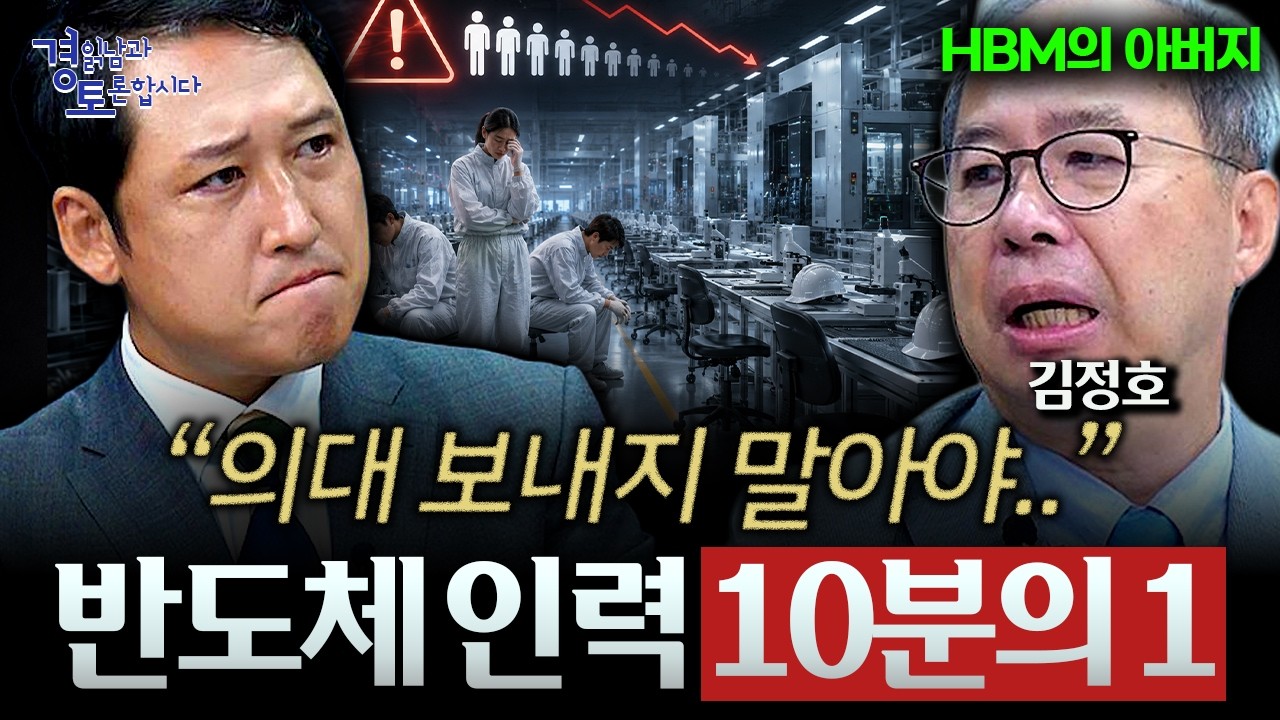
● Korea, Nvidia, AI, HBM, Physical AI
Can Korea Surpass Nvidia: The 10-Year Contest Shaped by AI Semiconductors, HBM, and Physical AI
The central issue is not a simple optimistic view that Samsung Electronics and SK Hynix can perform well.
For Korea to move beyond Nvidia, AI semiconductor technology, the AI transformation of manufacturing, semiconductor clusters, AI talent development, and industrial policy must be aligned in a single direction.
The point often missed in other coverage is that the key variables are not only technology, but also time and talent.
The semiconductor industry is not a one- or two-year trend; it is the result of at least 10 years, and often 30 to 40 years, of cumulative investment.
In the end, the next growth engine for the Korean economy will depend not on simply following Nvidia, but on building a Korea-specific AI industrial model that combines manufacturing and AI.
1. What it really means to say Korea could surpass Nvidia
Professor Kim Jung-ho’s message is not a straightforward stock-market call that Korea will defeat Nvidia immediately.
The core argument is that Korea can create new global competitiveness by combining its existing strengths in semiconductor manufacturing, memory semiconductors, HBM, automobiles, batteries, shipbuilding, and factory automation with AI.
Nvidia is the leading company of the AI era.
It has become the de facto standard in AI semiconductors by dominating GPUs, the CUDA ecosystem, and the data center market.
However, rather than competing in the same way as Nvidia, Korea can differentiate itself by applying AI deeply to manufacturing sites and semiconductor processes.
In practical terms, while Nvidia is a leader in the chips that run AI, Korea can become a leader in manufacturing that performs better through AI.
If Samsung Electronics, SK Hynix, Hyundai Motor, and domestic materials, parts, and equipment companies move together, Korea’s economic structure could change materially.
2. Why AI and semiconductors must be viewed together now
In the past, semiconductor competition centered on process miniaturization, yield, and production capacity.
Now AI models, data centers, HBM, packaging, design, manufacturing automation, and physical AI are linked within a single ecosystem.
HBM is Korea’s strongest card in the AI semiconductor market.
SK Hynix and Samsung Electronics occupy important positions in the global HBM supply chain.
As demand for AI servers and data centers increases, the strategic value of high-bandwidth memory is likely to rise further.
However, HBM alone is not sufficient.
The objective is not only to produce memory well, but to understand the entire AI system, apply AI to manufacturing processes, and extend capabilities toward solving customer problems.
This is the meaning behind the message that Korea must go beyond the walls of semiconductors and then beyond the walls of AI.
3. The core competitive advantage emphasized by Professor Kim: engineers who cross boundaries
Professor Kim said that he himself did not stop at being a semiconductor expert, but began focusing on AI study after 2015.
He explained that AI terminology is completely different from semiconductors, and that it was difficult at first, but that once the terms and structure were understood, the two fields began to connect.
This may sound like a personal anecdote, but it carries an important message for Korea’s industrial base.
Future manufacturing competitiveness cannot rely solely on AI specialists supporting manufacturing from the outside.
People who understand manufacturing sites must understand AI, and people who understand AI must understand real process and production issues.
Human resources, finance, production, engineering, quality control, and facilities management must all accept AI as a practical tool for their work.
Only when this change becomes part of corporate culture can manufacturing AI transformation deliver measurable results.
4. Policy direction: semiconductor fabs, AI data centers, and physical AI
The government is treating AI and semiconductors as core pillars of national industrial policy.
Key themes include semiconductor fab investment, AI data centers, physical AI, and manufacturing AI transformation projects.
The Ministry of Trade, Industry and Energy’s M·AX program should be understood within this context.
M·AX can be seen as a policy framework intended to combine manufacturing and AI to improve productivity and industrial competitiveness in Korea.
The important point is that this is not merely a digital transformation initiative.
It is closer to a strategy that embeds AI into decision-making, equipment operations, quality prediction, supply chain management, energy efficiency, robotics, and process optimization across manufacturing.
Korea has a strong manufacturing base.
That creates an opportunity to compete not by following the U.S. software model, but by applying AI to factories, equipment, semiconductor lines, and automotive production lines.
5. The biggest constraint is time
The most realistic point made by Professor Kim is that this is a race against time.
Korea’s memory semiconductor success was not created overnight.
It was the result of more than 40 years of corporate investment, national support, engineering effort, and university talent development beginning in the early 1980s.
AI semiconductors and physical AI follow the same logic.
Government projects are often designed around four- to five-year budget cycles.
But turning them into revenue, market share, operating profit, and global market power may require at least 10 years.
This is one of the main weaknesses of Korea’s industrial policy framework.
If administrations, ministries, budgets, and evaluation criteria change, long-term projects can lose momentum.
Semiconductors and AI require cumulative investment over long horizons, but current institutions still do not fully match that pace.
6. The fast-follower era is over
Korea grew for a long time through a fast-follower strategy.
It followed the paths created by leading companies in the U.S. and Japan, then succeeded through price competitiveness, production efficiency, and quality improvement.
But in the AI semiconductor era, there is no fixed playbook.
It is difficult to become a global leader by simply copying a model developed by someone else.
Now the country must move first, while accepting the risk of failure.
That is why collaboration is necessary.
In the past, competition among departments, companies, and individuals often produced results.
But in a frontier industry with high uncertainty, collaboration reduces risk.
Memory, foundry, system semiconductor design, packaging, materials, parts and equipment, AI models, data centers, and manufacturing sites must move together.
Within firms, internal barriers must also come down, and joint research and ecosystem building are needed across companies.
7. The core of a semiconductor cluster is not the plant, but the school
The Yongin semiconductor cluster, major investments by Samsung Electronics and SK Hynix, and the development of regional semiconductor fabs are all important issues.
However, Professor Kim emphasized that if a semiconductor cluster is designed properly, the school should be built at the center first.
This perspective is highly significant.
A cluster is not complete simply because it has factories, roads, power, and water.
It must also have a talent circulation structure in which people can study, research, experiment, and connect directly to companies.
He proposed a school that trains 1,000 students per year in semiconductors and AI.
The idea is for the government to cover tuition and living expenses from admission through doctoral study, then connect graduates to corporate hiring.
Without this level of ambitious talent policy, competing with the U.S. and China in AI semiconductors would be very difficult.
8. Korea’s biggest bottleneck: a shortage of AI and semiconductor talent
At present, Korea has far fewer engineers than the United States and China.
At major Chinese universities, electronic engineering graduate cohorts can reach around 1,000 students per school.
Korea’s population base is smaller, and its youth population is declining rapidly.
An even larger problem is the concentration of top talent in medical schools.
If the highest-performing students who should be entering AI semiconductors, electronics engineering, and manufacturing AI instead choose medicine, Korea’s long-term technological competitiveness will weaken.
Of course, physicians are essential to society.
But from the perspective of national growth strategy, Korea also needs enough doctoral-level semiconductor specialists, AI researchers, process engineers, and system designers.
The issue is not individual choice.
It is the incentive structure.
The system must make AI and semiconductor careers attractive in economic, social, and quality-of-life terms.
9. To reverse the medical-school concentration, compensation matters more than rhetoric
Professor Kim Gwang-seok’s interpretation is also realistic.
In a capitalist society, talent moves toward better compensation and opportunity.
The path to becoming a semiconductor PhD or AI engineer must offer a better future than the path to becoming a physician if talent migration is to occur.
Tuition support alone is not enough.
Research funding, living expenses, military-service benefits, guaranteed corporate hiring, higher starting salaries, long-term stock options, technology startup support, and social recognition must all be designed together.
Professor Kim mentioned a society in which core engineers at Samsung Electronics, SK Hynix, and related companies could eventually earn annual compensation at the KRW 1 billion level.
That may sound extreme, but it is not unreasonable by global AI talent-market standards.
Leading U.S. technology companies already offer compensation packages worth billions of won to top AI researchers.
To protect core technology in the global supply chain, Korea’s engineer compensation structure must also move toward global standards.
10. Korea’s differentiating strengths in AI semiconductors
Korea’s first strength is memory semiconductors.
Capabilities accumulated in HBM, DRAM, and NAND provide a strong foundation for the AI era.
The second strength is the manufacturing base.
Korea has a production structure rich in real industrial data, including semiconductors, automobiles, batteries, displays, shipbuilding, steel, and electronics.
The third strength is speed.
Korean companies are known for fast decision-making and the ability to concentrate investment in periods of crisis.
The fourth strength is the potential for industry-academia-research collaboration.
If KAIST, Seoul National University, POSTECH, major research institutes, corporate labs, and startups are properly connected, commercialization speed could improve significantly.
The fifth strength is a strong sense of national urgency.
The recognition that if semiconductors weaken, the entire Korean economy weakens, is already widespread.
If that urgency is translated into policy and investment strategy, it could create substantial momentum.
11. The most important points often omitted in other coverage
First, surpassing Nvidia is not simply a matter of building a better GPU.
It is a competition across an ecosystem that includes AI models, memory, packaging, manufacturing processes, data centers, power, talent, and clusters.
Second, Korea’s real opportunity lies in manufacturing that uses AI.
Rather than competing head-on with U.S. big tech in software platforms, Korea has a more realistic path in applying AI deeply to manufacturing and sharply improving productivity.
Third, the center of a semiconductor cluster should be a university, not only a fab.
Factories can be built with capital, but top engineers cannot be created instantly with money alone.
It takes at least 10 years of accumulated education and research infrastructure.
Fourth, a four- to five-year government program is not enough.
AI semiconductors and physical AI must be designed as national projects lasting more than 10 years.
Fifth, talent policy should be solved through incentives, not rhetoric.
To encourage top students to choose AI and semiconductors over medicine, those fields must offer better lives and better rewards in practice.
12. Investment considerations
This discussion is not only an industrial narrative, but also one relevant to long-term investment strategy.
As the AI semiconductor market expands, the importance of HBM, advanced packaging, semiconductor equipment, testing, power infrastructure, and data center-related companies may rise.
However, a short-term stock approach carries risk.
The semiconductor cycle remains volatile, and concerns about AI investment excess may recur.
The key is to distinguish between short-term themes and companies that can translate the theme into real revenue and profitability.
If manufacturing AI transformation accelerates, the beneficiaries may include not only software companies, but also factory automation, sensors, robotics, power management, and industrial data platform firms.
The sectors most likely to support Korea’s long-term growth are ultimately those that raise productivity.
13. Five hurdles Korea must overcome
The first hurdle is a shortage of talent.
Korea must train far more master’s and doctoral-level specialists in AI and semiconductors than it does today.
The second hurdle is ministerial fragmentation.
If fiscal, industrial, science and technology, education, and SME-related ministries act separately, results will be limited.
The third hurdle is internal corporate silos.
If memory, foundry, design, manufacturing, and AI organizations speak different languages, integrated competitiveness will not emerge.
The fourth hurdle is short-term performance pressure.
If a 10-year project is evaluated on a two- to three-year basis, meaningful innovation is difficult.
The fifth hurdle is the social definition of value.
Korea must move beyond the idea that only doctors, judges, and lawyers represent success.
Engineers, researchers, and manufacturing specialists must be respected and compensated accordingly if the country is to become a technology leader.
14. Conclusion: Korea’s 10-year contest has already begun
Saying that Korea can surpass Nvidia is not a slogan; it is a conditional scenario.
The conditions are clear.
Korea must develop AI semiconductor technology, execute manufacturing AI transformation, build schools within semiconductor clusters, and provide exceptional compensation for top-tier talent.
A future in which Samsung Electronics and SK Hynix move beyond Nvidia, and Hyundai Motor becomes a global automotive leader, would not be only a corporate success story.
The growth of those firms would extend to tax revenue, employment, housing, welfare, education, and regional economies.
Ultimately, AI and semiconductors are not only technology issues; they are national operating strategy.
To move Korea’s economy out of a low-growth structure over the next 10 years, semiconductors and AI must be designed as the country’s core growth engines.
What is needed now is not more slogans.
It is a policy framework that remains stable for more than 10 years, cooperation between ministries and companies, and a compensation structure that draws top talent into semiconductors and AI.
< Summary >
Korea cannot surpass Nvidia through GPU competition alone.
AI semiconductors, HBM, manufacturing AI transformation, physical AI, and semiconductor clusters must be connected.
The biggest bottlenecks are talent and time, not technology alone.
Government programs must last at least 10 years, not four to five.
The center of a semiconductor cluster must include schools and research institutions, not only factories.
To reduce medical-school concentration, Korea must offer AI and semiconductor talent greater financial rewards and social recognition.
Korea’s core strengths are memory semiconductors and manufacturing capability.
Combined with AI, these strengths could become the next growth engine for the Korean economy.
[Related Articles…]
- AI Semiconductor Industry Outlook and Korea’s Semiconductor Strategy
- Physical AI Reshaping Manufacturing and the Global Economy Outlook
*Source: [ 경제 읽어주는 남자(김광석TV) ]
– “한국이 엔비디아를 넘을 수 있습니다” AI·반도체 10년 승부 | 경읽남과 토론합시다 | 김정호 교수님 [3편]