● China AI Chip Self-Sufficiency, HBM Shock, Samsung, SK hynix at Risk
Why China’s AI Semiconductor Self-Sufficiency Matters for Samsung Electronics and SK hynix
The key issue is not simply that China is improving in AI.
China is rapidly localizing the full value chain that connects AI infrastructure, AI models, AI services, and physical AI products.
For Samsung Electronics and SK hynix, the more important issue is not near-term earnings over the next one or two years, but the direction of AI semiconductor demand after 2027.
The growth model that relied on U.S. Big Tech data center investment may face structural pressure, and as China completes its own AI ecosystem, the long-term revenue base and valuation of Korean semiconductor companies could also be affected.
This report summarizes how far China’s AI semiconductor self-sufficiency has advanced, why CXMT and YMTC matter, and what risks and opportunities Samsung Electronics and SK hynix are now facing.
1. Core News: China Is Viewing the AI Value Chain as Full Integration, Not Partial Catch-Up
Global AI competition is no longer just a contest of chatbot performance.
It is a competition to secure more computing power, collect more data, and commercialize AI services faster.
This trend is a key variable shaping U.S.-China technology rivalry, semiconductor supply chains, data center investment, HBM demand, and the global economic outlook.
The AI value chain can be divided into four stages:
- AI infrastructure: GPUs, HBM, DRAM, NAND, packaging, PCBs, CCL, data centers
- AI models: large language models and multimodal models such as DeepSeek, Kimi, and MiniMax
- AI services: super-app-based services such as WeChat, Alipay, Meituan, and DiDi
- AI products: collaborative robots, humanoid robots, home robots, autonomous vehicles, and smart appliances
The important point is that China is not developing these segments separately, but as a national ecosystem.
The United States is building AI through large-scale capital investment by companies such as Nvidia, OpenAI, Google, Amazon, Meta, and Microsoft.
China, by contrast, is linking domestic semiconductors, domestic models, domestic service platforms, and domestic robotics through a different model.
2. Data Center Counts Still Favor the United States by a Wide Margin
Based on the original source, the global number of data centers is cited at around 12,000.
The United States holds several thousand data centers and remains the clear leader.
China is cited at around 376, and Korea at around 105.
| Region | Data Center Scale | Implication |
|---|---|---|
| United States | Several thousand | Clear lead in AI data center investment and cloud infrastructure |
| China | Around 376 | Smaller in number, but faster ecosystem integration |
| Korea | Around 105 | Early stage of AI infrastructure expansion |
On the surface, the United States appears dominant.
However, the more important question is whether a large number of data centers alone is enough to control the full AI value chain.
The answer is no.
AI competitiveness is not determined only by data center count.
It requires integration across AI semiconductors, AI models, AI services, and productization capabilities.
3. AI Infrastructure: China Remains Weak in GPUs and HBM, but Is Advancing in PCBs, CCL, and DRAM
Semiconductors sit at the center of AI infrastructure.
GPUs are dominated by Nvidia in the United States.
HBM is led by Samsung Electronics, SK hynix, and Micron.
Advanced packaging is led by Taiwan’s ecosystem around TSMC.
Package substrates are still strongly influenced by Japanese firms.
In other words, the core pillars of high-performance AI semiconductors are still distributed across the United States, Korea, Taiwan, and Japan.
However, China is not weak across the board.
4. An Underappreciated Strength of China: PCB and CCL
As AI servers become more powerful, the importance of components that connect GPUs, HBM, and networking equipment increases.
This is where PCBs become critical.
PCBs serve as the interconnect platform for semiconductors and server components.
AI servers require high-speed data transmission, making signal-loss reduction increasingly important.
The key material for PCBs is CCL.
CCL is essential for minimizing signal loss in high-speed transmission environments.
As AI servers become more advanced, demand for high-spec CCL also rises.
China has competitiveness in PCB and CCL.
This area receives less attention in headlines, but it is a significant part of the AI semiconductor supply chain.
While China still trails in GPUs and HBM, its presence in server boards and materials is already substantial.
5. CXMT’s Rise: A Key Variable in China’s DRAM Localization
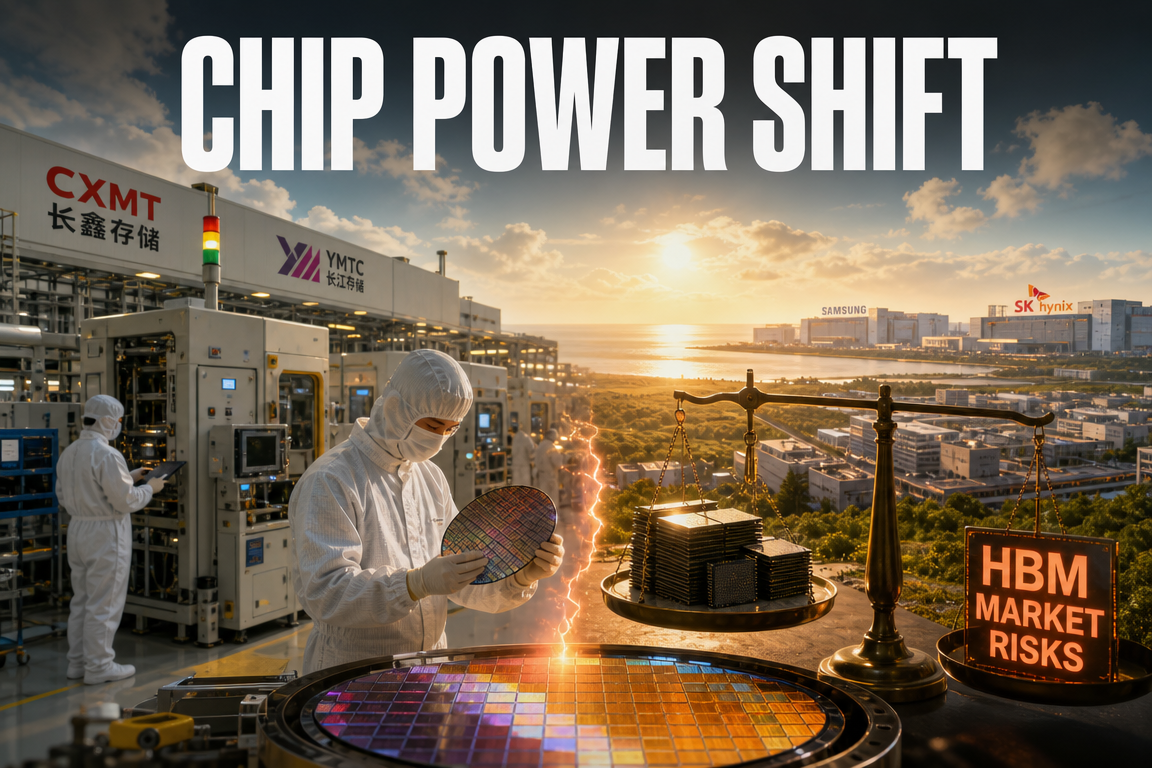
The most important company to watch in China’s AI semiconductor self-sufficiency is CXMT, or ChangXin Memory Technologies.
CXMT is China’s leading DRAM company.
It had little global presence in the past, but its share has recently increased rapidly.
The original source cites the following global DRAM market shares:
| Company | Share Cited in Original Source | Key Meaning |
|---|---|---|
| Samsung Electronics | Around 38% | Maintains a leading position in global DRAM |
| SK hynix | Around 29% | Strong in HBM and high-performance memory |
| Micron | Around 22% | Leading U.S. memory company |
| CXMT | Around 8% | Key driver of China’s DRAM localization |
More importantly, CXMT’s share may continue to rise.
The original source suggests that by 2026, CXMT’s share could expand to around 11%.
It remains difficult for China to match Samsung Electronics and SK hynix in technology, yield, and product breadth in the short term.
However, if China increases its share in commodity DRAM, pricing pressure could become real.
In that scenario, Samsung Electronics and SK hynix would need to move even faster toward higher-value products such as HBM, server DRAM, DDR5, LPDDR, and CXL memory.
China may dominate commodity products while Korea concentrates on premium products, but China is also attempting HBM mass production.
6. YMTC Also Matters: In the AI Era, NAND and Storage Remain Important
In China’s semiconductor localization strategy, CXMT represents DRAM, while YMTC, Yangtze Memory Technologies, is important in NAND flash.
AI data centers do not run on GPUs and HBM alone.
They also require storage infrastructure to save and retrieve large volumes of data.
Accordingly, NAND, SSDs, and data center storage competitiveness are part of AI infrastructure.
YMTC has continued technology development despite U.S. sanctions, supported by China’s domestic market.
China is building a structure in which DRAM is supplied by CXMT, NAND by YMTC, AI chips by Huawei and other fabless firms, and boards and materials by local suppliers.
The more complete this structure becomes, the lower China’s external dependence will be.
7. AI Models: DeepSeek and Kimi Show the Realistic Competitiveness of Chinese Models
China is also advancing rapidly in AI models.
Representative names include DeepSeek, Moonshot AI’s Kimi line, and MiniMax.
The original source references models such as Kimi K3 and DeepSeek V4 Pro.
The key issue is not whether a Chinese model wins a specific benchmark.
The more important point is whether actual usage and dependence are shifting.
The original source notes that between June 2025 and June 2026, reliance on U.S. models remains high, but the share of Chinese models is expanding rapidly.
The United States has a high-performance model ecosystem centered on OpenAI, Google, and Anthropic.
China has rapidly emerging models such as DeepSeek, Kimi, MiniMax, and Alibaba’s Qwen family.
Chinese models are particularly strong in cost efficiency, local service integration, Chinese-language data, and enterprise adoption speed.
AI competition is not solely about performance.
It is a comprehensive contest that includes price, inference cost, open-source strategy, government support, and speed of enterprise deployment.
China is expanding its market through a different approach from the United States.
8. AI Services: China’s Super Apps Offer a Distinct Data Advantage
The service layer shows China’s platform characteristics most clearly.
Chinese platforms such as WeChat, Alipay, Meituan, and DiDi integrate multiple services within a single app.
They combine messaging, payments, shopping, food delivery, ride-hailing, finance, public services, and healthcare.
By contrast, U.S. platforms are more fragmented.
Facebook and Instagram are centered on social networking.
Amazon is centered on e-commerce and cloud services.
Uber is centered on mobility.
| Chinese Platform | Main Functions | Advantage in the AI Era |
|---|---|---|
| Messaging, payments, shopping, public services, finance | Massive lifestyle data collection | |
| Alipay | Payments, finance, lifestyle services, commerce | Consumption and payment data accumulation |
| Meituan | Food delivery, reservations, local commerce | Offline behavior data collection |
| DiDi | Ride-hailing, mobility | Mobility and urban data accumulation |
The key keyword here is data.
In the AI era, companies that collect more data, more frequently, and across more use cases are better positioned.
Chinese super apps can collect broad daily-life data from users.
That data can be used to improve AI models, personalize services, and extend into advertising, finance, robotics, and autonomous driving.
9. Physical AI: The Real Battleground After 2027 Is Robotics and Productization
AI competition no longer ends at screen-based chatbots.
The next stage is physical AI.
Physical AI refers to AI products that move, judge, and perform tasks in the real world.
Examples include collaborative robots, humanoid robots, home robots, autonomous vehicles, and smart appliances.
The original source suggests that mass production of physical AI products may begin in earnest from 2027.
This matters because AI semiconductor demand will expand from data centers into robotics, vehicles, and appliances.
China already has a strong presence in the collaborative robot market.
For example, robot baristas such as Dobot Coffee are cited as capable of 24-hour operation and serving around 500 cups per day.
Humanoid robots such as Dobot Atom, used for popcorn vending, demonstrate the commercialization path of physical AI in mobility, autonomous decision-making, and repetitive task execution.
The home robot segment is also important.
Beyond U.S. companies such as Tesla’s Optimus and Figure AI, Chinese home-service robot companies are also moving quickly.
Typical use cases include dishwashing, laundry, cleaning, button operation, and switch control.
China’s advantage is price competitiveness.
Its strategy is to commercialize features that consumers are willing to pay for first, rather than pursuing technically perfect humanoid robots.
This resembles the pattern China has shown in electric vehicles, batteries, solar, and drones.
10. Impact on Samsung Electronics and SK hynix: The Main Issue Is Structural, Not Just Near-Term Earnings
This does not mean Samsung Electronics and SK hynix will see earnings collapse over the next one or two years.
Data center investment and HBM demand still support relatively strong near-term results.
SK hynix remains well positioned in HBM, while Samsung Electronics needs to recover HBM competitiveness and reorganize its foundry and memory portfolio.
The issue is that markets always discount the future.
Equity markets look beyond current earnings and begin pricing in the structure after 2027.
- First, rising DRAM share from China could lead to pricing pressure in commodity memory.
- Second, if China succeeds in HBM localization, Korea’s premium memory segment could also face competition.
- Third, the revenue structure tied to U.S. hyperscalers could weaken.
- Fourth, as the AI value chain shifts inside China, opportunities for Korean semiconductor sales into China may narrow.
- Fifth, valuations could be adjusted more by supply chain risk than by current earnings.
Another major variable is whether U.S. Big Tech can continue its large-scale AI data center investment.
U.S. hyperscalers are currently spending heavily.
This has driven explosive demand for Nvidia GPUs, HBM, server DRAM, and high-performance SSDs.
Korean semiconductor firms have benefited significantly from this trend.
However, if AI services fail to monetize as quickly as investment growth, markets will question whether this level of data center spending is sustainable.
If China expands AI more efficiently at lower cost, doubts about the U.S. high-cost AI investment model could deepen.
11. The Most Important Point That Is Often Understated in Other Coverage
The most important point is that China is not trying to outbuild the United States in data center count.
China is not competing only through massive U.S.-style data center spending.
Instead, it is integrating domestic semiconductors, cost-efficient AI models, super-app data, and manufacturing strengths in robotics, electric vehicles, and appliances.
This structure favors “mass-market AI” more than “high-end AI.”
As with China’s rise in electric vehicles, the initial strategy is to expand the market through affordable and practical products, then rapidly improve technology.
For Korean semiconductors, the real risk is not that China will immediately catch up to top-tier HBM.
The real risk is that China builds an AI ecosystem that does not require the highest-end HBM.
If a structure emerges in which lower-spec semiconductors are sufficient through model optimization, service integration, domestic data, and manufacturing efficiency, demand for expensive premium semiconductors may decline.
This is the most important structural change.
In other words, competition may shift from “who has the best chip” to “who can spread AI into daily life faster and at lower cost.”
12. History of Industrial Shifts: Is AI Semiconductor the Next Phase After Steel, Shipbuilding, Automobiles, Batteries, and Displays?
The most striking analogy in the original source is the shift in industrial leadership.
Steel moved from the United States to Japan, then Korea, and eventually China.
Shipbuilding also shifted from the United States and Japan to Korea, and then toward China.
China has rapidly expanded its presence in automobiles, EVs, batteries, and displays as well.
There is growing concern that a similar pattern could emerge in the AI semiconductor value chain.
Of course, semiconductors have much higher technological barriers than steel or shipbuilding.
HBM, advanced DRAM, EUV processes, advanced packaging, and high-performance GPUs are all difficult to replicate quickly.
However, assuming China cannot catch up is risky.
Like the tortoise in the classic fable, leadership should not be treated as permanent.
China is leveraging national strategy, domestic demand, price competitiveness, and manufacturing ecosystems at the same time.
13. Korea’s Response Strategy: DRAM Strength Alone Is Not Enough
Korea’s future direction is clear.
First, it must maintain a technological gap in HBM and next-generation memory.
HBM3E, HBM4, and HBM4E are important, along with CXL memory, PIM, and low-power AI memory.
Second, Korea must broaden its view to the entire AI infrastructure stack.
This includes packaging, substrates, materials, power semiconductors, cooling, networking, and data center operations.
Third, Korea needs an AI services and data strategy.
Korea is strong in semiconductor manufacturing, but weaker in super-app-style data ecosystems and global AI service platforms.
Ultimately, AI semiconductor demand comes from AI services, so manufacturing and services must be connected.
Fourth, Korea should secure the physical AI market early.
Korean companies must capture semiconductor and memory demand in robotics, vehicles, smart appliances, medical devices, defense, and logistics automation.
Fifth, Korea must design a more sophisticated strategy between the United States and China.
As U.S.-China technology rivalry persists, Korean firms may face pressure in both markets.
Accordingly, they need more than export-led growth: regional production, customer diversification, and technology portfolio diversification are increasingly necessary.
14. Investor Checklist: What to Monitor Now
Investors in Samsung Electronics and SK hynix should look beyond quarterly earnings.
The following items are important:
- The pace of CXMT’s DRAM share gains
- China’s HBM development and mass production prospects
- YMTC’s competitiveness in data center NAND and SSDs
- Whether U.S. hyperscalers continue their AI data center investment cycle
- The pace of monetization among AI service companies
- The mass production timing of Chinese physical AI products
- Samsung Electronics and SK hynix’s HBM customer diversification
- Supply bottlenecks in PCB, CCL, and packaging materials
Near term, AI semiconductor demand may remain strong.
However, over the medium to long term, China’s AI value chain self-sufficiency could become a variable that affects both growth rates and valuation multiples for Korean semiconductor firms.
< Summary >
China is pursuing self-sufficiency across the AI value chain, linking infrastructure, models, services, and physical AI products.
While the United States, Korea, and Taiwan remain strong in GPUs and HBM, China is advancing in PCBs, CCL, DRAM, NAND, AI models, super-app data, and robotics productization.
CXMT is increasing its DRAM share, and YMTC remains an important variable in AI data storage.
Samsung Electronics and SK hynix may continue to post solid near-term earnings, but as China’s AI ecosystem expands after 2027, medium- to long-term risks could increase.
The key issue is not whether China can immediately match top-tier semiconductors, but whether it is building an AI ecosystem that can operate at lower cost.
Korea will need to prepare across HBM leadership, next-generation memory, packaging, AI services, and the physical AI market.
[Related Articles…]
- AI Semiconductor Supply Chain Reorganization and Korean Corporate Strategy
- U.S.-China AI Competition and Key Variables for the Global Economic Outlook
*Source: [ 경제 읽어주는 남자(김광석TV) ]
– 중국이 AI 벨류체인 국산화(자립화)를 완성하고 있다. 삼성전자-SK하이닉스에 가져올 파장 [즉시분석]
● Pension Trap, 1500K Limit, Tax Shock
The 15 Million Won Annual Pension Receipt Limit: Why Receiving 15 Million Won in Your Account Can Already Be Excessive
One of the most commonly overlooked issues for those preparing for retirement through pension savings, IRPs, and private pensions is the following.
The 15 million won annual threshold for separate taxation of private pensions is based on pre-tax income, not after-tax income.
If you set your withdrawals so that 1.25 million won is deposited each month, totaling 15 million won per year, it may appear to be within the limit.
In practice, however, the pre-tax amount may already exceed 15 million won, making the taxpayer subject to comprehensive income tax reporting.
The issue does not end there.
Once the threshold is exceeded, the higher tax rate may apply to the entire private pension amount, not just the excess portion.
In addition, if health insurance contribution rules change in the future, retirement cash flow could be materially affected.
The key point is simple.
The 15 million won threshold for private pension separate taxation is based on pre-tax income, and for withdrawals starting after age 55, the safe benchmark is approximately 14.17 million won per year, or about 1.18 million won per month, in after-tax deposits.
1. Core point: the 15 million won private pension threshold is pre-tax
The most common misunderstanding among pension recipients is calculating the limit based on the amount actually deposited into the bank account.
However, tax law generally determines income thresholds on a pre-tax basis.
Just as annual salary is discussed in gross terms, pension income tax is also assessed on pre-tax withdrawal amounts.
For example, if monthly deposits are set at 1.25 million won, the annual cash received would be 15 million won.
But this is the after-tax amount.
Applying the 5.5% pension income tax rate for ages 55 and above implies a pre-tax withdrawal amount of approximately 15.87 million won.
In other words, the taxpayer may believe the threshold has been met, while legally the 15 million won limit has already been exceeded.
2. The numbers are more severe than they appear: earning 870,000 won more can increase taxes by nearly 1.8 million won
If private pension receipts remain at or below 15 million won pre-tax, the age-based pension income tax rate generally applies.
For ages 55 to 69, the rate including local income tax is 5.5%.
At 15 million won pre-tax, the tax burden is 825,000 won.
The net amount received is therefore 14.175 million won.
On a monthly basis, this is approximately 1.18 million won.
By contrast, if the account is structured so that 15 million won is received after tax, the pre-tax amount is approximately 15.87 million won.
In that case, the private pension separate taxation threshold is exceeded.
Once the threshold is exceeded, the taxpayer may need to choose 16.5% separate taxation, or in some cases the amount may be subject to comprehensive income taxation.
Applying a 16.5% rate to 15.87 million won results in tax of approximately 2.61 million won.
Compared with the 825,000 won tax burden at 15 million won pre-tax, the difference is roughly 1.78 million won.
In effect, receiving what appears to be 870,000 won more can lead to over 1.7 million won in additional tax.
This is the central trap of the 15 million won pension receipt limit.
3. Exceeding the threshold by even 1 won does not mean only the excess is taxed
Many assume that if the 15 million won threshold is slightly exceeded, only the excess amount will be taxed.
However, the tax structure for private pensions is not that simple.
Once the threshold is exceeded, the higher tax rate may apply to the entire private pension receipt amount rather than only the excess.
Currently, if private pension receipts exceed 15 million won per year, they are generally subject to comprehensive income taxation.
Alternatively, separate taxation at 16.5% may be elected.
Separate taxation avoids aggregation with other income, which is an advantage.
However, compared with the 3.3% to 5.5% pension income tax range, the burden is significantly higher.
For retirees with wage income, rental income, business income, or financial income, comprehensive income aggregation may also push them into a higher tax bracket.
In that case, the issue is not only pension taxation but overall retirement tax planning.
4. Health insurance contribution risk must also be considered
The 15 million won private pension threshold is not only a tax issue.
Health insurance contributions are another important variable.
At present, if private pension income exceeds 15 million won but separate taxation is elected, the burden on health insurance contributions may be partially avoided.
However, policy rules can change at any time.
Given aging demographics and ongoing pressure on the health insurance system, the linkage between pension income and health insurance contributions may become stronger over time.
For retirees, monthly cash flow is critical.
If pension withdrawals are increased slightly but result in higher comprehensive income tax and health insurance contributions, disposable retirement income may actually decline.
Accordingly, pension withdrawal strategy should be based not on gross withdrawal amounts alone, but on net income after tax and insurance contributions.
5. Public pensions and private pensions are not combined under the 15 million won threshold
Public pensions such as the National Pension are not combined with private pensions when applying the 15 million won threshold.
In other words, receiving a public pension does not count toward the private pension limit.
The 15 million won threshold applies to private pension products such as pension savings, IRPs, and private annuities that receive tax-favored treatment.
For retirement asset management, it is better to separate public pensions, occupational pensions, private pensions, ISAs, deposits, and dividend income into distinct layers.
Public pensions should be the foundation for basic living expenses, while private pensions should be drawn within the tax limit in a stable manner.
6. Practical safe benchmark: remember 1.18 million won per month after age 55
The most practical benchmark is 1.18 million won per month.
With a 5.5% tax rate for ages 55 to 69, the after-tax amount from 15 million won pre-tax is 14.175 million won.
That equals about 1.18 million won per month.
Accordingly, for those beginning pension withdrawals after age 55, monthly deposits of around 1.18 million won are the safer target.
It is not 1.25 million won per month.
Monthly 1.25 million won may look like 15 million won per year after tax, but on a pre-tax basis it can exceed the limit.
For those aged 70 and above, the applicable rate may change.
Generally, 4.4% may apply between ages 70 and 79, and 3.3% may apply at age 80 and above.
However, actual taxation depends on the product type, withdrawal method, and taxable amount, so verification with the financial institution or a tax professional is recommended before withdrawal.
7. Failing to distinguish between taxed and non-taxed contributions leads to calculation errors
Two types of funds can be mixed within pension accounts.
One is money that received a tax deduction.
The other is money that did not receive a tax deduction.
Tax-deducted contributions are subject to taxation when later withdrawn as pension income.
By contrast, principal that did not receive a tax deduction may face lower or no tax burden at withdrawal.
However, this does not mean all funds in the account are tax-free.
Investment returns generated inside the account may still be taxable.
Accordingly, the account may contain tax-deducted contributions, non-deducted contributions, investment gains, and retirement proceeds mixed together.
Withdrawal sequence and taxable sources must therefore be separated carefully.
8. The real issue is that financial institutions do not aggregate the 15 million won limit across all accounts
Many assume financial institutions will manage the limit automatically.
In reality, they do not.
A financial institution can explain how much can be withdrawn from its own account.
But it will not aggregate all pension accounts across multiple institutions and warn that the annual private pension limit has been exceeded.
For example, if 7 million won is withdrawn from A securities firm’s pension savings account, 6 million won from B bank IRP, and 3 million won from C insurance company’s private pension, the total is 16 million won.
Each institution may appear compliant when viewed individually.
But on an individual basis, the total exceeds 15 million won.
This is the most serious risk.
Those with multiple pension accounts, old insurance-linked pensions, or accounts managed by spouses or children should be especially careful.
9. Account-level withdrawal limits and the 15 million won private pension threshold are different concepts
Pension accounts have an “annuity withdrawal limit.”
This determines how much can be withdrawn annually as pension income from that specific account.
However, this account-level withdrawal limit is different from the 15 million won separate taxation threshold.
For example, suppose a pension account holds 150 million won and withdrawals begin at age 60.
If the sixth withdrawal year applies, annual withdrawals from that account could reach 36 million won.
But the fact that 36 million won can be withdrawn does not mean it is tax-safe.
The separate taxation threshold remains 15 million won pre-tax.
Conversely, if the account balance is 50 million won and the annual withdrawal limit is 12 million won, it may appear safe.
But if there are additional pension accounts at other institutions, the aggregate amount may exceed 15 million won.
The key variable is not the account-specific limit, but the total private pension income received in the individual’s name.
10. A spouse-based allocation strategy may also be useful
The 15 million won private pension threshold is assessed on an individual basis.
Therefore, if both spouses hold pension accounts, each may apply the 15 million won threshold separately.
For retirement asset management, it may be preferable to avoid concentrating all pension assets under one name.
For example, if only one spouse holds most of the private pension assets, withdrawal management around the 15 million won limit becomes more difficult.
By contrast, if pension accounts are distributed between spouses and withdrawals are balanced, tax burden may be reduced and cash flow stabilized.
That said, spouse income, health insurance dependency status, other financial income, and inheritance or gifting plans must also be considered.
Pensions are not simply financial products; they are part of the overall retirement tax structure.
11. A key point often missed in media and video coverage: why pension management apps and AI tax simulation are needed
The most important issue is not simply that the 15 million won threshold is pre-tax.
The real challenge is that individuals must aggregate all pension accounts, calculate gross and net income, distinguish between taxed and non-taxed contributions, and estimate comprehensive income tax and health insurance implications.
This is difficult even for younger individuals, and it becomes more burdensome in retirement.
It is a structural problem that cannot be solved by personal diligence alone.
In the future, AI-based pension management services linked to my data systems are likely to become increasingly important.
Services that consolidate pension savings, IRPs, occupational pensions, private pensions, and National Pension data from multiple institutions will be necessary.
If AI can automatically calculate pre-tax withdrawal amounts, estimated pension income tax, comprehensive income tax exposure, and health insurance impact, the value for retirees would be substantial.
This is not merely a convenience feature.
It could become a core fintech market in an aging society.
As pension assets grow, financial institutions may compete not only on product sales but also on withdrawal management and tax-efficient distribution strategy.
For individuals, real retirement asset management is completed not at the time of contribution, but at the time of withdrawal planning.
12. Practical checklist: what to verify before pension withdrawals
First, review all private pension accounts.
The Financial Supervisory Service’s integrated pension portal can be used to review National Pension, occupational pensions, and private pension information.
However, monthly withdrawal amounts and pre-tax versus after-tax calculations may still need separate confirmation.
Second, aggregate withdrawal amounts across institutions.
If pensions are received from A Bank, B Securities, and C Insurance, the amounts must be added together on a personal basis.
Third, calculate using pre-tax income, not the amount deposited into the account.
The relevant benchmark is 15 million won pre-tax, not 15 million won after tax.
Fourth, for ages 55 to 69, remember approximately 1.18 million won per month as the safe range.
To stay below 15 million won pre-tax, the key figure is approximately 14.175 million won per year after tax, or about 1.18 million won per month.
Fifth, distinguish between tax-deducted and non-deducted funds.
Tax-deducted contributions, non-deducted contributions, and investment gains are taxed differently.
Sixth, assess the possibility of aggregation with other income.
If there is wage income, business income, rental income, or financial income, comprehensive income tax exposure may increase.
Seventh, review health insurance implications as well.
Focusing only on taxes may distort the actual retirement living cost calculation.
13. Pension income tax rates by age
Pension income tax rates may vary by age at withdrawal.
Generally, 5.5% applies from age 55 to under 70.
4.4% may apply from age 70 to under 80.
3.3% may apply at age 80 and above.
Some withdrawal formats, such as life annuities, may be subject to separate rates.
Accordingly, it is better not to assume that 1.18 million won per month is universally applicable, but for those aged 55 to 69 it remains the most practical safe benchmark.
14. Situations retirees should be especially cautious about
First, continuing to work after retirement.
Lecture fees, consulting fees, wage income, and business income may be aggregated with private pension income, increasing the tax burden.
Second, having rental income.
Retirees with monthly rent income must consider both comprehensive income tax and health insurance contributions.
Third, having substantial financial income.
As interest and dividends increase, the overall tax burden may change due to financial income aggregation rules.
Fourth, holding multiple pension accounts.
Each account may appear compliant individually, but the aggregate amount can exceed 15 million won.
Fifth, applying for withdrawals online.
Online applications are convenient, but the taxpayer must still verify pre-tax and after-tax figures directly.
15. Conclusion: in pensions, withdrawal planning is more important than contribution planning
Pension savings and IRPs make tax deductions highly visible at the contribution stage.
As a result, many people manage contributions actively.
However, the most important stage is withdrawal after retirement.
If the pre-tax basis is misunderstood, pension income tax increases, comprehensive income tax reporting may be required, and health insurance contribution risk may also arise.
The 15 million won annual private pension threshold is always pre-tax.
For those in the 5.5% tax bracket after age 55, the practical benchmark is approximately 14.175 million won per year, or 1.18 million won per month, in account deposits.
Multiple pension accounts held across institutions must also be aggregated and managed carefully.
Retirement asset management is not a competition in returns; it is a strategy to protect after-tax cash flow.
Those who manage pension withdrawals well are the ones who truly succeed in retirement planning.
< Summary >
The 15 million won annual threshold for separate taxation of private pensions is based on pre-tax income, not after-tax income.
Structuring monthly withdrawals to deposit 15 million won after tax into the account may imply approximately 15.87 million won pre-tax, exceeding the limit.
If pre-tax income stays at or below 15 million won, the pension income tax rate at age 55 is 5.5%, or 825,000 won in tax.
However, receiving 15 million won after tax may result in tax of approximately 2.61 million won under 16.5% separate taxation.
For those withdrawing after age 55, a safe benchmark is approximately 14.175 million won per year, or 1.18 million won per month, in account deposits.
Public and private pensions are not combined under the 15 million won threshold, but all private pension accounts across financial institutions must be aggregated.
Tax-deducted contributions, non-deducted contributions, and investment gains must be distinguished to build an accurate tax strategy.
AI-based pension management and my data integration are likely to become important infrastructure for retirement tax management.
[Related Articles…]
Retirement Pension Tax Strategy and Withdrawal Planning
Retirement Health Insurance Contributions and Income Tax Management
*Source: [ Jun’s economy lab ]
– 연금 수령 한도 1,500만 원의 치명적인 함정! 세전과 세후 꼭 확인하세요 (ft.김봉옥 이사)