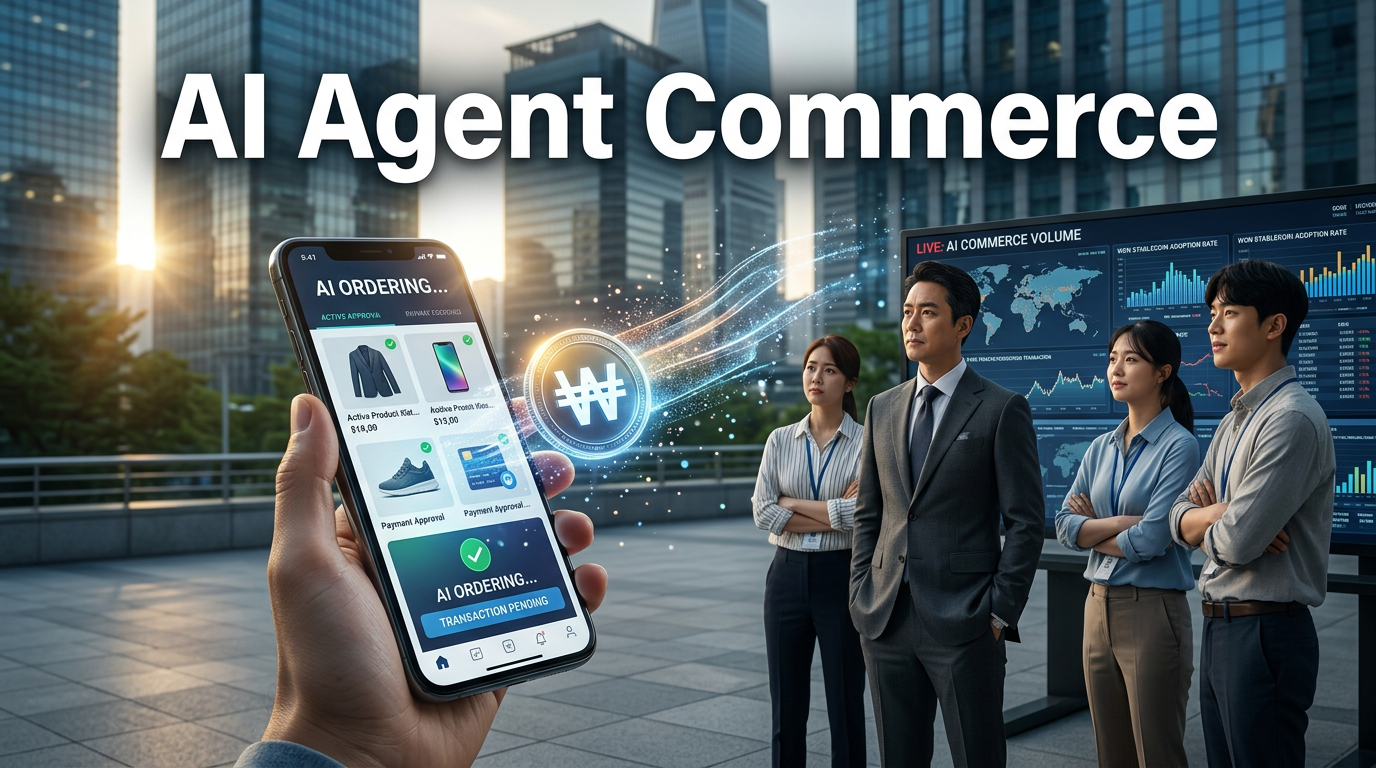
● AI Agent Commerce Payment Bottleneck Stablecoin Race
If Won-Backed Stablecoin Is Delayed, Why AI Commerce Leadership Will Shift to Overseas Platforms
The core point of this issue is not simply that “AI will do the shopping for you.”
What matters is that search boxes are disappearing, apps are receding into the background, and a structure is emerging in which AI agents handle consumption and payments 24 hours a day.
But the final bottleneck in this change is payments.
For AI agents to find flights, book hotels, place inventory orders, and even handle business-to-business transactions automatically, they need a payment method machines can use, not a credit card for humans.
That is why stablecoins are emerging as core infrastructure in the AI commerce era.
In particular, if won-backed stablecoin institutionalization is delayed, Korea’s domestic AI commerce market is likely to become dependent on dollar stablecoins and the standards of major U.S. tech companies.
This is not just a fintech issue, but a matter connected to monetary sovereignty, exchange-rate stability, the digital asset industry, global standard competition, and the direction of financial regulation.
1. What Is AI Agent Commerce?
AI agent commerce is a form of commerce in which an AI agent carries out the process of searching, comparing, and paying on behalf of the consumer.
Until now, online shopping has involved the consumer entering a desired product into a search box, comparing multiple sites, adding items to a cart, and paying directly.
But in AI agent commerce, when a consumer says, “Prepare a Tokyo trip for this weekend,” AI takes care of flights, hotels, schedules, and restaurant reservations on its own.
The consumer only states the conditions, and the AI connects with multiple platforms and APIs to find the optimal options.
Once this structure becomes fully established, the internet consumption pattern centered on search will shift to a consumption pattern centered on delegation.
- Consumers are freed from the labor of searching.
- AI reflects the user’s preferences, budget, schedule, and past purchase data.
- Apps disappear from the front end, and AI agents communicate with apps and APIs instead.
- Shopping, reservations, payments, and after-sales management all become automated.
In simple terms, until now consumers opened apps to get things done, but in the future they will delegate tasks to AI assistants.
Professor Kim Yong-jin describes this as the “era of intelligent delegation.”
2. How Will Consumers’ Daily Lives Change?
When AI agent commerce spreads, the first thing to disappear will be the fatigue of searching.
Today, the more information you find, the better your chances of making a good choice, but information overload also grows at the same time.
AI agents filter through enormous amounts of information on behalf of users and organize only the options they need.
- If you are going to Tokyo, it will build an itinerary by reflecting the weather, flight prices, hotel location, and personal preferences.
- When a refrigerator is connected to IoT sensors, it can automatically order daily necessities such as milk, eggs, and vegetables.
- By learning an individual’s consumption patterns, it can recommend and purchase the products needed at the right time.
- Users no longer have to repeat the same comparisons and payments every time.
The core point of this change is hyper-personalization.
AI agents remember what foods a user likes, what hotels they prefer, and even what time of day they like to travel.
If existing VIP concierge services were reserved for high-income users, AI agents can democratize that experience.
This is the beginning of the “democratization of the assistant.”
3. Why Will AI Agents Spread Faster in Business and the B2B Market?
AI agents are likely to spread faster in business-to-business transactions than in personal consumption.
That is because B2B transactions have clear objectives, obvious repetitive patterns, and a large amount of accumulated data.
AI is strong at analyzing vast amounts of data and finding patterns.
- Restaurants can automatically adjust ingredient order volumes based on the day of the week, weather, reservation status, and past sales.
- Manufacturers can analyze equipment data and predict the timing of parts replacement in advance.
- Factories can operate separate quality control agents, procurement agents, process management agents, and payment agents.
- Companies can reduce both excess inventory and stockout risk at the same time.
This flow also affects global supply chain management.
If AI calculates raw material prices, exchange rates, transportation costs, and delivery risk in real time, the speed of corporate purchasing decisions will increase dramatically.
In the end, AI agents go beyond simple task automation and become a core tool in AX transformation that changes a company’s cost structure and productivity itself.
4. The Problem Is Payments: If AI Can Do Everything but Payment Gets Blocked, the Market Stops
The most important bottleneck in AI agent commerce is payments.
If AI finds a good flight at 3 a.m. but has to wake the user for payment authentication, the meaning of automation is reduced.
If AI detects an inventory shortage and tries to order parts but lacks payment authority, a person must approve the transaction, and B2B automation is limited.
Credit cards today are a payment method for humans.
The card number entry, identity verification, payment confirmation, and approval procedures are all designed around human users.
For AI agents to pay independently, digital identity authentication and a machine-to-machine payment standard are needed.
- Credit cards are suitable for structures where humans make payments.
- AI agents must make payments automatically 24/7.
- For small, micro, and repeated transactions, card fee structures are inefficient.
- For AI to transact with AI, digital identity authentication and programmable payment methods are required.
That is why stablecoins are being discussed as the core payment method for AI agent commerce.
5. Why Stablecoins Instead of Credit Cards?
Credit card payments go through multiple steps, including card issuers, card networks, payment processors, and banks.
This process is stable, but it involves fees and settlement time.
Especially in an environment where AI agents handle countless small payments in real time, the existing card payment network can be inefficient.
Stablecoins are blockchain-based, enable 24-hour payments, offer faster settlement, and can reduce fees.
They also allow conditional payments through smart contracts.
- After receiving goods, payment can be made automatically once quality inspection is completed.
- AI can be configured to pay only within a set budget limit.
- Spending can be programmed to occur only at a specific time, for a specific purpose, or to a specific vendor.
- Settlement time can be greatly reduced even in cross-border transactions.
Traditional overseas card payments can take days to settle, but stablecoin-based payments can be processed much faster.
This creates a major competitive advantage in cross-border commerce, global B2B transactions, and digital content payments.
6. What Is the Difference Between Crypto Assets and Stablecoins?
Bitcoin, Ethereum, and stablecoins can all fall under the broad category of digital assets, but their characteristics are different.
Bitcoin has no issuing authority and exhibits high price volatility.
Ethereum has a strong character as a blockchain network that executes smart contracts.
By contrast, stablecoins are payment-oriented digital assets designed to be linked to the value of fiat currencies such as the dollar or the won.
| Category | Core Features | Suitability for AI Commerce |
|---|---|---|
| Bitcoin | No issuing authority, high price volatility | More of an asset than a payment method |
| Ethereum | Smart contract execution network | Strong infrastructure, but with price volatility |
| Stablecoin | Value linked to fiat currency, 24-hour payments possible | Most suitable for AI agent payments |
Stablecoins are usually designed by pegging value to a reference currency, such as 1 dollar per coin or 1,000 won per coin.
To do this, issuers must hold reserve assets such as government bonds and cash-equivalent assets.
They must also comply with financial regulations such as anti-money laundering and know-your-customer requirements.
7. The Biggest Problem if Won-Backed Stablecoin Is Delayed
The reason the discussion around won-backed stablecoin matters is not simply to create a new payment method.
The core point is who will dominate the payment standard in the AI commerce market.
If U.S. Big Tech firms, card networks, and payment companies create a dollar-stablecoin-based standard first, domestic companies will likely have to fit into that standard.
In that case, three problems arise.
- First, domestic companies may have to pay overseas platform usage fees.
- Second, transaction data may be accumulated within overseas standard systems.
- Third, Korea’s won-based payment ecosystem may be pushed aside by a dollar-based system.
Just as fee structures were created in the Apple App Store and Google Play Store, if global platforms dominate the payment standard in AI commerce, domestic companies may bear the cost burden.
Even more concerning is data dependency.
If payment, authentication, order, and consumption-pattern data pass through overseas platforms, domestic companies and the government may lose control over the data.
8. Why Monetary Sovereignty and Exchange-Rate Risk Are the Core Points
If there is no won-backed stablecoin and only dollar stablecoins spread, dollar-based payments may increase even in domestic transactions.
In that case, the Bank of Korea’s monetary policy influence could weaken.
Even if interest rates are adjusted, policy effects may be limited if actual digital transactions are moving on a dollar basis.
In addition, if the share of dollar payments in domestic consumption and corporate transactions increases, exchange-rate volatility may affect the real economy more directly.
Weakening the won-based payment ecosystem is not merely a fintech industry issue; it is a matter of monetary sovereignty.
- Domestic transactions may be processed through dollar stablecoins.
- The won-based payment data and financial flows may weaken.
- Exchange-rate fluctuations may be passed more directly to consumer and business costs.
- The transmission power of central bank monetary policy may decline.
This is the part many news reports treat relatively lightly.
Stablecoins are not just a coin industry; they are closer to the operating system of the future payment network.
9. How Are CBDCs and Private Stablecoins Different?
A CBDC is a digital currency issued by a central bank.
By contrast, a private stablecoin is issued by a private company, but maintains value based on fiat currency and reserve assets.
CBDCs have advantages in terms of stability and trust.
However, there are concerns that the central bank could directly track every transaction.
This is because personal consumption and corporate transaction information could become overly concentrated at the center.
Private stablecoins move fast in innovation and are easy to combine with various services.
However, they carry risks such as insufficient reserves, issuer risk, hacking, and internal control problems.
Therefore, the key point is not a simple either-or choice between “CBDC or private stablecoin.”
A mixed structure in which CBDCs are used for wholesale payments and interbank settlement, while private stablecoins are allowed for private AI commerce and digital payment innovation, is more realistic.
10. Why a Bank-Centered Approach Alone Is Not Enough
In Korea, there is a possibility that the stablecoin discussion will shift toward a bank-centered model.
Given the need for stability and supervisory control, a bank-centered approach is understandable.
But AI commerce and digital asset innovation are difficult to create with banks alone.
Innovation generally comes quickly from Big Tech, fintech, blockchain companies, and platform companies.
Banks are strong in trust and regulatory compliance, but in new user experiences and global platform competition, the speed of private technology companies matters.
- Banks can handle stable custody and settlement infrastructure.
- Fintech and Big Tech can create user experiences and AI payment services.
- Blockchain companies can provide on-chain payments and smart contract infrastructure.
- The government and the National Assembly must create an institutional framework that allows them to compete together.
If the entire system is designed around banks alone, speed and innovation may fall behind.
On the other hand, if everything is left to the private sector without regulation, stability risks may rise.
That is why what is needed is design, not control.
11. The Key Point Korea Must Not Miss in Global Standard Competition
The real battlefield of AI agent commerce is not the shopping mall screen but the standard.
Digital identity authentication standards, AI-to-AI transaction standards, stablecoin payment standards, and data portability standards are all connected.
Once a global standard is set, latecomers must bear the cost of following it.
Even if a company’s systems are already built, they must be adjusted again when the global standard changes.
That is the terrifying nature of standard competition.
- The countries that create standards earn platform revenue.
- The countries that follow standards bear transition costs.
- Platforms that dominate standards secure both data and authentication systems.
- In AI commerce, payment standards can directly translate into market power.
If Korea is slow to establish won-backed stablecoin and AI payment standards, domestic companies will have to compete under the rules of overseas platforms.
This is directly tied not only to corporate competitiveness but also to the national digital transformation strategy.
12. The Most Important Point Other News Often Does Not Explain Well
Many pieces of content view stablecoins from the perspective of “coin regulation” or “crypto investment.”
But the most important essence is that stablecoins may become the payment API of the AI agent economy.
As AI agents become part of everyday life, people may no longer enter shopping malls directly.
AI will choose products, compare prices, make payments, and track deliveries on their behalf.
At that point, the consumer touchpoint becomes the AI agent rather than the shopping mall app.
In this structure, who controls the authentication and payment standards of AI agents determines the market.
If overseas platforms dominate this standard, domestic commerce companies may lose the power to interact directly with customers.
Just as the search advertising market was reorganized around portal and global platforms, the AI commerce market could also be reorganized around agent platforms.
Ultimately, a won-backed stablecoin is not just a payment method but the minimum infrastructure for Korea’s AI commerce ecosystem to grow independently.
13. The Direction Korea Must Choose Going Forward
Korea should not approach won-backed stablecoin by allowing it recklessly or blocking it unconditionally.
The core point is rapid institutionalization and precise supervision.
- The issuance standards for won-backed stablecoin must be clearly defined.
- Full reserve backing and external audit systems must be strengthened.
- Anti-money laundering and customer verification rules must be designed for the digital environment.
- A competitive structure should be created in which banks, fintech, Big Tech, and blockchain companies can all participate.
- A digital identity authentication standard for AI agents must also be established quickly in Korea.
- The coexistence structure of CBDCs and private stablecoins should be reviewed.
The most dangerous choice is to decide nothing.
That is because the market will not wait.
If U.S. Big Tech and global payment companies set the standards first, Korea may end up importing those standards.
< Summary >
AI agent commerce is a major change that shifts consumption from search- and app-centered behavior to delegated consumption.
For AI to handle shopping, reservations, inventory management, and business transactions 24 hours a day, it needs a payment method machines can use.
The most suitable tool for this role is stablecoins.
If won-backed stablecoin institutionalization is delayed, Korea’s AI commerce market could become dependent on dollar stablecoins and overseas platform standards.
This issue is not about crypto investment; it is a national strategy issue involving monetary sovereignty, exchange rates, financial regulation, the digital asset industry, and global standard competition.
Korea must divide the roles of CBDCs and private stablecoins, and quickly design an open ecosystem where banks and technology companies can participate together.
[Related Articles…]
- Stablecoin and the Shift in the Digital Asset Market
- How AI Agents Are Changing Global Commerce Strategy
*Source: [ 티타임즈TV ]
– 원화 스테이블코인 늦어지면 AI 커머스, 글로벌에 먹힌다 (김용진 서강대 경영학과 교수)