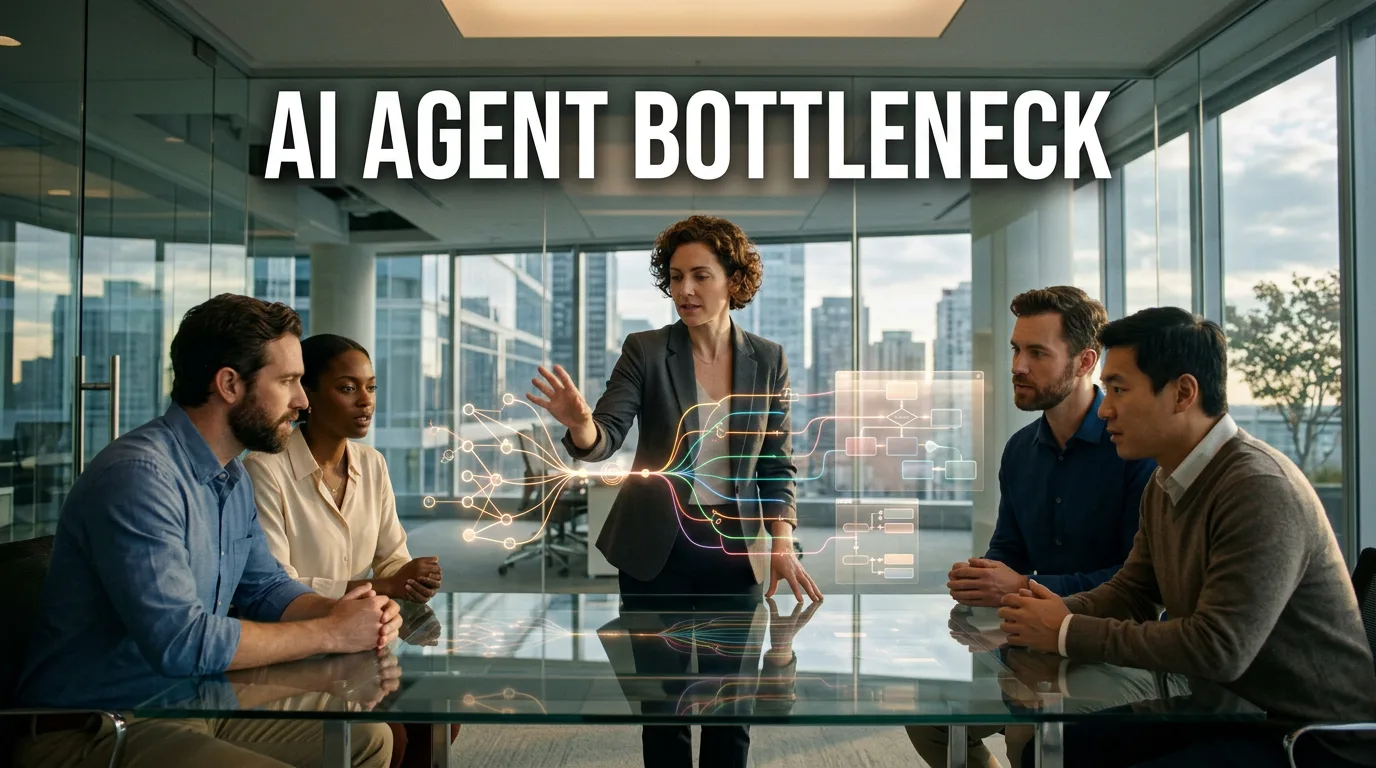
● AI Agent Bottleneck Is Human Understanding
Meta E7 Engineer on the Real Bottleneck in the AI Agent Era: What Is Slower Than Humans Is ‘Understanding’
The most important point in this piece is not simply that “AI agents replace jobs.”
What Meta is already struggling with internally is how to redesign an “organization whose main resource is people” into an “organization whose main resource is AI agents.”
In particular, the key takeaway is that the reason companies fail to adopt AI is not a lack of technology, but that people get stuck at the speed at which they understand, verify, and make decisions based on AI-generated results.
This perspective is an important shift that will connect everything from future global economic outlooks, productivity innovation, AI semiconductor investment, digital transformation, and smart factory strategies.
1. What Role Does a Meta E7 Engineer Play
Sunghyun Ahn, a senior staff engineer on Meta’s AX team, is at Meta’s E7 level.
At Meta, E7 is considered a top-tier technical leader, evaluated at roughly the top 3 to 5 percent of all engineers.
It is not simply a strong coder, but a role that must solve complex technical problems and create real business value and impact.
- He started as a Meta intern and grew to E7 in about eight years.
- E7 must solve technical complexity while also setting the direction for the organization and the business.
- It is a stage where one must solve problems that can affect not only the company but the entire industry.
The important point here is that Meta does not view an engineer’s growth as being centered only on “technical ability.”
As the level rises, the core evaluation shifts toward responsibility, strategy, risk management, collaboration, decision-making, and business outcomes.
2. Future Talent Standards Seen Through Meta Engineer Levels
What is interesting in this conversation is that Meta’s engineer level system is very close to the standards that will likely be used to evaluate talent in the AI era.
E3: Can You Finish the Work You Were Given?
E3 is a stage close to a new engineer.
The core point is whether, when given a project, you can produce visible results.
What matters more than working hard is the actual output.
E4: Can You Judge for Yourself and Collaborate?
From E4 onward, even when only a broad direction is given, you must decide for yourself what needs to be done.
It is not enough to simply do your own work well; you must also be able to help other E3s achieve their goals.
In other words, the evaluation standard expands from individual productivity to team productivity.
E5: Can You Take Responsibility for Part of the Business?
From E5 onward, this becomes the senior engineer stage.
Rather than simply finishing a project, you must design direction by looking at a roadmap spanning six months to two years.
Maintainability, scalability, risk management, and strategic thinking become important.
In particular, the move from E4 to E5 is described as the hardest transition.
The reason is that this is the stage where you are tested on whether you are someone others can trust and hand work to without worry.
When problems arise, you must not avoid them; you must be able to create and execute Plan A, Plan B, and Plan C.
E6: Can You Create Value for Other Leaders?
E6 goes beyond simply doing your own projects well.
You must be able to add real value to other senior leaders or organizational leaders.
You may solve problems by going deep technically, or you may help another leader work more easily by coordinating people relationships and risks.
E7: Do You Solve Problems That Can Influence the Entire Industry?
E7 is not enough if you only deliver internal company results.
You must directly tackle problems that only a few people in the entire industry can solve and produce results.
The problem Sunghyun Ahn focuses on is exactly this: “When AI agents appear, how should organizations be reorganized?”
3. AI Is Changing from an Answer Machine to a Working Colleague
Traditional chatbot-style AI was closer to a tool that answers when asked.
But AI agents are different.
Agents can remember, reason, and execute the next step on their own.
- Chatbots must be awakened and asked every time.
- AI agents can continue working while the user sleeps.
- Chatbots easily forget conversational context, but agents use past work and user preferences.
- Chatbots are answer-centered, while agents are task-execution-centered.
This change is huge from a company’s perspective.
In the past, when there were too few people, companies considered hiring more.
Going forward, the more important question is not “Should we hire more people?” but “How do we design agents and make them part of the organization’s resources?”
This is the starting point of the AI agent economy.
Corporate productivity innovation is shifting away from simply increasing headcount and toward creating a structure in which agents can work.
4. The Core Question for Meta’s AX Team: If People Are Not the Main Resource, How Does the Organization Change?
The organization Sunghyun Ahn belongs to is the AX team.
AX can be understood as a flow close to AI Transformation or Agent Experience.
The core point is to think about how AI agents can actually function as work resources inside an organization.
Traditional organizations are designed around human capabilities and limitations.
Because a CEO cannot directly know what 100,000 employees are doing, middle management, reporting systems, meetings, documents, and approval structures emerged.
In other words, the organizational structure itself is a system built to fit human limitations in understanding and time.
But once AI agents become the main resource, the premise changes completely.
Agents can perform multiple tasks simultaneously, summarize massive amounts of information, automate repetitive work, and prepare materials needed for decision-making.
In that case, simply adding AI on top of the existing organizational structure has clear limits.
5. The Real Bottleneck Is Not Technology but Human Understanding
The most powerful sentence in this conversation is that “the bottleneck is people, and our understanding has become the bottleneck.”
The machine has already finished the work, but people cannot move to the next step because they do not understand the results.
For example, imagine that ten AI agents produced reports, research, code, and market analysis materials overnight.
The problem is that in the morning, humans still have to read, verify, and judge all of those outputs.
Ultimately, the more work AI does, the greater the human cognitive load becomes—a paradox.
This is the real reason many companies do not achieve the expected results after introducing AI.
The issue is not that AI is insufficient, but that organizations lack the system to absorb, understand, and turn AI-generated results into decisions.
6. What It Means That “Understanding Cannot Be Delegated”
One widely cited view in AI is that “work can be delegated to AI, but understanding cannot be delegated.”
AI can write reports, draft code, and organize materials.
But whether the result is ultimately correct, whether it fits the organization, and what decision should be made must be understood by humans.
This is where differences in corporate competitiveness arise.
The company that uses the most AI does not win.
The company that quickly understands, verifies, and turns AI-generated results into action wins.
7. In the Agent Era, Harnesses and Control Devices Become Important
AI agents are powerful, but if you give them unlimited freedom, they become risky.
If you open up payment permissions, text messaging, calls, and access to external systems, unexpected problems can arise.
That is why something like a harness is needed.
A harness is, quite literally, a control device that keeps the agent from going off track.
You need to structure feedback so the AI agent does not repeat the same mistakes, design verification processes, and clearly define the scope of work.
Sunghyun Ahn gave the example of writing reports.
When AI produces a sentence you do not like, you do not just edit it and stop there.
You leave feedback such as “Why do I not like this expression?” and “How do I express and think in this way?”, and then reflect that in the control mechanism for the next task.
When this is repeated, the AI agent gradually comes to understand the user’s standards and the organization’s context.
Ultimately, good AI utilization is not about writing a single good prompt line; it is about building a system that trains and controls agents.
8. The Core Competencies in the AI Era Are Literacy and Questioning Skills
With the rise of AI, homework and document-work scores may go up.
But actual test performance or fundamental understanding may decline.
This problem is already appearing both in education and in corporate environments.
What will matter going forward is the ability to keep questioning AI until the end.
When an unfamiliar concept appears, you should not just move on; you should keep digging by asking, “What is that?”, “Why does it need to be designed that way?”, and “Is there another way?”
This is similar to the Socratic method of questioning.
When AI gives an answer, the person who turns that answer back into a question and keeps following the thread more deeply will achieve greater results.
Ultimately, the difference in AI utilization ability may come more from will and desire than from access to technology.
Some people stop at “this is good enough,” while others use AI to dig all the way down to the level of a paper.
Going forward, the gap in individual capability will likely depend greatly on how deeply one can leverage AI.
9. In Organizations, the First Problem AI Can Solve Is Communication Cost
One of the areas AI does best is communication.
Because it is a conversational model, it is strong at organizing, summarizing, explaining, translating, documenting, and delivering messages.
One of the biggest costs in business is communication overhead.
The scarcest resource for people is time, and a significant portion of that time is spent on alignment and persuasion.
- You must understand what the other person is thinking.
- You must persuade stakeholders inside the organization.
- You must organize meeting notes.
- You must prepare materials needed for decisions.
- You must repeatedly explain things to match context.
In Silicon Valley, AI use is already rapidly expanding in areas such as meeting minutes, presentation materials, code writing, and document summarization.
In particular, coding is text-based work, so the speed of AI adoption is very fast.
Next comes communication, and then decision-making processes.
10. Why Leadership Becomes the Bottleneck
In organizations, the biggest bottleneck often occurs at the leadership decision-making stage.
Even if a great deal of preparation is done in execution, important decisions ultimately rise to the leader.
But the leader’s time and understanding are limited.
The reason leaders can make good decisions is that they have a high level of information, context, experience, network, and organizational understanding.
Then the core question in the AI agent era becomes this.
“Can we make every member of the organization have leader-level context and information?”
If AI agents can understand the organization’s data, past decisions, project context, interpersonal relationships, and business goals, they can reduce decision-making bottlenecks.
In other words, it becomes possible to distribute the context concentrated in one leader’s head across the entire organization.
If this is implemented properly, corporate digital transformation will lead not just to simple automation, but to a change in the decision-making structure itself.
11. AI Agents Need Ontology to Work Properly
Ontology, simply put, is the work of structuring relationships and meaning so that AI can understand an organization’s information.
Humans can understand through context that “Alex An” and “Sunghyun Ahn” are the same person.
But if this relationship is not clearly defined, AI can get confused.
Inside companies, this problem becomes much more complex.
In areas with strong security and specialization, such as manufacturing sites, medical data, financial data, and defense data, there is a lot of context AI must understand.
- From which process did this data arise?
- How is this term used inside the company?
- What is the relationship between this project and that project?
- How do we distinguish this person’s opinion from objective facts?
- Why was a certain decision made in the past?
If this information system is not organized, the results created by AI agents may differ each time.
If one analysis says A and the next says B, the organization cannot trust AI.
On the other hand, an organization with a well-designed ontology is far more likely to get consistent results no matter who runs which AI.
This difference could greatly widen the AI productivity gap between companies in the future.
12. Why Context Engineering Is Becoming the New Blue Ocean
The field that designs how AI agents remember and use information is context engineering.
This is closely connected to ontology.
You must not simply store information; you must distinguish the nature of the information.
- Fact: objectively verified truth.
- Observation: something the agent observed.
- Opinion: one person’s view.
- Episode: events and context that occurred over time.
If information is systematized in this way, AI can distinguish “this is a fact, this is someone’s opinion, and this is an event that happened in a specific situation.”
Because project structures, data models, and work processes differ by company, generic AI alone is not enough.
Each organization needs a knowledge system and evaluation system tailored to it.
This area is highly likely to become a major blue ocean in the AX business.
The reason is that the market is opening up not just for consulting that introduces AI models, but for transforming an organization’s way of thinking and work structure into a form AI can understand.
13. Where NVIDIA’s AI Factory and Digital Twins Connect
The AI factory concept that Jensen Huang talks about also aligns with this flow.
An AI factory refers to a structure in which data is turned into knowledge, knowledge produces tokens, and those tokens function like an industrial operating system.
In manufacturing in particular, this connects with digital twins.
A digital twin is a method of creating a virtual world like a real factory and simulating processes and physical conditions within it.
This makes it possible to find inefficiencies without stopping the actual factory.
Process layout, production speed, bottlenecks, energy usage, and logistics flow can be optimized in a virtual environment.
Ultimately, a digital twin can be seen as the ontology of the physical world.
It is the process of turning real-world data into a structure AI can understand and enabling agents to optimize toward a goal.
This flow is directly connected to smart factories, AI semiconductors, manufacturing automation, industrial robots, and physical AI investment.
14. For Small and Medium-Sized Businesses, the Biggest Problem Is the Cost of Structuring Data
Large corporations can, given time, build their own AI organizations and organize their data.
The problem is small and medium-sized businesses.
SMEs struggle to handle ontology, data digitization, AI agent design, and security infrastructure.
That is why this area may require support at the national level.
This is because productivity innovation in SMEs is not just an individual company issue; it is directly tied to national competitiveness.
Going forward, what governments need to do may go beyond simply subsidizing AI education.
They may need to provide industry-specific standard data models, manufacturing process ontologies, SME AI agent platforms, and secure cloud infrastructure.
This part is also very important for the global economic outlook.
The productivity gap may widen significantly between countries where only large corporations use AI well and countries where AI adoption spreads to SMEs as well.
15. The Ethical Issue of How to Collect Employees’ Work Data
For AI agents to understand an organization, the work of members must be turned into data.
In Silicon Valley, there are even attempts to record workflows using wearable devices with recorders or cameras based on employee consent.
From a company perspective, this may be efficient.
If you record what employees talk about, how they make decisions, and what processes they use to work, it becomes easier to build an ontology.
But the ethical concerns are significant.
Should even conversations over coffee be recorded?
Where is the boundary between creative ideas and personal privacy?
Who owns the work data collected by the company?
Organizational innovation in the AI era is not just a technical issue.
Privacy, trust, labor rights, and data ownership must all be discussed together.
16. The Most Important Core Point That Most News Stories Do Not Talk About
Most AI news focuses on new model performance, AI semiconductor stock prices, and the scale of big tech investment.
But what is truly important in this conversation is something else.
First, the real battleground in AI adoption is not the model but the speed of organizational understanding.
No matter how good an AI a company uses, if people cannot understand it, the bottleneck remains.
Second, future corporate competitiveness will depend less on how much data you have and more on how well you define relationships within the data.
A company that structures its data so AI can understand it may become stronger than a company that simply has a lot of data.
Third, organizations where decision-making authority is concentrated in one leader may become slow in the AI era.
If AI agents provide leader-level context across the organization, decision-making structures may become more distributed.
Fourth, ontology and context engineering may become the next-generation AI infrastructure market.
It will not only be companies that build AI models that make money; companies that turn enterprise data into AI-friendly structures may create new markets.
Fifth, SME AI transformation becomes a core issue of national industrial policy.
Large corporations can manage on their own, but SMEs cannot.
If this gap is left unattended, the productivity gap across the entire industry could widen.
17. Changes to Watch From an Investment Perspective
This matters greatly from an investment perspective as well.
As the AI agent era becomes more established, solutions that change internal work structures may create a larger market than simple chatbot services.
- AI agent platform companies may draw attention.
- The enterprise data ontology solutions market may grow.
- Context engineering and AI memory management technologies may become important.
- Demand for AI semiconductors and data centers is highly likely to keep expanding.
- Digital twins and smart factories may become central to manufacturing AI transformation.
The next stage of AI investment is not just model competition.
It is moving into infrastructure competition that makes AI actually run inside organizations.
18. Questions Companies Should Check Right Now
Before choosing a model, a company that wants to introduce AI agents should first look at its organizational bottlenecks.
- What work consumes the most time in our organization?
- Where does decision-making get stuck most often?
- What context do we keep having to explain repeatedly?
- Are our company’s unique terms and knowledge system organized?
- Who will verify the results AI creates, and how?
- Do we have a feedback structure so agents do not repeat the same mistakes?
- How will we protect employee trust and privacy in the data collection process?
If you introduce AI without answering these questions, the POC may succeed while actual operations fail.
The core of AI transformation is not “adoption,” but “organizational redesign.”
19. Conclusion: Competitive Advantage in the AI Agent Era Belongs to the Organization That Understands Faster
When the era comes in which AI does the work instead of humans, the human role does not disappear; it changes.
People must verify more outputs, understand more quickly, and make more important decisions.
Therefore, the winner going forward will not be the organization that uses the most AI.
It will be the organization that rapidly absorbs AI-generated results into organizational knowledge, connects them to decision-making, and feeds them back into agent learning.
Ultimately, the core question in the AI agent era is this.
“Is our company an organization where AI can work?”
And the more important question is this.
“Is our organization ready to understand the results AI creates?”
< Summary >
The core message from Meta E7 engineer Sunghyun Ahn is that the bottleneck in the AI era is not technology but human understanding.
AI agents are changing from answer tools into working resources that remember and execute.
Companies must be redesigned from people-centered organizations into agent-centered organizations.
The biggest bottlenecks are communication, decision-making, and the speed of leadership understanding.
For AI agents to work properly, ontology and context engineering are needed.
Going forward, corporate competitiveness will likely depend less on adopting AI models and more on the ability to structure data so AI can understand it.
SME AI transformation may become a core issue requiring support at the level of national industrial policy.
[Related Articles…]
- How AI Agents Are Transforming Enterprise Productivity Strategy
- Global Economic Outlook Shaped by AI Semiconductors and Digital Transformation
*Source: [ 티타임즈TV ]
– “병목은 사람, 이해가 병목이다” (안상현 메타 AX팀 시니어스태프 엔지니어)