● Bond Shock, Korea Selloff
U.S. Treasury Risk and the Outlook for Korean Equities: After the Midterm Election, the Real Variable Is Not Rates but Treasury Supply
The core issue in this discussion is not simply whether U.S. interest rates will decline.
The more important point is that the U.S. Treasury market is already under notable pressure, and if this issue combines with political shifts after the midterm election, it could increase volatility across global financial markets.
At the same time, it is necessary to assess whether the AI semiconductor cycle that has supported the Korean equity market, especially Samsung Electronics and SK Hynix, can remain strong.
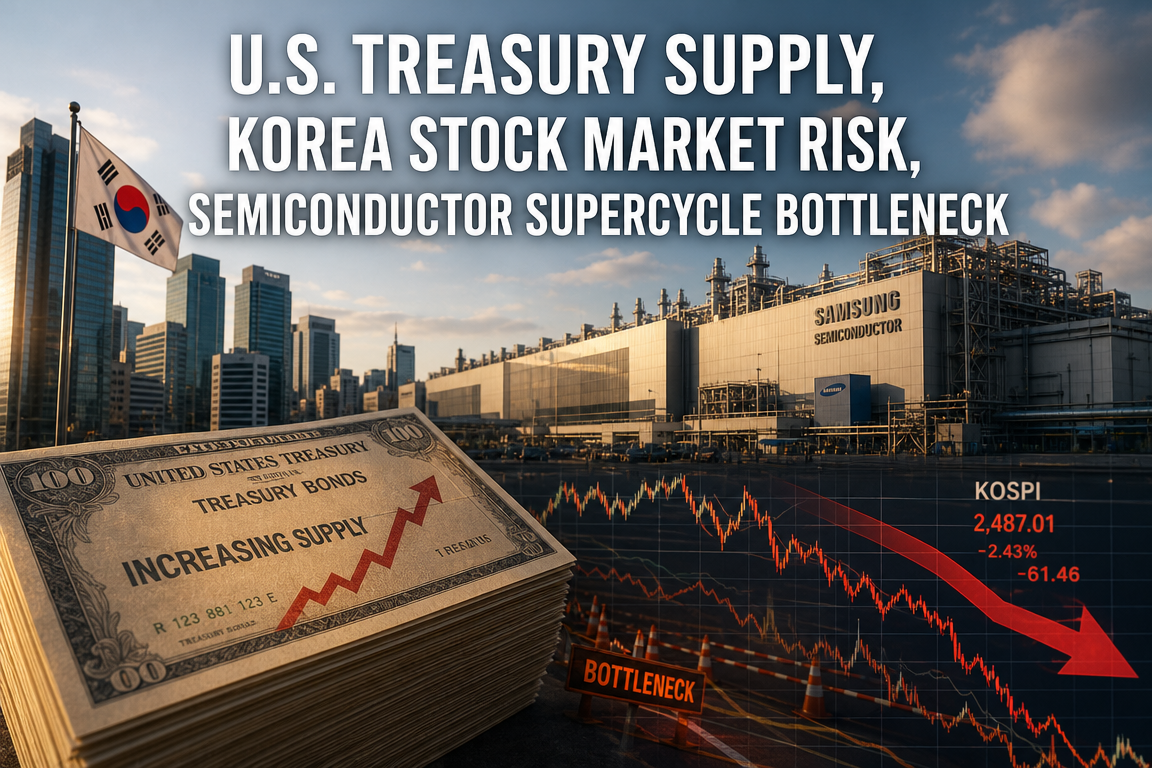
In summary, this article connects U.S. Treasuries, the rate-cut outlook, Trump’s liquidity policy, the KOSPI outlook, and the sustainability of the semiconductor supercycle.
News coverage typically emphasizes that AI remains strong, U.S. equities are at record highs, and semiconductors will continue to lead. From an investor’s perspective, however, the more important question is where money is being created, where it is being constrained, and which industrial bottlenecks will define the next leadership group.
1. U.S. equities are at record highs, but the Treasury market is already signaling stress
The U.S. stock market continues to set new all-time highs.
At first glance, the U.S. economy still appears fundamentally strong.
Employment, consumption, and corporate earnings have not deteriorated, and expectations for AI-related investment remain firm.
Liquidity is another key factor.
The discussion emphasized that the U.S. continues to inject money into the system through multiple channels.
Rising stock prices do not necessarily imply that real value has increased.
When money supply expands, asset prices can rise as well.
In other words, the current U.S. equity rally reflects not only corporate fundamentals but also a liquidity-driven market environment.
The most important variable, however, is the Treasury market.
Even if yields appear stable in the secondary market, the more critical issue is pricing in the Treasury auction market.
The discussion noted that auction yields for 20-year and 30-year Treasuries have remained near cycle highs.
This suggests that the market is no longer absorbing U.S. government debt at the same cost as before.
In practical terms, the U.S. government must pay higher borrowing costs to fund itself.
2. The Treasury problem is severe because the key issue is not rates, but who will buy the debt
U.S. Treasuries are the global financial system’s most important safe asset.
However, as the fiscal deficit continues to widen and spending pressures from war, tax cuts, and economic support measures accumulate, Treasury issuance rises further.
The problem is that each new issuance must still find sufficient buyers.
Major buyers include U.S. financial institutions, the Federal Reserve, foreign central banks, and countries such as Japan and China.
If Japan sells U.S. Treasuries to secure dollars for yen defense, the implications for the U.S. are significant.
When Japan sells Treasuries, prices fall and upward pressure builds on yields.
Even if the U.S. wants lower rates, rising Treasury yields can destabilize the broader financial system.
This was one of the central points raised in the discussion.
Japan’s yen issue is not merely an exchange-rate issue; it is directly linked to Treasury supply and demand.
This is also why the U.S. Treasury is highly sensitive to yen stabilization and Treasury-market support.
While such measures may appear to be support for an ally, the underlying objective is likely to preserve stability in the U.S. Treasury market.
3. The midterm election is a key risk because Trump’s policy room may narrow afterward
The strongest warning in the discussion concerned the period after the midterm election.
If the current administration is using temporary measures to address Treasury, liquidity, and currency issues, political constraints may become more binding after the election.
If the result leads to a divided Congress, the Trump administration may find it harder to push through aggressive fiscal policy.
The point was that the side effects of earlier tax cuts, fiscal expansion, and liquidity support could become more visible after the election.
Before the election, policymakers may still try to support markets by any available means.
Afterward, however, political checks, budget constraints, and Treasury funding pressures may all intensify at once.
If U.S. Treasury yields rise sharply at that point, equities, real estate, emerging-market currencies, and Korean equities could all come under pressure.
For that reason, this issue is not simply a political story; it is a key variable for the global economic outlook.
4. Expectations for rate cuts may be too aggressive: the Fed is unlikely to move until markets weaken materially
Markets continue to expect rate cuts.
Even with U.S. equities at record highs, investors still assume the Fed will eventually ease policy.
The discussion argued that this expectation may be excessive.
With U.S. equities strong, inflation risks still present, and geopolitical and oil-price risks unresolved, the Fed has limited room to deliver a surprise cut.
There are still hawkish voices within the Fed, and the institution remains focused on preserving its independence.
If Jerome Powell and the broader Fed continue to defend that independence, the Trump administration may not be able to influence monetary policy as easily as it would like.
The discussion also noted that among Fed governors and regional presidents, the bias may still favor holding rates steady, with the possibility of higher rates not fully excluded if conditions warrant.
In other words, the large rate cuts priced by markets may only become possible if financial markets weaken materially.
As long as equities remain at all-time highs, the Fed has little incentive to provide additional support.
5. Even so, Trump may still pursue liquidity support: the tools extend beyond the Fed
That said, there is an important counterpoint.
While direct rate cuts via the Fed may be difficult, the government still has several ways to support liquidity.
The discussion suggested that the Trump administration may continue to inject liquidity through multiple channels before the election.
The first is fiscal spending.
Higher government spending directly adds liquidity to the system.
Although this eventually increases Treasury supply and rate pressure, it can support asset markets in the short term.
The second is the repo market and dollar liquidity facilities.
FIMA repo was specifically mentioned.
By allowing foreign governments or central banks to borrow dollars against their holdings as collateral, such measures can expand global dollar liquidity.
The third is energy-price management.
Higher crude prices increase inflation pressure and make it harder for the Fed to cut rates.
Accordingly, policymakers may seek to stabilize oil prices through strategic reserve releases, pressure on producing countries, or other supply measures.
Ultimately, Trump’s priority before the election is to avoid damaging equity performance and economic sentiment.
Even if monetary policy remains constrained, fiscal measures and administrative tools may continue to support liquidity.
6. Semiconductors remain central to Korean equities, but strong fundamentals do not always translate into further share-price gains
It is difficult to discuss Korean equities without semiconductors.
Samsung Electronics and SK Hynix have been major drivers of KOSPI performance.
Demand for AI semiconductors remains solid.
Data-center investment continues, and hyperscalers are likely to maintain AI infrastructure spending next year as well.
The key issue is not absolute demand, but the growth rate.
Capital markets do not only focus on whether a company is profitable.
They also look at whether revenue and earnings growth are accelerating or slowing.
If hyperscaler capex growth slows from doubling rates to 10% or 20%, that still represents growth in the real economy.
But in equity markets, it can be interpreted as a deceleration in momentum.
That is the essence of valuation repricing.
This is why even strong companies may see their share prices consolidate or correct.
7. The bottleneck in the semiconductor supercycle is shifting: from GPU to HBM, and then potentially to MLCC
Bottlenecks matter in the AI cycle.
In capital markets, the leading stocks are often not the companies with the highest end demand, but those with supply shortages and pricing power.
Last year, GPUs were the bottleneck.
That made Nvidia the dominant leader.
In the first half of this year, HBM and DRAM became the main constraints.
That supported SK Hynix, Samsung Electronics, and other memory-related stocks.
The discussion argued that this bottleneck is gradually moving elsewhere.
This does not mean memory semiconductors are weak.
Rather, the phase of extreme share-price re-rating may be passing.
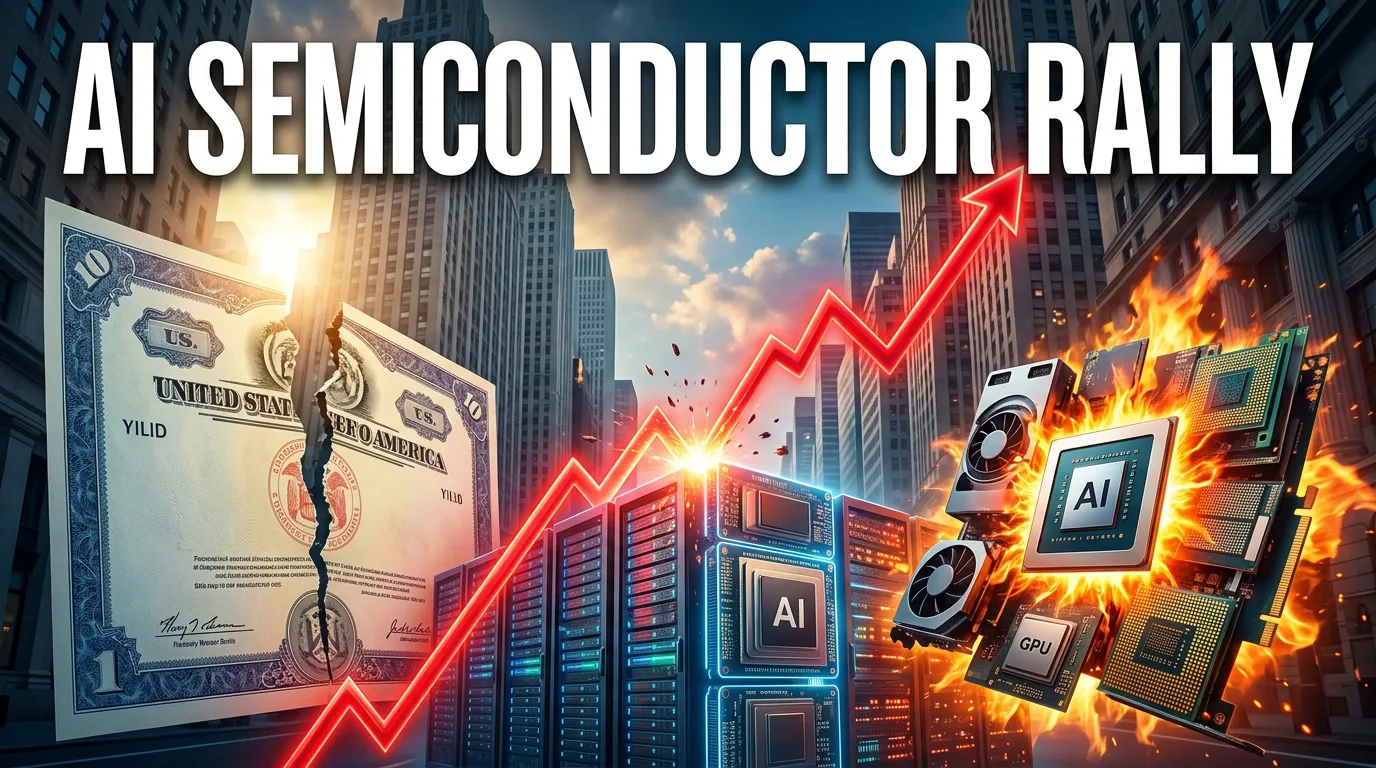
Looking ahead, market attention may shift toward MLCCs, power semiconductors, packaging, cooling, network equipment, and data-center power infrastructure.
In other words, the AI cycle is not over; the leadership segment is changing.
This is highly important for Korean investors.
The focus should move from only Samsung Electronics and SK Hynix to the broader AI value chain.
8. Memory prices are still rising, but the pace is slowing: equity markets are sensitive to that shift
The discussion also highlighted memory-price trends.
Price increases were very strong in the first quarter and remained firm in the second quarter.
However, the pace may slow in the third and fourth quarters.
In some segments, a negative turn in the fourth quarter was mentioned as a possibility.
This does not mean the semiconductor cycle has peaked in a fundamental sense.
Rather, the most aggressive phase of price appreciation may be passing.
Semiconductor companies may still generate strong profits next year.
However, share prices may already reflect much of that growth expectation.
For that reason, investors need to assess not only whether results are strong, but whether companies can continue to exceed expectations.
In particular, the earnings-growth trend for Samsung Electronics and SK Hynix remains critical for the KOSPI outlook.
9. Why it may be harder for Korean equities to repeat the prior rally
There is another issue in Korean equities: investor confidence.
The discussion noted that confidence in semiconductor stocks weakened materially after the corrections in June and July.
When confidence is strong, investors engage in FOMO-driven buying, expecting further gains.
After a sharp correction, however, the tone changes.
Even modest gains begin to trigger doubts about whether profits should be taken or whether another correction is imminent.
In that environment, it is difficult to build the kind of strong trend seen in prior rallies.
This is especially relevant in the Korean market, where sector concentration is high.
If semiconductors pause, the broader KOSPI is likely to pause as well.
Accordingly, for Korea the key question is not only whether liquidity improves, but whether the semiconductor leaders can maintain their trend.
10. The most important point not widely covered in the media: AI is still expanding, but the location of profit pools is changing
The most important point from the discussion, and the one least emphasized in standard news coverage, is the shift in bottlenecks.
Most coverage simply says AI is strong, semiconductors are strong, and Nvidia is strong.
For capital markets, the real question is where the next bottleneck emerges.
When GPUs are scarce, GPU suppliers lead the market.
When HBM becomes constrained, HBM suppliers lead.
If the next bottleneck moves into power, cooling, packaging, MLCCs, networks, data-center real estate, copper, or transformers, leadership can shift again.
In other words, the AI industry can keep growing while the market winners continue to change.
If investors miss this, they may end up asking why AI is still growing while their semiconductor holdings are not advancing.
For Korean investors, the key is not just belief in the semiconductor supercycle, but an understanding of where the bottleneck is moving within the AI value chain.
11. Key checkpoints for investors
First, monitor U.S. Treasury auction yields.
It is more important to assess demand in new issuance auctions than to focus only on temporary stability in the secondary market.
If auctions remain weak, U.S. fiscal risk could again unsettle markets.
Second, watch the midterm election outcome.
If Republicans gain control of Congress, Trump-style fiscal expansion and liquidity support may become stronger.
If control is divided, policy momentum may weaken and the side effects of earlier measures could become more visible.
Third, keep rate-cut expectations restrained.
The Fed is unlikely to move aggressively while equities remain strong.
Rate cuts are more likely only if the economy or financial markets weaken materially.
Fourth, focus on the growth rate in semiconductors, not just demand.
Even if AI semiconductor demand remains strong, a slower growth rate can still pressure share prices.
In particular, slowing memory-price momentum is a key variable for Korean equities.
Fifth, identify the next bottleneck in the AI value chain.
After HBM and DRAM, market attention may shift to MLCCs, power infrastructure, cooling, networking, and data-center-related industries.
12. Conclusion: the second half of the year is likely to combine abundant liquidity with rising risk
U.S. equities may continue their upward trend for now, supported by liquidity and resilient fundamentals.
However, beneath that strength lies a meaningful risk from U.S. Treasury supply and demand.
Before the midterm election, policymakers may still be able to manage the issue through temporary measures.
After the election, however, a change in the political balance could bring Treasury funding pressures, fiscal deficits, and liquidity side effects back into focus.
Korean equities remain centered on semiconductors.
But while the AI semiconductor cycle is not over, the phase of explosive memory-driven gains may become more selective.
Investors should move beyond a narrow focus on Samsung Electronics and SK Hynix and monitor where bottlenecks are shifting within the AI value chain.
This is not a market that should be avoided outright.
However, it is also not a market where liquidity alone should be followed uncritically, given the variables of U.S. Treasury supply, rate-cut expectations, and KOSPI concentration in semiconductors.
In the second half of the year, the correct framework is not simply “AI will keep growing,” but rather “where is the next phase of AI growth being monetized?”
< Summary >
U.S. equities continue to hit record highs, but Treasury auction yields indicate rising funding pressure.
If the political balance shifts after the midterm election, Trump’s fiscal policy and liquidity support may face greater constraints.
The market’s expectation for a surprise Fed rate cut appears too aggressive under current conditions, with rate holds remaining the base case.
Korean equities remain dependent on semiconductors, but slowing memory-price gains and moderating hyperscaler capex growth are key risks.
The AI semiconductor cycle is not over, but leadership may move from GPU and HBM toward MLCCs, power, cooling, packaging, and related infrastructure.
Investors should monitor U.S. Treasury supply, the midterm election, the Fed’s stance, semiconductor growth rates, and bottlenecks across the AI value chain.
[Related Articles…]
- U.S. Treasury Supply and Global Market Risk Outlook
- AI Semiconductor Supercycle and Korean Equity Strategy
*Source: [ 경제 읽어주는 남자(김광석TV) ]
– “미국 국채 상황 심각합니다” 중간선거 끝나면 진짜 위험이 터질 수 있다 | 경읽남과 토론합시다 | 3자토론 김대호x홍춘욱x김광석 [4편]