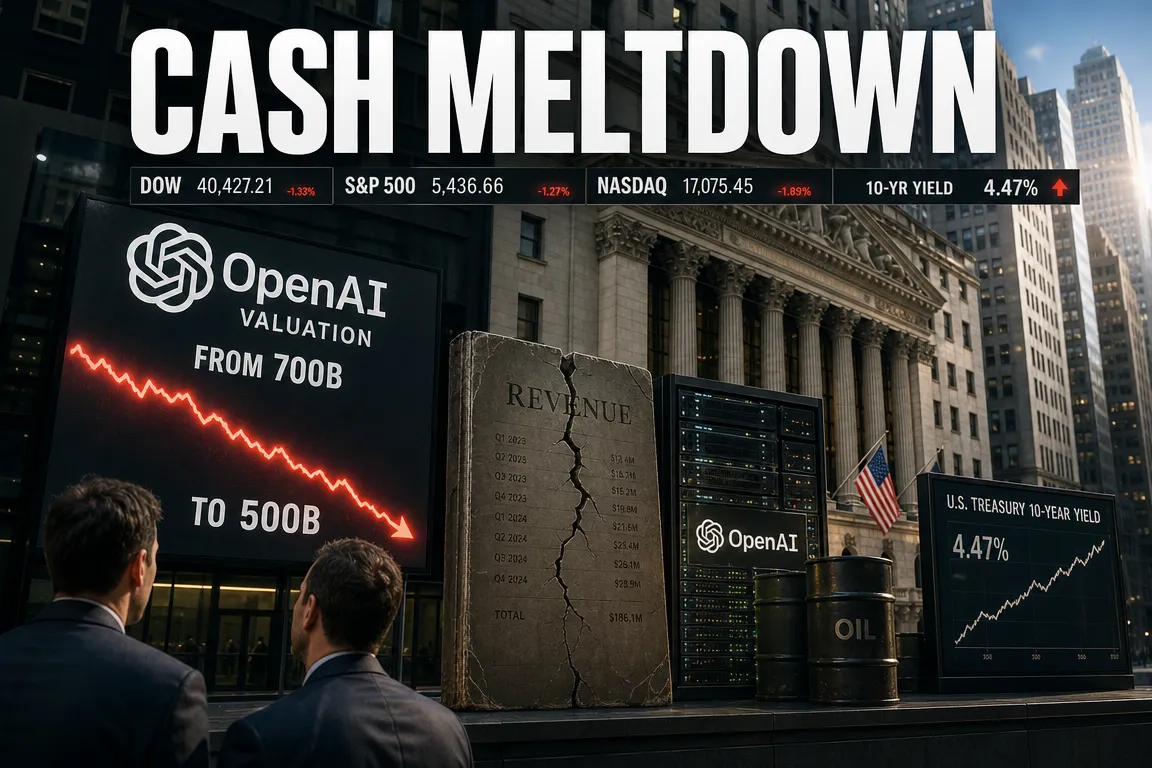
● Samsung Shock, KOSPI Hit, China Tech Tremor
Why Samsung Electronics’ Disappointing Shareholder Returns Shook the KOSPI: No Share Buyback, Semiconductor Sentiment, and Spillover Effects into China’s Tech Market
The core issue is not simply that Samsung Electronics’ share price fell.
Market expectations for Samsung Electronics’ shareholder return policy were weaker than anticipated, which undermined sentiment across the KOSPI and extended the impact to semiconductor large caps such as SK Hynix, China’s tech market, and domestic growth-stock flows.
This decline was driven less by earnings and more by concerns over confidence in capital allocation.
The market was looking not only for dividends, but also for share buybacks, clearer free cash flow discipline, and a stronger commitment to shareholder returns. Samsung Electronics did not fully meet those expectations, triggering selling pressure.
In addition, Alibaba’s large-scale equity offering intensified concerns over dilution across Asian technology stocks, adding further downward pressure on the KOSPI.
1. Samsung Electronics was at the center of today’s KOSPI decline
The first point to note is that the KOSPI fell sharply again.
Samsung Electronics was the primary driver of the decline.
Given Samsung Electronics’ large weight in the KOSPI, weakness in the stock inevitably weighs on the broader index.
This decline was not simply short-term profit-taking. It was driven directly by disappointment over the shareholder return policy announced last week.
The market had expected Samsung Electronics to help improve sentiment in the domestic equity market through a stronger shareholder return framework.
Instead, investors viewed the announcement as weaker than expected, leading to concentrated selling in the stock.
As Samsung Electronics fell, the KOSPI also declined, and sentiment toward semiconductor large caps weakened quickly.
2. Three reasons Samsung Electronics’ shareholder return plan fell short of expectations
The market was mainly disappointed for three reasons.
First, there was dissatisfaction with the way free cash flow was defined and calculated.
Shareholder returns ultimately depend on how much of a company’s generated cash is returned to investors.
However, the market viewed the free cash flow framework as less aggressive and less clear than expected.
Second, the company did not provide specific guidance on share buybacks.
The key expectation was not simply higher dividends.
If the stock is considered undervalued, direct share repurchases would send a strong signal.
Share buybacks can communicate that management believes the stock is inexpensive, which is important for restoring sentiment.
However, investors did not see the level of buyback commitment they had hoped for, making this one of the main disappointment factors.
Third, the policy lacked a strong message on the payout ratio.
The market had expected a clearer benchmark, such as returning at least 50% of free cash flow to shareholders.
The absence of such a firm commitment led investors to conclude that Samsung Electronics’ shareholder return stance was more conservative than expected.
3. Why a single stock issue became a broader KOSPI problem
Samsung Electronics is not just an individual stock.
It is a flagship company and a symbolic name in the Korean market.
As a result, its shareholder return policy affects not only its own valuation but also the valuation framework for the broader Korean equity market.
Domestic equities have recently been sensitive to themes such as reducing the Korea discount, improving shareholder returns, and corporate value-up initiatives.
Had Samsung Electronics announced a stronger shareholder return package, it could have served as a positive signal for the entire KOSPI.
Instead, the outcome was the opposite.
Investors interpreted the announcement as evidence that even Korea’s leading company remains cautious on shareholder returns, dampening expectations among foreign and institutional investors.
The issue therefore expanded beyond Samsung Electronics into a broader question of how attractive the Korean market appears to global capital.
4. SK Hynix was hit despite having no direct fault
One notable point in the original analysis is the reference to SK Hynix.
SK Hynix is not directly tied to Samsung Electronics’ shareholder return disappointment.
On the contrary, market expectations for AI semiconductors, HBM, and high-value memory remain intact.
Still, the stock came under pressure because it belongs to the same semiconductor large-cap category.
The market often responds by sector rather than by individual company distinctions.
When Samsung Electronics weakens, investors may quickly conclude that the entire semiconductor large-cap segment is under pressure.
In particular, passive flows and ETF allocations often move based on sector and index trends rather than company-specific fundamentals.
As a result, SK Hynix was affected by the deterioration in sentiment around Samsung Electronics despite having no direct negative catalyst.
5. Alibaba’s equity offering added pressure to the KOSPI
The decline was not driven only by domestic factors.
In China, Alibaba announced an equity offering worth approximately KRW 14 trillion, which unsettled China’s tech market.
For existing shareholders, an equity offering can raise concerns about dilution.
When a major platform company such as Alibaba pursues a large capital raise, investors may also worry that other Chinese technology companies could follow similar financing strategies.
This concern spread selling pressure across China’s tech sector and negatively affected sentiment toward Asian technology stocks more broadly.
The Korean market is not directly the same as China’s, but foreign investors tend to view Asian technology stocks within a broader regional allocation framework.
Accordingly, weakness in China’s tech market can weigh on sentiment toward the KOSPI, especially in semiconductors and growth stocks.
6. The fact that KOSDAQ held up is an important sign
One relatively positive takeaway was that KOSDAQ held up comparatively well.
This is more important than it may appear.
In the past, weakness in Samsung Electronics or semiconductor large caps often led to indiscriminate selling across the market.
This time, however, disappointment in semiconductor large caps did not immediately translate into broad-based liquidation.
That suggests investors are beginning to distinguish between weakness in Samsung Electronics and the broader equity market.
Relative resilience in KOSDAQ indicates that capital may still rotate into small- and mid-cap growth stocks, biotech, secondary batteries, AI software, robotics, and defense themes.
This does not mean KOSDAQ is risk-free.
However, the market appears to be moving away from a phase in which all stocks are judged solely by the performance of one semiconductor leader.
7. The issue matters even more from an AI semiconductor perspective
Samsung Electronics’ shareholder return disappointment may look like a short-term stock event, but it has broader implications for AI semiconductor investors.
The global semiconductor market is being reshaped by AI data centers, HBM, high-performance memory, and foundry competition.
Samsung Electronics must continue making large-scale capital investments to compete in this environment.
The issue is that investors are no longer satisfied with generic explanations that investment is being made for future growth.
The market now wants to see how a company allocates capital between growth investment and shareholder returns.
If investment is necessary for AI semiconductor competition, management must explain why the spending is required now.
Conversely, if cash generation is sufficient, the company must clearly state how much will be returned to shareholders.
The broader message is that in the AI era, large technology companies need more than a growth story; they also need credibility in capital allocation.
8. The real issue that is often missed in other coverage
The most important point is not the absolute amount of shareholder returns, but the credibility of the policy framework.
Investors dislike corporate communication that remains vague and changes with circumstances.
Global investors in particular focus on how predictable a shareholder return policy is and how much management prioritizes shareholder value.
Samsung Electronics disappointed the market not simply because the dividend was too low.
The concern was that the announcement increased uncertainty over whether the company would continue to hold cash without returning it more actively to shareholders.
Another important point is that this outcome directly conflicted with the broader value-up narrative in Korea.
While policymakers and the market are discussing how to reduce the Korea discount, a weaker-than-expected shareholder return policy from the country’s leading company undermines the credibility of that narrative.
In that sense, the Samsung Electronics issue is not just a company-specific policy matter, but also a test of confidence in the Korean equity market.
9. What investors should monitor now
First, investors should determine whether Samsung Electronics can rebound purely on valuation support.
A lower share price alone does not necessarily indicate a bottom.
It is important to see whether the disappointment is addressed, including any renewed discussion of share buybacks or additional shareholder return measures.
Second, foreign investor flows should be monitored.
Samsung Electronics has a high foreign ownership base, so continued foreign selling could keep pressure on the KOSPI.
Third, investors should watch whether Samsung Electronics and SK Hynix begin to diverge again.
If the market continues to value AI semiconductor and HBM strength, SK Hynix may trade differently from Samsung Electronics.
Fourth, the potential spread of equity offering concerns in China’s tech sector should be tracked.
If the Alibaba issue remains isolated, the impact may be limited. If it spreads to other large tech companies, however, it could weigh on Asian growth stocks more broadly.
Fifth, investors should determine whether KOSDAQ strength reflects temporary defense or genuine capital rotation.
If funds leaving semiconductor large caps move into KOSDAQ growth names, it could create new opportunities within the market.
10. Forward-looking market scenarios
In a positive scenario, Samsung Electronics restores expectations through stronger shareholder returns or through support from semiconductor cycle recovery and AI memory demand.
In that case, the stock could stabilize and the KOSPI may attempt a rebound.
In a neutral scenario, Samsung Electronics remains weak while SK Hynix, KOSDAQ growth stocks, and selected AI-related names move independently.
In that case, the broader index may remain subdued, but stock-specific trading opportunities could continue.
In a negative scenario, disappointment in Samsung Electronics persists, concerns over China’s tech-sector equity offerings broaden, and foreign investors reduce exposure to Asian technology stocks simultaneously.
That would likely increase downside pressure on the KOSPI and raise volatility across the semiconductor sector.
11. Conclusion: Samsung Electronics’ shareholder return policy was a test of market confidence, not just a routine announcement
This announcement was not simply about how much dividend the company would pay.
The market expected Samsung Electronics, as Korea’s leading company, to support efforts to reduce the Korea discount.
Instead, the absence of a share buyback, the weaker-than-expected shareholder return message, and concerns over free cash flow guidance led to disappointment.
As a result, Samsung Electronics dragged the KOSPI lower, and SK Hynix was also pressured as part of the same semiconductor group.
At the same time, Alibaba’s equity offering added to weakness in China’s tech market and broader Asian technology sentiment.
That said, KOSDAQ’s relative resilience suggests that the market is no longer moving entirely through indiscriminate selling of all stocks.
Going forward, the key question is whether Samsung Electronics can provide a clearer shareholder return framework and restore confidence in both its AI semiconductor strategy and its capital allocation discipline.
[Related Articles…]
Samsung Electronics share price and semiconductor sentiment outlook
AI semiconductors and global technology stock trends
*Source: [ 내일은 투자왕 – 김단테 ]
– 삼성전자 주주환원의 나비효과 #삼성전자 #주주환원 #나비효과
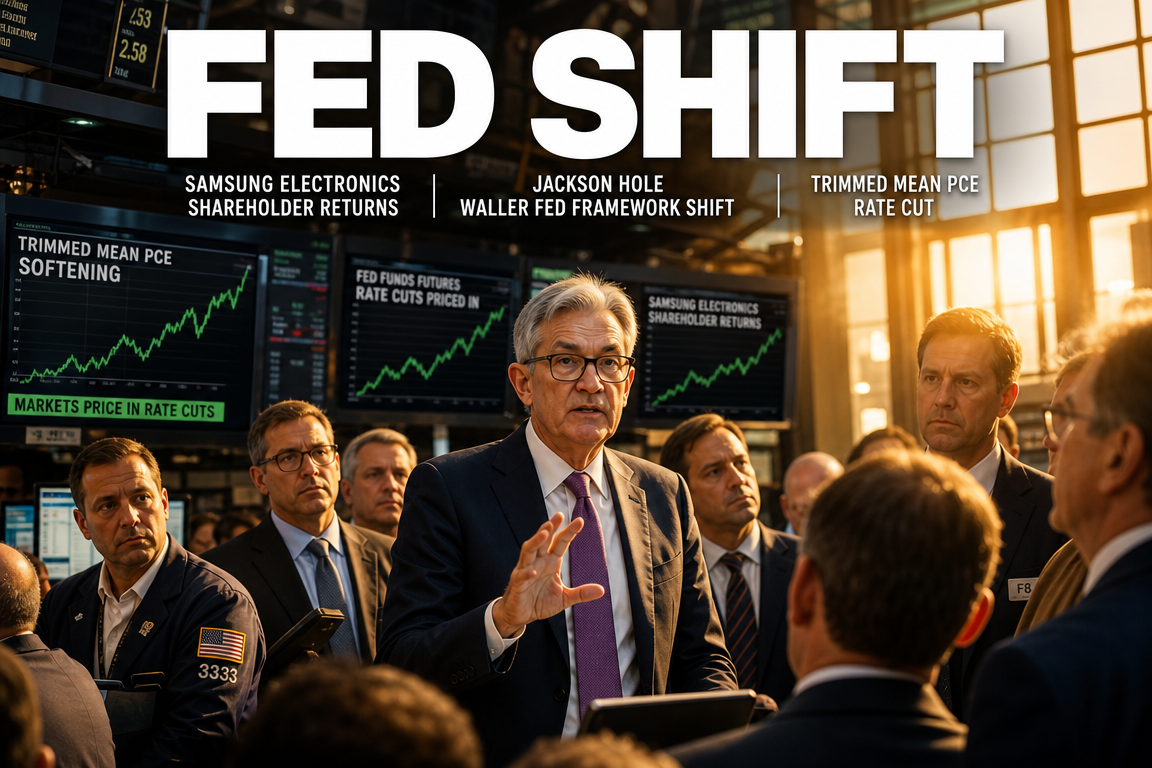
● Jackson Hole Bombshell, Fed Overhaul, Rate Cut Shock
Jackson Hole Meeting Preview: Waller Speech Could Be the Key Variable for Equities, Long-Term Yields, and Fed Policy
The key issue for this Jackson Hole meeting is not simply whether rates will be cut.
The main focus is whether Fed Chair Kevin Waller can signal a change in the Federal Reserve’s operating framework itself.
This report reviews the post-Jackson Hole implications for U.S. Treasury yields, equities, inflation metrics, the Fed’s balance sheet, and the AI productivity debate.
Although the event appears to center on financial innovation and monetary policy framework, it may also influence the direction of U.S. economic policy ahead of the 2026 midterm elections and the global economic outlook.
Many headlines frame the event as a simple hawkish-versus-dovish debate, but the more important issue is whether the Fed can change how it communicates with markets, measures inflation, and builds the case for rate cuts.
1. Core Theme of This Jackson Hole Meeting: Financial Innovation and Monetary Policy Re-Design
The official theme of the 2026 Jackson Hole meeting is financial innovation.
On the surface, the agenda is likely to cover payment systems, financial infrastructure, digital assets, and stablecoins.
However, the market will focus more closely on Fed Chair Kevin Waller’s speech.
The key question is how far he may go in signaling changes to the Federal Reserve’s monetary policy framework in the speech scheduled for 11:00 p.m. Korea time on the 28th.
- First, the Fed’s communication strategy could change.
- Second, the inflation metric could shift from core PCE to trimmed mean PCE.
- Third, the Fed may pursue rate cuts while continuing balance sheet reduction.
- Fourth, real-time economic data could be incorporated more directly into policy decisions.
- Fifth, AI productivity and labor-market shifts could be used to justify lower rates.
In that sense, this Jackson Hole meeting may mark the beginning of a broader change in the Fed’s operating model rather than a short-term event.
2. Why the Market Views Waller’s Remarks as a Potential Shock
Waller recently said at the FOMC meeting that the Fed would remain steady.
That statement implies that the 2% inflation target will not be abandoned.
At the same time, he also raised the question of whether rate hikes are the only solution.
That distinction matters.
While the message appears to reaffirm price stability, it can also be interpreted as a willingness to manage inflation through tools other than higher rates.
In other words, Waller’s position can be summarized as follows.
- The 2% inflation target remains intact.
- However, high policy rates may not be the only way to bring inflation under control.
- Inflation metrics, the balance sheet, data usage, and AI productivity effects may all be considered together.
This is why markets are sensitive to the speech.
If Waller formalizes a new policy framework, expectations for rate cuts could rise and U.S. Treasury yields and equities could move sharply.
3. First Change: Reduced Fed Communication
The first likely change is a reduction in Fed communication.
Traditionally, the Fed has provided extensive guidance through FOMC meetings, statements, minutes, dot plots, and press conferences.
Waller appears more inclined to view this as a source of confusion rather than clarity.
The Fed currently holds eight FOMC meetings per year.
Under a Waller-led approach, the number could be reduced to about four per year.
Emergency meetings would still be possible during periods of stress, as seen when the Fed cut rates outside of scheduled meetings during the pandemic.
Statements and minutes could also become shorter.
The length of recent statements has already declined, and minutes have become more concise.
The dot plot could also be reduced in scope or lose influence.
The dot plot shows policymakers’ rate projections, but under Waller’s view it may create unnecessary forward guidance and increase bond-market volatility.
In practical terms, the Fed could move from “we will explain everything” to “the market should draw its own conclusions.”
4. Implications of Reduced Communication for Equities and Bonds
Reduced communication could raise near-term volatility.
If FOMC statements shorten and the dot plot becomes less central, investors may find it harder to interpret the Fed’s intentions.
As a result, U.S. Treasury yields, the dollar, Nasdaq, and the S&P 500 could experience larger moves around FOMC meetings.
Over the medium term, however, the Fed may become less constrained by market expectations.
That could support the case for stronger policy independence.
On the other hand, during periods of political pressure, this could also be seen as a way to avoid accountability.
For investors, actual data and liquidity trends may become more important than incremental Fed commentary.
Key indicators will include labor data, consumer spending, inflation, Treasury auction demand, and balance sheet developments.
5. Second Change: A Shift in the Inflation Framework
The most important issue at this Jackson Hole meeting is a possible change in how inflation is measured.
Markets currently focus primarily on core PCE when assessing U.S. inflation.
Core PCE excludes food and energy, which are typically more volatile.
Under a Waller framework, trimmed mean PCE could gain greater importance.
Trimmed mean PCE excludes the most extreme price increases and decreases and calculates inflation based on the middle distribution.
Because it removes outliers, it tends to show underlying inflation trends more smoothly.
The concern is that trimmed mean PCE could make inflation appear materially lower.
If core PCE remains in the mid-to-high 3% range, trimmed mean PCE could fall closer to the low 2% range.
That would allow the Fed to argue that inflation is already much closer to its target.
This is not just a statistical adjustment.
It could become a key mechanism for justifying rate cuts.
6. Why Trimmed Mean PCE Matters
Investors often miss this point.
The Fed does not need to abandon the 2% target for policy outcomes to change.
A change in the measurement framework alone can alter the policy conclusion.
For example, inflation still looks elevated under core PCE.
That supports the case for keeping rates high.
By contrast, trimmed mean PCE may suggest inflation is already approaching the low 2% range.
That creates room for rate cuts.
This is the key point for Jackson Hole.
The Fed can still say that it has not lowered the inflation target.
But the market may interpret the change as a new calculation method designed to support cuts.
7. Third Change: Fed Balance Sheet Policy
The third major issue is the Fed’s balance sheet.
The Fed still holds a very large portfolio of assets accumulated after the pandemic.
Reducing that balance sheet tightens liquidity.
In effect, balance sheet reduction is a form of tightening.
A key argument emerges here.
If balance sheet reduction has a tightening effect similar to rate hikes, then policy rates could be cut without fully easing overall conditions.
The analogy is straightforward.
If the air conditioner is too strong and the room becomes cold, one can turn on the heater slightly to restore balance.
The logic is that rate cuts can coexist with balance sheet reduction.
However, this approach carries risk.
Excessive balance sheet reduction can drain bank reserves and push up repo market rates.
The September 2019 spike in the U.S. repo market is a relevant precedent.
For that reason, a more realistic approach may be to shorten the duration profile of the portfolio rather than reduce it aggressively.
That would mean reinvesting more into shorter-dated Treasury bills rather than long-duration securities.
8. Impact of Balance Sheet Policy on Long-Term Treasury Yields
The direction of long-term Treasury yields may be one of the most important variables after Jackson Hole.
If the Fed reduces its long-duration Treasury holdings and shifts toward shorter maturities, supply pressure on longer bonds could increase.
At the same time, expectations for policy easing could push long-term yields lower.
In other words, long-term yields will be pulled by two opposing forces.
- Rate-cut expectations tend to lower long-term yields.
- Balance sheet reduction and long-duration supply pressure tend to raise them.
- Rising stablecoin adoption and short-term Treasury demand may stabilize the front end of the curve.
It is therefore not enough to assume that a more dovish speech will automatically lower long-term yields.
The key issue is how much the Fed reduces long-duration holdings and how aggressively it reinvests into shorter-dated securities.
9. Fourth Change: Real-Time Data-Driven Policy
Another area where Waller could push for change is data latency.
Current PCE inflation and GDP figures are published with a significant lag.
For example, by the time policy is set in late August, the Fed may still be relying on June inflation data.
The same issue applies to GDP.
The second-quarter advance estimate may not be available until late July, followed by revisions later on.
The issue is that the Fed is making decisions based on backward-looking data.
During periods of rapid economic change, that can lead to delayed responses.
As a result, real-time estimates such as the Atlanta Fed’s GDPNow and the New York Fed’s Nowcast may become more important.
The idea is to incorporate live estimates of inflation, employment, consumption, and growth more directly into policy.
If formalized, this would allow the Fed to respond more flexibly.
At the same time, it would raise concerns about model reliability.
Real-time estimates are faster, but they also carry a higher risk of error.
10. Fifth Change: Reassessing AI Productivity and Employment
The final major issue is AI productivity and employment.
Waller may argue that AI raises productivity and lowers costs, which in turn reduces long-term inflation pressure.
As AI adoption expands, companies can deliver more services at lower cost.
Legal, accounting, software, customer support, content creation, and data analysis are all already experiencing this shift.
Higher supply and lower unit costs can help stabilize prices.
This argument could support a lower-rate environment.
In that sense, AI may justify a greater policy focus on employment than on inflation.
However, there is also a counterargument.
In the short term, AI expansion may actually add inflationary pressure.
Rising data-center investment increases demand for electricity.
Prices for semiconductors, servers, HBM, DRAM, NAND, power infrastructure, and cooling systems are also moving higher.
The AI infrastructure boom is therefore reducing costs over the long term while raising them in the near term.
It is not correct to assume that AI will automatically be disinflationary.
It may help stabilize prices over the long run, but it can also increase cost pressures through energy and semiconductor channels in the short run.
11. Equity Market Scenarios After Jackson Hole
Equities may react in three broad scenarios depending on the strength of Waller’s message.
- Scenario 1: Strong dovish message
If trimmed mean PCE, real-time data usage, balance sheet adjustments, and a rate-cut rationale are all presented together, equities could rally in the short term.
Technology, growth, AI-related, and high-valuation stocks would likely respond most strongly. - Scenario 2: A largely conventional message
If the 2% target is emphasized while specific changes are delayed, the market reaction may be limited.
In that case, equities may remain range-bound. - Scenario 3: A more hawkish-than-expected message
If the speech highlights renewed inflation risks and pushes back against rate-cut expectations, equities could face downside pressure.
Higher Treasury yields would likely increase valuation pressure on growth stocks.
The market is currently positioned most favorably for the first scenario.
However, the extent of any institutional change that Waller may signal remains uncertain.
12. Long-Term Treasury Yield Scenarios After Jackson Hole
Long-term Treasury yields may also move in a non-linear way.
If rate-cut expectations rise, the 10-year Treasury yield could decline.
But if balance sheet reduction and long-term supply concerns are emphasized, the decline could be limited.
- Greater probability of trimmed mean PCE adoption could put downward pressure on long-term yields.
- Signals that the Fed will reduce long-duration holdings could push yields higher.
- Expansion in stablecoin usage and short-term Treasury demand could stabilize the front end of the curve.
- AI-related investment, especially in power and semiconductors, could renew inflation concerns.
Bond investors should therefore focus less on the rate-cut headline and more on the balance sheet and maturity-structure comments.
13. The Most Important Point Often Missed in Other Coverage
The real issue at this Jackson Hole meeting is not whether rates will be cut.
The real issue is whether the Fed can create a new measurement framework and policy rationale for doing so.
Three points are most important.
- First, the inflation target can remain unchanged while the measurement framework changes.
Using trimmed mean PCE may allow the Fed to argue that inflation is already close to target. - Second, balance sheet reduction can be used as justification for lower policy rates.
The Fed could maintain a tightening posture overall while still cutting the policy rate. - Third, AI productivity can support a framework that gives more weight to employment than inflation.
Claims that AI lowers costs over time can weaken the case for sustained high rates.
If these three elements are combined, the Fed may remain formally committed to price stability while moving toward a more accommodative stance in practice.
That would have the greatest impact on equities and bond markets.
14. Key Phrases Investors Should Watch
If Waller uses the following phrases, markets may react more sharply:
- If he says “underlying inflation should be measured more accurately,” investors should watch for trimmed mean PCE adoption.
- If he says “balance sheet normalization and the rate path must be considered together,” investors should focus on the rate-cut rationale.
- If he says “real-time data and new economic models should be used,” the market may interpret that as a change in FOMC decision-making.
- If he says “AI and productivity gains are changing the inflation structure,” investors should watch for a shift toward employment-focused policy.
- If he says “we will not provide excessive forward guidance,” that would support expectations for reduced emphasis on the dot plot and press guidance.
If several of these lines appear together, the market may view the speech as a sign of a broader Fed framework shift.
15. Conclusion: Jackson Hole as a Starting Point for Policy Regime Change
This Jackson Hole meeting should not be treated as a routine speech event.
Depending on Waller’s wording, the direction of monetary policy, U.S. Treasury yields, and global equities could all change.
The inflation framework is especially important because it could substantially strengthen expectations for rate cuts.
Balance sheet policy could be the key variable for long-term Treasury yields.
The debate over AI productivity and employment may provide a new rationale for prioritizing labor-market conditions over inflation.
For investors, the key is not just the immediate market reaction after Jackson Hole, but the Fed’s evolving framework for evaluating the economy.
The next direction for financial markets may depend less on one rate cut and more on whether the policy framework itself changes.
< Summary >
The central issue at this Jackson Hole meeting is whether Waller will formalize a shift in the Fed’s monetary policy framework.
Potential changes include reduced communication, adoption of trimmed mean PCE, balance sheet adjustments, real-time data usage, and a reassessment of AI productivity and employment.
In particular, a change in the inflation measure could strengthen the case for rate cuts.
A strategy that combines balance sheet reduction with policy easing could also materially affect long-term Treasury yields.
AI may be disinflationary over the long run, but it can also raise near-term inflation pressure through semiconductors and power demand.
This speech could become an important inflection point for equities and U.S. Treasury yields.
[Related Articles…]
- Jackson Hole Meeting and the Fed Rate Outlook: Key Takeaways
- Inflation Shifts and the Global Economic Outlook: An Analytical Review
*Source: [ 경제 읽어주는 남자(김광석TV) ]
– [잭슨홀 미팅 프리뷰] 증시 방향 바꿀까? 장기채 금리 떨어질까? 워시의 잭슨홀 연설 중대 시험대 [경읽남 259화]