● Tesla Solar Roof Shutdown, 14T Solar Cell Factory Shock
Tesla’s Solar Roof Exit and the 14 Trillion Won Solar Cell Factory Filing Suggest the Real Story Is Not Retreat, but Supply Chain Control
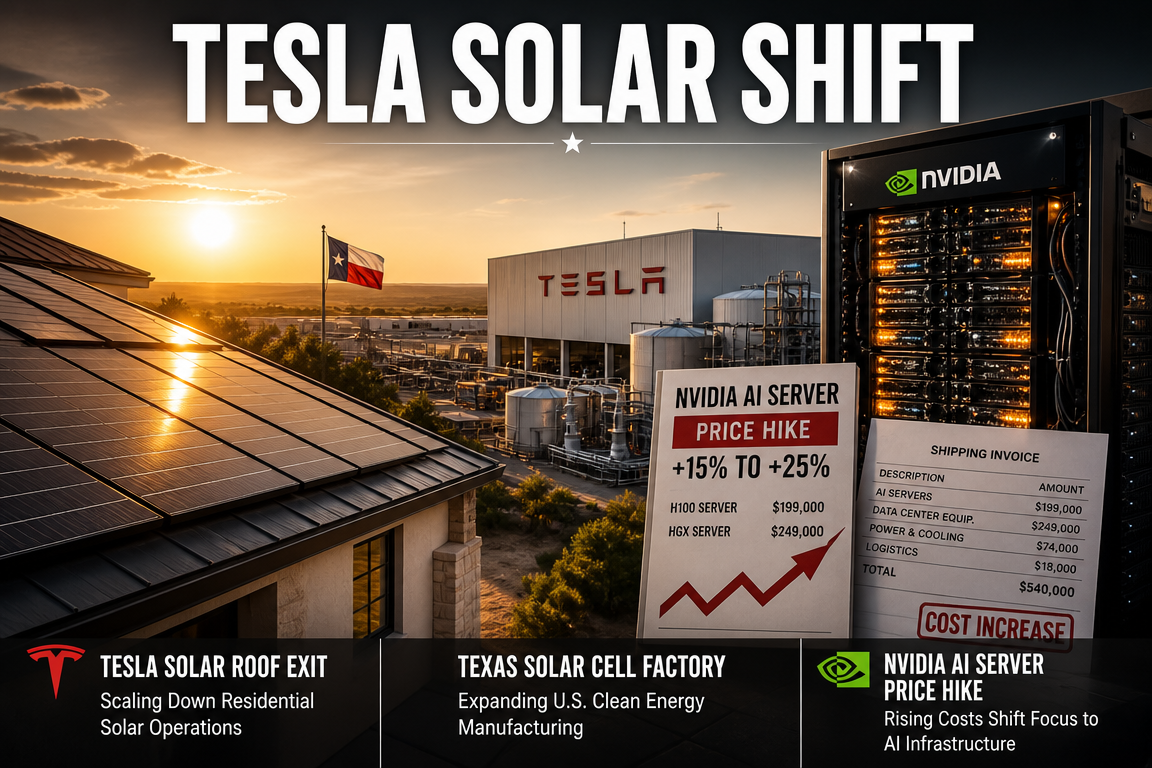
At the same time Tesla quietly wound down the Solar Roof program it had promoted for nearly a decade, a filing for a solar cell factory in Texas worth roughly 14 trillion won appeared.
On the surface, this looks like another headline about Tesla failing in solar. However, the underlying picture is different.
Solar Roof termination, U.S. tariff risk, the end of residential solar subsidies, battery supply chain integration, and direct solar cell production are all connected. Taken together, they point to a clearer strategic shift.
The key issue is not how much Tesla stock fell in one day, but whether Tesla is moving its energy business away from “selling attractive roofs” and toward “controlling the solar manufacturing supply chain.”
For investors tracking EV markets, U.S. tariffs, solar subsidies, battery supply chains, and Tesla stock, this issue should not be treated as a simple product discontinuation.
1. Why Tesla Fell More Than the Index
On the reference date, Tesla closed at $348.95, down 3.83% for the day.
SpaceX’s private market transaction price was mentioned at $135, down 1.44%.
With the Nasdaq down 0.77% and the S&P 500 down 0.28%, Tesla’s decline was materially larger than the broader market.
The move was not driven only by Tesla-specific issues, but by broader pressure across the U.S. auto sector.
The main backdrop was President Trump’s announcement of a 50% tariff on all Canadian imports.
The measure was described as covering automobiles, trucks, parts, and steel, with an implementation date of January 1, 2027.
The market began pricing in future cost pressure immediately.
Ford fell 3.5%, General Motors fell 1.13%, and Stellantis fell 4.77%.
Tesla also fell as part of the broader tariff risk affecting the auto industry.
In addition, reports related to Chinese regulators and a recall added pressure to sentiment.
However, the more important issue in this report is Tesla’s business model transition rather than short-term price action.
2. Tesla Removed a 10-Year-Old Product From Its Website: Solar Roof
Last Thursday, U.S. time, Tesla’s official website removed the Solar Roof page.
Visitors to the old Solar Roof URL were redirected to the solar panel page.
The Solar Roof section also disappeared from the Energy menu, which now focuses on solar panels, Powerwall, and Megapack.
Tesla reportedly informed certified third-party installers that Solar Roof tiles could no longer be ordered and that only standard solar panels would be supplied going forward.
Although Tesla did not issue an official press release, the website change, installer notices, and related remarks together indicate that the Solar Roof program has effectively ended.
According to related sources, the internal conclusion was that the product was not financially viable.
It is important to note that Solar Roof was not just another solar product.
It was one of the signature products associated with Tesla’s SolarCity acquisition.
3. Why Solar Roof Was Important in Tesla’s History
Solar Roof was unveiled by Elon Musk on October 28, 2016.
The product was presented on a Hollywood set, with solar glass tiles installed on the roof of a house used for filming.
Elon Musk described it as a roof that was more attractive than conventional roofing, more durable, and capable of generating electricity.
Weeks later, Tesla shareholders approved the SolarCity acquisition.
The transaction was valued at about $2.6 billion, or roughly 3.6 trillion won.
SolarCity was a solar installation company with significant debt, and Elon Musk was its largest shareholder and chairman.
Operational control was held by his cousins.
At the time, SolarCity’s business model required ongoing financing because it installed solar systems upfront and recovered costs over time.
It also issued Solar Bonds, and Delaware court records indicated that major buyers included SpaceX and Elon Musk himself.
In other words, the companies led by Elon Musk were acting as each other’s funding sources.
That structure led some shareholders to sue, arguing that Tesla’s acquisition of SolarCity was unfair to Tesla shareholders.
In 2020, Tesla board members other than Elon Musk settled for $60 million.
Elon Musk رفض the settlement and took the case to trial, ultimately winning in 2022.
During the proceedings, however, an important detail emerged.
The Solar Roof tiles shown on stage in 2016 were not a fully functional mass-market product, but a design-oriented mockup.
This is why Solar Roof became both a symbol of innovation and a symbol of controversy in Tesla’s history.
4. The Structural Reasons Solar Roof Failed
Solar Roof failed not simply because of weak technology, but because its business model did not align with Tesla’s strengths.
Tesla is strong at mass-producing standardized products and improving margins through software and manufacturing efficiency.
Roofs are the opposite.
Every house has a different roof shape, slope, size, and condition.
Each installation requires custom design work.
Elon Musk acknowledged in a 2021 earnings call that the company had not realized how diverse roof structures would be, calling it a major mistake.
Solar Roof is not just a solar panel product; it is a roof replacement product.
As a result, homes with roofs in good condition had little incentive to choose it.
The target market was therefore limited to households needing roof replacement, wanting solar power, and able to afford the cost.
This was closer to a high-income subset of the U.S. housing market than to the broader residential market.
In 2021, Tesla cited a goal of 1,000 installations per week.
That would have implied an annual pace of about 52,000 homes.
Actual deployment fell far short of that target, and by early 2024 Tesla stopped disclosing Solar Roof deployment figures in its quarterly materials.
When a company stops reporting a metric, it usually means that metric is no longer central to its growth narrative.
5. The निर्णायक Factor Was the End of the Residential Solar Tax Credit
Solar Roof still had some potential because of the U.S. residential clean energy tax credit.
The provision, known as Section 25D, allowed U.S. households to deduct 30% of solar installation costs from federal taxes.
It was a tax credit, not merely a deduction, so the benefit was direct and substantial.
For example, a solar system costing 24 million won would generate a 7.2 million won tax credit.
There was no cap, and unused credits could be carried forward.
Originally, the program was scheduled to remain at 30% through 2032, then decline to 26% in 2033 and 22% in 2034 before ending.
However, according to the reference text, President Trump signed the One Big Beautiful Bill on July 4, 2025, changing the schedule and ending the program on December 31, 2025.
That means households installing residential solar after January of that year would lose the 30% federal tax credit.
This is especially damaging for a high-cost product such as Solar Roof.
The market was already narrow, and the subsidy that had softened the price burden disappeared.
6. Tesla May Not Be Exiting Solar
Most coverage focuses on Tesla “ending Solar Roof.”
But the more important question is whether Tesla is exiting solar altogether or simply moving away from low-margin custom products toward a larger manufacturing market.
Based on current signals, the latter appears more likely.
Tesla has been moving to control the battery supply chain more directly in recent years.
At the Austin Gigafactory in Texas, a large-scale cathode materials plant reportedly began production.
Cathode material is one of the most expensive components in a battery cell and accounts for a significant share of cell cost.
Historically, cathode production was heavily dependent on China.
Tesla is now moving from a model of buying cathode material to one of making it directly.
The lithium refining facility near Corpus Christi, Texas, also began operations.
The traditional model involved mining in Australia, refining in China, and then supplying the finished material.
Tesla is trying to complete that chain within Texas.
Seen together, lithium refining, cathode production, and battery cell manufacturing show a clear strategy: directly control core inputs and critical components rather than outsourcing them.
7. Tesla Sold Solar Panels Without Making Solar Cells In-House
Many investors assume that because Tesla sells solar panels, it also manufactures solar cells directly.
According to the reference text, Tesla was not producing solar cells in-house.
The solar panel production process can be simplified as follows.
First, raw materials are melted into crystal ingots, which are then sliced into wafers.
Those wafers are processed into cells, and multiple cells are assembled into the glass-and-frame product known as a solar panel.
The cell is the key manufacturing stage, while panel assembly is a downstream step.
Tesla’s January product datasheet reportedly described its New York facility as handling “assembly.”
That suggests the company was sourcing cells externally and assembling them into panels.
This becomes more significant as Solar Roof disappears.
Tesla appears to be shutting down a highly customized roof product while preparing a much larger solar cell manufacturing project.
8. The Meaning of the 14 Trillion Won Texas Solar Cell Factory Filing
According to the reference text, Tesla’s tax attorney filed an application in Texas, and the filing became public around August 6.
The core plan was to build a solar cell factory on a site at 3050 southwest of Houston.
The stated investment was $10.116 billion, or roughly 14 trillion won.
Of that amount, $1.5 billion was allocated to real estate and $8.6 billion to equipment.
The heavy emphasis on equipment suggests a large-scale manufacturing project rather than a simple land acquisition or assembly plant.
The planned production start was set for the first quarter of 2029.
The most important distinction is that this was described as a “solar cell production plant,” not merely an assembly facility.
This indicates that Tesla may want to internalize solar cell production in the same way it is internalizing lithium refining and cathode manufacturing.
Solar Roof may be ending, but the filing points to a broader strategic shift.
9. The Solar Roof Market and the Solar Cell Market Are Different in Scale
Solar Roof’s peak target was 1,000 installations per week.
Even that target was not achieved, and the addressable market was narrow from the outset.
The product required a household needing roof replacement, wanting solar energy, and able to bear the cost.
By contrast, the solar cell and panel market is much larger.
Demand comes not only from homes, but also from commercial buildings, industrial facilities, data centers, and utility-scale solar farms.
As AI data center power demand rises, demand for solar and energy storage could expand together.
Given Tesla’s expansion of Megapack, solar cell integration could have strategic value beyond panel sales alone.
First Solar, one of the largest U.S. solar manufacturers, reportedly targets 17.7 GW of production capacity by 2027.
Elon Musk has previously referenced a long-term 100 GW scale.
Whether that target is realistic is a separate issue, but Tesla appears to view the market as far larger than Solar Roof ever was.
10. Is This a Subsidy-Driven Factory, or One That Can Win Without Subsidies?
This is the key investment question.
The U.S. residential solar tax credit has ended, but federal manufacturing credits for domestic solar production remain in place.
These credits reduce taxes by a fixed amount based on units produced or output volume.
The issue is that the benefit is not permanent.
According to the reference text, the credit remains at 100% through 2029, then falls to 75% in 2030, 50% in 2031, 25% in 2032, and then expires.
Tesla’s planned production start for the solar cell factory is the first quarter of 2029.
Under that timeline, the period for full credit availability would be less than one year.
Four years later, the subsidy benefit would disappear.
That makes it hard to argue the project is being built solely for subsidies.
If Tesla proceeds, it likely believes direct solar cell manufacturing is economically superior over the long term, even after incentives fade.
This is the key point often missed in other coverage.
Tesla is not simply a company dependent on subsidies; it is making large bets in areas where it expects to maintain cost advantages even after subsidies decline.
11. The Core Point Missed by Other Coverage
The main story is not that Solar Roof failed.
The real point is that Tesla appears to be reducing emphasis on customized consumer products and moving toward standardized, large-scale manufacturing.
Solar Roof was visually distinctive, but its installation complexity made it a poor fit for a company built around mass production.
By contrast, solar cells are a standardized, automatable manufacturing product.
That aligns much better with Tesla’s operating model.
Another important factor is the change in U.S. industrial policy.
Tariff policy is pressuring automotive supply chains, while solar subsidy policy is weakening residential demand.
At the same time, manufacturers that expand domestic production still retain opportunity.
Tesla appears to be shifting weight away from sales subsidies and toward manufacturing integration.
The supply chain battle that began in electric vehicles is now extending into batteries and solar.
This is not only a Tesla issue, but also one tied to U.S. industrial restructuring, energy security, and global supply chain decoupling.
12. Reframing Tesla’s Energy Strategy
Tesla’s energy business can be viewed in three segments.
First, residential energy storage products such as Powerwall.
Second, large-scale storage products such as Megapack.
Third, solar panel and solar cell manufacturing.
Solar Roof was the most complex and least scalable consumer product among the three.
By contrast, Megapack and solar cells are areas where large demand, standardization, manufacturing efficiency, and cost reduction can matter more.
In an environment where AI data centers, grid stabilization, renewable expansion, and EV charging infrastructure are all growing, the strategic value of energy storage and solar manufacturing may increase.
Tesla may therefore be moving not as a roof seller, but as a company seeking control over the cost structure of electricity generation and storage.
From that perspective, Solar Roof’s termination looks less like defeat and more like the removal of an inefficient business line.
The 14 trillion won solar cell factory filing then becomes a bet on a larger market.
13. What Investors Should Watch
Investors should separate the short-term and long-term implications of this development.
In the short term, Tesla faces tariff risk, Chinese recall-related headlines, and broader weakness in auto-sector sentiment.
If Canadian import tariffs are implemented, North American vehicle supply chain costs could rise.
Even though Tesla is relatively more vertically integrated than many automakers, it is not completely insulated from parts, inputs, and logistics costs.
In the medium term, the end of residential solar subsidies could reduce demand for household solar products.
Solar Roof’s termination is consistent with that shift.
Over the long term, the key question is whether Tesla can connect solar cell manufacturing, lithium refining, cathode production, and battery manufacturing into one supply chain.
If Tesla succeeds, its competitive advantage could come not just from vehicle sales, but from cost leadership across the energy platform.
If the 14 trillion won investment is delayed or becomes less profitable after subsidy reductions, it could instead become a capital burden.
14. Conclusion
Tesla’s Solar Roof exit clearly includes elements of failure.
Launched with fanfare in 2016 and accompanied by a 2021 target of 1,000 installations per week, it never scaled into a meaningful business.
The product was expensive, difficult to install, limited in market scope, and now faces the loss of residential solar subsidies.
At the same time, Tesla does not appear to be retreating from solar entirely.
Rather, the available evidence suggests it is moving from buying cells and assembling panels toward producing cells directly.
The broader pattern of lithium refining and cathode integration supports the same interpretation.
The key point is that Tesla appears to be shifting from customized consumer products to industrial-scale manufacturing.
For investors, the more important question is not whether Solar Roof disappeared, but whether the Texas solar cell plant is actually built and reaches production in 2029.
If that happens, this episode may later be viewed not as a retreat, but as the starting point of Tesla’s energy strategy reset.
< Summary >
Tesla appears to have effectively ended its Solar Roof program by removing it from its official website after nearly a decade of development.
Solar Roof became less viable because of its high cost, installation complexity, limited market, and the end of the residential solar tax credit.
At the same time, Tesla reportedly filed for a solar cell factory in Texas worth about 14 trillion won.
This may indicate a shift away from solar retreat and toward direct in-house manufacturing of solar cells rather than sourcing them externally.
Tesla is showing the same pattern in lithium refining, cathode production, battery supply chain integration, and now possibly solar cells.
For investors, the key issue is not short-term Tesla stock movement, but whether Tesla succeeds in controlling the energy manufacturing supply chain.
[Related Articles…]
Tesla Energy Strategy and Stock Outlook: Key Analysis
U.S. Solar Industry and Energy Supply Chain Reorganization Outlook
*Source: [ 오늘의 테슬라 뉴스 ]
– 테슬라가 10년 된 솔라루프를 접은 그 달, 태양광 셀 공장 신청서엔 14조원이 적혀 있었습니다 — $348 주주는?
● AI-Server-Price-Shock, Nvidia-Earnings-Fear, US-Factory-Pressure
Three Major Headwinds Behind the Sharp Decline in Samsung Electronics and SK Hynix: AI Server Pricing, Nvidia Earnings, and U.S. Factory Pressure
The key driver of the recent decline is not simply that semiconductor stocks had risen too much and were due for a pause.
The market is simultaneously pricing in the following chain: higher AI server prices → heavier spending pressure on Big Tech → earnings caution ahead of Nvidia’s results → rising costs for Samsung Electronics and SK Hynix.
In the Korean market, Samsung Electronics and SK Hynix have been the leading names supporting the KOSPI. When both weaken, broader index sentiment is likely to deteriorate as well.
Although the move appears to be driven by “Nvidia-related news,” the underlying issues are actually a combination of the memory semiconductor cycle, the sustainability of AI infrastructure investment, and U.S. pressure on supply-chain localization.
1. First headwind: concerns over a 15% increase in Nvidia AI server prices
The initial catalyst was the report that Nvidia may raise AI server prices by about 15% due to higher memory costs.
An AI server is not limited to GPUs.
It also includes high-performance GPUs, HBM, DRAM, SSDs, networking equipment, and power and cooling solutions.
Among these components, one of the strongest recent cost pressures has been memory semiconductors.
- HBM demand is surging, supporting pricing for high-value memory products.
- As AI data center construction expands, demand for server DRAM is also increasing.
- Nvidia has little choice but to pass through part of the component cost increase.
- The issue is that higher prices increase the burden on customer companies.
The key issue is not the price increase itself, but demand elasticity.
A 15% increase in AI server prices does not mean Microsoft, Google, Amazon, or Meta will stop buying immediately.
However, it may prompt them to slow the pace of investment.
In other words, the likely response is not “we will stop buying,” but rather “we will buy more slowly than planned.”
Semiconductor stocks tend to move ahead of actual earnings based on expectations for future demand.
For that reason, the market did not view the potential AI server price increase as a purely positive sign for memory suppliers.
Instead, it reacted more sensitively to the risk that more expensive AI infrastructure could slow Big Tech’s investment cycle.
2. Second headwind: growing concern that Big Tech’s AI investment capacity is not unlimited
One of the most realistic points in the original text is that “Big Tech does not have unlimited capital.”
That is correct.
These companies generate substantial cash flow, but AI infrastructure spending has become very large.
Building data centers, purchasing Nvidia GPUs, securing power contracts, installing cooling systems, and expanding cloud services all require enormous capital.
- Higher AI server prices increase capital expenditure pressure for cloud providers.
- Rising capex can reduce free cash flow in the near term.
- Investors are concerned that AI investment costs may be rising faster than AI monetization.
- As this concern intensifies, not only Nvidia but also Samsung Electronics and SK Hynix can come under pressure.
The key point for KOSPI investors is whether the AI investment cycle is starting to weaken.
In the short term, higher AI server prices could be positive for Samsung Electronics and SK Hynix.
That is because higher memory prices generally imply improved profitability for HBM and server DRAM.
However, if prices rise to the point where customers begin to feel pressure, the interpretation changes.
At that stage, the market begins to focus more on the risk of demand slowdown than on the benefit of price increases.
3. Third headwind: pre-earnings selling ahead of Nvidia’s results
Another important factor is that Nvidia’s earnings announcement is approaching.
In global markets, Nvidia is no longer treated as just a single company, but as a key barometer for the AI semiconductor sector as a whole.
When Nvidia beats expectations, AI-related stocks generally strengthen. When results disappoint even slightly, the broader semiconductor sector can weaken.
The problem is that expectations are already very high.
Nvidia has entered a phase in which even strong results may not be enough unless they significantly exceed market expectations.
As a result, some investors may choose to lock in gains before the announcement.
- There is concern that even good results may not prevent a decline in the share price.
- Valuation pressure has increased across AI semiconductor names.
- Institutional investors may reduce exposure to avoid event risk.
- When U.S. semiconductor stocks decline first, selling pressure often spreads to Korean semiconductor leaders.
This is why Samsung Electronics and SK Hynix have been affected.
Both companies occupy key positions in the global AI semiconductor supply chain.
SK Hynix is viewed as a core Nvidia-related name due to its HBM competitiveness.
Samsung Electronics is supported by expectations for expanded HBM supply and a recovery in the memory cycle.
As a result, risk-off sentiment ahead of Nvidia’s earnings tends to hit these stocks first in the Korean market.
4. A fourth factor in practice: U.S. pressure to build memory semiconductor plants in the United States
Another important development is the report that the U.S. government may push Samsung Electronics and SK Hynix to build memory semiconductor plants in the United States.
This is not a simple investment-related headline.
From a corporate perspective, it is a major issue that can alter cost structures.
Semiconductor fabs are highly capital intensive.
The United States typically has higher labor costs, construction costs, regulatory costs, and power infrastructure costs than Korea or other Asian locations.
The same applies to foundries and advanced packaging, and memory fabs built in the United States would likely face higher cost burdens as well.
- U.S. fab construction requires very large upfront investment.
- Labor sourcing and operating expenses are also substantial.
- Even with subsidies, it is difficult to fully offset total costs.
- If overseas investment overlaps with domestic investment plans, financial burden can increase.
- As a result, investors begin to worry about margin pressure.
The market is particularly uneasy about the political cost of this trend.
As Samsung Electronics and SK Hynix begin to benefit from a recovery in the memory cycle, governments are increasingly pressuring them to localize investment for supply-chain security reasons.
For management, it becomes difficult to make capital allocation decisions based solely on profitability.
Companies must also consider access to the U.S. market, subsidies, regulation, China risk, and customer relationships.
In other words, semiconductors are no longer just a manufacturing business. They are now a strategic industry shaped by global macro conditions and geopolitics.
This structural shift may continue to affect the valuation of Samsung Electronics and SK Hynix.
5. Why Samsung Electronics and SK Hynix are declining together
Samsung Electronics and SK Hynix are both tied to the same memory semiconductor cycle.
Their market positions are not identical.
SK Hynix has stronger expectations tied to HBM, while Samsung Electronics has a broader portfolio spanning DRAM, NAND, foundry, and smartphones.
However, the key market themes for both companies are currently similar.
| Category | Samsung Electronics | SK Hynix |
|---|---|---|
| Core expectations | Memory recovery, expanded HBM supply, earnings improvement | HBM competitiveness, AI server demand, Nvidia supply-chain exposure |
| Main risks | Delayed confirmation of HBM competitiveness, foundry burden, large investment costs | Overheated HBM expectations, customer concentration, valuation pressure |
| Current decline drivers | Concerns over AI server demand slowdown and U.S. investment burden | Earnings caution ahead of Nvidia and concerns over HBM pricing pressure |
In short, this decline is not a company-specific issue.
Expectations for the broader AI semiconductor supply chain rose too quickly, and the market is now reassessing whether the underlying numbers can continue to support those expectations.
6. The scenario the market is actually worried about
What investors are most concerned about is not the rise in memory prices itself.
The real concern is the following sequence:
- Higher memory prices raise AI server costs.
- Higher AI server costs increase Big Tech’s investment burden.
- Big Tech slows the pace of AI data center investment.
- Nvidia’s forward guidance comes in below market expectations.
- HBM and server DRAM demand expectations are revised lower.
- Valuation expectations for Samsung Electronics and SK Hynix are reduced.
Even if this scenario does not materialize, equity markets tend to price in the possibility in advance.
This is especially true for semiconductors, where small changes in demand can trigger large stock price moves because the sector is cyclical.
7. The most important point that is often overlooked
The most important point is that rising memory prices are not necessarily a positive for all parties.
Normally, higher DRAM and HBM prices improve earnings for Samsung Electronics and SK Hynix.
Many investors therefore assume that higher memory prices are always favorable.
However, in the AI server market, prices can rise to a level that slows customer investment decisions.
In other words, the current phase is about balancing profitable pricing for suppliers and affordable pricing for customers.
Samsung Electronics and SK Hynix need higher memory prices to improve earnings.
But if prices rise too far, Nvidia’s server prices also rise, which can put pressure on Big Tech procurement plans.
That is the essence of the current decline.
The market is now reassessing whether the benefit of higher memory prices or the risk of slower AI server demand is more significant.
8. Key indicators to monitor going forward
When evaluating Samsung Electronics and SK Hynix, investors should look beyond the share price chart.
The following indicators should be monitored together:
- Nvidia earnings and guidance: forward AI server demand outlook matters more than the headline results.
- Big Tech capex plans: whether Microsoft, Google, Amazon, and Meta continue increasing AI infrastructure spending.
- HBM pricing and supply contracts: whether pricing power remains sustainable.
- U.S. semiconductor policy: whether local investment requirements translate into meaningful cost pressure.
- Foreign investor flows in the KOSPI: Samsung Electronics and SK Hynix are highly sensitive to foreign capital flows.
- KRW/USD exchange rate: affects both export earnings and foreign investor sentiment.
9. Investment interpretation
This correction is better understood as a validation phase after AI semiconductor expectations were priced in too quickly rather than as a signal that the semiconductor supercycle has ended.
The medium- to long-term direction for Samsung Electronics and SK Hynix still depends on AI infrastructure investment and the recovery in the memory cycle.
In the near term, however, volatility may remain elevated depending on Nvidia’s earnings, the performance of U.S. semiconductor stocks, and Big Tech investment plans.
SK Hynix may be more sensitive to Nvidia-related news because a larger portion of its valuation reflects HBM expectations.
Samsung Electronics has a broader business mix, but market expectations for HBM competitiveness and the pace of memory recovery remain high.
In conclusion, rather than treating the decline as an automatic buying opportunity, investors should monitor whether AI server demand remains intact, Nvidia’s guidance stays strong, and U.S. investment pressure intensifies.
< Summary >
The decline in Samsung Electronics and SK Hynix is driven by three main factors.
First, concerns that Nvidia may raise AI server prices are increasing the investment burden on Big Tech.
Second, investors are engaging in pre-earnings selling ahead of Nvidia’s results, which is pressuring the broader semiconductor sector.
Third, U.S. pressure to build memory semiconductor plants in the United States may increase cost burdens for Samsung Electronics and SK Hynix.
The most important point is that rising memory prices are not necessarily a positive factor.
If prices rise too far, they may lead to weaker AI server demand.
Going forward, investors should monitor Nvidia guidance, Big Tech capex, HBM pricing, U.S. semiconductor policy, and foreign investor flows in the KOSPI.
[Related Articles…]
- AI Semiconductor Cycle and Memory Semiconductor Outlook
- How Nvidia Earnings Affect Global Equities and the KOSPI
*Source: [ 내일은 투자왕 – 김단테 ]
– 삼전닉스 대형악재 3가지