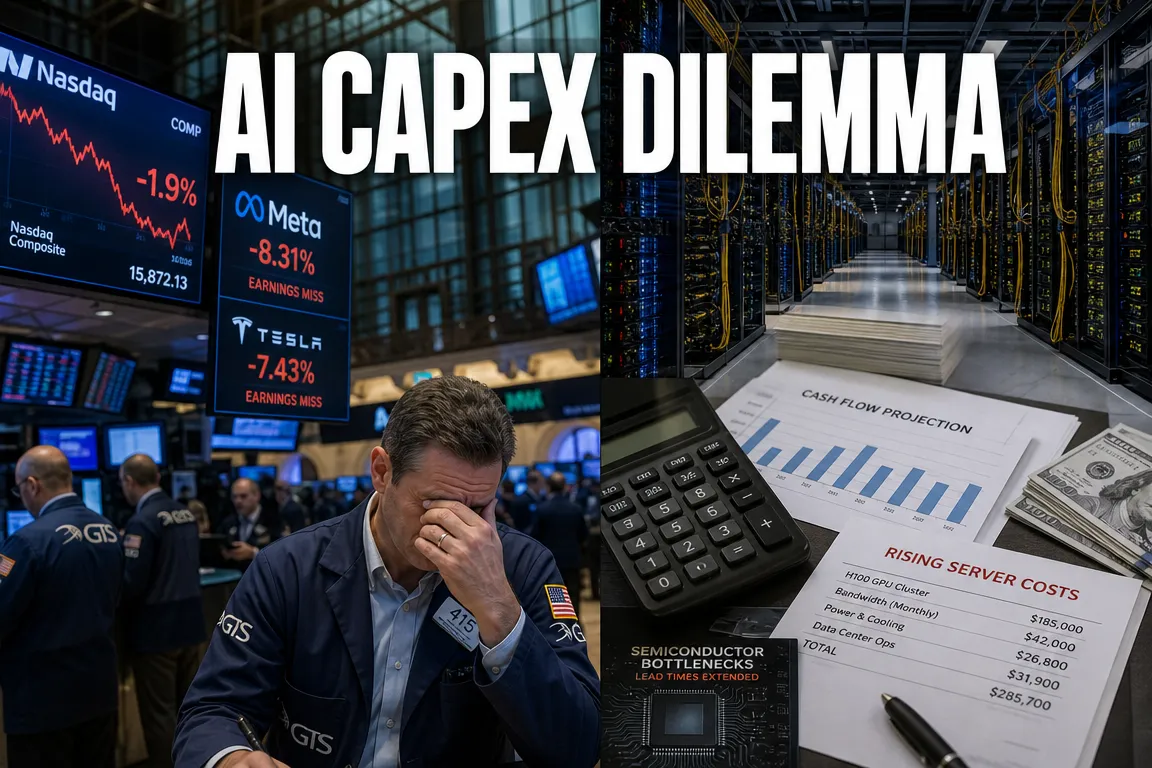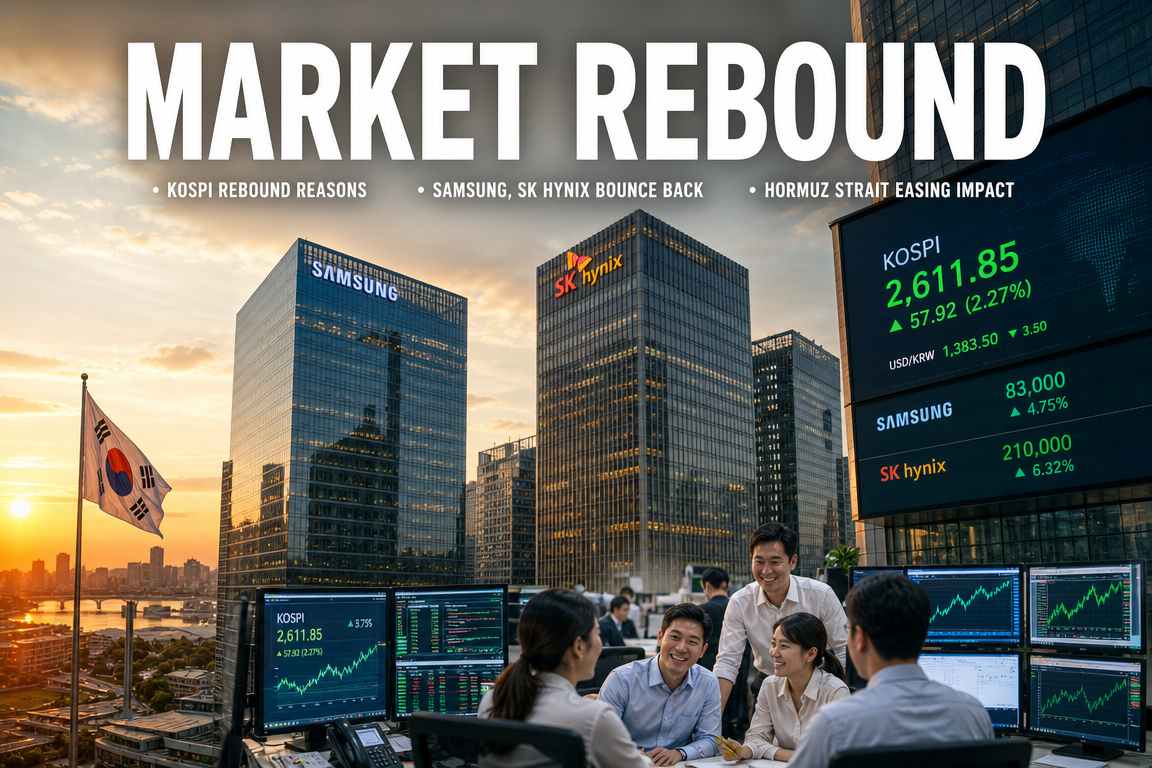
● KOSPI-Rebound-3-Reasons-Samsung-SK-Hynix-Bounce-Back
Three Reasons for the KOSPI Rebound: The Underlying Drivers Behind the Market Recovery After SK Hynix and Samsung Electronics Declined
The key point in today’s KOSPI move was not simply that the market rebounded after falling sharply.
The recovery reflected a combination of semiconductor correction, shareholder-return expectations, easing Hormuz Strait risk, and a turn in investor sentiment.
In particular, when high-index-weight stocks such as Samsung Electronics and SK Hynix weaken, the critical issue is what supports the downside and attracts renewed buying.
This report summarizes the three main drivers behind the KOSPI recovery and highlights the key points that are often overlooked in other news coverage and video commentary.
1. Shareholder Returns Supported the Market After the Sharp Selloff in Semiconductor Stocks
The first reason is that expectations for shareholder returns reemerged after semiconductor stocks such as Samsung Electronics and SK Hynix had declined significantly in a short period.
Recent market sentiment was pressured by reports of price increases related to Nvidia, which weighed on the broader semiconductor value chain.
Although demand for AI semiconductors remains strong, uncertainty around pricing negotiations and margin structure often triggers profit-taking first.
As a result, selling intensified in large-cap KOSPI names, with core semiconductor stocks such as SK Hynix and Samsung Electronics coming under pressure.
As the decline deepened, the market refocused on dividend expansion and share buybacks.
When a company has already announced a buyback program, lower share prices allow it to repurchase more shares with the same amount of capital.
This is not only a psychological support factor; it can also provide real demand support and limit downside pressure.
For example, if a company is set to repurchase KRW 1 trillion worth of shares, it can buy more shares in the market at a lower price than at a higher one.
If those shares are later canceled, expectations for higher earnings per share, improved per-share value, and better return on equity may follow.
For investors, the idea that “the company itself may step in at this price level” can support the market and reduce further downside in the KOSPI.
2. Easing Risk Around the Hormuz Strait Improved Global Market Sentiment
The second reason is the easing of geopolitical risk in the Middle East.
As noted in the original report, remarks from the Pakistani side suggested progress in discussions over ending tensions between the United States and Iran.
Expectations that the Hormuz Strait could be reopened also helped reassure markets.
The Hormuz Strait is a critical route for global crude oil shipments.
Rising tension in the region typically pushes up oil prices, which then increases inflation pressure.
Higher inflation weakens expectations for U.S. rate cuts and can lead to a stronger dollar and a weaker won.
For the Korean market, this often translates into more volatile foreign capital flows and higher KOSPI volatility.
By contrast, when risks around the Hormuz Strait ease, concerns about a sharp rise in oil prices diminish.
This can restore risk appetite across global financial markets.
Given Korea’s export-oriented market structure and high sensitivity to foreign investor flows, the KOSPI tends to respond quickly to such geopolitical relief.
In other words, today’s rebound should be viewed not only as a domestic market move, but also as the result of lower geopolitical and oil-price risk at the global level.
3. Sentiment Reversal: The “Reverse Indicator” Joke Reflects Real Market Psychology
The third reason is investor sentiment, illustrated by the term “reverse indicator.”
This is an internet expression suggesting that if one follows a certain negative call in the opposite direction, the outcome may be favorable.
Although the phrase is humorous, it reflects an important aspect of market psychology.
When markets fall sharply, most investors focus on identifying the cause of the decline.
Semiconductor correction, Nvidia pricing issues, Middle East risk, foreign selling, and currency pressure all tend to receive attention at the same time.
However, when everyone becomes worried in the same direction, it may indicate that much of the bad news has already been priced in.
At that point, even a modest positive catalyst can trigger a quick rebound.
Today’s KOSPI recovery fits that pattern.
With semiconductor stocks already having declined significantly, the combination of shareholder-return expectations and easing Middle East risk helped sentiment recover rapidly.
Key News Summary: What Drove the KOSPI Rebound Today
Market conditions: The KOSPI weakened intraday but later trimmed losses and moved into a recovery phase.
Key sectors: Samsung Electronics and SK Hynix were the main drivers of market direction.
First catalyst: Shareholder-return policies emerged as a support factor after the decline in major semiconductor names.
Second catalyst: Expectations for easing tensions between the United States and Iran, along with possible reopening of the Hormuz Strait, supported risk appetite.
Third catalyst: The view that much of the bad news had already been reflected encouraged short-term bargain hunting.
Investment focus: Whether this is only a technical rebound or the start of a broader trend will depend on foreign flows, exchange rates, oil prices, and semiconductor earnings outlooks.
The Most Important Point Often Missing in Other Coverage
The most important point in today’s KOSPI rebound is that share buybacks can become more powerful when share prices fall.
Many reports describe shareholder returns only as a positive signal.
In practice, however, the effect of a buyback increases when the stock price declines.
When a company repurchases shares with a fixed amount of capital, a lower stock price allows it to buy more shares.
If those shares are later canceled, the number of shares outstanding declines.
With fewer shares outstanding, earnings per share can improve even if total earnings remain unchanged.
For long-term investors, a price decline can therefore become a period in which shareholder-return effects are amplified.
One important condition remains.
Holding repurchased shares is different from canceling them.
In the market, cancellation is generally viewed as a stronger form of shareholder return than repurchase alone.
Accordingly, for Samsung Electronics, SK Hynix, and other KOSPI large caps, investors should focus less on how much was repurchased and more on whether those shares are ultimately canceled.
Semiconductor Stocks: What Matters for Samsung Electronics and SK Hynix
Samsung Electronics and SK Hynix are key stocks that drive the broader KOSPI trend.
As long as the AI semiconductor cycle remains intact, the earnings outlook for these two companies will remain closely tied to the direction of the Korean market.
For SK Hynix, demand for AI memory, especially HBM, remains central.
Its market position and profitability within Nvidia’s supply chain are key variables.
If HBM pricing, supply agreements, and margins remain favorable, buying interest could strengthen again after the correction.
For Samsung Electronics, the main factors are recovery in the memory cycle, competitiveness in foundry operations, and progress in the HBM market.
Investors are looking not only at an improving semiconductor cycle, but also at whether Samsung Electronics can regain its position in the AI semiconductor supply chain.
Accordingly, a stronger share-price recovery for Samsung Electronics will likely require greater visibility on AI-related earnings, not only a recovery in memory prices.
Global Macro Perspective: Oil, FX, and Rates Drive the KOSPI
This rebound may appear to be a domestic market event, but it is strongly linked to global macro variables.
If risks around the Hormuz Strait ease, upward pressure on crude oil prices should moderate.
Stable oil prices reduce inflation concerns and help preserve expectations for U.S. rate cuts.
Lower rate pressure tends to support growth stocks and technology shares.
In the Korean market, exchange rates also matter.
A weaker won can increase foreign investors’ currency risk.
By contrast, if geopolitical risk declines and dollar strength moderates, foreign capital may return to the KOSPI.
Ultimately, today’s rebound reflects simultaneous movement in semiconductors, oil, exchange rates, interest rates, and foreign investor flows.
Five Variables to Watch Going Forward
1. Whether foreign investors turn net buyers
For the KOSPI to sustain a trend reversal, foreign inflows need to return.
In particular, investors should monitor whether buying resumes in Samsung Electronics and SK Hynix.
2. Speed of share repurchases and cancellations
Shareholder returns depend on execution, not just announcements.
The key question is whether buybacks are actually carried out and whether they proceed to cancellation.
3. Further developments on the Hormuz Strait
Middle East risk does not end with a single news item.
It is important to see whether the easing of tensions develops into substantive progress in negotiations.
4. Movements in oil prices and the exchange rate
A renewed spike in oil prices could raise inflation and rate pressure.
Stability in the KRW/USD exchange rate is also essential for the durability of the KOSPI rebound.
5. AI semiconductor earnings outlook
Ultimately, semiconductor stocks must be supported by earnings.
HBM demand, memory pricing, and changes in Nvidia’s supply chain remain the main variables.
Conclusion for Investors
Today’s KOSPI rebound was not simply a technical bounce; it reflected multiple catalysts converging at once.
After a short-term correction in semiconductor stocks, shareholder-return expectations helped support the downside, while easing Hormuz Strait risk improved global risk sentiment.
As the market concluded that much of the bad news had already been priced in, the KOSPI recovered.
However, the rebound does not by itself confirm a sustained uptrend.
Investors should continue to monitor foreign flows, oil prices, exchange rates, U.S. rate expectations, and earnings momentum at Samsung Electronics and SK Hynix.
If the AI semiconductor cycle remains strong, the KOSPI may regain upward momentum.
Conversely, renewed Middle East tensions or rising uncertainty around Nvidia’s supply chain could increase volatility again.
< Summary >
The first reason for the KOSPI rebound is that expectations for shareholder returns increased after declines in semiconductor stocks such as Samsung Electronics and SK Hynix.
The second reason is that easing tensions between the United States and Iran, along with discussion of reopening the Hormuz Strait, reduced concerns about oil prices and geopolitical risk.
The third reason is that bargain hunting strengthened as the market concluded that much of the negative news had already been reflected.
The most important point is that share repurchases can provide stronger downside support when stock prices fall, because more shares can be acquired at lower prices.
Going forward, investors should continue to monitor foreign flows, exchange rates, oil prices, and the AI semiconductor earnings outlook.
[Related Articles…]
AI Semiconductor Cycle and the Outlook for SK Hynix and Samsung Electronics
KOSPI Rebound and Global Equity Market Trends
*Source: [ 내일은 투자왕 – 김단테 ]
– 코스피 부활의 3가지 이유 #하이닉스 #코스피 #삼성전자
● Treasury-Driven Bitcoin Surge
Why the U.S. is Pressing Down Treasury Yields and Lifting Bitcoin: A Fiscal Liquidity Rally Has Begun Ahead of the Midterm Elections
The key issue is not simply that the U.S. is “printing money.”
The core mechanism is that the U.S. Treasury is buying back long-dated Treasuries, increasing short-dated issuance, and using the stablecoin market to help manage Treasury yields.
As a result, U.S. Treasury yields, the Bitcoin outlook, gold prices, the U.S. stock market, and global liquidity conditions are moving at the same time.
In particular, the market should focus on the emergence of fiscal dominance ahead of the November 2026 U.S. midterm elections, where fiscal policy increasingly leads market direction.
1. Core News: The U.S. Treasury Is Expanding Long-Dated Treasury Buybacks
The U.S. Treasury is strengthening its buyback program for long-dated Treasuries, meaning it is repurchasing government bonds already in the market.
What had previously been expected at around $20 billion is now being discussed at roughly $40 billion.
More importantly, the buyback schedule is expected to continue through November 4.
November 3 is the key political date linked to the U.S. midterm elections.
This suggests that the measure is not merely a bond-market stabilization tool, but also part of a pre-election economic support strategy.
For the Trump administration, the objective is to keep equities, crypto assets, and consumer sentiment as strong as possible before the election.
At the same time, cutting policy rates remains difficult.
Inflation concerns persist, and there is still concern about renewed rate pressures.
As a result, fiscal policy has become the preferred route.
Instead of liquidity created by monetary easing, the market is seeing liquidity driven by fiscal spending and Treasury issuance.
This is the most important turning point in the current global macro outlook.
2. Why Treasury Yields Need to Be Contained
If the U.S. wants to expand fiscal spending, it must issue more Treasury debt.
When Treasury issuance rises, Treasury prices generally fall and yields generally rise.
The problem is that if U.S. Treasury yields rise too much, pressure builds across all asset markets.
For example, when 10-year and 30-year Treasury yields remain elevated, investors have less reason to allocate to risky assets.
U.S. Treasuries offer an attractive return with little credit risk.
That reduces flows into equities, Bitcoin, gold, and corporate credit.
The corporate sector faces an additional challenge.
When Treasury yields rise, corporate borrowing costs also rise.
That increases funding costs, which can force firms to reduce investment and hiring.
In that case, government stimulus intended to support growth can instead crowd out private borrowing.
This is the crowding-out effect.
In short, if the U.S. government wants fiscal expansion to support the economy, it must contain Treasury yields.
That is why long-dated Treasury buybacks have become a policy tool.
3. Buy Long-Dated Treasuries, Issue More Short-Dated Debt
The structure of the policy can be summarized as follows.
The U.S. Treasury buys long-dated bonds from the market.
As demand for long-dated Treasuries increases, their prices rise and yields fall.
At the same time, the Treasury is likely to fund itself through greater issuance of short-dated bills, or T-bills.
In effect, the policy removes pressure from the long end while increasing supply at the short end.
This leads to a natural question.
“Will short-term yields rise as a result?”
Yes.
A larger supply of T-bills can pressure short-term rates higher.
However, the U.S. is building a new source of demand to absorb that supply.
That source is stablecoins.
4. Stablecoins Function as Buyers of Short-Dated U.S. Treasuries
The stablecoin business model is straightforward.
When investors deposit dollars, the issuer creates stablecoins against those funds.
Rather than simply holding cash, the issuer typically invests in short-dated U.S. Treasuries.
Major stablecoin issuers such as Tether and Circle use customer deposits to purchase T-bills.
If short-term Treasury yields are around 4% to 5%, issuers can generate stable interest income.
Stablecoins should therefore be viewed not only as crypto products, but also as a major buyer base for short-dated U.S. Treasuries.
This matters because the U.S. Treasury needs buyers for the additional short-dated debt it issues while buying back long-dated bonds.
As the stablecoin market expands, global investors indirectly become buyers of short-dated U.S. Treasuries by holding stablecoins.
In effect, the U.S. is using global capital to stabilize its own Treasury market.
5. Why Bitcoin Is Drawing More Attention Than Gold
Both gold and Bitcoin can respond to this environment.
When Treasury yields fall, non-yielding assets such as gold become relatively more attractive.
Bitcoin can also benefit under the same logic.
However, market expectations currently appear stronger for Bitcoin.
There are two reasons.
First, there is an expectation of Treasury yield stabilization.
Second, there is rising confidence in crypto sector institutionalization.
Gold is a traditional safe-haven asset.
Bitcoin, by contrast, can attract much larger inflows if it gains institutional acceptance.
If geopolitical risks ease and a more constructive tone emerges in major diplomatic events, capital may rotate more quickly toward risk assets than toward safe havens.
In other words, gold’s move reflects expectations of lower Treasury yields, while Bitcoin’s move reflects both lower yields and regulatory normalization.
6. Clarity Act and Expectations for Crypto Institutionalization
In the crypto market, the Loomis proposal and the Clarity Act are often referenced.
The Loomis proposal is more closely associated with a regulatory framework for stablecoin issuance.
The Clarity Act focuses on rules for trading, circulation, and custody of digital assets.
The market response to the Clarity Act is driven by a simple expectation.
Crypto assets may no longer remain in a regulatory gray zone and could increasingly be treated like mainstream financial products.
In practical terms, Bitcoin is moving from a less formal market posture to a more institutional one.
The participation of former President Trump at a crypto event with key industry figures, along with calls for passage of the Clarity Act, reinforces this trend.
Markets often react to the expectation of passage before actual legislative approval.
As a result, Bitcoin must be analyzed not only as a price chart, but also in the context of fiscal policy, Treasury markets, election strategy, and regulatory change.
7. The Complex Background of Middle East Conflict and Inflation
The Middle East conflict is another important variable in the current market environment.
Geopolitical risk in the region tends to push up oil prices.
Higher oil prices increase inflation pressure.
Conflict affects more than just crude prices.
It disrupts supply chains, raises energy costs, and increases fiscal burdens for governments.
Warring states must raise defense spending to replenish weapons and equipment.
Non-war states may also be forced to expand fiscal outlays through energy subsidies, emergency support, and other measures.
As a result, the global economy is moving into a phase where fiscal policy, rather than monetary policy, is driving markets.
This is fiscal dominance.
Even without central bank rate cuts, governments can still supply liquidity through fiscal expansion.
8. Why This Is a Liquidity Rally Even as Treasury Yields Rise
A liquidity rally usually refers to a period supported by rate cuts, quantitative easing, or monetary expansion.
In that environment, Treasury yields typically fall while equities, gold, and Bitcoin rise together.
This cycle is different.
The liquidity is not coming from rate cuts, but from fiscal spending.
Because the government must issue debt to fund spending, Treasury supply rises and yields can increase.
That is why liquidity is expanding even as Treasury yields also rise.
In this environment, not all assets rise together.
Capital tends to concentrate in select equities with clear earnings visibility, high-growth sectors, and assets such as Bitcoin that benefit from institutional demand.
In Korea, this can also support names linked to AI semiconductors, such as Samsung Electronics and SK hynix.
9. The Less Discussed Point: The U.S. Is Turning the World into a Treasury Buyer
Many reports stop at the observation that the U.S. is conducting Treasury buybacks, Bitcoin is rising, or yields are falling.
The more important point comes next.
The U.S. is suppressing long-dated yields while increasing short-dated issuance, and stablecoin ecosystems are helping absorb that debt.
As global users adopt dollar-based stablecoins, they indirectly support demand for short-dated U.S. Treasuries.
What looks like a stablecoin purchase at the retail level effectively channels liquidity into the U.S. Treasury market.
This is the core of the stablecoin competition.
It is not only about expanding the crypto market.
It is also a strategy to preserve dollar dominance and sustain Treasury demand.
Bitcoin and stablecoins should therefore be viewed not as isolated investment themes, but as part of a larger financial infrastructure linked to U.S. fiscal policy.
10. Key Market Signals Investors Should Monitor
The first indicator is the U.S. long-term Treasury yield.
Investors should monitor whether the 30-year yield stabilizes and whether the 10-year yield rises again.
If long-term yields remain stable, that is constructive for equities, gold, and Bitcoin.
The second indicator is the short-term Treasury market.
Investors should watch whether T-bill supply continues to rise and whether demand remains sufficient.
Stablecoin issuance and reserve composition may provide useful clues.
The third indicator is the probability of Clarity Act passage.
As expectations for regulatory clarity strengthen, additional capital may flow into Bitcoin and major crypto assets.
If the bill is delayed or faces political resistance, expectations could fade quickly.
The fourth indicator is the scale of fiscal spending ahead of the midterm elections.
As elections approach, the U.S. government has a stronger incentive to support growth and asset prices.
However, policy direction may shift again after the elections, so investors should also monitor the post-election turning point.
11. What This Means for Korean Investors
For Korean investors, this should not be viewed as a purely U.S. story.
Movements in U.S. Treasury yields affect the dollar-won exchange rate, foreign capital flows, the Korean equity market, and even property markets.
If long-term yields stabilize, foreign investor sentiment may improve.
Capital may then continue to concentrate in sectors with clear growth drivers, such as AI semiconductors, data centers, power infrastructure, cloud services, and crypto-related industries.
If Treasury yields rise again, growth stocks and risk assets could come under pressure.
Themes without strong earnings support may become especially volatile.
At this stage, the priority is not indiscriminate risk-taking, but portfolio adjustment based on fiscal policy and Treasury yield direction.
12. Core View: The Market Is Now Driven More by Fiscal Policy Than by Rates
The center of the market is no longer policy rates alone.
The current cycle is shaped by Treasury buybacks, short-dated issuance, stablecoin demand, crypto institutionalization, and election strategy.
If this structure holds, Treasury yields may stabilize, equities may rebound, gold may rise, and Bitcoin may strengthen at the same time.
However, this is not a permanent condition.
Because it is driven by political timing and policy expectations, market direction could change after the midterm elections.
For investors, the key is to understand the structure rather than focus only on short-term price calls.
They need to understand why the U.S. is trying to suppress Treasury yields, why stablecoin institutionalization is accelerating, and why Bitcoin may be reacting more sharply than gold.
That framework is essential for understanding the broader global market path in the second half of 2026.
< Summary >
The U.S. is expanding Treasury buybacks ahead of the midterm elections in an effort to suppress Treasury yields.
With rate cuts difficult, fiscal policy is being used to supply liquidity.
The structure involves buying long-dated Treasuries while increasing short-dated issuance, with the stablecoin market likely absorbing much of that supply.
Stablecoins are effectively becoming a key buyer of short-dated U.S. Treasuries.
Expectations for Treasury yield stabilization and crypto institutionalization are creating stronger upside momentum for Bitcoin than for gold.
At the same time, this trend is tightly linked to the midterm election calendar, so policy shifts after the election must also be monitored.
[Related Articles…]
- Bitcoin Institutionalization and Shifting Global Capital Flows
- U.S. Treasury Yields and the Liquidity Cycle
*Source: [ 경제 읽어주는 남자(김광석TV) ]
– “중간선거 전 돈 풀기 시작됐다” 미국이 국채금리 누르고 비트코인 띄우는 이유 | 김광석의 경제학교 | 8월 월간특강 [1편]