● Humanoid Robots Demand Surge
The real reason humanoid robots are obsessed with “folding laundry”: the core signal in the Tesla Optimus, Figure AI, and LG Electronics robot competition
These days, there is a scene that repeatedly appears in humanoid robot demo videos.
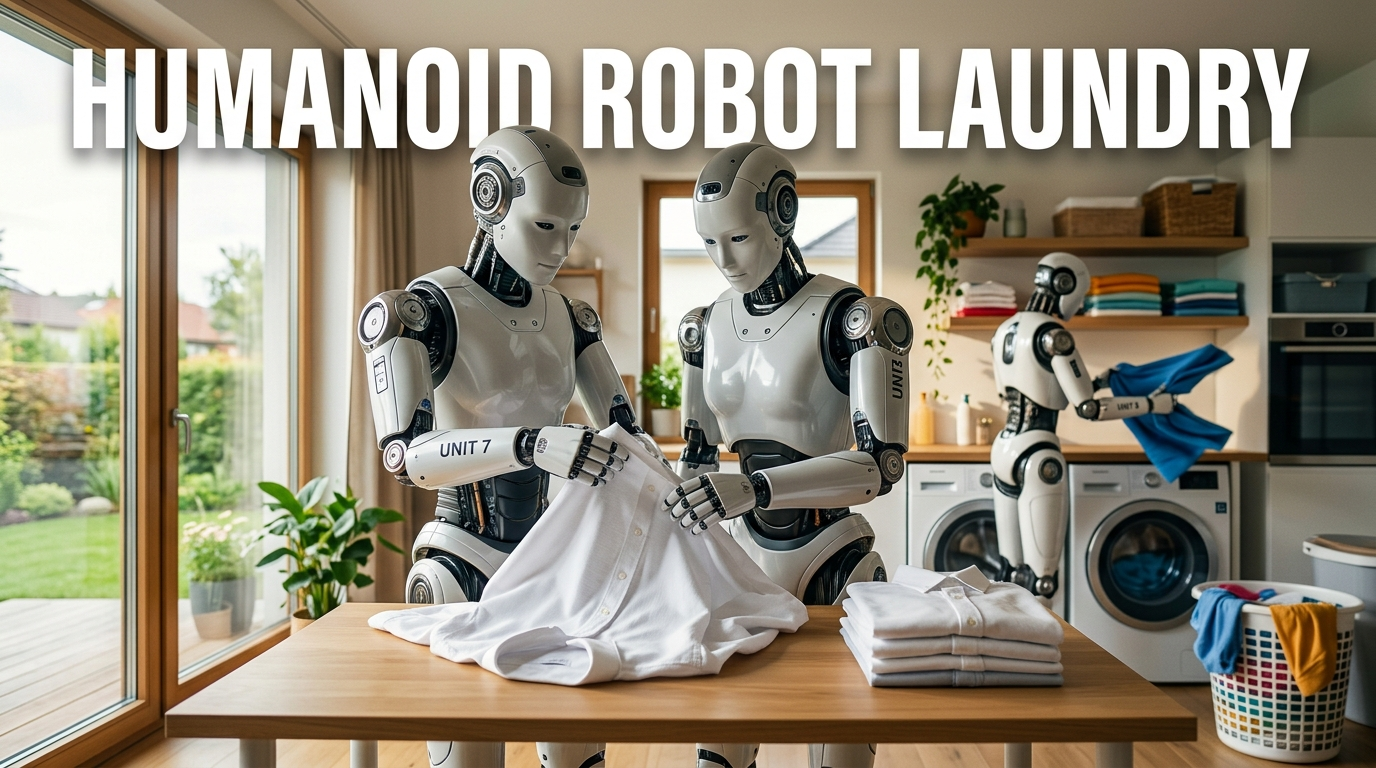
It is the act of a robot unfolding and folding wrinkled towels, T-shirts, and pants with both hands: “folding laundry.”
At first glance, it looks like a simple household chore, but in fact this scene contains important clues that reveal the technology level of the robotics industry, changes in AI training methods, the possibility of commercializing home robots, and even the global economic outlook.
In particular, the reason companies like Tesla Optimus, Figure AI, LG Electronics, Sunday Robotics, and Weave Robotics repeatedly show laundry folding is not just publicity.
Folding laundry is the hardest challenge for a humanoid robot, and at the same time the best training ground for safely and efficiently accumulating data.
1. Why “folding laundry” in particular: fabric is the most difficult object for robots
For a robot, picking up a cup or moving a box is relatively straightforward.
Cups and boxes have fixed shapes, and it is comparatively predictable where to grasp them.
But laundry is completely different.
Objects made of fabric, such as towels, T-shirts, pants, and socks, change shape the moment you touch them.
They wrinkle, fold, overlap, stretch, and even change direction.
Even the same T-shirt appears in a different form every time it is taken out of the laundry basket.
This is the difficulty of what the robotics industry calls “deformable object manipulation.”
- The robot must first recognize whether it is a towel or a T-shirt.
- It must find edges and corners.
- It must understand the structure of the garment, such as sleeves or waistline.
- It must spread the fabric with both hands.
- It must align the direction and match both ends.
- It must determine and execute the folding sequence.
- When it fails, it must unfold and recover.
In other words, folding laundry is not simple labor; it is a comprehensive test that simultaneously verifies a robot’s visual perception, spatial judgment, bimanual coordination, force control, and error recovery abilities.
When a humanoid robot can fold laundry well, it is a powerful signal that “this robot can move with some flexibility in a real home environment.”
2. Why Tesla Optimus, Figure AI, and LG Electronics show laundry folding
Tesla’s Optimus drew major attention when Elon Musk personally revealed a scene of folding a T-shirt.
Figure AI also devoted a considerable portion of its Figure 02 and Figure 03 demo videos to folding laundry.
LG Electronics also showed CLOi robots placing laundry into a washing machine and folding towels at CES.
The reason all these companies chose laundry folding is clear.
Folding laundry is a representative scene that shows whether a humanoid robot can actually be useful in spaces where people live.
- Tesla Optimus: used it as a symbolic demo to show the potential of a general-purpose humanoid robot.
- Figure AI: used laundry folding as a scene emphasizing vision-based judgment and bimanual task capability.
- LG Electronics CLOi: placed laundry organization scenes to show the practicality of a home assistance robot.
- Sunday Robotics: presented clothing folding as the first test task for its home robot, Memo.
- Weave Robotics: introduced Isaac Zero, a fixed robot specialized in folding laundry, and Isaac One, a mobile robot.
In the end, folding laundry is the “stage” where robot companies can most intuitively showcase their technology.
It is easy for people to understand and technically very difficult, so the demo effect is strong.
3. Core robot capabilities required for folding laundry
For a robot to fold laundry, simply moving its arms is not enough.
Everything humans do unconsciously must be calculated and judged by the robot.
- Visual perception: it must identify the type of clothing and its current state through cameras.
- Object understanding: it must distinguish structural differences among towels, pants, and T-shirts.
- Grasp point selection: it must judge where to hold so the fabric will spread.
- Bimanual coordination: it needs to hold with one hand and pull or fold with the other.
- Force control: if it grips too hard, the fabric twists; if too weakly, it slips.
- Direction alignment: it must match the front and back, top and bottom, and left and right of the garment.
- Error recovery: if it fails during folding, it must unfold and try again.
Performing all of these processes stably is an important advance in AI robot technology.
In particular, for robots to enter human living spaces, they must be able to handle such unstructured tasks.
4. Why past laundry-folding robots failed
Laundry-folding robots actually appeared 10 years ago as well.
But at that time, the technology was far more limited than it is now.
- 2010 UC Berkeley PR2: it took an average of 25 minutes to fold one towel.
- 2015 imitation learning experiments: the success rate for properly folding wrinkled towels was around 6 out of 10.
- Japan’s Seven Dreamers Laundroid: it developed a home appliance that recognized and folded clothes with cameras and robotic arms, but failed to commercialize due to speed and recognition accuracy issues.
- U.S. FoldiMate: people had to manually spread each garment and hang it on the feeder, and it could not handle socks, underwear, or baby clothes.
Laundroid could take up to 10 minutes to fold a single garment, and often failed to recognize clothing if it was only slightly different in shape.
In the end, Seven Dreamers went bankrupt in 2019.
FoldiMate also drew attention at CES but never reached mass production or shipping, and shut down in 2021.
The biggest limitation at the time was that the robot lacked the ability to make judgments on its own according to the situation.
Researchers had to design each step one by one, including how to find the corners of clothing, the order of arm movements, and the folding stages.
If the state of the garment changed even slightly, the system would easily collapse.
5. Why recent robots are different: the evolution of VLA models and AI learning
The background behind recent humanoid robots becoming much better at folding laundry than in the past includes VLA models.
VLA stands for Vision-Language-Action, an AI model that integrates vision, language, and action for training.
- Vision: recognizes the current scene through cameras.
- Language: understands the meaning and goal of the task.
- Action: determines how the robot arms and hands should move.
In the past, humans directly designed the motions, but now robots learn behaviors by training on diverse situation data.
In other words, instead of only performing fixed commands like “grab the left corner of the towel and pull it to the right,” robots are changing to a method where they look at the current state in front of them and choose the appropriate action.
This change is reshaping the robotics industry.
As AI semiconductors improve, large-scale data training, sensor technology, and generative AI inference capabilities combine, robots are becoming closer to functioning in real environments.
In the long term, this could also have a major impact on productivity innovation and changes in the labor market.
6. Why laundry is the best training task
Another reason folding laundry matters is that it is very good for accumulating training data.
Robots must learn by making mistakes, but not every task is suitable for repeated errors.
- Cooking is dangerous because of fire and knives.
- Dishwashing can break dishes.
- Factory assembly requires millimeter-level precision.
- Furniture assembly has high failure costs.
By contrast, laundry does not break when dropped.
If it is folded incorrectly, you can simply unfold it again.
Just crumpling a towel or changing its direction can create a new training situation.
You can even fix the camera in place and repeat the same task thousands of times.
From a company perspective, this allows the collection of large amounts of trial-and-error data while lowering cost and risk.
This part is very important.
The competitiveness of humanoid robots is likely to be determined more by data and learning loops than by hardware alone.
7. What Sunday Robotics’ 99.1% success rate means
Looking at the results recently disclosed by robot companies, it is clear they are different from 10 years ago.
Sunday Robotics said its home robot Memo succeeded in 778 out of 785 laundry-folding tests conducted in unfamiliar home environments.
The success rate is 99.1%.
The median time to fold one garment was 2 minutes and 13 seconds.
Of course, it would be difficult to say on the basis of this number alone that laundry-folding robots will soon enter every home.
There are many factors to check, such as test conditions, clothing types, failure criteria, and whether there was human intervention.
Still, the important point is that speed and success rates are rapidly approaching a level where commercialization can be discussed.
Whereas 10 years ago it was closer to a “technology demo,” now the atmosphere is shifting toward the stage of “verifying productization potential.”
8. The core point less covered in other news: folding laundry is a robot’s “data flywheel”
Many news stories focus on the scene of the robot folding laundry itself.
But what matters more is the data structure created behind that scene.
Folding laundry is a repeatable task.
At the same time, it is a task whose state changes every time.
When these two conditions combine, they create a very good data flywheel for AI training.
- The robot picks up the laundry.
- It succeeds or fails.
- It records the cause of failure.
- It tries again in a different way.
- It accumulates success data.
- It updates the model.
- Next time, it performs faster and more stably.
If this process is repeated thousands or tens of thousands of times, the robot does not just become good at folding laundry.
It gains a general ability to handle unstructured objects.
This ability can expand into bed making, closet organization, tablecloth arrangement, hospital linen management, hotel laundry handling, and logistics packaging tasks.
In other words, folding laundry is not just one function of a home robot; it is a core training problem for developing general robot intelligence.
9. The humanoid robot competition from an economic perspective
The humanoid robot competition is not just a technology event.
It is also emerging as an important investment theme in the global economic outlook.
In particular, during periods when expectations for interest-rate cuts grow, capital inflows into growth stocks and future industries may strengthen again.
The robotics industry is connected to AI semiconductors, batteries, sensors, motors, cameras, cloud infrastructure, and manufacturing automation.
Therefore, if the humanoid robot market grows, it is likely that not just a single company but the entire supply chain will move together.
- AI semiconductors: high-performance computing is needed for robot vision recognition and action judgment.
- Sensor industry: demand for cameras, lidar, tactile sensors, and force sensors may increase.
- Precision motors: core components that control robot joints and finger movements.
- Batteries: determine the operating time of mobile humanoid robots.
- Cloud AI: the foundation for learning and updating the data collected by robots.
In the end, folding laundry demos are not just publicity for home robots, but scenes that show the direction of automation in the next generation of manufacturing and services.
This is why robot technology must be viewed from the perspective of productivity innovation.
10. Realistic challenges remaining before home robot commercialization
Just because a robot can fold laundry does not mean it will immediately become widespread.
Several major barriers must be overcome for commercialization.
- Price: it must come down to a level affordable for ordinary households.
- Speed: if it is too slow compared with a human folding laundry directly, its practical value drops.
- Noise: it should not be uncomfortable to use in a home for long periods.
- Safety: it must operate stably even in environments with children, pets, and furniture.
- Handling diverse clothing: it must deal not only with towels but also pants, shirts, socks, underwear, and baby clothes.
- Organization function: it must go beyond folding and continue to the step of placing clothes into closets or drawers.
- Update structure: because each home environment is different, continuous learning and improvement are necessary.
Price is especially the biggest variable.
If a home humanoid robot remains in the tens of millions of won, the market will inevitably be limited.
But in B2B markets such as companies, hospitals, hotels, care facilities, and laundry factories, the initial adoption potential is higher.
11. Where will laundry-folding robots be used first?
Commercial spaces are the area most likely to spread before home use.
The more repetitive the work and the greater the labor cost burden, the stronger the rationale for introducing robots.
- Hotels: towels, bedding, and robe organization tasks occur repeatedly.
- Hospitals: there is high demand for managing patient gowns, bed sheets, and linens.
- Care facilities: there is a lot of laundry organization work and heavy staffing burden.
- Laundry service companies: because they process large volumes of clothing, automation can have a strong effect.
- Logistics centers: can be applied to clothing packaging and sorting tasks.
If home robots are the final goal, the B2B market is likely to be the intermediate stage.
Companies can accumulate data in commercial environments, lower hardware costs, and then gradually enter the home market.
12. Core checkpoints investors and readers should watch
When looking at humanoid robot news, you should not just focus on the scene of “the robot folded laundry.”
You should also ask the following questions.
- Did a person pre-spread the clothes, or did the robot take them directly from the basket?
- Did it only fold towels, or did it handle a variety of garments?
- Did it recover by itself when it failed?
- How long did it take to fold one item?
- Was the test environment a tidy lab or a real unfamiliar home?
- Are the criteria for the success rate clearly defined?
- Did the company disclose whether the robot is teleoperated or fully autonomous?
- Can the collected data be expanded to other tasks?
The clearer the answers to these questions are, the higher the technology credibility of the company.
Conversely, if there is only flashy video and no specific conditions, the content may be more marketing-oriented.
13. Core conclusion: folding laundry is not a “small scene” in humanoid robots, but a “major turning point”
For humans, folding laundry is an annoying household chore.
But for robots, it is a high-difficulty task that demands vision, hand skills, judgment, and error recovery all at once.
At the same time, it is the best practice problem because it is safe, repeatable, and favorable for data accumulation.
That is why Tesla Optimus, Figure AI, LG Electronics, Sunday Robotics, and Weave Robotics repeatedly show this scene.
What they want to sell is not merely a laundry-folding function.
The real message is, “Our robot is moving toward a stage where it can see, judge, and act in a complex real world.”
The humanoid robot market is still in its early stage.
But if meaningful progress continues in unstructured tasks like folding laundry, the robotics industry is likely to become the next growth engine of the AI era.
< Summary >
The reason robot companies focus on folding laundry is not just to demonstrate a household chore, but because it can showcase the core capabilities of a humanoid robot at once.
Fabric is a deformable object that keeps changing shape, making it extremely difficult for robots.
Folding laundry requires visual perception, bimanual coordination, force control, directional judgment, and error recovery.
Past systems like Laundroid and FoldiMate failed due to speed and recognition limitations, but recent performance has improved greatly thanks to advances in VLA models and AI learning.
Even if laundry fails, the risk is low and repeated learning is easy, making it an ideal task for accumulating robot data.
In the future, humanoid robots are likely to spread first in B2B markets such as hotels, hospitals, and laundry services rather than in homes.
From an investment perspective, AI semiconductors, sensors, precision motors, batteries, and cloud AI supply chains should also be watched together.
[Related Articles…]
- Humanoid robot market outlook and the global big tech race
- How AI semiconductors are reshaping the future of the robotics industry
*Source: [ 티타임즈TV ]
– 빨래개기는 로봇 최대 난제이자 최고 연습문제