● Tesla-Optimus Data War, AlphaGo Zero Style Robot Breakthrough
Tesla Optimus Academy: The real meaning of AlphaGo Zero-style learning is entering the robotics industry
The key issue in this debate is not simply that Tesla is building robots.
What matters is that Figure AI said it plans to spend about $1 billion, or roughly KRW 1.4 trillion, over the next year on robotics training data and computing.
More importantly, the company explicitly said it had tried to buy data but could not.
This suggests that the core of the humanoid robotics race is shifting away from hardware and toward who can collect and train on real-world data more effectively.
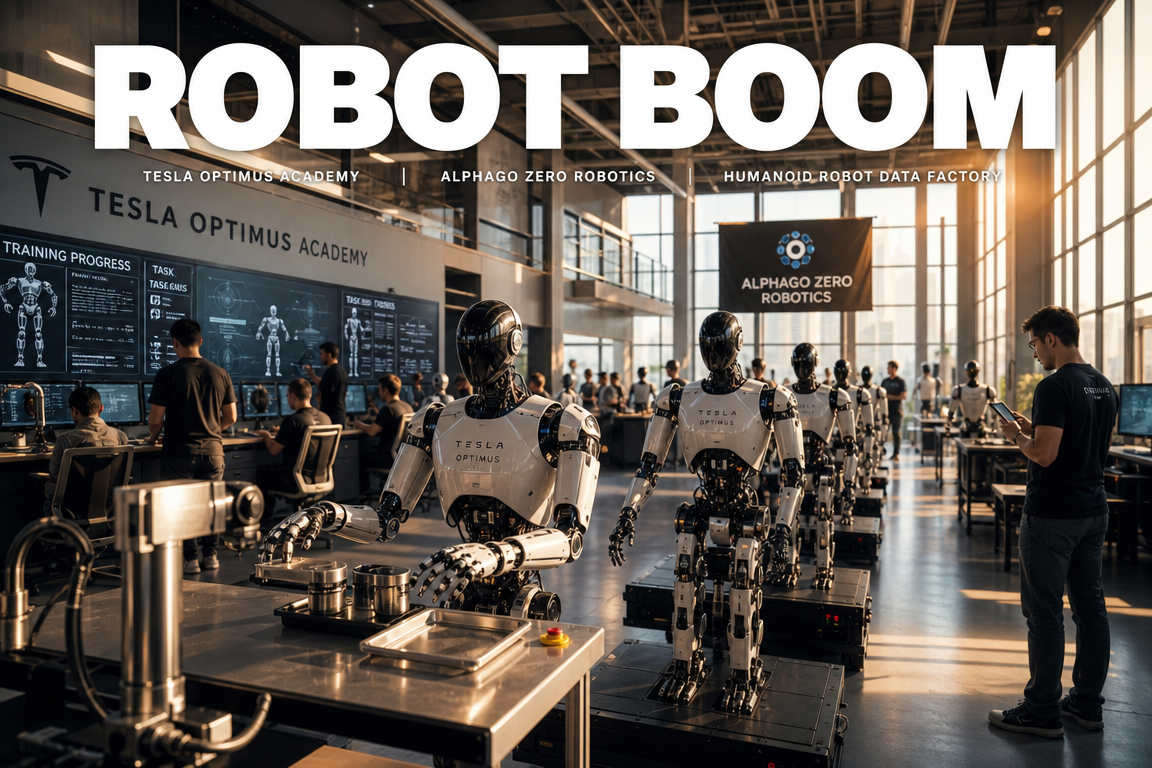
Tesla’s Optimus Academy is designed to target exactly this point.
Elon Musk’s stated plan for a training facility with 10,000 to 30,000 robots is not simply a laboratory. It is closer to a data factory in which robots learn through repeated trial and error, similar to AlphaGo Zero.
With Tesla trading around $345, investors should focus not only on EV deliveries, but also on AI investment, the robotics industry, growth-stock valuation on the Nasdaq, and how Tesla is building a data moat within the global economic outlook.
1. Market context: Tesla and SpaceX moved in opposite directions
- Tesla closed at $345.82.
- The stock fell 1.26% on the day.
- SpaceX rose 1.2% to $139.63.
- The S&P 500 fell 0.02%.
- The Nasdaq fell 0.08%.
- The Dow Jones fell 0.21%.
Major indices were essentially flat, but Tesla and SpaceX moved in different directions.
On a short-term price basis, there may have been little visible catalyst.
However, from the perspective of the robotics data race, Tesla shareholders are now seeing a meaningful inflection point.
Even as slowing EV growth and higher interest rates pressure Tesla’s valuation, the key question is whether the company can create a new growth narrative through AI and humanoid robotics.
2. Figure AI’s “Index Project”: A declaration to spend KRW 1.4 trillion on robotics data
The starting point for this story is Figure AI, a humanoid robotics company in San Jose, California.
Figure AI is still relatively unfamiliar in Korea, but it is widely regarded as one of the highest-valued startups in humanoid robotics.
According to the original report, the company was valued at roughly $39 billion, or about KRW 54 trillion, during its funding process.
Investors reportedly include Nvidia.
The company’s main initiative is a smartphone app called “Index.”
The structure is straightforward.
Users install the app and are paid for uploading videos of tasks they perform at home or at work.
- Making a bed can be recorded.
- Folding laundry can be recorded.
- Washing dishes can be recorded.
- Serving customers in a cafe can be recorded.
- Changing engine oil in a car may also be included.
- Clearing dishes in a restaurant also becomes usable data.
The scale is significant.
- The app has been downloaded about 264,000 times.
- Downloads came from 108 countries.
- About 44,000 users upload videos each week.
- More than 16 million videos have been uploaded so far.
- About $15 million has been paid to users.
- This is equivalent to roughly KRW 20.8 billion.
Processing speed is particularly notable.
Figure AI says it currently processes about 30 minutes of video per second.
That equates to about 43,200 hours of video per day.
By the company’s own framing, that is roughly the equivalent of five years of human work processed in a single day.
Figure AI also said it will spend more than $1 billion on data and computing over the next 12 months.
That is about KRW 1.38 trillion, or close to KRW 1.4 trillion.
The important point is that this spending is concentrated on data and computing rather than robot production scale.
This is a strong signal that the bottleneck in robotics is shifting beyond motors, batteries, and joints toward training data.
3. Figure AI’s core message: “The data robots need does not exist on the internet”
Figure AI’s reasoning for this spending is clear.
The company believes that the data required for truly general-purpose robots does not exist on the internet.
Chatbots and large language models can learn from web pages, documents, code, and online posts.
Robots are different.
Even if YouTube contains many cooking videos, those videos do not precisely capture how much force a person applies with each finger when gripping a cup.
They also do not fully show wrist angles, object weight, slippage, or contact pressure.
What robots need to learn is not just visual content on a screen.
They need to learn physical interaction in the real world.
That is why Figure AI chose to collect as much data as possible from different people, objects, and environments.
According to the original report, Figure AI’s data includes 373 distinct tasks per 1,000 hours.
It includes 1,146 distinct objects.
It includes 116 different spaces.
These figures matter because the hardest part of robotics is not memorizing one correct motion, but adapting to highly variable environments.
Every home has a different kitchen layout.
Every home has different dish sizes.
Every person folds laundry differently.
For robots to enter homes and factories at scale, they must learn that variability.
4. The most important point often overlooked: “We tried to buy data, but could not”
The most important statement in Figure AI’s announcement is that it tried to buy data first.
This may sound minor, but it reveals the core bottleneck in robotics.
A company valued at $54 trillion won went into the market with capital and still could not buy the data it needed.
The issue was that data vendors could not meet the required throughput, diversity, and quality.
As a result, Figure AI built its own data pipeline.
The implication is clear.
Robotics data is not a raw material that can simply be purchased with cash.
It is a strategic asset that must be designed, collected, filtered, and converted into a trainable format.
In future AI investment, competitive advantage may depend less on how many GPUs a company can buy and more on how much proprietary real-world data it can secure.
5. Tesla has already reached a similar conclusion
It is notable that Tesla has also been moving in this direction.
According to the original report, Tesla’s Optimus program underwent a major shift.
After Milan Kovac, who was previously said to oversee Optimus, left the company, the internal approach changed.
The key shift was away from motion-capture suits and VR teleoperation, and toward camera-based data collection.
Optimus has since been more closely linked to Tesla’s AI organization.
Since January this year, data collection has reportedly also started inside the Austin Gigafactory.
This is important.
It suggests Tesla is collecting data not only in controlled labs, but also on the factory floor where vehicles are actually produced.
Although Figure AI and Tesla did not coordinate, they appear to have reached the same conclusion.
The direction is to capture first-person video of people performing real work and train robots on that data.
6. Figure AI leads in data volume, while Tesla may differ in data quality
On raw volume alone, Figure AI appears to be far ahead.
Figure AI processes about 30 minutes of video per second.
That equals 43,200 hours per day.
By contrast, if Tesla’s data-collection workforce is only in the dozens, the total would be far smaller.
- 30 people collecting 8 hours per day would total about 240 hours.
- 50 people collecting 8 hours per day would total about 400 hours.
- Even 100 people would total about 800 hours.
In volume terms, Figure AI is much larger than Tesla.
But robotics data cannot be judged by quantity alone.
Figure AI relies mainly on smartphone video.
Tesla is more likely to use helmet-mounted cameras, gloves, tactile information, and precise motion data from workers.
Smartphone video is easier to scale, but it is limited in how much information it captures about force, touch, and fine motor control.
Tesla’s approach may produce less data, but with higher information density.
The real competition may therefore be between large, lower-density data and smaller, higher-density data in training general-purpose robots.
7. Tesla’s FSD data cannot be used for Optimus as-is
Many investors view Tesla’s largest moat as its FSD data.
That is because millions of Tesla vehicles generate video every day, and the data has been used to train autonomous driving systems.
It is natural to ask whether this data can simply be used for Optimus.
However, Elon Musk has responded cautiously to that idea.
According to the original report, when asked on a podcast whether FSD data from Tesla vehicles could be used for robots, Musk indicated that it would not work directly.
The reason is simple.
Cars operate on roads.
Optimus must grasp objects, open doors, move boxes, and handle slippery materials.
The sensor setup is different, the action space is different, and the physical interaction is more complex.
Accordingly, Tesla’s FSD data is better understood not as direct robot-training data, but as experience in building a real-world AI training pipeline and simulation infrastructure.
8. Figure AI’s BMW deployment is notable, but it is still far from general-purpose robotics
Figure AI has already deployed robots in a BMW factory.
According to the original report, the robots worked 10 hours a day, five days a week for 11 months, moving more than 90,000 parts.
That may appear close to commercialization.
However, the specifics suggest a more limited interpretation.
The robot’s task was to pick up stamped parts and place them accurately at welding points.
Moving 90,000 parts does not mean performing 90,000 different tasks.
It is closer to repeating one task 90,000 times.
Another deployment involved sorting and organizing logistics parts in sequence.
These are meaningful industrial tasks.
However, they are still far from a general-purpose humanoid robot that can independently solve a wide range of problems in varied environments.
For BMW, even one minute of production downtime would be costly.
That makes it difficult to let a robot freely explore new actions or accept frequent failures.
Customer factories are useful for validating hardware reliability, but they are limited as environments for open-ended learning.
9. Tesla’s real advantage is that it can generate failure data inside its own factories
Tesla’s difference from Figure AI is that it owns its own factories.
This is a major advantage.
Tesla can assign Optimus not only easy tasks, but also tasks that may fail.
It can also record why those failures happened.
In robotics learning, failure data can be as important as success data.
A cup broken by gripping too tightly is data.
A cup dropped because the grip was too weak is also data.
A box slipped during lifting is data.
A door was opened with the wrong hand position is data.
Humans learn through failure.
Robots can also learn better when failures are recorded in sufficient volume and detail.
In that sense, Tesla’s factory can become not just a production site, but a robotics data laboratory.
10. Optimus Academy: a structure in which 10,000 to 30,000 robots learn on their own
The core of Elon Musk’s Optimus Academy concept is scale.
If there are only 10 robots, only 10 failures can be generated.
If there are 10,000 robots, the picture changes.
Ten thousand robots can all try to pick up a cup at the same time.
Some will grip too tightly and break it.
Some will grip too weakly and drop it.
Some will grab the handle, while others will grasp the body of the cup.
All of these attempts become data.
This is not a system in which a human provides every correct answer. It is a system in which robots try, record outcomes, and improve themselves.
This is the point that connects to an AlphaGo Zero-style learning model.
11. AlphaGo and AlphaGo Zero: the learning model Tesla appears to be targeting
In 2016, AlphaGo defeated Lee Sedol 4 to 1.
At that time, AlphaGo had learned from human games.
It trained on about 30 million moves from professional and high-level amateur matches.
It then improved through reinforcement learning.
In 2017, DeepMind introduced AlphaGo Zero.
AlphaGo Zero did not use any human games.
It was given only the rules and then played against itself.
It initially made moves close to random, but after about 4.9 million games over three days, it defeated the original AlphaGo 100 to 0.
After 21 days, it had also surpassed the version that beat Ke Jie 3 to 0.
David Silver, who led the project, said that people often see machine learning as a contest of data and compute, but AlphaGo Zero showed that algorithms can matter more.
The key point is that self-learning at scale is possible.
However, the sequence matters.
AlphaGo Zero did not appear from nowhere.
AlphaGo first used human games, and that process validated the learning approach.
Only then did AlphaGo Zero emerge as a system that could improve without human examples.
Applied to robotics, Figure AI’s 16 million uploaded videos and Tesla’s camera-based factory data correspond to the first stage.
Optimus Academy is closer to a move toward the AlphaGo Zero stage.
12. But robotics is much harder than Go
There is an important distinction.
Go is a fully defined rules-based world.
The computer can calculate exactly how the board changes when a stone is placed.
There is no gap between the virtual world and the real world.
That is why AlphaGo Zero could train through self-play and still succeed in real matches.
Robotics is different.
The moment a cup slips from a hand is not fully captured by simple rules.
Trip hazards on a floor are also complex.
Whether laundry is folded “well” does not have a clear win-loss definition like Go.
Every home has different object placement, lighting, and flooring.
For robots to learn in an AlphaGo Zero-like way, they need a realistic simulated training environment.
And to build that simulation, real-world data is again required.
Real-world data is therefore both the starting point of robotics learning and the raw material for simulation.
13. Tesla’s hidden card: extending its automotive physics training infrastructure to robotics
Tesla already has experience building a large-scale real-world training environment for autonomous driving.
That was possible because the company accumulated more than a decade of real driving data.
Musk has also said in interviews that Tesla has built a physics training environment for cars and adapted it for robots.
If true, Tesla’s FSD data may not be direct robot-training data, but it could still contribute indirectly to robotics simulation infrastructure.
This is often the overlooked part of the story.
Tesla’s advantage is not only that it has a large volume of vehicle data.
It has already operated the full pipeline of collecting real-world data, cleaning it, simulating it, and using AI models to improve product performance.
That matters because AI and robotics are becoming central to productivity gains in the global economic outlook.
The important shift is from robots that simply replace labor to automated systems that continuously improve through data.
14. China’s robotics events, Figure AI, and Tesla point to the same conclusion
At China’s robotics events, what is visible is speed, balance, and physical performance.
That kind of hardware competition is easy to compare.
It is easy to see how many seconds a robot took, whether it fell, or whether it jumped.
Figure AI and Tesla are focused elsewhere.
They are trying to build robots that learn faster, not just move faster.
Figure AI says it will concentrate capital on data and computing.
Tesla is using Fremont and Gigafactory production environments to train Optimus.
Different companies are identifying the same bottleneck.
That bottleneck is not the robot’s body.
It is the robot’s mind.
In other words, the real competitive edge in robotics is shifting toward AI systems that can understand and adapt to the physical world.
15. What a Tesla shareholder at $345 should focus on
More important than the fact that Tesla trades at $345 is how the market will re-rate the company.
If Tesla is viewed only as an EV manufacturer, its valuation will remain difficult to justify.
EV competition is intensifying, and pricing pressure remains high.
But if Tesla is viewed as an AI infrastructure company, a robotics platform company, and a self-driving data company, the valuation framework changes.
Optimus is still closer to R&D than to a meaningful contributor to earnings.
Musk has also acknowledged that Optimus is still deployed mainly for learning rather than productivity.
Accordingly, it should not be viewed as a near-term earnings driver.
However, over the long term, it could determine Tesla’s AI narrative.
- How quickly Optimus can learn real factory tasks matters.
- How systematically Tesla records failure data matters.
- How much it can reduce robot manufacturing costs matters.
- How well it can close the gap between simulation and reality matters.
- Whether it can extend the AI training pipeline built for FSD into robotics matters.
For Nasdaq growth investors, these factors may help explain Tesla’s long-term premium.
If they stall or fail, Tesla’s AI premium could compress back toward that of a traditional EV company.
16. The most important points that many news reports do not emphasize
First, robotics data is not something that can simply be bought with money.
Figure AI’s statement that it tried to buy data but could not highlights the supply-chain bottleneck in robotics.
GPUs and servers can be purchased with capital, but high-quality behavior data must be created.
Second, failure data may become more important than success data.
For robots, it is not only the successful cup grip that matters. The reasons for dropping, breaking, or losing balance may be more valuable training signals.
Tesla’s ownership of its own factories is a major advantage because it can support that kind of experimentation.
Third, Tesla’s FSD data is more likely to support the training infrastructure than to be directly transferred to Optimus.
Many simplify the issue by saying car data can directly become robot data, but that is not a realistic assumption.
The key is that Tesla’s pipeline for data collection, auto-labeling, simulation, and model training can be applied to Optimus.
Fourth, Optimus Academy is not a robot production line. It is a robot learning engine.
If 10,000 to 30,000 robots each generate different attempts and those results are captured as data, it becomes more than a testbed.
It could become Tesla’s new data moat.
Fifth, the winner in robotics is likely to be the company that builds the fastest learning system, not the most visually impressive robot.
Humanoid form factors may converge over time.
But the speed at which companies collect real-world data, record failures, improve simulation, and update models can differ sharply.
17. Conclusion: Tesla and Figure AI are converging on the same answer
Figure AI is paying users around the world to collect videos of real-world actions.
Tesla is collecting higher-density data inside its factories and, in the long term, may use Optimus Academy to enable self-learning robots.
The methods differ, but the conclusion is the same.
The core of humanoid robotics is data and learning, not just the physical machine.
Just as AlphaGo Zero defeated the original AlphaGo 100 to 0 through self-play without human game records, Tesla is trying to build a system in which Optimus learns through real or realistic simulated environments.
However, robotics is much harder than Go.
The physical world has no perfect rules, and there is always a gap between simulation and reality.
The key question going forward is therefore not how many robots Tesla can build, but how much useful training data those robots can generate.
For Tesla shareholders, the focus should be on the Optimus data pipeline, factory-level learning speed, simulation accuracy, and real-world deployment milestones rather than short-term share-price moves.
This is not just a Tesla story. It is a significant signal for how AI and robotics may reshape productivity in the global economy.
< Summary >
- Figure AI said it will spend about KRW 1.4 trillion over the next year on robotics training data and computing.
- The main reason is that the real-world behavior data needed for general-purpose robots does not exist on the internet.
- Figure AI tried to buy data, but quality and diversity were insufficient, so it built its own collection pipeline.
- Tesla is also moving away from motion capture and VR toward camera-based real-world data collection.
- Figure AI has an advantage in data volume, while Tesla may benefit from higher-density data and the ability to generate failure data inside its own factories.
- Optimus Academy resembles an AlphaGo Zero-style structure in which 10,000 to 30,000 robots learn through repeated trial and error.
- Robotics is far more complex than Go, so simulation accuracy remains a critical variable.
- Tesla shareholders should focus more on the Optimus data moat and AI training pipeline than on short-term stock moves.
[Related Articles…]
- Tesla AI Strategy and the Outlook for Optimus Robotics
- Humanoid Robotics Market and the Global Economic Outlook
*Source: [ 오늘의 테슬라 뉴스 ]
– 알파고를 100대 0으로 이긴 방법 — 테슬라가 옵티머스 아카데미에서 하려는 게 정확히 이겁니다, $345 주주는?
● Debt Bomb, Tariff War, Global Shock
U.S. Debt Bomb Warning in Three Years and the Real Link to Trump’s Trade War
The key issue is not simply that the United States has a large amount of debt.
The more important point is that the U.S. fiscal deficit, Treasury yields, trade war, protectionism, and global supply chain restructuring are all connected within a single macroeconomic trend.
Below is a news-style summary of why Ray Dalio warned that the U.S. federal debt bomb could explode within three years, why Trump described tariffs as “a more beautiful word than love,” and how this trend could affect the U.S. economic outlook and the global economy.
1. Ray Dalio’s Warning: The U.S. Debt Problem Is No Longer Just a Numbers Issue
Ray Dalio, a leading figure in the hedge fund industry, has warned that the U.S. federal debt problem could develop into a serious crisis within three years.
The concern is not merely the size of the debt.
The issue is that the U.S. government spends far more than it collects each year and continues to fund the gap through Treasury issuance.
-
U.S. federal revenue: about $5.5 trillion
-
U.S. federal spending: about $7.5 trillion
-
Annual fiscal deficit: about $2 trillion
-
Annual principal repayment: about $10 trillion
-
Annual interest expense: about $1 trillion
In practical terms, the U.S. government is running an annual deficit of roughly $2 trillion while also facing rising principal rollovers and interest costs on existing debt.
Some analyses indicate that interest expense on U.S. debt has already exceeded defense spending.
This should be viewed as a structural burden on the U.S. economy, not merely an accounting issue.
2. If U.S. Treasury Yields Do Not Decline, the Debt Problem Will Intensify Faster
The key variable in the U.S. debt problem is Treasury yields.
When Treasury yields are low, the government can borrow heavily with relatively limited interest burden.
Under a prolonged high-rate environment, the situation changes materially.
As the U.S. government issues new debt or refinances maturing debt, it must absorb higher yields.
This raises interest expense, which in turn requires additional debt issuance, creating a negative feedback loop.
This can be understood by analogy to a personal loan structure.
It is similar to taking out a short-term loan to repay a long-term loan.
Although the debt appears to be serviced in the short term, the overall burden becomes more difficult to manage.
The U.S. government faces a comparable dynamic.
A growing volume of Treasury securities is reaching maturity, new issuance remains large, and markets continue to demand higher yields.
3. The U.S. Government’s Short-Term Response: Buybacks and TGA Use
The U.S. government is not without policy tools.
As noted in the source material, it is considering several measures to stabilize the Treasury market.
-
Expanded Treasury buyback program: The government repurchases outstanding Treasuries to improve market liquidity and stability.
-
Use of the TGA balance: The Treasury General Account can be used to reduce market stress through cash deployment.
-
Adjustments to issuance structure: The government can manage the mix of long-term and short-term debt issuance to control interest costs.
However, these measures are better understood as time-buying tools than as structural solutions.
If the government intervenes to stabilize yields while continuing to issue more debt to finance deficits, the policy may amount to shifting the burden rather than resolving it.
This is the point that markets are most concerned about.
If the government fails to reduce the fiscal deficit and continues increasing debt issuance, investors are likely to demand higher returns.
That would place renewed upward pressure on Treasury yields and weigh on U.S. equities and global financial markets.
4. The Real Reason Behind Trump’s Trade War: The Link Between Trade Deficits and Fiscal Deficits
Trump’s trade war is not simply a political move aimed at China.
The core issue is the U.S. twin-deficit problem.
-
Trade deficit: Arises when the U.S. imports more than it exports.
-
Fiscal deficit: Arises when government spending exceeds tax revenue.
Trump’s approach is straightforward.
Higher tariffs are imposed on imports to reduce the price competitiveness of foreign goods.
The intended result is stronger domestic production, more manufacturing jobs, higher business investment, and potentially higher tax revenue.
Tariffs are also used as leverage in negotiations, pressuring global companies to invest in the United States in exchange for lower trade barriers.
This is not only a trade policy but also a broader economic strategy aimed at reshoring manufacturing, increasing fiscal revenue, and easing the deficit burden over time.
In other words, Trump’s trade war is an attempt to reduce both the trade deficit and, ultimately, the fiscal deficit.
The key question is whether this strategy can succeed in practice.
5. The Meaning of “Tariff Is a More Beautiful Word Than Love”
During his 2024 campaign, Donald Trump described tariffs as “a more beautiful word than love.”
Although the phrase sounds exaggerated, it accurately reflects the logic of Trump’s economic policy.
For Trump, tariffs are not simply taxes.
They are a tool for reviving U.S. manufacturing, a bargaining chip in trade negotiations, and a source of government revenue.
For decades, the global economy treated free trade as the default order.
The WTO-centered rules-based system encouraged countries to lower tariffs and open markets.
That order is now under pressure.
6. Has the Free Trade Order Ended? Why Protectionism Has Become the New Normal
The book “The Order After Trump” conveys an important message.
Returning to the old free trade order may be an unrealistic expectation.
In practice, the world has already gone through several turning points in the direction of protectionism.
-
Brexit: The United Kingdom’s exit from the European Union weakened the momentum of globalization.
-
Trump’s first-term tariff policy: The U.S.-China trade conflict escalated materially.
-
The pandemic: Export restrictions on masks, medical equipment, and vaccines exposed supply chain vulnerabilities.
-
The U.S.-China technology conflict: Restrictions intensified on semiconductor equipment, advanced technology, and rare earth exports.
-
Tariff pressure after 2025: The U.S. has again revived broad tariff measures.
The global economy can no longer assume permanently low tariffs and unrestricted market access.
National security, supply chain resilience, manufacturing protection, and technological leadership have moved to the center of trade policy.
7. The Side Effects of Trade Wars: Import Barriers Can Act Like a Drug
The source material uses a striking analogy.
“Import barriers are like drugs: they create an initial high, but the side effects arrive later.”
At first, higher tariffs may appear to benefit U.S. firms and workers.
Foreign goods become more expensive, improving the relative competitiveness of domestic products.
Over time, however, the side effects emerge.
-
Imported raw material costs rise.
-
Corporate production costs increase.
-
Consumer prices move higher.
-
Global supply chains are restructured less efficiently.
-
Retaliatory tariffs from trading partners become more likely.
As a result, tariffs may provide short-term political benefits, but they can also contribute to inflation and higher costs over the medium to long term.
This is why tariff policy remains a critical variable for the U.S. economic outlook.
8. What iPhone, Sushi, and a Pencil Reveal About the Global Supply Chain
The value of free trade is best illustrated by the global supply chain.
Most products used daily are not produced within a single country.
The iPhone is a clear example.
It is designed in California, assembled in China, and relies on a supply chain involving roughly 28 countries and more than 200 companies.
Even a single semiconductor depends on inputs such as Germanium from China, high-purity sand from the United States, wafer processing in Japan, equipment from the Netherlands, foundry operations in Taiwan, and software from the United States.
Sushi lunch boxes are similarly global.
They may include wasabi from Japan, seaweed from Korea, pickled ginger from Thailand, rice from Italy or Vietnam, salmon from Norway, and shrimp from Vietnam.
A pencil is also a global product.
The wood may come from Brazil or Indonesia, graphite from Sri Lanka or Brazil, clay from the United States or the United Kingdom, eraser materials from Thailand or Malaysia, metal bands from China or Japan, and coatings and adhesives from Germany or Korea.
This structure has enabled lower prices and higher-quality goods.
However, as tariffs and protectionism intensify, this efficiency can weaken.
The result may be a more expensive consumer environment.
9. The Advantages of Free Trade: Efficiency, Innovation, and Scale
The main advantage of free trade is efficiency.
Each country specializes in what it produces most effectively, and trade allows resources to be allocated more productively.
For example, if Brazil can produce wood more cheaply and efficiently, there is less reason for another country to bear the cost of producing the same input domestically.
Each country can instead focus on industries where it has a comparative advantage.
Free trade also supports innovation.
Global competition encourages firms to improve products and reduce costs.
It also enables economies of scale.
Large-scale production reduces unit costs and allows consumers to purchase goods at lower prices.
Korea’s access to oil despite not being an oil-producing country is one example of the benefits of trade.
Free trade creates value by making available what a country does not produce itself.
10. The Drawbacks of Free Trade: Industrial Decline and Job Loss
However, free trade does not benefit all participants equally.
Trade liberalization can impose severe shocks on less competitive industries.
Historically, Britain contributed to the collapse of India’s textile industry in the 19th century.
Low-cost British products dominated the Indian market and undermined local production.
When Japanese exports to the United States surged in the 1960s and 1970s, some U.S. workers were also significantly affected.
Manufacturing-dependent communities in particular saw their economic base weaken under import competition.
More recently, the China shock has become a major example.
China’s large-scale production and low-cost exports have pressured manufacturing in the United States and Europe.
Concerns about oversupply from China continue in sectors such as electric vehicles, batteries, solar panels, and steel.
For this reason, free trade should not be treated as universally beneficial in all cases.
From a national policy perspective, strategic industries such as food, energy, semiconductors, defense, and critical materials may require a degree of protection.
11. The Infant Industry Argument: Why Some Sectors Should Be Protected
The infant industry argument mentioned in the source remains relevant.
It refers to industries that are not yet fully competitive but are strategically important and should be developed domestically.
Korea’s rice sector is a useful example.
If Korea depended entirely on imports for rice, consumers might benefit from lower prices in the short term.
However, if domestic rice farming disappeared and a supplier later restricted exports, food security would be compromised.
Even a disruption in the supply of key inputs, as seen in the urea solution shortage, can affect the broader economy.
For that reason, not every industry can be left entirely to market forces.
From this perspective, Trump’s tariff policy can also be interpreted as an effort to protect strategic industries and rebuild manufacturing capacity, rather than as simple isolationism.
12. How Trade Deficits Can Feed Into Fiscal Deficits
The most important connection is the relationship between the trade deficit and the fiscal deficit.
The United States has long tolerated trade deficits because of dollar dominance.
Global demand for the dollar and the perception of U.S. Treasuries as safe assets have allowed the U.S. to sustain deficits within the system.
However, when manufacturing jobs leave the country, the government must respond to unemployment, regional decline, and income inequality.
That often leads to higher welfare spending, subsidies, industrial support, and infrastructure investment.
In other words, trade deficits can weaken manufacturing, manufacturing decline can raise government spending, and that can feed back into the fiscal deficit.
This is the negative cycle Trump seeks to break through tariffs.
13. The Core Point Markets May Be Missing: Tariffs Are Not Just Taxes, but a Political Response to the Treasury Crisis
This is the key issue that is often less emphasized in other media coverage and online commentary.
Trump’s trade war cannot be understood fully as only anti-China policy or election messaging.
The real issue is the U.S. Treasury market and the fiscal crisis.
The current model of financing persistent deficits through debt issuance is approaching its limits.
The U.S. therefore needs new sources of revenue and a stronger industrial base.
Tariffs serve three functions in this process.
-
First, revenue generation: Tariffs increase government income from imports.
-
Second, investment inducement: Foreign companies are pressured to build production capacity in the United States.
-
Third, support for Treasury credibility: A stronger manufacturing and revenue base is intended to sustain confidence in U.S. debt over time.
In this sense, the trade war may appear to be a trade policy, but it is also part of the U.S. response to debt pressure.
Viewed this way, protectionism in the United States is likely to remain in place for some time.
14. Potential Effects of a Trade War on the U.S. and Global Economy
If the trade war accelerates, the global economy could experience several shifts.
-
Renewed inflation pressure: Higher import prices may push consumer inflation higher.
-
Delayed rate cuts: If inflation rises again, the Federal Reserve may slow the pace of policy easing.
-
Greater Treasury yield volatility: Fiscal concerns and inflation concerns may operate simultaneously.
-
Supply chain restructuring: Supply chains may shift away from China toward the United States, Mexico, India, and Southeast Asia.
-
Sector differentiation in U.S. equities: Domestic manufacturing, defense, energy, and infrastructure-related stocks may benefit, while import-dependent companies face margin pressure.
Korea, as an export-oriented economy, is particularly exposed to these changes.
Semiconductors, autos, batteries, steel, shipbuilding, and defense are likely to be directly affected by U.S. trade and industrial policy.
15. Key Considerations for Korean Investors and Companies
The U.S. debt issue and trade war should not be viewed only as macro headlines.
They are directly relevant to Korean companies and investors.
-
U.S. Treasury yields: Affect global capital flows and equity valuation multiples.
-
Dollar strength: Influences the KRW/USD exchange rate, import prices, and foreign capital flows.
-
U.S. tariff policy: Can alter pricing power and production strategies for Korean exporters.
-
China supply chain risk: Companies with high dependence on China need stronger risk management.
-
Pressure to invest in the U.S.: Semiconductor, battery, and automotive firms may face greater demands to expand local production.
Future global economic conditions will be shaped not only by interest rates and inflation, but also by the interaction of fiscal policy, trade policy, industrial policy, and national security policy.
16. Conclusion: The Post-Trump Order Is Not a Return to Free Trade, but Selective Globalization
The central message is clear.
The world is unlikely to return fully to the previous free trade order.
The more probable outcome is not complete deglobalization, but selective globalization.
This means pursuing efficiency where possible while restructuring critical industries around domestic production or allied supply chains.
The United States is seeking to restore its manufacturing base as a way to contain debt pressure.
Tariffs and protectionism are being used as tools in that process.
However, these policies also carry the risk of higher inflation, greater supply chain costs, and deeper trade conflict.
The key question going forward is this.
Can the United States reduce both the trade deficit and the fiscal deficit through tariffs?
Or will tariffs instead reinforce inflation and higher Treasury yields, accelerating the debt problem?
The answer to that question is likely to shape the U.S. economic outlook, dollar dominance, U.S. equities, and the direction of the global economy.
< Summary >
Ray Dalio has warned that U.S. federal debt could evolve into a serious crisis within three years.
The United States is running an annual fiscal deficit of about $2 trillion, while debt interest costs are rising rapidly.
Trump’s trade war is not only directed at China; it is also an effort to reduce both trade and fiscal deficits.
However, tariffs can increase consumer prices, raise global supply chain costs, and add volatility to Treasury yields.
The likely direction of the global economy is not a return to free trade, but a coexistence of protectionism and selective globalization.
[Related Articles…]
*Source: [ 경제 읽어주는 남자(김광석TV) ]
– “미국 부채폭탄 3년 안에 터진다” 트럼프가 관세전쟁 꺼내든 진짜 이유 | 김광석의 북리뷰 | 트럼프 이후의 질서 [1편]