● Nvidia Shockwaves, Samsung, SK Hynix, KOSPI Jump
Why NVIDIA’s Earnings Are Moving Samsung Electronics, SK Hynix, and the KOSPI
The key takeaway from NVIDIA’s latest earnings release is not simply that results were strong.
The critical point is that NVIDIA delivered a significantly stronger signal than the market expected on demand for AI semiconductors next year.
That single message links global equities, semiconductor stocks, Samsung Electronics, SK Hynix, and the outlook for the KOSPI.
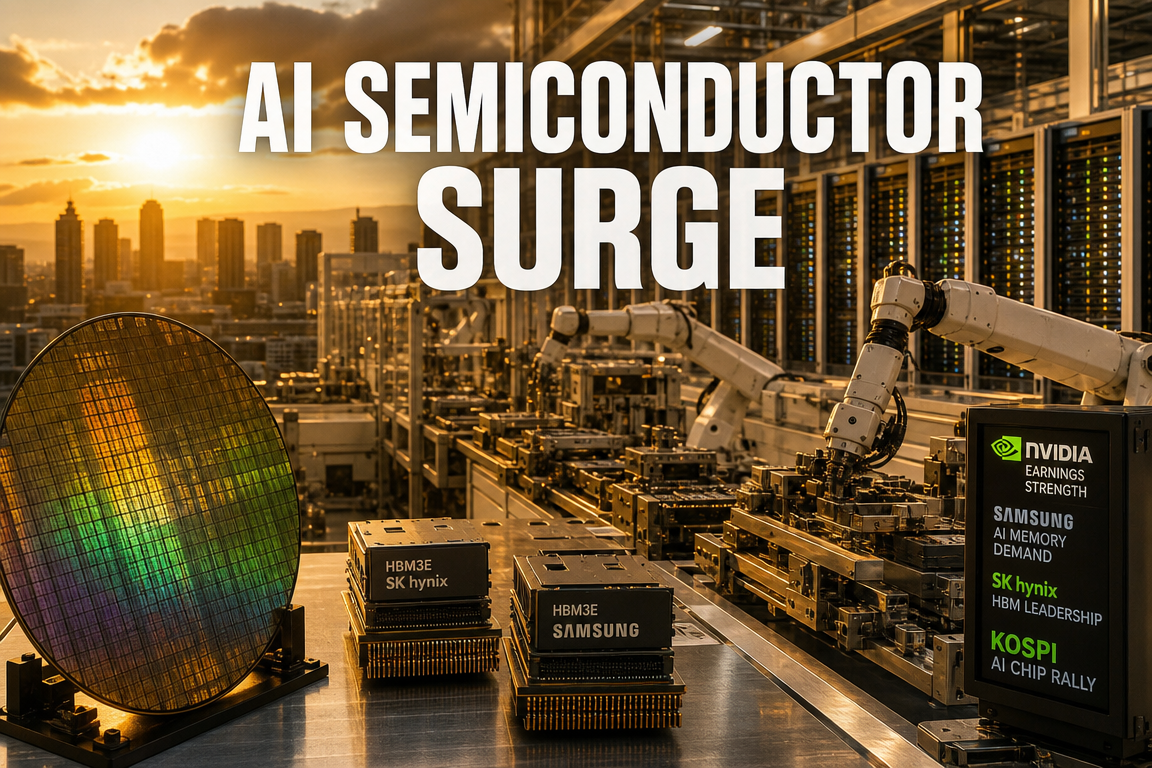
In particular, higher GPU sales tend to benefit memory chips first, and the leading suppliers of those chips are Samsung Electronics and SK Hynix.
This report explains why NVIDIA’s earnings are viewed as one of the most important earnings releases globally and what it implies for Korean AI-related equities.
1. Market focus today: NVIDIA’s earnings set the direction for AI equities
NVIDIA is now effectively the leading name in the AI equity market.
As AI infrastructure spending rises, NVIDIA is the first company investors watch, and its earnings are widely treated as a barometer for AI semiconductor demand.
The market reacted most strongly to two points in this release.
First, current-quarter results were solid.
Second, and more importantly, the company delivered a much stronger outlook for next year than expected.
Based on the original report, NVIDIA indicated that revenue could grow by about 70% next year.
The market had been expecting growth of about 45%.
In other words, the company delivered a growth signal that was 25 percentage points above consensus.
This gap is not merely a numerical difference.
It was interpreted as evidence that the AI investment cycle has not ended and may remain strong next year.
As a result, NVIDIA shares rose more than 6% in after-hours trading.
2. Why NVIDIA’s earnings matter for Samsung Electronics and SK Hynix
When NVIDIA sells more GPUs, the result is not limited to NVIDIA’s own revenue.
More GPU sales require more high-performance memory inside those chips.
This is where Samsung Electronics and SK Hynix become relevant.
AI server GPUs are different from consumer graphics cards.
Training and inference for large-scale AI models require extremely high data throughput and memory bandwidth.
The key component in this process is high-bandwidth memory, or HBM.
SK Hynix has established strong competitiveness in the HBM market, and Samsung Electronics is also focusing on expanding supply and improving technology.
Accordingly, stronger expectations for NVIDIA’s GPU sales naturally increase expectations for Korean memory semiconductor companies.
The mechanism is straightforward.
Higher NVIDIA GPU sales lead to greater AI server investment, which increases HBM demand, supports Samsung Electronics and SK Hynix, and strengthens Korean semiconductor equities.
3. Immediate impact on the Korean market
Following NVIDIA’s earnings release, AI-related equities in Korea showed firm momentum across the market.
Investor sentiment improved not only for Samsung Electronics and SK Hynix, but also for semiconductor equipment, materials, components, power infrastructure, and data center-related names.
Samsung Electronics and SK Hynix account for a significant share of the KOSPI.
Their stock performance affects not only individual names but also the broader direction of the index.
Korean equities have recently been highly sensitive to U.S. technology stocks and the AI semiconductor cycle.
When NVIDIA reports strong results and guidance, investors in Korea tend to expect the semiconductor upcycle to last longer.
That expectation becomes a support factor for the KOSPI outlook.
4. The number that mattered most: 70% growth outlook versus 45% expected
The main reason investors reacted strongly was the gap in growth expectations.
The market had expected NVIDIA’s revenue growth for next year to be around 45%.
The company’s message pointed to potential growth of about 70%.
A 25 percentage point difference is substantial.
In corporate earnings, a gap of this size is more than a simple surprise; it forces a reassessment of industry-wide demand.
NVIDIA sits at the top of the AI semiconductor value chain.
When NVIDIA signals strong demand, it is generally interpreted as evidence that cloud providers, big tech companies, data centers, and AI startups will continue purchasing GPUs.
In effect, this earnings release reinforced the view that AI investment is not a short-lived trend, but a capital expenditure cycle with longer duration.
5. Key implications for Samsung Electronics and SK Hynix
Samsung Electronics and SK Hynix are both memory semiconductor companies.
At present, investors are paying closer attention to HBM than to conventional DRAM.
AI GPUs require advanced memory.
As NVIDIA sells more GPUs, HBM demand rises, and expectations for pricing and supply agreements also increase.
SK Hynix is already viewed as a major supplier in the HBM market.
If demand tied to NVIDIA remains strong, expectations for further earnings improvement at SK Hynix may increase.
For Samsung Electronics, the key issue is restoring competitiveness in HBM and expanding supply.
If Samsung secures meaningful share in the AI memory market, it could be re-rated as a growth semiconductor company rather than being viewed primarily through smartphones and consumer electronics.
6. The most important point often missed in other coverage
Most reports focus on NVIDIA’s more than 6% after-hours gain.
However, the more important point is not the share-price move itself.
The key issue is that the market has begun to reprice the durability of AI semiconductor demand.
AI investment is no longer only a software theme.
It is a large-scale capital expenditure cycle that extends into GPUs, HBM, data centers, power infrastructure, cooling systems, and semiconductor equipment.
Korean companies are competitive in memory within this cycle.
The more GPUs NVIDIA sells, the more memory is required for those systems.
This linkage explains why Samsung Electronics and SK Hynix are so sensitive to NVIDIA’s earnings.
Valuation is another important factor.
If NVIDIA sustains strong growth, high valuation multiples across AI semiconductor companies become more defensible.
If growth slows, current premiums could be corrected quickly.
For that reason, this earnings release is both a near-term catalyst and a reference point for future market expectations.
7. What this means for the KOSPI and KOSDAQ
For the Korean market, the most constructive scenario is an NVIDIA-led AI semiconductor rally that lifts Samsung Electronics and SK Hynix and supports the KOSPI.
If the two large-cap names rise steadily, foreign capital inflows are also likely to improve.
In the KOSDAQ, semiconductor equipment, materials, back-end processing, testing, power efficiency, and cooling-related companies may also attract attention.
As AI data center investment expands, demand will extend beyond chips to surrounding infrastructure.
However, AI-related KOSDAQ stocks tend to be volatile.
The gap between companies with actual earnings visibility and those trading only on theme-driven momentum can widen quickly.
Investors therefore need to distinguish between names with real revenue linkage and pure thematic exposure.
8. Key items investors should monitor next
First, investors should watch whether NVIDIA’s next-quarter guidance remains strong.
Even after a strong release, weaker forward guidance could quickly disappoint the market.
Second, investors should monitor whether HBM supply tightness persists.
If supply remains constrained, pricing power improves and margin expansion expectations for Samsung Electronics and SK Hynix strengthen.
Third, the scale of AI capital spending by major cloud and platform companies should be tracked.
Microsoft, Amazon, Google, and Meta must continue expanding AI data center investment for demand in NVIDIA and memory semiconductors to remain firm.
Fourth, the timing of earnings translation for Korean companies should be confirmed.
Stock prices move on expectations, but the trend is sustained only when the numbers are reflected in earnings results.
Fifth, the U.S. dollar-won exchange rate and interest-rate trends also matter.
Because semiconductors are export-oriented, they are sensitive to exchange rates and global liquidity conditions.
A stronger expectation for rate cuts would support growth and technology equities.
9. One-sentence summary of NVIDIA’s latest earnings release
NVIDIA’s strong earnings and forward guidance indicate that the AI semiconductor cycle is still intact, and that signal extends to Samsung Electronics, SK Hynix, the KOSPI, and AI-related stocks in the KOSDAQ.
In particular, the stronger-than-expected growth outlook gave investors renewed confidence that AI infrastructure spending could last longer than previously assumed.
This is why NVIDIA shares reacted sharply in after-hours trading, and why AI-related stocks in Korea moved higher as well.
Ultimately, the market’s focus is not on the theme itself but on earnings.
Investors are likely to continue concentrating on companies that convert AI semiconductor demand into actual sales and profits.
< Summary >
NVIDIA’s earnings release was a key event for the direction of AI equities.
Current-quarter results were strong, but the more important message was that next year’s revenue outlook was stronger than expected.
Based on the original report, NVIDIA referred to about 70% revenue growth, versus market expectations of about 45%, a gap of 25 percentage points.
NVIDIA shares rose more than 6% in after-hours trading as a result.
Higher GPU sales at NVIDIA support increased demand for HBM and other memory chips.
Samsung Electronics and SK Hynix are therefore viewed as direct beneficiaries.
In the Korean market, expectations for AI semiconductors supported gains in the KOSPI and related KOSDAQ names.
The central takeaway is that AI investment may continue as a longer-term capital expenditure cycle centered on data centers and semiconductors.
[Related Articles…]
- NVIDIA Earnings and the AI Semiconductor Cycle
- HBM Demand, Samsung Electronics, and SK Hynix Outlook
*Source: [ 내일은 투자왕 – 김단테 ]
– 지구상에서 가장 중요한 실적발표 #삼성전자 #하이닉스 #엔비디아● AI-Powered, Dollar-Down, Liquidity-Driven, Supercycle
The Real Reason U.S. Treasury Yields and the Dollar Are Being Suppressed: Capital Continues to Flow Toward AI Semiconductors and Hyperscaler CAPEX
The key issue here is not simply expectations for rate cuts or a weaker dollar outlook.
The real question is why the U.S. is seeking to suppress Treasury yields, weaken the dollar, and incorporate stablecoins and the corporate bond market into its policy framework.
The conclusion is that these policies are ultimately aimed at redirecting global liquidity back into AI semiconductors, Nvidia, data centers, and hyperscaler CAPEX investment.
Although tariffs, exchange rates, Treasury yields, stablecoins, and the KRW/USD rate may appear to move independently, they are in fact part of a single integrated policy flow.
This is also a key clue for understanding why U.S. equities may continue to be led by the AI value chain in the second half of 2026 and into 2027.
1. Core message: Why is the U.S. suppressing both Treasury yields and the dollar?
The central message is clear.
U.S. policy is converging on a single package of lower yields, a weaker dollar, liquidity support, and sustained AI investment.
- First, fiscal policy.
The U.S. is likely to continue tolerating large fiscal deficits in order to support the economy and asset markets. - Second, monetary policy.
Expectations for rate cuts, stable market yields, and lower Treasury yields are mechanisms to keep liquidity flowing. - Third, exchange-rate policy.
A weaker dollar improves the price competitiveness of U.S. exporters and can support growth.
The important point is that the U.S. is not only pursuing general stimulus.
It is attempting to create a flow from lower Treasury yields to improved corporate bond financing conditions, sustained hyperscaler CAPEX, continued AI semiconductor demand, and support for U.S. equity leadership.
In other words, capital is not simply being distributed broadly across the market; it is being directed toward a specific growth engine.
2. Stablecoins: dollar-strength factor or liquidity channel?
Many investors interpret stablecoins as follows.
“If stablecoin issuance expands, dollar demand rises, so should that not support the dollar?”
At first glance, that appears reasonable.
However, the emphasis in this framework is different.
The key function of stablecoins is less about expanding dollar demand and more about serving as a U.S. Treasury buyer and a liquidity distribution mechanism.
When stablecoins are issued, U.S. Treasuries can become a major reserve asset in their backing structure.
That means stablecoins can effectively create a new source of demand for U.S. government debt.
For the U.S., which must continue issuing large volumes of debt, an additional stable and scalable buyer base is valuable.
From that perspective, stablecoins are not best understood simply as a dollar-strength factor.
They may instead function as a broader dollar-based liquidity channel, which can also create downward pressure on the dollar.
3. Greater dollar usage does not necessarily mean a stronger dollar
A critical distinction should be made here.
Global dollar usage and the dollar’s market value are not the same thing.
Even if the dollar is used more widely around the world, its value does not have to rise.
Reserve-currency dominance and dollar index performance are not identical concepts.
The dollar can be used more extensively while still weakening in value.
Conversely, even if dollar usage declines, the dollar can strengthen when safe-haven demand increases.
For that reason, it is not appropriate to automatically equate stablecoin growth with dollar strength.
In the current context, stablecoin expansion is more likely to matter as a mechanism for supporting U.S. Treasury market stability and broadening global liquidity.
4. After the tariff war comes the currency war: the broader picture in the Miran report
A key background reference in the lecture was the so-called Miran report released in November 2024.
The report argues that tariffs alone are insufficient to reduce the U.S. trade deficit.
During the Trump administration, tariff measures were already used extensively.
However, China responded in part by weakening the renminbi.
For example, if the U.S. raises tariffs by 10% and the counterparty currency depreciates by 10%, much of the tariff effect is offset.
For the U.S., this means tariffs alone are unlikely to materially improve the trade balance.
This is why a currency war may follow the tariff war.
A weaker dollar improves the price competitiveness of U.S. goods and services.
This is particularly relevant for sectors where the U.S. is structurally strong, including AI services, AI servers, semiconductor equipment, GPUs, and cloud infrastructure.
5. A modern Plaza Accord: yen strength and dollar index decline
The 1985 Plaza Accord is the classic example of coordinated action to correct an overvalued dollar.
In this framework, the current environment is interpreted as a modern version of the Plaza Accord.
This would not necessarily take the form of an explicit public announcement to strengthen the yen.
Today, the process is more likely to operate through quiet coordination, foreign-exchange intervention, and policy signaling by central banks.
- Potential Bank of Japan rate hikes
Continued discussion of further rate hikes can reinforce yen strength. - Direct intervention by Japanese authorities
Purchases of the yen can help curb excessive weakness. - Possible U.S.-Japan coordination
Stronger policy alignment could reduce yen weakness and push the dollar index lower.
The dollar index measures the dollar against a basket of six major currencies.
The yen has a meaningful weight in that basket.
Accordingly, yen strength can increase downward pressure on the dollar index.
This trend could also influence the KRW/USD exchange rate.
However, the more accurate interpretation is not that the won suddenly becomes stronger on its own, but that the won appears stronger relative to a weakening dollar.
6. KRW/USD outlook: more a dollar-weakness effect than a structural won-strength story
The lecture suggests that the KRW/USD rate may stabilize within a certain range in the second half of 2026.
The key point is that the won may not be strengthening structurally; rather, the exchange rate may decline because dollar-weakening policy is exerting a strong influence.
Short-term volatility remains possible.
The KRW/USD rate can still be affected by geopolitical risk, safe-haven demand, U.S. inflation data, Federal Reserve communications, Bank of Japan policy, and foreign-exchange intervention.
Still, the broader direction points to a higher probability of a weaker dollar.
If the U.S. seeks to support growth and asset prices ahead of the 2026 midterm elections, global liquidity could expand again.
7. The real U.S. objective: if debt cannot be reduced, grow GDP
The U.S. faces a large fiscal deficit and heavy debt burden.
However, reducing debt in the near term is difficult.
That leaves another option.
Increase GDP.
Debt ratios are generally measured as debt relative to GDP.
If the numerator cannot be reduced, expanding the denominator can make the ratio appear more manageable.
A weaker dollar benefits U.S. exporters.
Higher exports can improve corporate revenue and earnings.
Stronger corporate earnings can support tax receipts.
Higher growth can make the debt-to-GDP ratio appear more stable.
This is a central rationale behind policies aimed at suppressing both rates and the currency.
8. The core of U.S. exports is AI enablement goods
When discussing U.S. exports, many investors assume the U.S. is not a major export economy because it runs persistent trade deficits.
However, the U.S. does export substantial amounts.
The deficit reflects even larger imports.
A key structural change in U.S. exports is the rapid rise of AI enablement goods.
In practical terms, these are the products that make AI possible.
- AI semiconductors
- GPUs
- Semiconductor equipment
- Semiconductor materials
- Data center servers
- Cloud infrastructure components
- AI services and software
A weaker dollar can improve the export competitiveness of these sectors.
This directly benefits companies across the AI value chain, including Nvidia, AMD, Broadcom, Micron, Oracle, Microsoft, Amazon, and Alphabet.
In this sense, dollar weakness is not only a manufacturing policy tool.
It can also be viewed as an exchange-rate strategy designed to reinforce U.S. leadership in AI.
9. Where does the money go: still into the AI value chain
The most important question is this.
“Where will the liquidity ultimately flow?”
The lecture’s answer is clear.
For now, it is likely to remain within the AI value chain.
Leadership may shift within that chain.
Initial leadership came from GPU makers such as Nvidia, while the next phase may extend to HBM, foundry services, power equipment, data centers, cooling systems, software, and cloud providers.
But the broader investment cycle remains centered on AI infrastructure.
In earlier periods, infrastructure growth was driven by railroads, highways, and telecommunications networks.
Today, the equivalent infrastructure is AI data centers and semiconductors.
That is why AI semiconductor investment should not be viewed as a simple thematic trade.
It should be understood as core infrastructure investment supporting U.S. growth.
10. What supports U.S. growth: net exports and CAPEX
The composition of U.S. GDP growth shows that net exports and capital expenditure have become increasingly important.
AI-related CAPEX is particularly significant.
CAPEX refers to corporate investment in fixed assets.
In the AI era, that includes data centers, servers, GPUs, networking equipment, power infrastructure, and software investment.
Hyperscaler companies are deploying very large amounts of capital.
- Amazon is expanding AWS data center investment.
- Microsoft is strengthening Azure and OpenAI-related infrastructure.
- Alphabet is increasing investment in Google Cloud and proprietary AI chips.
- Meta is spending heavily on AI recommendation systems and generative AI infrastructure.
- Oracle is aggressively expanding cloud infrastructure.
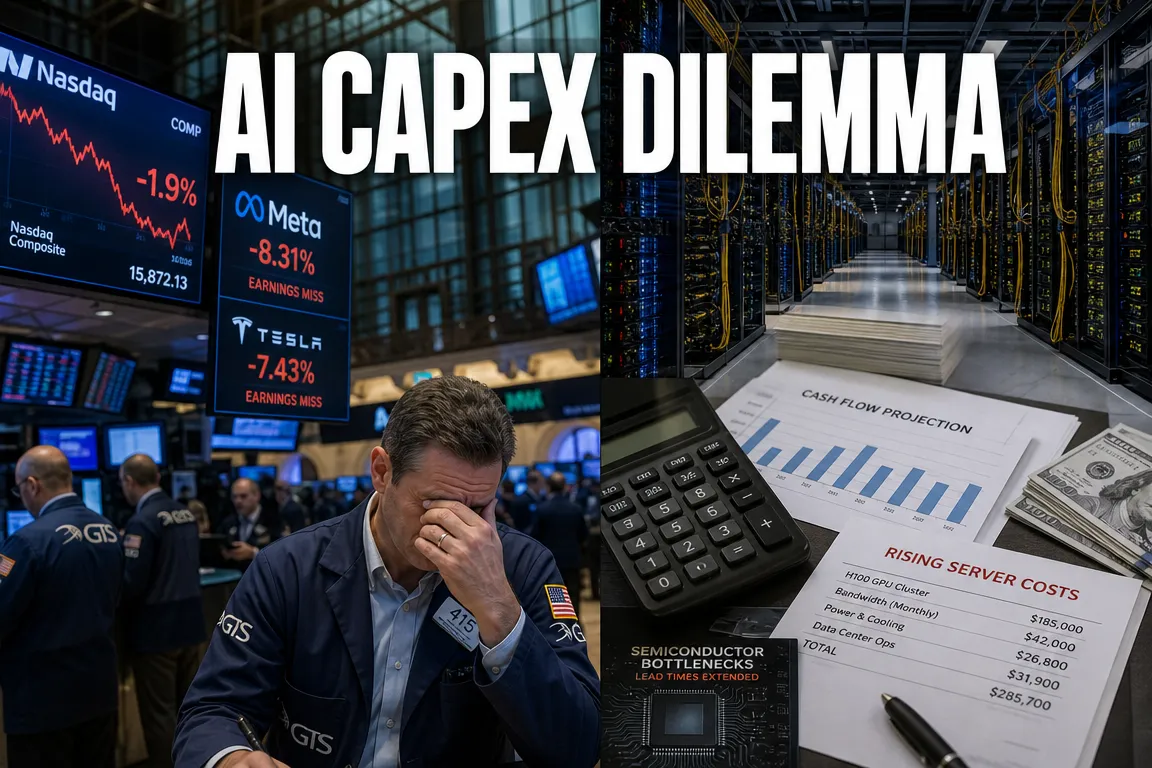
If this investment slows, demand for AI semiconductors could weaken.
Conversely, if hyperscaler CAPEX remains strong, the AI-led equity cycle is likely to stay intact.
11. Why semiconductors can still be purchased even if cash flow declines: corporate bond issuance
A common concern in the market is the following.
“If hyperscalers see weaker free cash flow, can they still keep buying AI semiconductors?”
That is a valid question.
AI investment is capital-intensive.
Even a single data center requires substantial funding.
GPU purchases, HBM, power systems, cooling equipment, and networking hardware are all expensive.
However, corporations do not rely only on cash for investment.
They can issue corporate bonds.
This is where lower Treasury yields matter.
If Treasury yields decline, corporate borrowing costs are also likely to fall.
That allows firms to finance CAPEX at lower cost.
As a result, they may continue investing even if free cash flow weakens.
In this sense, suppressing Treasury yields is not only about reducing government interest expense.
It also helps create a financing environment in which AI-intensive companies can continue to issue debt.
12. The center of the investment-grade bond market is shifting toward AI companies
In the U.S. investment-grade corporate bond market, many of the largest issuers are linked to AI CAPEX.
Examples include Amazon, Meta, Nvidia, Oracle, Salesforce, and Alphabet.
These companies are not issuing debt simply because they lack cash.
They are doing so to maintain the scale of investment required to compete in the AI infrastructure race.
In the AI era, the strategy is often to build the infrastructure first and monetize later.
The same pattern was seen in cloud computing, search, and mobile platforms.
AI is likely to follow a similar path.
For that reason, it would be too narrow to conclude that the AI cycle has ended based only on short-term cash flow pressure.
13. The key point often missed in other commentary
First, the real beneficiary of lower Treasury yields is not only the government.
Many analyses focus on lower interest expense for the Treasury.
However, the more important transmission channel is the corporate bond market.
Rates must fall in order for AI CAPEX companies to raise large amounts of capital on favorable terms.
In other words, lower Treasury yields are an indirect support mechanism for AI semiconductor demand.
Second, a weaker dollar is not simply about a stronger won; it is a U.S. export strategy.
When the KRW/USD rate declines, the won may appear stronger to Korean investors.
But at a global level, the policy goal may be to weaken the dollar and improve U.S. export competitiveness.
Third, stablecoins are not only a crypto issue; they are a U.S. Treasury market issue.
Looking at stablecoins only through the lens of digital assets misses the core issue.
For the U.S., stablecoins can become a new piece of financial infrastructure that supports Treasury demand.
Fourth, the AI leadership trade may not be over; rather, the financing model may be changing.
Equities can remain volatile if cash flow weakens.
But if corporate bond issuance keeps CAPEX going, real demand in the AI value chain can remain firm.
Fifth, the U.S. may prefer to manage debt ratios through growth rather than debt reduction.
This is a crucial point.
If GDP grows faster than debt, the debt ratio can appear more stable.
That is why a weaker dollar, export growth, AI CAPEX, and equity-market support are interconnected.
14. Investment checklist: seven indicators to monitor
- U.S. Treasury yields
Stable 10-year yields are constructive for growth stocks and the AI semiconductor value chain. - Dollar index
Continued dollar weakness is generally positive for U.S. exporters and global risk assets. - KRW/USD exchange rate
A lower exchange rate may reduce FX gains for exporters in Korea, but can support foreign inflows. - U.S. M2 growth
A key indicator of whether global liquidity is expanding. - Hyperscaler CAPEX guidance
Spending plans at Amazon, Microsoft, Alphabet, and Meta will shape AI semiconductor demand. - Investment-grade bond issuance
A key signal of whether AI companies are still able to fund investment at scale. - Nvidia and HBM supply-chain earnings
One of the fastest ways to assess whether real AI demand remains intact.
15. Implications for Korea: semiconductors remain favorable, but FX effects require caution
For Korean investors, this is a mixed but important setup.
If AI semiconductor demand remains strong, it should support Samsung Electronics, SK Hynix, HBM, semiconductor equipment, and materials companies.
However, if the KRW/USD rate declines, FX-related benefits for exporters may weaken.
In other words, semiconductor fundamentals may improve even if the FX tailwind becomes smaller.
Going forward, the focus should shift away from a simple “high exchange rate beneficiary” view and toward actual AI demand and the durability of CAPEX.
In the Korean market as well, stock selection within the AI value chain is likely to become more important.
16. Conclusion: the end point of rates, the dollar, stablecoins, and corporate bonds is AI
The entire framework can be summarized in one sentence.
The U.S. is suppressing rates and the dollar in order to create liquidity, and that liquidity is being directed toward AI CAPEX and the AI semiconductor value chain.
Within that process, stablecoins can broaden the base of demand for U.S. Treasuries.
A weaker dollar can improve U.S. export competitiveness.
Lower Treasury yields can improve corporate bond financing conditions.
Corporate bond issuance can allow hyperscalers to sustain AI investment.
At the end of that chain are Nvidia, AI semiconductors, data centers, cloud infrastructure, and power systems.
Volatility and corrections may still occur.
Concerns over free cash flow, valuation, higher yields, and geopolitical risk can all weigh on markets at any time.
However, if the policy direction continues to favor liquidity expansion and sustained AI investment, the broad flow of capital is still likely to remain within the AI value chain.
< Summary >
- Lower Treasury yields and a weaker dollar are not separate policy goals; they are part of a single liquidity strategy.
- Stablecoins should be viewed not only as a crypto theme but also as a mechanism that can broaden demand for U.S. Treasuries and dollar liquidity.
- A weaker dollar can improve U.S. export competitiveness and help stabilize debt ratios through GDP growth.
- Lower Treasury yields improve corporate bond financing conditions and help hyperscalers sustain AI CAPEX.
- Global liquidity is still likely to concentrate in the AI value chain, including U.S. equities, AI semiconductors, Nvidia, data centers, and cloud infrastructure.
[Related Articles…]
- AI Semiconductor Supercycle and Global CAPEX Investment Outlook
- 2027 Economic Outlook Through the Lens of KRW/USD and U.S. Treasury Yields
*Source: [ 경제 읽어주는 남자(김광석TV) ]
– “국채금리·달러 찍어 누르는 진짜 이유” 결국 돈은 AI로 몰립니다 | 김광석의 경제학교 | 8월 월간특강 [3편]