● Hawkish Shock
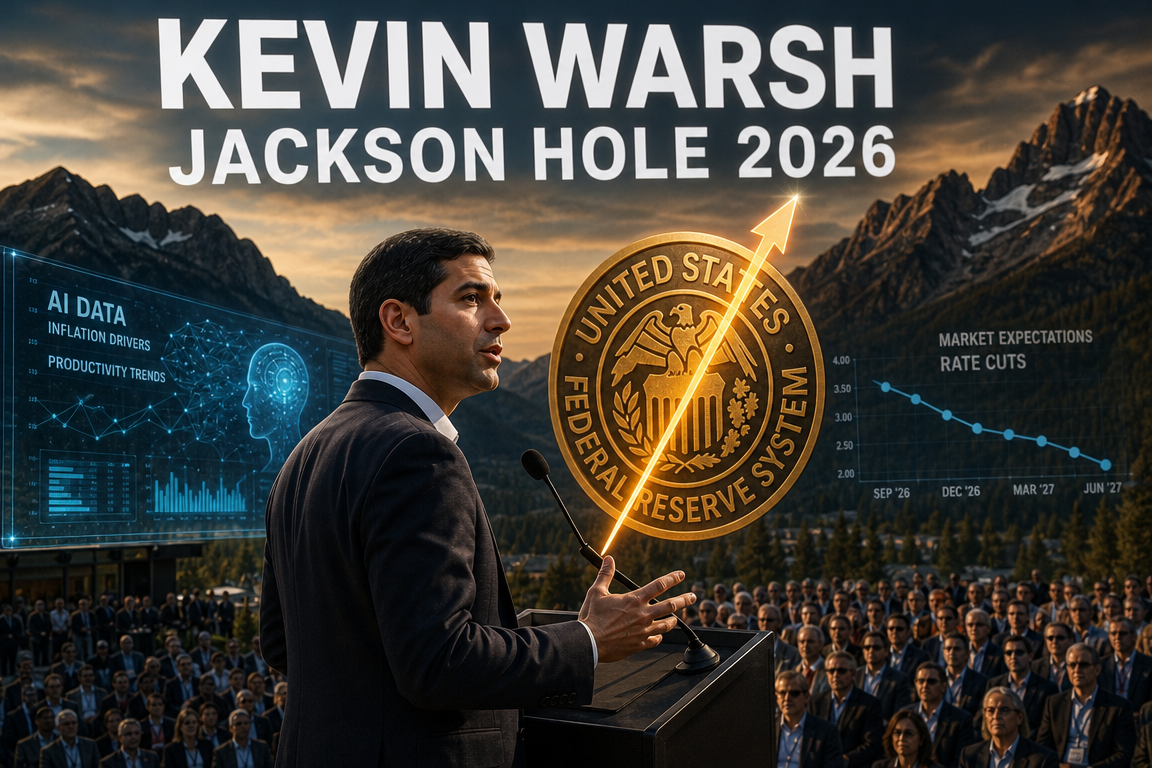
Key Takeaways from Kevin Warsh’s 2026 Jackson Hole Speech: The Fed Has Turned More Hawkish Again
The most important point from this Jackson Hole speech was not simply that rate hikes remain possible.
Kevin Warsh delivered a message that could reshape the Fed’s communication approach, inflation target, the market’s interpretation of AI-driven growth, and Treasury market behavior.
In particular, investors should focus on three key takeaways.
First, expectations for U.S. rate cuts have weakened materially.
Second, the Fed signaled that the 2% inflation target remains non-negotiable.
Third, AI investment and productivity gains are increasingly being treated as evidence that the economy is running too hot.
Although the speech appeared to be a conventional central bank address, it carried implications for Treasury yields, equities, the dollar, and corporate valuations.
1. Why Jackson Hole Matters: A Venue Where the Fed Often Signals Policy Shifts
The Jackson Hole Economic Symposium is a global central banking conference held in Jackson Hole, Wyoming.
It brings together central bankers, economists, and policymakers to discuss the outlook for the global economy and monetary policy.
The Fed chair’s Jackson Hole speech is particularly important to markets.
Historically, it has often signaled major shifts in policy direction.
This year drew added attention because Kevin Warsh appeared on the Jackson Hole stage for the first time as the new Fed chair.
Markets focused on whether he would maintain his traditionally hawkish stance or issue a more accommodative message in the interest of financial stability.
The conclusion was clear: the speech was meaningfully hawkish.
More importantly, it suggested a Fed that intends to act with less noise and greater force.
2. First Key Point: AI May Lift Growth Potential
Warsh said AI is advancing faster than even optimists expected.
This was not merely a favorable comment on technology.
From a central bank perspective, it implies that AI could raise productivity and support stronger economic growth.
Higher growth is positive in isolation.
However, from a monetary policy perspective, it reduces the urgency for rate cuts.
Stronger growth and more resilient business investment can also keep inflation pressures elevated.
In other words, AI may be bullish for equities but a headwind for lower policy rates.
Warsh said the Fed has established a task force to study AI’s economic impact.
He also said that AI research will not directly determine policy decisions.
Even so, the decision to frame AI as an upside growth risk was significant.
As AI-driven productivity gains become more visible, markets may need to price both stronger growth and higher-for-longer rates.
3. Second Key Point: Criticism of Forward Guidance, and a Likely Shift Toward Less Communication
Warsh was sharply critical of forward guidance.
Forward guidance is the Fed’s practice of signaling the likely future path of rates to markets.
For example, the Fed may signal that it could cut rates if inflation or employment data weaken.
Markets have long relied on these hints to price Treasuries and equities.
Warsh argued that this approach has reduced the Fed’s flexibility.
Once guidance is given, it becomes harder to change direction quickly if conditions shift.
He effectively used the 2021 inflation episode as a cautionary example.
At that time, the Fed treated inflation as transitory and maintained an overly accommodative message for too long.
The result was a delayed policy response and a more disruptive rate-hiking cycle later on.
Put simply, his message was: the Fed will likely stop giving markets as much advance notice.
It may remain quiet and act when needed.
That would have important implications for markets.
Investors may need to rely more on actual data and less on interpreting every Fed statement, dot plot, or press conference comment.
4. Third Key Point: The 2% Inflation Target Remains Fixed
The most hawkish part of the speech was Warsh’s stance on inflation.
He said the 2% inflation target is fixed and non-negotiable.
That is highly significant.
Under the prior Fed framework, average inflation targeting allowed some tolerance for inflation running moderately above 2% after periods below target.
Warsh’s message was different.
He appears to favor a stricter interpretation: inflation must return clearly to 2% before policy can be considered normalized.
The speech referenced PCE inflation at 3.7% year over year and 4.1% on a six-month annualized basis.
At those levels, it is difficult for the Fed to justify easing policy.
Indeed, the speech leaves open the possibility of additional tightening.
That naturally reduces market expectations for rate cuts.
If core inflation remains elevated and broad price pressures are not clearly easing, the Fed is unlikely to pivot quickly.
5. Fourth Key Point: The Fed’s Main Tool Is the Short Rate; QE Is for Crises Only
Warsh reiterated that the Fed’s core instrument is the short-term policy rate.
This can be read as a clear preference for avoiding routine reliance on nontraditional tools such as quantitative easing or large-scale bond purchases.
In other words, the Fed should use the policy rate in normal times and reserve balance sheet tools for exceptional situations such as a financial crisis.
This stance also subtly contrasts with Treasury policy.
The original text noted that the U.S. Treasury has recently used buyback-like measures to support longer-term yields.
Against that backdrop, Warsh’s message signaled that the Fed intends to stay focused on the short rate rather than align itself with Treasury’s objectives.
That distinction matters.
The fiscal side may want lower long-term yields.
The Fed, by contrast, may keep rates elevated or even raise them further if inflation remains a concern.
In that sense, the Treasury and the Fed may be pulling in different directions.
6. Fifth Key Point: The Current U.S. Economy Is Described as Strong Growth, Strong Jobs, and Elevated Inflation
Warsh summarized the U.S. economy in one sentence.
Employment is stable, output remains solid, but inflation is still too high.
That description closely matches the logic for tighter monetary policy.
If growth is weak and labor conditions deteriorate, the Fed has room to cut rates.
But if growth is strong, labor markets are resilient, and inflation remains above target, the Fed has little reason to ease.
Warsh said he would continue to assess supply chains, investment flows, and geopolitical shifts before making policy decisions.
Still, the overall tone of the speech left room for additional tightening.
That is why markets interpreted it as hawkish.
7. Corporate and Financial Market Assessment: Little Evidence of Tightening Stress
Warsh gave a strong assessment of corporate and financial conditions.
He noted that capital expenditures have risen 9% over the past four quarters, the highest pace since 2021.
S&P 500 earnings have increased by more than 20% over the past year.
Corporate profit margins remain historically elevated.
Equity market volatility is low.
Business lending standards are still relatively loose by historical standards.
Credit spreads in both the investment-grade and leveraged loan markets remain narrow.
His point was that financial conditions are not yet restrictive enough to force the Fed into easing.
If markets, credit, and corporate activity remain stable despite higher rates, the case for cuts weakens.
Indeed, easier policy could re-accelerate demand and inflation.
8. Labor Market Assessment: Some Risks, but Still Near Full Employment
Warsh also described the labor market as broadly healthy.
Unemployment remains low by historical standards.
Initial jobless claims are near multi-decade lows.
He acknowledged some risks, but the overall picture remains close to full employment.
That again supports a hawkish policy bias rather than an easing case.
If employment remains solid and business activity is strong while inflation is still elevated, the Fed has little reason to move quickly.
Its focus can remain on restoring price stability.
9. Inflation Assessment: Weakness in Good Prints Is Not Enough
Warsh was cautious and firm on inflation.
He said that even though some recent inflation prints were better than expected, he does not see a convincing improvement in the underlying trend.
In other words, a few favorable data points are not enough to declare victory.
Moderating wage growth could be supportive for inflation, but Warsh argued that wages have not been a reliable leading indicator of future inflation for some time.
He also said item-level inflation patterns still point to price increases that are explainable but not sufficiently subdued.
He continues to monitor commodity prices as an upside risk to inflation.
On inflation expectations, he noted that medium-term expectations remain anchored, but expectations can appear stable until they are not.
That is a forceful point.
It suggests the Fed will not overreact to reassuring headline numbers.
Instead, it will remain focused on the risk that inflation could reaccelerate.
10. Central Bank Accountability: Persistent Inflation Is the Fed’s Responsibility
Warsh said the central bank bears responsibility for prolonged inflation.
The message was not merely reflective.
It was also intended to justify a firmer policy response going forward.
His point was not that the Fed should simply acknowledge past mistakes, but that it must now respond more forcefully.
He said the Fed needs clear evidence that underlying inflation is moving toward target at a sufficient pace.
If that confidence is lacking, he implied, more work remains to be done.
Given the current readings on PCE and CPI, that confidence does not appear to be in place.
Markets may therefore interpret his remarks as a signal that tightening remains on the table.
11. Market Reaction: Higher Odds of a September Rate Hike, Higher Short-Term Yields
According to the original text, markets raised the probability of a September rate hike to about 50%.
The bond market reacted most strongly.
The U.S. 2-year Treasury yield moved sharply higher.
The 2-year sector is highly sensitive to expectations for the policy rate.
That move suggests markets are pricing in the possibility of near-term tightening.
Most Treasury yields rose, but the 30-year yield declined.
That was the most notable part of the market reaction.
Short-term yields rose as traders priced in a higher policy rate.
At the same time, the decline in the 30-year yield suggests confidence that stronger Fed action could eventually help contain inflation over the long run.
In other words, markets saw the speech as hawkish in the near term but supportive of long-term price stability.
12. Equity Market Reaction: Why the Nasdaq Did Not Sell Off Sharply
The original text said the Nasdaq moved slightly lower or roughly flat.
Normally, a higher probability of rate hikes would pressure growth and technology stocks.
This time, equities did not fall sharply.
The main reason was the stability in long-term yields.
One of the biggest headwinds for equities has been rising long-term Treasury yields.
Higher long-term rates reduce the present value of future earnings and pressure valuations, especially for AI-related growth stocks and large-cap technology names.
In this case, the decline in the 30-year yield offset some of the pressure from higher policy-rate expectations.
As a result, equities traded in a mixed and relatively contained range rather than selling off decisively.
13. The Most Important Point Often Overlooked in Other Coverage
The main takeaway from this speech is not simply the possibility of another rate hike.
The more important issue is that the Fed’s reaction function appears to be changing.
In the past, markets expected the Fed to respond to data while also providing enough guidance to limit shock.
Warsh criticized forward guidance and emphasized a quieter, more outcome-driven Fed.
That implies markets will receive fewer helpful signals and will have to rely more heavily on actual economic data.
Another major point is the treatment of AI-driven growth.
Many market narratives view AI only as a driver of earnings and equity gains.
Warsh, however, appears to treat AI as an upside risk to growth and potentially to the neutral rate.
If the neutral rate rises, the economy may not be returning to the very low-rate environment investors became accustomed to in the past.
That is the most important but least emphasized implication of the speech.
14. What Investors Should Focus on Now
First, assets that have priced in rapid rate cuts may face renewed volatility.
Short-duration credit, growth stocks, and high-valuation technology names are likely to remain sensitive around FOMC meetings.
Second, Treasury markets may continue to diverge across maturities.
The 2-year yield may remain responsive to tighter policy expectations.
The 30-year yield may stay more stable if inflation credibility improves.
Third, the AI investment cycle remains important, but it should not be viewed only as an equity tailwind.
If AI lifts productivity and demand across the economy, the Fed may have more justification for keeping rates higher for longer.
Fourth, investors should not overreact to a few better inflation prints.
Warsh appears more focused on the underlying trend and the risk of reacceleration.
Fifth, actual economic data matter more when forward guidance is less informative.
CPI, PCE, employment data, wage growth, and commodity prices are likely to drive market pricing more directly.
15. Key Variables to Monitor
-
Whether the Fed actually delivers a rate hike at the September FOMC meeting.
-
Whether PCE inflation and core CPI continue to move toward the 2% target at a sufficiently fast pace.
-
Whether the 2-year Treasury yield continues to rise and the 30-year yield remains stable.
-
Whether AI investment translates into stronger earnings while also adding to inflation pressure.
-
Whether credit spreads and the leveraged loan market remain stable.
-
How much the Fed limits its communication in future dot plots and press conferences.
16. One-Sentence Summary
Warsh’s 2026 Jackson Hole speech conveyed a clear message: AI may strengthen growth, labor conditions remain solid, and inflation is still too high, so the Fed is unlikely to ease as quickly as markets had expected.
For investors, the speech argues for lower expectations of near-term rate cuts and a renewed focus on higher-for-longer policy risk.
At the same time, the decline in long-term yields helped prevent a broad risk-off reaction.
Overall, the speech combined a hawkish policy outlook with some stabilization in long-term inflation expectations.
[Related Articles…]
*Source: [ 내일은 투자왕 – 김단테 ]
– 케빈 워시 180도 바꿨습니다 ㄷㄷ (2026 잭슨홀 연설)
● Jackson Hole Shock, Fed Pivot, AI Boom
Jackson Hole Meeting Immediate Analysis: The Real Message from Kevin Warsh’s Remarks on Policy Rates, Inflation, and AI Investment Flows
The key point from this Jackson Hole meeting was not simply whether rates should be cut or raised.
The core issue was that the Federal Reserve’s monetary policy framework is changing.
In particular, the remarks touched on reduced forward guidance, greater use of real-time data, the possible role of trimmed-mean PCE in assessing inflation, AI investment and productivity changes, and financial innovation including tokenization.
Markets may initially interpret the remarks as hawkish, but a closer reading suggests several elements that could later re-accelerate expectations for rate cuts.
This Jackson Hole meeting should be viewed as an important inflection point for understanding the Fed, policy rates, inflation, and AI investment trends together.
1. The official theme of this Jackson Hole meeting was financial innovation, not rates
The official theme of this Jackson Hole meeting was Financial Innovation.
The agenda was not limited to policy rates, but centered on structural changes such as stablecoins, tokenization, payment innovation, the future banking system, and AI-based financial services.
- Stablecoins and payment system changes
- Tokenized assets and market structure changes
- AI-driven financial data analysis
- The future banking system and the role of central banks
- The balance between financial innovation and supervision
However, because Kevin Warsh delivered the opening remarks, he focused more on the principles that could shape future monetary policy than on financial innovation itself.
That is the important point.
Markets tend to ask whether a rate-cut signal was delivered, but the actual message was closer to a shift in how the Fed communicates with markets.
2. The first key message: a signal to reduce forward guidance
Kevin Warsh took a cautious stance on forward guidance.
Forward guidance is the Fed’s practice of signaling in advance how rates may move.
It was useful during extreme stress such as the 2008 global financial crisis, but the view implied that it can create side effects in a more normal economic environment.
In simple terms, the issue is this.
If the Fed gives too many hints, markets begin to focus more on the Fed’s words than on economic fundamentals.
FOMC meetings, minutes, press conferences, and individual Fed speeches can then move the Nasdaq, Bitcoin, U.S. Treasury yields, and the dollar index excessively.
Warsh appeared to view that structure as undesirable.
As a result, the Fed may be less likely to provide direct signals such as when it will cut rates or how many cuts to expect.
Instead, it may become a more data-dependent and less vocal central bank.
3. The second key message: real-time data matters more than legacy data
One of the most important shifts in the remarks was the emphasis on real-time data.
The CPI, PCE, GDP, and employment figures used in rate decisions all arrive with a lag.
For example, by late August, inflation data being reviewed is often still July data.
Even at the September FOMC meeting, policy is decided using information that is already historical.
Warsh’s point was that this approach alone may not be sufficient in a rapidly changing economy.
With faster-moving variables such as AI investment, supply-chain changes, labor-market shifts, and service inflation, real-time indicators are increasingly important.
This was not merely a technical comment.
If real-time inflation data begins to show faster disinflation than CPI or PCE, markets may interpret that as support for rate cuts.
If real-time data shows renewed inflation pressure, the Fed gains a stronger case for holding rates or maintaining a tighter stance.
4. The third key message: trimmed-mean PCE was not named directly, but the direction was left open
Markets had been watching to see whether Warsh would explicitly mention trimmed-mean PCE.
He did not use that exact term.
However, the context of his remarks indicated a clear willingness to adopt a more refined approach to inflation assessment.
Trimmed-mean PCE excludes the most volatile components and is used to gauge the underlying inflation trend.
Compared with headline PCE or core PCE, it can provide a more stable view of the long-term inflation path.
This matters because the Fed’s choice of inflation measure can change rate decisions.
If headline CPI remains elevated but trimmed-mean PCE is stable, the case for cuts can strengthen.
If headline inflation falls but trimmed-mean PCE remains sticky, the Fed may be reluctant to ease policy.
The message was effectively that the Fed will not rely on CPI alone going forward.
That is a key point that is easy to overlook in general coverage.
5. The fourth key message: a strong U.S. economy does not necessarily imply higher rates
Warsh gave a broadly positive assessment of the U.S. economy.
He said corporate capital spending and intangible investment are rising quickly, profitability and margins remain healthy, and financial conditions are not severely restrictive.
He also said consumption is not weak.
On the surface, this sounds hawkish.
If the economy is strong, there is less urgency to cut rates quickly.
If the labor market remains stable and unemployment does not deteriorate, the Fed has less reason to move aggressively.
But there is also another interpretation.
If the economy is strong because of AI investment and productivity gains rather than overheating, the Fed may be less concerned about inflation pressure.
In other words, if growth remains solid while inflation expectations stay anchored, the case for rate cuts does not disappear.
6. The fifth key message: AI is becoming a structural turning point for the U.S. economy
One of the most notable parts of the remarks was the reference to AI.
Warsh described AI as pushing the economy toward a structural inflection point.
He emphasized the large flow of capital into AI infrastructure, semiconductors, data centers, cloud services, and hyperscaler companies.
This is not simply a story about tech stocks.
AI investment is a major variable that can affect U.S. capital spending, productivity, corporate earnings, employment structure, and inflation.
- Expanded AI data center investment
- Rising demand for semiconductors and HBM
- Increased cloud infrastructure spending
- Higher Capex among large tech companies
- Potential productivity gains and growth with limited hiring
The possibility of growth with limited employment is especially important for monetary policy.
If AI raises productivity but does not generate proportionate job growth, the Fed may need to pay closer attention to softer areas of the labor market even if growth appears healthy.
That could support the case for rate cuts over time.
7. AI can also create short-term inflation pressure
AI may reduce inflation over the long term by improving productivity.
However, in the short term it can create inflation pressure.
As demand rises for AI servers, GPUs, HBM, memory chips, power infrastructure, cooling systems, and data-center sites, related prices can move higher.
Those costs may eventually feed into corporate investment costs and product prices.
For example, higher HBM prices can lift semiconductor costs, and higher semiconductor costs can affect servers, PCs, smartphones, and cloud service pricing.
For that reason, AI is a long-term disinflationary force, but a short-term cost-inflation factor.
This is why the Fed cannot view AI as only a growth catalyst.
8. Inflation assessment: prices remain sticky, but inflation expectations are anchored
Warsh said U.S. inflation remains elevated based on CPI and PCE.
He also noted that the underlying inflation trend is not yet fully stable.
The pace of disinflation has slowed.
That can clearly be read as hawkish.
A statement that inflation is still elevated implies no rush to cut rates.
At the same time, he said medium-term inflation expectations remain stable.
This is highly important.
The Fed’s goal is not only to observe the current inflation reading, but to prevent households and firms from expecting persistent inflation.
If inflation expectations remain anchored, the Fed has less need to push toward further tightening.
9. Markets may first interpret the remarks as hawkish, then later as dovish
The remarks were essentially textbook in tone.
There was no explicit signal for rate cuts, but also no call for rate hikes.
Instead, the focus remained on principles, data, price stability, maximum employment, real-time indicators, and a shift in the policy framework.
As a result, markets may initially read the remarks as hawkish.
The U.S. economy remains strong, inflation is still elevated, and the Fed continues to emphasize its inflation mandate.
Over time, however, markets may focus on different elements.
Reduced forward guidance, real-time data usage, anchored inflation expectations, concern over growth without hiring, and AI-driven productivity changes are all factors that could revive rate-cut expectations.
In other words, the remarks may sound hawkish at first, but later be viewed as less restrictive than expected.
That is the most subtle aspect of this Jackson Hole meeting.
10. Implications for equities: positive for AI megacaps and semiconductors
Warsh’s positive comments on AI investment and corporate Capex may support Nasdaq and large-cap tech stocks.
The recognition of AI infrastructure spending as a structural growth driver should keep semiconductors, cloud providers, data centers, and power infrastructure companies in focus.
That said, weaker rate-cut expectations can pressure growth-stock valuations.
If rate-cut expectations return, AI growth stocks could strengthen again.
Ultimately, Treasury yields remain the key variable.
If the 10-year Treasury yield declines, Nasdaq and AI-related stocks are likely to benefit.
If long-term yields rise again, short-term correction risk increases.
11. Implications for Bitcoin and digital assets: the financial innovation theme matters
The fact that the official theme of the meeting was financial innovation is relevant for the crypto market.
Stablecoins, tokenization, payment innovation, and digital financial infrastructure were all part of the discussion.
Even if the Fed did not directly address Bitcoin, bringing tokenization and payment innovation into mainstream policy discussion is meaningful.
It suggests that digital assets are moving from experimental use cases toward institutional financial infrastructure.
If rate-cut expectations strengthen, Bitcoin and other risk assets should benefit.
If the Fed emphasizes inflation risks more strongly, the crypto market may see higher volatility in the short term.
12. Key points for Korean investors: FX, the Bank of Korea, and the AI value chain
For Korean investors, this remarks should not be viewed only through the lens of U.S. equities.
The outlook for U.S. policy rates directly affects the KRW/USD exchange rate, Bank of Korea policy, foreign capital flows, and domestic growth-stock valuations.
If rate-cut expectations in the U.S. revive, dollar strength may ease, which would be supportive for Korean markets.
If inflation concerns increase and the market prices in a longer period of rate stability, FX pressure may rise.
In the AI value chain, Korean semiconductor companies remain central.
HBM, memory, foundry, advanced packaging, power semiconductors, and data-center equipment firms all deserve attention.
Warsh’s recognition of AI infrastructure spending as a structural force is an important signal for the Korean AI semiconductor ecosystem as well.
13. Related domestic AI themes: proprietary foundation model competition and SK Telecom’s “AI for Everyone” strategy
The source text also referenced domestic AI industry developments alongside Jackson Hole.
The key issue is competition in proprietary foundation models.
Within the national AI model race involving Naver, LG AI Research, SK Telecom, Upstage, and Motive Technologies, model performance is important, but full-stack AI capability is increasingly critical.
Full-stack AI means more than building a strong model.
Infrastructure, models, services, and applications must all be connected for true competitiveness.
- AI infrastructure capability
- Foundation model performance
- Service deployment capability
- Industry application ecosystem
- Security and data governance
The evaluation results indicated strong performance for SK Telecom and LG AI Research among expert reviewers and AI professional users.
SK Telecom was described as receiving a particularly strong overall assessment.
SK Telecom’s “AI for Everyone” strategy is also significant.
The company is aiming to build a nationwide AI assistant and extend services across finance, payments, small businesses, public services, healthcare, caregiving, education, security, and lifestyle.
This is not simply a telecom company launching an AI initiative.
It signals a shift from model competition to real service competition within the national AI ecosystem.
For investors tracking AI in Korea, the performance and deployment capabilities of companies such as SK Telecom, LG AI Research, and Upstage remain important.
14. The most important point often missed in other coverage
The real issue in this Jackson Hole meeting is not whether Warsh is hawkish or dovish.
The more important point is that the Fed appears to be re-setting its relationship with markets.
Markets have become overly dependent on the Fed’s signals.
Dot plots, minutes, press conferences, and speeches have had an outsized effect on stocks, bond yields, and exchange rates.
Warsh’s remarks suggested a desire to reduce that dependence.
Going forward, the Fed may speak less, rely more on data, and make decisions more quietly.
For short-term traders, that increases uncertainty.
For long-term investors, it is a reminder to focus more on fundamentals such as economic productivity, AI-driven growth, corporate earnings, and inflation trends.
Another key point is that AI is now part of the monetary policy discussion, not only an equity-market theme.
AI can lower inflation through productivity gains, but excessive AI infrastructure spending can also support short-term price pressure and asset inflation.
The Fed is now treating AI as a macroeconomic variable, not merely a technology-sector narrative.
That is the detail most often missed in general coverage.
15. Investment takeaway
First, volatility may rise in the short term.
Because the remarks did not provide a clear rate-cut signal, U.S. Treasury yields and the dollar may fluctuate.
Second, rate-cut expectations may return over the medium term.
Real-time data, anchored inflation expectations, and reduced forward guidance are all factors that markets may eventually interpret as supportive of easing.
Third, AI investment remains central.
The Fed chair’s direct reference to AI investment and productivity changes indicates that AI has become a core macroeconomic factor.
Fourth, inflation tracking may shift toward PCE rather than CPI, especially toward measures that capture the underlying trend more accurately.
Market sensitivity to trimmed-mean PCE and real-time inflation indicators may increase.
Fifth, Korean investors should monitor FX and the semiconductor value chain together.
Shifts in U.S. rate expectations affect KRW/USD, while AI infrastructure spending supports earnings expectations for Korean semiconductor companies.
< Summary >
The main message from this Jackson Hole meeting was not the direction of policy rates, but a change in the Fed’s policy framework.
Warsh signaled reduced forward guidance, greater emphasis on real-time data, and a more refined approach to inflation assessment.
U.S. growth remains solid, inflation is still sticky, and inflation expectations remain anchored.
AI investment is now recognized as a structural driver of the U.S. economy, although it can create short-term inflation pressure as well.
Markets may first interpret the remarks as hawkish, but rate-cut expectations could re-emerge over time.
Korean investors should watch U.S. Treasury yields, KRW/USD, the AI semiconductor value chain, and PCE inflation trends together.
[Related Articles…]
- U.S. Policy Rates Outlook and Global Asset Market Shifts
- AI Investment Cycle and Semiconductor Value Chain Analysis
*Source: [ 경제 읽어주는 남자(김광석TV) ]
– [LIVE] 잭슨홀 미팅, 케빈워시 연준의장의 발언과 그 영향은? [즉시분석]