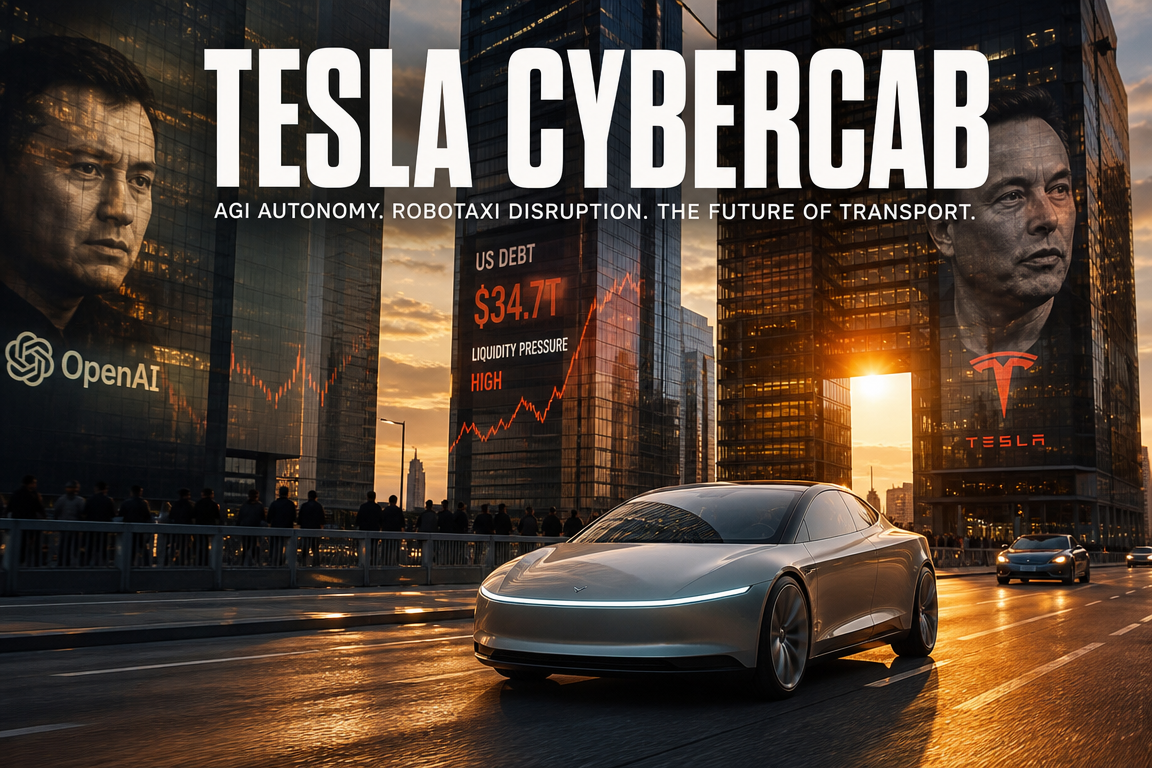
● Tesla, OpenAI, AGI Clash, Cybercab Shock
OpenAI Comments Ahead of Tesla Cybercab D-Day Highlight a Narrative Conflict Around AGI, Not Just a 10-Year Autonomy Timeline
The key issue here is not simply the claim that Tesla’s autonomy is still 10 years away.
An OpenAI vice president argued that affordable full self-driving, meaning mass-market robotaxis, will require artificial general intelligence, and that it will take at least another 5 to 10 years.
Yet only days earlier, OpenAI CEO Sam Altman said the company could have a system it internally regards as AGI by the end of this year.
In effect, the CEO and a senior vice president gave conflicting timelines for the same company.
Elon Musk responded not with a detailed rebuttal, but with a clown emoji.
With Tesla shares trading around $348, investors need to distinguish between a mere verbal dispute and a market-sentiment move ahead of the September 3 Cybercab event.
The central questions are Tesla’s autonomy roadmap, robotaxi economics, AGI competition, the OpenAI-Musk dispute, and broader global macro variables.
1. How the Dispute Started: OpenAI Vice President’s “10 Years to Autonomy” Comment
The controversy began when OpenAI product vice president Peter Welinder posted on X.
He argued that affordable full self-driving requires AGI first.
He added that such AGI would need to operate in real time and run on low-power, low-cost chips inside a vehicle.
His conclusion was that meeting these requirements would take at least 5 to 10 more years.
He is not a marketing executive, but a technical figure with a background that includes OpenAI’s early robotics research team and leadership roles in product and engineering around the GPT-3 API launch.
That made the remarks more sensitive for the market.
They came just ahead of Tesla’s Cybercab event and implied that fully autonomous driving remains distant.
2. The Eight Conditions Welinder Sees as Defining True Level 5 Autonomy
Welinder later outlined his standard in more detail.
In his view, low-cost full self-driving is not simply about operating a driverless taxi in a limited city.
The vehicle must be able to handle nearly every environment a human can drive in.
-
First, the cost must be low.
A new vehicle should cost less than $30,000, or, in robotaxi mode, the cost per mile with passengers should be below 65 cents.
-
Second, there should be no geofenced operating area.
If the service only works inside a defined zone, requires remote supervision, or depends on road-side infrastructure, it is not true full autonomy.
-
Third, reliance on HD maps should be minimal.
The car should operate with standard maps and onboard sensors, not centimeter-level high-definition mapping or high-precision GPS dependence.
-
Fourth, it should work anywhere in the world.
It should function on any road where a human can drive, not only in selected U.S. cities.
-
Fifth, it must handle adverse conditions.
The system should recognize and respond to heavy rain, snow, faded lane markings, roadworks, and police hand signals.
-
Sixth, it must handle novel situations.
The vehicle must make independent decisions even when the road differs from the map or the scenario is not in the training data.
-
Seventh, it must manage the full trip.
Pickup location, drop-off, curbside stopping, parking, and recovery from problems should all be handled by the vehicle.
-
Eighth, there must be no human intervention.
If a driver ever needs to take the wheel, it is not Level 5.
By this definition, the bar is extremely high.
In practice, the standard is not only beyond Tesla, but also beyond Waymo, Cruise, and Nvidia’s autonomy models.
3. Elon Musk’s Response: A Clown Emoji Instead of a Detailed Rebuttal
Musk did not respond with a point-by-point technical argument.
Instead, he posted a clown emoji.
The response is symbolic.
It contrasts with his more specific comments on Nvidia’s autonomy model.
When Nvidia released its autonomy model, Musk said that getting to 99% was easy, but the last 1% could take years.
In this case, he reacted to the OpenAI vice president’s claim with ridicule rather than technical critique.
That suggests he views Welinder’s framework as detached from industry reality.
In other words, Tesla is being judged against a standard so strict that no one in the industry has yet satisfied it.
4. The Deeper Contradiction: OpenAI’s CEO Said AGI Could Arrive This Year
The most notable issue in this debate is the inconsistency inside OpenAI’s own timeline.
Welinder said AGI is at least 5 to 10 years away.
But Sam Altman reportedly said in a recent interview that OpenAI may have an internally recognized AGI system by the end of this year.
OpenAI’s chief research leadership has also suggested it may already be around 80% of the way there, and co-founder Greg Brockman has said this period may later be remembered as the time AGI was created.
This matters because the logic directly conflicts.
Welinder’s argument is that affordable full self-driving is distant because AGI is still distant.
If Altman is correct, that premise weakens.
If Welinder is correct, then Altman’s AGI optimism appears overstated.
The market therefore has to ask whether OpenAI is describing real technical progress or reinforcing a narrative for valuation and fundraising purposes.
5. OpenAI and Musk: This Is More Than a Technical Dispute
The background to this exchange is the long-running conflict between OpenAI and Elon Musk.
Musk helped found OpenAI in 2015 but later left the board and has since sued the company over its shift from a non-profit origin to a for-profit structure.
The original text also refers to OpenAI cutting ties with a specific AI coding company and raising trust concerns about Musk-linked businesses.
The key point is that commercial interests sit behind the technical debate.
AI model access, coding automation tools, supercomputing infrastructure, large-scale GPU supply, and the competitiveness of xAI’s Grok model are all connected.
Musk is building a broader AI ecosystem around Tesla autonomy, xAI, SpaceX, and the X platform.
OpenAI is seeking to dominate the developer ecosystem and enterprise market around ChatGPT.
Accordingly, the “10 years to autonomy” comment may be both a technical view and a competitive signal.
6. Key Items to Watch at Tesla’s Cybercab Event
The original text says Tesla will hold its Cybercab event on September 3 at its Austin site.
The event is reportedly invitation-only and will be streamed live.
For investors, the important issue is not design alone, but operating capability.
-
First, the operating cost of Cybercab.
The key question is how low Tesla can bring the cost per mile.
Investors should assess whether Tesla can go below Welinder’s 65-cent benchmark.
-
Second, the operating area.
If the robotaxi service remains limited to one city or a narrow zone, the pace of geographic expansion will matter.
-
Third, the scale of deployable vehicles.
The market will differentiate between a small demonstration fleet and a vehicle base large enough for commercial service.
-
Fourth, remote intervention.
Investors should check whether vehicles operate independently or rely on hidden human monitoring and intervention.
-
Fifth, the rider experience.
The front light bar color used to identify a passenger’s vehicle is a small but relevant indicator of how Tesla is thinking about the user experience.
That light bar feature may appear minor, but it suggests Tesla is already focused on the passenger experience, not only vehicle manufacturing.
At the same time, alternative identification methods would be needed for color-blind or visually impaired users.
7. Compared with Waymo, Tesla Is Not the Only One Still Short of the Standard
Applied to Waymo, Welinder’s eight conditions would also be difficult to satisfy.
Waymo still depends on geofenced operations and high-definition mapping in specific areas.
It is not available everywhere, and it does not fully solve every road, weather, or construction scenario.
In that sense, Welinder’s framework is not a Tesla-specific critique.
It is a standard that nearly all current autonomy systems fail to meet.
That is why interpreting the comment as “Tesla has failed” would be too narrow.
The more accurate conclusion is that the industry has not yet reached the fully autonomous Level 5 standard he described.
However, equity markets do not always distinguish carefully between these nuances.
For a stock like Tesla, where expectations are tied closely to future cash flow, even a negative narrative can increase short-term volatility.
8. Macro Factors Also Matter: The Strait of Hormuz and the Yen
The original text also mentions broader macro variables that are not directly tied to Tesla but remain relevant.
The first is the Strait of Hormuz.
Iran is described as taking a cautious stance on de-escalation, while geopolitical risk remains elevated.
Because the Strait of Hormuz is a critical corridor for global oil flows, prolonged tension could affect energy prices and logistics costs.
Higher energy prices could revive inflation pressure and weigh on U.S. rate expectations and growth-stock valuations.
The second factor is the yen.
Sharp moves in the yen could trigger forced liquidations and capital repositioning, while also influencing borrowing costs for U.S. households and companies.
Yen weakness and the risk of carry-trade unwinding may create indirect pressure on U.S. equities, including large-cap growth names such as Tesla.
In short, Tesla investors should also monitor crude oil, foreign exchange, U.S. rates, and global liquidity conditions.
9. What Tesla Shareholders Around $348 Should Focus On
If Tesla shares are trading around $348, the market is likely already pricing in substantial expectations.
At this level, what matters most is not the event video, but the numbers.
Investors should focus on how quickly robotaxi service can scale, the economics of each vehicle, where regulatory approval is possible, and how cheaply the autonomy software can expand.
Tesla’s strength is that it combines vehicle manufacturing, batteries, autonomy data, AI chips, and software updates within one company.
Its weaknesses are regulatory risk, reputational damage from accidents, and the gap between Level 5 rhetoric and operational reality.
Accordingly, investors should ask not whether Tesla has achieved perfect Level 5 autonomy, but whether it can build a profitable robotaxi network in constrained conditions first.
Equity markets generally respond to business models that generate money before they reward perfect technology.
10. The Most Important Point Often Missed in Other Coverage
The real issue in this debate is not autonomy alone, but who gets to define the AGI narrative.
OpenAI benefits from saying it is getting closer to AGI, because that supports valuation and market expectations.
But if it says AGI is near, that can conflict with the argument that Tesla autonomy is still far away because AGI has not yet arrived.
Conversely, if AGI is truly 5 to 10 years away, then OpenAI’s short-term optimism appears exaggerated.
That contradiction is the center of the debate.
Musk’s clown emoji likely reflects his view that OpenAI’s own statements already weaken its argument.
For investors, the key question is not whether Tesla meets Welinder’s idealized Level 5 standard today.
The real question is whether Tesla can move beyond the theoretical autonomy debate and scale a robotaxi business that generates revenue and margin.
11. What to Watch Going Forward
-
On the day of the Cybercab event
Watch the vehicle design, passenger summon process, live driving demo, operating cost, and production plan.
-
In the 1 to 2 weeks after the event
Monitor how Wall Street analysts revise their robotaxi revenue assumptions.
-
At the next quarterly earnings release
Check how Tesla incorporates Cybercab and FSD into its financial outlook.
-
On future OpenAI AGI announcements
Assess whether Altman’s claim is supported by products, papers, benchmarks, or enterprise use cases.
-
On macro conditions
The Strait of Hormuz, crude oil, the yen, and U.S. rates may continue to influence Tesla’s share-price volatility.
< Summary >
An OpenAI vice president argued that affordable full self-driving requires AGI and is at least 5 to 10 years away.
But OpenAI CEO Sam Altman said the company could have a system it internally regards as AGI by the end of this year, creating an internal contradiction.
Musk responded with a clown emoji, which can be read as a rejection of OpenAI’s autonomy framework.
Welinder’s eight Level 5 conditions are so demanding that they remain out of reach not only for Tesla, but for most of the industry.
For Tesla shareholders, the key issue is not perfect Level 5 autonomy, but whether Cybercab can scale into a viable robotaxi revenue model.
The Strait of Hormuz, the yen, and U.S. rate dynamics may also affect Tesla’s shares indirectly.
[Related Articles…]
*Source: [ 오늘의 테슬라 뉴스 ]
– 오픈AI 부사장이 테슬라 자율주행은 10년 남았다고 했습니다 — 근데 사흘 전 이 회사 CEO는 “연내 AGI”라고 말했습니다. $348 주주는?
● Debt-Bomb, Liquidity, Trade-War
Why Money May Keep Easing Before the U.S. Debt Bomb Hits: Three Scenarios That Could Reshape the World Order After Trump
The key point is not simply that U.S. debt is becoming dangerous.
The more serious issue is that as the U.S. debt crisis expands, markets may receive more liquidity in the near term.
At the end of that liquidity cycle, the global economic order may shift toward a China-centered system, a U.S.-alliance-centered system, or a new global compromise.
U.S. Treasuries, tariff conflicts, rare earths, semiconductor supply chains, protectionism, and the U.S.-China rivalry are all part of the same structural trend.
Although this appears to be a trade war on the surface, the underlying driver is the interaction between the U.S. fiscal deficit, trade deficit, and a weakening global economic outlook.
1. News Summary: Why Liquidity May Increase Before the U.S. Debt Crisis
Warnings about a U.S.-driven debt crisis continue to rise.
The source material highlights the risk that the U.S. debt problem could develop into a major crisis within the next three years.
However, one point is critical: before the crisis fully materializes, liquidity may continue to rise.
-
The U.S. government increases fiscal spending.
Supporting the economy, industrial subsidies, social safety nets, defense spending, and supply-chain restructuring all require funding.
-
To finance this, the U.S. issues more Treasuries.
Bond issuance is the government’s way of borrowing from the market.
-
The borrowed funds flow back into companies, households, and industrial policy.
Fiscal policy therefore functions as a liquidity channel.
Liquidity is often associated only with policy rates, monetary policy, or quantitative easing by the Federal Reserve.
In practice, however, government fiscal spending is also a major source of liquidity.
In other words, a rising U.S. debt burden can also mean more borrowing, more spending, and more liquidity flowing into financial assets before the system reaches a breaking point.
2. The Root Cause of the U.S. Debt Problem: Trade Deficit First, Fiscal Deficit Second
The U.S. debt problem is not only the result of excessive government spending.
The core structural sequence is trade deficit → industrial decline → job losses → expanded social safety net → fiscal deficit → rising national debt.
-
The U.S. has long maintained a structure in which imports exceed exports.
This is the trade deficit.
-
As manufacturing capacity moved offshore, U.S. industrial jobs declined.
China’s large-scale production capacity placed significant pressure on U.S. manufacturing.
-
When jobs decline, the government must increase unemployment support and welfare spending.
This expands the fiscal deficit.
-
To finance the deficit, the U.S. issues more Treasuries.
As a result, national debt continues to rise.
This framework explains why Trump’s tariff strategy should be viewed as more than a political event.
Tariffs are a tool to pressure China, but they are also an attempt to rebuild U.S. manufacturing.
At the same time, higher tariffs can raise prices, disrupt supply chains, and increase corporate costs.
3. The Current Starting Point for the Global Economy: The Changing Scale of the U.S. and China
The source material uses mid-2020s GDP composition as an important reference point.
On a purchasing power parity basis, the combined GDP of the U.S. and the European Union is described as roughly 29% of global GDP.
China alone is estimated at around 19%.
India is cited at about 8%.
In nominal terms, the U.S. still accounts for a large share of global output, but on a purchasing power basis, the economic scale of emerging economies such as China and India is larger.
The key point is not the numbers alone.
Seven out of ten countries trade more actively with China than with the United States.
China is not simply a low-cost manufacturer.
It is also a vast purchasing market for materials, components, equipment, raw inputs, and intermediate goods.
For that reason, many countries are reluctant to antagonize China.
China has the economic leverage to say, in effect, that it can buy, but expects political alignment in return.
4. Scenario 1: A China-Centered Global Order
The first scenario is a world in which China surpasses the United States.
This would require China to withstand its debt burden, demographic decline, property-sector weakness, and concerns about state intervention, while still emerging as the dominant power.
-
China’s large-scale production capacity would dominate global manufacturing.
China has built major scale in electric vehicles, batteries, solar, steel, chemicals, machinery, and consumer electronics.
-
The West would criticize this as overcapacity.
From China’s perspective, this is mass production; from the U.S. and Europe, it is a supply shock that undermines domestic industry.
-
China could use rare earths and critical minerals as strategic leverage.
Rare earths, graphite, gallium, and copper are essential for semiconductors, electric vehicles, defense systems, and AI infrastructure.
-
China would expand its influence as the world’s largest consumer market.
Countries in Latin America, Africa, and Southeast Asia place high value on access to the Chinese market.
If this scenario materializes, the global economy would become increasingly dependent on China’s supply chains and consumer market.
The U.S. tariff campaign could also strengthen a China-centered bloc as an unintended consequence.
If China tightens export controls on rare earths and critical minerals, advanced industries in the U.S. and its allies could face significant pressure.
5. Scenario 2: The U.S. and Its Allies Contain China
The second scenario is a world in which China does not gain full dominance.
The key is not for the U.S. to defeat China alone, but to use its alliance network to reduce China’s control over supply chains.
-
The U.S. is moving to secure rare earths and critical minerals.
Companies such as MP Materials are part of a strategic effort to strengthen rare earth production and processing capacity.
-
It is deepening resource cooperation with Australia, Canada, Korea, Japan, and Europe.
The goal is to restructure supply chains so that they are no longer dependent on China.
-
The G7, Korea, and Australia may coordinate tariffs and subsidies.
The system is shifting from free trade toward strategic protectionism centered on critical industries.
-
Environmental standards may be used as new trade barriers.
Carbon reduction, green policy, and clean-production standards may function not only as environmental measures but also as tools that reduce the price competitiveness of China and other emerging economies.
The most important line in this scenario is that “America’s real power lies in its alliances.”
If Trump’s unilateral approach weakened alliances, the post-Trump order may move back toward recognizing their strategic value.
The semiconductor supply chain illustrates this structure clearly.
The U.S. is strong in GPU design and semiconductor architecture.
The Netherlands controls EUV lithography equipment.
Japan leads in key materials and components.
Korea and Taiwan play critical roles in memory, foundry, and HBM production.
In short, a united U.S. alliance system can constrain China’s advance in advanced industries.
China has a strong manufacturing base, but it does not control every core node in the semiconductor value chain on its own.
6. Scenario 3: A Global Compromise
The third scenario is one in which neither the U.S. nor China achieves a decisive victory, leading to a new compromise.
After years of trade conflict and economic fragmentation, the conclusion may be that the costs are too high for all sides.
The source material describes this as a new framework, similar to a global New Deal.
The world could divide into three major blocs:
-
Western bloc
The U.S., the European Union, the United Kingdom, Korea, and Japan form the core.
-
Eastern bloc
China and its partner countries form the core.
-
Neutral bloc
India and other non-aligned countries become more important.
The core of this scenario is a new system for managing trade imbalances.
The West could demand that China import more U.S. energy, advanced products, agricultural goods, and services when China’s surplus becomes too large.
China can argue that its production capacity provides low-cost goods to global consumers.
If confrontation continues, all parties lose; therefore, a negotiated framework with mutual concessions could emerge.
In this case, the global economy would move toward an intermediate model rather than pure free trade or pure protectionism.
Strategic sectors would be protected, while the broader trade system would be managed to avoid collapse.
7. Comparison of the Three Scenarios
| Category | Core Direction | Main Variables | Impact on Korea |
|---|---|---|---|
| Scenario 1 | China-centered order | China domestic demand, rare earths, manufacturing competitiveness | Opportunities for China-linked industries; risks for security-sensitive sectors |
| Scenario 2 | U.S. alliance-centered order | Alliance restoration, supply-chain restructuring, semiconductor controls | Higher strategic value for Korea’s semiconductors and batteries |
| Scenario 3 | Global compromise | Trade imbalance adjustment, bloc-level negotiation | Most stable environment for an export-driven economy like Korea |
Which scenario becomes reality is not predetermined.
The outcome will depend on how strongly the U.S. restores alliances, how aggressively China uses supply-chain leverage, and how India and other emerging economies position themselves.
If the U.S. debt problem turns into a financial shock, the pace of all three scenarios could accelerate significantly.
8. The Most Important Points Rarely Emphasized in Other Coverage
First, the U.S. debt crisis is not necessarily a short-term negative for asset markets.
Before the crisis fully breaks, the U.S. may issue more Treasuries and expand fiscal spending, which can increase liquidity.
Therefore, “debt risk” and “an immediate market collapse” are not the same thing.
Second, the real purpose of the tariff war is industrial relocation, not taxation.
Tariffs make Chinese goods more expensive, but more importantly they are designed to bring manufacturing and supply chains back to the U.S.
This extends to semiconductors, batteries, electric vehicles, AI data centers, and defense.
Third, rare earths are not just raw materials; they are a switch for geopolitical power.
China’s control over rare earth processing and critical mineral refining means it controls a bottleneck in advanced industries.
The U.S. is pursuing rare earth security for strategic and defense reasons, not simply for resource development.
Fourth, fiscal policy may matter more than interest rates in the next phase of the global economy.
The Federal Reserve’s policy rate remains important, but U.S. spending priorities, industrial subsidies, supply-chain policy, and tariffs may have a greater market impact.
Fifth, Korea should focus on positioning rather than binary alignment.
Korea is integrated into the U.S. security framework while remaining deeply connected to the Chinese market.
Accordingly, rather than fully abandoning one side, Korea should strengthen bargaining power in strategically important sectors such as semiconductors, batteries, shipbuilding, defense, and AI infrastructure.
9. Key Points for the Korean Economy and Investors
Korea is not a peripheral economy in this transition; it is a core participant.
Its strategic importance may rise in semiconductors, battery materials, electric vehicles, shipbuilding, defense, and AI data-center infrastructure.
-
Semiconductors
As the U.S.-alliance supply chain strengthens, the importance of Korea’s memory chips and HBM increases.
-
Batteries
U.S. and European efforts to reduce dependence on China may create opportunities for Korean battery companies.
-
Raw materials
Competition for rare earths, lithium, nickel, and graphite increases the importance of resource diplomacy and long-term supply contracts.
-
Exchange rates and interest rates
Rising U.S. Treasury issuance and debt concerns may influence the dollar, the won, and global rates.
-
Exporters
As protectionism and tariffs become more persistent, companies will face greater pressure to diversify production and localize operations.
For investors, the key is not only the U.S. debt problem itself, but also the sectors to which that debt is allocated.
If government spending shifts toward semiconductors, AI, defense, energy, and infrastructure, those sectors may still find growth opportunities even in a debt-driven environment.
10. Conclusion: Trade Conflict Is Becoming the New Normal
The final message in the source material is pragmatic.
For the foreseeable future, trade conflict must be treated as part of the operating environment.
The U.S. debt crisis did not emerge suddenly.
It reflects a long accumulation of trade deficits, industrial erosion, fiscal expansion, and rising Treasury issuance.
In response, tariffs, supply-chain restructuring, rare earth controls, semiconductor restrictions, and protectionist policies are all emerging at the same time.
Global economic order may ultimately move in one of three directions.
It may become more China-centered, more alliance-centered around the U.S., or shift toward a compromise that reduces losses on all sides.
Whatever the outcome, one fact is clear.
Globalization is no longer defined only by cheap and fast trade.
The next phase of globalization will likely be shaped by security, resources, technology, alliances, and debt.
< Summary >
The U.S. debt crisis may increase liquidity in the short term.
This is because the government issues more Treasuries and expands fiscal spending.
The root of the U.S. debt problem lies in the trade deficit and industrial decline.
The global order may split into three scenarios: China-centered, U.S.-alliance-centered, or global compromise.
Rare earths, semiconductors, supply-chain restructuring, and tariff conflict will be key variables shaping the global economic outlook.
Korea should respond by increasing its strategic value in semiconductors, batteries, defense, and AI infrastructure.
[Related Articles…]
- U.S. Debt Risk and the Reshaping of the Global Economic Order
- AI Semiconductor Supply Chain Restructuring and Industrial Strategy
*Source: [ 경제 읽어주는 남자(김광석TV) ]
– “미국 부채폭탄 터지기 전 돈은 더 풀립니다” 이후 세계질서 바꿀 3가지 시나리오 | 김광석의 북리뷰 | 트럼프 이후의 질서 [3편]