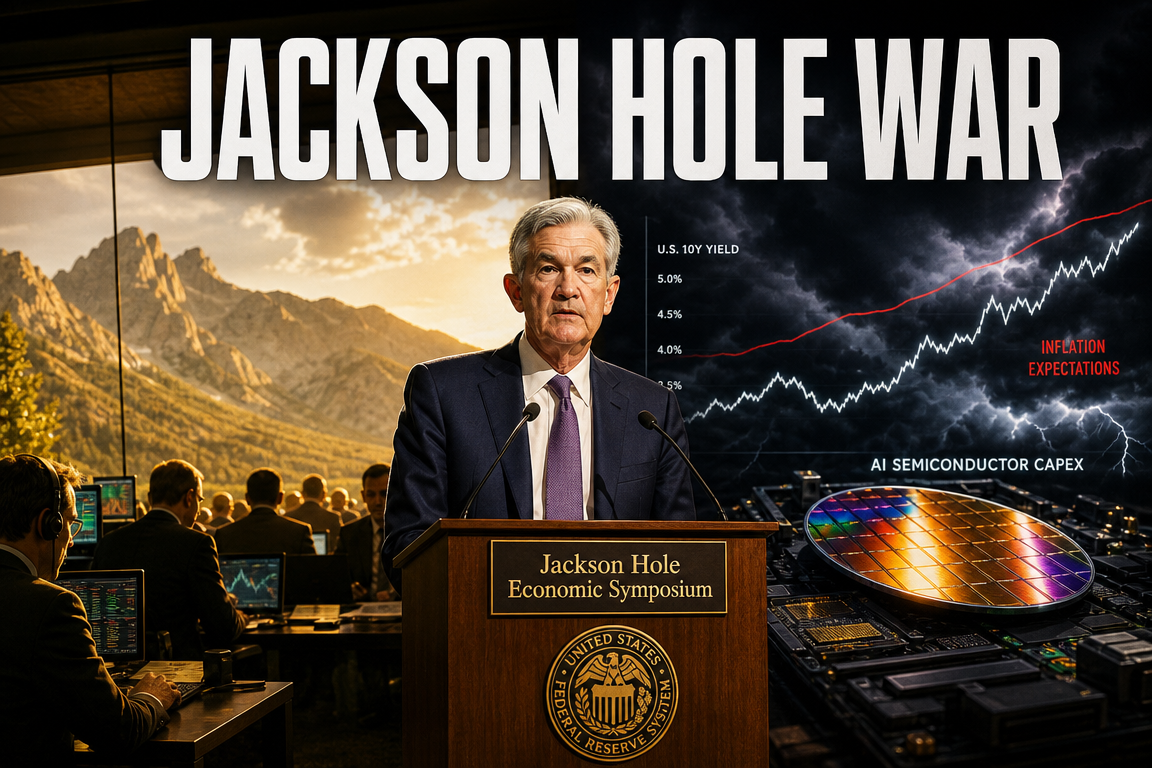
● Jackson Hole Shock – Warsh Sparks Rate Cut, Hike Fears
Jackson Hole Meeting Review: The Real Implications of Kevin Warsh’s Remarks and the U.S. Policy Rate Outlook
The key question from this Jackson Hole meeting is whether the remarks signaled higher rates or reflected a market misreading.
Based on the original text, markets interpreted Kevin Warsh’s remarks as hawkish, but the message was not a straightforward signal that rates would be raised.
The central themes were Federal Reserve policy principles, inflation expectations management, reduced forward guidance, the economic inflection point created by AI, and financial innovation.
A particularly important point often missed in coverage is the policy paradox that rates can only be cut if the Fed does not talk about cutting them.
This report summarizes the implications for U.S. policy rates, inflation, FOMC decision-making, the global economic outlook, and AI-driven semiconductor investment trends.
1. Why the market read Kevin Warsh’s remarks as hawkish
Jackson Hole is not a routine press event.
It is an annual gathering in late August that brings together central bankers, economists, and market participants from around the world.
As a result, each sentence from a Federal Reserve official can have an immediate impact on global financial markets.
Following the remarks, the market response was broadly that they were hawkish.
The reasons were straightforward.
- U.S. inflation has not yet reached the 2% target.
- The remarks reaffirmed that price stability remains the Fed’s primary mandate.
- The U.S. labor market has not deteriorated sharply.
- Accordingly, there is room to maintain restrictive monetary policy for longer.
However, one point is critical.
There was no direct statement that rates would be raised.
In other words, the market read the words, but may not have fully captured the intent behind them.
2. The core message: inflation expectations management, not a rate-hike announcement
The main message was closer to managing inflation expectations than announcing a higher policy rate.
The Fed does not focus only on realized inflation.
It also places significant weight on whether households and markets expect inflation to remain elevated.
A central message from the original text was the following:
The Fed’s job is to prevent inflation expectations from losing their anchor.
This is an important point.
The best way to fight inflation is not only through repeated rate increases.
Credibly convincing markets that the Fed will contain inflation is also a powerful policy tool.
Put simply:
- The Fed communicates a strong commitment to price stability.
- Markets lower expectations for rate cuts.
- Inflation expectations stabilize.
- Actual inflation pressure eases.
- Only then does room emerge for rate cuts.
From this perspective, the remarks may have appeared hawkish on the surface, but they also functioned as preparatory work for eventual policy easing.
3. The paradox: rate cuts require not talking about rate cuts
The most important monetary policy message from Jackson Hole is here.
If the Fed publicly says that rate cuts are coming soon, what happens?
- Equities are likely to rally immediately.
- Bond yields may fall.
- Risk appetite may rise.
- Asset prices across equities, real estate, and digital assets may accelerate again.
- Inflation expectations may re-accelerate.
In that case, the Fed could lose room to cut rates even if it wanted to.
This is the core paradox of monetary policy.
To prepare for rate cuts, the Fed may first need to suppress expectations for them.
If markets move too far ahead, the Fed’s options narrow.
Viewed this way, Warsh’s remarks were less a hawkish policy signal than a deliberate attempt to cool excessive market expectations.
4. The most important line: “I came here to speak about principles, not decisions”
The most significant sentence in the speech was the following message:
I came here today not to speak about decisions, but to speak about principles.
This was not mere rhetoric.
It clarified that the Fed is not an institution that pre-announces specific rate decisions to the market.
The Fed’s role is not to predict the next meeting’s move in basis points.
Its role is to make policy decisions based on economic data, inflation trends, labor-market conditions, and financial conditions.
For investors, this message is important.
Any claim that a rate cut or rate hike is “certain” should be treated with caution.
Economic forecasting is not about receiving an answer key; it is about using available information to judge direction.
5. Reduced Fed communication: the side effects of forward guidance
Another notable point was the Fed’s communication approach.
The speech suggested concern that excessive communication can distort markets rather than stabilize them.
Forward guidance was originally intended as a market-stabilizing tool.
However, if markets become overly dependent on every Fed statement, problems emerge.
- Markets stop analyzing the economy independently and wait for Fed signals.
- Small wording changes trigger sharp moves in asset prices.
- The Fed’s policy process becomes more difficult because it must manage market reactions.
- Ultimately, communication can interfere with policy itself.
The “hall of mirrors” metaphor used in the original text captures this dynamic.
Markets watch the Fed, the Fed watches market reactions, and markets then react again to the Fed’s response.
When this loop intensifies, expectations and interpretation begin to matter more than the real economy.
For this reason, Fed policy may shift toward less forward guidance and greater data dependence.
6. The meaning of “The Fed must be humble, but not naive”
Another important statement was that the Fed must be humble, but not naive.
This captures the central bank’s posture well.
Being humble means recognizing that no one can fully predict the economy.
Not being naive means refusing to ignore excessive market reactions and expectation formation.
The U.S. economy is not in a position where inflation is fully defeated.
With consumer and core inflation pressures still present, the Fed cannot easily claim that conditions are benign.
Doing so could trigger an overly dovish market response.
Accordingly, the Fed has an incentive to maintain a cautious and firm tone.
That is one reason the remarks sounded hawkish.
7. U.S. labor market interpretation: a new low-unemployment, low-hiring structure
The labor market interpretation was also notable.
The U.S. currently shows low unemployment, but job creation has not been especially strong.
On the surface, that creates an ambiguous picture.
Warsh’s interpretation focused on labor-market re-matching after the pandemic.
During COVID-19, employment conditions were severely disrupted, and from mid-2021 through 2023, workers and firms went through a re-matching process.
As a result, the economy may now be in a phase where job switching and hiring are naturally less intense because the reallocation process has already occurred.
In summary:
- The labor market was heavily disrupted during the pandemic.
- Re-matching between firms and workers followed.
- Labor-market turnover has since declined.
- Unemployment remains low, but hiring growth is also limited.
- This can be viewed as a low-unemployment, low-hiring environment.
AI adoption may also contribute to this pattern.
As firms increase AI investment to improve productivity, they may become less aggressive in expanding headcount.
8. AI is now a macroeconomic variable, not just a technology theme
Another key point from Jackson Hole was AI.
AI is no longer only a growth story for large technology companies.
It has become a macroeconomic variable affecting growth, productivity, capital spending, inflation, employment, and financial markets.
The original text framed AI as a force capable of creating a historical inflection point.
Just as the wheel, steam engine, electricity, and the internet changed production, AI may become a new production input.
AI infrastructure investment is already attracting substantial capital.
Data centers, GPUs, memory semiconductors, power grids, cooling systems, and cloud infrastructure are all part of the capital flow shift.
This is especially relevant for South Korea.
Semiconductors account for a large share of Korean exports, and even industries that do not directly produce semiconductors depend heavily on them for manufacturing and product competitiveness.
It is increasingly difficult to discuss the Korean economy without considering AI and semiconductors across autos, mobile devices, consumer electronics, displays, shipbuilding, and factory automation.
9. The real Jackson Hole theme: financial innovation and tokenization
Many investors view Jackson Hole only as a rate event.
However, as noted in the original text, one of the main themes was financial innovation.
This includes the following trends:
- Tokenized financial markets
- Stablecoins
- Digital asset infrastructure
- AI-based financial services
- Financial data innovation
- Real-time payments and capital market efficiency
This matters over a longer horizon than short-term policy rates.
When market structure changes, liquidity, settlement, access, and regulation can all change as well.
Looking at the global economic outlook, policy rates alone are no longer sufficient.
AI, financial innovation, tokenized assets, and stablecoin regulation must also be monitored.
10. Market reaction was likely a temporary misinterpretation rather than a medium-term trend
The main judgment in the original text is clear.
The market interpreted Warsh’s remarks as hawkish, but the reaction may prove temporary.
That is because the substance of the speech was closer to principle-based communication aimed at stabilizing inflation expectations than to a rate-hike signal.
Investors should distinguish between the following:
- Did the Fed actually say rates would rise?
- Did the Fed simply maintain vigilance on inflation?
- Did the market overinterpret the remarks?
- Did that interpretation create a short-term impact on asset prices?
In this case, the latter two appear more relevant.
In other words, the event moved rate expectations more than the actual path of U.S. policy rates.
11. U.S. Treasury yields and liquidity: TGA, buybacks, and China
The Treasury liquidity issue mentioned in the Q&A section is also important.
The U.S. Treasury General Account was described as elevated, and some of that cash balance may affect market liquidity.
Treasury buybacks can support liquidity in financial markets.
However, there is debate over whether the scale is large enough to materially reflate asset markets.
What matters is that higher Treasury yields impose a growing burden on the U.S. economy and fiscal position.
Given large interest expenses, the U.S. cannot easily ignore a further rise in long-term yields.
China is also relevant to Treasury market stability.
From the U.S. perspective, it is preferable for China to continue holding or selectively buying U.S. Treasuries rather than reducing exposure further.
For that reason, Treasury holdings, trade, technology, and exchange rates may all be discussed in broader U.S.-China negotiations.
12. Implications for South Korea: rates, housing, and won strength
The original text also touched on the Bank of Korea’s rate path.
The key issue is why rate-tightening language can persist even when Korean domestic conditions feel weak outside of semiconductors.
Housing is a major factor.
The Bank of Korea may weigh financial stability, housing prices, and household debt alongside growth considerations.
The won is another important variable.
Higher rates can support the currency.
When exchange-rate stability is a priority, monetary policy may partially reflect currency defense.
At the same time, whether repeated rate hikes are consistent with a conventional policy response remains open to debate.
In practice, the Bank of Korea may be placing greater weight on financial stability than on cyclical support.
13. The most important points that are often undercovered in media commentary
First, this was not just a rate outlook event; it was a turning point in central bank communication strategy.
Markets focused on whether rates would rise or fall, but the real issue was how much the Fed intends to communicate with markets going forward.
Second, the Fed may need to make markets uncomfortable on purpose.
If markets become too comfortable, financial conditions loosen, which can revive inflation pressure.
Third, stronger expectations for rate cuts can push actual rate cuts further away.
Understanding this paradox is essential to interpreting market moves after Jackson Hole.
Fourth, AI is now a variable that affects inflation and rates.
Rising AI investment can improve productivity, but it can also sharply increase capital expenditure, power demand, semiconductor demand, and infrastructure spending.
Fifth, financial innovation is central to the next cycle.
Tokenization, stablecoins, and AI-enabled financial services are not just themes; they may reshape capital-market structure.
14. Key items for investors and corporates to monitor
Following Jackson Hole, investors and companies should monitor the following:
- Whether the next FOMC places greater weight on inflation or employment.
- The pace of decline in PCE inflation and core PCE.
- Whether inflation expectations remain stable.
- Whether the U.S. 10-year Treasury yield resumes upward pressure.
- Whether AI semiconductor capex translates into corporate earnings.
- Whether the export recovery in Korean semiconductors broadens.
- Regulatory developments in tokenized finance and stablecoins as medium-term themes.
Markets may remain sensitive to hawkish commentary in the short term.
But over the medium term, actual data will matter more.
As the Fed indicated, investors should focus on principles rather than headlines.
< Summary >
At this Jackson Hole meeting, the market interpreted Kevin Warsh’s remarks as hawkish.
However, there was no direct announcement of higher rates.
The core message was an effort to stabilize inflation expectations through communication.
To create room for rate cuts, the Fed may need to avoid encouraging excessive rate-cut expectations.
The most important line in the speech was that the speaker came to discuss principles, not decisions.
AI has moved beyond a technology theme and is now a macro variable affecting inflation, employment, investment, and growth.
Financial innovation, tokenization, and stablecoins should also be viewed as central elements of the next economic cycle.
Investors should monitor the FOMC, PCE inflation, inflation expectations, U.S. Treasury yields, and AI semiconductor investment trends alongside short-term market reactions.
[Related Articles…]
*Source: [ 경제 읽어주는 남자(김광석TV) ]
– [생방송] (잭슨홀 미팅 리뷰) 케빈워시의 발언과 속내 [즉시분석]