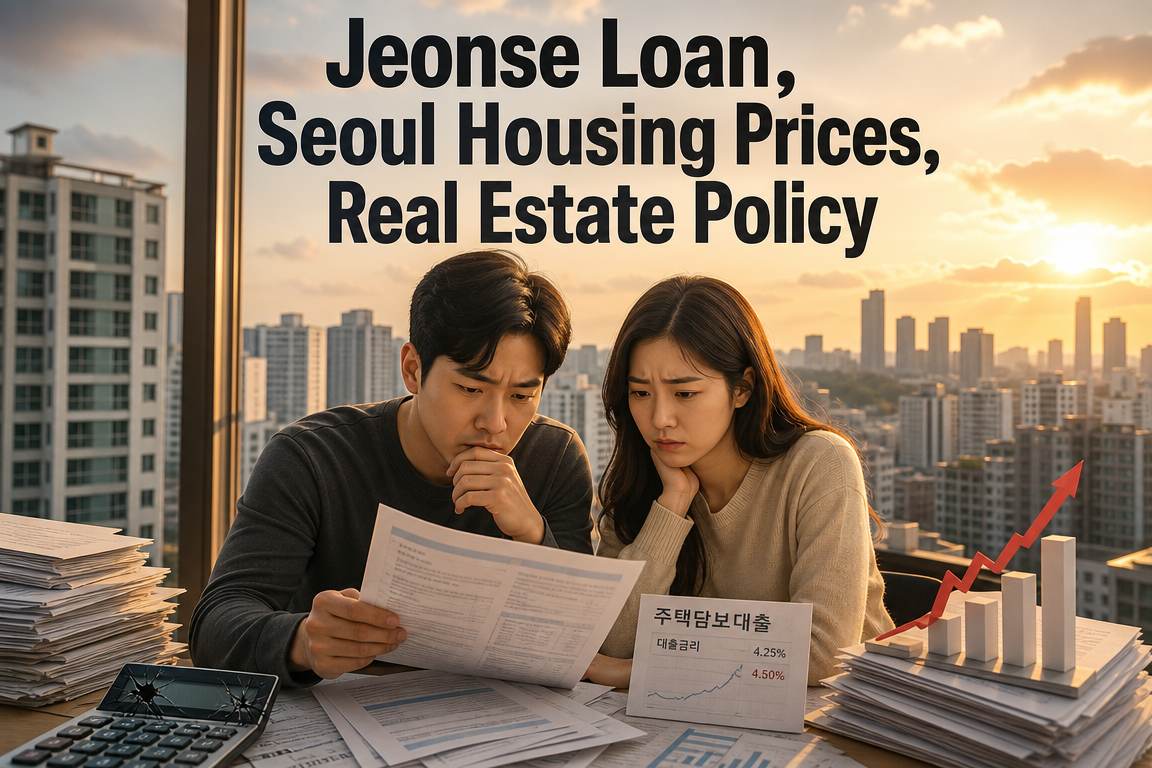
● Jeonse-Loan Frenzy Sparks Seoul Property Explosion
Was Jeonse Lending the Starting Point of the Housing Price Surge? Key Takeaways from a Three-Way Expert Debate
This article summarizes how jeonse lending, housing price outlook, housing supply, lending restrictions, and real estate policy interact to affect Seoul apartment prices and the jeonse and rental markets.
The core issue is not simply whether housing prices will rise or fall.
The more fundamental question is whether jeonse lending is a housing support tool or a leverage mechanism that pushes prices higher.
There was also a warning that using taxes to control housing prices could instead trigger a jeonse shortage.
Although many supply measures have been announced, the key criticism is that they often lack specifics on when, where, and at what price homes will be supplied.
One point that is often overlooked in other media and on video platforms is that without AI-based simulation of real estate policy, the same unintended harms may be repeated.
1. Core Issue in the Debate: Can the Government Control Housing Prices?
The debate began with the question of whether government real estate policy can actually stabilize housing prices.
The views were divided into three positions.
- Kim In-man, Chief Executive: The government cannot realistically control housing prices through policy alone.
- Professor Han Moon-do: Prices can be controlled if the government implements the right policy, but it has not done so to date.
- Professor Kim Gwang-seok: Prices are ultimately set by the market, while policy mainly influences direction and slope.
The key distinction is not whether policy has any effect.
It does.
However, its impact may be limited when it conflicts with larger variables such as interest rates, liquidity, the global economy, household sentiment, supply shortages, and the jeonse market.
For example, the sharp rise in housing prices in 2020 and 2021 was not unique to Korea.
Apartment prices also rose in the United States, Canada, Australia, and Europe amid near-zero interest rates and liquidity expansion.
Conversely, the correction in 2022 and 2023 was driven less by domestic policy than by global rate hikes and inflation shocks.
In other words, housing price outlooks must consider not only real estate policy but also policy rates, liquidity, household debt, jeonse prices, and supply schedules.
2. The Jeonse Lending Debate: Housing Support or a Leverage Mechanism for Price Growth?
The strongest argument in the debate was that jeonse lending may have been the starting point of housing price inflation.
On the surface, jeonse lending supports tenants.
But within the market structure, it can also function as leverage for landlords and investors.
Put simply, when tenants use jeonse loans to afford higher deposits, landlords can use those funds for additional purchases or gap investing.
As jeonse deposits rise, they also help support sales prices.
When repeated, jeonse lending becomes not only a housing support tool but also a liquidity supply mechanism for the real estate market.
Professor Han raised particularly strong objections to jeonse lending for single-home owners.
He argued that when a homeowner lives in another home on jeonse and receives a jeonse loan, the structure effectively supports gap investing or asset allocation.
At the same time, abruptly eliminating jeonse lending would shock the rental market.
Accordingly, the debate suggested maintaining support for vulnerable groups, young households, and first-time entrants while gradually reducing jeonse lending for the general population.
The key issue is not whether to abolish jeonse lending, but who should receive guarantees, for what purpose, and to what extent.
3. Tax Reform Debate: Controlling Prices Could Trigger a Jeonse Shortage
All three participants expressed concern about tax reform.
In particular, they repeatedly warned that aggressively pressuring non-occupying single-home owners and multi-home owners could destabilize the rental market.
Strengthening policy around owner-occupancy is understandable.
However, treating all non-occupying single-home owners as speculative demand is risky.
For example, some parents move to help their children with commuting and childcare while leaving their own home to the child.
If such cases are penalized simply because they are non-occupying owners, unintended harm will follow.
The larger issue is rental supply.
If tax burdens push multi-home owners or non-occupying single-home owners to sell, existing jeonse units may be converted into sales listings.
That would increase for-sale inventory while reducing jeonse supply.
As jeonse listings decline, tenants may face higher deposits or be pushed into monthly rent.
If this trend spreads, policies designed to stabilize housing prices could instead trigger a jeonse shortage.
Professor Kim Gwang-seok compared this to “starting a forest fire while trying to remove a pest.”
Even if the goal is to stabilize housing prices, destabilizing the broader rental market would contradict the original objective of housing stability.
4. The Fair Taxation Dilemma: How Should Holding, Transaction, and Capital Gains Taxes Be Adjusted?
The basic principle of tax policy is tax equity.
From the standpoint of vertical equity, it is reasonable that owners of more expensive assets pay more tax.
However, taxation also requires predictability and gradual implementation.
If the tax burden doubles or triples within one or two years, tax resistance will inevitably increase.
In addition, if holding taxes are raised, transaction taxes and capital gains taxes should be adjusted downward in a balanced way.
If holding tax burdens rise while transaction taxes remain high and capital gains rules become more restrictive, the market becomes even less flexible.
Sellers cannot sell, and buyers cannot buy, creating a locked inventory effect.
Kim In-man argued that long-term holding deductions should recognize long-term ownership itself, not only owner-occupation.
He proposed a more realistic framework, such as an 80% deduction for 10 years of owner-occupation and an 80% deduction for 20 years of long-term ownership.
He noted that treating a person who has held a property for 20 years as a speculative investor does not reflect market reality.
5. Supply Policy Debate: Many Figures, but Missing the Price
The supply policy was assessed as showing effort but lacking sufficient credibility to move the market.
Supply policy is not judged by the number of pages in a press release.
The market focuses on three factors.
- When will supply be delivered?
- Where will it be delivered?
- At what price will it be sold?
The latest supply measures included land identification and medium- to long-term supply plans, but the schedule for supply that would be felt in 2026 and 2027 was considered weak.
Kim In-man compared this to “giving a hungry child seeds instead of rice.”
The market currently needs supply that can be used immediately, meaning actual sales and move-in schedules.
If the government continues to announce land that will be developed five or ten years later, it will not stabilize sentiment.
In particular, it was noted that projects already initiated under the previous administration, such as the 3rd new town program and the Seoripul district, should be completed quickly.
If each administration ignores the supply plans of the previous one, policy continuity is lost.
Because real estate markets move on cycles much longer than a five-year term, the previous administration’s projects should become the current administration’s output, and the current administration’s projects should become the next administration’s output.
6. The Real Question in the Price Cap Debate: Why Is Public Land Priced Like the Market?
Professor Han identified the missing element in the supply policy as pricing.
Even if more homes are supplied, prices will not be accessible if sale prices are too high.
In particular, he argued that when price caps are applied to public land but land costs are reflected at appraised value rather than cost, the final sale price may remain high.
He described this as a “fake price cap.”
The logic is straightforward.
If land acquired with public funds and public resources is used for housing supply, the resulting homes should be priced reasonably for the public.
If public land still produces market-like prices, the public purpose of the supply policy is weakened.
If the government truly aims to stabilize housing, it should lower prices on public land and manage speculative demand through long-term occupancy requirements and resale restrictions.
Lower prices combined with stronger occupancy requirements would reduce speculation while protecting end users.
7. Will More Supply in Seoul Solve the Problem? The Structural Issue Is Jobs and Industry Concentration
In the latter part of the debate, a structural question emerged.
If demand is concentrated in Seoul, will increasing supply alone stabilize prices?
In the short term, supply is necessary.
However, in the long term, without addressing Seoul concentration, the country will remain in an endless catch-up cycle.
If high-quality jobs, top universities, cultural infrastructure, and medical services remain concentrated in Seoul, people will continue moving there.
Whenever demand rises, expanding supply through greenbelt releases, park reductions, or higher density may still result in further concentration.
Professor Kim Gwang-seok argued that supply alone cannot fully offset this demand.
He called for better jobs, education infrastructure, and regional development outside Seoul, along with stronger metropolitan transportation networks.
Ultimately, real estate policy is not only about housing.
It must be coordinated with industrial, educational, transportation, and balanced regional development policy.
8. The Yongsan Park Development Debate: Symbolic Supply or Damage to Future Assets?
The possibility of using part of Yongsan Park for housing supply was also discussed.
Professor Han said he opposed damaging the entire park, but that using a limited area for modular housing for young people could be reviewed as a symbolic measure.
By contrast, Kim In-man argued that urban green space is difficult to restore once lost and should be approached cautiously.
He noted that urban green assets such as Seoul Forest and Cheonggyecheon are not only for selected residents but are public assets for all citizens.
Accordingly, the Yongsan issue is not simply a question of how many units can be supplied.
It requires balancing public access to green space, long-term urban value, and the actual effect on housing stability.
Short-term supply pressure should not lead to irreversible loss of long-term urban assets.
9. Financial Policy Debate: Support for Young Borrowers Is Needed, but So Are Safeguards
In financial policy, the idea of easing conditions for young people and owners without homes was viewed positively.
Older generations benefited from lower prices and easier credit when purchasing homes.
By contrast, today’s younger households face high prices, high jeonse deposits, strict lending limits, and unstable employment conditions at the same time.
Accordingly, policy finance for young, non-owning households is necessary.
However, there is a risk.
If the government seeks to stabilize prices while also expanding credit to young buyers, younger households may absorb the downside risk.
Wealthier owners and multi-home investors could sell near the top while young borrowers take on the assets.
This risk is especially pronounced in non-apartment properties, which are less liquid.
Once funds are tied up, such assets may be difficult to sell and slow to recover in price.
Therefore, support for young borrowers should not simply mean more lending.
It must also define what type of property they can buy, at what price, and with what risk controls.
10. The PF Issue: Expanding Supply Could Recreate Financial Stress
Professor Kim Gwang-seok issued an important warning on property PF.
The PF distress seen in 2023 and 2024 placed a major burden on financial markets.
At that time, financial institutions reduced lending to builders in order to contain losses.
This, in turn, reduced supply.
Now, in order to address supply shortages, PF financing is being eased again.
The problem is that while this may raise supply to some extent, it may also revive weak projects and repeat financial risks.
PF easing must therefore be highly selective.
Viable projects should receive funding relief, while weak projects should still undergo restructuring.
Using the supply agenda to postpone financial cleanup would shift a larger burden onto the public later.
11. The Most Important Point Rarely Covered Elsewhere
The most important point is that real estate policy fails when it is designed around housing prices alone.
If prices are suppressed, jeonse prices may rise.
If jeonse lending is expanded, tenants may gain short-term relief, but deposit and sale prices can be pushed higher over time.
If taxes rise, multi-home owners may list more properties, but jeonse inventory may shrink.
If supply expands, it can help stabilize prices, but high sale prices may still exclude ordinary buyers.
If PF is eased, supply may increase, but financial stress may return.
These are all part of the same system.
That is why real estate policy should be simulated with AI before implementation.
For example, tax reform should model how many non-occupying single-home owners would sell, how many of those units are jeonse listings, how much tenant relocation would cost, and where jeonse prices would rise.
Adjustments to jeonse lending limits should also be tested for their effects on jeonse prices, the shift to monthly rent, gap investing demand, and young households’ housing burdens.
Supply policy should not be evaluated only by unit counts, but also by move-in timing, sale prices, eligible income levels, transport access, and local job availability.
The future competitiveness of real estate policy is likely to depend less on stronger regulation and more on more precise, data-driven design.
12. Key Indicators for Investors and End Users to Monitor
- Jeonse price trends: A leading indicator that should be monitored before housing prices.
- Jeonse lending policy: Changes in lending caps and guarantee conditions affect sales prices as well.
- Tax reform progress: Non-occupying single-home owners, long-term holding deductions, and capital gains surtaxes are the key variables.
- 3rd new town schedule: Actual sale prices and transportation plans will shape market sentiment.
- Application of price caps: Whether land costs are based on cost or appraised value is critical.
- Property PF restructuring: Risks could rise again in both builders and financial institutions.
- Interest rates and liquidity: The most powerful external drivers of housing price outlooks.
- Policies to reduce Seoul concentration: Jobs and transport will determine prices over the long term.
13. Policy Direction: Priorities for Housing Market Stability
First, the top priority for housing stability should be the stability of the jeonse and rental markets.
These are the most immediate sources of housing insecurity for tenants and non-owners.
Second, jeonse lending should be redesigned around vulnerable groups.
Broad expansion across all income groups can act as a leverage mechanism for price growth.
Third, tax reform should include exceptions to avoid unintended harm.
If all non-occupying single-home owners are treated as speculators, public acceptance will fall.
Fourth, supply policy should prioritize execution over new announcements.
The sale schedule and pricing of projects already underway, such as the 3rd new town program and the Seoripul district, should be made explicit.
Fifth, prices on public land should reflect genuine housing stability objectives.
If land is secured with public funds, its pricing should reflect its public purpose.
Sixth, PF easing should be limited to viable projects.
Extending weak projects under the banner of supply expansion would increase financial risk.
Seventh, industrial, educational, and transportation policy should be used to reduce Seoul concentration.
In the long term, supply alone cannot offset demand concentration in Seoul.
< Summary >
The central message of the debate is that jeonse lending, taxes, supply, and finance must be designed as one system rather than separate policies.
Jeonse lending supports tenants, but it can also function as leverage that lifts housing prices.
Tax reform may stabilize prices, but it can also reduce jeonse supply and create a shortage.
Supply measures help, but without realistic pricing, they remain inaccessible to non-owners.
PF easing may increase supply, but it can also revive financial risk.
Future real estate policy should rely on AI-based simulation and data analysis to reduce unintended harm.
[Related Articles…]
- 2026 Housing Market Outlook and Key Price Drivers
- How Changes in Jeonse Lending Affect the Rental Market
*Source: [ 경제 읽어주는 남자(김광석TV) ]
– [풀버전] “전세대출이 집값 폭등의 출발지입니다” 부동산 전문가가 지목한 진짜 원인 | 경읽남과 토론합시다 | 3자토론 김인만x한문도x김광석