● AI Slop
AI Slop Is Eroding Organizational Productivity: Why Leadership and Performance Management Standards Are Changing in the AI Transition Era
AI made reports faster to produce, so why are leaders busier?
In this article, we organize the growing “AI slop” in corporate AI adoption, organizational management complexity, AI ROI measurement methods, leadership changes in the AX era, and the core standards that will determine future corporate productivity.
We will explain in a news-style format why AI reports that look plausible on the surface but only increase verification costs are being created, and what companies need to change to make their AI transition work properly.
1. What Is AI Slop: Pretty but Useless AI Output
“Slop” originally means food scraps or waste.
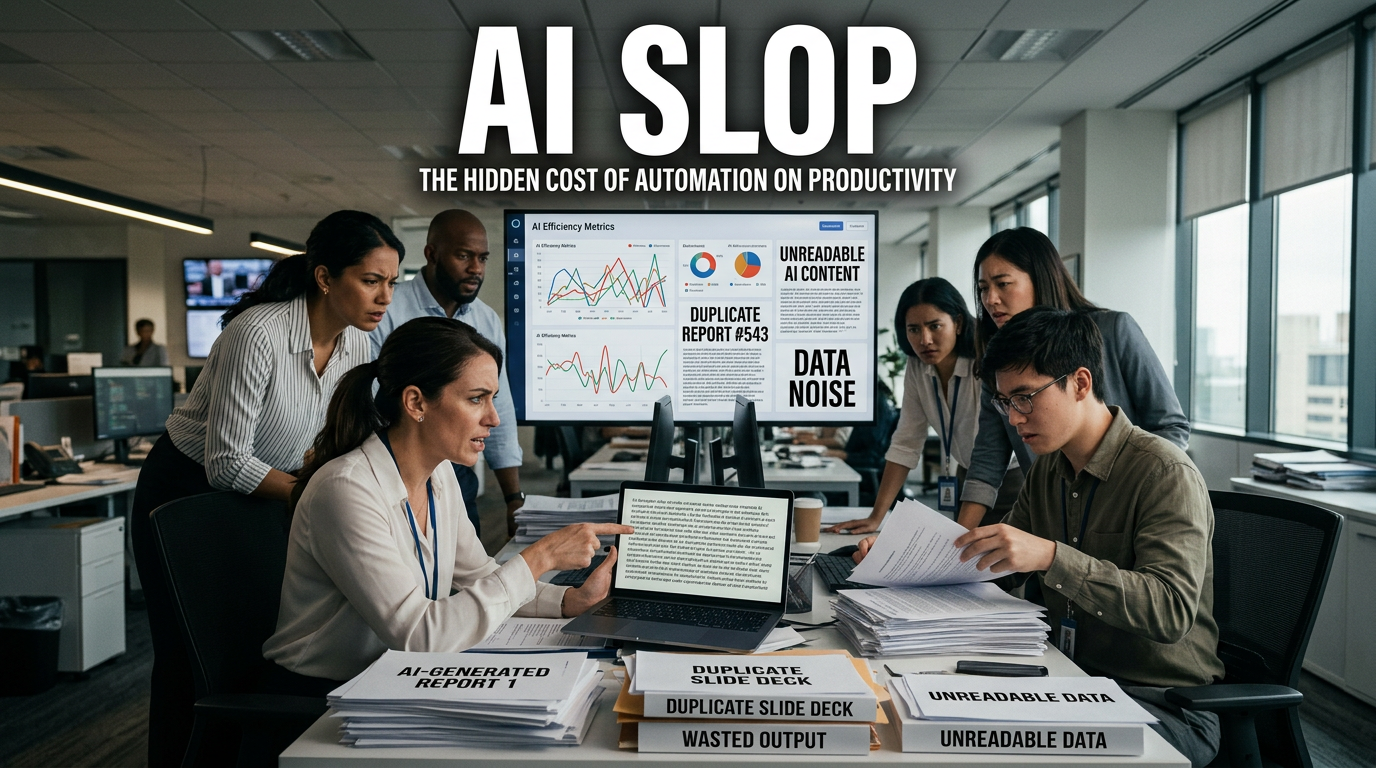
Recently, in corporate settings, plausibly made reports, materials, and analyses created quickly with AI have started being called “AI slop.”
The problem is that these outputs look neat and professional on the surface.
But when you look closely, they often lack core insights, have unclear sources, or do not help actual decision-making.
In particular, when an employee with low motivation uses AI to produce a rough output and passes it to a manager or another team, hidden costs arise across the organization from that moment on.
This cost is called “handoff cost.”
The writer moved it along quickly, but the reviewer has to check again whether the material is correct, usable, and free of distortion.
In other words, AI did not reduce work; it shifted the verification burden to someone else.
2. Why AI Slop Is Dangerous for Companies: Increased Verification Costs, Not Productivity Gains
The reason companies adopt AI is clear.
They expect work automation, cost reduction, productivity improvement, and faster decision-making.
But in the field, the opposite can happen.
- There are more reports, but decisions become slower.
- Materials look nicer, but core judgment becomes harder.
- The workload seems lighter, but the reviewer’s burden increases.
- AI usage rates rise, but actual AI ROI can be low.
This creates a bigger problem for leaders.
In the past, they could more or less tell whether an employee had thought through the material themselves or simply copied and pasted it.
But materials generated by generative AI are smooth in writing and clean in format.
So leaders end up spending even more time checking, “Is this really correct?”
If the AI transition goes wrong, digital transformation in an organization may not accelerate; it may turn into a “verification hell.”
3. Four Ways AI Changes Organizational Decision-Making
Wonlab’s business executive Yoong Myung-hoon explains the structure through which AI changes organizational decision-making from the perspective of “questions” and “answers.”
In the end, corporate decision-making is about what answers you find for which questions.
① When You Know Both the Question and the Answer
Examples include sales performance, customer count, applicant count, and sales status—areas where the question is already clear and the answer exists in data.
In this area, AI excels at fast organization and summarization.
Report automation, meeting materials, and performance summaries fall into this category.
In this case, AI can raise corporate productivity relatively easily.
② When You Know the Question but Not the Answer
Examples include next year’s sales outlook, competitor strategy, the possibility of entering a new market, and business scenarios based on changes in global economic forecasts.
In this area, AI can quickly help with simulations and hypothesis review.
However, blindly trusting AI’s answer is dangerous.
Leaders should make judgments based on AI-generated analysis, but they must always verify the assumptions and the reliability of the data.
③ When You Know the Answer but Not the Question: Tacit Knowledge Inside the Organization
One of the most important areas is tacit knowledge.
Tacit knowledge is knowledge that employees know from experience but have not documented.
For example, a salesperson’s skill in persuading customers, a recruiter’s sense for identifying good candidates, or a project manager’s way of coordinating in a crisis all belong here.
This knowledge exists within the company, but it has not been organized into clear questions and data.
For AI to truly exert its power in an organization, this tacit knowledge must be turned into explicit knowledge.
That is why companies record meeting minutes and convert them to text, build internal wikis, or create LLM-based knowledge repositories.
What companies recently call a “Company Brain” or “Shared Memory” is ultimately an attempt to assetize the organization’s tacit knowledge.
④ When You Know Neither the Question nor the Answer
This area is a state of “not knowing what you don’t know.”
It is also an area where AI can be used most interestingly.
For example, finding lessons from how a completely different industry operates, referencing AX cases from overseas companies, or exploring unexpected business opportunities.
In this area, AI becomes not just a tool but a partner that expands thinking.
But it is also the most dangerous area.
Because the question itself is unclear, AI slop can be created most easily.
4. Does AI Make Organizational Management Easier? In Reality, It Becomes More Complex
Many companies expect that adopting AI will make organizational management easier.
But in reality, the opposite is more likely.
Employees who use AI well begin to move faster, do more, and take on a wider variety of tasks.
If it once felt like managing 10 employees who were taking a walk, now it can feel like managing 10 racehorses.
Every day or two, new experiments, new automations, and new agents appear.
So the capability leaders need is not simple direction but orchestration.
In other words, the ability to coordinate scattered experiments and work, reduce duplication, and bundle multiple activities into one business value.
Organizational management in the AI era is shifting from watching less work to seeing more deeply connected work.
5. The Biggest Mistake Leaders Make: “Since We Have AI, Let’s Try This Too”
There is a phrase leaders often use in the early stages of AI adoption.
“Since we have AI, why don’t we try this too?”
It sounds innovative on the surface, but in reality, it can greatly increase organizational complexity.
Adding something new always means pushing back or giving up on something existing.
But many leaders talk about what to do without deciding what not to do.
The core of strategy is not adding; it is subtracting.
Especially in the AI transition era, technology keeps showing new possibilities, so organizations can easily become overloaded.
Therefore, leaders must ask these questions before starting a new AI project.
- What work gets pushed back if we add this?
- Does this experiment connect to our current strategy?
- Does it fit into the actual user workflow?
- Does it improve leading indicators rather than short-term performance?
- Does this output become a decision asset rather than AI slop?
6. AI ROI Should Be Viewed as “Return Intelligence,” Not Just Return on Investment
The question companies ask most often when adopting AI is, “So, does ROI come out of this?”
Traditional ROI means return on investment.
But AI ROI is difficult to judge using short-term revenue alone.
The effect of AI tends to accumulate like compound interest.
As internal data accumulates, employee experience grows, and tacit knowledge connects to AI agents, value can increase over time.
So if AI ROI is viewed only as “Return on Investment,” important changes may be missed.
Instead, we should look at “Return Intelligence,” meaning how much organizational intelligence is being accumulated.
For example, even if revenue does not rise immediately, if core customer data is being organized, workflow automation is increasing, decision-making is speeding up, and good talent inflow is growing, then the drivers of future performance are improving.
Performance management in the AI era should look more closely at leading indicators than outcome indicators.
7. Leading Indicators More Important Than Short-Term Revenue: You Must Look at the Company’s Story
Revenue matters.
But revenue is usually a lagging indicator.
It is the numerical result of activities that have already happened.
For example, in a recruiting platform company, there are leading indicators that matter before revenue.
- Is the number of sign-ups increasing?
- Are sign-ups from key talent increasing?
- Are application numbers increasing?
- Are successful placements increasing?
- Is the client company’s hiring success rate improving?
If these indicators improve, they are likely to translate into revenue over time.
The same applies to AI transition.
If you only look at short-term cost reduction, it may seem rational to stop AI investment.
But the story changes when you look at leading indicators.
If AI is improving your organization’s learning speed, experimentation speed, data utilization, and automation rate, then long-term competitiveness is building up.
8. Low-Motivation Employees Create AI Slop
The core cause of AI slop is not the technology itself.
The biggest cause is low motivation.
Employees who do not want to do well quickly produce plausible materials using AI.
Those materials make it look like work has been done.
But in reality, they pass the verification burden to someone else.
When such employees increase, the organization looks like it is using AI a lot, but actual productivity falls.
On the other hand, highly motivated employees use AI to run new experiments, improve work methods, and create better output.
So in the AI era, the performance gap between employees may widen even further.
If the gap between someone with motivation 100 and someone with motivation 0 used to be 100, now the person with motivation 100 can use AI agents to generate not just a result worth 1, but 10,000 attempts.
9. Talent Standards in the AX Era: Autonomy and the Builder Mindset
In the AI transition era, important talent is not simply the person who gets the right answer.
The ability to solve a defined problem accurately still matters, but AI is becoming better and better at solving well-defined problems.
Going forward, the more important person is the one who defines the problem for themselves, builds something directly, and learns through failure.
This can be seen as the “Builder Mindset.”
People with a Builder Mindset do not say, “I’ll do it if someone defines it for me.” They move with, “I’ll try building it myself and verify it.”
For such people, AI becomes not just a search tool but an engine that amplifies execution.
Conversely, people with low autonomy who wait for instructions are unlikely to deliver major results even if they use AI.
In the AI era, talent competitiveness is likely to be determined more by attitude, responsibility, execution, and learning speed than by the amount of knowledge.
10. Autonomy Does Not Mean Doing Whatever You Want
Even if autonomy is important in the AI era, leaders should not leave everything to employees.
There is something leaders must clearly provide.
That is purpose and goals.
Why this work is being done, how far it needs to go, and what standards will be used to judge performance must all be clear.
However, employees should be given more autonomy regarding “how” to do it.
The reason many large organizations run into problems is that they do the opposite.
They throw out vague goals and tightly control the methods.
But in the AX era, goals must be clear and methods must be autonomous.
Only when this structure is in place can employees use AI to solve problems in new ways.
11. In an Era Where No One Knows the Answer, What Is the Leader’s Role?
In the past, leaders had authority because they knew more.
But in the AX era, there are many problems even leaders do not know how to solve.
Consultants do not know, people running 100 AI agents do not know, and frontline staff do not know.
This is an era where everyone experiments and searches for answers.
Then why are leaders needed?
The leader’s core role is to be the one who takes responsibility.
Team members can express opinions and even challenge the leader.
But the final decision and responsibility must rest with the leader.
And to make better judgments, leaders must increase the resolution of their questions, coordinate multiple opinions, and ensure the organization moves in one direction.
Leadership in the AI era is becoming less about giving the correct answer and more about making responsible decisions in uncertainty.
12. Performance Management Standards Will Also Change: Is There a New Discovery?
Traditional performance management was centered on numbers like revenue, number of sign-ups, and cost reduction.
Of course, these indicators are still important.
But in the AI era, “new discovery” is emerging as an important performance standard.
Was there a new customer insight discovered this quarter or this month?
Did you secure material for the next strategy through a new experiment?
Did you discover market reactions that were not visible in existing data?
Only with such discoveries can a company plan its next move.
If you keep doing things the same way, it may seem like performance will hold steady, but in reality, business often slowly declines over time.
That is why performance management in the AI era must look at operational efficiency and exploration capability together.
13. Obsessing Over a Single Metric Distorts the Organization
When managing performance, pushing too hard on one metric creates side effects.
A representative example is the mouse-tail reward story in Vietnam.
As the number of mice grew too large, a policy was created to pay a reward if people brought in mouse tails.
Then people started breeding more mice instead of getting rid of them.
The metric distorted behavior.
Companies are the same.
If you say, “Just increase the number of sign-ups,” low-quality sign-ups may increase.
If you say, “Just increase revenue,” long-term customer trust may be damaged.
If you say, “Just increase AI usage,” AI slop may explode.
So companies need to look at composite metrics.
They should look together at revenue, customer satisfaction, growth in core users, number of experiments, discovered insights, automation quality, and verification costs.
14. The Trap of Data Analysis: Analysis Can Block Execution
As AI and data analysis become stronger, there is a trap organizations can fall into.
That is creating too many reasons not to act.
When you look at the data, it keeps showing that this method is difficult, that method has risks, and previous experiments did not succeed.
Then the organization cannot execute anything.
In the AI era, the ability to obtain data through action is just as important as analyzing data.
In other words, instead of sitting still and analyzing results, you need to create new data through small experiments.
Execution creates data, and data makes better judgment possible.
The key to AI transition is becoming not an analysis-centered organization, but an execution-centered learning organization.
15. Why AI Projects Do Not Work in the Field
One of the biggest reasons AI services or AX projects fail is that the people who build them and the people who use them are different.
From the provider’s perspective, the features look polished, the demo runs well, and the workflow seems organized.
But frontline users feel something very different.
Their data must go in, it must work naturally within their workflow, and the results must be genuinely useful.
But many AI features are just attached like a separate chat window.
If it is separated from the existing workflow, users will not bother using it.
For a payroll service, AI must work within the payroll calculation flow.
For a recruiting service, AI must be inside the candidate review, evaluation, and communication flow.
AI outside the workflow is ultimately not much different from opening ChatGPT or Claude separately.
16. Why 80% Accuracy in AI Services Is Dangerous
There is a phrase often heard in AI projects.
“It works well 80% of the time.”
The problem is the remaining 20%.
In the field, those 20% exceptions can become the most critical issues.
Even if AI handles general cases well, if it makes the wrong judgment in exceptional situations, it can lead to customer complaints, legal risk, and higher costs.
That is why AI projects are much harder in actual operation than in the demo stage.
The reason the first AI service you build seems the most accurate is that it only works in limited training data and a limited testing environment.
Once it enters the real world, data changes, exceptions increase, and operational conditions become more complex.
17. The Condition for AX Success: Employees Must Be Able to Use and Change It Themselves
A common approach in large companies is to gather business requirements, organize the flow, and build the system.
This approach worked to some extent for traditional IT systems and digital transformation projects.
But it has major limitations for AI transition.
With AI, it is hard to know which workflow is right until you actually try it.
In fact, applying AI can change the existing workflow itself.
That is why companies need an environment where employees can use the tools hands-on, build small automations, and keep revising them through feedback.
This is also why vibe coding and no-code automation tools are getting attention.
Frontline employees need to build things themselves to know what kind of AI they need.
18. Start with Basic Automation, Not Overly Grand AI Agents
There is a trap companies often fall into when talking about AI.
They imagine a massive system from the start, running dozens or hundreds of agents.
But in real company settings, basic automation such as email, meeting notes, calendar, document organization, and ERP data connection may be far more important.
A practical starting point can be a method like Google Workspace Studio, which connects mail, calendar, documents, and tasks to automate work inside the tools people already use.
This approach may seem less ambitious, but the data connections are stable, the risk of hallucination is lower, and it can blend directly into actual work.
Companies should look less at “how cutting-edge the AI is” and more at “how naturally it has entered everyday workflows.”
19. The Real Meaning Behind Saying AI Transition Cannot Happen Without Specialized Talent
Many companies say AX is difficult because they lack specialized talent.
But if you look at companies that are succeeding, the success factor is often a clear strategy rather than specialized talent.
If the strategy is unclear, people end up being blamed.
“We can’t do it because we don’t have AI experts.”
“We can’t do it because we lack data scientists.”
“We need more engineers.”
Of course, specialized talent is important.
But if it is not clear what to do with AI, even the best talent will struggle to create results.
On the other hand, if the strategy is clear, results can be achieved even without a large number of frontier-level researchers.
The essence of AI transition is not a technology problem, but a management strategy and organizational design problem.
20. The Most Important Point Rarely Stated Clearly on Other YouTube Channels or in the News
The core point is not AI usage rate, but the organization’s verification cost.
Many news stories and content focus on how much AI companies have adopted, how much employees use AI, and which tools are good.
But what really matters is not AI usage volume.
It is whether AI use has reduced or increased the organization’s overall judgment cost.
When AI slop increases, productivity may appear to rise on the surface.
Reports come out faster, materials multiply, and meeting preparation seems easier.
But if leaders and reviewers have to spend more time checking the facts, organizational productivity has actually fallen.
Going forward, corporate AI competitiveness is likely to be determined not by who uses it more, but by who makes better decisions with lower verification costs.
From this perspective, AI governance, data quality, workflow automation design, leadership, and performance management standards are all connected.
Companies adopting AI must ask the following questions.
- Who verifies AI outputs?
- Is verification cost decreasing or increasing?
- Does the material created by AI help decision-making, or does it hinder it?
- How will we distinguish AI slop from low-motivation employees?
- When AI use is recognized as performance, what are the quality standards?
21. How Should Leadership Change Going Forward
Leaders in the AI era are no longer people who know all the answers.
Rather, they are people who coordinate stronger individuals.
One employee can use AI agents and automation tools to do the work that used to require several people.
Individuals are becoming more powerful.
The more that happens, the higher the level of coordination needed to do big things.
Leaders must bring together different perspectives, different speeds, and different experiments into one direction.
Leaders’ own motivation and cognitive stamina also become important.
In the AI era, there is a lot to learn, a lot to judge, and a lot to let go of.
If leaders cannot maintain a healthy state, it becomes hard to continue making responsible decisions.
As the saying goes, “Understanding cannot be delegated,” even if thought processing can be left to AI, final understanding and responsibility remain with the leader.
22. The AI Transition Checklist Companies Must Review Right Now
- Do you have standards for managing AI slop?
- Do you have a source and verification process for AI outputs?
- Are you turning employees’ tacit knowledge into internal knowledge assets?
- Are you viewing AI ROI from the perspective of leading indicators and organizational intelligence, not short-term revenue?
- When starting a new AI project, do you also decide which work to give up?
- Do frontline users have an environment where they can try AI tools themselves and revise them?
- Is AI functionality naturally embedded within existing workflows?
- Are you measuring decision quality and verification costs rather than AI usage volume?
- Are you selecting talent with autonomy and a builder mindset?
- Are you evaluating new discoveries and experimental data in performance management?
< Summary >
AI slop refers to plausible but useless reports and materials created by AI.
When employees with low motivation create AI slop, the verification burden on leaders and colleagues increases significantly.
AI transition is not just about work automation; it changes organizational management, performance management, and leadership as a whole.
AI ROI should be viewed not by short-term revenue alone, but by the organization’s learning speed, leading indicators, assetization of tacit knowledge, and decision quality.
In the AX era, autonomy, a builder mindset, execution, and responsibility become the core talent standards.
Leaders must change from people who give answers to people who take responsibility and coordinate amid uncertainty.
A company’s real AI competitiveness lies not in using AI more, but in reducing verification costs and making better judgments faster.
[Related Articles…]
- The Real Reason AI Transition Is Reshaping Corporate Productivity
- New Standards for Leadership and Organizational Management in the AI Era
*Source: [ 티타임즈TV ]
– 잘할 마음 없는 직원이 ‘AI 슬롭’ 쏟아낸다 (원티드랩 윤명훈 사업 총괄)