● Hyundai Tesla Data War, Robot AI Gap
Hyundai Motor’s “2033 Tesla data overtaking” claim: the real issue is the missing AI layer for robots
The key point in this issue is not simply Hyundai Motor’s declaration that it will surpass Tesla.
Hyundai Motor disclosed autonomous driving AI, a data center, software-defined vehicle plans, and robot production plans in one package, but the most important element—the name of the AI that will power robots—was missing.
The presentation was delivered by an engineer who previously worked on Tesla’s Autopilot computer vision team.
In that sense, this was not a simple competition in the electric vehicle market between Hyundai Motor and Tesla, but a contest over autonomous driving data, AI semiconductor infrastructure, humanoid robots, and leadership in the global automotive industry.
1. Market reaction: Tesla stock fell, while Hyundai Motor presented a “2033 data overtaking” target
According to the source, Tesla shares closed at $348.75, down 1.17%.
SpaceX-related transaction pricing was cited at $141.5, with a modest increase.
U.S. equities were broadly soft, and investors were reassessing valuations across AI growth stocks and EV-related names.
Against this backdrop, Hyundai Motor delivered an aggressive message at its CEO Investor Day at the Conrad Seoul in Yeouido.
Hyundai Motor Group said it could overtake a competitor in cumulative training data scale around 2033.
Although the competitor was not named in the presentation, the market and investors interpreted the statement as a direct reference to Tesla.
2. The presenter: Park Min-woo, former Tesla Autopilot engineer
The presentation was led by Park Min-woo, head of Hyundai Motor Group’s AVP division and CEO of 42dot.
Park is known to have previously worked at Tesla on the Autopilot computer vision team.
He worked at Tesla from 2015 to 2017 and served as a senior engineering manager in visual perception.
This period was a major turning point in Tesla’s autonomous driving history.
Tesla moved away from its previous dependence on Mobileye in 2016 and shifted toward a camera-based proprietary vision system.
Park therefore experienced firsthand the transition period that led Tesla toward its current FSD direction.
For that reason, Hyundai Motor’s message that it would compete on data is not a generic slogan.
The key issue is that a person familiar with how Tesla built its autonomous driving capability is designing a similar strategy inside Hyundai Motor.
3. Hyundai Motor’s core autonomous driving AI: Atria AI
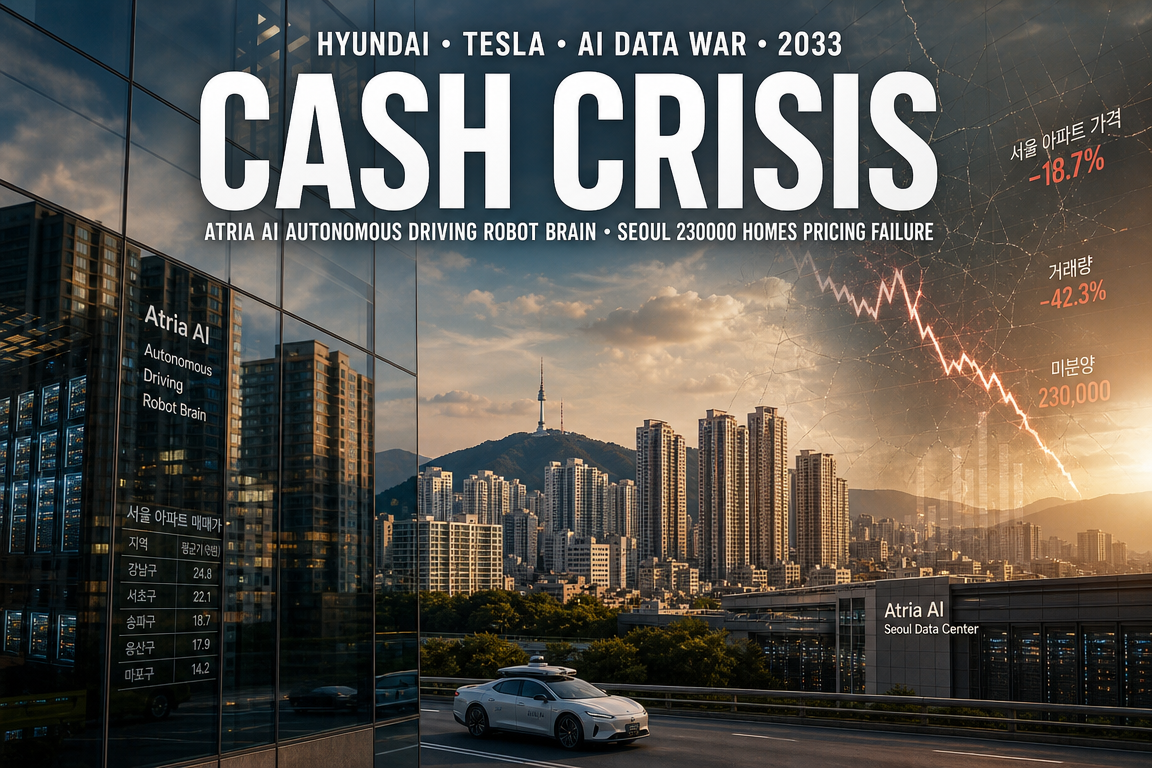
Hyundai Motor unveiled its proprietary autonomous driving model, Atria AI, at the presentation.
According to the materials, Atria AI is an end-to-end autonomous driving AI that integrates perception, decision-making, and control.
In simple terms, instead of a car interpreting scenes through human-written rules, a single AI model handles steering, acceleration, and braking in an integrated manner.
This approach is highly similar to the direction Tesla FSD v12 is taking.
Tesla shifted from tens of thousands of lines of human-written C-code control logic to a neural-network-based system, and Hyundai Motor appears to be targeting the same destination.
4. Hyundai Motor’s timeline: 2026 pilot, 2028 SDV, 2029 mass deployment
Hyundai Motor’s plan is more specific than expected.
- By late 2026, it plans to begin real-world testing in downtown Gwangju with approximately 200 vehicles.
- The purpose of the pilot is to collect data on rare but difficult edge cases.
- In 2028, it plans to apply Level 2+ autonomous driving features to its first software-defined vehicle, or SDV.
- From 2029, it plans to sequentially deploy Atria AI to production vehicles.
- It also plans to build infrastructure at the Saemangeum data center capable of housing more than 50,000 GPUs.
The important point is that Hyundai Motor is moving beyond the idea of simply making better cars.
The company is now positioning itself to expand from an automaker into an AI infrastructure company, a data company, and a robot platform company.
5. Cooperation with Nvidia: Hyundai Motor’s autonomous driving strategy is not fully in-house
Hyundai Motor and Kia are working with Nvidia to build an integrated structure based on the Drive Hyperion platform, connecting Level 2 through Level 4 autonomous driving capabilities.
This differs from Tesla’s vertically integrated approach, in which hardware and software are developed within a single stack.
Hyundai Motor’s strategy is closer to rapidly assembling the required technology through external partnerships.
It is leveraging Nvidia’s AI chips and autonomous driving platform, as well as partner data.
This approach offers speed advantages.
However, in the long term, the issue is who controls the core AI technology.
6. Data Union strategy: Hyundai Motor is not relying only on its own data
Hyundai Motor emphasized the concept of a “Data Union” in its presentation.
Data Union refers to a strategy that uses not only Hyundai Motor’s own pilot-driving data and customer data, but also data held by partners.
This is a realistic approach.
For Hyundai Motor, which does not yet have Tesla’s scale of hundreds of thousands of vehicles continuously generating FSD data, combining external data is necessary.
There is, however, an important caveat.
The cumulative data Hyundai Motor refers to may not consist entirely of data collected directly from Hyundai vehicles.
Accordingly, the claim of data overtaking in 2033 should be interpreted carefully, distinguishing between Hyundai-owned vehicle data and combined data that includes partner sources.
7. Hyundai Motor’s scale: 7 million vehicles and 190 countries
Hyundai Motor Group cited annual sales of more than 7 million vehicles and operations in approximately 190 countries as the basis for its data capability.
The 7 million figure refers to the Hyundai Motor Group as a whole, including Kia.
In the same presentation, Hyundai Motor set a target of 5.55 million vehicles in annual sales by 2030, with an operating margin target of 9%.
Its global footprint is a major strength.
Presence in more than 190 countries means access to diverse road conditions, weather, driving cultures, and regulatory environments.
The question, however, is whether all currently sold vehicles are producing standardized data that can immediately be used for autonomous driving training.
The chart in the presentation shows Hyundai Motor’s data curve remaining near the bottom from 2026 to 2029 and rising sharply only after 2029.
This suggests that the existing 7 million vehicle base has not yet translated into a full autonomous driving data flywheel.
8. The key point on page 68: the AI name for robots is missing
The most important slide in the presentation is page 68.
The title is the technological foundation for the AI era, with a subtitle describing the core technologies that activate the data flywheel.
Hyundai Motor presented five core technologies:
- CODA: a next-generation electrical and electronic architecture for data collection and processing.
- Pleos Connect: a next-generation infotainment system.
- Pleos AI: a virtual assistant AI that understands customer context and intent.
- Atria AI: the autonomous driving AI that integrates perception, decision-making, and control.
- Data Union: a global data ecosystem for sharing driving data.
Each of the following has a name: the in-car interface, the voice assistant, the electrical and electronic architecture, the autonomous driving AI, and the data ecosystem.
But there is no named AI for powering robots.
This is highly significant.
Hyundai Motor also said in the same presentation that it will begin making robots in the United States in 2028 and can produce up to 30,000 units annually.
An initial volume of 25,000 units was also mentioned.
However, there was little explanation of the AI model that would actually allow those robots to reason and act.
9. The real challenge in robotics: the body is not the main issue, the brain is
Hyundai Motor owns Boston Dynamics.
Boston Dynamics has already demonstrated world-class capabilities in walking, balance, and motion control.
Atlas is known for running, jumping, lifting objects, and performing complex motions.
However, the true challenge in humanoid robotics is no longer the body.
The real issue is the “brain” that enables the robot to understand context, decide task sequences, and follow human instructions appropriately.
This is why Tesla Optimus matters.
Tesla’s strategy is to extend the visual AI, real-world perception, action prediction, and control models accumulated in FSD into robotics.
By contrast, Hyundai Motor has strong capabilities in robot bodies, but it has not yet clearly explained whether it can complete a general-purpose robotics AI on its own.
10. The missing answer was already shown at CES: Google DeepMind and Gemini Robotics
The reason the robotics AI name was absent from Hyundai Motor’s presentation may not have been accidental.
At CES in January, Boston Dynamics announced an AI partnership with Google DeepMind.
The plan was to apply Google’s robotics AI model, Gemini Robotics, to Atlas.
This announcement was tied to a Hyundai Motor Group media event, and Boston Dynamics was explicitly identified as part of Hyundai Motor Group.
In other words, Hyundai Motor may be structuring robotics AI around a partnership with Google.
Seen in this light, the absence of a robotics AI name from page 68 becomes clear.
If a name had to be inserted for the robot’s brain, it may well have been Gemini rather than a Hyundai-owned brand.
11. Google is already moving ahead with Gemini Robotics 2
Google reportedly announced Gemini Robotics 2 ahead of the investor day.
Where the earlier version focused largely on upper-body actions, the new model advances toward integrated control of the legs, torso, arms, and fingers under a single learned policy.
This is not simple robotic arm control.
It is a direction in which the entire humanoid robot is controlled by a single AI policy.
Ultimately, competition in AI robotics is shifting from hardware production capability to control over the robotics foundation model.
12. Market reaction from brokerage firms: expectations for the robotics business weakened
Despite Hyundai Motor’s presentation of robot production scale and a U.S. factory plan, brokerage reaction was somewhat cautious.
Korea Economic Daily reported that there was little new information on the robotics business.
NH Investment & Securities reportedly lowered Hyundai Motor’s target price from KRW 760,000 to KRW 620,000.
Samsung Securities also reportedly cut its target price from KRW 650,000 to KRW 600,000.
The main reason was that the market felt the update on new business strategy was insufficient.
In particular, in robotics, production volume, factories, and investment figures were disclosed, but the question of who holds the strategic control over robotics AI remained unclear.
Analyst Lee Moon-young at Samsung Securities also noted an important issue.
If robotics is developed as a separate subsidiary, early losses may be reduced, but future gains in the robotics company’s valuation may not be fully reflected in Hyundai Motor shareholders’ returns.
In that case, Hyundai Motor may remain valued like a traditional automaker.
13. The problem with the 2033 data overtaking chart: no units, no numbers, no methodology
On page 80 of the presentation, the key chart for this issue appears.
The horizontal axis runs from 2026 to 2036, and the data curves for Hyundai Motor Group and the competitor intersect in 2033.
The competitor is labeled “Competitor,” and Hyundai Motor Group is labeled “HMG.”
The problem is the vertical axis.
It refers only to “training data,” without specifying a unit.
It is unclear whether the measure is miles, driving time, video frames, storage volume, or scenario count.
Another unusual point is the competitor’s data curve.
In the chart, the competitor’s data accumulation appears to flatten almost completely after 2033.
However, Tesla’s FSD data trend suggests that accumulation is not slowing but accelerating.
14. Tesla’s FSD data is still accelerating
Tesla’s publicly disclosed cumulative FSD mileage indicates very rapid data growth.
- 7 billion miles: December 27, according to the source
- 8 billion miles: February 18
- 10 billion miles: May 4
- 13 billion miles: August 3
The source also says Tesla was collecting FSD driving data at an average rate of about 28.8 million miles per day as of May.
That suggests the data flywheel is already operating, not merely accumulating data.
By contrast, Hyundai Motor’s plan begins with approximately 200 pilot vehicles in Gwangju at the end of 2026.
Hyundai Motor can of course accelerate by using external partner data and Nvidia’s platform.
Still, overtaking Tesla’s multi-year accumulation of real-world data from a fleet of millions of vehicles within three years is a highly aggressive target.
15. Tesla’s path: a seven-year transition to end-to-end autonomy
Tesla took a long time to reach what is now FSD v12.
Starting in 2017, Tesla moved its camera-based vision stack toward a neural-network-centered system.
Andrej Karpathy joined Tesla in June 2017 and led Tesla AI and Autopilot vision until 2022.
Even during Karpathy’s tenure, Tesla’s decision-making and control still retained rule-based C-code written by humans.
Later, as Ashok Elluswamy took charge of autonomy, the shift toward neural networks from perception through control accelerated.
In 2023, Elon Musk said vehicle control was the final piece of FSD and that more than 300,000 lines of C-code would be significantly reduced.
The result was FSD v12 in early 2024.
In short, Tesla spent roughly seven years moving toward end-to-end autonomy through trial and error.
Hyundai Motor is talking about pilot testing in 2026, Level 2+ in 2028, and end-to-end mass deployment in 2029.
If successful, this would represent a major leap, but execution risk remains material.
16. Hyundai Motor’s advantage: even if autonomous driving AI lags, it can still sell vehicles
The most interesting aspect of Hyundai Motor’s strategy is this.
Even if Hyundai Motor does not immediately catch Tesla in proprietary autonomous driving AI, it can still supply autonomous-capable vehicles.
Hyundai Motor is reportedly planning to supply Ioniq 5-based robotaxis produced at its Georgia plant to Waymo.
Its subsidiary Motional is also known to be pursuing driverless services in Las Vegas with Uber.
In this structure, Hyundai Motor can still secure revenue opportunities as a robotaxi vehicle platform supplier even if it does not rank first in autonomy algorithms.
The same logic applies to robotics.
Even if the robot’s brain comes from Google, Hyundai Motor Group can still handle the body and production.
17. Tesla’s advantage and risk: it can capture more if it succeeds, but it has fewer alternatives if it fails
Tesla is the opposite of Hyundai Motor.
Tesla is trying to keep FSD, vehicles, AI chips, data centers, and the Optimus robot within a single integrated stack.
If successful, this approach can deliver exceptional profitability and technology leadership.
Once autonomy is complete, Tesla could be re-rated not as a car company but as a robotaxi network, an AI platform, and a robotics manufacturer.
If Optimus succeeds, Tesla’s valuation in the AI robotics market could also be assessed on a completely different basis.
However, if FSD and Optimus take longer than expected, Tesla’s stock could experience significant volatility.
Because Tesla does not plan to adopt an external autonomous driving platform as a substitute, its own technology must succeed.
18. The deeper issue: the real question is not 2033 data overtaking, but where AI control resides
Most coverage focuses on Hyundai Motor’s claim that it will overtake Tesla in data by 2033.
But the more important question is not how much data is collected, but who owns the AI model that trains on that data.
Hyundai Motor presented Atria AI as its proprietary model in autonomy.
But in robotics, no proprietary AI name was visible.
Boston Dynamics’ body technology is strong, but the general intelligence layer for robots appears to depend on Google DeepMind and Gemini Robotics.
This difference matters over the long term.
Vehicle manufacturing, robot production, and global distribution are Hyundai Motor’s strengths.
But if the AI platform is owned externally, Hyundai Motor’s margins and valuation framework may remain constrained.
Tesla, by contrast, is trying to accumulate AI and hardware within its own stack even if it takes longer.
This strategy is slower and riskier, but the upside is larger if it succeeds.
19. Investor checklist: five points to monitor for Hyundai Motor and Tesla
- First, whether Hyundai Motor discloses concrete units and methodology for its 2033 data overtaking chart.
- Second, whether Atria AI demonstrates rapid performance gains on public roads at Level 2+ and beyond.
- Third, whether the Saemangeum GPU data center is built on schedule and functions as a real training infrastructure.
- Fourth, whether the AI used in Boston Dynamics robots is Hyundai-owned or based on Google Gemini.
- Fifth, whether Tesla’s cumulative FSD mileage and intervention-rate improvements continue to accelerate.
Ultimately, the key factor separating Hyundai Motor and Tesla is not near-term sales, but the speed of AI transition.
As the EV market matures, auto company valuations are increasingly likely to depend not only on battery costs, unit sales, and operating margins, but also on autonomous driving data and the scalability of AI robotics.
20. Conclusion: Hyundai Motor’s strategy is realistic, but the Tesla overtaking claim still requires verification
Hyundai Motor’s presentation was not implausible.
Its autonomous driving AI, SDV plans, data center, Nvidia collaboration, Waymo robotaxi supply, and U.S. robot production plan all reflect real initiatives.
However, the statement that it will overtake a competitor in data by 2033 remains difficult to verify.
The chart lacks units, and the assumption that the competitor’s data accumulation will stop does not appear consistent with reality.
In particular, Tesla’s FSD data appears to be growing rapidly.
Hyundai Motor’s true strengths are global manufacturing and partnerships.
Tesla’s true strengths are vertical AI integration and the data flywheel.
Hyundai Motor’s strategy is to enter the market quickly by leveraging external technology, while Tesla’s strategy is to own core technology even if it takes longer.
Which approach will prove superior remains unresolved.
For investors, the key is no longer to assess automakers solely by sales volume.
The focus should be on who owns the data, who controls the AI model, and who becomes the final platform for autonomy and robotics.
< Summary >
Hyundai Motor said it aims to overtake a competitor in cumulative training data by 2033.
The presentation was delivered by Park Min-woo, a former Tesla Autopilot engineer, and Hyundai Motor unveiled Atria AI as its end-to-end autonomous driving model.
Hyundai Motor plans a Gwangju pilot in 2026, SDV Level 2+ in 2028, mass deployment in 2029, and construction of a GPU data center in Saemangeum.
However, the 2033 data overtaking chart lacks units and methodology, and appears to assume that Tesla’s data accumulation will stop, which is unlikely.
The most important missing element is robotics AI.
Hyundai Motor presented robot production plans, but did not disclose the name of a proprietary AI model for robots.
Boston Dynamics is working with Google DeepMind’s Gemini Robotics, suggesting that the robot’s brain may depend on Google.
Hyundai Motor’s strengths are manufacturing and partnerships, while Tesla’s strengths are AI vertical integration and the data flywheel.
Going forward, the key factors in the EV and autonomous driving markets will be data, AI model ownership, and control of robotics platforms rather than sales volume alone.
[Related Articles…]
- Tesla FSD Data Flywheel and Autonomous Driving Investment Focus
- AI Robotics: Optimus and the Humanoid Competition Landscape
*Source: [ 오늘의 테슬라 뉴스 ]
– 현대차가 2033년에 테슬라를 넘어선다고 한 날, 그 말을 한 사람은 테슬라에서 오토파일럿을 만들던 엔지니어였습니다 — $348 테슬라 주주는?
● Housing Shock, Price Flaw, Supply Failure
The Critical Flaw in the 230,000-Home Housing Supply Plan: Pricing Matters More Than Volume
The key issue in this 230,000-home housing supply plan is not simply how many homes will be built.
The real question is whether homes will be supplied at prices households can actually afford.
The central criticism raised in the discussion was that the plan emphasized the 230,000-home target while omitting a clear message on sale prices.
The policy combines multiple unresolved issues, including the effectiveness of the price ceiling system, LH’s structural constraints, follow-up plans for the 3rd new towns and the Seoripul district, controversy over Yongsan Park development, and the role of early GTX openings in easing demand for Seoul apartments.
Ultimately, the success of this housing policy depends on whether supply can be delivered quickly and at affordable prices.
1. The biggest issue in the plan: no clear answer on sale prices
The first major point raised in the discussion was pricing.
No matter how many housing units the government announces, the policy has limited impact if sale prices are close to market levels.
In the Seoul apartment market, concerns are already emerging that sale prices are rising to levels comparable with prime Gangnam districts.
Even in northern Seoul, new-build prices are rising quickly, leaving many households with units they cannot realistically afford.
This is the plan’s most serious weakness.
A supply policy must also stabilize expectations about future prices.
Without a clear message on when, where, and at what price homes will be sold, the market will not wait.
Potential buyers remain anxious, investors return to core Seoul areas, and the stabilizing effect of the policy weakens.
2. The “fake price ceiling” debate: why are public-site homes so expensive?
One of the strongest criticisms in the discussion was the so-called “fake price ceiling” issue.
The price ceiling system is designed to limit sale prices based on land cost and construction cost.
However, if land cost in public sites is reflected at appraised values rather than actual cost, sale prices rise naturally.
The concern is whether a site created with public funds and taxpayer-backed resources should generate additional profit through land pricing.
This is a key issue that is often overlooked in general coverage.
The reason prices are rising in public-site housing may not be construction cost alone.
Land valuation methods, LH’s financial structure, and pressure to maintain institutional profitability are all connected.
Accordingly, the more important issue is not simply expanding supply, but determining how public sites will be priced and delivered.
3. There are separate ways to prevent speculative windfalls
One common argument for keeping sale prices high is to avoid speculative windfalls.
The claim is that if homes are sold cheaply, winners in the lottery system will capture excessive capital gains.
However, the discussion argued that this problem should not be addressed by raising sale prices.
The alternative is straightforward.
Strengthen occupancy requirements, extend resale restrictions, and limit sales for 10 or 15 years.
In other words, if speculative gains are the problem, then those gains should be restricted directly. Raising entry prices and blocking access for first-time buyers does not solve the underlying issue.
This distinction is important for housing policy.
Affordable pricing and anti-speculation measures can be designed together.
4. The LH issue: separate rental housing costs from sale-price formation
The discussion also highlighted LH’s structural problem.
LH performs multiple functions at once, including public sales housing, public rental housing, and land development.
The issue is that the cost burden of rental housing affects LH’s finances, which can indirectly influence public sales housing prices.
That is why the proposal of a separate rental housing agency was raised.
The argument is to separate rental housing into a distinct public welfare account and allow LH to operate land development and public sales housing more transparently.
This could reduce the need for LH to generate excess profit from public sites and create room to lower sale prices.
The need to separate LH’s deficit logic from public housing pricing has been discussed before, but follow-up measures have remained limited.
The core point is that LH’s financial burden and public sales pricing should be treated separately.
5. Why the 230,000-home plan failed to create market confidence
A housing supply policy must serve two functions.
First, it must deliver actual housing.
Second, it must signal to the market that buyers can wait.
This plan was seen as weak on the second function.
The discussion noted that recent administrations have repeatedly used similar supply-plan formats.
The previous administration also announced large supply targets, and the current administration followed with plans for 2.7 million homes and 1.35 million homes in earlier announcements.
Now, even with 230,000 homes announced, the market response has weakened.
One participant described this as repeatedly boiling the same soup until it has become plain water.
In other words, repeated announcements of new sites no longer move the market.
What buyers want is not another announcement, but visible results from projects already underway.
6. Why follow-up plans for the 3rd new towns and Seoripul district matter more
A key weakness of the plan was the lack of detailed execution guidance for existing projects.
The 3rd new towns are major supply projects already being advanced through greenbelt adjustments.
Although they take time, they are among the most realistic supply options.
However, in the 61-page plan, coverage of the 3rd new towns was very limited.
Only broad references to how many units would be sold in the second half of this year and next year were provided, while the timing and pricing that buyers care about remained unclear.
The same applies to Seoripul district.
Seoripul district, first identified under the previous administration as a supply option of around 20,000 households, was not given significant emphasis in the current plan.
The broader point is that housing policy should be treated as a matter of national continuity, not administration-to-administration competition.
Even projects started by a previous administration should be accelerated if they meet public needs.
Rather than continuing to identify new sites, it may be more effective to specify sale schedules, densities, pricing, and transport links for the 3rd new towns and Seoripul district.
7. The real issue is the supply gap in 2026 and 2027
Housing supply does not translate into occupancy immediately after announcement.
It takes time to move from site identification and designation through compensation, permits, construction, sale, and completion.
The actual effect of this 230,000-home plan is therefore unlikely to materialize until 2026 or 2027.
That makes the supply gap in 2026 and 2027 the most important near-term issue.
If a gap emerges during that period, Seoul’s apartment sales and rental markets could become unstable again.
Even with supportive tax, financing, lending, and interest-rate conditions, prices can remain under pressure if occupancy supply is insufficient.
If the government issues additional measures, the focus should be on supplementing 2026 and 2027 supply rather than emphasizing housing delivered only after 2029.
8. The Yongsan Park debate: supply source or loss of urban green space
Yongsan Park development was another major topic in the discussion.
One view is that part of Yongsan Park could be used for youth housing or modular housing to demonstrate the government’s commitment to housing stability.
The argument is that limited use of a small portion of the site could create both symbolic and practical supply effects.
Modular housing was noted as having improved technology, including the potential for higher-rise construction and future dismantling or recycling.
The opposing view was also strong.
Urban green space in central Seoul is difficult to restore once developed, and Yongsan Park could become a public asset comparable to Seoul Forest or Cheonggyecheon.
Building housing on central green space may benefit residents of those units, but it reduces public space for everyone else.
There are also concerns that temporary-use housing often becomes difficult to remove in practice, as seen in long-term lease housing and public rental cases.
The core issue is not simply whether homes should be built in Yongsan Park, but whether one of Seoul’s last major public assets should be used to relieve short-term housing pressure.
9. More practical alternatives: higher density in the 3rd new towns and earlier GTX openings
The discussion identified higher density in the 3rd new towns and early GTX openings as more realistic alternatives.
Increasing floor area ratios in the 3rd new towns would allow more homes to be supplied from existing sites.
For example, planned supply could be expanded from about 170,000 homes to 250,000 or 300,000 homes.
Because these projects are already underway, they may offer a faster path than identifying entirely new sites.
If GTX lines open earlier, demand concentrated in Seoul could be redirected toward key metropolitan nodes.
What young households and first-time buyers want is ultimately housing with good access to Seoul at a manageable price.
If GTX connections improve quickly and public-site prices come down, the need to focus exclusively on central Seoul may weaken.
This is why housing supply and metropolitan transport must be considered together.
10. Can Seoul demand be matched by supply alone?
One more fundamental question was raised near the end of the discussion.
If Seoul generates around 47,000 new households of demand per year and currently faces a supply shortfall of about 20,000 households, additional supply is clearly needed.
However, expanding supply can also create new migration demand to Seoul, repeating the shortage cycle.
This becomes a never-ending catch-up game.
Even if parks are reduced, green belts are released, and apartment construction continues, the problem will not be solved if demand keeps concentrating in Seoul.
Therefore, housing stability cannot depend on supply policy alone. Jobs, transport, education, and industrial location must also be addressed.
As long as opportunity remains concentrated in Seoul, new supply is likely to be absorbed by new demand.
Ultimately, market stability requires not only housing policy, but also a broader metropolitan spatial strategy and economic policy.
11. Key points that are often missed in other coverage
First, price signaling matters more than supply volume.
The 230,000-home figure is headline-friendly, but buyers care about whether the homes are affordable.
If sale prices are close to market levels, the policy loses its psychological stabilizing effect.
Second, land valuation methods in public sites are a hidden variable in price stability.
If public-site housing is expensive, the issue is not only construction cost but also land pricing and institutional incentives.
Third, LH’s rental housing burden should be separated from public sales pricing.
Whether rental housing is treated as welfare or as part of LH’s business structure affects pricing policy.
Fourth, completing existing projects matters more than finding new sites.
Market response depends on concrete sale schedules and pricing for projects such as the 3rd new towns and Seoripul district.
Fifth, expanding supply only within Seoul has structural limits.
GTX, metropolitan node development, and job decentralization must move together to reduce pressure on Seoul apartments.
12. Implications for investors and end users
For first-time buyers and households without homes, the focus should be on pricing, sale schedules, occupancy timing, and transport links rather than headline supply volume.
The key issue is how much lower public-site prices will be relative to nearby market prices in the 3rd new towns and other public projects.
For move-up buyers, both the supply shortage in core Seoul and improvements in metropolitan transport should be monitored.
Areas linked by early GTX openings may gain long-term accessibility premiums.
For investors, actual indicators such as construction starts, sale approvals, and scheduled occupancy matter more than policy announcements.
Announced supply and actual occupancy supply are not the same.
From a policy perspective, the main checkpoints are normalization of the price ceiling system, separation of LH accounts, disclosure of public land costs, and acceleration of existing projects.
< Summary >
The main issue in the 230,000-home supply plan is pricing rather than volume.
If sale prices remain high, households will not feel the impact of the supply plan.
The debate highlighted land valuation methods and LH’s structure as key reasons why public-site housing remains expensive.
The lack of detailed sale schedules and prices for ongoing projects such as the 3rd new towns and Seoripul district was another weakness.
Yongsan Park development remains controversial because it pits supply considerations against the loss of urban green space.
More practical options include higher density in the 3rd new towns, earlier GTX openings, and lower-priced public housing.
Housing stability in Seoul cannot be achieved through supply alone; transport, jobs, and metropolitan redistribution must move together.
[Related Articles…]
- 2026 Seoul Housing Market Outlook and Apartment Price Trends
- Impact of Early GTX Openings on the Metropolitan Housing Market
*Source: [ 경제 읽어주는 남자(김광석TV) ]
– “공급 많이 하면 뭐합니까, 너무 비싼데” 23만호 대책의 치명적 허점 | 경읽남과 토론합시다 | 3자토론 김인만x한문도x김광석 [4편]