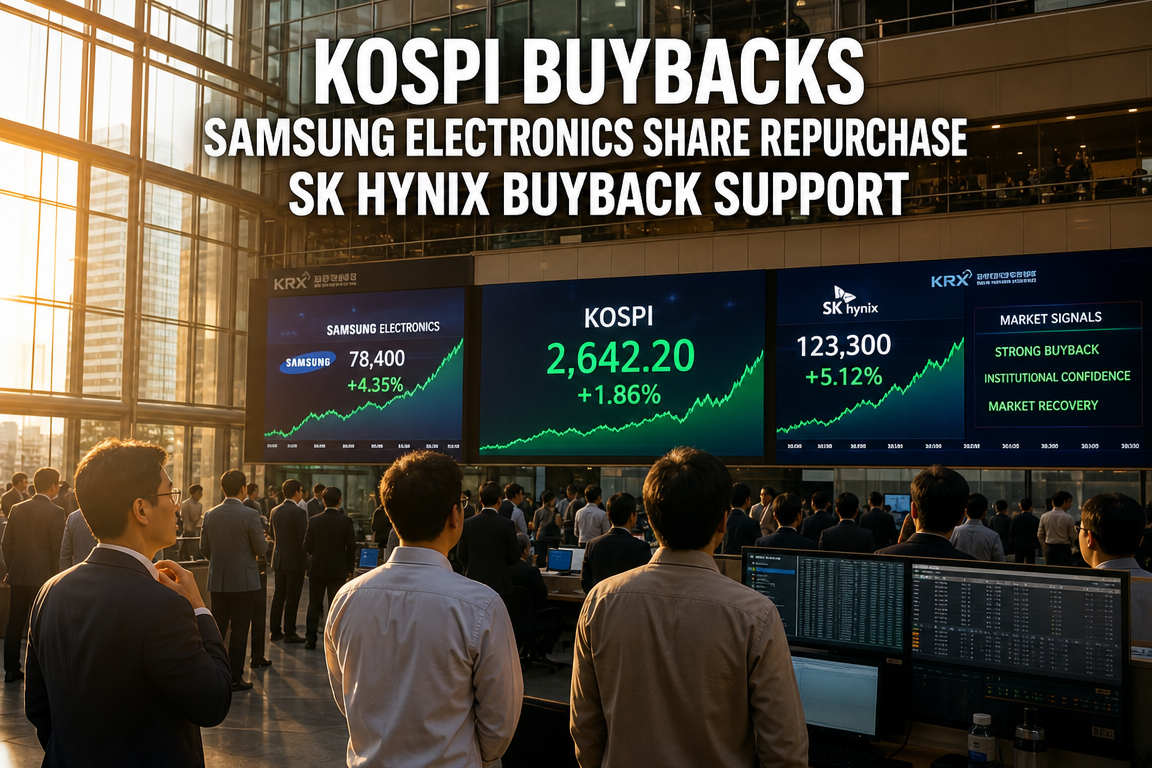
● KOSPI-Surges-on-Buybacks,-Defies-Rate-Fears
The real reason the KOSPI recovered despite higher-rate headwinds: the impact of share buybacks by Samsung Electronics and SK Hynix, and September market risks
This rebound cannot be explained simply by saying “foreign investors returned” or “semiconductors were strong.”
The key point is that, despite renewed concerns over a U.S. rate hike, large-cap support led by Samsung Electronics and SK Hynix helped lift the index.
In a thin-liquidity market, share buybacks can create a stronger price effect than the underlying change in corporate value would suggest.
In other words, today’s KOSPI move is better described as “index defense by concentrated large-cap buying” than as evidence that overall market conditions have improved.
To assess the next move, investors should also consider September seasonality, uncertainty around U.S. monetary policy, semiconductor large-cap flows, and the KOSPI outlook.
1. Why the KOSPI opened weakly today: renewed concern over a U.S. rate hike
The KOSPI started the session on a cautious note.
The main reason was the market’s renewed pricing of Federal Reserve tightening risk after last week’s Jackson Hole meeting.
The original source summarized remarks from senior Fed officials as implying the possibility of a rate hike later this year, which was enough to weigh on market sentiment.
When the possibility of a U.S. rate hike rises, global financial markets react quickly.
Higher rates increase corporate borrowing costs.
Rising interest expenses can reduce investment capacity and lead to more conservative earnings expectations.
Growth and technology stocks are particularly sensitive because valuations often depend on discounting future earnings to present value.
When rates rise, the discount rate increases, and the present value of the same earnings outlook declines.
For that reason, U.S. rate-hike concerns can directly pressure the KOSPI outlook.
2. Why higher rates are negative for equities, in simple terms
Rising rates generally create three major headwinds for the equity market.
First, funding costs for companies increase.
When firms borrow for expansion or working capital, higher rates raise interest expenses.
Second, investors may rotate toward bonds from equities.
As deposit and government bond yields rise, the relative appeal of volatile stocks can decline.
Third, equity valuations may compress.
Because stock prices reflect the present value of future earnings, higher rates reduce that present value.
This is why a more hawkish Fed tone can affect Samsung Electronics, SK Hynix, and the broader KOSPI at the same time.
3. Why did the KOSPI recover anyway? The key was buyback-related supply support
Despite the negative backdrop, the KOSPI reduced losses and recovered intraday because of share buyback-related support.
A share buyback occurs when a company purchases its own shares in the market.
Because the company itself becomes a buyer, it can provide near-term support to the stock price.
When large-cap stocks conduct buybacks, the effect is also transmitted directly to the index.
Samsung Electronics and SK Hynix carry significant market-cap weight, so their moves affect the index beyond their individual names.
As a result, when these stocks hold up, the KOSPI is less likely to weaken sharply.
Even on days with external headwinds, large-cap support can make the index rebound more than expected.
4. The main feature of today’s rebound: low trading volume amplified the move
The most important point in today’s KOSPI rebound was that trading volume remained light.
Low volume means there are fewer active market participants buying and selling.
In such conditions, order books become thin.
Thin liquidity means buy and sell orders are not densely stacked.
When buying interest appears in this environment, prices can move more easily than usual.
Persistent buy orders such as buybacks can lift prices with less capital than would be needed in a normal market.
Accordingly, today’s rebound is better viewed as a price move driven by concentrated large-cap demand in a thin market, rather than as a broad recovery in market confidence.
5. Are share buybacks a positive or negative signal?
Share buybacks are generally positive from a shareholder-return perspective.
They indicate that management may view the stock as undervalued or want to improve shareholder value.
Buybacks can reduce the free float and support per-share value.
However, not all buybacks signal a durable bullish trend.
Without earnings improvement or an industry recovery, price gains driven mainly by supply support may be difficult to sustain.
For Samsung Electronics and SK Hynix to extend gains, semiconductor cycle recovery, AI-related demand, memory price stabilization, and earnings improvement must also be visible.
Buybacks can support downside protection, but earnings remain the main driver of a sustained uptrend.
6. A sign of fading market participation: low volume should not be overlooked
Although the KOSPI recovered, the lack of volume is a cautionary signal.
Low volume suggests that market participants are not yet committing with conviction.
Foreign investors, institutions, and retail investors may all be waiting for clearer direction.
In such a market, index rebounds do not necessarily translate into a broader risk-on environment.
Large-cap gains may coexist with continued weakness in mid- and small-cap stocks.
Until a major catalyst appears, the KOSPI may remain range-bound.
When participation is thin, small negatives can trigger declines, while small positives can produce short-term rebounds, resulting in a volatile trading environment.
7. Why September matters: it is a month of concentrated market events
The market is now moving into September.
September has historically been a period of higher volatility in global equities.
Fed meetings, inflation data, employment data, U.S. Treasury yields, and dollar strength can all affect markets at the same time.
It is also a period when institutional investors adjust second-half portfolios.
As year-end approaches, earnings expectations are revised and global capital flows can shift again.
Korean equities are highly sensitive to U.S. monetary policy and exchange rates because of their export exposure and foreign ownership base.
If the won weakens further against the dollar, foreign buying interest may soften, adding pressure to large-cap stocks.
Therefore, the September KOSPI outlook should be based not only on domestic issues but also on U.S. rates, the dollar, semiconductor fundamentals, and foreign flows.
8. Key variables to watch for Samsung Electronics and SK Hynix
Samsung Electronics and SK Hynix are the most important stocks for assessing KOSPI direction.
They are not just individual names but indicators of the market’s underlying strength.
The first variable is memory semiconductor pricing.
If DRAM and NAND prices stabilize and recover, earnings expectations may improve.
The second is AI semiconductor demand.
As global tech companies continue investing in AI infrastructure, demand for HBM becomes increasingly important.
This is particularly significant for SK Hynix and also serves as a medium-term catalyst for Samsung Electronics.
The third is foreign investor flow.
If foreign investors begin buying Korean semiconductor large caps again, overall market sentiment could improve materially.
The fourth is the duration of buyback activity.
Buybacks can support prices in the short term, but sustained upside still requires earnings and industry improvement.
9. A less discussed point: today’s rebound may reflect a supply vacuum rather than a bull-market signal
The most important issue is not simply that the KOSPI rose today.
The key question is why it rose.
Most observers can explain it as “semiconductors held up,” “buybacks were present,” or “losses were recovered.”
But a deeper reading is that the move may have been driven less by strong market conviction and more by a supply vacuum in a thin-volume session.
That distinction matters.
A rally supported by strong volume may indicate new capital entering the market.
By contrast, a rebound on light volume may simply mean prices rose because selling pressure was absent.
In that sense, today’s rebound is not sufficient to conclude that the market has fully turned higher.
A true trend reversal would require rising turnover, a shift to net foreign buying, improving semiconductor earnings expectations, and stabilization in U.S. Treasury yields.
10. A checklist for investors
First, monitor the U.S. 10-year Treasury yield.
A sharp move higher could pressure growth stocks and semiconductor large caps.
Second, watch the won-dollar exchange rate.
A weaker won can reduce foreign appetite for Korean equities.
Third, track trading volume in Samsung Electronics and SK Hynix.
Price gains without volume confirmation may not be durable.
Fourth, verify whether share buybacks continue.
Market interpretation depends on whether they are a one-off event or part of a broader capital-return policy.
Fifth, monitor the September macro calendar.
U.S. employment data, inflation releases, and Fed remarks can materially change the KOSPI outlook.
11. KOSPI outlook: short-term rebounds are possible, but confirmation of a trend is still needed
The current market is less a broad risk-on rally than a defensive move supported by supply management.
In such a market, investors should avoid chasing every rebound and instead distinguish between stocks rising on earnings and those rising on flow alone.
Even if Samsung Electronics and SK Hynix support the index, a weak overall market turnover may limit further upside.
Conversely, if concern over U.S. rate hikes eases and semiconductor recovery is confirmed in the data, the KOSPI could enter a stronger rebound phase.
The key question is not whether the market rose today, but whether the move was driven by improving fundamentals or by a temporary supply imbalance.
< Summary >
The KOSPI opened weakly on renewed U.S. rate-hike concerns, but losses were recovered through large-cap support from Samsung Electronics and SK Hynix, along with share buyback effects.
However, because the rebound occurred on low trading volume, it should not yet be interpreted as the start of a strong uptrend.
Buybacks can support prices in the near term, but a sustained rally requires earnings improvement and stronger foreign flows.
September is likely to bring higher volatility due to U.S. rates, inflation, employment data, exchange rates, and Treasury yields.
The main issue is whether today’s rebound reflects market strength or a thin-liquidity flow effect.
[Related Articles…]
Semiconductors Outlook and Global Equity Trends
How U.S. Interest Rates Affect Equity Markets
*Source: [ 내일은 투자왕 – 김단테 ]
– 코스피 다 말아올린 이유 ㄷㄷㄷ #삼성전자 #하이닉스 #코스피
● Liquidity Shock, Debt Trap, Bitcoin Surge
The core of U.S. midterm strategy is liquidity provision: buybacks, the TGA balance, and stablecoins could reshape Treasury yields and AI investment flows
The key issue is not simply that U.S. debt is becoming unsustainable.
The central question is how the U.S. government manages the debt challenge while still releasing liquidity into markets before the midterm elections, and where that liquidity flows.
In particular, the focus should be on the U.S. Treasury’s long-dated bond buybacks, the use of the roughly $1 trillion TGA balance, stablecoins’ role in purchasing U.S. Treasuries, and capital expenditure by AI hyperscalers.
Although the situation appears to be a fiscal crisis, market participants may interpret it as a powerful liquidity-driven environment until a crisis actually materializes.
In practical terms, the U.S. appears to be attempting to suppress Treasury yields, inject dollar liquidity, support asset prices, and improve economic conditions ahead of the midterm elections.
1. U.S. debt stress: why the numbers are severe
The core of the U.S. debt issue is the large and persistent gap between federal revenue and spending.
- U.S. federal revenue is estimated at around $5.5 trillion.
- U.S. federal spending is estimated at around $7.5 trillion.
- The annual fiscal deficit is therefore close to $2 trillion.
- Annual principal maturities are around $10 trillion.
- Annual interest expense has risen to around $1 trillion.
- As a result, the total annual debt-service burden can be viewed at roughly $11 trillion.
The issue is not only the size of the debt.
The U.S. must continuously issue Treasuries, the market must absorb them, and yields cannot rise too far without destabilizing the broader economy.
This is the background behind Ray Dalio’s warning that the U.S. debt problem could become acute within three years.
For investors, however, there is another important interpretation.
Before a debt crisis actually breaks, the U.S. government is likely to deploy more borrowing to fund fiscal support, which can function as liquidity for markets.
2. The debt trap is a risk, but it is also liquidity
The global economy is already heavily leveraged.
Not only the U.S. but also China is using substantial debt to fund fiscal support, pursue industrial policy, and defend growth.
Government debt is the funding source for fiscal spending.
When governments issue debt and channel the proceeds into the economy, liquidity is provided to households, companies, and financial markets.
Liquidity is usually associated with rate cuts or quantitative easing, but the more relevant source now is fiscal policy.
- When central banks cut rates, monetary liquidity increases.
- When governments issue debt and expand spending, fiscal liquidity increases.
- When companies issue bonds and expand investment, private credit liquidity expands.
- When stablecoins buy U.S. T-Bills, demand for Treasuries is created through digital finance channels.
Accordingly, investors should assess not only policy rates but also fiscal policy, Treasury issuance, Treasury purchase structures, and stablecoin demand.
3. The debasement trade: currency value weakens while asset prices rise
The central theme in this environment is debasement.
Debasement refers to the erosion of money’s value.
Historically, the money supply has expanded over time, and when money grows faster than real output, its purchasing power declines.
As money loses value, more currency is required to buy the same goods or assets.
That can translate into higher consumer prices, higher equity valuations, stronger property prices, and gains in gold and Bitcoin.
In that setting, the debasement trade refers to a preference for real assets, equities, gold, crypto, and property over cash.
The U.S. government’s preferred outcome ahead of the midterm elections is broadly consistent with this dynamic.
- Liquidity increases.
- Treasury yields stabilize.
- Equity markets rise.
- Bitcoin and the stablecoin ecosystem gain momentum.
- Gold and real assets retain defensive value.
- AI and manufacturing investment continue, supporting growth.
In this context, the debasement trade should be viewed not merely as an investment theme but as part of a larger interaction between U.S. fiscal policy and election strategy.
4. Fiscal dominance: when rate cuts are constrained, fiscal policy does the work
For the Trump administration, rate cuts would be the cleanest form of stimulus.
Lower rates reduce corporate funding costs and tend to support equities, real estate, and digital assets.
The constraint is that the Federal Reserve does not respond directly to presidential preference.
The Fed chair must consider the FOMC, inflation data, and broader macro conditions.
If inflation is not sufficiently close to target, aggressive rate cuts are difficult.
This is where fiscal dominance becomes relevant.
Fiscal dominance describes an environment in which government fiscal policy has more influence on markets than central bank policy.
It includes tax cuts, debt issuance, and expanded fiscal spending that inject liquidity into the system.
The U.S. is increasingly relying on fiscal tools because monetary policy alone may be insufficient to support growth and asset markets.
5. OBBBA and the debt ceiling increase: Washington’s version of a larger credit line
The OBBBA referenced in the original text is an important starting point for the midterm strategy.
It is described as a tax-cutting measure, but it also includes a debt ceiling increase, which is more consequential.
A higher debt ceiling allows the U.S. government to borrow more.
In practical terms, it is similar to increasing the limit on a line of credit.
Even if the full amount is not used immediately, the government gains capacity to deploy fiscal support when needed.
This becomes the foundation for liquidity provision ahead of the midterm elections.
- Tax cuts leave more cash flow in households and businesses.
- A higher debt ceiling allows additional Treasury issuance.
- Treasury issuance supports fiscal spending.
- Fiscal spending expands market liquidity.
- More liquidity can support asset prices.
The downside is that this worsens the fiscal deficit and increases long-term debt risk.
Accordingly, the current U.S. environment should be viewed as one in which short-term liquidity support and medium-term debt stress coexist.
6. The key variable is Treasury yields
The most important variable in this framework is U.S. Treasury yields.
Even if liquidity is expanded, a sharp rise in Treasury yields will destabilize markets.
U.S. Treasury yields serve as the global benchmark for interest rates.
For global investors, U.S. Treasuries are generally more attractive than Korean government bonds at the same nominal yield because they are considered the world’s safest sovereign asset.
As a result, when U.S. Treasury yields rise, other countries often need to offer higher yields to attract capital.
The effect does not stop at sovereign debt.
Higher Treasury yields also lift corporate bond yields.
For companies, funding costs rise, which can reduce new investment and capital expenditure.
This is the crowding-out effect.
- Higher U.S. Treasury yields transmit into higher global rates.
- Higher global rates raise corporate financing costs.
- Higher financing costs can reduce investment.
- Lower investment can weaken growth and employment.
- Therefore, managing Treasury yields is central to defending U.S. growth.
For that reason, the U.S. Treasury is likely to use every available tool to suppress long-dated yields.
7. U.S. Treasury long-bond buybacks: a key tool for suppressing long rates
U.S. Treasury buybacks are one of the most direct tools for stabilizing long-term yields.
A buyback means the government repurchases Treasuries that were previously issued.
When long-dated bonds are bought back, demand for those securities rises, prices increase, and yields may decline.
The original text refers to expanding the existing buyback program and extending it through November 4.
The mechanism is effectively “taking from the short end to support the long end.”
In other words, the Treasury issues more short-term debt to raise funds and uses those funds to buy back long-term debt.
This is similar to using a shorter-term loan to reduce a longer-term debt burden.
It is not a structural solution to the debt problem, but it can help suppress long-term yields in the near term.
- Long-bond buybacks can reduce long-end yields.
- Lower long rates can support corporate investment and bond issuance.
- They can also improve mortgage-rate and asset-market sentiment.
- They may be constructive for AI data centers, semiconductors, and power infrastructure investment.
The issue is that greater short-term issuance can put upward pressure on short-term rates.
That makes it necessary to identify a new buyer base for short-duration Treasuries.
8. Stablecoins are becoming a new buyer base for U.S. short-term Treasuries
Stablecoins are the key mechanism for creating demand for short-term Treasuries.
A stablecoin is a digital asset designed to maintain a $1 value.
Issuers such as Tether and Circle receive dollars from users in exchange for stablecoins.
Those dollars are not simply held idle; they are invested in short-term U.S. Treasuries, especially T-Bills.
As stablecoin adoption grows, demand for U.S. short-term debt also grows.
- Users pay dollars to buy stablecoins.
- Issuers hold the dollars as reserve assets.
- Those reserves are largely invested in short-term U.S. Treasuries.
- Higher stablecoin usage increases demand for short-term Treasury purchases.
- This helps reduce the funding burden on the U.S. Treasury for short-duration issuance.
This is why stablecoins are increasingly viewed as a new liquidity channel for the U.S. Treasury market.
From Washington’s perspective, broader global use of dollar-linked stablecoins is beneficial.
It indirectly creates demand for short-term U.S. Treasuries.
Accordingly, dollar stablecoin expansion should be viewed not only as a crypto-sector issue but also as part of U.S. Treasury and dollar-system strategy.
9. The Genius Act and the Clarity Act: creating a framework, not just regulation
A stablecoin-led Treasury demand structure requires a clear legal and regulatory foundation.
The original text highlights the Genius Act and the Clarity Act as important legal mechanisms.
The Genius Act can be understood as a framework that formalizes stablecoin issuance and reserve structures.
The Clarity Act can be viewed as a framework for how digital assets are traded, circulated, and custodied.
Many investors think of regulation as restrictive, but in financial markets it also creates a legal environment for business expansion.
Institutional investors, banks, payment firms, and global technology companies need clear rules in order to participate confidently in stablecoin businesses.
- Clear regulation makes institutional participation easier.
- Banks and payment firms can design stablecoin services more efficiently.
- The use cases for dollar stablecoins expand.
- The demand base for short-term U.S. Treasuries becomes stronger.
- The environment may also become more constructive for Bitcoin and digital assets.
From this perspective, crypto policy is not only about supporting digital assets; it is also part of Treasury-market and dollar-system management.
10. The TGA balance of roughly $1 trillion is another liquidity tool
The U.S. Treasury General Account, or TGA, is another important variable.
The TGA is essentially the Treasury’s cash account at the Federal Reserve.
The original text places the current TGA balance at around $1 trillion.
When this balance is drawn down and spent, it creates a liquidity effect in markets.
During the 2020 pandemic shock, a large decline in the TGA balance helped inject significant liquidity into the system.
If the TGA balance is currently elevated, the Treasury can use it to support spending when needed.
- Using the TGA increases government spending.
- Government spending transfers cash into the private sector.
- More liquidity can support equities and risk assets.
- It may also serve as a funding source for Treasury buybacks.
In this sense, buybacks, stablecoins, and the TGA are different tools serving a similar objective.
They are intended to stabilize Treasury yields, provide liquidity, and support growth and asset prices ahead of the midterm elections.
11. Where will the liquidity go? AI, crypto, equities, gold, and real estate
The key question is where the debt- and fiscal-driven liquidity will flow.
The original text places particular emphasis on capital expenditure by AI hyperscalers.
A major driver of U.S. growth is investment in data centers, semiconductors, power infrastructure, and cloud systems.
The challenge is that free cash flow at some major AI firms is no longer as abundant as before.
Several companies are continuing large-scale AI investment despite tighter cash flow conditions.
Yet the U.S. cannot easily slow AI capital spending because it is competing with China for AI leadership.
What these companies need is lower rates and a functioning corporate bond market.
- Lower Treasury yields can help stabilize corporate bond yields.
- Easier bond issuance improves access to capital for AI firms.
- Data-center and semiconductor investment may continue to expand.
- Power infrastructure, nuclear, transmission, and cooling systems can also benefit.
- This can support U.S. growth more broadly.
In short, the reason the U.S. wants to suppress Treasury yields is not only the interest burden on government debt.
It is also to sustain the AI investment cycle, support equities, and preserve the growth narrative ahead of the midterm elections.
12. Why Bitcoin may outperform gold
The original text argues that in the second half of 2026, Bitcoin could potentially rise more sharply than gold.
The rationale is based on three factors.
- First, policies that suppress Treasury yields are supportive of risk assets.
- Second, stablecoin and digital asset regulation can improve confidence in the crypto market.
- Third, geopolitical tensions may ease temporarily around major elections and summits, reducing demand for traditional safe havens.
Gold tends to perform better during periods of geopolitical stress and war risk.
By contrast, when liquidity improves, risk appetite rises, and policy support becomes more favorable, Bitcoin and digital assets can outperform.
This remains a scenario rather than a certainty.
Crypto assets are highly volatile and sensitive to policy, regulation, and liquidity conditions.
Accordingly, the more realistic interpretation is that liquidity conditions may become more constructive for crypto assets, rather than assuming a guaranteed rally.
13. The central issue often missed in media coverage
Most news coverage treats U.S. debt stress, Treasury yields, and stablecoin regulation as separate topics.
In reality, these factors are linked within a single system.
Core point 1. Stablecoins are a U.S. Treasury demand policy, not just a crypto theme
Stablecoins are not merely digital dollars for payments.
As issuance grows, they create demand for short-term U.S. Treasuries.
The reason Washington supports regulatory clarity and global expansion of dollar stablecoins is that it strengthens dollar dominance while also expanding Treasury demand.
Core point 2. Buybacks stabilize yields, but they are not a structural fix
Long-bond buybacks can help suppress long-term yields.
However, if the Treasury issues more short-term debt in order to repurchase long-dated bonds, the overall debt problem is not resolved.
It is primarily a time-buying measure.
That may be supportive for markets in the short term, but it can worsen long-term fiscal sustainability.
Core point 3. The TGA balance is a hidden liquidity reservoir
Investors who focus only on policy rates can overlook the TGA.
But when the TGA balance declines, dollars are released into the market.
Liquidity can be created through Treasury operations even when the central bank does not appear to be easing directly.
Core point 4. AI investment also requires lower Treasury yields
The AI cycle is not only a technology story; it is also a financing story.
Data centers, GPUs, semiconductors, and power infrastructure require very large amounts of capital.
For hyperscalers to sustain that investment, the corporate bond market must remain functional.
Accordingly, Treasury yield stability is also a prerequisite for U.S. AI competitiveness.
Core point 5. Midterm strategy is ultimately an asset-market stability strategy
Before elections, governments tend to be most concerned about recession and asset-price declines.
A simultaneous decline in equities, crypto, real estate, investment, and employment would be politically unfavorable.
As a result, fiscal policy, Treasury buybacks, TGA deployment, and stablecoin policy can all be interpreted as part of the midterm strategy.
14. Key indicators investors should monitor
Investors should look beyond CPI and the policy rate when assessing U.S. liquidity.
The following indicators are important for understanding the liquidity cycle.
- Track the movement of the U.S. 10-year Treasury yield.
- Monitor the U.S. 2-year yield and short-term T-Bill rates.
- Watch the size and maturity structure of Treasury buybacks and issuance.
- Track whether the TGA balance is rising or falling.
- Monitor stablecoin issuance and the Treasury holdings of Tether and Circle.
- Assess free cash flow and bond issuance by AI hyperscalers.
- Compare the combined trend in Bitcoin, gold, Nasdaq, and the dollar index.
If Treasury yields stabilize, the TGA balance declines, and stablecoin issuance expands, conditions may become supportive for risk assets.
By contrast, if Treasury yields rise again, short-term funding tightens, and stablecoin demand weakens, expectations for a liquidity-driven market may fade.
15. Market implications by asset class
Equities
Lower Treasury yields are supportive of growth and technology stocks.
AI, semiconductors, cloud, data center, and power infrastructure companies may benefit most.
However, stocks that rise only on liquidity and lack earnings support can remain volatile.
Bonds
Treasury buybacks can help stabilize long-dated yields.
However, larger short-term issuance may place pressure on the front end of the curve.
The key issue is how the yield curve evolves.
Crypto
Stablecoin regulation and Treasury purchase structures are constructive for the crypto market.
Bitcoin may again be viewed as a debasement-trade asset.
That said, expectations may already be partly priced in, so sharp corrections remain possible.
Gold
Gold remains attractive over the medium to long term amid U.S. debt stress and concerns about dollar debasement.
In the short term, however, it may lag risk assets if risk appetite strengthens.
Real estate
Lower long-term yields can support mortgage-rate stability.
However, real estate remains highly sensitive to regional supply, income, and credit conditions.
16. The risks are clear
This strategy may be supportive for markets in the near term, but structurally it defers risk rather than resolves it.
Expanding debt to provide liquidity can lift asset prices temporarily.
However, if interest costs continue to rise and Treasury demand weakens, markets may eventually question U.S. fiscal sustainability.
At that point, Treasury yields could rise sharply again, and both the dollar and risk assets could come under pressure simultaneously.
- Rising U.S. fiscal deficits remain a risk.
- Renewed Treasury yield pressure remains a risk.
- Stablecoin confidence could weaken.
- AI firms face the risk of overinvestment and weaker cash flow.
- The debasement trade could become overextended and create asset-bubble risk.
Accordingly, this should not be seen as a market that must be bought indiscriminately, but rather as one in which liquidity is still being released while the exit becomes narrower.
< Summary >
The U.S. is likely to intensify liquidity support ahead of the midterm elections.
The main tools are long-bond buybacks, use of the TGA balance, and stablecoins’ purchases of short-term U.S. Treasuries.
The objective is to suppress Treasury yields, support AI investment and asset markets, and maintain the growth backdrop.
Stablecoins should be viewed not simply as a crypto theme but as financial infrastructure that helps generate demand for U.S. Treasuries.
If Treasury yields stabilize and liquidity increases, equities, Bitcoin, and AI-related industries could benefit.
However, the longer-term risk of a U.S. debt crisis and broader fiscal sustainability concerns would also rise.
Investors should monitor Treasury yields, the TGA balance, stablecoin issuance, and AI capital expenditures and cash flow together.
[Related Articles…]
*Source: [ 경제 읽어주는 남자(김광석TV) ]
– 중간선거 작전에 들어간다. 바이백, TGA 잔고, 스테이블코인으로 유동성 풀리나? [경읽남 260화]