● Tesla Soars on Cybercab Shock
Tesla Shares Jump 5.5%: Why 45 Cybercabs in the Texas Registry Mattered
The key point in this Tesla news is not simply that the stock rose.
On a day when all three major U.S. indices declined, Tesla rose 5.51% and closed at $367.95.
That implies an increase of roughly $85 billion in market capitalization in a single day, despite Tesla issuing no official announcement.
The market’s response was driven by a different development.
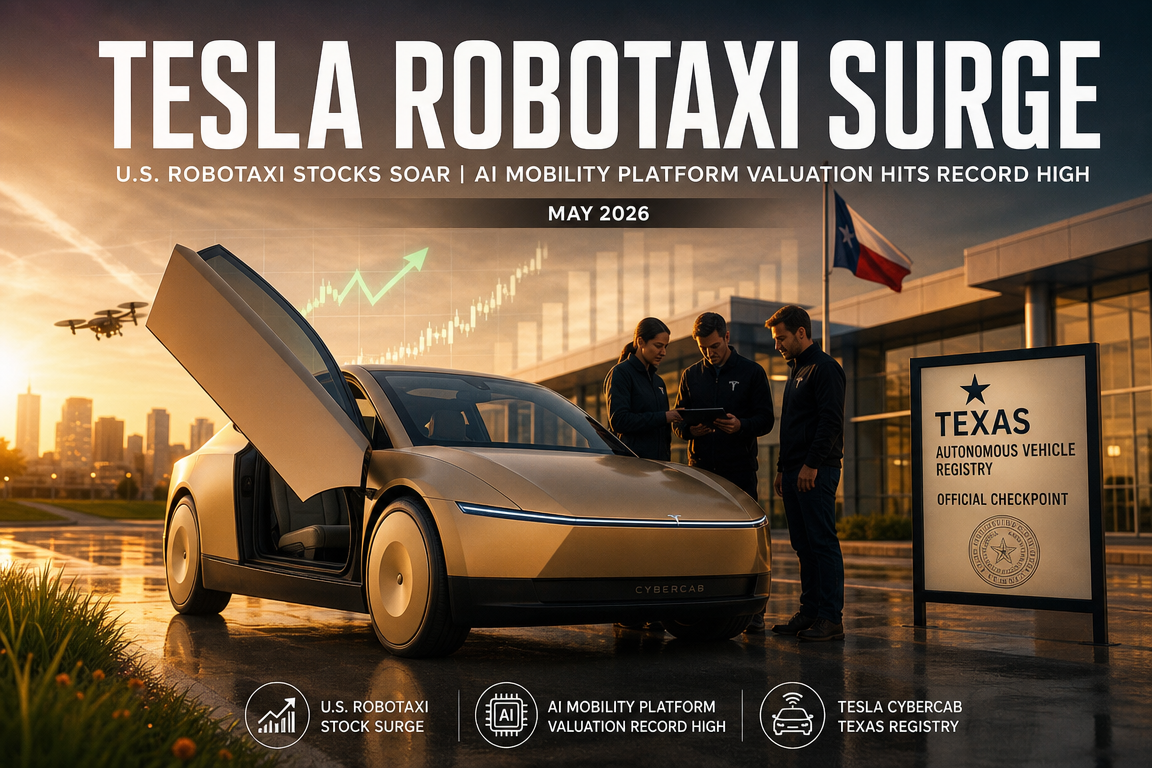
Specifically, 45 Cybercabs with no steering wheel or pedals appeared for the first time in Texas’s autonomous vehicle registration database.
That figure is not just a vehicle registration event; it may represent the first administrative record supporting Tesla’s transition from an automaker to an autonomous mobility platform company.
1. Tesla moved against a weak market
On the day in question, U.S. equities were broadly weaker.
The S&P 500 fell 0.33%, the Dow Jones Industrial Average declined 0.77%, and the Nasdaq slipped 0.12%.
Tesla, by contrast, gained 5.51% to close at $367.95.
When a single stock rises sharply on a down day for the broader market, it typically reflects pricing around a new business catalyst or event expectation rather than a simple technical rebound.
- Tesla close: $367.95
- Tesla gain: +5.51%
- S&P 500: -0.33%
- Dow Jones: -0.77%
- Nasdaq: -0.12%
- Estimated market cap increase: about KRW 85 trillion
Importantly, Tesla did not release a formal announcement that day.
Moves of this magnitude are usually associated with earnings, orders, product launches, or regulatory approvals.
In this case, the market was reacting more to regulatory documentation and a signal of service expansion.
2. Media cited Optimus, but the timing does not fit
Several outlets attributed Tesla’s surge to news that Optimus production had begun.
Some reports said production started at the Fremont factory.
However, that explanation has a timing issue.
The Optimus-related news had already circulated around August 27, based on the original timeline.
After that announcement, Tesla’s stock actually fell.
By August 28, the stock had declined 1.71%.
In other words, the market had already priced in the Optimus headlines, and the response at the time was not positive.
For that reason, Optimus alone is not a strong explanation for the 5.5% move.
This does not mean Optimus is unimportant.
Optimus remains a central part of Tesla’s long-term AI robotics strategy.
But the more direct driver of the day’s rally appears to have been the Cybercab registration and the clearer signal of a robotaxi business transition.
3. The most important development: 45 Cybercabs appeared in Texas’s autonomous vehicle registry
Texas requires operators of Level 4 or Level 5 autonomous vehicles to keep vehicle lists updated.
The system is intended in part to clarify responsibility if a driverless vehicle is involved in an incident.
As a result, the Texas registry is a more reliable administrative source than rumors or blog posts.
According to the original report, Tesla’s robotaxi registration total was 314 vehicles.
Of those, 269 were Model Ys and 45 were Cybercabs.
- Total registered vehicles: 314
- Model Y: 269
- Cybercab: 45
- Cybercab share: about 14%
On a purely numerical basis, 45 vehicles may not appear significant.
What matters is the vehicle type.
Model Y is a standard electric vehicle originally sold to consumers.
Tesla has used that vehicle in its robotaxi service.
Cybercab, by contrast, is designed specifically for robotaxi use.
It has no steering wheel, no pedals, and a two-seat configuration centered on autonomous mobility.
That distinction could change how Tesla is valued.
Until now, Tesla has mainly been assessed by quarterly vehicle deliveries.
With Cybercab deployment, the more relevant metric could become how long each vehicle operates per day and how much platform revenue it generates.
4. Tesla’s business model may be shifting from vehicle sales to utilization-based revenue
Under the traditional vehicle-sales model, revenue is recognized once when the car is sold.
Tesla also earns from FSD, insurance, charging, and software subscriptions, but vehicle sales remain the core business.
Cybercab is different.
Once deployed in a robotaxi network, the vehicle becomes a revenue-generating asset over time.
In that scenario, Tesla could be evaluated not only as an EV manufacturer but also as an autonomous service operator and AI mobility platform.
That is why investors reacted so strongly.
The number 45 is less important than the fact that Tesla has now registered its purpose-built robotaxi vehicle in official state records.
That is a stronger signal than commentary from Elon Musk or event teasers.
5. A JP Morgan memo is easier to interpret now: why Tesla may not have scaled Model Y robotaxis faster
The original report said JP Morgan, after a Fremont factory visit, suggested that Tesla had not been pushing Model Y aggressively into robotaxi service.
At the time, that interpretation seemed unclear.
If Tesla had wanted to support the stock in the short term, scaling Model Y robotaxis faster would have seemed more logical.
With the Cybercab registration now visible, the rationale becomes clearer.
If Tesla had heavily expanded Model Y robotaxi use for near-term optics, it would later have had to manage the transition to Cybercab.
Model Y and Cybercab differ materially in service design, maintenance, seat configuration, insurance, and operating cost.
Tesla may have preferred to prepare for a network transition centered on a dedicated vehicle rather than simply maximize near-term robotaxi volume.
That is the key takeaway from the registry data.
6. Austin robotaxi geofence expanded: direction matters more than size
Tesla reportedly expanded its Austin robotaxi service area by about 9%.
In autonomous vehicle operations, the map boundary within which service is allowed is called a geofence.
Within that boundary, rides can be dispatched; outside it, service is restricted.
The important point is not just that the area expanded.
The direction of expansion matters more.
- Expanded area: near the Domain north commercial district
- Additional areas mentioned: toward Mesa Park and Pflugerville
- Key corridor: north Austin’s U.S. Route 183 axis
- Characteristics: commuter traffic, commercial density, residential density, complex traffic flow
The 183 corridor carries significant commuter demand.
For autonomous vehicles, it is a more difficult operating environment than a simple straight road.
Lane changes, merges, intersections, pedestrians, and commercial access points create more variables.
If Tesla expanded service into this area, it suggests that FSD and robotaxi operations are moving into more demanding real-world conditions.
The September 3 Cybercab event should clarify the role of this zone.
7. Grok updates: voice-based control becomes necessary in a steering-wheel-free vehicle
Another notable development in the original report was Grok’s expanding in-car control capability.
Previously, Grok functioned mainly as an in-car assistant for questions, navigation, and conversational support.
After the update, it appears to have expanded into direct vehicle control.
- Adjusting air conditioning by voice
- Controlling headlights
- Folding side mirrors
- Handling multiple commands in a single sentence
- Vehicle control through a conversational interface
In a conventional car, these functions are convenience features.
In a vehicle without a steering wheel or pedals, they become much more important.
Voice and AI become the main interface between the passenger and the vehicle.
Grok’s vehicle-control features are therefore not a novelty item; they are part of the user experience layer for the robotaxi era.
Inside an autonomous vehicle, the passenger is not a driver but a user.
The user is expected to issue spoken commands, and the AI is expected to execute them.
8. What to watch at the September 3 Cybercab event
According to the original report, the Cybercab launch event in Austin is scheduled for September 3, U.S. time.
The event is described as invite-only, and the market is treating it as highly significant.
For Tesla shareholders, especially those holding stock around the $367 level, the following items merit attention.
This is a checklist for event interpretation, not investment advice.
- Whether the 45 Cybercabs are actually used at the event
- Whether the registered fleet expands further before or after the event
- Whether consumer reservation or purchase procedures are disclosed
- Whether robotaxi service expansion is described in more detail
- Whether pricing below $30,000 is announced
- Whether a structure for private owners to join Tesla’s network is explained
- Whether insurance, maintenance, cleaning, charging, and revenue-sharing terms are disclosed
The market’s main focus will likely be pricing and timing of delivery.
Elon Musk has previously said Cybercab pricing could fall below $30,000.
The original report also said prediction markets were assigning roughly an 18% probability to a sub-$30,000 launch price.
If Tesla presents a sub-$30,000 price, open reservations, live operation, and a delivery schedule at the same time, the market reaction could be substantial.
If pricing and timing remain vague, short-term disappointment is possible.
9. Tesla’s presentation style is starting to resemble Apple’s
The original report compares Tesla’s recent communication style with Apple events.
Apple typically introduces a product on stage, opens preorders the same week, and begins shipping soon after.
That short gap between announcement and product delivery builds credibility with investors and consumers.
Tesla appears to be moving in a similar direction.
For example, the Nevada Sparks Semi factory groundbreaking is scheduled for September 24, while the first truck was already reported to have come off the production line on April 29, according to the original report.
In other words, the event may come after meaningful production progress, rather than before it.
That matters for Tesla.
The company has long been known for bold vision and fast execution, but some product cycles have faced criticism for long delays between announcement and scale production.
If Cybercab event messaging is backed by actual vehicle registration and operational readiness, Tesla’s credibility may improve.
10. Robotaxi business models: Waymo and Tesla may take different paths
Waymo relies on a capital-intensive model in which the company directly expands its vehicle fleet and operating infrastructure.
That approach is stable, but expensive.
Fleet growth requires substantial company capital.
Tesla’s earlier autonomy-day concept points to a different model.
Elon Musk has said customers could add or remove their vehicles from Tesla’s network, and that Tesla could retain 25% to 30% of the revenue.
This structure resembles a mix of Uber, Airbnb, and a franchise model.
- Tesla: vehicle design, FSD development, network operations, app, demand generation
- Vehicle owners: vehicle purchase, charging, maintenance, loan servicing, network participation
- Revenue model: operating revenue shared between Tesla and vehicle owners
If successful, this model would reduce Tesla’s capital burden in scaling robotaxi deployment.
If owners purchase Cybercabs and contribute them to the network, Tesla can allocate more capital to factory expansion and AI infrastructure.
However, there are risks.
Many owners may be reluctant to lend out their vehicles to strangers.
Vehicle-sharing services exist, but owners still face concerns around cleanliness, accidents, insurance, and depreciation.
Cybercab may partially address those issues.
It is designed from the outset as a revenue-generating robotaxi asset rather than a personal-use emotional purchase.
Even so, actual participation from consumers and operators remains uncertain.
11. Macro factors: oil prices and rate decisions also matter
While Tesla-specific news was positive, the broader market faced macro pressure.
The original report referenced rising geopolitical tension between the United States and Iran, risks near the Strait of Hormuz, and higher oil prices.
West Texas Intermediate October futures rose 3.48%, which can weigh on U.S. equities more broadly.
The Strait of Hormuz is a critical route in global oil supply.
If tensions increase there, oil prices tend to rise, which can feed inflation concerns and affect rate expectations.
September is also the start of a period with earnings releases, rate decisions, and major technology events.
As a result, Tesla should be viewed not only through the lens of Cybercab news but also in the context of market risk appetite, oil prices, and interest-rate expectations.
12. SpaceX and AI data-center power constraints: vertical integration returns
Another notable section of the original report concerns SpaceX’s gas-turbine component casting facility.
Elon Musk reportedly confirmed that SpaceX is building a facility in Bastrop, Texas, to cast gas-turbine components.
The key components are blades and vanes.
These are the parts inside a gas turbine that operate in the hottest zone.
They must withstand temperatures of roughly 1,650 to 1,980 degrees Celsius and require advanced casting expertise.
Why does this matter?
AI data centers are driving a sharp rise in electricity demand.
Major technology companies are seeking gas turbines to secure power, but large turbine makers are reportedly sold out through much of 2030.
The bottleneck is concentrated in high-temperature parts such as blades and vanes.
Elon Musk has historically addressed bottlenecks by building the supply chain internally rather than waiting for external suppliers.
As Tesla vertically integrated batteries, chips, software, and charging infrastructure, SpaceX may now be targeting the power bottleneck emerging around AI infrastructure.
This is not just an aerospace story.
It is also a signal that the next AI constraint may shift from semiconductors to power infrastructure.
13. The key point often missed in other coverage
First, 45 Cybercabs are not just a number; they are a signal of a new revenue model.
Tesla may no longer be evaluated only on vehicle sales.
Once robotaxis generate real revenue, utilization, passenger volume, margin, and platform fees become more important metrics.
Second, the slower expansion of Model Y robotaxi service may have been preparation for a transition.
If Tesla was redesigning the network around Cybercab rather than simply maximizing Model Y deployment, recent actions make more sense.
Third, Grok’s vehicle-control features are central to Cybercab user experience.
In a vehicle without a steering wheel, the passenger is the primary user, and voice AI is likely to be the main control layer.
Fourth, Tesla is increasingly being judged by documentation rather than statements.
The central signal in this case was a state registration record, not a post from Elon Musk.
Fifth, robotaxi competition is both a technology contest and a capital-structure contest.
If Waymo expands through company-owned vehicles while Tesla uses owner-contributed vehicles, the long-term implications for cash flow and scaling could differ materially.
14. Key risks from an investor perspective
The news is constructive, but the risks are clear.
Because Tesla’s stock prices in expectations quickly, the market can also punish delays or disappointments.
- Regulatory risk: rules for selling and operating vehicles without steering wheels or pedals vary by jurisdiction.
- Pricing risk: it remains unclear whether a sub-$30,000 price point is feasible.
- Operating risk: cleaning, charging, maintenance, accident response, and insurance must be defined.
- Demand risk: consumers and operators must have sufficient incentive to place Cybercabs into the network.
- Technology risk: reliable Level 4 performance in dense urban environments still needs to be demonstrated.
- Valuation risk: Tesla’s share price already reflects substantial future expectations, making it sensitive to delays.
In short, the September 3 event is more than a product reveal.
It is a test of whether Tesla can move from an EV manufacturer to an AI-driven autonomous mobility company.
< Summary >
Tesla shares rose 5.51% to close at $367.95 on a day when the three major indices declined.
Media coverage cited Optimus, but that news had already been known and the stock had fallen afterward.
The key catalyst was the first appearance of 45 Cybercabs in Texas’s autonomous vehicle registry.
Unlike Model Y, Cybercab is a purpose-built robotaxi with no steering wheel or pedals.
This suggests Tesla may be shifting from a vehicle-sales model to an autonomous service platform model.
The Austin geofence expansion and Grok vehicle-control updates also fit into this transition.
At the September 3 Cybercab event, the key variables are pricing, reservations, delivery timing, actual deployment, and the network revenue model.
The more important question is not the stock’s one-day move, but whether Tesla can transition from EV sales to AI autonomous mobility revenue.
[Related Articles…]
- Robotaxi Strategy and Autonomous Mobility Market Outlook
- Cybercab Pricing and Tesla’s Autonomous Vehicle Expansion
*Source: [ 오늘의 테슬라 뉴스 ]
– 핸들도 페달도 없는 차 45대가 하루 만에 텍사스 등록부에 올라왔습니다 — 3대 지수가 다 내린 날 테슬라만 5.5%, 9월 3일 $367 주주는?
● Liquidity-Driven Rally
U.S. Liquidity Expansion Ahead of the Midterm Election: Key Outlook for the U.S. and Korean Equity Markets in 2H 2026–2027
The key issue in this phase is not simply whether rates are cut.
The market needs a consolidated view of why volatility increased in June and July 2026, why the rebound logic re-emerged from August onward, and which variables will shape the outlook for U.S. equities and Korean equities through 2027.
The main factors in this discussion include National Pension Service selling, single-name leveraged ETFs, concerns over semiconductor valuation excess, the Middle East conflict and rising Treasury yields, and fiscal liquidity support ahead of the U.S. midterm election.
Although the market may appear to have “sold off and then rebounded,” the more important point is that capital flow is shifting from monetary policy to fiscal policy.
1. The 2025–2026 Macro Backdrop: A Pivot Phase and a Liquidity-Driven Market
The broader economic backdrop in 2025 and 2026 can be characterized as a pivot phase.
In this context, a pivot phase refers to a period in which central banks move away from a high-rate stance and gradually reduce policy rates, or at least ease the intensity of tightening.
From an equity perspective, this type of environment is generally associated with a liquidity-driven market.
When expectations build that rates will move lower, some capital previously parked in bonds, deposits, and dollar-denominated assets tends to rotate back into risk assets.
Accordingly, the market trend from the March–April 2025 low can be interpreted as a broader uptrend in 2025 and 2026.
However, an uptrend does not mean a straight-line advance.
As with rest stops on a long-distance trip, interim volatility and consolidation phases are inevitable.
2. Why Volatility Increased in June–July 2026
The June and July 2026 correction cannot be explained by a single factor.
Equity prices are driven by a combination of flows, rates, earnings expectations, geopolitical risk, and sentiment.
This correction was shaped by three main factors.
2-1. National Pension Service Rebalancing: A Directional Driver
The first factor was selling by the National Pension Service in the domestic equity market.
From January to May 2026, the National Pension Service increased its domestic equity allocation and supported the Korean market’s advance.
From June, however, the situation changed.
As domestic equity weight exceeded the target range, rebalancing pressure increased and selling intensified.
The key point is that the National Pension Service changed the market’s direction.
In other words, it was one of the largest flow-driven factors that shifted the market from an uptrend to a downtrend.
2-2. Single-Name Leveraged ETFs: A Factor That Amplified the Decline
The second factor was single-name leveraged ETFs.
Leveraged ETFs do not determine direction on their own; rather, they amplify the slope of an existing move.
In simple terms, they magnify gains in rising markets and accelerate declines in falling markets.
This is particularly important in Korea, where Samsung Electronics and SK hynix account for a very large share of market capitalization.
In the United States, the Magnificent 7 represent roughly 35% of total market capitalization, and in China, the China Dragon 7 represent around 40%.
By contrast, Korea is far more concentrated in Samsung Electronics and SK hynix, making market-wide volatility more sensitive to leverage products linked to these names.
Taiwan also has a high concentration in TSMC, but it does not have this type of single-name leveraged ETF structure.
For that reason, single-name leveraged ETFs may pose structurally higher risk in the Korean market.
2-3. Semiconductor Sentiment Deterioration: Future Expectations Matter More Than Current Earnings
The third factor was a weakening in future expectations for semiconductor equities.
The market discounts future earnings before they are realized.
Even if Samsung Electronics and SK hynix report strong current results, share prices can correct in advance if investors become concerned that the upward cycle in memory prices is slowing.
In particular, concerns increased that hyperscaler free cash flow was weakening.
Hyperscalers include major cloud, big tech, and AI data center operators.
Whether these companies can continue expanding AI infrastructure investment is a central variable for semiconductor demand.
Investors began to question whether AI semiconductor demand had already moved ahead of fundamentals.
This negative shift in expectations further weighed on the Korea market’s semiconductor-led decline.
3. Additional Macro Drivers Behind the June–July Correction: Middle East Conflict, Oil, and Treasury Yields
Another major source of volatility in June and July 2026 was renewed conflict in the Middle East.
When tensions rise in the region, the first market reaction is usually in crude oil.
Concerns over a possible Strait of Hormuz blockade increase uncertainty around energy transport and feed directly into higher oil prices.
Higher oil prices raise inflation expectations.
Higher inflation expectations then put upward pressure on Treasury yields.
When Treasury yields rise, the discount rate applied to risk assets increases, creating headwinds for growth stocks and semiconductors.
In this sense, the Middle East conflict was not only a geopolitical event but also a rate variable that affected both U.S. and Korean equity markets.
4. Why Some Countries Raised Rates Despite the Pivot Trend
Although the broad trend in 2025–2026 is a pivot, not all countries move at the same pace.
Each central bank responds to domestic inflation, exchange rates, energy prices, and capital flows.
When Middle East tensions push oil higher and inflationary pressure rises, some countries may even move toward rate hikes.
Korea, Japan, Australia, New Zealand, Indonesia, the Philippines, and the euro area are among the economies that may consider rate hikes or a tighter stance depending on inflation and FX conditions.
This can be understood as a brief stop on the broader pivot path.
The long-term direction remains easier, but short-term inflation shocks can still trigger tighter policy responses.
5. Why the Rebound Logic Re-Emerged from August
The rebound case strengthened from August because the factors that had driven the June–July decline gradually weakened.
Selling pressure from National Pension Service rebalancing eased materially after the correction.
Regulatory measures on single-name leveraged ETFs were also tightened.
Higher entry thresholds, tighter marketing restrictions, launch constraints, and trading condition changes reduced the market impact of these products.
The move away from easy access for smaller investors reduced speculative flow into single-name leveraged ETFs.
These changes helped reduce the risk of another sharp decline in the Korean market.
6. The Most Important Point: The U.S. Is Releasing Fiscal Liquidity Ahead of the Midterm Election
The most important element in this phase is U.S. fiscal policy.
Many investors think of liquidity only in terms of monetary policy, such as rate cuts or quantitative easing.
However, liquidity is not created solely by central banks.
Government fiscal spending also increases market liquidity.
In other words, liquidity comes from both monetary policy and fiscal policy.
The key issue in 2H 2026 is likely to be fiscal policy rather than monetary policy.
The U.S. has effectively secured substantial fiscal capacity through the OBBA legislation and an expanded debt ceiling.
These resources may be used for economic stimulus, industrial support, infrastructure spending, household support, and local budget execution ahead of the midterm election.
A government facing a midterm election cannot easily tolerate weak growth or a sharp equity correction.
As a result, U.S. fiscal liquidity could become a major support factor for equities in 2H 2026.
7. Monetary Liquidity vs. Fiscal Liquidity
Monetary liquidity refers to the central bank lowering policy rates or providing liquidity through quantitative easing.
Fiscal liquidity refers to the government injecting funds through bond issuance, budget execution, subsidies, and tax incentives.
From an investor perspective, both can support asset prices.
However, they operate differently.
Monetary policy affects the financial system broadly, while fiscal policy can target specific industries, groups, and regions.
For the U.S. equity outlook in 2H 2026, the critical question is where this fiscal liquidity will flow.
Likely beneficiaries include AI infrastructure, semiconductors, power grids, defense, manufacturing reshoring, data centers, and energy infrastructure.
8. Geopolitical Risk Is Also Moving Toward Easing from August
In June and July, renewed conflict in the Middle East increased geopolitical tension.
From August onward, however, the probability of easing tensions has improved, which supports risk assets.
Rising geopolitical tension leads investors toward safe-haven assets.
By contrast, easing tensions tends to restore risk appetite.
The U.S.-China summit in September 2026, the U.S. midterm election in November, and the China Shenzhen APEC summit in late November could all serve as de-escalation catalysts.
If U.S.-China relations remain manageable rather than deteriorating sharply, global equities could see an additional relief rally.
9. U.S. Equity Outlook: Conditions for Another Move Higher
For U.S. equities to resume higher, three conditions are important.
First, Treasury yields need to stabilize.
If the U.S. 10-year yield rises sharply, valuation pressure increases for growth stocks and AI-linked equities.
Second, fiscal liquidity must actually be deployed.
The debt-ceiling expansion and budget capacity must translate into real economic support rather than remaining a market expectation.
Third, the AI investment cycle must remain intact.
Data center spending by big tech, GPU and HBM demand, and power infrastructure investment must continue to support market leadership.
If these conditions are met, U.S. equities in 2H 2026 could reflect both a midterm-election rally and a fiscal-liquidity cycle.
10. Korean Equity Outlook: Semiconductors Remain Central, but Flow Structure Matters
Korean equities remain highly dependent on semiconductors.
If Samsung Electronics and SK hynix weaken, the KOSPI is likely to weaken as well.
That said, the flow pressures that drove the June–July correction have eased from August.
As National Pension Service selling pressure fades and the impact of leveraged ETFs declines, Korean equities may once again respond more directly to fundamentals.
The key is not simply whether semiconductors are strong.
Investors should monitor AI server demand, HBM pricing, memory supply discipline, hyperscaler capex capacity, and the recovery in Chinese demand.
For SK hynix, HBM competitiveness is critical. For Samsung Electronics, the main checkpoints are the memory upcycle and improvements in foundry execution.
11. The Most Important Points Not Fully Reflected in Other Coverage
First, it is important to distinguish between flow creation by the National Pension Service and flow amplification by leveraged ETFs.
Most market commentary stops at “the National Pension Service sold” or “leveraged ETFs caused the problem.”
In practice, National Pension Service selling created the downward direction, while single-name leveraged ETFs increased the speed of the decline.
Second, this liquidity cycle should not be explained only by policy rate cuts.
The core source of liquidity in 2H 2026 may be fiscal policy rather than the central bank.
Government spending ahead of the midterm election can be a powerful short-term driver for equities.
Third, Korean-style single-name leveraged ETFs carry different risk characteristics from U.S. products.
In the United States, large technology exposure is spread across multiple names, while in Korea market capitalization is concentrated in Samsung Electronics and SK hynix.
In this structure, a larger single-name leveraged ETF market can cause disproportionate volatility across the entire Korean equity market.
Fourth, semiconductor share prices are more sensitive to hyperscaler investment capacity than to current earnings alone.
Even with strong AI demand, concerns about big tech free cash flow can lead to a slowdown in capex expectations.
When that happens, semiconductor stocks may correct before earnings results are reported.
Fifth, geopolitical risk is effectively a rate variable for equities.
The Middle East conflict affects crude oil, inflation expectations, Treasury yields, and risk appetite simultaneously.
12. Key Indicators for Investors to Monitor
First, monitor the U.S. 10-year Treasury yield.
Yield stabilization is supportive for growth and AI-related equities.
Second, track crude oil and developments around the Strait of Hormuz.
A renewed oil spike would increase inflation concerns and upward pressure on rates.
Third, monitor the pace of U.S. fiscal execution.
What matters is where funds are actually deployed after the debt-ceiling expansion.
Fourth, watch both National Pension Service and foreign investor flows.
The Korean market tends to show clearer direction when domestic institutional flows and foreign flows move in the same direction.
Fifth, track HBM, memory pricing, and AI server demand for Samsung Electronics and SK hynix.
Semiconductors are not just another sector in Korea; they are a key driver of the entire index.
13. Core Conclusion from a 2027 Macro Perspective
The core issue in the 2027 outlook is where liquidity flows next.
While 2025–2026 has been defined by pivot expectations and rate-easing hopes, 2H 2026 through 2027 may be shaped more by fiscal liquidity and industrial policy.
The U.S. is likely to release additional funding ahead of the midterm election, and that capital may flow into AI, semiconductors, manufacturing, energy infrastructure, and defense.
Korean equities may benefit through semiconductor supply chains and AI infrastructure exposure, but they also face structural risks from market concentration and leveraged product volatility.
Accordingly, the right framework for 2H 2026 and 2027 is not simply to ask whether the market will rise or fall, but to identify where liquidity is created and where it is ultimately deployed.
< Summary >
The June–July 2026 correction was driven by a combination of National Pension Service selling, single-name leveraged ETFs, weaker semiconductor sentiment, the Middle East conflict, and rising Treasury yields.
From August onward, the rebound case strengthened as National Pension Service rebalancing pressure and leveraged ETF effects eased.
The most important point is that fiscal liquidity support ahead of the U.S. midterm election may become a major market driver.
This liquidity cycle should be viewed not only through the lens of policy rate cuts, but also through government spending and debt-ceiling expansion.
For U.S. equities, the key variables are Treasury yield stability, fiscal execution, and continued AI investment. For Korean equities, semiconductor performance and the structure of market flows are likely to determine direction.
[Related Articles…]
- Liquidity Cycle and Global Equity Market Outlook for 2027
- AI Semiconductor Cycle and Korean Equity Investment Strategy
*Source: [ 경제 읽어주는 남자(김광석TV) ]
– “중간선거 앞두고 돈 대대적으로 풉니다” 미국 증시 다시 달릴까 | 클로즈업 | 머니트렌드 강의 [1편]