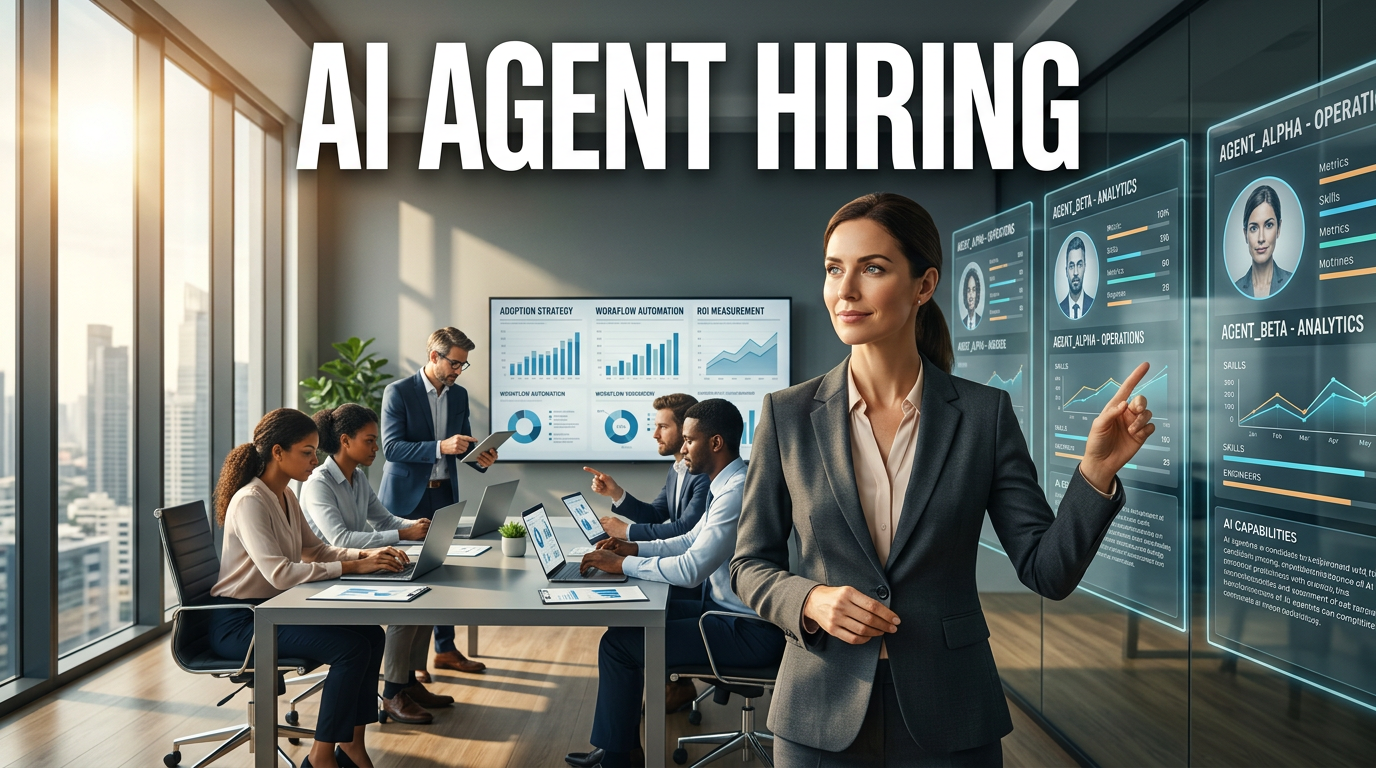
● AI Agent Hiring Fever
AI Agent Adoption Is No Longer a “Try It Out” Stage; It Is a Stage of Hiring, Developing, and Dismissing
The core point many companies miss when adopting AI agents is not “which AI should we use?”
What really matters is who will be responsible for this AI agent, what tasks it will be assigned to, how its performance will be evaluated, and when it will be retired.
In particular, as AI agents increase inside an organization, not only productivity gains but also token costs, security risks, operational debt, and work dependencies all grow together.
The key takeaway of this article is that AI agents should be managed not as simple task automation tools, but like “digital employees.”
For organizations considering digital transformation and AX strategy, we have organized the practical criteria that must be checked before adopting AI agents.
1. The Way We Use AI Is Changing
Until last year, corporate interest was mainly focused on how to use AI tools well, such as “How should we use ChatGPT?”, “Is Claude better?”, or “Is Gemini better?”
In other words, the way was for people to open an AI tool, ask questions, receive answers, and use them as references in their work.
But the recent trend has changed completely.
Now companies are trying to embed AI directly into business processes rather than using it as a simple support tool.
They are moving into a stage where AI agents directly perform repetitive tasks such as report writing, meeting note organization, customer inquiry classification, purchase request handling, HR policy guidance, and sales material analysis.
- Past: People used AI tools.
- Present: AI enters the workflow.
- Future: AI agents detect conditions and execute tasks on their own.
This change is not just a technological shift.
For companies, it is a change that requires redesigning workforce operations, automation structures, data security, cost management, and organizational productivity.
2. AI Tools and AI Agents Are Completely Different
AI tools only work when a user opens them and gives commands directly.
By contrast, AI agents are assigned a specific goal and role, and when task conditions are met, they can judge or act on their own.
That is why AI agents are closer to “task delegates” than simple programs.
The term “agent” itself is a representative example of personifying technology.
Refrigerators, washing machines, and smartphones are not called employees no matter how advanced they become.
But because AI agents actually perform specific tasks on behalf of people, concepts such as hiring, evaluation, development, and dismissal become necessary.
| Category | AI Tool | AI Agent |
|---|---|---|
| How it works | Used directly by people | Executes based on goals |
| Role | Support tool | Task delegate |
| Need for management | Relatively low | Very high |
| Performance measurement | Centered on personal satisfaction | Centered on speed, quality, cost, and scalability |
| Risks | Wrong answers, security issues | Malfunctions, abuse of authority, rising costs, operational debt |
3. AI Agents Also Need a Lifecycle Like People
When companies hire people, they have job definitions, interviews, onboarding, evaluations, compensation, training, and retirement procedures.
AI agents are the same.
From the start, you must clearly define what tasks they will handle, measure actual performance, and update their skills when needed.
And agents that no longer deliver results or only consume costs should be retired decisively.
- Hiring: Define what work the AI agent will handle.
- Onboarding: Connect the required data, tools, permissions, and work rules.
- Development: Improve performance, refine prompts, replace models, and add skills.
- Evaluation: Measure speed, quality, cost, user satisfaction, and error rate.
- Compensation: Assign more task authority or a higher-level model.
- Dismissal: Remove or consolidate agents that only consume tokens and underperform.
The important point here is that as the number of AI agents increases, a company’s operating costs also increase.
AI agents are not free employees.
Model usage fees, API costs, cloud infrastructure, data connection costs, security management, and monitoring costs all continue to occur.
In the end, operating AI agents is an issue that changes both corporate competitiveness and cost structure at the same time.
4. Four Types You Must Distinguish Before Adopting AI Agents
Not every task needs an AI agent.
Some tasks only need a simple chatbot, some are better suited to a copilot tool, and some are more efficient with workflow automation.
Rather than making AI agents unconditionally, it is important to choose the type that fits the nature of the task.
1) Q&A Chatbot Agent
This type answers frequently asked questions such as HR rules, procurement rules, welfare benefits, and internal manuals.
For example, it answers questions like “How many vacation days can be carried over?” or “Where do I submit a purchase request?”
This type has a relatively low adoption barrier and is good for starting with internal knowledge search.
2) Productivity Support Copilot
This type helps with document writing, presentation drafts, meeting note organization, email writing, and code writing.
By connecting with tools like Microsoft 365 Copilot, Google Workspace, Claude, and ChatGPT, it can improve individual productivity.
It is effective for improving personal productivity, but a separate management system is needed to change the overall organizational workflow.
3) Workflow Automation Agent
This type automates repetitive processes with clear business rules.
For example, when a customer inquiry ticket comes in, it classifies the content, assigns it to the responsible department, and updates the handling status.
It is similar to Make, Zapier, n8n, and RPA tools, and the clearer the rules, the better the results.
4) Standalone AI Agent
This is a more advanced type where the AI makes judgments and acts on its own when certain conditions are met.
For example, if you say, “Please apply for vacation next Thursday and Friday,” the agent accesses the HR system, checks whether vacation is available, and proceeds with the application process.
From this stage onward, permission management, approval procedures, security policies, and audit logs are absolutely necessary.
5. Seven Essential Conditions Needed to Adopt AI Agents
AI agents are not complete just because the prompt is well written.
To deploy them in corporate operations, at least the seven conditions below must be in place.
1) Goals and Success Criteria
You must clearly define what task the AI agent should perform.
“Help with sales work” is too broad.
The execution unit must be specific, such as “Classify new customer inquiries by industry and assign them to the appropriate sales team.”
2) Model and Reasoning Method
You need to decide which AI model to use and how it will reason.
Simple responses can be handled by lighter models, but complex judgments or multi-step tasks may require a high-performance model.
Balancing cost and performance is important.
3) Knowledge, Memory, and Context Understanding
A good AI agent must remember business context.
It should be able to learn and reflect what users frequently revise, the company’s document style, and the work rules of specific departments.
How you design short-term and long-term memory creates differences in performance.
4) Skill and Tool Usage Ability
The core point of an AI agent is its ability to connect with external systems.
Through technologies such as MCP, it can connect to internal databases, HR systems, CRM, ERP, email, calendars, and document tools.
Only when this connection is possible can it go beyond simple responses and actually execute tasks.
5) Execution Authority and Approval Structure
It is dangerous to let AI agents read, modify, and send data as they wish.
Important tasks must have a structure where a person confirms, “Is it okay to execute this task?”
This is called human in the loop.
In particular, approval systems are essential for finance, HR, customer information, and contract-related tasks.
6) Evaluation and Audit System
You must be able to verify whether the AI agent is working properly.
Records should remain of what data it read, what judgments it made, and what results it produced.
These records are needed to trace causes and improve when errors occur.
7) Operational Owner and Improvement Cycle
The most commonly missed issue is ownership.
You need to decide who is responsible for this AI agent, who will fix it when problems arise, and how often performance improvements will be made.
An AI agent without an operational owner is likely to be neglected or disappear eventually.
6. AI Agent Performance Must Be Measured by Four Criteria
After adopting an AI agent, it should not end with just “it seems better.”
From a corporate perspective, clear ROI and task performance metrics are necessary.
1) Speed
You should see how much the task processing time has been reduced.
If a report draft that previously took three days now takes three hours, that is a clear result.
Speed improvement is the most direct effect of adopting AI agents.
2) Scale
You need to see whether it is used by one person, the whole team, or the entire company.
Individual productivity may improve, but if it does not spread across the organization, economies of scale are hard to achieve.
3) Quality
You must check whether the output produced by the AI agent is accurate and consistent.
If it is only fast but produces many errors, review costs will actually increase.
Quality criteria include accuracy, rework rate, error rate, and user satisfaction.
4) Learning Capability
It is also important whether the AI agent can improve by reflecting feedback.
There must be a structure where it does not repeat the same mistakes and improves to match the organization’s way of working.
Only agents that can learn can contribute to long-term productivity improvement.
7. Tasks Assigned to AI Agents Must Be Broken Down by Seven Conditions
If you tell an AI agent to “do all my work for me,” failure is likely.
It is unrealistic to design a general-purpose agent.
Instead, one task must be broken down into executable units.
- Start condition: When does this task begin?
- Input condition: What data or request must come in?
- Decision rules: Based on what criteria is it classified or decided?
- Tools used: What systems or apps must it be able to use?
- Output result: What form should the result take?
- Owner: Who is responsible for this task?
- Exception condition: In what situations should it be handed over to a person?
Tasks that cannot be explained by these seven conditions are still difficult to delegate to an AI agent.
On the other hand, if these conditions are clear, the task is highly suitable for agentization.
8. Building an Advanced AI Agent from the Start Is Likely to Fail
Organizations adopting AI agents for the first time should not set goals that are too big.
If you try to create a high-performance agent that thinks and acts autonomously from the start, it will take a long time and involve many trials and errors.
It is better to begin with simple, standardized tasks.
- Information collection
- Material organization
- Drafting documents
- Classifying customer inquiries
- Reviewing checklists
- Summarizing market research
- Writing meeting notes
After building successful experience in these tasks, it is safer to add skills and external system connections.
9. AI Agents Must Grow Step by Step
AI agents also have growth stages.
Rather than going fully autonomous from the start, expanding step by step is more realistic.
- Stage 1: An agent that answers questions and makes recommendations
- Stage 2: An agent that generates drafts or summaries
- Stage 3: An agent that designs work plans and execution plans
- Stage 4: An agent that automatically executes some tasks according to the plan
- Stage 5: An agent that operates autonomously by recognizing conditions and situations
For most companies, it is better to start at stages 1 and 2.
As organizational experience accumulates, they can move to stages 3 and 4.
Stage 5 should only be approached after security, permissions, auditing, and cost management systems are sufficiently established.
10. The Most Important Point Rarely Mentioned in Other News: AI Agents Are “Assets That Can Disappear”
There was a case where, after the employee who built the AI agent left the company, the organization’s AI usage methods that had been built up over a year returned to the old way in a single day.
Employees went back to the old method, saying, “Well, that’s what happens. We’re not some AI agent company. Let’s just keep using Excel like before.”
This case matters because it shows that the success or failure of AI agents depends more on the operational structure than on the technology itself.
If there is only an agent builder and no agent owner, it is risky.
Without documentation, without a maintenance system, and without portfolio management at the organizational level, AI agents can end up as personal hobby projects.
This is the core point many companies miss.
- Who keeps operating the AI agent matters more than who built it.
- If it depends only on one person’s ability, the system can collapse as soon as that person leaves.
- AI agents also need documentation, permission design, and an assigned operational owner.
- AI assets must be managed as organizational assets, not left as personal projects.
In the end, the essence of the AI agent era is not technology adoption, but organizational operating structure.
That is the real difficulty of digital transformation.
11. Should You Buy AI Agents or Build Them?
When adopting AI agents, companies can broadly choose from several options.
They can use personal general-purpose agents, build with low-code platforms, use cloud-based agent platforms, or build their own based on open source.
1) Personal General-Purpose Agent
Tools such as Claude Code, ChatGPT, and Codex fall into this category.
They are suitable for individuals to experiment quickly and improve work productivity.
However, they have limits when connecting to a company’s core systems or handling sensitive data.
2) Low-Code Agent Builder
Tools like Microsoft Copilot Studio are representative examples.
They allow you to combine multiple functions to build agents without deep coding.
They are especially well integrated for companies that use Microsoft 365, Teams, and Office environments extensively.
However, there may be constraints from operating within a specific ecosystem.
3) Cloud-Based Agent Platform
This approach uses agent-building environments provided by cloud platforms such as Google Cloud, Microsoft Azure, and AWS.
It is suitable when organization-wide tasks, enterprise system integration, security management, and permission control are needed.
When handling sensitive information such as HR, finance, sales, and customer data, this approach is safer.
4) Open Source or In-House Build
This approach uses frameworks such as LangChain, LangGraph, and AutoGen, or modifies open-source agents to fit the corporate environment.
It offers a high degree of freedom but requires development and operational capabilities.
For companies aiming to secure core competitiveness directly over the long term, this can be a meaningful option.
12. You Must Distinguish Between Personal, Organizational, and Enterprise Use
The first criterion to separate when adopting AI agents is the scope of use.
Depending on whether it is for individual use, team-level organizational use, or company-wide shared use, the technology choice and security standards differ.
| Scope of Use | Suitable Approach | Points to Watch |
|---|---|---|
| Personal | ChatGPT, Claude, Codex, etc. | Need to restrict sensitive information input |
| Organizational | Copilot Studio, low-code builder | Need task owners and permission management |
| Enterprise | Cloud platform, in-house build | Security, auditing, cost, and operational systems are essential |
If an AI agent is used by employees across the company and affects customers as well, it is risky to operate it with a simple general-purpose tool.
In that case, you should consider a proper cloud platform or an in-house development platform.
The moment AI agents become directly linked to corporate competitiveness, technology selection is no longer just a tool purchase; it becomes a management strategy.
13. More AI Agents Is Not Always Better
Many organizations initially approach this with the mindset of “let’s just build a lot first.”
But as the number of AI agents keeps increasing, management costs rise as well.
Token usage fees, API call costs, cloud costs, monitoring costs, and security management costs accumulate.
So at some point, AI agents can become a liability rather than an asset.
It is most ideal to operate the necessary agents in a small and clear way.
14. Criteria for Separating AI Agents
Sometimes one agent should be split into several.
For example, you may start with one sales agent, but if B2B sales and B2C sales have completely different goals and data, it is right to separate them.
- When success metrics are completely different
- When the data that must be accessed is different
- When security policies are different
- When approvers and owners are different
- When user groups are clearly different
In these cases, it is more efficient to separate them rather than force everything into one agent.
15. Criteria for Integrating AI Agents
Conversely, sometimes several agents should be combined into one.
For example, if you created separate HR and general affairs agents but usage is low and the types of inquiries are similar, they can be integrated.
- When usage is low
- When functions overlap
- When maintenance costs exceed performance gains
- When the same data and approval structure are used
- When users do not need to distinguish between them
AI agent portfolio management is likely to become an important operational capability for companies going forward.
16. The Economic Changes Created by AI Agents
AI agents are not just an IT trend; they are an economic issue that changes labor productivity and cost structure.
When AI handles repetitive tasks, companies can process more work with the same number of employees.
This leads to productivity gains and, over time, affects corporate competitiveness and profitability.
But if AI agent operating costs are not controlled, they become a new financial burden.
In the future, companies will need to manage not only labor costs but also token costs, AI infrastructure costs, and data operation costs together.
As the number of AI agents increases, the concept of “digital labor cost” may become more important.
In other words, future executives are likely to run organizations by assigning and evaluating human workers and AI agents together.
17. Checklist Companies Must Prepare Right Now
- Check whether the work to be turned into AI agents has been broken down into specific execution units.
- Define the goals, success metrics, and owners for each agent.
- Clearly distinguish between personal, organizational, and enterprise agents.
- Design access permissions and approval procedures for sensitive data.
- Track the cost and token usage of each agent.
- Create criteria for dismissing or integrating underperforming agents.
- Be sure to establish documentation and maintenance systems for AI agents.
- Build an operating structure that does not rely on just one employee.
The core point of adopting AI agents does not end with “making them well.”
It also includes making them last, continuously improving them inside the organization, and decisively cleaning them up when they are no longer needed.
18. Key Takeaway: AI Agents Are Not a Technology Project, but an Organizational Design Project
Many companies think of AI agents as experimental projects for the IT or innovation department.
But in reality, they are closer to organizational design projects that change work methods, authority structures, performance evaluation, cost management, and data governance all at once.
Companies that operate AI agents properly can work faster and achieve greater results at lower cost.
On the other hand, companies that keep adding agents without clear standards may suffer from operational debt and cost burdens.
In future AX competition, the deciding factor will likely not be “who uses more AI,” but “who manages AI agents better.”
< Summary >
AI agents are closer to digital employees that perform work on behalf of people than to simple AI tools.
When adopting AI agents, companies must design the full lifecycle, from hiring and development to evaluation and dismissal.
Performance must be measured by speed, scale, quality, and learning capability.
More AI agents are not always better; they must be managed as a portfolio while considering costs and operational debt.
In particular, if there is no agent owner, documentation, permission management, or maintenance system, the organization’s AI capability can disappear the moment the person who built it leaves.
Ultimately, the essence of adopting AI agents is not a technology experiment, but a redesign of the company’s digital transformation and workflow automation strategy.
[Related Articles…]
- The Next Stage of Business Workflow Automation in the AI Agent Era
- How AX Transformation Is Reshaping Corporate Productivity and Future Competitiveness
*Source: [ 티타임즈TV ]
– AI에이전트도 면접보고 채용하고 은퇴시켜야 한다 (김덕중 퍼브 AI연구소장)