● FSD Breakthrough
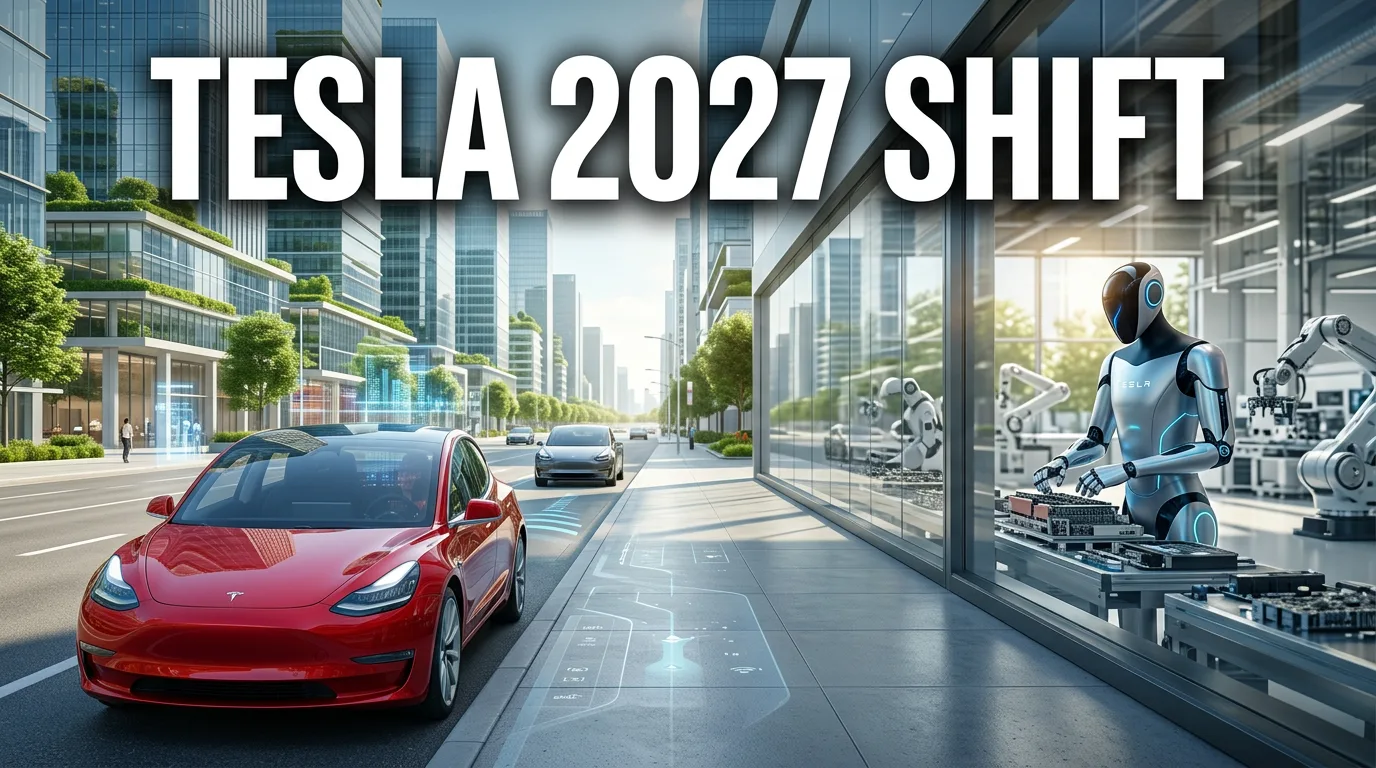
Tesla’s core in 2027 comes down to just 3 things: FSD approval, robotaxi monetization, and Optimus mass production
The really important thing in Tesla’s earnings this time is not whether revenue missed by 1%.
The core point is whether numbers have actually started to emerge showing that Tesla can move from an automaker to an autonomous-driving software, robotaxi, and physical AI company.
In this article, we will take a single look at Tesla’s earnings, FSD penetration, the robotaxi commercialization schedule, Optimus production plans, cash flow, and the burden of AI chip investment.
In particular, we will separately address “whether Tesla really has a structure that can make money in 2027”, which other news outlets and YouTube often gloss over lightly.
1. Tesla earnings summary: Revenue was disappointing, but EPS and margins held up well
Tesla’s revenue for this quarter was announced at about $28 billion.
Since that was about 1% below market expectations, it is hard to call this a very strong result based on revenue alone.
However, earnings per share, or EPS, came in at $0.48, beating the market expectation of $0.45.
In simple terms, revenue came in slightly short, but profit management was not bad relative to market expectations.
- Revenue: $28 billion, about 1% below expectations
- EPS: $0.48, above the expected $0.45
- Gross margin: 18.1%
- Previous quarter gross margin: 16.3%
- After-hours stock price: weakened after giving back intraday gains
The most positive part of this earnings report is the improvement in gross margin.
Rising from 16.3% in the previous quarter to 18.1% this quarter means profitability is partially recovering despite pricing pressure.
Even if Tesla’s stock is volatile in the short term, long-term investors ultimately focus on margin recovery and future cash flow.
2. Cars are still the center: 73% of Tesla’s revenue comes from vehicles
Although Tesla is being valued as an AI company, its current revenue structure still makes it very much an automaker.
About 73% of total revenue comes from the automotive segment.
The energy business accounts for about 10%, and autonomous driving plus other software-related segments are around 16%.
- Automotive: about 73%
- Energy: about 10%
- Autonomous driving and others: about 16%
This means that no matter how much Tesla has the narrative of being an AI company, its short-term stock price is still heavily influenced by vehicle sales and automotive margins.
That is why, in this earnings report, the market wanted to hear about FSD and robotaxi, while also closely watching delivery volume and margins.
3. Demand is alive: Orders are at the highest level in 4 years
One unexpectedly important point in this earnings report is that orders are at the highest level in 4 years.
There had been persistent concerns that demand for Tesla vehicles was slowing, but according to the company, demand itself was strong.
The problem was not demand, but battery supply shortages.
In other words, the company did not fail to sell because customers did not order; deliveries could not keep up with demand because battery supply was insufficient.
This point is quite important when looking at Tesla’s earnings.
That is because in the automotive market, demand slowdown and supply bottlenecks are completely different problems.
A slowdown in demand could mean weakening brand competitiveness.
By contrast, a supply bottleneck is a problem that can be addressed through production capacity, battery sourcing, and cost structure improvements.
4. FSD is the real core point of this earnings report
The biggest keyword in Tesla’s earnings this time is undoubtedly FSD.
It is said that as many as 75% of Tesla vehicle owners delivered in the U.S. in the recent quarter signed up for the paid FSD service.
That is about a 20% increase from the previous quarter.
This number is significant.
It means that three out of four people who bought a Tesla chose the paid autonomous-driving service.
This is not just an option sale; it can be seen as a signal that consumers are beginning to feel the real utility of FSD.
- Paid FSD adoption rate for new U.S. deliveries: about 75%
- Increase from previous quarter: about 20%
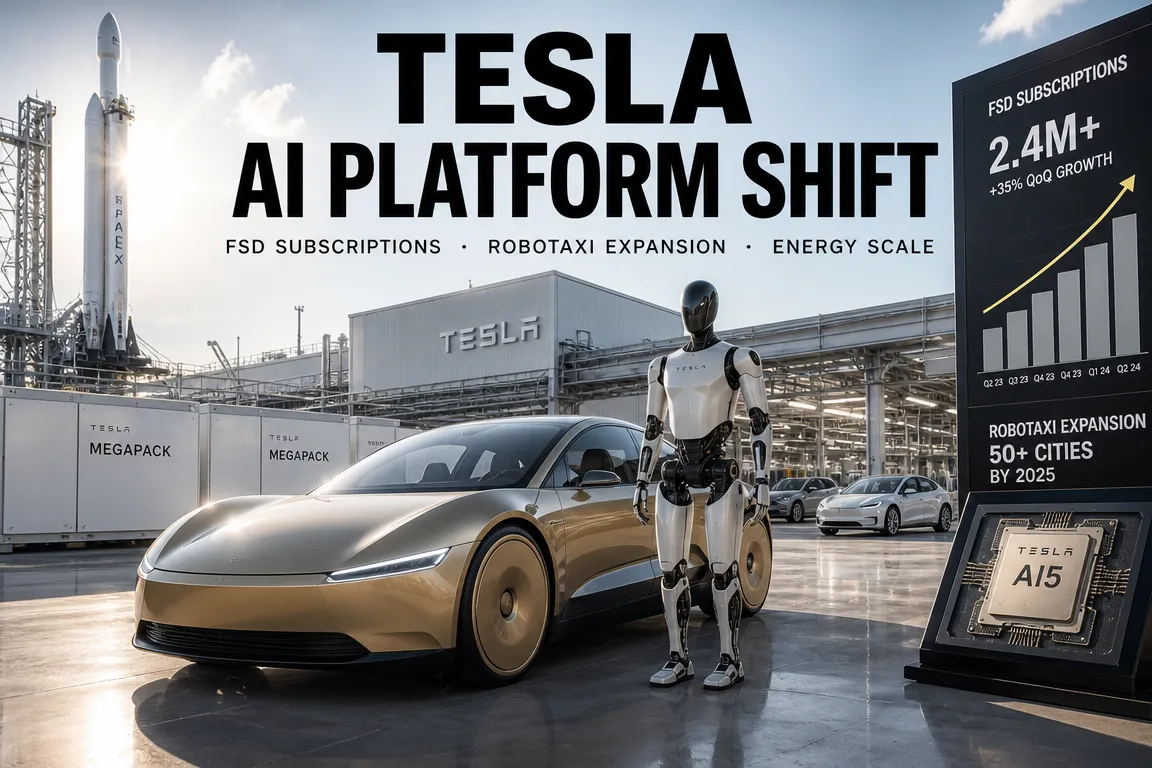
- Global paid FSD users: increased from 1.04 million to around 1.74 million
- Annual growth rate: about 70%
- Estimated overall FSD penetration: about 20%
- Penetration rate a year ago: about 12%
Especially important is the fact that global paid users increased from about 1.04 million to 1.74 million.
That FSD subscribers are growing by nearly 70% annually means Tesla can create recurring revenue even after vehicle sales.
Here is where Tesla’s investment appeal comes from.
Cars are hardware revenue: once sold, that is basically it.
But FSD is software revenue that can generate income monthly or annually.
As software revenue expands, operating margin has a strong chance of improving significantly.
5. Why FSD matters: It has greater profit leverage than vehicle sales
For Tesla, raising paid FSD subscription rates significantly can have a stronger impact on operating profit than increasing vehicle sales by 30%.
The reason is simple.
Vehicles require raw materials, batteries, factories, logistics, and labor costs.
FSD, by contrast, applies already developed software to more vehicles.
Of course, FSD development and AI infrastructure require enormous spending.
But as additional subscribers increase, unit costs are likely to fall and profit margins are likely to rise.
This is the core reason Tesla is seen not merely as an EV company, but as an AI-based platform company.
6. Robotaxi: It is not making money yet, but the numbers could change from 2027
The next core point is robotaxi.
Tesla’s autonomous driving mileage reportedly increased about 8 times quarter over quarter, reaching around 2 million miles.
Looking at the growth curve, it is not a simple straight line but one that is becoming steeper.
That said, it still has a long way to go.
For robotaxi to become a true large-scale commercial service, mileage, safety data, regulatory approval, vehicle deployment, and operating efficiency all have to line up.
At this stage, it is still an early market, to the point where Tesla is said to need nearly 10x expansion every quarter.
- Autonomous driving mileage: about 8x increase quarter over quarter
- Cumulative mileage: about 2 million miles
- CyberCab deployment in Austin: reportedly increased about 10x in one month
- Dallas launch: mentioned for next month
- U.S. cities where operations may be possible: expansion to about 6 cities
Tesla acknowledged that robotaxi is not yet profitable.
That is actually a realistic statement.
At the early stage, vehicle numbers are small, operating regions are limited, and regulatory barriers are high.
However, the company says robotaxi could gain real momentum starting in Q2 2027, and could generate a meaningful revenue contribution in Q3 or Q4 2027.
7. Robotaxi economics: The key is that there is no driver
The reason robotaxi is so powerful is not simply that autonomous driving is impressive.
The core point is its cost structure.
In traditional ride-hailing services, driver costs account for the largest share.
But robotaxi has no driver.
Tesla can also make the vehicle relatively inexpensive.
Based on the original text, CyberCab manufacturing cost is said to be under 20 million won.
In that case, vehicle depreciation and operating costs can be reduced.
While ride-hailing services like Uber currently trade at about $4 to $6 per mile, Tesla CyberCab is said to target $0.30 per mile in the long run.
By simple comparison, that is roughly a 20x cheaper structure.
Of course, this gap has not materialized yet, and some say the real difference may currently look closer to half that level.
But the story changes if robotaxi operates at scale and economies of scale kick in.
The ride-hailing market is highly price sensitive.
If Tesla secures safety and regulatory approval, cost competitiveness alone could strongly disrupt the existing mobility market.
8. Optimus: Expectations are high, but investors need to look at a longer timeline
The third core point is Optimus.
Tesla’s humanoid robot Optimus is a project that represents the era of physical AI.
However, based on this material alone, it is difficult to expect major revenue from it right in 2027.
Optimus production has started, but delivery to external customers is expected at the end of 2027.
There is also an explanation that it is still not a fully satisfactory product in terms of hand design, durability, and software completeness.
The company believes these issues can be solved during mass production within a year, but the actual commercialization schedule could be later.
- Current status: production stage has begun
- Expected external delivery: end of 2027
- Remaining issues: hand design, durability, software stability
- Realistic commercialization timing: possible in 2028 or 2029
Elon Musk’s timelines are always aggressive.
So the phrase “external delivery by the end of 2027” may actually be more realistically viewed with 2028 or later in mind.
That said, the direction is clear.
If chatbots and generative AI are AI in digital space, Optimus is physical AI that moves in the real world.
If it connects to factories, logistics, service industries, and even household robots, the market size could become much larger than that of EVs.
9. Cash flow was better than expected, but there is a lot of spending ahead
Another positive point in this earnings report is free cash flow.
Although an initial loss was expected, the company actually posted positive cash flow.
These days, the market values cash flow as much as revenue growth.
In a high-interest-rate environment, the valuation gap between companies that make money well and companies that keep burning cash becomes very large.
In addition, Tesla lowered its capital expenditure plan from $25 billion to $20 billion.
In the short term, this is positive.
It can reduce the investment burden while protecting cash flow.
But the problem starts next year.
Tesla will need massive investments in AI chips, data centers, Optimus factories, and robotaxi infrastructure.
Elon Musk has also mentioned a concept for a semiconductor factory.
If the potential expansion of the Austin, Texas Optimus factory is added on top of that, capital expenditures could rise again.
10. If SpaceX, data centers, and Starlink become linked, capital burden could rise even more
The market continues to pay close attention to the possibility of Tesla’s combination with SpaceX or an expanded partnership.
This is less a confirmed fact and more of a long-term scenario viewed by investors.
Still, if the Tesla, SpaceX, Starlink, and xAI ecosystems become more tightly connected, the scale of AI infrastructure investment could become much larger.
In particular, data center investment is an area where cash goes out immediately.
FSD, robotaxi, and Starlink need cash to come in quickly if such investments are to continue.
But global FSD approval and robotaxi monetization still need more time.
In other words, Tesla’s biggest concern is this.
The future growth engine looks certain, but it will cost too much money right now to build that future.
11. The 3 things that must be watched in 2027
If you look at Tesla through 2027, the core is not complicated.
It comes down to three things.
① Global approval of FSD
The first is global approval of FSD.
Tesla has obtained approval in some countries, but it has not yet reached a sufficiently widespread global stage.
Approval in China is especially important.
China is the world’s largest EV market and at the same time a market with high data and regulatory barriers.
If FSD becomes approved in Korea as well, it could become a meaningful market for Tesla’s software revenue expansion.
If FSD is approved globally, Tesla could generate tens of billions of dollars in recurring cash flow every year.
That money could then be reinvested into AI chips, data centers, Optimus, and robotaxi.
② Robotaxi monetization
The second is robotaxi monetization.
Tesla believes robotaxi could achieve profitability in the first half of 2027.
Personally, I also see robotaxi as a highly competitive model if regulatory barriers are removed.
That is because there is no driver, manufacturing costs are low, and operating efficiency can continue to improve through software updates.
However, in the robotaxi business, regulation is a bigger variable than technology.
One accident, one regulatory tightening, and expansion speed can slow dramatically.
③ Optimus commercialization
The third is Optimus commercialization.
Optimus is the biggest option in Tesla’s long-term valuation.
But it is still difficult for it to contribute meaningfully to short-term earnings.
Even if the company talks about external delivery by the end of 2027, meaningful revenue and productivity improvements are more likely to be confirmed in 2028 or 2029.
Therefore, Optimus should be viewed less as an earnings catalyst for 2027 and more as a long-term card that could determine Tesla’s corporate value after 2030.
12. The real core point that other coverage often misses
First, the core of this earnings report is not vehicle sales volume but the FSD conversion rate.
A 75% paid FSD sign-up rate for new U.S. deliveries is a sign that Tesla’s software business is actually beginning to work.
Second, for robotaxi, regulation timing matters more than technology.
Even if the technology is good, monetization will be delayed if approval is slow city by city, state by state, and country by country.
Third, Optimus is likely to make money later than expected.
For robots, actual factory deployment, durability, maintenance, and safety certification are much harder than demo videos suggest.
Fourth, Tesla’s biggest risk is not a lack of growth story, but the burden of capital expenditures.
If it simultaneously pushes AI chips, data centers, robotaxi, and Optimus factories, cash will be needed quickly.
Fifth, 2027 could be the year when Tesla is judged on whether it is truly recognized as an AI platform company rather than an EV company.
If FSD and robotaxi connect to actual revenue and earnings, Tesla’s valuation could be assessed in a completely different way.
13. Investment perspective summary: Metrics to watch before the stock price
Tesla’s stock may fluctuate in the short term after the earnings announcement.
But long-term investors should look at the following metrics before the stock price.
- Whether the FSD paid subscriber growth rate continues to stay above 50 to 70%
- Whether the number of countries with global FSD approval rises quickly
- Whether autonomous-driving regulations ease in China and Europe
- Whether robotaxi operating cities and mileage surge quarter by quarter
- Whether robotaxi shows real profitability in the first half of 2027
- Whether Optimus creates meaningful productivity gains inside factories
- Whether free cash flow remains positive despite large-scale AI investment
- Whether the market accepts rising capital expenditures as growth investment
Ultimately, the core of Tesla stock is moving away from “how many more EVs were sold” and toward “how much recurring cash flow are software and AI generating?”
If this transition succeeds, Tesla can be revalued not as an automaker, but as an autonomous-driving platform, robotaxi network, and physical AI company.
< Summary >
Tesla’s earnings this time came in at $28 billion in revenue, about 1% below expectations, but EPS beat market expectations at $0.48.
Gross margin improved to 18.1%, and orders reached the highest level in 4 years.
The most important point is the FSD paid subscription rate.
75% of new U.S. deliveries signed up for FSD, and global paid users increased from about 1.04 million to 1.74 million.
Robotaxi is not yet profitable, but it was said to be ramping up in earnest from Q2 2027, with the potential to create a meaningful revenue contribution in Q3 and Q4.
Optimus is expected to be delivered externally at the end of 2027, but its real economic value is more likely to be confirmed in 2028 to 2029.
The core of Tesla in 2027 is global FSD approval, robotaxi monetization, and Optimus commercialization.
The short-term risk is the burden of large-scale AI infrastructure and capital expenditures, while the long-term opportunity is being re-rated as a platform company in the autonomous driving and physical AI era.
[Related Articles…]
- Tesla AI transition and autonomous driving market outlook
- How robotaxi commercialization could reshape mobility
*Source: [ 월텍남 – 월스트리트 테크남 ]
– 테슬라는 27년에 3가지만 보면 됩니다.