● AI-Selloff, Capex-Fears, Nasdaq-Jitters
The U.S. Equity Market in a Tight Spot: Why the Nasdaq Is Weak Despite AI Tailwinds
The recent correction in U.S. equities is not simply a case of weak earnings.
In fact, comments from Meta, Tesla, Lam Research, and AI cloud-related companies indicate that AI demand remains resilient.
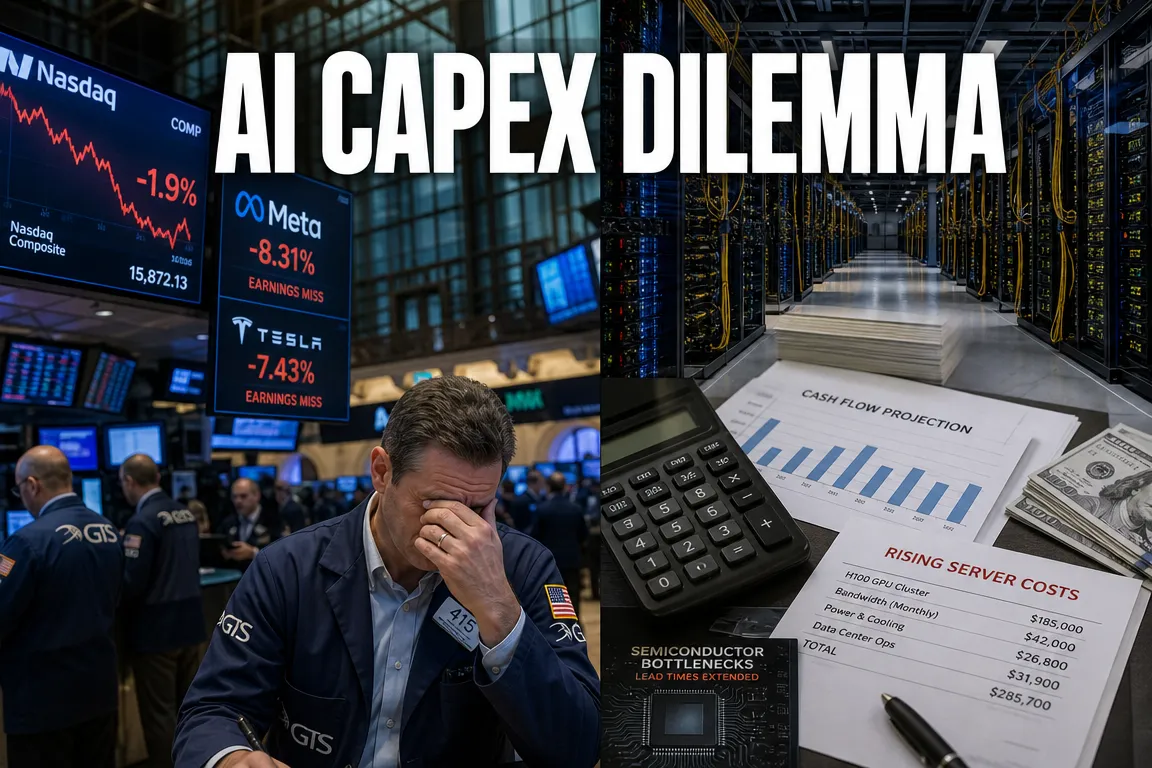
Yet the market is selling companies that say they will spend more on AI, while also selling companies that say they will cut AI-related capital spending.
The current weakness in the Nasdaq reflects less skepticism about AI growth itself than concern over how quickly AI investment will translate into earnings and cash flow.
Meta’s AI app growth, Tesla’s post-2027 momentum, Lam Research’s semiconductor equipment bottlenecks, the expansion of AI agents, and cybersecurity risks are all intersecting at once, leaving the market in a difficult position.
1. Current Market Conditions: Why Did the Nasdaq Fall Despite AI Tailwinds?
Nasdaq futures were down by approximately 1.7% in the source material.
The immediate catalyst was earnings releases and guidance from major companies.
However, revenue and demand have not collapsed.
The issue is that the market is applying a much stricter standard to corporate results.
- When AI demand is strong, investors worry that capital spending is too high.
- When companies reduce AI capex, investors question whether long-term growth strategy is weakening.
- Even strong semiconductor equipment demand is sold off if guidance is lowered due to supply-chain bottlenecks.
- When companies present future plans, investors now demand immediate proof in the numbers.
In other words, this is no longer a market driven only by recession fears.
It is a phase in which AI investment returns, cash flow, semiconductor supply chains, and execution quality are being tested simultaneously.
2. AI Demand Remains Strong: The Core Issue Is GPU and Compute Shortage
The most important point in the source material is AI compute demand.
It was noted that even GPU and TPU capacity is difficult to secure in the market.
Large-scale compute requests from major cloud providers were also highlighted.
This matters because AI semiconductor demand is not just a narrative; it is now visible as infrastructure bottlenecks.
In particular, the preference among cloud and neocloud providers for short-term contracts is significant.
- If contract prices are expected to rise, short-term contracts are more attractive than long-term commitments.
- If demand is expected to weaken, locking in long-term pricing is usually preferable.
- Preference for short-term contracts suggests the supplier has pricing power.
This is a detail the market can easily miss.
If AI compute demand were truly weakening, customers would not insist on short-term contracting.
The current setup suggests demand is strong and suppliers retain leverage over pricing.
3. Is the CoreWeave-Style AI Cloud Model Really Risky?
The market has recently questioned the business model of AI cloud companies such as CoreWeave.
The structure relies on debt-funded data center construction and leasing compute capacity to large technology customers.
This model carries interest-rate risk, high leverage, and customer concentration risk.
However, if the reported AI compute demand is accurate, the picture changes.
If compute resources remain scarce and contract pricing continues to rise, the payback period for AI infrastructure could be shorter than expected.
- One comment in the source material suggested a one-year payback period for AI server investment.
- It was also noted that a six-month payback period next year may not be impossible.
- Under those conditions, some AI infrastructure investment can remain economically viable even in a high-rate environment.
That said, several conditions must hold.
GPU supply, power availability, data center utilization, and customer retention all need to remain stable.
Therefore, AI cloud companies should be viewed as both growth assets and leveraged infrastructure businesses.
4. Meta Earnings: The Numbers Were Fine, but the Market Disliked Capex
Meta’s earnings were not weak on the surface.
Revenue was slightly above expectations.
EPS came in modestly below estimates.
Guidance was also slightly above market expectations.
The market’s concern centered on AI-related capital expenditures.
When Meta signaled that AI investment would rise further, investors focused on the risk to cash flow.
Meta’s free cash flow turned negative for the first time, which heightened concern.
Meta has long been viewed as a company that generates substantial cash from its advertising business.
The fact that AI infrastructure spending pushed it into negative free cash flow was a significant psychological setback for investors.
5. Meta’s AI App “Muse”: The Key Point the Market May Be Undervaluing
The AI service referred to as Muse is an important point.
It was described as a personal AI assistant app.
It reportedly surpassed 10 million downloads in the U.S. within 40 days of launch.
That is an exceptionally fast adoption rate by historical standards.
More notably, Muse was reportedly launched only in the U.S. and Canada.
Even with a limited regional rollout, the app showed rapid growth.
- It reportedly surpassed 10 million downloads within 40 days of launch.
- The rollout was limited to the U.S. and Canada, yet adoption was rapid.
- More than one-third of active users reportedly used shopping features.
- The average purchase value was said to exceed $200.
- Retention metrics were also described as relatively strong among AI apps.
This is significant.
It suggests that AI apps may evolve beyond conversational use cases into shopping, advertising, payments, and commerce.
For Meta, Muse could become not only a product but also a new monetization channel if it improves ad efficiency and supports purchase conversion.
6. Meta’s Advertising Business Remains Strong: The Market Is Focusing Too Much on Costs
Meta’s core advertising business remained solid.
The source material stated that ad revenue increased 26% year over year.
Ad impressions and pricing were both described as healthy.
This supports the view that Meta’s AI-based advertising efficiency gains are already visible in the numbers.
In other words, Meta is not simply a company spending on AI.
It is also using AI to improve ad performance while building a new AI ecosystem.
However, the market is currently prioritizing cash flow over growth.
As a result, even strong ad performance can be overshadowed when AI capex rises further.
7. Possible Non-Voting Share Issuance: How Large Is Zuckerberg’s AI Bet?
The source material also mentioned that Meta may consider issuing non-voting shares.
This is not just a financing issue.
It can also be interpreted as an attempt by Mark Zuckerberg to secure AI funding while maintaining control and voting power.
From the market’s perspective, this raises two possible interpretations.
- Positive scenario: Meta is investing aggressively to secure leadership in AI.
- Negative scenario: The scale of AI investment may exceed what current operating cash flow can support.
The core question is whether Meta’s AI spending will dilute shareholder value or build the next decade’s platform leadership.
8. Tesla: The Market Criticizes Both Higher and Lower Capex
Tesla is facing a similarly paradoxical market response.
Meta was penalized for increasing AI capex.
Tesla, by contrast, faced concern after signaling lower capex, which raised doubts about the strength of its AI strategy.
This reflects the market’s current contradiction.
Investors want an AI growth story.
At the same time, they do not want that investment to weaken near-term earnings and cash flow.
For Tesla, the larger issue is timing.
The source material suggested that key projects may not materially affect financials until after 2027.
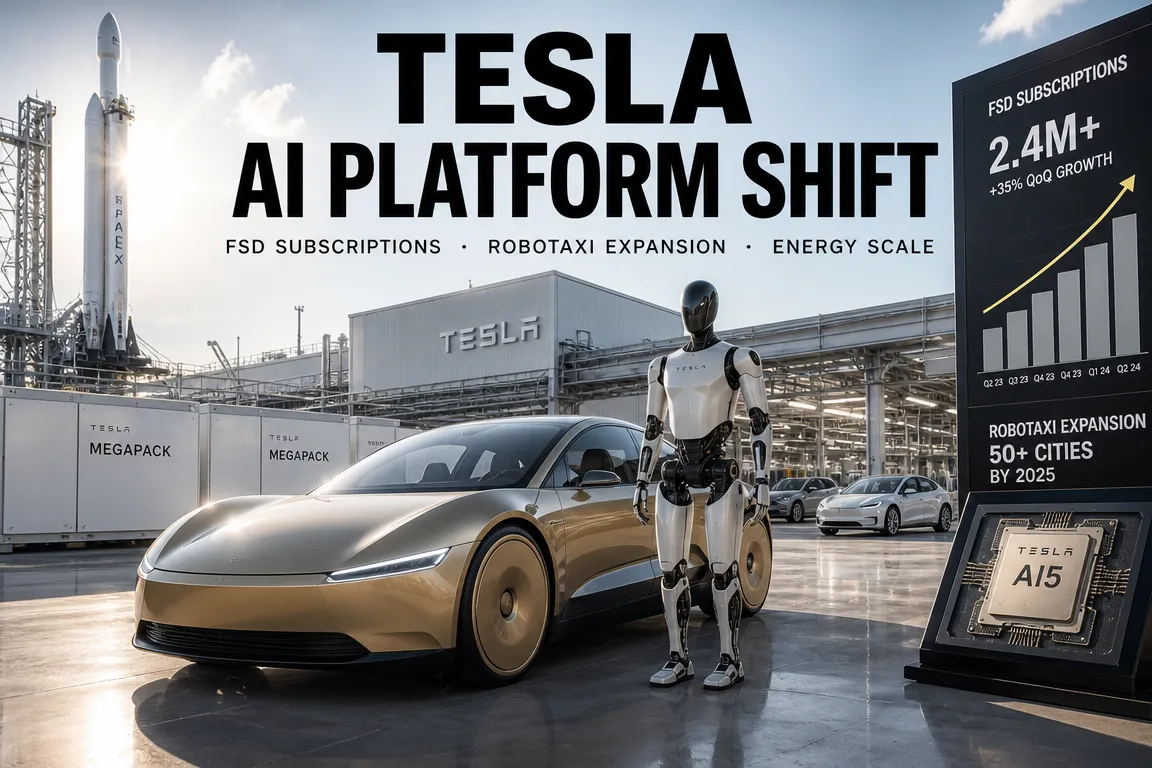
- Unsupervised FSD was referenced around Q2 2027.
- External sales of Optimus were referenced around late 2027.
- Investors now want verifiable near-term numbers rather than future vision.
Tesla still has a large story around autonomy, robotics, and AI infrastructure.
But the market is currently asking, “What do the numbers show this quarter?”
That gap is increasing volatility.
9. The SpaceX-Tesla Merger Rumor: Expectations Must Be Balanced with Verification
The source material also mentioned the possibility of a SpaceX-Tesla merger.
It stated that Elon Musk supported the idea and that both boards had formed special committees.
This should be treated cautiously.
SpaceX is a private strategic asset, while Tesla is a public company.
Valuation, shareholder alignment, regulation, business structure, and Musk’s control dynamics would all be involved.
If such a merger were to proceed, it could be a major catalyst.
The combination of Tesla’s AI, robotics, battery, and manufacturing capabilities with SpaceX’s space infrastructure, satellite communications, and compute potential would be significant.
However, the practical hurdles are substantial.
Accordingly, this should be viewed as a high-volatility event rather than a confirmed corporate action.
10. Lam Research Earnings: The Issue Was Supply Chain, Not Demand
Lam Research is a critical supplier of etch and deposition equipment used in semiconductor manufacturing.
If ASML is the leading name in lithography, Lam Research is a key barometer for broader semiconductor equipment investment.
Lam Research’s reported results were strong.
Revenue and EPS both exceeded expectations in the source material.
The issue was the next-quarter outlook.
Forward guidance for revenue and adjusted EPS came in slightly below market expectations.
As a result, investors worried about a slowdown in the semiconductor equipment cycle.
However, the company’s explanation was different.
The issue was not weak demand, but delayed shipments caused by component shortages.
Orders that could not be shipped in December may be deferred to March of next year.
- Semiconductor equipment demand was still described as solid.
- Supply partners were said to be operating at full capacity, creating production constraints.
- Shipment delays lowered near-term guidance.
- The market reacted more to the numbers than to the explanation.
Semiconductor investors should pay close attention to this distinction.
A guidance cut driven by demand weakness is very different from one driven by supply bottlenecks.
In this case, the source material points more toward supply-chain constraints than toward a collapse in demand.
11. The Market’s Real Problem: “Good Stories” Are No Longer Enough; Immediate Numbers Are Required
The market is moving beyond the phase in which AI narratives alone could support valuations.
In 2023 and 2024, AI alone was often enough to drive multiple expansion.
That is no longer the case.
Investors are now asking:
- How quickly does AI investment translate into revenue?
- How much does AI capex reduce free cash flow?
- Do AI app users convert into actual purchases and ad revenue?
- Is lower guidance from semiconductor equipment companies caused by demand or supply?
- When will autonomy and robotics begin to show up in reported revenue?
Companies that cannot answer these questions clearly may see share price volatility even if headline fundamentals remain intact.
This correction in the Nasdaq is therefore better understood as a mid-cycle review of AI investment rather than the end of the AI theme.
12. Claude AI Agent Launch: AI App Competition Is Shifting Toward Agents
The source material also referenced the launch of Claude’s AI agent.
It appears to be available through a waiting list, so access may remain limited for now.
Claude’s positioning is notable.
It may offer a more affordable alternative to OpenAI while remaining a paid rather than fully free product.
That suggests three broad models in the AI agent market:
- OpenAI, targeting the high-performance paid agent segment.
- Claude, targeting a more cost-effective productivity-oriented segment.
- Meta’s Muse, targeting mass adoption through a free or ecosystem-based model.
The competition is not only about model quality.
Pricing, distribution, installed user base, commerce integration, and task automation capability all matter.
13. Grok Bot Growth: The X Ecosystem Has Entered the AI Agent Race
The source material also indicated that X’s Grok Bot is gaining usefulness.
It was said to have reached around 800,000 weekly or daily active users.
Grok’s advantage is its connection to X as a real-time information platform.
If an AI agent can incorporate live sentiment and news flow rather than simply summarize documents, its utility increases.
That said, Grok still needs to prove retention and monetization.
In the AI agent market, repeat usage matters more than downloads.
14. AI Security Risk: PHP Vulnerabilities and the Cybersecurity Opportunity
One of the most important warnings in the source material concerns AI-driven hacking and vulnerability discovery.
PHP and other legacy web technologies were specifically mentioned.
PHP was widely used in earlier web development.
The problem is that there are still enormous numbers of older websites and legacy systems in operation.
If AI improves both vulnerability discovery and attack automation, the frequency of security incidents could rise.
This creates two implications.
- For companies, AI-era cybersecurity spending may rise structurally.
- For investors, cybersecurity firms may benefit from a new source of demand.
AI can increase productivity for both defenders and attackers.
As a result, cybersecurity spending is likely to rise alongside broader AI infrastructure investment.
15. The Key Point Often Missed Elsewhere: The Market Is Not Questioning AI Itself, but AI Accounting
The most important takeaway is this.
The market is not rejecting AI demand.
GPU shortages, AI app growth, stronger ad efficiency, and cloud compute demand all indicate that AI demand remains firm.
What the market is now questioning is whether AI can be validated through the income statement and cash flow statement.
- When will AI revenue scale meaningfully?
- How long will AI capex remain elevated?
- How much will depreciation and power costs pressure margins?
- Will AI app users convert into paid activity?
- Can data center investments truly be recovered within six months to one year?
Companies that can answer these questions are more likely to be rewarded.
Those that cannot may remain under pressure.
Accordingly, the next phase of AI investing is not simply about owning AI-related stocks, but about selecting companies that can prove the return on AI investment.
16. Investment Takeaways: What to Monitor
- For Meta, focus on Muse’s commerce conversion rate and advertising efficiency rather than capex concerns alone.
- For Tesla, near-term auto margins and FSD commercialization progress matter more than post-2027 projects.
- For Lam Research, continue to distinguish between demand softness and supply-chain bottlenecks behind guidance cuts.
- For AI cloud companies, debt structure and data center utilization matter more than revenue growth alone.
- For AI agent companies, retention and paid conversion are more important than downloads.
- Cybersecurity companies may emerge as another beneficiary of AI expansion.
Volatility remains elevated, but not all signals are negative.
AI demand is still strong; the key issue is which companies can convert that demand into profit most efficiently.
As the Nasdaq weakens, investors should focus more closely on company-specific execution, semiconductor supply chains, and AI investment efficiency.
< Summary >
U.S. equities are weakening despite AI-related tailwinds.
The reason is not a collapse in AI demand, but the market’s concern over how quickly AI investment can translate into cash flow and profitability.
Meta has strong advertising fundamentals and Muse growth, but AI capex is weighing on sentiment.
Tesla is facing skepticism as reduced capex raises questions about its AI roadmap.
Lam Research delivered strong results, but supply-chain bottlenecks lowered guidance and were interpreted negatively by the market.
Claude, Grok, and Muse indicate that AI agent competition is intensifying.
AI adoption is also increasing cybersecurity risk, which may support demand for security solutions.
Overall, this is better understood as a phase of AI return-on-investment validation rather than an AI bubble collapse.
[Related Articles…]
- Key U.S. Market Indicators to Watch During a Nasdaq Correction
- AI Semiconductor Cycle and Big Tech Capex Outlook
*Source: [ 내일은 투자왕 – 김단테 ]
– 진퇴양난에 빠진 미국 증시
● AI Rout, Oil Shock, Bond Spike
Meta and Tesla Earnings Shock AI Stocks Lower, While Brent Crude Breaks Above $112 and French Bond Yields Surge
Today’s market theme is broader than a simple selloff in technology shares.
Meta fell because it is spending too aggressively on AI, while Tesla declined because its AI and robotics spending was seen as insufficient.
At the same time, the Brent crude price moved above $112 amid Middle East escalation, and French sovereign yields surged past U.S. Treasury yields in an unusual move.
Japanese institutional investors are also increasing sales of long-duration overseas bonds, adding another important variable for global bond markets and U.S. equities.
In short, markets are now facing a compound shock from AI spending pressure, renewed inflation risk, bond yield volatility, and geopolitical risk.
1. Pre-Open and Intraday Market Action: Broad Declines Led by AI and Semiconductor Stocks
On October 22, U.S. equities showed a strong risk-off tone.
S&P 500 futures fell by nearly 1%, while Nasdaq 100 futures dropped by more than 1.7%.
Dow futures were also weaker, and the Russell 2000, which tracks smaller companies, also opened lower.
The VIX index rose into the high 18s, reflecting increased volatility.
The decline was concentrated in AI-related and semiconductor names.
Nvidia, TSMC, Broadcom, Micron, AMD, Intel, and SK Hynix all fell in tandem.
AMD and Intel dropped more than 5%, while SK Hynix fell by more than 3%.
Lam Research, a semiconductor equipment maker, sold off by 8% to 10% after its guidance failed to meet investor expectations.
Apple held up relatively well.
The reason is straightforward.
Apple faces a much smaller burden from AI infrastructure spending, including data centers and AI semiconductor capex, than Meta, Alphabet, or Amazon.
The market is currently rewarding companies that use AI efficiently rather than those that spend the most on AI.
2. Meta Earnings: Strong Revenue, but AI Investment Pressure Weighed on the Stock
Meta’s third-quarter 2026 revenue came in at $64.6 billion, above market expectations.
Advertising remained strong across Facebook and Instagram.
Third-quarter ad revenue reached $63.1 billion, up 26% year over year.
The main issue was costs.
Operating income fell 37% from a year earlier.
This included a $9.9 billion charge related to a settlement in a teen mental health lawsuit.
Excluding that item, operating income would have been $22.9 billion, or 11% higher year over year.
The core business has not weakened materially.
Even so, the stock declined because of AI investment intensity.
Meta spent $34.9 billion on capex in the third quarter alone.
Full-year capex guidance was raised to $135 billion to $145 billion, with the low end lifted by $5 billion.
The company continues to commit substantial capital to AI data centers, in-house AI chips, and large-scale compute infrastructure.
As a result, free cash flow turned negative by $2.1 billion.
Revenue remains strong, but cash generation has deteriorated.
This is a key concern for investors.
3. Meta Earnings Call: AI Assistant “Muse” Is Growing, but Compute Costs Remain a Constraint
Meta’s new AI service, “Muse,” surpassed 10 million users in the U.S. and Canada within six weeks of launch.
User adoption has been rapid.
Muse is designed to assist with shopping, travel planning, and other AI assistant tasks.
CEO Mark Zuckerberg identified compute cost as the main bottleneck.
He said Meta aims to improve compute efficiency by more than 10 times within the next year.
The competitive focus in AI is shifting from model quality alone to the economics of operating those models.
The monetization plan is becoming clearer.
Zuckerberg said Muse will likely be monetized faster than Facebook or Instagram.
More than 25% of Muse users are already using the service for shopping, and the company may eventually add transaction fees and premium subscription pricing.
Another important item was the introduction of Class C shares.
Meta announced plans to issue non-voting Class C shares to existing shareholders.
The market views this as functionally equivalent to a 2-for-1 stock split.
It is also seen as a structure that preserves Zuckerberg’s control while providing flexibility for future AI funding or acquisitions.
4. Meta’s Legal Risk: A $25 Billion Penalty Also Emerges
Meta faces more than just AI spending pressure.
A New Mexico court imposed a $25 billion penalty on the company in connection with the Cambridge Analytica data privacy case.
Meta plans to appeal, and the final amount remains uncertain.
Importantly, the $25 billion penalty is separate from the previously mentioned $9.9 billion legal cost.
Meta is therefore dealing simultaneously with revenue growth and AI expansion on one side, and capex pressure plus legal risk on the other.
5. Tesla Earnings: EPS Beat, but Profitability Fell Sharply
Tesla reported third-quarter adjusted EPS of 48 cents, above the market estimate of 45 cents.
Revenue was $28.0 billion, roughly flat year over year.
Vehicle deliveries exceeded 486,000 units, showing some recovery.
However, profitability weakened sharply.
Operating income fell 56% year over year.
Operating margin declined from 5.8% to 2.6%.
Higher AI and robotics development costs, lower carbon credit revenue, and weaker energy business profitability all contributed.
R&D spending rose by roughly 70% year over year.
The market has been pricing Tesla as more than an EV company, with expectations centered on robotaxis, Optimus, and in-house AI chips.
However, the rapid decline in current profitability and a softer pace of future project spending have made investors more cautious.
6. Why Tesla Fell: The Market Was Concerned Not That It Spent Too Much, but That It Spent Too Little
Tesla lowered its 2026 capex outlook from $25 billion to $20 billion.
That is a reduction of $5 billion.
Normally, lower capex would support cash flow.
Indeed, the market had expected a $4.5 billion cash outflow, but Tesla reported a $1.5 billion cash inflow.
The market did not view this positively.
The improvement was interpreted as the result of reduced investment.
Robotaxi, Optimus, and in-house AI chip development all require substantial capital.
A lower capex outlook signaled that some future growth projects could be delayed.
In other words, Meta fell because it is spending too much on AI, while Tesla fell because it is not spending enough on AI and robotics relative to expectations.
This was the most notable takeaway from the U.S. market session.
The AI investment cycle is moving beyond narrative and into a phase where investors are focused on how much is spent and when returns will arrive.
7. Tesla Earnings Call: No Mention of a SpaceX Merger, but Chip Vertical Integration Was Clarified
There was no direct mention of a possible merger with SpaceX during Tesla’s earnings call.
Questions on the topic were not entertained.
However, the call did include details showing how closely the two companies are linked.
That involved a large-scale semiconductor manufacturing project pursued by Tesla and SpaceX.
Tesla needs AI chips for autonomous vehicles and humanoid robots.
SpaceX needs semiconductors for space AI computing.
That is why both companies are working toward chip vertical integration.
Elon Musk said the project will require tens of billions of dollars by early 2028, with long-term spending potentially reaching $100 billion.
That is more than KRW 130 trillion.
Tesla is already building its first research chip plant and has largely placed the necessary equipment orders.
It is still unclear how future costs will be shared between Tesla and SpaceX.
8. Robotaxi, FSD, and Optimus: Strong Expectations, but Profitability Has Yet to Be Proven
Tesla has begun real customer operations in Austin, Texas, with its two-seat autonomous taxi vehicle, the Cybercab, which has no steering wheel or pedals.
Service is currently operating in Austin, with expansion to Dallas planned for next month.
Musk said robotaxis should contribute more meaningfully to results starting next quarter, and that the business could reach a meaningful scale in Q3 or Q4 next year.
However, Tesla has not disclosed the economics per mile, the scale required for profitability, or the operating cost structure.
For investors, the key issue is not how many robotaxis are deployed, but whether the model can generate profits.
FSD subscription trends were more favorable.
Global paying subscribers exceeded 1.7 million.
In North America, more than 75% of new deliveries in the third quarter opted for FSD at delivery.
The CFO effectively confirmed that annual recurring revenue from FSD is approaching $1 billion.
This reinforces Tesla’s software monetization potential beyond vehicle sales.
The company reiterated its goal of unveiling the Optimus humanoid robot to external customers by the end of next year.
Musk said the hardest technical challenge remains the dexterity of hands and fingers.
This underscores how difficult it remains for robots to perform small-object handling and repetitive industrial tasks with human-like precision.
Tesla also plans to deploy the AI5 chip next April, which will have 10 times the compute capability of the current version, and has begun construction of a new robot factory in Austin.
9. Crude Oil Surges: Brent Breaks $112, Driven More by Transport Risk Than by Supply Loss
Brent crude rose above $112 intraday.
WTI approached $100.
Middle East escalation and reports of tanker attacks near the Strait of Hormuz pushed global oil prices higher.
Saudi Aramco’s Shaybah oil field was attacked.
The field has production capacity of 1 million barrels per day.
However, there were no major disruptions to actual output.
Iran’s Revolutionary Guard claimed responsibility for attacks on several tankers near the Strait of Hormuz, and some vessels reportedly caught fire.
The key point is that regional crude exports have recovered above pre-war levels.
Oil exports from the Middle East excluding Iran have returned to around 24.6 million barrels per day.
Even so, prices are rising because the issue is transport risk rather than output loss.
Higher risk of tanker attacks is pushing up freight and insurance costs.
If crude can be produced but not safely delivered, prices will reflect that risk premium.
This is being reinforced by stronger Chinese imports.
China’s crude imports have increased by about 3 million barrels per day from the June low.
Seasonal demand for heating oil in the U.S. and Europe may also rise.
As a result, supply uncertainty, higher transport costs, recovering Chinese demand, and winter consumption are all supporting oil prices.
10. Why $112 Brent Matters: Inflation and Fed Rate Pressure Could Reaccelerate
Brent at $112 is more than a commodity move.
If oil remains near this level, inflationary pressure could build again.
Transport costs, jet fuel, diesel, and heating oil would likely rise together, potentially feeding into consumer price indices.
With the next FOMC meeting approaching, markets must reassess the Fed’s policy path.
Technology stocks are already under pressure from AI spending concerns, and higher oil prices add another inflation risk to valuations.
If oil rises, expectations for rate cuts may weaken.
11. French Sovereign Yields Rise Above U.S. Treasury Yields: European Fiscal Risk Returns
France’s 10-year government bond yield rose to as high as 5.11% intraday.
That was the highest level since 2002.
More importantly, France’s 10-year yield moved above the comparable U.S. Treasury yield for the first time since 2013.
The spread between German and French government bond yields widened to 174 bps.
That is the largest since the 2011 European debt crisis.
Investors are demanding a higher risk premium to hold French debt.
The background is France’s fiscal stress.
The government is trying to reduce the budget deficit through austerity measures, but the proposals are being repeatedly rejected in parliament.
According to UBS, a planned EUR 10 billion deficit reduction effort has already been disrupted.
Investors had expected austerity measures to pass eventually, but repeated blockages to spending cuts have raised doubts about the government’s fiscal repair plan.
France’s parliament is currently reviewing the social security budget.
The key issue is how much pension and healthcare spending can be restrained.
Limits on pension increases are facing strong political resistance.
If additional austerity measures are rejected again, pressure on French bonds could intensify further.
12. U.S. Yields Fall While French Yields Rise: The Market Is Sending Two Very Different Signals
The bond market showed a clear divergence today.
In the U.S., AI spending concerns and falling equities drove demand for safe-haven assets, bringing in buyers of Treasuries.
As a result, the U.S. 10-year yield declined to the low 5% range.
In France, by contrast, fiscal concerns led to bond selling and higher yields.
U.S. Treasuries functioned as a safe haven, while French bonds were treated more like risk assets.
This divergence could have implications for European financial markets and the euro.
13. Japanese Institutional Selling of Overseas Long Bonds: Not Yet a Full Carry Trade Unwind, but a Risk to Watch
Japanese investors have sold overseas bonds for five consecutive weeks.
That is the longest such streak in four years.
Net sales over the past five weeks totaled JPY 3.43 trillion.
The background is rising Japanese yields.
Japan’s 10-year government bond yield recently exceeded 3%, the highest in 30 years.
In the past, very low Japanese rates encouraged capital to move abroad into U.S. Treasuries and other foreign bonds.
Now that Japanese bonds offer meaningful yield, investors have less incentive to hold long-duration overseas debt.
However, this should not yet be viewed as a full unwind of the yen carry trade.
Japanese banks have been selling foreign bonds, but foreign equities were still bought in five of the last six weeks.
In addition, large long-term investors such as life insurers and pension funds have not yet begun broad-based foreign bond selling.
In other words, the current move is better described as a reduction in overseas long-bond exposure by Japanese banks, rather than a full capital repatriation.
If life insurers and pension funds join the trend, the impact on global bond yields, U.S. equities, and Korean markets could be larger.
14. Why the Yen Did Not Strengthen Despite Overseas Bond Sales
Even though Japanese investors sold overseas bonds, the yen recently weakened instead.
It moved from the mid-154 range to the upper-158 range versus the dollar.
Today the yen did strengthen modestly, but recent trends show that foreign bond sales do not automatically translate into yen appreciation.
There are three reasons.
First, selling foreign bonds does not necessarily mean buying yen.
Proceeds from U.S. bonds can remain in dollars or be reinvested in other dollar assets, including foreign equities.
Second, the yield gap between the U.S. and Japan remains wide.
Even with rising Japanese yields, U.S. yields remain higher, which still supports dollar asset holdings for investors without currency hedging.
Third, major Japanese long-term investors have not yet fully returned.
Without life insurers and pension funds participating, upward pressure on the yen may remain limited.
15. Implications for Korea: Semiconductor Stocks, the Won, and Bond Yields Are All Connected
Other Asian markets also fell sharply today.
The KOSPI declined by about 3%, and the Nikkei fell by more than 2%.
Samsung Electronics and SK Hynix were pressured alongside global AI and semiconductor names.
Three factors matter most for the Korean market.
First, if U.S. tech and semiconductor weakness continues, foreign capital inflows could slow.
Second, higher oil prices could lift inflation expectations and add pressure to Korean bond yields.
Third, if Japanese investors continue reducing overseas assets, global risk assets could face broader capital outflows.
The won is also affected by multiple crosscurrents.
If Japanese capital returns and the yen strengthens, the won may strengthen alongside it.
But if global risk aversion deepens, the yen could gain as a safe haven while the won weakens, pushing USD/KRW higher.
The key is not to treat yen strength as automatically positive for the won; risk appetite must also be considered.
16. Barclays to Cut 5,000 Jobs: AI Productivity Gains Are Now Affecting Employment
Barclays announced plans to cut about 5,000 jobs, citing productivity gains from AI adoption.
That is roughly 5% of its workforce.
The reduction will include some software developers.
The bank recently expanded its partnership with Anthropic and said it would require all developers to use the AI coding tool Claude Code by year-end.
The job cuts were announced after the company said AI had increased employee productivity enough to support a smaller workforce.
Importantly, Barclays’ results were not weak.
Third-quarter pre-tax profit rose 12% year over year to GBP 2.3 billion.
This is not a layoff driven by weak earnings, but by productivity gains from AI.
This trend could extend to other financial firms, IT companies, consulting firms, and software companies.
AI appears increasingly likely to support margins while creating pressure in labor markets.
17. The Most Important Points Hidden in the Broader News Flow
First, the market’s assessment of the AI cycle is changing.
Earlier this year, investors were willing to assign high valuations simply because a company was “doing AI.”
That is no longer the case.
Heavy spending now raises concerns about cash flow, while lighter spending raises concerns about slower future growth.
The standards for AI investment have become much stricter.
Second, the recent oil rally is driven primarily by logistics risk rather than a loss of supply.
Middle East exports have recovered.
But tanker attack risk, higher insurance premiums, and freight costs are pushing prices higher.
That premium may persist as long as the conflict remains unresolved.
Third, the rise in French bond yields is not just a European issue; it is also a test of global bond market confidence.
The fact that French yields are now above U.S. yields shows how seriously investors are treating French fiscal risk.
Because this is happening in a core European economy, it creates pressure for the euro and global rates.
Fourth, Japanese overseas bond sales are still limited, but the real risk comes if life insurers and pension funds join in.
Bank-led selling can be absorbed by markets.
But if major Japanese institutions cut foreign bonds more broadly, that could push up U.S. long-term yields, pressure tech valuations, and trigger foreign selling in Korea.
Fifth, AI is now showing up in labor market data.
The Barclays case is a clear example of AI productivity gains leading directly to layoffs.
As more companies report that AI is reducing costs, concerns about labor-market softness and weaker consumption may also rise.
18. Key Variables Investors Should Monitor Next
First, watch whether Brent remains above $110.
If oil stays elevated, inflation and Fed policy expectations will face pressure.
Second, focus on capex and free cash flow in upcoming mega-cap tech earnings, especially after Meta and Tesla.
The key issue is not revenue alone, but the pace of monetization relative to AI investment.
Third, monitor the French budget process.
If additional austerity measures are rejected, French bond yields could become even more volatile.
Fourth, watch for further foreign bond selling by Japanese life insurers and pension funds.
If the trend extends beyond banks, the impact on global bond markets could be much larger.
Fifth, determine whether the semiconductor pullback is simply a short-term correction or the beginning of a slower AI investment cycle.
JPMorgan sees selective buying opportunities in memory and semiconductors, rather than a broad bearish call on technology.
Even so, investors should focus on earnings, demand, capex, and cash flow rather than treating this as a simple dip-buying opportunity.
< Summary >
Meta fell due to AI spending pressure and legal risk.
Tesla declined despite an EPS beat because of weaker margins and concerns about reduced capex.
Brent crude moved above $112 on Middle East escalation and tanker transport risk.
France’s 10-year yield rose above U.S. Treasury yields because of fiscal concerns.
Japanese institutional investors sold overseas long bonds for a fifth consecutive week, but this is not yet a full carry trade unwind.
Barclays announced 5,000 layoffs, showing that AI-driven productivity gains are now affecting employment.
The main market issue is no longer AI enthusiasm, but the need to assess AI capex, cash flow, inflation, bond yields, and geopolitical risk at the same time.
[Related Articles…]
- AI Spending Pressure and Big Tech Cash Flow Review
- How Surging Oil Prices Affect Inflation and Rates
*Source: [ Maeil Business Newspaper ]
– 메타·테슬라 실적에 AI주 급락|중동 확전·유가 112달러 돌파|프랑스 국채금리 미국 추월, 왜?|일본 기관투자자 해외 장기채 매도 확대|어닝콜 집중분석|홍혜진의 뉴욕브리핑