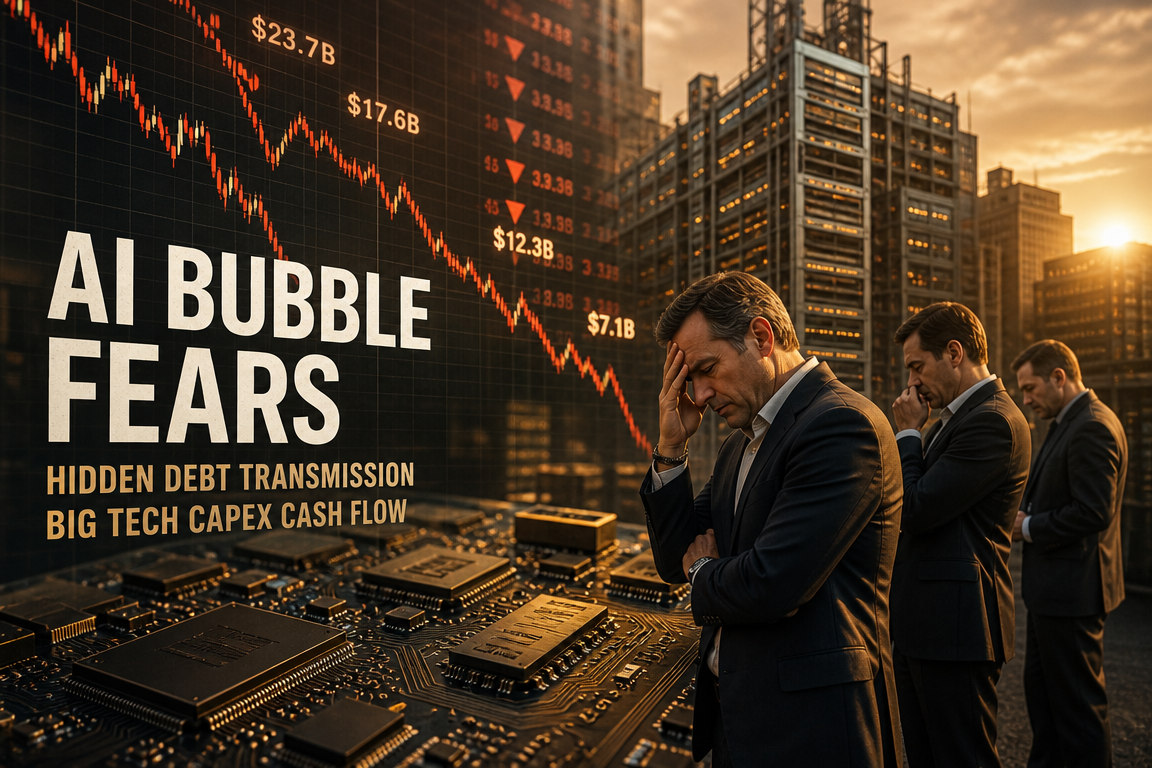
● AI Bubble Fears
AI Bubble Collapse Warning: Now We Need to Look at the “Transmission Path” More Than the “Possibility”
What matters more than whether the artificial intelligence bubble can really burst is where the shock spreads first.
Will it end with a stock market plunge, turn into a credit crunch, or shake Korea’s semiconductors, power supply, exchange rate, and growth rate?
At this point, we need to look at those links.
In today’s discussion, I will summarize
why overheated AI investment is leading to bubble concerns,
why the gap between Big Tech capital expenditure and cash flow is a warning signal,
how hidden debt and circular financing can pressure the financial system,
and why the Korean economy should not treat this issue as someone else’s news.
1. What Is Happening in the AI Market Right Now?
AI Is an Innovation, but Its Investment Structure Has Already Entered an Overheated Phase
Since the Industrial Revolution, almost every major technological shift has brought both an investment boom and a bubble collapse.
AI is unlikely to be an exception.
The issue is that AI is not just an IT topic.
It is an extremely capital-intensive industry that connects semiconductors, data centers, power, cloud computing, finance, and the bond market all at once.
In other words, AI is both a “technology race” and a “money race.”
Today’s market is moving in a direction that prioritizes preemption over profitability, scale over efficiency, and speed over verification.
This is a pattern that appears very often when bubbles form.
The Core Point Is That Winner-Takes-All Expectations Are Driving an Investment Surge
Hyperscalers such as Alphabet, Microsoft, Meta, Amazon, and Oracle are acting under pressure from the belief that only one player may ultimately survive and take the entire market.
On top of that, AI is increasingly being treated like a national security asset, making it even harder to stop investment.
In short,
the fear of “falling behind if we do not spend now” is pushing investment decisions forward.
2. Why Are Bubble Warnings Growing?
Stock Market Indicators Are Already Pointing to a Danger Zone
Warnings continue to emerge that the U.S. market has moved beyond a simple overvaluation phase.
For example, the Shiller CAPE ratio is around 41, very close to the peak seen just before the dot-com bubble burst.
The Buffett Indicator has also risen to around 240%, showing a clear sign of overheating.
What these numbers mean is simple.
Expectations are running far ahead of actual earnings.
In other words, current prices already reflect a large amount of “massive future success.”
The Market’s Pricing Response Is No Longer the Same as Before
Funding markets are already showing signs of instability.
Subscription demand for AI corporate bonds has weakened compared with the past, and some data center-related bonds have been issued at yields above 7%.
Credit default swap spreads are also rising rapidly.
This means the market is saying, in numbers, “This is becoming risky.”
Looking only at stock prices gives only half the picture.
Bonds, CDS, leases, and private equity fund flows must also be examined together.
3. The Real Risk Is the Divergence Between Surging Capital Expenditure and Cash Flow
The Nature of the AI Boom Is a Structure Where Money Goes Out Before Money Comes In
As of August, the 2026 capital expenditure plans of the five major Big Tech companies totaled $796 billion, up 64% from the beginning of the year.
However, cash flow growth over the same period has not kept pace with the increase in investment.
Simply put,
they are spending money faster than they are earning it.
The reason this pattern is dangerous is that it may look like growth on the surface, while internally cash capacity can weaken rapidly.
When Free Cash Flow Shrinks, Dependence on Debt Increases
It is true that Big Tech companies have traditionally held large amounts of cash.
But the pace of investment growth is now so fast that free cash flow is heading toward the floor.
As a result, corporate bond issuance is increasing, and the investment-grade bond market is becoming a key channel for AI financing.
The problem does not end there.
Debt is moving deeper into structures that do not appear clearly on balance sheets.
4. The Most Important Point Rarely Covered in Other News: “Hidden Debt”
Debt That Is Not Visible Can Be More Dangerous Than Debt That Is Visible
The most important point in this issue is not a simple stock market bubble.
It is shadow debt accumulated through special purpose vehicles, leases, guarantees, and private equity structures.
Because this debt does not appear cleanly on financial statements, companies can look healthy on the surface.
But when a crisis arrives, this hidden debt can return as pressure all at once.
The Structure of Moving Data Centers Off the Balance Sheet Is the Problem
A representative workaround structure is one in which technology companies and private equity firms establish special purpose vehicles, raise funds, build data centers, and then lease them back to the parent companies.
This method can make financial soundness look better in the short term, but in reality it is similar to moving debt outside the company.
In addition, unopened lease commitments for data centers that have been contracted but are not yet available for use are also accumulating massively.
These commitments can later return as cash flow burdens.
Circular Financing Is the Hidden Link in the AI Bubble
A structure in which GPU suppliers such as Nvidia provide funding to AI companies or cloud companies, and those companies then use that money to buy the supplier’s own semiconductors, is risky.
On the surface, this may look like investment, but in reality it is closer to circular financing in which money keeps circulating among the same parties.
As this structure grows, the portion of the market sustained by financial circulation rather than real demand increases.
Bubbles often grow precisely in these areas.
5. Why This Can Spread Across the Entire Financial System
Even If Direct Lending Is Small, Indirect Exposure Is Large
Some argue that “because bank lending exposure is low, this is not a systemic crisis.”
On the surface, that statement is correct.
But the actual risk looks completely different when funds provided by banks, major life insurers, and pension funds to private equity vehicles for data center investment are included.
Some estimates suggest this amount exceeds $1 trillion.
In other words, even if direct lending from banks is small, the broader financial system is already connected to the issue.
If It Turns Into a Credit Crunch, the Story Changes
If the bubble ends simply with a stock price plunge, the shock may be limited.
But if funding becomes blocked, the corporate bond market freezes, and refinancing becomes difficult, the situation changes.
From that point, a credit crunch can lead to an economic recession.
This is the path somewhere between a 2008-style crisis and the dot-com bubble.
6. Why the Argument That “This Time Is Different” Is Not Completely Wrong
Big Tech Is Not the Same as the Weak Companies of the Dot-Com Era
Clearly, this AI boom is not exactly the same as the late 1990s.
Today’s Big Tech companies already have earnings, and their cash generation capabilities have been proven.
They also have reliable revenue engines such as advertising, cloud computing, search, and platform businesses.
So the argument that “this is different from the dot-com companies that had no revenue” has some validity.
But the Same Condition Still Applies: Monetization Must Keep Up With the Pace of Investment
The problem is sustainability.
AI capital expenditure is still moving fast, while actual cash inflows are slower.
As Panmure Liberum’s calculations suggest, to justify the current level of investment, Big Tech would need to multiply revenue several times without increasing costs.
That is not easy.
Data centers in particular do not become profitable immediately after they are built, so the longer the delay between operation and monetization becomes, the larger the burden grows.
7. The Real Criteria That Will Determine the Direction of the AI Bubble
The Key Takeaway Is the Balance Between Capital Expenditure and Free Cash Flow
The most important factor in judging the future direction of the AI market is not technological capability or novelty.
The core point is whether cash flow can keep up with the pace of capital expenditure growth.
If this gap cannot be closed quickly, investment expansion will soon become a financial burden.
Conversely, if the gap narrows and investment connects to real revenue, bubble concerns may ease.
Now Is the Time to Verify Profitability
AI may indeed change the world.
But not every AI investment will turn into profit.
Therefore, going forward, the more important standard will not be “how much AI has been adopted,” but “which companies have monetized AI.”
Without this perspective, it is easy to confuse bubbles with innovation.
8. What Does This Mean for the Korean Economy?
Korea Is a Beneficiary of the AI Investment Cycle, but It Is Also Vulnerable
Korea is receiving significant benefits from the current AI investment boom.
Memory semiconductors, power equipment, energy storage systems, optical communications, server components, and several other industries are connected to data center investment.
The fact that semiconductor exports in the first half of the year have already exceeded last year’s total exports clearly shows this trend.
The semiconductor boom is also an important support for domestic growth, the current account balance, and exchange rate stability.
But If the U.S. Cycle Turns Down, Korea Could Be Shaken Even More Severely
Korea’s domestic demand remains weak.
Therefore, if the U.S. AI bubble bursts, both semiconductor demand and prices may be hit at the same time.
In that case, the Korean economy could be affected broadly across exports, investment, employment, and tax revenue.
The transmission force of the shock is especially large because semiconductors play a role similar to one of the core pillars of the Korean economy.
Korean Companies and the Government Must Also Prepare Different Scenarios
It is risky to build plans only on the assumption that AI investment will continue as it is now.
Downside scenarios that reflect the possibility of a bubble collapse should also be included in plans for semiconductor fabs, power supply, and infrastructure investment.
This is not pessimism.
It is risk management.
Preparing now is exactly what can reduce the shock later.
9. The Most Important Conclusion of This Article
What Matters More Than Whether AI Is a Bubble Is How Far Debt Has Spread
Many people look at the AI bubble only at the level of “have stock prices risen too much?”
But the real core point is how complex and interconnected the financing structure has become.
When special purpose vehicles, leases, guarantees, private equity lending, and circular financing are combined, markets can become unstable faster than expected.
In other words, the essence of this potential crisis is not the failure of technology, but the accumulated fatigue of capital structures.
And Korea Is One of the Countries That Must Prepare for This Issue Most Realistically
Korea may become a victim of the AI bubble, but it is also a beneficiary of the semiconductor boom.
That is exactly why scenario-based responses are necessary.
It is dangerous to believe in only one side.
This is a moment that requires a balanced perspective: enjoy the boom, but also prepare for the possibility of collapse.
The AI investment boom is not just a technology race, but a complex risk involving capital expenditure, corporate bonds, hidden debt, and circular financing.
The most important issue now is not stock prices, but Big Tech cash flow and debt structures.
Korea is benefiting from the semiconductor boom, but if the U.S. AI bubble bursts, it could be among the first to feel the impact, making scenario-based preparation necessary.
[Related Articles…]
- AI Investment Overheating: Bubble Warning Signals the Market Is Missing
- Semiconductor Boom and Data Center Expansion: The Real Impact on Korea
*Source: https://www.hani.co.kr/arti/economy/economy_general/1275398.html#ace04ou