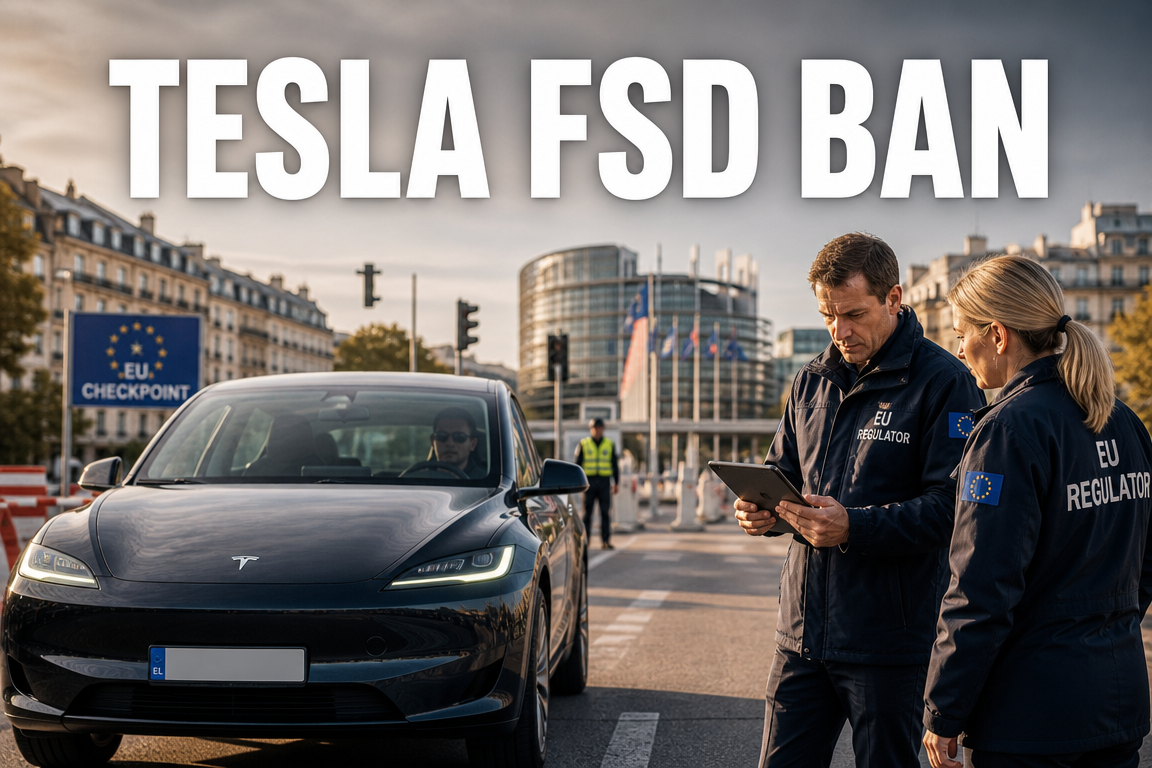
● Tesla FSD, Crushed by Korea Ban Shock
The Real Meaning of the Ministry of Land’s Statement That Tesla FSD Is “Not Compliant with Domestic Standards”
The key issue here is not simply whether FSD is legal or illegal.
It is important that the Ministry of Land, Infrastructure and Transport has now explicitly stated in writing that Tesla FSD does not comply with domestic vehicle safety standards. More important, however, is that Korea still lacks a formal review and exemption channel for approving highly advanced autonomous driving software such as FSD.
For investors, this controversy should not be viewed only as a domestic regulatory issue affecting Tesla’s stock or the EV market. It also connects to autonomous driving regulation, software revenue potential, robotaxi expectations, and the broader global macro outlook.
1. Today’s Market Move: Drivers Behind Tesla’s Share Price Decline
In the original report, Tesla closed at $356.09, down 3.2% for the day.
The main factor behind the decline was August vehicle registration data in Europe.
Vehicle registrations reflect the number of cars that have actually received license plates, making them a more direct indicator of real sales trends than order volume.
Tesla’s registration trends across major European markets diverged sharply by country.
- France: up 279% year over year
- Denmark: up 104% year over year
- Norway: down 79% year over year
- Sweden: down 41% year over year
France and Denmark showed a strong rebound, while Norway and Sweden posted sharp declines.
However, the key markets of the United Kingdom and Germany had not yet been included, so this data alone is insufficient to assess the broader European EV market.
There was also some profit-taking ahead of the Cybercab event.
Tesla shares often show elevated volatility around major product and strategy announcements, as expectations tend to be priced in ahead of time.
2. Rising Oil Prices Are Also Affecting the EV Market
The original report noted that Brent crude rose above $94 per barrel and gained more than 6% in a day due to geopolitical risks in the Middle East.
When oil prices rise, the operating cost burden for internal combustion vehicles increases, which can encourage European consumers to reconsider EV purchases.
Reuters also identified higher fuel costs as one factor supporting a recovery in European EV sales.
In other words, rising oil prices increase inflation pressure in the short term, but they can also support EV demand.
For investors, Tesla should be evaluated not only through sales data, but also through oil prices, interest rates, U.S. employment data, and consumer sentiment.
In particular, the U.S. jobs report affects expectations for Federal Reserve rate cuts, which in turn has a direct impact on Tesla’s valuation as a growth stock.
3. What the Ministry Meant by “FSD Not Compliant with Domestic Standards”
The core issue is that, in a response to a public petition, the Ministry of Land, Infrastructure and Transport said Tesla’s supervised FSD and FSD Version 14 Lite are not compliant with Korea’s vehicle safety standards.
The ministry cited Article 89 of the Automobile Regulations and Appendix 6-2, which relate to steering system requirements.
In practical terms, the issue is who controls the turn signal and who makes the lane-change decision.
Korean standards generally assume that the driver operates the turn signal directly.
Tesla FSD, however, can autonomously execute lane changes based on traffic conditions and navigation routes.
This is the specific point the ministry objected to.
The statement does not mean FSD was deemed dangerous because of accident frequency. Rather, it indicates that the current domestic regulatory framework is not aligned with how the software operates.
Accordingly, the term “not compliant” should be interpreted as an administrative determination that the software’s operating logic does not match existing legal language, rather than as a blanket safety judgment.
4. Do U.S.-Made Tesla Vehicles in Korea Face Any Immediate Issue?
Tesla owners in Korea using FSD in U.S.-made vehicles do not appear to face immediate restrictions or corrective orders.
According to the ministry’s response, U.S.-made vehicles are subject to an exception under the Korea-U.S. FTA mutual recognition framework.
In practical terms, even if the vehicle does not fully match Korean standards, U.S.-manufactured vehicles may still be recognized if they comply with U.S. standards.
This exception may apply to U.S.-made Model S, Model X, Cybertruck, and certain U.S.-made Model 3 and Model Y vehicles.
The original report stated that FSD Version 14 Lite deployed to U.S.-made Model 3 and Model Y vehicles with Hardware 3 is also within this exception range.
Importantly, the ministry did not mention any immediate corrective orders or usage bans for these vehicles.
The wording in the response is closer to an indication that post-market oversight will continue.
5. Why Is FSD Difficult to Use in China-Made Model 3 and Model Y Vehicles?
A significant share of Model 3 and Model Y vehicles sold in Korea are manufactured at Tesla’s Shanghai plant.
Although these vehicles are built on similar hardware and software architecture, FSD cannot be officially activated in Korea.
Some owners reportedly enabled FSD through unofficial methods, and the ministry previously requested a police investigation into unauthorized software installation.
From the owner’s perspective, the key question is obvious: if the hardware and software are the same, why is FSD permitted in U.S.-made vehicles but not in China-made ones?
The ministry’s position is that the issue is not country-of-origin discrimination, but rather differences in certification and approval channels.
However, a structural contradiction remains.
The ministry said it does not pre-verify FSD technology for either U.S.-made or China-made vehicles.
At the same time, U.S.-made vehicles are recognized through the Korea-U.S. FTA exception, while China-made vehicles remain constrained by the lack of a separate approval route.
Ultimately, the issue is less about technical validation and more about the existence of a formal administrative pathway.
6. The Larger Problem: Korea Has No Formal Entry Point for FSD Review
The most important point in this issue is that Korea does not yet have a formal system to evaluate and grant exemptions for advanced autonomous driving software such as FSD.
In Europe, there is a mechanism to review and conditionally approve technologies that do not fully comply with existing regulations.
By contrast, Korea currently appears to have only a limited exception pathway through the Korea-U.S. FTA for U.S.-made vehicles.
Vehicles made in China or other countries cannot easily use that pathway.
Therefore, the issue is not whether U.S.-made Tesla vehicles receive unfair preferential treatment. The real issue is when Korea will establish a formal review process for new autonomous driving technologies.
According to the ministry’s response, there is no separate policy study or dedicated task force currently underway.
It is attending international meetings, but there is no evidence of a formal Korean proposal or a concrete timeline for new guidance.
This suggests that Korea’s FSD approval issue is not a technology problem, but a matter of administrative timing and institutional design.
7. Europe Is Already Moving Through an FSD Exemption Process
Tesla has submitted safety evidence to regulators in Europe in pursuit of FSD approval.
According to the original report, the submission included 8 studies and 25 databases, along with more than 230,000 tests across six European cities covering traffic lights, roundabouts, pedestrian crossings, and other scenarios.
The overall pass rate reportedly exceeded 99%, with no critical safety incidents recorded.
However, the key point is not the numbers but the filing structure.
The document was submitted in the form of an “Article 39 Dashboard.”
Article 39 is a regulatory mechanism that allows exemptions for new technologies that do not fully fit existing rules.
In other words, Tesla was not claiming that FSD fully complies with current regulations. It was asking regulators to review the software as an exception to the existing framework.
This connects directly to the Korean ministry’s response.
Korea labeled the issue as non-compliance, while Tesla is asking Europe to resolve that non-compliance through exemption-based approval.
8. Why Tesla Included Unfavorable Data in Its European Filing
One notable detail in the original report is that Tesla included data that could be viewed as unfavorable.
In European residential streets, the automatic emergency braking activation rate for FSD was reported at 682.7 incidents per 1 million miles, compared with 653.6 incidents for human driving.
That implies FSD’s automatic emergency braking was triggered about 4.5% more often than human driving in that environment.
In practical terms, this may indicate that FSD responds more conservatively or more sensitively in certain road conditions.
Tesla’s disclosure strategy appears aimed at building trust with regulators.
Some regulators, including Norway’s road authority, have noted that the safety figures Tesla publishes on its website may differ from the data submitted to regulators.
Tesla therefore appears to be shifting toward greater transparency by disclosing both strengths and limitations.
9. Why the October 6 Vote in Europe Matters for Korea
According to the original report, the Netherlands first opened the door to FSD exemption approval, followed by Lithuania, Estonia, Denmark, and Belgium.
FSD is currently said to be officially usable in about five European countries, with more than 70,000 customers.
However, those five countries together account for less than 9% of Europe’s population.
Expansion across Europe requires a vote involving all 27 member states, and the original report cited October 6 as the key date.
This vote matters because Europe may become a global reference point for autonomous driving regulation.
Since the Korean ministry also stated that domestic standards will be operated in line with international standards, a successful European outcome would create both pressure and a reference case for Korea.
That does not mean approval in Europe would automatically lead to approval in Korea.
But it could become the most important benchmark for future Korean policy design.
10. Key Investment Points for Tesla Shareholders
Looking at Tesla only through vehicle sales can cause investors to miss the significance of the FSD issue.
Tesla’s long-term valuation reflects not only EV sales, but also expectations for FSD, robotaxi, Cybercab, and Optimus as software and AI businesses.
FSD, in particular, could generate recurring high-margin revenue after vehicle delivery.
For that reason, autonomous driving regulation is directly linked to Tesla’s margin outlook.
For investors, the ministry’s response is less a short-term negative than a case study in how governments may regulate FSD into the mainstream.
Key items to monitor include:
- The outcome of the FSD-related vote in Europe on October 6
- August Tesla registration figures in the United Kingdom and Germany
- Robotaxi strategy disclosed at the Cybercab event
- Changes in U.S. employment data and rate-cut expectations
- The effect of higher oil prices on EV demand
- Korea’s regulatory timeline for autonomous driving software
Ultimately, Tesla’s valuation depends on whether investors view it as an automaker or as an AI-driven autonomous mobility platform.
11. The Most Important Point That Other Coverage Often Misses
The core issue is not whether FSD is safe or unsafe.
The more important issue is that Korea has not yet built a regulatory framework capable of formally accepting AI-based autonomous driving software such as FSD.
The ministry said FSD is not compliant with domestic standards, but it also said it did not pre-verify the technical differences between U.S.-made and China-made FSD systems.
It further stated that it did not judge the system to be safe or unsafe.
This means the issue should not be reduced to a purely technical debate.
The real focus is administrative procedure, international standards, exemption mechanisms, and the legislative timeline.
Europe is already moving through an Article 39 pathway that says, in effect, “this does not fully fit the rules, but let us review it.”
Korea, by contrast, still lacks such a formal mechanism and currently relies mainly on the Korea-U.S. FTA exception route.
As a result, the complaints from China-made Tesla owners should be seen not only as a nationality issue, but as a signal that Korea’s autonomous driving regulatory system is not yet prepared for this level of technological change.
12. Forward Scenarios
The first scenario is broader FSD approval in Europe.
If the European vote produces a positive result, Tesla can use it as a key example in regulatory discussions globally.
Korea would also face stronger pressure to review its own framework in line with international standards.
The second scenario is a delay in Korea’s policy response.
Even if Europe approves FSD, Korea may continue with its current structure unless it develops its own guidelines, leaving U.S.-made vehicles with an exception and China-made vehicles restricted.
The third scenario is Tesla introducing a Korea-specific limited version.
For example, Tesla could release a version that restricts automatic lane changes or requires stronger driver intervention through turn-signal operation in order to align with domestic rules.
The fourth scenario is that the ministry builds a separate review framework for autonomous driving software.
In that case, FSD or similar systems could be evaluated under the same rules regardless of whether they are produced in the U.S., China, or Germany.
< Summary >
The Ministry of Land, Infrastructure and Transport has formally stated that Tesla FSD does not comply with domestic vehicle safety standards.
However, this should be interpreted less as a declaration that FSD is immediately illegal or unsafe, and more as a sign that its automatic lane-change behavior does not match current regulations.
U.S.-made Tesla vehicles appear to have no major immediate issue under the Korea-U.S. FTA exception.
By contrast, China-made Model 3 and Model Y vehicles face restrictions because the formal approval pathway remains limited, even if the hardware and software are similar.
Europe is already moving through an Article 39 exemption process, while Korea still lacks a comparable formal channel.
In the end, the main issue is not technology itself, but the ministry’s institutional design and the legislative timeline.
Tesla investors should monitor the European vote on October 6, the Cybercab event, EV registration trends, oil prices, and the U.S. jobs report.
[Related Articles…]
- Tesla FSD Approval and the Outlook for Autonomous Driving Regulation
- EV Market Recovery and the Outlook for Global Growth
*Source: [ 오늘의 테슬라 뉴스 ]
– 국토부 “FSD는 국내 기준에 안 맞는다”, 근데 진짜 중요한 건 그 문장이 아니었습니다 – $356 테슬라 주주는?
● Global Rebound, Korea Slowdown, Money Reversal
2027 Global Economy: Recovery Abroad, Slower Momentum in Korea — Key Variables That Could Rewire Capital Flows
The most important point in the 2027 economic outlook is not simply whether growth rises or falls.
The global economy is likely to rebound in 2027 on the base effect following the 2026 Middle East war shock, while the Korean economy may lose momentum after the 2026 AI semiconductor boom.
At the same time, concerns over stagflation, persistent consumer price pressure, weak domestic demand, semiconductor concentration, and Middle East-related commodity risks are creating a shift in capital flows.
This report summarizes the 2027 outlook across the real economy, the global economy, the Korean economy, AI semiconductors, the Middle East war, and stagflation-related risks.
1. The Real Economy Comes Before the Stock Market
When evaluating the economy, many investors first focus on equities, exchange rates, real estate, and bonds.
However, the real economy should be assessed first.
The real economy refers to the actual flow of earnings, consumption, investment, and exports.
- GDP growth
- Corporate revenue growth
- Export growth
- Consumer spending growth
- Household income growth
These are the core indicators of the real economy.
By contrast, capital markets reflect expectations and sentiment through stock prices, exchange rates, interest rates, bonds, and property prices.
Importantly, the real economy and capital markets do not always move in the same direction.
Growth can slow while equities rise, or GDP growth can remain stable while household sentiment deteriorates.
For this reason, the 2027 outlook should begin with the real economy and then assess how that trend transmits into capital markets.
2. The Core Concept for 2027 Is “Capital Reversal”
The key term in this outlook is “capital reversal.”
Typically, capital flows toward areas with higher growth potential, stronger stability, or better returns.
However, major shocks such as crises, wars, or technological shifts can reverse existing patterns.
This is the essence of reversal.
Just as water flows downward, capital normally follows a predictable path, but major events can redirect it in the opposite direction.
- The pandemic disrupted existing consumption and supply-chain patterns.
- The Middle East war shook energy prices and corporate investment sentiment.
- The AI transition redirected capital toward semiconductors and data centers.
- High interest rates and inflation continued to pressure household spending and domestic demand.
Such reversal does not necessarily imply only risk.
It creates losses for some participants and opportunities for others.
The key to the 2027 outlook is identifying where capital is leaving and where it is concentrating.
3. The Global Economy May Rebound in 2027 Within a Low-Growth Regime
The global economy remains in a prolonged low-growth environment.
Relative to the historical norm of around 3.7%, global growth has not returned to its pre-pandemic pattern.
Major institutions such as the IMF, OECD, and World Bank continue to characterize the global economy as weak.
| Period | Key Trend | Implication |
|---|---|---|
| Post-pandemic | Growth below historical average | Persistent global low-growth conditions |
| 2026 | Growth slowdown due to Middle East war effects | Weaker corporate investment and greater energy uncertainty |
| 2027 | Potential rebound on base effects | Statistical recovery from a weak prior year |
In particular, 2026 is likely to be a weak point in the global cycle.
The Middle East war increased geopolitical risk, while companies delayed new investment and expansion plans.
Outside the semiconductor sector, sentiment weakened across many industries.
In 2027, the low base set in 2026 may support a rebound.
However, this is more likely a statistical recovery than a structural acceleration in global growth.
4. The Korean Economy May Slow After the 2026 Recovery
Korea’s cycle is likely to differ from the global pattern.
While the global economy may weaken in 2026 and rebound in 2027, Korea may experience a sharp improvement in 2026 followed by slower growth in 2027.
In 2025, Korea’s growth rate was exceptionally low outside of major crisis periods.
Excluding episodes such as the Asian financial crisis, the global financial crisis, and the pandemic, the level was unusually weak.
Conditions improved in 2026.
The extremely weak 2025 base created a strong base effect, and AI semiconductor exports added further support.
Samsung Electronics, SK Hynix, and other major semiconductor firms benefited from HBM demand and AI server investment, lifting aggregate growth.
| Year | Korean Economic Trend | Main Driver |
|---|---|---|
| 2025 | Very weak growth | Soft domestic demand, weak consumption, low base |
| 2026 | Sharp rebound | Base effect, AI semiconductor export strength |
| 2027 | Potential slowdown in growth momentum | Harder comparisons after a strong 2026 rebound |
The key point is not that Korea’s economy would deteriorate in 2027.
Rather, the pace of growth may moderate because the 2026 rebound was unusually strong.
Growth near 2% or below 2% is plausible under this framework.
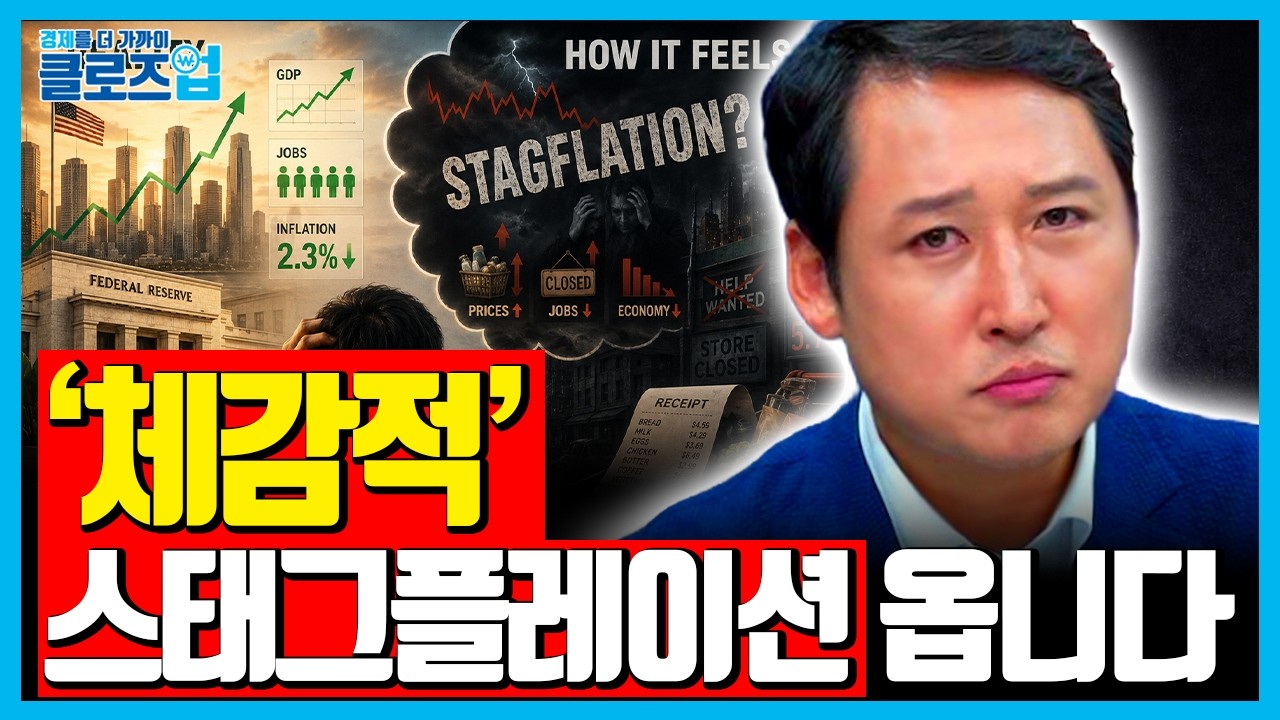
5. This Is Not Classic Stagflation, But It Is a Perceived Version of It
Many market participants are concerned that stagflation could emerge in 2026 and 2027.
Stagflation refers to a situation in which inflation rises while the economy stagnates.
In other words, inflation and recession occur at the same time.
However, the current backdrop does not fully meet that definition.
Inflation has likely passed its peak and is trending lower, while the economy is better described as low-growth rather than recessionary.
- Inflation may continue to normalize from its peak.
- Consumer prices may move closer to the central bank’s 2% range.
- Aggregate growth remains supported by semiconductor exports rather than broad recession dynamics.
- As a result, the situation does not qualify as classic stagflation.
That said, the public perception is different.
The reason is that people experience the price level, not just the inflation rate.
Even if inflation falls from 5% to 2%, prices remain elevated and continue to rise from a higher base.
As a result, headline inflation may ease while living-cost pressure remains high.
The same applies to economic conditions.
Semiconductor exports may lift aggregate growth, but the benefit is not evenly felt across households and industries.
Large technology firms and semiconductor suppliers may see strong earnings, while domestic-demand sectors, small businesses, and service industries continue to face weakness.
This is why the current environment is better described as a “perceived stagflation” rather than formal stagflation.
6. Why the Perception Matters for Policy
If policymakers diagnose stagflation, they typically respond with broad macroeconomic tools.
Interest rates, fiscal spending, and monetary policy become the primary levers.
If the problem is instead perceived stagnation combined with cost pressure, the response should be more targeted.
Support should focus on the households and sectors experiencing the greatest strain.
- Households facing high living costs may require energy vouchers and food support.
- Small businesses affected by weak demand may need consumption support and financing relief.
- Small and medium-sized enterprises may need working capital, tax relief, and market access support.
- Policy should strengthen the transmission from semiconductor strength to domestic demand.
This distinction is important.
Incorrect diagnosis leads to incorrect policy.
Calling the situation stagflation when it is not may result in unnecessary tightening.
Ignoring real household pain, on the other hand, may further weaken consumption and domestic activity.
7. The Middle East War Has Forced the Global Economy onto a Longer Route
The Middle East war was a major factor behind the slowdown in global growth in 2026.
It did not fully change the direction of the economy, but it extended the recovery path and increased uncertainty.
The IMF has noted the shadow cast by the war over the global economy.
The transmission mechanism operates through three main channels.
8. The Economic Impact of the Middle East War Differs by Region
| Category | Impact | Key Point |
|---|---|---|
| Middle East oil producers | Negative | Possible damage to production, storage, and refining facilities |
| Energy-importing countries | Negative | Higher oil prices and rising input costs |
| Energy-exporting countries | Relatively positive | Potential export revenue gains from higher oil prices |
| Global corporates | Negative | Weaker investment due to elevated uncertainty |
The Middle East is highly concentrated in oil production, storage, and refining infrastructure.
If war disrupts these facilities, crude supply can tighten.
Lower supply puts upward pressure on international oil prices.
For import-dependent economies such as Korea and Japan, this creates a cost burden.
Some energy-exporting countries may benefit from higher prices.
In other words, the war does not affect all countries equally; the outcome depends on industrial structure and energy dependence.
9. For Korea, AI Semiconductors Have Provided a Stronger Offset Than the Middle East Shock
Korea has been exposed to the negative effects of the Middle East war.
Energy import costs increased, commodity procurement became less certain, and corporate investment sentiment weakened.
At the same time, Korea had a stronger positive driver.
That driver was AI semiconductors.
Korea has strong competitiveness in HBM.
Expanding investment in AI data centers, GPUs, and servers sharply increased demand for high-bandwidth memory.
Samsung Electronics and SK Hynix benefited directly, and the sector played a major role in supporting total exports.
In summary:
- The Middle East war was a downward force on Korea’s economy.
- AI semiconductors were an upward force.
- In 2026, the semiconductor upswing was stronger.
- In 2027, the same rate of improvement may be harder to sustain because of base effects.
10. The Most Important Point Missing from Many Reports
The key question is not whether the economy is improving or deteriorating, but who is benefiting and who is losing.
Even if the global economy rebounds in 2027, not every country or industry will improve.
Even if Korea slows, not every company or household will weaken.
The central issue is the quality of the recovery.
Aggregate indicators may improve while consumer sentiment remains weak.
Semiconductor exports may remain strong while domestic demand stays soft.
Large corporations may report stronger earnings while small business owners see limited recovery.
Inflation rates may ease while the cost of living remains elevated.
This divergence is the defining feature of the 2027 outlook.
GDP alone is not sufficient.
Investors should track how capital is redistributed across industries, households, and asset classes.
11. Key Watchpoints for Capital Flows in 2027
- Nature of the global rebound: Determine whether the recovery is structural or driven mainly by base effects.
- Potential slowdown in Korea: Watch for moderating growth after the 2026 semiconductor surge.
- Durability of AI semiconductors: Assess how long HBM demand can sustain momentum.
- Middle East risk: Monitor oil prices, helium, commodities, and logistics costs.
- Perceived inflation: Lower inflation does not quickly translate into lower living costs.
- Domestic demand: Confirm whether semiconductor strength is spreading into consumption and employment.
- Exchange rates: Geopolitical risk and dollar demand may continue to pressure the won.
- Interest rates: Monetary policy will depend on the pace of disinflation and growth slowdown.
12. How Investors and Wage Earners Should Prepare for 2027
Investors should avoid interpreting a global recovery headline as a broad-based improvement.
At the same time, Korea’s growth slowdown should not be treated as a sign of systemic weakness.
The key is to identify where capital is diverging.
Investors should monitor AI semiconductors, energy, commodities, exchange rates, and interest rates together.
Employees should assess whether their industry is positioned to benefit from semiconductor strength or exposed to weak domestic demand.
Small business owners should focus less on the inflation rate itself and more on actual consumer spending recovery.
Companies should manage supply-chain risk and commodity price volatility linked to the Middle East.
The 2027 economy is unlikely to move in a single direction.
The global economy may recover while Korea slows, exports may outperform while domestic demand remains weak, and inflation rates may fall while living-cost pressure persists.
Understanding these divergences will be critical for interpreting capital flows in 2027.
< Summary >
The global economy may rebound in 2027 on the base effect following the 2026 Middle East war shock.
However, the global backdrop remains one of structurally weak growth.
Korea rebounded sharply in 2026 on the strength of AI semiconductor exports, but growth momentum may slow in 2027.
This is not classic stagflation, but a perceived version of inflation pressure alongside weak domestic demand may persist.
The Middle East war created downward pressure through energy prices, commodities, and investment sentiment, while AI semiconductors provided the main offset for Korea.
The central issue in 2027 is not whether the economy improves or weakens, but where capital shifts across industries and income groups.
[Related Articles…]
- Global Economy Outlook and Capital Flow Shifts in 2027
- AI Semiconductor Supercycle and the Korea Outlook
*Source: [ 경제 읽어주는 남자(김광석TV) ]
– [3편] “2027년 세계경제는 반등, 한국은 주춤합니다” 돈의 흐름 뒤집을 거대한 변수 | 클로즈업 | 2027년 경제전망 강의