● Tesla Cybercab, Austin Shock, Robotaxi War
Tesla Cybercab D-1 Key Takeaways: The Real Venue Is Not the Factory, but Downtown Austin
The key issue in this Tesla Cybercab event is not simply how many vehicles appear.
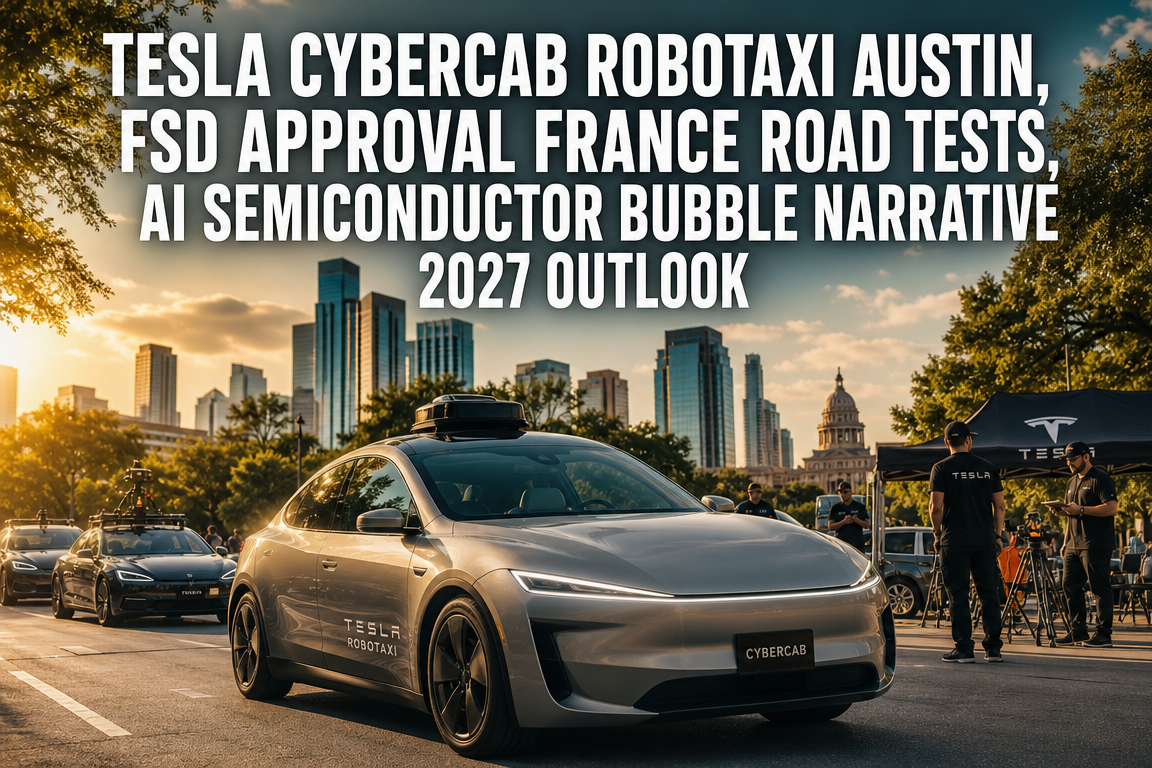
The more important point is that Tesla is creating its first real-world stage for its transition from an automaker to a autonomous mobility services company.
In particular, this event is likely to take place not in a controlled studio setting, as in the past, but in downtown Austin, Texas, using registered vehicles on public roads.
At the same time, Uber’s large-scale layoffs, rising odds of another U.S. rate hike, and signs of FSD approval in France are all shaping the outlook for Tesla shares and the robotaxi industry.
1. Tesla Stock and U.S. Market Direction: Markets Rose, but Rate Pressure Increased
In the source material, Tesla closed at $357.01.
The daily gain was 0.26%.
All three major U.S. indices also finished higher.
- S&P 500: +0.46%
- Nasdaq: +0.45%
- Dow Jones: +0.56%
On the surface, market sentiment was constructive.
However, underlying conditions show that factors weighing on growth stocks such as Tesla are clearly increasing.
The biggest variable is U.S. interest rates.
The source notes that the probability of a 0.25 percentage point Fed rate increase in September rose to 67.9%.
Given that the probability was 34.7% one week earlier, market expectations for rates shifted materially in a short period.
When rates rise, companies whose earnings are concentrated further in the future are typically valued less favorably.
Tesla, AI semiconductors, autonomous driving, and robotics companies are among the most exposed.
Accordingly, Tesla should be viewed not only through the Cybercab event, but also through rates and employment data.
2. Middle East Risk and Higher Oil Prices: Another Headwind for Growth Stocks
Another source of market pressure is geopolitical risk in the Middle East.
The source says U.S. Central Command struck air defense systems, radar, and naval assets linked to Iran’s Revolutionary Guard.
This was described as the second attack in the week, indicating rising geopolitical risk.
Brent crude rose to around $95.29 per barrel and extended gains for a third straight session.
Higher oil prices can increase inflation pressure again.
If inflation strengthens, the Fed will have less room to cut rates.
Ultimately, higher oil prices, rate-hike expectations, and valuation pressure on growth stocks are closely linked.
3. Uber’s 10% Workforce Reduction: More Than Cost Cutting, It Is Preparation for the Autonomous Driving Race
One of the most important items in the news flow is Uber.
According to CEO Dara Khosrowshahi’s message to employees, the company plans to cut about 10% of its global workforce.
- Total Uber employees: about 34,000
- Planned layoffs: about 3,300
- Layoff rate: about 9.7%
- Planned reduction in managers: about 20%
Notably, Uber is not reducing staff because it is unprofitable.
According to the source, Uber posted operating income of $1.9 billion and net income of $2.4 billion in the second quarter.
In other words, this is closer to an organizational restructuring than a survival-driven downsizing.
Uber believes too many management layers have slowed decision-making.
As a result, the company intends to reduce headcount primarily in organizations that are more than seven reporting layers below the CEO.
This is a different approach from a typical business-unit restructuring.
Uber also plans to limit remote work to about 1% of the total workforce and bring employees into hub cities such as New York and San Francisco.
This indicates a more centralized and faster operating model.
4. Where Will Uber’s Savings Go? The Answer Is Autonomous Driving
Wedbush estimates that this restructuring could save Uber about $1.7 billion annually.
Uber has also said it intends to invest more than $10 billion in autonomous driving over the next few years.
The key point is not that Uber plans to build autonomous vehicles itself.
Uber’s core model is a platform business that connects vehicles and labor while taking a fee, rather than owning cars directly.
As autonomous vehicles expand, Uber will need to adapt its model, which has traditionally relied on human drivers.
Put simply, Uber wants to become a platform that brings autonomous vehicles into its app.
The issue is that Tesla can potentially connect the vehicle, software, battery, data, and robotaxi app within one vertically integrated system.
That difference may become a central competitive advantage in the mobility platform market.
5. Tesla Robotaxi Registration Count: Up 10-Fold From 42 to 420
Tesla is registering autonomous vehicles through Texas state registration systems.
Commercial autonomous vehicle operations in Texas require prior state approval and vehicle registration.
According to the source, the registration framework began on May 28 this year.
The initial number of registered vehicles was 42.
At present, Tesla’s total registered robotaxi fleet in Texas is said to have reached 420.
That is exactly a 10-fold increase.
- Initial registrations at end-May: 42
- Additional registrations on August 27: 79 Model Y vehicles
- Most recent additions: 106 Model Y vehicles
- Total current registrations: 420
Compared with Waymo’s 736 registered vehicles, Tesla’s total is not yet dominant.
However, in terms of growth rate, Tesla’s expansion has been aggressive.
6. Why Cybercab Stands at 45: Model Y May Be the More Important Asset
Many investors expected the Cybercab event to be accompanied by a sharp increase in Cybercab registrations.
However, the source says Cybercab registrations remain at 45.
The additional registrations are all Model Y vehicles.
As of August 31, when total registrations stood at 314, Cybercab accounted for about 14% of the fleet.
As total registrations rose to 420, Cybercab’s share declined to about 10.7%.
This is an important signal.
Tesla may be planning to expand its robotaxi service first through the mass-produced Model Y rather than relying immediately on Cybercab alone.
In other words, Cybercab may serve as the symbolic product, while Model Y becomes the operational vehicle for early expansion.
Many reports focus only on the number of Cybercabs, but from a business perspective, Model Y-based robotaxi expansion may be the more realistic factor.
7. Why Downtown Austin, Not Giga Texas
The main distinction in this Cybercab event is the location.
According to the source, Tesla may hold the event not at Giga Texas, but in downtown Austin.
This is not just a location choice.
When Tesla first unveiled Cybercab at its robot-focused event on October 10, 2024, the event was held at Warner Bros. Studio in Burbank, California.
At the time, around 20 concept Cybercabs carried attendees in a controlled studio environment.
That environment was not a real public road.
Traffic was controlled, and there were no unpredictable civilian vehicles.
As a result, media criticism focused on whether the demonstration represented true autonomous validation, and Tesla shares fell about 9% at the open.
This time, the setting is different.
If Tesla places registered vehicles on public roads in downtown Austin and carries ordinary passengers in vehicles without steering wheels or pedals, the implications are materially different.
That would directly address the criticism of the earlier event.
8. Texas Law Made Cybercab Possible
The reason Cybercab can operate without a steering wheel or pedals on public roads is Texas legislation.
Texas opened the door to autonomous vehicle operations through a 2017 Senate bill.
In 2021, a House bill clarified that vehicles designed for full autonomy may omit traditional controls such as a steering wheel and brake pedals.
In other words, the legal foundation for Cybercab on public roads has been in place for several years.
This is the main difference from the 2024 studio event.
In the past, even if the technology was shown, questions remained about how it could legally operate.
Now, at least in Texas, the institutional framework is already in place.
9. France and FSD: Signs of Renewed European Approval Potential
There has also been an important development in Europe related to Tesla FSD.
French Transport Minister Philippe Tabarot posted a photo on X showing a video call with Elon Musk.
French authorities have reportedly been coordinating technically with Tesla for months and said they will begin road tests using two Tesla FSD vehicles.
This matters because the minister had said just six weeks earlier that safety was not sufficiently assured and had taken a negative stance on FSD approval.
According to the source, there are about 260,000 Tesla vehicles in France equipped with the hardware needed to activate FSD.
However, the feature cannot be used without government approval.
A vote scheduled for October 6 on European matters has not yet been finalized.
Still, the fact that the transport minister has spoken directly with Elon Musk and referenced real-road testing is a constructive signal.
10. Morgan Stanley’s View: If Vehicle Count Is Low, the Stock Could Come Under Pressure
Morgan Stanley analyst Andrew Percoco kept a neutral rating on Tesla and set a $400 price target.
He said Tesla shares could come under pressure if only a limited number of vehicles are seen driving in downtown areas during the Cybercab event.
Conversely, a meaningful number of vehicles on public roads could support a positive stock reaction.
This view is reasonable.
The first number investors will likely watch on the event day is the vehicle count.
However, there is another number that may matter more.
11. The Most Overlooked Variable: The Real Number Is the Fare
The most important number in this event may not be the number of Cybercabs, but the robotaxi fare.
The source compares Tesla robotaxi pricing with Uber fares for the same destination in Austin.
- Tesla robotaxi fare: $14.17
- UberX fare: $22.40
- Uber Comfort fare: $25.44
UberX is about 36.7% more expensive than Tesla’s robotaxi.
Uber Comfort is about 44.3% more expensive.
On a pre-discount basis, the gap may widen to about 47.5%, according to the source.
An $8 to $11 difference per ride is meaningful for U.S. consumers.
That is roughly equivalent to about 10,000 won in practical terms.
The core reason for this price difference is the driver cost.
Uber’s fare includes the driver’s share.
Tesla’s robotaxi does not have a driver, so its cost structure is fundamentally different.
Once autonomous driving becomes a pricing competition rather than just a technology race, Uber and Waymo face a much harder challenge.
This is the core of the Cybercab event.
12. Why Tesla Robotaxi Is Formidable: It Can Combine Scale and Cost Structure
The fact that Cybercab registrations stand at only 45 does not imply that the business opportunity is small.
The key is that this number is a starting point rather than an endpoint.
Tesla designs the vehicle, integrates the battery, develops FSD software, and accumulates driving data.
If it connects that capability to a robotaxi network, the boundary between manufacturing and services begins to disappear.
Uber has the app and demand, but it does not manufacture vehicles.
Waymo has strong technology, but it faces limitations in production scale and cost structure.
Tesla is trying to combine both areas.
If this model works, Tesla could be re-rated not only as an EV company, but as an autonomous platform company.
That is why some overseas investors refer to this event as an iPhone moment or a ChatGPT moment.
13. Potential Cybercab Retail Sales: Will the Sub-$30,000 Target Hold?
Another issue to watch is whether Cybercab retail sales will be discussed.
When Musk first unveiled Cybercab in October 2024, he said the target price was below $30,000.
He also mentioned potential customer deliveries and retail sales starting in 2027.
If Tesla reiterates its retail sales plan at this event, it would be significant.
It would suggest a model in which not only the robotaxi network, but also privately owned Cybercabs, could participate in Tesla’s network.
In that case, Tesla could become a company that earns not only once from vehicle sales, but repeatedly through vehicle utilization and platform economics.
That would materially change the way Tesla is valued.
14. Key Metrics Investors Should Monitor on Event Day
When evaluating the Cybercab event, it is useful to watch the following metrics in order.
- Actual number of vehicles operating in public roads: Determines whether this is a demonstration or a service-level deployment.
- Change in Cybercab registrations: Whether the count rises from 45.
- Rate of Model Y robotaxi expansion: Early service expansion may depend more on Model Y than Cybercab.
- Robotaxi fare: Whether Tesla maintains a cost advantage over Uber.
- Service area expansion: The degree to which the Austin operating zone broadens.
- Presence of safety operators: Directly tied to confidence in commercial autonomy.
- Retail sales plan: Whether the $30,000 target and 2027 delivery timing remain intact.
- Mentions of FSD approval in Europe: A gauge of expansion potential in France and the broader European market.
15. Implications for Uber and Waymo: If Pricing Falls, Platforms Will Be Pressured
Uber’s decision to cut 3,300 jobs and invest more than $10 billion in autonomous driving has a clear rationale.
The company is preparing for pressure on its existing commission-based model as autonomous driving scales.
If Tesla robotaxi can sustain fares 30% to 40% below Uber’s, consumer adoption could shift quickly.
In repetitive urban transportation markets, price differences can translate directly into market share changes.
Waymo remains a technologically strong competitor.
However, if Tesla combines large-scale vehicle production with software update speed, the long-term competitive landscape becomes more complex.
Ultimately, the winner in future mobility may not be the company with the best autonomous technology alone, but the company that can deploy vehicles at low cost, at scale, and at prices consumers can clearly feel.
16. The Core of the Event: Tesla Is Moving from Selling Cars to Selling Services
This Cybercab event may not materially change Tesla’s quarterly revenue immediately.
Even if 45 Cybercabs operate all day, their share of total revenue would remain small.
However, the market is not focused on current revenue.
It is focused on the type of company Tesla could become.
When Tesla shifts from a vehicle-sales model to an autonomous services model, its earnings structure changes.
That includes vehicle sales margin, transportation service fees, software subscriptions, FSD licensing, and network revenue.
This is why investors place so much importance on the event.
Short-term volatility may remain elevated, but strategically this could be a turning point in Tesla’s business model.
< Summary >
The key point of the Tesla Cybercab event is not the vehicle reveal, but real-road testing in downtown Austin.
Tesla’s robotaxi registrations increased from 42 to 420, a 10-fold rise, according to the source.
Cybercab remained at 45 units, while Model Y robotaxi registrations expanded more quickly.
Uber is restructuring by cutting 10% of staff and planning to invest more than $10 billion in autonomous driving.
The most important variable is not vehicle count, but pricing.
Tesla’s robotaxi fare was cited at $14.17, well below UberX at $22.40.
If that pricing gap persists, both Uber and Waymo could face significant pressure.
France’s FSD testing move is a constructive sign for renewed European approval potential.
This event could mark Tesla’s transition from an automaker to an autonomous services company.
[Related Articles…]
*Source: [ 오늘의 테슬라 뉴스 ]
– 사이버캡 D-1, 내일 무대는 공장이 아니라 오스틴 도심입니다 테슬라 $357 주주는?
● AI Bubble Fears, Semiconductors Shake, 2027 Outlook, Five Key Variables
Why Semiconductor Earnings Are Strong but Share Prices Remain Volatile: Five Variables to Watch in the AI Bubble Debate and the 2027 Outlook
The core message is straightforward.
AI semiconductor earnings may remain strong, yet share prices can continue to fluctuate.
The reason is not that the AI bubble has already burst, but that markets repeatedly price in the “AI bubble” narrative.
In particular, semiconductor prices, market share, China’s AI value chain, AI company profitability, and hyperscaler CAPEX are likely to be the main variables affecting the share prices of Samsung Electronics, SK Hynix, Micron, NVIDIA, and TSMC.
In addition, the shift in oil and inflation trends following the Middle East conflict is also affecting the interest rate path, which means semiconductor stocks and the U.S. equity market cannot be assessed separately in the 2027 outlook.
1. First conclusion: the more relevant risk is not an AI bubble collapse, but the AI bubble narrative
The most important premise is not that the AI bubble is actually collapsing.
AI industry growth is still likely to continue.
Data center investment is expected to remain active, and hyperscalers are unlikely to stop competing on AI infrastructure.
The issue is that equity markets do not move on earnings alone.
In the real economy, semiconductor sales and operating profit may improve, but in capital markets, share prices often correct first when expectations weaken.
In other words, the question is not why earnings are weak, but whether the sustainability of those earnings is being questioned.
- Will AI earnings continue?
- Will hyperscalers keep buying semiconductors?
- Can Samsung Electronics and SK Hynix defend market share?
- Will the rise of China’s AI value chain reduce demand for Korean semiconductors?
- Can big tech maintain CAPEX while free cash flow declines?
Whenever these questions intensify, the AI bubble narrative re-emerges and semiconductor stocks may face short-term corrections.
2. First key variable: semiconductor prices
The main reason semiconductor companies delivered strong earnings in 2026 was not only demand growth, but more directly the surge in prices.
DRAM, NAND flash, and HBM prices all rose sharply.
Hyperscalers and major technology firms increased demand for AI infrastructure, while supply remained constrained.
Demand surged while supply stayed tight, driving prices higher.
Corporate earnings are generally driven by price and volume.
Revenue equals price multiplied by quantity.
When semiconductor prices rise sharply, revenue can increase even if shipment volumes decline.
Operating profit can improve even more than revenue if logistics, variable costs, and production-related expenses decline.
For example, if 100 watermelons are sold at 10,000 won each, revenue is 1 million won.
If only 50 watermelons are sold the following year, but the price rises to 30,000 won each, revenue becomes 1.5 million won.
Even with lower volume, higher prices lift revenue.
If costs also decline, operating profit can improve further.
This is the core structure behind semiconductor earnings in Q1 and Q2 of 2026.
However, the equity market looks one step ahead.
It anticipates what happens when prices peak and begin to decline.
When semiconductor prices fall, markets may start to question whether earnings have peaked.
The concern is not that earnings are deteriorating, but that the pace of improvement may be slowing.
Share prices are more sensitive to the direction of earnings growth than to absolute earnings levels.
The key point is this.
Once semiconductor prices weaken, the market may interpret it as a risk of earnings peak-out.
The issue is not worse earnings, but slower earnings growth.
3. Second key variable: market share for Samsung Electronics and SK Hynix
The expansion of the overall semiconductor market is a different issue from the market share held by individual companies.
When the AI semiconductor market grows, all companies can benefit.
Samsung Electronics, SK Hynix, TSMC, Micron, and NVIDIA can all post strong results.
However, investors focus on who captures the larger share of that growth.
In DRAM, there are concerns that the long-term market share of Samsung Electronics and SK Hynix may come under pressure.
Micron in the U.S. and CXMT in China are expanding their presence.
HBM presents a similar issue.
SK Hynix remains the dominant player, but over time Micron’s entry, Samsung Electronics’ efforts to narrow the gap, and the potential rise of Chinese competitors may increase competition.
If Micron increases HBM production and improves the probability of supplying NVIDIA, the market may discount the premium previously assigned to Korean semiconductor leaders.
For Samsung Electronics, foundry market share is also critical.
As TSMC retains a dominant lead and SMIC, UMC, and GlobalFoundries expand in selected segments, Samsung Electronics’ foundry valuation may face pressure.
Here the key analogy is the “cake.”
The AI semiconductor market can continue to grow.
But if Samsung Electronics and SK Hynix’s share of that market declines from 35% to 30%, the companies may still be profitable while their stock valuations are re-rated lower.
The key point is this.
Even if the market grows, valuation can decline when share is lost.
Semiconductor investors must evaluate both market growth and each company’s share of that growth.
4. Third key variable: the shift of the AI value chain toward China
Another factor supporting the AI bubble narrative is the concern that the AI value chain is shifting toward China.
Global dependence on AI models continues to increase.
However, dependence is not limited to U.S. AI models; reliance on Chinese AI models is also increasing rapidly.
In 2025, U.S. AI models from Google, OpenAI, and Anthropic were highly dominant.
By 2026, Chinese AI models and services from DeepSeek, Tencent, and Xiaomi began gaining greater influence.
Chinese AI firms are pursuing a strategy of offering efficient models with relatively lower CAPEX than U.S. hyperscalers.
This creates a mixed implication for Korean semiconductor firms.
Growth in China’s AI market can increase semiconductor demand.
At the same time, China may not follow the same model of massive data center spending and high-end chip purchases seen in the U.S.
China is also strengthening its domestic semiconductor value chain.
As a result, AI demand shifting toward China may not translate directly into revenue for Samsung Electronics and SK Hynix.
Each time Chinese memory firms such as CXMT, AI platforms such as Tencent, and Chinese physical AI companies expand, markets raise similar questions.
Is the AI value chain moving from the U.S. toward China?
Will China increasingly rely on domestic semiconductors?
Could this reduce long-term demand for Korean semiconductors?
The key point is this.
China’s AI growth is not only an opportunity.
For Korean semiconductor firms, it is both a demand driver and a supply chain diversion risk.
5. Fourth key variable: concerns over AI company profitability
AI semiconductor demand begins with hyperscalers.
Amazon, Microsoft, Google, and Meta increased data center spending and AI server deployment, driving strong demand for semiconductors.
However, if markets begin to doubt that these firms can generate sufficient returns from AI, semiconductor demand expectations weaken immediately.
One indicator often cited in assessing AI profitability is an index related to LLM token spending.
An increase in this metric may be interpreted as stronger AI service usage and improved monetization expectations.
A decline can raise concerns about AI company profitability.
The lecture notes that in March 2026, when this indicator bottomed, share prices also bottomed, and as the indicator rebounded through June, share prices rose as well.
Conversely, when the indicator adjusted between June and July, share prices also corrected.
This suggests that AI profitability indicators and semiconductor share prices may move closely together.
Investors are asking a simple set of questions.
Can AI companies make money?
If not, can they continue buying semiconductors?
Will data center investment eventually slow?
The key point is this.
AI semiconductor investors should not focus only on semiconductor earnings.
They also need to monitor the profitability of large technology platforms and hyperscalers.
6. Fifth key variable: big tech CAPEX and free cash flow
The most important variable is CAPEX.
CAPEX refers to capital expenditures.
In practical terms, it represents how much big tech spends on data centers, servers, GPUs, HBM, and networking equipment.
Semiconductor earnings have moved in line with rising big tech CAPEX.
The issue is that hyperscalers’ free cash flow, or FCF, is declining.
Free cash flow is the cash left after operating income, investment, and expenses.
When this cash is ample, firms can keep investing aggressively in data centers and AI semiconductor purchases.
But when FCF declines or turns negative, markets begin to question whether spending can continue.
Can semiconductor purchases continue without excess cash?
This concern is what reinforces the AI bubble narrative.
AI demand may not disappear.
But when the quality of financing changes, equity markets become more sensitive.
The lecture argues that U.S. big tech is likely to continue CAPEX even if free cash flow declines, through corporate bond issuance and similar financing tools.
The reason is that AI is not just an industry trend but also a strategic competition between the U.S. and China.
Because the U.S. cannot afford to concede AI leadership to China, investment is likely to continue through policy support and financial market mechanisms.
However, sustained investment does not mean share prices will keep rising.
When CAPEX is maintained through debt issuance, the market may become more concerned about sustainability.
As a result, AI industry growth can continue while AI semiconductor stocks remain volatile.
The key point is this.
AI investment is unlikely to stop, but declining free cash flow can increase share price volatility.
This is why semiconductor stocks and big tech CAPEX must be considered together in the 2027 outlook.
7. News-style summary: why share prices can fall even when earnings are strong
- Risk of price peak-out
If HBM, DRAM, and NAND prices are seen as having peaked, the market may first price in slower operating profit growth.
- Concerns over market share loss
Even when Samsung Electronics and SK Hynix remain profitable, valuations may decline if competitors such as Micron, CXMT, and TSMC gain share.
- Rise of China’s AI value chain
As Chinese AI models and semiconductor firms grow, long-term demand assumptions for Korean semiconductor firms may weaken.
- Debate over AI company profitability
If hyperscalers cannot monetize AI effectively, concern over the durability of semiconductor demand increases.
- Sustainability of big tech CAPEX
Whether data center spending can continue as free cash flow declines becomes a key market variable.
8. The less emphasized factor in other coverage: capital flow matters more than earnings alone
Much of the news flow focuses on quarterly semiconductor earnings, HBM supply contracts, and NVIDIA shipment orders.
These are important.
However, capital flow is even more important.
In the real economy, semiconductor demand may be strong.
But in capital markets, interest rates, liquidity, valuation, expected returns, and risk premia move together.
Even when semiconductor earnings are strong, capital can rotate quickly if rate pressure rises, the AI bubble narrative intensifies, and big tech cash flow weakens.
In other words, the core question for investors through 2027 is not simply which companies are strong, but when capital moves into and out of semiconductors.
Semiconductor stocks are not only an earnings-driven sector; they are also a liquidity-driven sector.
In particular, when U.S. AI-related mega-cap stocks weaken, Korean semiconductor names are likely to move in the same direction.
The most important point is this.
Even if the AI bubble does not actually burst, the AI bubble narrative alone can be enough to push share prices lower.
Investors should separate the long-term growth of the industry from short-term share price volatility.
9. Interest rate outlook: the world remains in a pivot phase through 2027
The second half of the discussion covers the interest rate outlook.
Interest rates are the gravity of the economy.
When rates are high, risk assets such as equities and real estate come under pressure.
When rates fall, liquidity improves.
From 2020 to 2021, policy was accommodative.
Low rates and rate cuts supported a liquidity-driven bull market.
From 2022 through mid-2024, policy was restrictive.
Rate hikes and liquidity withdrawal led to significant corrections in equity markets.
From 2025 to 2026, the economy has been in a pivot phase.
This is a period of gradual rate cuts from elevated levels.
However, the Middle East conflict emerged as a new variable in 2026.
As transit volumes through the Strait of Hormuz fell sharply and crude oil prices rose, the inflation outlook became less stable.
Higher oil prices increase import costs and feed into consumer inflation.
This temporarily disrupted the monetary policy paths of major central banks.
Korea, the euro area, and Japan had relatively lower policy rate levels, which gave them some room to respond to inflation.
The United States, by contrast, had already maintained a restrictive policy rate around 3.75%, so the need for additional rate hikes was relatively limited.
10. Korea interest rate outlook: 2026 is a temporary stop, 2027 brings stabilization
The Bank of Korea expects consumer inflation to stabilize around 2.7% in 2026 and 2.3% in 2027.
This suggests inflation may move back toward the 2% target range.
As a result, 2026 may see temporary pressure for rate hikes due to the Middle East conflict and higher oil prices.
But in 2027, once inflation stabilizes, the door may reopen to a hold or a cut.
In simple terms, 2026 is a brief stop on the way to Busan.
The policy direction was originally toward easing, but the route has been delayed by oil and inflation shocks.
The broader direction remains toward a pivot.
11. U.S. interest rate outlook: inflation is more important than growth
In the United States, inflation may rise temporarily in 2026, but it is expected to stabilize again in 2027 and 2028.
If core PCE inflation and the broader inflation outlook move toward the 2% target, the Federal Reserve may regain room to cut rates.
The market is now focused more on inflation than on employment.
Unless there is a severe recession or a collapse in jobs, central banks are likely to respond primarily to inflation trends.
Growth appears to be largely contained, and the current focus is on monitoring inflation.
Accordingly, U.S. equities and AI semiconductor stocks are highly sensitive to the Fed’s rate path.
If expectations for rate cuts remain intact, they support growth stocks and semiconductors.
By contrast, if an oil shock raises inflation again, rate-cut expectations weaken and valuation pressure increases for AI-related stocks.
12. Investor checklist
- HBM price trend
Determine whether prices are still rising or have peaked and begun to decline.
- DRAM and NAND prices
These are key indicators for the overall direction of the memory cycle.
- Market share for Samsung Electronics and SK Hynix
Share changes may matter more for valuation than earnings alone.
- Micron and CXMT entry pace
Monitor whether competition in HBM and DRAM is intensifying.
- Dependence on Chinese AI models
As the Chinese AI ecosystem expands, the possibility of a broader global AI value chain shift increases.
- Big tech FCF
Watch whether free cash flow is declining and whether CAPEX is being maintained through bond issuance.
- Hyperscaler CAPEX guidance
Data center spending plans are a leading indicator for semiconductor demand.
- Crude oil and inflation
Higher oil prices can delay expectations for rate cuts.
- Federal Reserve and Bank of Korea policy
Interest rate direction directly affects the valuation of semiconductors and AI growth stocks.
13. Final interpretation from the 2027 outlook
The key issue for the 2027 outlook is not whether AI has ended.
AI industry growth is likely to continue.
The U.S.-China AI competition is also unlikely to stop soon.
Data center investment and AI semiconductor demand are likely to remain in place.
However, the market will continue to ask the same questions.
Is the stock too expensive relative to growth?
Have semiconductor prices already peaked?
Is market share being lost?
Are AI companies actually generating profits?
Can big tech continue to absorb CAPEX?
When these concerns intensify, the AI bubble narrative gains traction and share prices correct.
When pricing, market share, profitability, CAPEX, and rates stabilize, AI semiconductors and U.S. equities may regain momentum.
Ultimately, the investment approach through 2027 should not be simple optimism or pessimism.
The key is to read the cycle of the AI bubble narrative rather than assume an outright AI bubble collapse.
Investors should separate the real economy from capital markets and track where money is moving.
< Summary >
Semiconductor stocks can fall even when earnings are strong.
The reason is not an AI bubble collapse, but the repeated re-emergence of the AI bubble narrative.
The main variables are semiconductor prices, market share, China’s AI value chain, AI company profitability, and big tech CAPEX.
In particular, the sustainability of CAPEX as hyperscalers’ free cash flow declines is the most important factor.
Rates remain in a pivot phase, but the 2026 path may be temporarily disrupted by the Middle East conflict and higher oil prices.
In 2027, if inflation stabilizes, the probability of policy holds or rate cuts may increase again.
Investors should look not only at semiconductor earnings, but also at the AI value chain, big tech cash flow, rates, inflation, and U.S. market liquidity.
[Related Articles…]
- AI Semiconductor Cycle and the Global Memory Market Outlook
- Interest Rate Cuts, the U.S. Equity Market, and Big Tech Investment Strategy
*Source: [ 경제 읽어주는 남자(김광석TV) ]
– “반도체 실적은 계속 좋은데 주가는 왜 떨어질까?” 답은 이 5가지입니다 | 클로즈업 | 2027 경제전망 강의 [5편]