● AI Data Centers Rate Cut Strategy
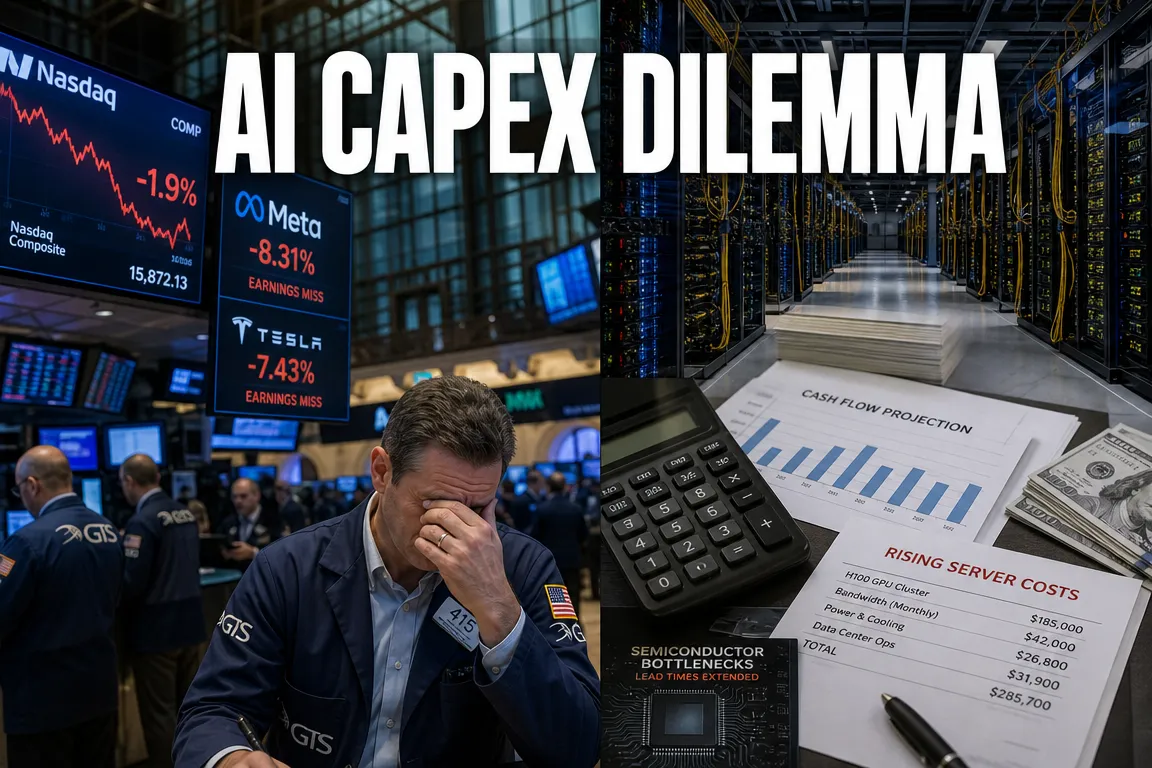
The Real Reason the U.S. Is Betting Its Life on AI Data Centers: Data Centers May Be a Rate-Cut Strategy, Not Just “Computer Facilities”
The core point of this piece is quite strong.
The reason the U.S. is pushing AI data centers is not simply to run AI services like ChatGPT better.
If I summarize the original from my perspective, the U.S. government sees AI data centers as “a giant economic mechanism that lowers prices by improving productivity and, in the long run, creates a rationale for rate cuts.”
This ties together the U.S. economy, Treasury yields, AI investment, data centers, and the U.S.-China technological rivalry all at once.
One point that is especially overlooked in other news reports and YouTube videos is this.
AI investment may now look like it is pushing up inflation and rates, but the policy core in the U.S. believes AI could ultimately become evidence that lowers inflation.
In other words, data centers can be interpreted not as a cost, but as “productivity factories that justify future rate cuts.”
1. Why Trump Directly Defended Data Centers
According to the original text, on August 31 Trump sent a message to the effect that U.S. regions rejecting data centers could fall behind and become poorer.
On the surface, that sounds a little strange.
That is because resistance to data centers is growing across the U.S.
- There are complaints that they use too much electricity.
- There are concerns about rising local power and utility costs.
- There are also water shortage controversies due to cooling water use.
- And in politics ahead of the midterm elections, data centers are becoming an easy target.
Even so, Trump’s public defense of data centers is hard to explain as mere pro-business policy.
The first reason is, of course, competition with China for AI supremacy.
But the more important second reason is America’s interest rate problem.
The U.S. is now carrying both massive national debt and the burden of high long-term interest rates.
If the logic holds that AI data centers raise productivity and reduce inflationary pressure, then the government gains a basis to argue for rate cuts or at least rate holds.
2. The Structure That Links AI Data Centers and Interest Rates
At first, this may sound strange.
Building data centers requires enormous amounts of money.
Companies need to buy GPUs, build out power grids, secure land, and install cooling infrastructure.
Big tech firms issue corporate bonds to fund this investment.
That increases bond supply, and market rates can rise instead.
In fact, based on the original text, by late August 2026 the U.S. 10-year Treasury yield had risen to around 4.7%, creating a growing burden.
That is a very uncomfortable situation for the U.S. government.
When Treasury yields are high, the interest expense the government must pay on existing and new debt rises sharply.
In the extreme, there is even fear that a significant share of tax revenue could be consumed by interest payments.
But Treasury Secretary Bessent’s logic is different.
His argument is that while AI investment may absorb capital and push rates up in the short term, over time it can sharply improve productivity, lower prices, and stabilize long-term rates.
The original text mentions a forecast that U.S. productivity could rise from 2.5% to 3%.
That 0.5 percentage point difference may seem small, but in macroeconomics it is a very big deal.
Higher productivity means more goods and services can be produced with the same labor cost.
As a result, unit costs fall, and that works to reduce inflationary pressure.
3. What the Fed Wants Is Evidence of Falling Prices
Trump wants lower rates.
The Treasury also feels burdened by high Treasury yields.
But the Fed cannot cut rates without justification.
For the Fed to lower rates, it needs confidence that prices are sufficiently moving toward the 2% target.
The original text explains that the personal consumption expenditures price index, or PCE, which the Fed watches closely, is still at an annualized 3.7%, a high level.
It also notes that based on the last six months, inflation pressure is around 4.1%.
At that level, it is not easy for the Fed to talk about rate cuts.
That is also why Powell said at the Jackson Hole meeting that if he is not confident prices are falling fast enough toward 2%, he can keep the possibility of rate hikes open.
In the end, the one thing the U.S. policy core wants is this.
Evidence that “AI is increasing productivity, and that productivity improvement is lowering prices.”
If that evidence exists, then there is a rationale for rate cuts.
That is exactly where AI data centers stop being just industrial infrastructure and become linked to monetary policy.
4. How Productivity Lowers Prices
Let’s reframe the example from the original in simpler terms.
Suppose 10 employees produce 100 reports a day.
Then after introducing AI, the same 10 employees can produce 200 reports a day.
Even if those employees’ wages rise by 5%, the labor cost per report drops significantly.
That is productivity improvement.
When the same wages produce more output, unit costs for companies fall.
And when unit costs fall, the pressure to raise prices also falls.
So productivity gains become a force that lowers inflation over the long run.
The original text says U.S. labor productivity in Q2 2026 rose 2.2% from a year earlier, while unit labor costs rose only 1.4% annualized.
That is not an explosive number, but it can be read as a sign that productivity is improving faster than wages.
For the Fed, the more solid that trend becomes, the more room there is to consider holding or cutting rates.
5. The Really Important Concept: Dark Output
The most important concept in the original text is “dark output.”
SemiAnalysis describes dark output as the phenomenon where AI is creating real economic value, but that value is not properly captured in GDP or price statistics.
In simple terms, AI-driven productivity gains are hiding outside the statistics.
For example, suppose it used to cost a lawyer $1,000 to draft a complaint.
Now, using AI, a draft can be produced for around $20.
A contract that used to take four days can now be finished in one hour thanks to AI.
The lawyer saves a huge amount of time, and the client gets the result much faster.
But statistically, if revenue stays the same, GDP may also appear unchanged.
In reality, economic utility has increased, but that value is not well reflected in existing statistics.
The same applies when individuals use AI for translation, travel planning, coding, or research.
Things that used to be outsourced or done through paid services are now handled directly by individuals.
Time is saved and output increases, but if money does not change hands, GDP does not capture it well.
That is the statistical illusion of the AI era.
6. AI Productivity May Already Be Larger Than the Statistics
The original text says Stanford researchers estimated that the consumer benefits Americans gain from generative AI amount to $172 billion annually.
That is roughly 200 trillion won.
The U.S. Bureau of Economic Analysis, or BEA, has also produced an interesting calculation.
Including the value of free digital content and AI, the U.S. real growth rate over three years may have been 0.2 percentage points higher than existing statistics suggest.
There are also even more aggressive estimates.
Some researchers believe that while AI computing spending is increasing by more than 140% annually, AI output is increasing by more than 2,000% annually.
If costs rise 140% but output rises 2,000%, that is not just a simple cost increase.
It may be a sign that the productivity structure of the entire economy is changing.
The problem is that this change is not yet fully captured by existing GDP statistics.
That is why the Fed and economists are beginning to think about how to measure AI productivity, which is a core point of the original text.
7. The 1996 Internet Revolution and Today’s AI Revolution
This scene resembles the internet revolution of the 1990s.
In 1996, the U.S. economy was growing rapidly and unemployment was falling.
Inside the Fed, voices were saying the economy was overheating and the dot-com bubble was growing, so rates needed to go up.
Even then, there were claims that computers and the internet were boosting productivity.
But in the early statistics, productivity gains were only recorded at about 0.4%.
Looking only at the statistics, the internet revolution seemed almost nonexistent.
But in reality, it was different.
Then-Fed Chair Alan Greenspan believed information technology was increasing corporate productivity, but the statistics were not properly capturing the effect.
A few years later, revised figures showed productivity gains were not 0.4% but closer to 2.4%.
This example is very important when interpreting today’s AI economy.
If AI productivity does not show up in current statistics, that does not mean the effect is unreal. If you jump to that conclusion, you could repeat the same mistake made in the 1990s.
8. Why the U.S. Wants to Change the “Ruler” Used in Statistics
One especially sharp part of the original text is its reinterpretation of the phrase “manipulating statistics.”
Here, manipulation does not mean someone secretly changing numbers.
It is closer to changing the measurement standard itself.
Current GDP statistics capture well the parts where money is actually transacted.
AI subscription fees, GPU purchases, data center construction costs, and power infrastructure costs are almost fully counted.
By contrast, the time saved by AI, tasks handled directly by individuals, faster output, and knowledge and productivity gained for free are not well captured.
That means statistics show costs rising sharply while the benefits appear small.
If this structure remains unchanged, AI investment may look only like a factor pushing up inflation and rates.
That is why the U.S. government and the economics profession are likely to create measurement standards that reflect the new value generated by AI.
Once such a new standard appears, the market’s interpretation can change as well.
AI investment can then be valued not as a “bubble cost,” but as a “future productivity asset.”
9. The Most Important Point Other News Rarely Mentions
Most news coverage treats data centers only from the perspective of power shortages, local complaints, and big tech investment competition.
But the real core point is that data centers may be linked to America’s rate strategy.
- Data centers are not just server facilities; they are factories that generate AI productivity.
- AI productivity can become evidence that inflation will fall over the long term.
- If there is evidence that inflation has fallen, the Fed gains a rationale for rate cuts.
- If Treasury yields fall, the U.S. government’s debt interest burden also declines.
- At the same time, the U.S. can maintain AI supremacy over China.
In other words, AI data centers are the intersection where politics, finance, industry, and security all meet.
If Trump and the Treasury want lower rates, the Fed wants evidence of falling prices, and the U.S. wants to beat China, then AI investment is the logic’s nearly only card that can satisfy all three goals at once.
10. How Should We View the AI Bubble Debate?
There are clearly criticisms surrounding the AI industry.
Some say it is circular investment.
The argument is that big tech firms are investing in one another, signing cloud contracts, buying GPUs, and then creating revenue again, making the structure overheated.
There is also valid criticism that the scale of data center investment is too large and the timing of actual profits is uncertain.
But what the U.S. policy core wants is not the collapse of an AI bubble.
They want to believe AI will eventually lead to productivity gains.
And on that belief, they aim to achieve two goals.
- First, a political goal: stabilize prices and secure a rationale for rate cuts.
- Second, a national strategy goal: avoid losing AI supremacy to China.
That is why, even if there is noise around AI investment, the U.S. is unlikely to hit the brakes easily.
In fact, support for the power grid, semiconductors, data centers, cloud infrastructure, and the AI software ecosystem is likely to continue.
11. Checkpoints Investors and the Korean Economy Should Watch
This trend is not just America’s problem.
Korean investors and companies must watch it closely as well.
If U.S. AI investment continues, it will affect a wide range of industries, including semiconductors, power equipment, cooling systems, network equipment, nuclear power, natural gas, data center REITs, and cloud software.
In particular, Korea is linked to memory semiconductors, HBM, power infrastructure, transformers, distribution equipment, and the AI server supply chain.
But that does not mean you can simply buy any AI-related stock.
Going forward, these indicators should be watched together.
- Check whether the U.S. 10-year Treasury yield keeps rising.
- Watch whether PCE inflation moves down toward the 2% target.
- Check whether U.S. labor productivity and unit labor costs improve.
- Watch the scale of big tech corporate bond issuance and data center investment.
- Check whether electricity prices and grid bottlenecks are getting worse.
- See whether AI usage is actually translating into corporate productivity.
- Pay attention to whether the U.S. government and the Fed introduce new statistics that reflect AI productivity.
- Watch how semiconductor export controls and supply chain restructuring change amid the U.S.-China technological rivalry.
The most important thing is timing.
Data center investment is, right now, a factor pushing rates up.
But the effect the U.S. government is expecting is future productivity improvement and rate stabilization.
The time gap between current costs and future benefits is the market’s biggest risk.
12. Conclusion: What America Really Wants Is AI Investment
If you summarize the original in one sentence, it is this.
What America’s top policymakers want is not data centers themselves, but the AI productivity that data centers will create.
And that productivity is a card that can simultaneously satisfy multiple goals: rate cuts, easing inflation, reducing the burden of national debt, and maintaining U.S.-China technological supremacy.
Going forward, local backlash against data centers, power shortages, water scarcity, and AI bubble debates are likely to continue.
But if the U.S. government sees AI as a national strategic asset, this investment trend is unlikely to be easily reversed.
From an investor’s perspective, AI data centers should not be seen as just a thematic stock issue.
Now we need to view them together with the U.S. interest-rate cycle, Treasury yields, productivity statistics, AI investment, and the U.S.-China rivalry for supremacy.
Data centers are no longer just buildings full of servers.
They may be the massive economic infrastructure the U.S. chose in order to lower rates and preserve its supremacy.
< Summary >
The reason the U.S. is strongly pushing AI data centers is not simply technological competition.
AI data centers are interpreted as core infrastructure that can lower inflation through productivity gains and, in the long run, create a rationale for rate cuts.
Current data center investment can pressure rates through corporate bond issuance and rising power demand, but the U.S. government is placing greater weight on the future benefits of productivity improvement.
A large portion of the economic value created by AI remains “dark output” that is not captured by existing GDP statistics.
Going forward, the U.S. may create new statistical standards to measure AI productivity.
This trend could directly affect U.S. Treasury yields, rate-cut expectations, semiconductors, power infrastructure, data centers, and the U.S.-China technological rivalry.
[Related Articles…]
*Source: [ 월텍남 – 월스트리트 테크남 ]
– 미국의 정점이 “뭘 원하는지” 모르면 크게 손해보는 이유