● Hormuz Oil Shock Inflation Rates Stocks
Why the Strait of Hormuz Crisis Triggered a Surge in Oil Prices, Inflation, and Interest Rates at the Same Time, and the Real Core Point Investors Need to Watch
The core point of this Hormuz Strait issue is not simply that “an oil tanker was attacked.”
The market is being shaken again as oil price forecasts, inflation, benchmark interest rates, U.S. stocks, and global supply chain risks are all linked at once.
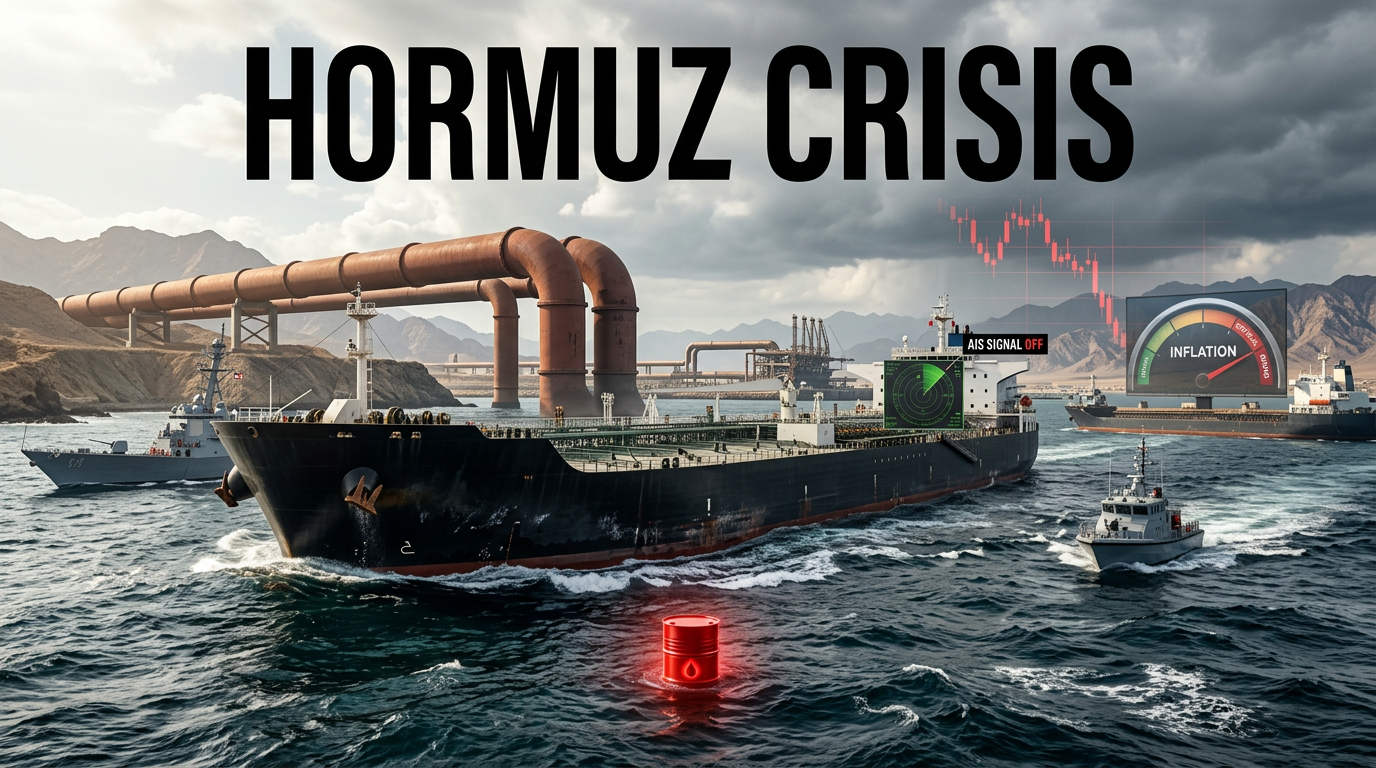
What is especially important is that while the Strait of Hormuz appears to be completely blocked, in reality crude oil is still flowing out through U.S. military control, stealth tankers, and pipeline bypass routes.
This is the most important reason why oil prices have surged but have not immediately shot above the past peak of $120 per barrel.
And in the bigger picture, a structure is being created in which the United States can pressure Iran while also destabilizing China’s energy supply chain.
1. What happened in the Strait of Hormuz right now
According to the original text, two very large tankers carrying Saudi crude were attacked near the Strait of Hormuz.
The Iranian Revolutionary Guard is suspected to be the perpetrator.
In response, the United States was summarized as immediately announcing strikes on the Revolutionary Guard’s radar, air defense systems, maritime assets, and mine-laying capabilities.
And that was not the end of it, as additional reports said the United States attacked the engine rooms of two Iranian-flagged tankers.
The wording used by U.S. officials is quite blunt.
“Tanker for Tanker,” meaning they will respond to tankers with tankers.
In simple terms, if Iran interferes with oil transport vessels, the United States will directly strike Iran’s oil transport capability.
2. Why the market reacted immediately: oil prices pressure inflation and interest rates at the same time
After the Hormuz crisis, Brent crude reportedly jumped about 5% in a single day to the mid-$90s per barrel.
WTI also rose above $90 per barrel.
The problem is that rising oil prices do not stay confined to the energy market.
Fuel costs are a basic expense that pushes up transportation costs, manufacturing costs, airline fares, food prices, and even service inflation.
So when oil prices rise, inflationary pressure increases again.
When inflation rises, the Fed finds it harder to cut its benchmark rate.
Instead, the market starts pricing in the possibility of higher interest rates again.
The original text mentions that the yield on the U.S. 10-year Treasury rose to around 4.8%.
That is a very heavy combination for the U.S. stock market.
Oil rises, inflation pressure grows, interest rates remain high, and corporate valuations come under pressure.
3. The point that the Trump administration finds most uncomfortable: high rates and the midterm election
The most politically sensitive issue is interest rates.
Trump, Bessent, and Kevin Warsh are portrayed as people who are fundamentally uncomfortable with high rates.
When the economy slows more, the stock market shakes, and consumer sentiment weakens, it becomes a major setback for a government facing an election.
But if oil prices rise because of the Hormuz crisis, the Fed loses the rationale for cutting rates.
Ultimately, the low-rate environment the U.S. government wants and geopolitical conflict are colliding head-on.
This is the point investors should focus on most right now.
The key is not simply whether there is war or not, but whether the war risk can change the U.S. interest rate path.
4. But is the Strait of Hormuz really blocked?
This is where the core point that is relatively less emphasized in other news reports or YouTube coverage begins.
The Strait of Hormuz is a key passage through which about 20% of the world’s oil shipment volume passes.
Under normal conditions, about 20 million barrels of crude oil pass through this route every day.
If this route were completely blocked, oil prices could jump far above the $90 range rather than simply staying there.
However, the original text cites U.S. officials as saying that around 10 million barrels a day are still getting out.
There are even reports that 15 million to 20 million barrels moved on some nights.
In other words, unlike the fear in the market, physical crude transport has not been completely cut off.
5. How the U.S. keeps crude transport moving: nighttime escort and southern channels
According to the original text, the United States appears to be strongly controlling the outer side of Hormuz.
The U.S. military organizes lists of fully loaded tankers that can exit and empty tankers that can enter.
It then runs operations by dividing movement into time slots.
In particular, it is described as using the southern channel near the coast of Oman rather than the Iranian side.
Movement appears to take place mainly at night.
In simple terms, this is a structure where military bodyguards are attached to tankers passing through a high-risk area.
The channel is narrow and dangerous, but the important thing is that it has not been completely cut off.
6. Stealth tankers and turning off AIS: the shadow logistics of the energy market
One especially interesting part of the original text is AIS transponders.
AIS is a device that shows a ship’s location, like a navigation signal on the sea.
But in crisis situations, more ships move with this signal turned off.
This can be described as stealth tankers.
The purpose is to move without exposing their location and reduce the risk of attack.
These shuttle tankers that get out then travel to the waters off Oman or the UAE.
After that, they rendezvous at sea with larger tankers heading to China, India, and other parts of Asia.
The two tankers connect hoses and transfer crude oil.
In simple terms, this is maritime transshipment, moving crude in the middle of the ocean.
7. What satellite images and vessel data show about the actual flow
The original text also mentions Reuters’ verification of satellite images and vessel data.
It says that at least 116 ships moved in this way from early May.
There is also mention that 34 tankers were lined up side by side at the same time on June 11.
This point is very important for market interpretation.
That is because while the crisis may look severe officially, logistics data shows that crude oil is still flowing out.
From an AI trend perspective, this point is also highly important.
Going forward, crude oil market analysis is likely to move faster toward AI-driven analysis of satellite images, AIS data, port dwell time, and tanker-to-tanker transfer patterns rather than relying only on news headlines.
Data intelligence is becoming an increasingly important weapon in energy trading.
8. Iran is actually being cornered
According to the original text, after the United States strengthened control over the Strait of Hormuz, Iranian crude cargoes are described as unable to move out.
It is explained that 29 tankers carrying about 36 million barrels are tied up.
In other words, while Iran is superficially threatening Hormuz, the actual situation is one where the United States is blocking Iran’s crude exports in return.
Because Iran’s economy depends heavily on oil exports, prolonged pressure like this inevitably increases fiscal strain.
The original text says Iran’s year-over-year inflation rate has risen to as high as 84.4%.
In a situation already suffering from high inflation, blocking oil exports may intensify internal economic instability.
9. The United States is not automatically in a favorable position either
That said, the United States is not escaping unharmed.
If oil prices rise by around $20 per barrel, U.S. gasoline prices and logistics costs increase.
Energy companies and oil-producing regions may benefit from higher oil prices.
But for consumers, the burden of living costs grows.
Even a 0.1 to 0.2 percentage point rise in inflation becomes a political burden for a government ahead of an election.
In the end, economically the United States may be able to withstand this fight, but politically it is a very uncomfortable one.
That difference needs to be recognized.
10. Saudi Arabia and the UAE’s bypass strategy: reducing dependence on Hormuz
The original text presents not only tankers but also pipeline bypass routes as an important variable.
Saudi Arabia is using bypass routes that carry crude toward the Red Sea.
The UAE has a structure that routes flows through Fujairah.
If Iran continues to threaten Hormuz, Gulf countries are likely to expand bypass routes more aggressively.
This is why Bessent is said to have remarked that “the Strait of Hormuz may become meaningless within the next two years.”
That statement is closer to a warning to Iran than a simple forecast.
If the blockade continues, Middle Eastern oil producers will build infrastructure to bypass Hormuz faster, which means Iran’s geopolitical bargaining power will weaken.
11. The real target may be not only Iran, but China
China is the biggest customer for Iranian oil.
According to the original text, China buys more than 1.4 million barrels per day from Iran and covers about 12% of its total oil imports with Iranian crude.
If the United States strengthens control over the Strait of Hormuz, it can pressure Iran economically while also destabilizing China’s energy supply chain.
That is the biggest strategic meaning of this event.
On the surface it looks like a military clash between the United States and Iran, but underneath are U.S.-China supply chain competition, dollar hegemony, and energy settlement system issues.
The original text mentions the possibility of yuan-based settlement, but as long as the United States seeks to maintain dollar hegemony, it is unlikely to simply allow Iran and China’s bypass settlement structure to continue unchecked.
12. The market’s key scenario: defending $90 oil, or retaking $120?
The positive scenario is one in which oil prices are defended to some extent at current levels.
The reason is simple.
The Strait of Hormuz has not been completely blocked, and around 10 million barrels a day are still flowing out through stealth tankers and pipeline bypass routes.
If this structure holds, the chance of oil prices immediately breaking past the past peak of $126 may be limited.
A scenario in which the market finds equilibrium around $90 per barrel is possible.
By contrast, the pessimistic scenario is one in which the United States accepts the burden of the midterm election and moves to choke off Iran’s oil export capability over the long term.
In that case, the war risk becomes not a short-term event but a long-term geopolitical risk.
If that happens, the oil price outlook needs to keep the upside open again.
13. Impact on the U.S. stock market
For U.S. stocks, the current combination is not favorable.
Rising oil prices increase corporate costs.
Inflation concerns lower expectations for Fed rate cuts.
Rising 10-year Treasury yields pressure the valuations of growth stocks.
Higher consumer burdens can lead to concerns about an economic slowdown.
In particular, technology stocks and highly valued growth stocks are highly sensitive to rates, so volatility may increase.
On the other hand, energy stocks, defense stocks, and some raw material-related stocks may show relatively strong performance.
Still, it is risky to buy oil beneficiaries simply because oil prices are rising.
Geopolitical risk can change direction with a single line of news.
14. The most important things other news does not talk about enough
First, the Strait of Hormuz may be in a state closer to “selective control” than “blockade.”
It may not be completely blocked, but there is room to interpret the situation as one in which the U.S. is letting controllable ships pass while tying up Iran-related logistics.
Second, the reason oil prices are not exploding is stealth tankers, maritime transshipment, and pipeline bypass routes.
At first glance, headlines make it seem like oil should be above $120, but because part of the logistics flow is still maintained, the market is holding up.
Third, this event may target China’s energy supply chain beyond pressuring Iran.
Because China buys a great deal of Iranian crude, control of Hormuz can also burden China’s crude procurement.
Fourth, the U.S.’s real risk is not military spending but inflation and interest rates.
If rising oil prices stoke inflation, and inflation prevents benchmark rate cuts, the entire U.S. stock market could be shaken.
Fifth, AI-based satellite and vessel data analysis is becoming a new core tool in the energy market.
Going forward, the ability to read actual vessel movement data and crude transfer patterns may become more important than politicians’ statements.
15. Risk management investors should do now
In a market like this, it is more important to make your portfolio resilient than to get the direction right.
It is better to avoid strategies that use excessive leverage.
It is also necessary to maintain a certain amount of cash.
Oil beneficiaries and rate-sensitive assets should be viewed separately.
You should check the movement of U.S. 10-year yields, WTI prices, Brent prices, the dollar index, and China’s crude import data together.
In particular, whether oil stabilizes in the $90 range or breaks strongly above $100 could be the short-term turning point.
After a breakout above $100, concerns about renewed inflation could grow much more.
Conversely, if logistics through the Strait of Hormuz remain stable and signs of negotiation emerge, risky assets could rebound quickly.
16. Key indicators to watch going forward
Brent crude and WTI prices are the first indicators to check.
Whether WTI holds above $90 or exceeds $100 is important.
The U.S. 10-year Treasury yield is also key.
If it moves above the 4.8% area and continues rising, pressure on the U.S. stock market could intensify.
Traffic volume through the Strait of Hormuz is the 기준 for judging actual supply shocks.
You need to watch whether the level of about 10 million barrels per day is maintained.
Iranian crude export volume shows how strong the economic pressure on Iran is.
If more tankers remain tied up, Iran’s bargaining pressure also increases.
Changes in China’s imports of Iranian crude are an indicator for reading U.S.-China supply chain tensions.
You need to check whether China is finding alternative suppliers or expanding yuan settlements and bypass imports.
< Summary >
The Strait of Hormuz crisis is affecting oil prices, inflation, benchmark interest rates, and the U.S. stock market all at once.
But the core point is that the Strait has not been completely blocked, and crude is still moving through U.S. military control, stealth tankers, maritime transshipment, and pipeline bypass routes.
Because of this, oil prices have surged but have not yet spiraled immediately above $120 per barrel.
The United States has secured a strategic position that can pressure Iran while also destabilizing China’s energy supply chain.
Investors should focus closely on whether oil breaks above $100, the U.S. 10-year yield, traffic volume through Hormuz, and changes in China’s crude imports.
Right now, preserving cash and managing risk are more important than increasing leverage.
[Related Articles…]
*Source: [ 월텍남 – 월스트리트 테크남 ]
– 유가, 물가 폭등에 역대급 금리…”곧 끝날지도 모릅니다”