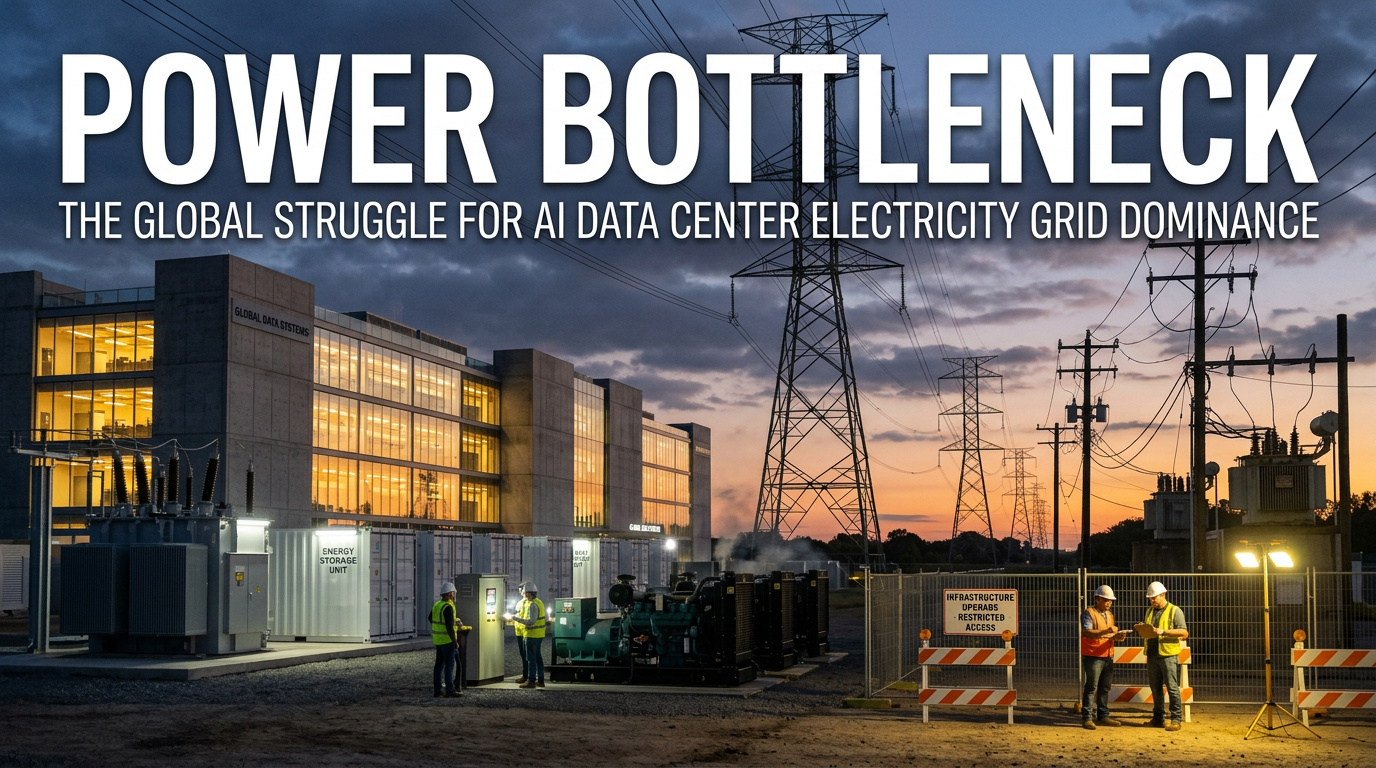
● Power Bottleneck
AI Data Center Shutdown Controversy, the core point is not a “Chinese public opinion campaign” but power infrastructure dominance
The real point to look at in this issue is not simply the provocative story that “China interfered with U.S. AI data center construction.”
What matters more is that electricity bill anxiety, water-use controversy, local resident backlash, and midterm-election politics that were already growing inside the United States are converging into one massive front around AI data centers.
In other words, the AI data center controversy is no longer a technology story; it is becoming a national strategy issue in which the U.S. economy, power infrastructure, big tech investment, semiconductor supply chains, and energy security are all intertwined at once.
On the surface, it looks like a debate over “data centers raising electricity bills,” but underneath, it is a fight over who secures power first, who dominates computing power first, and who takes control of the AI industry.
1. How it started: allegations that China-linked accounts amplified anti-data center sentiment in the U.S.
The first thing that appears in the original text is quite shocking.
It says that an organization suspected of being linked to China spread anti-AI data center comments across communities like X and Reddit, while posing as ordinary U.S. workers, moms angry about electricity bills, and local residents.
The core messages were simple.
- AI data centers use too much electricity.
- Data centers raise ordinary households’ electricity bills.
- Data centers drain and pollute local water supplies.
- Big tech takes the profits while residents bear the costs.
At first glance, this may sound like a conspiracy theory or a movie plot.
But according to the original text, OpenAI stated in a report released in June 2024 that it had identified signs of online opinion-manipulation activity targeting data centers by accounts linked to China.
In particular, some operators reportedly accessed ChatGPT from داخل China through VPNs and shared separate documents outlining methods to avoid account detection.
After that, Republican leadership in the U.S. House sent a letter to the FBI requesting an investigation, saying that “suspicious forces are slowing down the buildout of U.S. AI infrastructure.”
At this point, the conclusion looks straightforward.
The interpretation is that China is obstructing U.S. AI data center construction and waging an information campaign to check U.S. AI dominance.
2. But the real problem is that internal U.S. discontent was already large, even before outside manipulation
Whether China-linked accounts actually existed, and how effective they were, is an important issue.
But more important is the fact that this kind of information campaign did not create a brand-new grievance out of thin air; it amplified anxieties that already existed in American society.
U.S. local residents are already strongly opposed to AI data centers.
According to the original text, a Gallup survey asked Americans whether they supported building an AI data center in their area, and more than 70% said no.
More interestingly, this opposition was not limited to Democratic voters.
It is said that opposition also exceeded a majority among Republican voters and independents.
This is a classic NIMBY phenomenon.
Not In My Backyard: “I know it’s needed, but don’t build it in my neighborhood.”
It is almost the same structure as the recurring conflicts in Korea over substations, transmission towers, incinerators, logistics centers, and data centers.
3. Why residents oppose AI data centers
Local residents generally oppose data centers for three reasons.
① Concerns about rising electricity bills
The biggest complaint is electricity bills.
AI data centers consume enormous amounts of power.
In particular, training generative AI models and operating inference services requires GPU servers, cooling equipment, and power-supply systems to run 24/7.
From the resident perspective, it is only natural to ask, “Big tech is making money with AI, so why should our electricity bills go up?”
② Water use and environmental concerns
The second issue is water.
Data centers use cooling systems to remove heat from servers.
In some regions, water usage becomes a sensitive political issue.
Especially in drought-prone areas, the frame that “AI is taking away the region’s water” spreads easily.
③ Noise and deterioration of living conditions
The third issue is noise.
Large data centers include cooling fans, generators, and substation equipment.
From a resident’s point of view, if a huge gray building moves in and equipment noise is heard day and night, resistance is natural.
Technically, it is a core infrastructure asset for national competitiveness, but to residents it may simply look like a large, noisy facility that consumes a lot of electricity.
4. Why politicians seized on this issue: data centers are easy targets
The AI data center controversy is now growing from a local complaint into a political issue.
The original text says Democratic Congressman Frank Pallone proposed an AI data center moratorium.
Simply put, the claim is to stop new data center construction until power and water issues are resolved.
On the other hand, Republican leadership asked the FBI to investigate, saying Chinese forces are interfering with U.S. AI infrastructure.
Democrats are approaching the same data center issue from the angle of “resident protection and environmental concerns,” while Republicans are approaching it from “countering China and national security.”
This point is very important.
AI data centers are large, highly visible, and consume lots of electricity.
That makes them an easy target for politicians to criticize.
The reasons electricity bills rise are complex: aging transmission grids, insufficient power plant investment, fuel price increases, regulatory costs, and growing demand.
But explaining these structural causes is difficult.
By contrast, data centers are visible right in front of people.
So it is much easier to say, “That big data center is why electricity bills are rising.”
5. Do data centers actually raise electricity bills?
This question is the core point of this controversy.
To put it simply, yes, data centers do increase electricity demand.
But it is difficult to blame all electricity price increases on data centers alone.
Electricity rates are driven by multiple factors.
- Costs of replacing aging transmission grids
- Costs of building new power plants
- Fluctuations in natural gas and oil prices
- Costs of the renewable energy transition
- Rising peak power demand
- Utility companies’ tariff calculation methods
The SemiAnalysis report mentioned in the original text reaches a similar conclusion.
It says it is difficult to say that AI data centers directly caused a major increase in U.S. household electricity bills, and that some statistics showing more than 20% rate increases likely mixed in utility calculation methods or other variables.
Of course, data centers do place a burden on the power grid.
But the simplistic conclusion that “electricity bills rose = it’s because of data centers” is especially dangerous from an investor’s perspective.
Emotionally, this issue makes data centers look like the culprit, but looking at the data, it is closer to a structural problem created by insufficient power infrastructure investment and rising demand together.
6. The water-use controversy is more complex than it seems
The water-use issue at data centers is also a frequent target of criticism.
But the original text presents a somewhat different perspective on this point.
It argues that while data centers do use water, their consumption is much lower than that of almond farms or golf courses.
According to the original text, almond farms use tens to hundreds of times more water than data centers, and golf courses also use more than 20 times as much water as data centers.
It also says Microsoft is applying water-recycling systems at its Washington state data center, and companies like Nebius and CoreWeave are moving away from directly drawing local groundwater and toward maximizing water recycling.
Ultimately, the water issue should not be seen as “data centers are always bad,” but rather judged differently depending on the cooling method used, the water recycling rate, and local water-resource conditions.
7. Data centers also deliver major positive effects to local economies
There is something often left out of anti-data center arguments.
That is local tax revenue and job creation.
The Loudoun County case in Virginia, mentioned in the original text, is a representative example.
In 2026 data, 38% of the county’s general fund revenue came from data centers, and when looking at county property taxes alone, they account for nearly 50%.
In simple terms, you could say the region operates its finances thanks to data centers.
Data center construction requires electrical engineers, plumbing, civil engineering, cooling equipment, security, network, and maintenance workers.
Like the large semiconductor plant construction sites in Pyeongtaek, Korea, major infrastructure projects provide significant vitality to the local economy.
Of course, data centers are not facilities that create large-scale permanent employment like manufacturing plants.
But if you consider the construction phase, power infrastructure expansion, and tax revenue effects, their impact on the local economy is by no means small.
8. Historically, today’s AI data centers are similar to 19th-century railroads
An interesting comparison appears in the original text.
It says that the 1862 construction of the U.S. transcontinental railroad resembles today’s AI data center investment.
At the time, private companies built the railroad, but the federal government strongly supported it by providing land and bonds.
In return, the government was able to use the railroad for military and economic purposes.
There was opposition then too.
But in the end, railroads became core infrastructure for America’s industrialization, territorial integration, and logistics revolution.
Today’s AI data centers are similar.
Private big tech companies are investing, but from the U.S. government’s point of view, they are strategic infrastructure that determines national security and economic dominance.
There is also an interpretation that the connection between GPUs, power grids, semiconductor fabs, cloud services, and data centers is creating a renewed U.S. industrialization trend.
9. Jensen Huang’s core point: AI is bringing manufacturing back to the United States
The original text also mentions a post on X by legendary tech investor Evan Baker.
He strongly argued that data centers revive small towns, create blue-collar jobs, can even lower electricity bills, and use very little water.
Perhaps his wording was too strong, because he later posted that he regretted the tone.
Then NVIDIA’s Jensen Huang commented.
The core point was that AI is bringing back to the U.S. many industries that left overseas for decades.
The idea is that as investment in power grids, energy, semiconductor fabs, and data centers returns to the U.S., it is effectively driving American reindustrialization.
That said, Jensen Huang also says compromise with local communities is necessary.
In other words, AI data center construction is an unstoppable trend, but it cannot continue long-term if the costs are simply pushed onto residents.
10. The U.S. government’s direction: if big tech pays the costs, permits will be processed faster
The original text also outlines an important policy direction.
The structure proposed by the White House in the past is roughly as follows.
“Companies should bear the costs of power generation and transmission/distribution needed for data centers. In return, the government will process permits quickly.”
This is a very realistic compromise.
What residents worry about in the end is cost shifting.
They oppose it because they fear that the costs of expanding the grid, building power plants, and investing in transmission infrastructure will be passed on to ordinary households’ bills.
Then big tech needs to directly shoulder the cost of power infrastructure while providing tax revenue, jobs, and power-grid improvements to the community.
Going forward, AI data center permitting will no longer be a simple land-acquisition issue.
It is likely to become a high-difficulty project that must solve power procurement, resident negotiations, environmental standards, tax incentives, and utility contracts as a package.
11. The true meaning of the “more than half of data center projects canceled” news
Recently, the market has also heard that more than half of data center projects were canceled.
On the surface, that seems to suggest AI infrastructure investment is slowing down.
But the original text interprets this statistic differently.
As a representative case, it mentions a huge power-demand request of more than 410GW submitted to the Texas grid.
This scale is far beyond the actual power Texas can supply.
So were all of these projects real?
That is probably unlikely.
Many developers submit applications to multiple regions and utility companies at the same time before securing land and power infrastructure.
It is similar to applying to multiple colleges during university admissions.
The original text calls these “phantom data centers.”
They are not projects that can actually be built, but rather duplicated plans submitted to test the chances of approval.
Therefore, the interpretation is that many of the canceled projects were phantom projects with low feasibility from the start, and it is difficult to say that actual data center projects with secured land and power were canceled on a large scale.
12. What investors should look at: power procurement capability becomes a premium
From an investment perspective, the answer to this issue is fairly clear.
The bottleneck for AI data centers is not only GPUs.
It is now power.
The most important asset in the AI industry is computing power, and to secure computing power, you need GPUs, data centers, cooling, and power grids at the same time.
Among these, the biggest bottleneck going forward is likely to be securing stable power.
So investors should not look only at AI software companies, but also at the following areas together.
- Hyperscale cloud companies that secured power infrastructure first
- Infrastructure companies that secured data center sites and power contracts
- Companies related to transmission grids, transformers, and power equipment
- Companies offering eco-friendly distributed power solutions
- Companies specializing in cooling systems and power-efficiency technologies
In particular, companies that secure power first can receive a significant premium in the market.
The AI race is a speed race.
The faster you secure computing power, the better AI models you can build, the faster you can launch services, and the faster you can dominate the ecosystem.
Within this flow, access to power is not just a cost item but a strategic asset.
13. Why alternative power solutions like Bloom Energy are drawing attention
The original text also mentions Bloom Energy.
Bloom Energy is known for fuel-cell-based power solutions.
From a data center’s point of view, it can be an alternative that reduces local resident backlash compared with traditional gas turbines or reciprocating engines.
The reason is simple.
It is relatively eco-friendly, raises fewer air-pollution concerns, and can be used as a distributed power source.
What local communities hate most is the feeling that “a big power facility and pollution source is coming into our neighborhood.”
But if a power solution is quiet, has fewer emissions issues, and reduces burden on the grid, it can be much more favorable in the permitting process.
Going forward, AI data center investment is likely to expand beyond GPU companies to include power technology companies, energy storage, fuel cells, and transmission/distribution equipment companies.
14. The most important point often missed in other news and YouTube coverage
Many reports on this controversy focus on surface-level issues such as “China is interfering with U.S. data centers” or “opposition to data centers is growing in the U.S.”
But the truly important point is elsewhere.
① Anti-data center sentiment has become a new battlefield in the AI dominance race
In the past, the AI race centered on GPU export controls, semiconductor supply chains, and model performance competition.
Now, local resident opinion and permitting are also becoming part of the AI dominance race.
If directly blocking another country’s data center construction is difficult, slowing it down by amplifying local opposition is a viable strategy.
This is likely to repeat in the future.
② The power grid is the real bottleneck of the AI era
Many people look only at NVIDIA GPUs when examining the AI industry.
But even if you have GPUs, you cannot run a data center without power.
Even if you have land, you cannot start construction without a transmission grid.
Even if permits are approved, the schedule slips if local communities oppose it.
In the end, the key bottleneck for AI data centers is the combination of “GPU + power + permits + local consent.”
③ Looking only at canceled data center project counts can lead to mistakes
In the market, people may see canceled project numbers and interpret them as a slowdown in AI infrastructure investment.
But in reality, it may be the process of sorting out duplicated phantom data centers.
What really matters is not the cancellation count, but whether the projects that secured land and power are actually continuing.
④ Data centers are not just cost-generating facilities; they can become a core part of local finances
Data centers may seem to offer few immediately felt benefits to residents.
But if you consider tax revenue, power-grid improvements, construction jobs, and local infrastructure investment, they can make a significant contribution to the local economy.
The problem is that these benefits are not clearly communicated to residents.
Going forward, big tech will need to explain not just “we are needed for AI,” but “what tangible benefits will we bring to this area?”
⑤ AI data center construction is hard to stop
This is the most important conclusion.
It is unlikely that the U.S. will completely stop building AI data centers because of China’s counterpressure or internal political conflict.
AI is now a strategic asset.
National security, economic growth, military technology, manufacturing competitiveness, and the cloud industry are all connected.
From the U.S. perspective, it cannot fall behind China.
So although short-term noise will increase, long-term AI data center investment is likely to continue.
15. Checkpoints to watch in the market going forward
- Changes in AI data center permitting regulations by U.S. state
- Power-grid connection wait times and transmission investment 규모
- Expansion of big tech’s self-generated power and long-term power purchase agreements
- Data center cooling methods and whether water recycling technology is applied
- Cases of negotiations with local residents over taxes, schools, and power benefits
- The scale of actual construction projects after phantom data centers are cleared out
- Order trends for distributed power companies like Bloom Energy
- Earnings performance of power equipment, transformers, cables, and cooling-system companies
From an investor’s perspective, there is no need to be frightened just by headlines saying “opposition to AI data centers is growing.”
Instead, you should look at where the bottleneck is emerging.
Wherever a bottleneck appears, a price premium follows.
In the current AI infrastructure cycle, that bottleneck is increasingly shifting toward power infrastructure and permitting capability.
16. Final view: the AI data center controversy is not the end, but the beginning of industrial restructuring
This issue should not simply be dismissed as an allegation of Chinese information warfare.
AI data centers are likely to become a core issue cutting across the U.S. presidential election, midterms, local politics, electricity bills, water use, big tech regulation, semiconductor investment, and energy security.
In the short term, there may continue to be news about construction delays, local opposition, and tighter regulation.
But in the long term, it will be hard for the United States to stop investing in AI infrastructure.
The AI race is a speed race, and computing power is national competitiveness.
In the end, the winners in the market will likely be not only the companies that own GPUs, but those that secure power, reach agreement with residents, pass permitting, and actually operate data centers.
So the core point of this controversy is not whether data center construction will stop.
The real question is: who will solve the AI data center bottleneck first?
< Summary >
Anti-AI data center sentiment is growing as allegations of information warfare by China-linked accounts combine with U.S. internal complaints about electricity bills, water use, and noise.
But it is difficult to say that data centers are the sole cause of rising electricity bills, and the real issue is closer to a structural problem in which aging power grids and growing demand overlap.
Data centers also have positive effects in terms of local tax revenue, jobs, and power infrastructure investment.
Many of the recently said-to-be-canceled projects are likely phantom data centers with weak substance.
From an investment standpoint, rather than completely stopping AI data center construction, companies with the ability to secure power, obtain permits, and reach agreements with residents are likely to command a premium.
The AI race is ultimately a speed race, and power infrastructure may become the most important bottleneck in the AI industry going forward.
[Related Articles…]
- AI Infrastructure Investment Cycle and Data Center Bottleneck Analysis
- How Power Infrastructure and Energy Security Are Reshaping the Global Economy
*Source: [ 월텍남 – 월스트리트 테크남 ]
– AI 데이터센터 전면 중지 위기의 전말