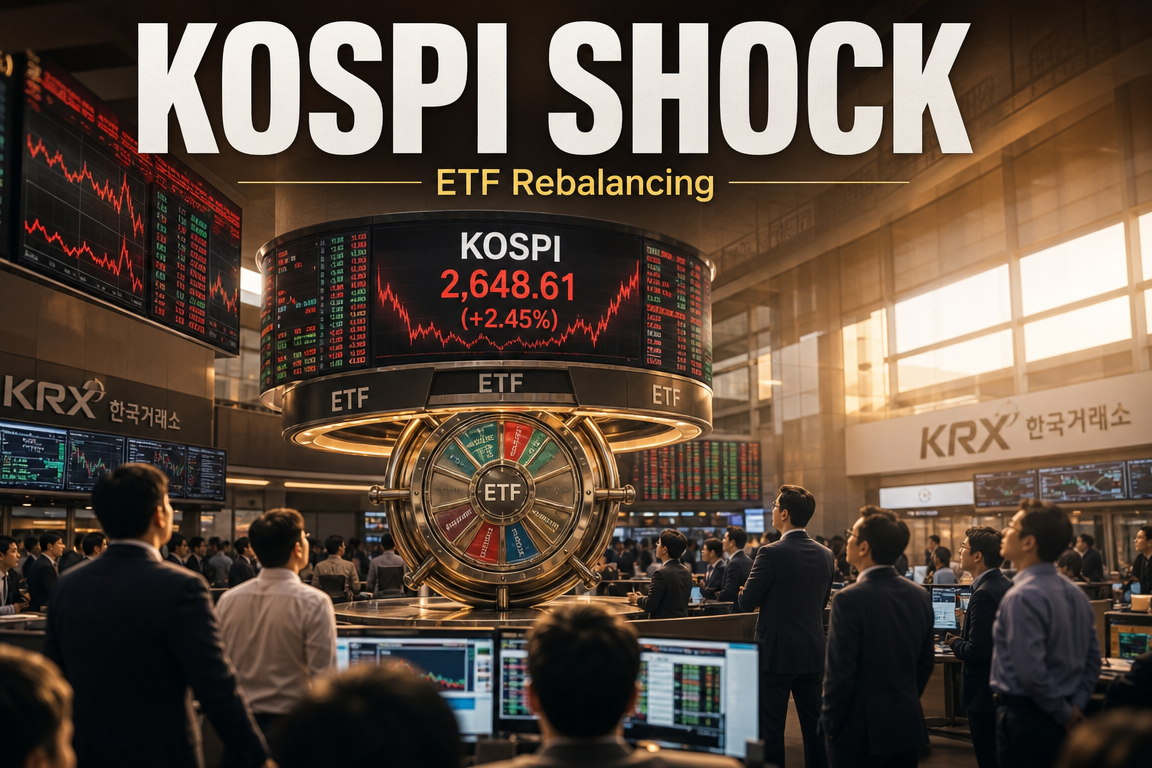
● KOSPI Shock, ETF Rebalancing, TSMC Surge, AI Rebound
Why the KOSPI Recovered After an Intraday Drop: ETF Rebalancing, Quadruple Witching, and TSMC’s Sales Surprise
The key feature of today’s KOSPI session was not a simple rebound, but a trading day in which a supply shock first pressured the market before AI semiconductor momentum helped stabilize it.
At the open, selling pressure intensified, led by Samsung Electronics and SK Hynix, and market sentiment turned noticeably weaker.
However, bargain buying emerged later in the session, and TSMC’s stronger-than-expected monthly sales provided an additional catalyst, allowing the KOSPI to recover.
At first glance, the session may appear to have been a routine drop and rebound. In reality, it was a day in which ETF rebalancing, quadruple witching, AI semiconductor earnings expectations, and the SK Hynix ADR valuation gap were all closely linked.
The most important question today is not the KOSPI level itself, but whether global capital continues to maintain its view on large-cap semiconductor stocks.
1. Why the KOSPI fell sharply at the open: multiple supply-side events converged
The initial weakness in the market was not driven by a sudden deterioration in corporate fundamentals.
The main factor was order flow.
Today had the characteristics of quadruple witching.
When index futures, index options, single-stock futures, and single-stock options expire on the same day, market volatility typically rises.
ETF rebalancing also added pressure.
ETF rebalancing refers to the process of adjusting portfolio weights to match predefined benchmarks.
Securities with weights that have become too large are partially sold, while underweighted holdings are increased.
In this process, large-cap stocks that have recently risen strongly can face short-term selling pressure.
2. Why Samsung Electronics and SK Hynix were hit first
The main targets of early selling were Samsung Electronics and SK Hynix.
Because these semiconductor giants have contributed a large share of recent KOSPI gains, their ETF weights are also substantial.
During rebalancing, mechanically generated sell orders can be concentrated in such high-weight stocks.
As a result, the early session created the impression that semiconductors were breaking down.
However, interpreting this move as a deterioration in earnings or a slowdown in AI semiconductor demand would be misleading.
The initial decline was driven more by temporary supply pressure associated with expiration and rebalancing than by fundamentals.
3. First reason the KOSPI recovered: forced selling was absorbed faster than expected
As selling pressure increased in Samsung Electronics and SK Hynix, the KOSPI quickly declined.
After a certain point, however, market sentiment began to shift.
Investors started to believe that the bulk of rebalancing-related selling had likely already been released.
Large-cap semiconductors also remain closely tied to AI demand, making them attractive candidates for bargain buying after a sharp intraday decline.
The first driver of the rebound was therefore absorption of forced selling followed by opportunistic buying.
This helped lift the broader KOSPI as well.
4. The main catalyst for the rebound: TSMC’s monthly sales rose 53% year on year
The factor that clearly changed market sentiment was TSMC’s monthly sales announcement.
TSMC is the dominant player in the global foundry market.
It is a key manufacturing partner for global megacap technology firms and AI chip companies, including Nvidia, Apple, and AMD.
TSMC’s monthly sales rising 53% from a year earlier sent a strong signal to the market.
The significance of this figure is not simply that TSMC reported strong earnings.
Strong sales imply that AI chip orders, high-performance computing demand, and advanced-node utilization remain resilient.
The market’s interpretation was straightforward:
The AI semiconductor cycle has not yet broken down.
That signal brought renewed buying into KOSPI semiconductor leaders.
5. Why TSMC’s results matter for Korea’s equity market
In the Korean market, semiconductors are not just one sector.
They are a central driver of the KOSPI index.
In particular, Samsung Electronics and SK Hynix are directly linked to memory semiconductors, HBM, and AI server demand.
TSMC’s strong monthly sales suggest that global AI infrastructure investment remains intact.
As AI server deployments increase, demand rises for high-performance GPUs, which in turn require HBM and other high-value memory products.
In this structure, Samsung Electronics and SK Hynix are seen as direct beneficiaries.
For that reason, TSMC’s sales surprise is not merely a Taiwan-specific headline; it also affects Korean equity sentiment and semiconductor valuations.
6. Why SK Hynix ADR was at a record high while the local share stayed muted
One notable feature of today’s session was the movement in the SK Hynix ADR.
The ADR listed in the U.S. reached a new high on the previous day.
Normally, a strong ADR performance tends to support the local ordinary share the following day.
However, that effect was not immediately reflected in the domestic listing today.
The reason was the combination of ETF rebalancing and expiration-related supply pressure weighing on the local share.
In other words, global investors were constructive on SK Hynix in the U.S. market, while domestic trading was dominated by short-term supply events.
7. Why the more than 40% valuation gap between the SK Hynix ADR and the local share matters
An important point raised in the original text is the valuation gap between the SK Hynix ADR and the local ordinary share.
The gap was described as exceeding 40%, versus an average gap of about 34% since the ADR listing.
A wider gap means that the price of the ADR in the U.S. market and the price of the local share in Korea have diverged more than usual.
In such cases, the market naturally considers whether the gap may narrow.
There are two main ways that narrowing can occur.
First, the ADR can decline and close part of the gap.
Second, the local share can rise and close the gap from the Korean side.
Given the AI semiconductor backdrop and TSMC’s sales surprise, market participants may pay attention to the second scenario as well.
This does not mean the valuation gap alone guarantees upside.
However, on a day when the local share was pressured by supply factors, the possibility of normalization remains an important point to watch.
8. News-style summary of today’s market
[Market Overview]
The KOSPI weakened sharply at the open due to quadruple witching and ETF rebalancing pressure.
Semiconductor heavyweights such as Samsung Electronics and SK Hynix led the decline.
[Supply Factors]
ETF rebalancing appears to have triggered selling in semiconductor leaders with large benchmark weights.
Expiration-related position adjustments in derivatives likely added to intraday volatility.
[Recovery Factors]
As the market absorbed the initial sell orders, bargain buying emerged in Samsung Electronics and SK Hynix.
Sentiment then improved further after TSMC reported monthly sales growth of 53% year on year, reinforcing the AI semiconductor investment theme.
[Notable Point]
SK Hynix ADR hit a record high in the U.S. market, but the local share remained under pressure from short-term supply factors.
The valuation gap between the ADR and the local share remains wider than average, making any subsequent narrowing an important variable.
9. The main takeaway that is often missed in other reports
The key message today was not simply that the KOSPI rebounded, but that confidence in the AI semiconductor cycle remained intact.
Many reports are likely to describe the session as a volatile rebound in semiconductors.
More importantly, however, the market absorbed a supply shock and still responded quickly to a fundamental signal from AI semiconductors.
ETF rebalancing and quadruple witching are temporary supply events.
By contrast, TSMC’s 53% sales increase is a fundamental indicator supporting the global AI investment cycle.
In other words, today was a day in which short-term supply pressure and medium-term growth expectations came into conflict.
By the close, the market assigned greater value to growth than to temporary supply distortions.
That is the most important interpretation of today’s KOSPI rebound.
10. Key items investors should monitor going forward
First, watch whether SK Hynix’s local share follows the strength in the ADR.
Given that the valuation gap remains wider than average, investors should monitor whether the Korean listing reacts with a delay.
Second, watch whether TSMC’s sales strength leads to higher earnings expectations for Samsung Electronics and SK Hynix.
If this is translated into upward revisions from analysts, the semiconductor sector could gain additional momentum.
Third, monitor whether any supply vacuum remains after ETF rebalancing.
If foreign and institutional buying continues after rebalancing-related selling ends, the quality of the KOSPI rebound improves.
Fourth, track whether AI semiconductor stocks in the U.S. continue to perform strongly.
Stocks such as Nvidia, AMD, Broadcom, and TSMC have a direct impact on semiconductor sentiment in Korea.
Fifth, monitor the exchange rate and foreign investor flows.
A sustained KOSPI rally in large caps depends largely on foreign inflows.
If the KRW/USD exchange rate stabilizes and foreign net buying continues, the rebound could become more durable.
11. Conclusion: the KOSPI did not simply recover; it absorbed a supply shock
Today’s KOSPI opened under heavy pressure but ultimately recovered.
That rebound should not be interpreted as a random recovery.
The early decline was largely driven by supply-side effects from ETF rebalancing and derivatives expiration.
The later rebound resulted from the absorption of selling pressure, bargain buying in semiconductors, and TSMC’s sales surprise.
In particular, TSMC’s strong monthly sales during a period of rising concern about the AI semiconductor cycle carried meaningful implications.
The market’s message today is clear:
Short-term supply conditions weakened, but confidence in the AI semiconductor cycle has not broken down.
Going forward, investors should monitor not only the index level, but also the trading flow in Samsung Electronics and SK Hynix, TSMC’s sales trajectory, and the valuation gap in the SK Hynix ADR.
< Summary >
Today’s KOSPI decline was driven more by supply pressure from quadruple witching and ETF rebalancing than by weaker fundamentals.
Samsung Electronics and SK Hynix faced selling pressure because of their large weights in ETFs.
As that selling was absorbed, bargain buying emerged and the KOSPI recovered.
TSMC’s monthly sales, which rose 53% year on year, then helped revive sentiment toward AI semiconductors.
SK Hynix ADR reached a record high in the U.S. market, while the domestic share remained under short-term supply pressure.
The valuation gap between the ADR and the local share remains wider than average, making any narrowing an important point to watch.
The key takeaway is not the rebound itself, but that confidence in the AI semiconductor cycle was preserved.
[Related Articles…]
*Source: [ 내일은 투자왕 – 김단테 ]
– 코스피 죽었다 살아난 이유 #코스피 #하이닉스 #TSMC
● Treasury-Short-Squeeze, Yield-Reversal, Liquidity-Shock
Record Short Position in 30-Year Treasuries: Scenario for a Reversal in U.S. Yields in September and October
The key issue here is not simply whether U.S. yields will rise or fall.
The market is now carrying an historically unusual short position in 30-year U.S. Treasury futures, while September tax payments, the TGA, Federal Reserve policy, excess tax revenue from the AI value chain, and U.S. fiscal spending are all interacting at the same time.
In practical terms, September may bring a temporary liquidity drain and higher market volatility, while October could see liquidity improve as government spending is released into the system.
Against that backdrop, the 10-year Treasury yield approaching 5% could pressure risk assets, but it may also create a buy-the-dip opportunity ahead of the year-end rally.
A point that is often overlooked is that strong AI corporate earnings are feeding into higher tax revenue, which could help ease concerns over the U.S. fiscal deficit.
1. The largest current market variable: an excessive short position in 30-year Treasuries
The most notable feature in the U.S. long-duration Treasury market is the short position in 30-year Treasury futures.
During the discussion, the 30-year short position was described as being around -2 standard deviations from a historical perspective.
In other words, selling pressure in this segment is near levels that have been rare over the past 20 years.
In such a setup, the probability that rates keep rising and shorts continue to profit may be lower than the probability of a sharp reversal driven by short covering.
Because Treasury prices and yields move inversely, a broad unwind of short positions could lift Treasury prices sharply and drive U.S. yields lower quickly.
In addition, TLT and similar long-duration Treasury ETFs were said to remain well above historical highs in terms of borrow balance.
This suggests the positioning may be more hedge-fund driven than long-term investor driven.
The key point is this.
When positioning becomes too one-sided, prices can reverse sharply through liquidation alone, even without a major change in fundamentals.
As seen in past examples such as carry-trade unwinds and sharp equity selloffs in Japan, crowded positioning can move markets faster than expected.
2. September volatility driver: the TGA and tax payment season
The TGA is another important variable for September markets.
The TGA is the U.S. Treasury’s operating account.
It plays a central role when the government collects taxes, issues debt, and executes spending.
In the U.S., tax payments are typically concentrated in September.
Given the structure of the U.S. tax system, where personal income taxes are significant, the seasonal inflow of tax payments into the government account can temporarily reduce liquidity in the private sector.
During the discussion, it was noted that the TGA balance has historically increased by about $400 billion on average in September.
If this year’s AI-related corporate earnings, capital gains, dividends, and interest income are especially strong, tax inflows could potentially reach around $600 billion.
In that case, September could see a liquidity drain and higher volatility across equities and bonds.
However, the money does not disappear permanently.
Once the government begins spending, liquidity could be re-injected in October.
In other words, September may be a liquidity absorption period, while October may become a liquidity relief period.
3. Is 5% on the 10-year yield a crisis or an opportunity?
One of the most interesting scenarios discussed was the possibility that the 10-year U.S. Treasury yield touches 5%.
In general, a 10-year yield at 5% would be a major headwind for equities.
Higher discount rates compress valuations, especially for growth stocks, and reduce risk appetite.
At the same time, this level could also be viewed as a buy-the-dip opportunity.
Earlier in the year, in March and April, the market was shaken by multiple negative developments and liquidity issues, yet investors who bought semiconductors and AI-related stocks during that period later saw strong gains.
This time as well, September could bring volatility through tax payments, FOMC decisions, inflation data, and geopolitical headlines.
But if the correction is driven by a liquidity gap and position unwinding rather than a fundamental deterioration, it may again create a buying opportunity ahead of the year-end rally.
There is, however, one condition.
If the 10-year yield peaks around 4.7% to 4.8% and then declines, a short-term correction followed by recovery becomes more likely.
By contrast, if the 10-year yield breaks above 5% and remains elevated, weakness could extend from September into October.
4. Federal Reserve policy risk: inflation may be easing, yet the Fed could still stay hawkish
One of the recurring risks discussed was a hawkish surprise from the Federal Reserve.
Current real-time inflation indicators and core inflation trends suggest that disinflation is continuing.
Even so, the Fed could ignore this and either raise rates or deliver a strongly hawkish message.
Political factors may also influence monetary policy.
As a result, it is difficult to forecast the Fed’s response based only on CPI or PPI data.
Another important point was the market impact of a rate hike versus a hold.
Typically, a rate hike is seen as more negative for equities.
However, the discussion suggested that a hold could push long-term yields higher.
The reason is that the market may interpret a hold as evidence that inflation is not being contained decisively.
In that case, inflation expectations could rise again and long-term Treasury yields could move higher.
By contrast, a rate hike would be a short-term shock, but it could also signal a stronger commitment to controlling inflation and limit further upward pressure on long-term yields.
5. Labor market assessment requires more than the unemployment rate
When evaluating the U.S. labor market, the unemployment rate alone can be misleading.
The discussion emphasized the importance of also watching the labor force participation rate.
Even if the unemployment rate appears low, a declining participation rate may indicate that the labor market is weaker than it seems.
If more people stop looking for work, the unemployment rate can remain artificially low.
Therefore, to assess recession risk in the U.S., investors should look at unemployment, payroll growth, wage growth, and labor force participation together.
This also has important implications for Fed policy and the direction of U.S. equities.
6. A hidden fiscal lever: excess tax revenue and TGA spending
Markets are widely focused on the U.S. fiscal deficit.
However, the discussion offered a different perspective.
If the U.S. Treasury receives strong tax inflows in September, it may be able to spend without increasing borrowing as much as expected.
If the TGA balance is not critically low, the government could recycle tax receipts into spending and support liquidity in October.
In that case, fiscal spending could support the economy without materially increasing the burden of new Treasury issuance.
The discussion suggested that the U.S. government may already have roughly $1 trillion in funds, and that additional tax receipts could bring available spending capacity closer to $2 trillion.
That would be a large amount relative to U.S. GDP.
If deployed after September, it could make the October liquidity backdrop more constructive than many expect.
7. A key point often missing from mainstream coverage: the AI value chain is changing tax revenue
The most important hidden point from the discussion is the link between the AI value chain and excess tax revenue.
AI is often discussed in terms of Nvidia, semiconductors, data centers, power infrastructure, and cloud companies.
But the more important trend is that the AI investment boom is increasing corporate earnings, and those earnings are translating into government tax revenue.
This is not limited to Korea.
Countries involved in the AI value chain may also benefit from higher tax receipts.
The U.S. is strong in AI chip design, hyperscalers, AI models, and cloud infrastructure.
Japan is strong in semiconductor materials and components.
The Netherlands is critical in semiconductor equipment.
Taiwan plays an essential role in foundry manufacturing.
Korea remains important in memory semiconductors and HBM.
These countries are entering a period in which AI infrastructure spending is driving substantial growth in revenue and operating profit.
Free cash flow may decline because of higher investment, but not because companies are failing to generate earnings.
From a tax perspective, revenue and profit growth matter far more.
In this sense, AI is not only a stock-market theme but also a structural factor affecting national fiscal positions.
Countries positioned in the AI value chain may experience stronger tax revenue, greater fiscal room, and a lower deficit burden.
Countries outside the AI value chain may be relatively disadvantaged in terms of growth and tax collection.
8. Korea’s excess tax revenue should be viewed through the same lens
Korea’s excess tax revenue should also be interpreted in connection with the semiconductor cycle.
As earnings at Samsung Electronics and SK hynix improve, corporate tax revenue rises.
Korea has a relatively direct link between corporate earnings and tax receipts.
One notable feature is that Korean semiconductor companies can still deliver record earnings even if some market share declines.
The reason is that the overall market is expanding rapidly.
AI demand is driving growth in memory, HBM, foundry, equipment, and materials markets.
As a result, even if market share declines slightly, earnings can still rise if the total addressable market becomes much larger.
This is the mechanism through which AI value chain countries can simultaneously benefit from stronger tax revenue.
9. The Treasury Department as the key player in long-term yield control
If long-term yields keep rising, the institution that can most directly influence them may be the U.S. Treasury rather than the Federal Reserve.
One of the main tools is the composition of Treasury issuance.
In 2023, when the 10-year yield approached 5% and markets became stressed, the Treasury increased the share of short-term issuance in its funding plans, easing pressure on long-term yields.
If long-term yields remain elevated this time, the November Quarterly Refunding Announcement could become a major market event.
By reducing long-duration issuance and adjusting the funding mix toward shorter maturities, the Treasury could help cap long-term yields.
Buybacks are also an important signal.
In this context, the message that the Treasury is actively supporting market stability may matter more than the size of the program itself.
Once the market recognizes the Treasury’s intent, short positions in long-duration bonds may come under pressure.
10. Potential triggers for short covering in long-duration Treasuries
With such a large short position in 30-year Treasuries, even a small catalyst could trigger a major move.
-
Lower-than-expected CPI or PPI would strengthen disinflation expectations.
-
A less hawkish Fed message could increase downward pressure on long-term yields.
-
The Treasury could signal support for rate stability through buybacks or issuance adjustments.
-
Broader TGA spending could improve liquidity conditions in October.
-
A reduction in 30-year issuance or a lower supply burden in long bonds could trigger short covering.
Any one of these factors could push yields lower quickly in a market with crowded positioning.
In periods where positioning matters more than fundamentals, investors cannot rely solely on macro data interpretation.
11. September and October strategy: maintaining some exposure may be preferable to going fully to cash
The discussion also highlighted the risk of trying to go completely to cash and waiting for a pullback.
If the market does not correct as expected, re-entry can become difficult.
Accordingly, maintaining some equity exposure while leaving room to add on weakness may be a more practical approach.
In particular, AI semiconductors, data centers, cloud infrastructure, power infrastructure, and equipment and materials remain structurally attractive even in the face of short-term volatility.
That said, if long-term yields move above 5% and fail to stabilize, valuation pressure on growth stocks could intensify and a more cautious entry strategy may be appropriate.
12. Key dates and indicators for investors to watch
-
September tax payment season: Monitor whether TGA balances rise and private-sector liquidity tightens.
-
FOMC: The market reaction to the Fed’s stance may matter more than whether the move is a hike, hold, or cut.
-
CPI and PPI: Softer inflation readings could act as a trigger for short covering in long-duration Treasuries.
-
10-year yield at 5%: This is a level at which market stress and buy-the-dip opportunities should both be considered.
-
30-year short positioning: Investors should watch whether crowded positioning begins to unwind.
-
TGA spending flow: This will be central to the October liquidity backdrop.
-
November QRA: The Treasury’s funding plan could change the direction of long-term yields.
-
Labor force participation rate: Do not rely on the unemployment rate alone when assessing labor market strength.
13. Scenario summary
Positive scenario.
September tax payments create a temporary liquidity drain, but TGA spending begins to flow in October and global liquidity improves.
Inflation data comes in softer, short covering emerges in long-duration Treasuries, and U.S. yields decline.
In this case, the September correction could become a buying opportunity ahead of the year-end rally.
Neutral scenario.
Long-term yields peak around 4.7% to 4.8%, and markets remain range-bound with elevated volatility.
AI value chain equities continue to show relative strength on earnings expectations.
Negative scenario.
The Fed turns more hawkish than expected, or the 10-year yield moves above 5% and fails to stabilize.
In that case, equities could remain under pressure from September through October.
Risk appetite may stay weak until the Treasury signals a clearer shift in issuance strategy or market support measures.
The most important points that are often missing from other coverage
First, the AI value chain is not just an equity theme; it is changing national tax revenue structures.
AI-related investment in semiconductors and infrastructure is raising corporate earnings, which in turn increases tax receipts and fiscal capacity in the U.S., Korea, Japan, Taiwan, and the Netherlands.
Second, U.S. deficit concerns may be partially offset by excess tax revenue.
The market often assumes the U.S. must continue borrowing heavily, but stronger-than-expected tax collections could allow the government to spend without proportionally increasing debt issuance.
Third, the 30-year short position is itself fuel for a market reversal.
Even if the case for lower yields is not overwhelming, a crowded short can drive a sharp decline in long-term yields through short covering alone.
Fourth, September weakness and October liquidity improvement should be viewed together.
September may look weak because of tax payments and higher TGA balances, but October could be more supportive once government spending is released.
Fifth, the Treasury may have more influence over long-term yields than the Fed.
The Fed sets policy rates, but the Treasury controls issuance structure, buybacks, and funding strategy.
At present, Treasury actions are as important as Federal Reserve policy for long-duration rates.
< Summary >
A historically large short position has built up in 30-year U.S. Treasuries.
September may bring a temporary liquidity drain due to tax payments and TGA growth.
October could see liquidity improve as government spending is released.
If the 10-year yield touches 5%, markets may face stress, but it could also create a buy-the-dip opportunity.
AI value chain countries are benefiting from higher corporate earnings and potential excess tax revenue, which may ease concerns over the U.S. fiscal deficit.
Key risks include a hawkish Fed surprise, a further rise in long-term yields, and weaker labor force participation.
Investors should monitor CPI, PPI, FOMC, TGA, 30-year short positioning, and the November QRA as core checkpoints.
[Related Articles…]
- U.S. Yield Outlook and Global Liquidity Shifts
- How the AI Value Chain Is Reshaping Economic Outlook and Investment Trends
*Source: [ 경제 읽어주는 남자(김광석TV) ]
– 30년물에 역대급 숏이 쌓였다… 국채금리 ‘대반전’ 나올까? | 경읽남과 토론합시다 | 3자토론 문홍철x성상현x김광석 [6편]