● KOSPI Sinks as Middle East Shock and 5 Percent US Yield Jolt Markets
Why the KOSPI Fell Suddenly: U.S. Treasury Yield Above 5% and Middle East Risks Outweighed AI Concerns
The key driver behind this KOSPI decline was not simply a pause in AI-related stocks.
At the open, the market was supported by the view that the slowdown in AI investment may not be as severe as initially feared, with Samsung Electronics and SK hynix helping the index hold up.
However, sentiment shifted sharply in the afternoon.
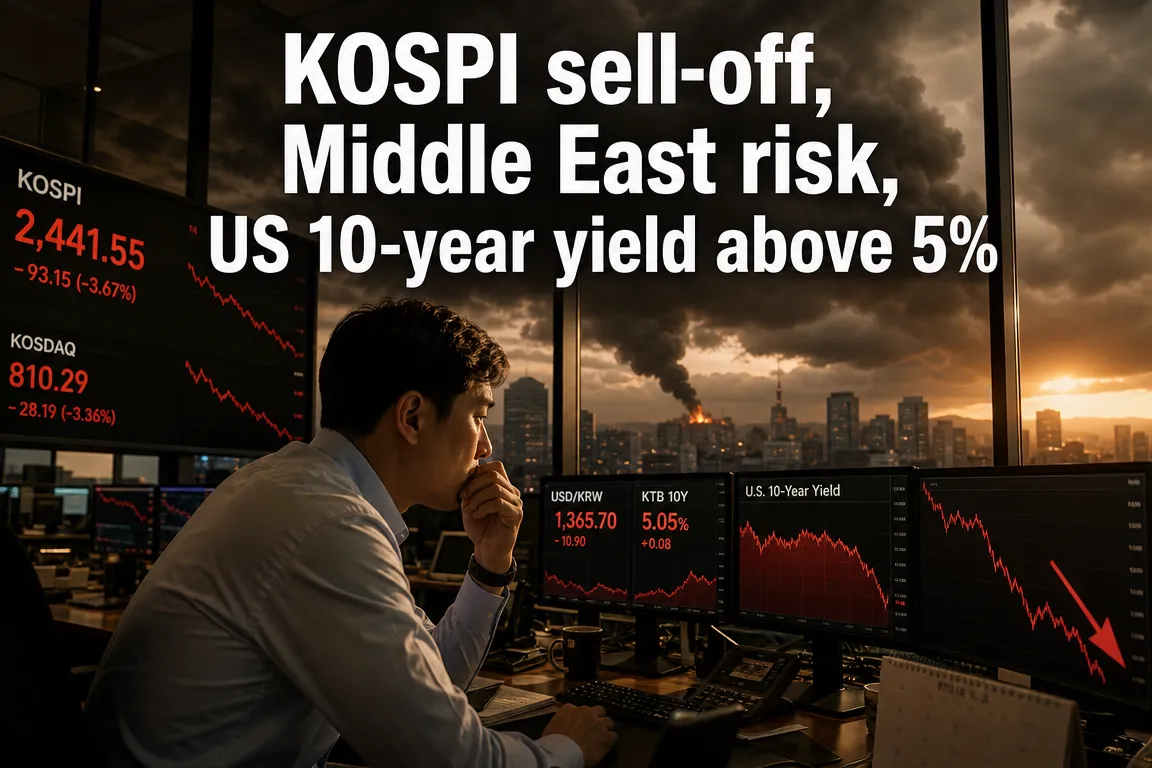
The main trigger was renewed Middle East risk, while the U.S. 10-year Treasury yield moved above the psychologically important 5% level, adding pressure across global equities.
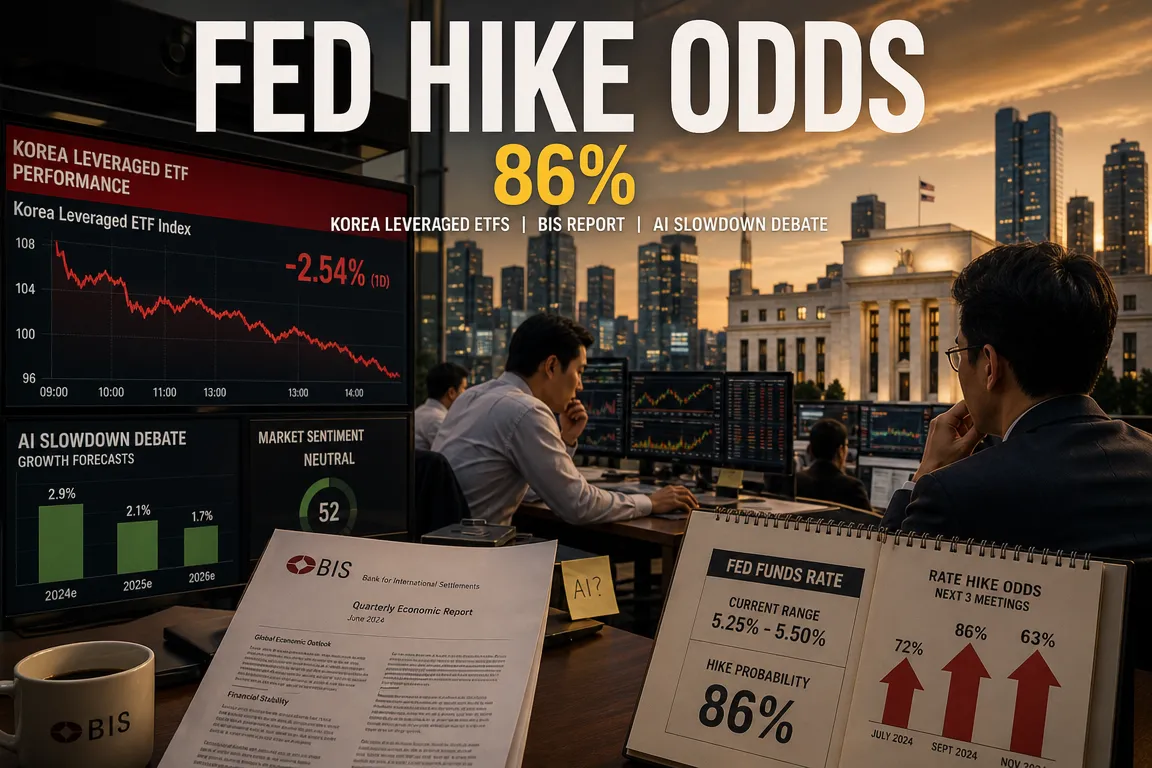
With this week’s FOMC approaching, concerns over additional rate hikes also intensified investor caution toward the KOSPI outlook.
1. Early Session: AI Slowdown Concerns Were Less Severe Than Expected
The KOSPI was not under heavy pressure in the early session.
The previous day’s market volatility had been driven by concerns over a slowdown in AI investment.
In practical terms, this reflected fears that global tech firms could reduce the pace of AI infrastructure spending.
- Concerns over a slowdown in AI server investment
- Fears that HBM demand may be approaching a peak
- Profit-taking pressure on semiconductors such as SK hynix and Samsung Electronics
- Valuation concerns across AI-related stocks
By the early session, however, these concerns had eased somewhat.
The market interpretation was that AI demand had not weakened, but rather that investment spending may be moderating.
As a result, semiconductor stocks were relatively resilient early in the day.
2. Afternoon Shift: Middle East Tensions Returned to the Forefront
The situation changed in the afternoon.
Market attention moved away from AI and back toward geopolitical risk.
The key issue cited in the source material was attacks by Houthi forces on Saudi Arabia.
When geopolitical tensions rise in the Middle East, markets do not treat them as isolated headlines.
Investors immediately factor in the implications for crude supply, logistics costs, inflation, rates, and corporate expenses.
- Rising Middle East tensions
- Higher expectations for crude oil prices
- Renewed inflation concerns
- Upward pressure on U.S. Treasury yields
- Stronger risk-off sentiment
This is particularly negative for emerging markets such as Korea.
Korea is highly sensitive to energy imports, global trade, and the semiconductor cycle.
3. The Decisive Factor: U.S. 10-Year Treasury Yield Above 5%
The most important figure in this decline was the U.S. 10-year Treasury yield above 5%.
In global financial markets, this yield serves as a reference point for asset pricing.
A move above 5% signals that investors can earn attractive returns from U.S. government bonds without taking equity risk.
The source notes that this level was the highest since 2007.
That makes it a psychologically significant threshold for markets.
- Higher yields raise the discount rate applied to future earnings
- Valuation pressure increases for growth and technology stocks
- AI-related and semiconductor stocks face stronger profit-taking
- Foreign investors may reduce exposure to emerging markets
- Won weakness and funding concerns can increase KOSPI volatility
Stocks such as SK hynix, which have risen sharply on AI expectations, are especially sensitive to rising yields.
Equities with highly valued future growth expectations tend to be more exposed when discount rates rise.
4. FOMC Risk: The Market Focused More on the Next Message Than the Rate Decision Itself
This week’s key event is the FOMC, where monetary policy will be set.
According to the source, the market had already largely priced in the possibility of another rate increase.
The real concern was not the rate decision itself.
What investors feared more was the Federal Reserve’s guidance.
- Whether the Fed would keep the door open to further rate hikes
- Whether it would emphasize a prolonged period of high rates
- Whether it would warn of renewed inflation pressures
- Whether it would prioritize inflation control over growth
In other words, the main concern was not a single rate hike, but how long high rates would remain in place.
That remains a critical factor for the KOSPI outlook.
5. Why the KOSPI and Semiconductors Were Hit Harder
The KOSPI is highly sensitive to global risk sentiment.
In particular, the Korean market is anchored by large-cap semiconductor stocks such as Samsung Electronics and SK hynix.
These stocks have recently rallied on expectations tied to AI semiconductors, HBM, and data center investment.
However, after a strong advance, adverse external shocks can quickly trigger profit-taking.
- AI expectations had already been priced in
- Higher U.S. Treasury yields increased pressure on growth stocks
- Middle East risk strengthened risk-off sentiment globally
- Investor caution rose ahead of the FOMC
- Foreign flow shifts added to index volatility
In the end, the decline was not caused by a single factor, but by several negative drivers moving in the same direction.
AI concerns eased temporarily, but rates and geopolitical risk pushed the market lower again.
6. The Most Important Point Often Missed in Other Coverage
The most important point is that Middle East risk quickly translated into rate risk.
Many reports discuss the Houthi forces, attacks on Saudi Arabia, and the 10-year Treasury yield as separate issues.
Markets, however, do not view them separately.
The actual chain of events was as follows.
- Houthi attacks increased Middle East tensions
- Concerns over crude supply and logistics costs rose
- Inflation fears reemerged
- Expectations grew that the Fed may keep rates higher for longer
- The U.S. 10-year Treasury yield moved above 5%
- Valuation pressure increased across equities
- Downward pressure on the KOSPI and semiconductor stocks intensified
In short, this correction reflected not only geopolitical headlines, but also renewed fears of inflation and rate pressure.
That linkage is essential for assessing where the KOSPI may find support.
7. Key Variables Investors Should Monitor Now
At this stage, macro variables matter more than company-specific news.
For the KOSPI outlook, the following five factors are especially important.
- U.S. 10-year Treasury yield: whether it remains above 5% or stabilizes
- FOMC guidance: the key issue is prolonged high rates rather than one additional hike
- Middle East risk: developments in Saudi Arabia, the Red Sea, and supply chains may continue to affect markets
- Crude oil prices: higher oil prices can reignite inflation concerns and upward rate pressure
- Foreign flows: whether buying interest in Samsung Electronics and SK hynix remains intact
Semiconductor investors should not focus on AI demand alone.
Even if the AI outlook remains favorable, a sharp rise in rates can still pressure share prices in the near term.
This is a phase that requires attention to both the growth narrative and the macro backdrop.
8. One-Sentence Summary of the KOSPI Decline
The KOSPI fell abruptly not only because of AI slowdown concerns.
While the market held up early on easing AI concerns, the afternoon brought stronger Middle East risk and a rise in the U.S. 10-year Treasury yield above 5%, which sharply weakened investor sentiment.
With additional tightening concerns ahead of the FOMC, profit-taking intensified in semiconductor stocks such as Samsung Electronics and SK hynix.
[Related Articles…]
*Source: [ 내일은 투자왕 – 김단테 ]
– 잘나가던 코스피 갑자기 떨어진 이유 #코스피 #하이닉스 #후티반군
● Trump 5000 Dollar Payout Shock, Markets Brace for Chaos
Trump’s $5,000 Dividend Pledge and U.S. Equity Beneficiaries
The key issue is not simply that Trump is trying to distribute cash ahead of an election.
The more important point is that if the U.S. government again turns to large-scale cash-based stimulus, it could affect fiscal deficits, interest-rate expectations, inflation concerns, confidence in the dollar, and flows into alternative assets such as Bitcoin and gold.
For investors, the more relevant question is not whether $5,000 is ultimately paid out, but which asset classes could benefit once the market begins to price in the possibility that the U.S. government may loosen fiscal policy again.
This article summarizes the Trump dividend debate, the $500 Obamacare refund, U.S. fiscal deficit risks, U.S. equity beneficiaries, and capital flows into Bitcoin and gold in a news-style format.
1. Trump’s bold move: a $5,000 payment proposal per adult citizen
At a Republican event, former President Trump said that if the party retains both the Senate and the House in the midterm elections, every adult U.S. citizen would receive a $5,000 payment.
At a simple KRW conversion, this is roughly 6.7 million won.
Separately, if the $500 Obamacare refund is included, some households could expect nearly 7.7 million won in combined cash-related benefits.
Trump’s side described this as a “Trump dividend.”
The argument is that just as a company distributes dividends when it generates profits, the U.S. should return money to citizens because it has earned revenue through tariffs and economic growth.
It was also suggested that the payment would be restricted to use only within the United States.
In other words, the proposal is presented not only as cash distribution, but also as a measure to support domestic consumption.
2. Why the proposal is controversial: criticism of election-year cash policy
The controversy is driven largely by timing.
Because the proposal was announced ahead of the midterm elections, critics have characterized it as a vote-buying policy.
U.S. midterm elections are traditionally unfavorable for the party in power.
Since the president’s party often loses seats, keeping control of both chambers would be a difficult objective for Trump.
As a result, some analysts view the proposal as a strong election message rather than a highly feasible policy.
However, financial markets do not treat this merely as a political event.
Markets tend to react less to the probability of actual implementation than to the signal that political leadership is again shifting toward fiscal expansion.
3. The cost of a $5,000 payment: estimated at about $1.2 trillion
The main issue is funding.
If approximately 200 million adult U.S. citizens receive $5,000 each, the total cost is estimated at around $1.2 trillion.
This scale is reported to exceed the total amount of several pandemic-related stimulus checks distributed during COVID-19.
During the pandemic, the U.S. government used large-scale support measures to send cash directly to households, which boosted consumption and asset prices.
However, the subsequent impact was a sharp rise in inflation, forcing the Federal Reserve into aggressive rate hikes.
This is why the proposed $5,000 payment is drawing attention.
If a larger cash-based stimulus than the COVID-19 response is pursued outside an emergency, concerns over fiscal deficits and inflation would likely intensify again.
4. Trump’s argument: tariffs and growth can fund it
Trump’s side argues that tariff revenue and economic growth can cover the cost.
The claim is that the U.S. is generating substantial revenue through tariffs and that increased domestic investment in factories will lift tax receipts materially.
The logic is that semiconductor plants, pharmaceutical facilities, and manufacturing reshoring would strengthen U.S. growth, which would in turn increase tax revenue and create room for the payment.
The payment is also presented as a way to stimulate domestic consumption if the funds can be spent only inside the U.S.
In simplified terms, the argument is that cash payments raise consumption, higher consumption lifts corporate revenue, higher profits raise tax revenue, and the cycle supports growth.
Critics, however, view this as overly optimistic.
They argue that tariff revenue alone is unlikely to fund $1.2 trillion and that tax receipts from growth would not materialize quickly enough to support the proposal.
5. The $500 Obamacare refund is a more realistic issue
Separate from the $5,000 dividend proposal, the Obamacare refund is viewed as a far more feasible measure.
The plan would refund $500 to roughly 1 million people who overpaid their Obamacare premiums.
The total cost is about $500 million, far smaller than the $1.2 trillion needed for the dividend proposal.
Even so, the timing of a pre-election refund carries clear political value.
Trump’s side is using the issue to contrast itself with the previous administration by portraying itself as a government that returns money to the public.
Although the amount is small, the political effect could still be meaningful.
For middle- and lower-income households under pressure from living costs, $500 is still a noticeable amount.
6. What the market is really focused on: who benefits if money is distributed
For investors, the key issue is not policy morality, but the direction of capital.
If the U.S. government increases cash-based stimulus, consumer-related sectors could benefit in the short term.
At the same time, the policy could also increase fiscal deficits, raise Treasury issuance, pressure interest rates, and weaken confidence in the dollar.
This combination creates mixed effects across U.S. equities.
Consumer stocks may benefit, while long-duration growth stocks could face valuation pressure from higher rates.
By contrast, gold, Bitcoin, cryptocurrency exchanges, and stablecoin infrastructure could attract inflows if demand for alternative assets rises.
7. First likely beneficiary group: U.S. consumer stocks
If direct payments are implemented, the most immediate beneficiaries would likely be consumer-related stocks.
When cash reaches households, spending on dining, retail, apparel, travel, online shopping, and electronics may increase.
Large retailers such as Walmart, Costco, and Target could attract investor attention.
Amazon could also benefit directly from stronger consumer spending.
Restaurant names such as McDonald’s, Starbucks, and Chipotle may also benefit from a recovery in household consumption.
That said, consumer stocks are only likely to benefit meaningfully if the policy is actually enacted.
Before implementation, the market may only price in expectations, with volatility depending on legislative progress.
8. Second likely beneficiary group: gold and gold miners
When fiscal deficits expand and confidence in the dollar weakens, gold is historically one of the first assets to gain attention.
Gold is viewed as a store of value that governments cannot print, making it a defensive asset when concerns about currency debasement rise.
If the U.S. government pushes through a large cash payment, markets may interpret it as requiring either more money creation or additional Treasury issuance.
In that case, gold prices could benefit from a more supportive environment.
Gold miners may also gain through leverage to higher gold prices.
However, gold miners are more volatile than gold itself because they are also affected by production costs, exchange rates, and balance sheet quality.
9. Third likely beneficiary group: Bitcoin and crypto-related equities
Bitcoin has increasingly been interpreted as a form of digital gold in recent years.
As concerns about uncontrolled government spending rise, some capital may move toward both gold and Bitcoin.
Coinbase’s CEO has expressed a similar view.
He noted that when government spending appears out of control, investors tend to shift capital toward gold and Bitcoin.
Under this framework, cryptocurrency exchanges such as Coinbase, companies holding Bitcoin on their balance sheets, miners, and blockchain infrastructure firms could gain attention.
Bitcoin, however, is much more volatile than gold.
If the Federal Reserve responds more aggressively than expected or the dollar strengthens, Bitcoin could experience a sharp short-term correction.
Accordingly, exposure to alternative assets is more practical as part of a diversified portfolio than as a concentrated bet.
10. Fourth likely beneficiary group: stablecoins and the Treasury-linked ecosystem
One often overlooked area is stablecoins.
Stablecoins are not just digital assets; they can also be linked to demand for U.S. Treasuries.
Many major dollar-based stablecoins hold U.S. Treasuries or short-dated government debt as reserve assets.
As the stablecoin market grows, private demand for short-term U.S. debt may also increase.
For the U.S. government, this matters because rising deficits and Treasury issuance make the stablecoin ecosystem difficult to ignore.
As a result, regulatory clarity could help attract institutional investors into the market.
This is also why legislation clarifying crypto rules remains important.
11. Fifth likely beneficiary group: banks and short-rate financials
Rising fiscal deficits can lead to higher Treasury issuance.
As supply of government debt increases, upward pressure on long-term yields may follow.
Higher rates can support banks’ net interest margins.
In particular, large banks that do not need to raise deposit rates aggressively may be relatively advantaged in a rising-rate environment.
However, if rates rise too quickly, concerns about economic slowdown and credit deterioration can offset the benefit.
Therefore, financial stocks tend to benefit from moderate rate increases, but can face pressure if yields rise too sharply.
12. Sectors that could face pressure: long-duration growth and high-valuation technology stocks
Large fiscal expansion is not always positive for growth stocks.
Although cash injection can support liquidity in the short term, it may also raise inflation concerns and put upward pressure on interest rates.
Long-duration growth companies, whose valuations depend heavily on future earnings, are especially sensitive to rate expectations.
As rates rise, the discount rate applied to future cash flows increases, which can weigh on high-valuation technology stocks.
AI semiconductors, cloud services, and software companies may remain attractive over the long term, but their short-term volatility could increase in a higher-rate environment.
13. A point that is often missed: the key issue is the fiscal premium, not the proposal itself
The most important issue is not whether the $5,000 payment is actually made.
The real question is whether the market starts to view U.S. fiscal management as less credible.
Put simply, this is a fiscal premium.
If investors conclude that the U.S. government will continue expanding spending and financing the gap with more debt issuance, they may demand a higher yield on Treasuries.
That would raise government borrowing costs and could weaken confidence in the dollar.
At that point, some capital may move into gold, Bitcoin, commodities, and selected foreign assets.
This is why a political promise can become a global asset-allocation issue rather than just an election headline.
14. Another key issue: the government may ease while the Fed fights inflation
One of the market’s main concerns is the possibility that fiscal and monetary policy move in opposite directions.
The government may want to support consumption with pre-election spending.
The Federal Reserve, however, may keep rates elevated or consider further tightening to control inflation.
In simple terms, one side is adding fuel while the other is trying to cool the system.
This policy mismatch tends to increase market volatility.
Equities may rise on liquidity expectations, while bond markets react to deficit and inflation concerns.
As a result, investors need to monitor not only U.S. equities, but also yields, the dollar, commodities, and cryptocurrencies.
15. Scenario-based investor response
First scenario: the proposal is not implemented.
In this case, the market impact may remain limited.
However, consumer stocks and alternative assets may still see short-term speculation during the election period.
Second scenario: only limited cash refunds are implemented.
A smaller measure such as the $500 Obamacare refund would not materially affect the fiscal balance.
Even so, it may be interpreted as a signal that cash support is becoming more politically competitive.
Third scenario: a large-scale stimulus is actually pursued.
In that case, consumer and cyclical stocks could benefit in the short term.
Over the medium to long term, however, investors would need to consider higher deficits, higher Treasury yields, renewed inflation pressure, and the possibility of dollar weakness.
Fourth scenario: the Federal Reserve responds forcefully.
If fiscal expansion is met with monetary tightening, volatility across risk assets could rise sharply.
In that environment, cash, short-duration Treasuries, gold, the dollar, and high-quality defensive stocks may become more important.
16. Asset classes to monitor now
Consumer stocks: Retail, dining, and e-commerce companies could benefit if direct payments become more likely.
Gold and gold miners: These may act as defensive assets if fiscal deficits and dollar concerns intensify.
Bitcoin: It may attract interest as a store-of-value alternative if confidence in fiat discipline weakens.
Crypto exchanges: These may benefit if Bitcoin trading volumes and institutional participation increase.
Stablecoin infrastructure: This area may become more important over the medium term because of its link to Treasury demand.
Large financials: These may benefit from rising rates, although they should be evaluated alongside growth risks.
17. The issue in one sentence
Trump’s $5,000 dividend proposal is not just a campaign cash promise; it is a broader signal of fiscal expansion that could affect rates, the dollar, and alternative assets.
For that reason, the story should be viewed not only as a political headline, but as a macro event with implications for U.S. equities, inflation, deficit expectations, and Bitcoin flows.
For investors, the key question is not whether the money will actually be paid, but how the market will price the proposal across asset classes.
< Summary >
Trump has proposed a $5,000 payment per adult U.S. citizen if Republicans retain both chambers in the midterm elections.
The $500 Obamacare refund is a smaller but more feasible cash-related policy.
The $5,000 proposal would require about $1.2 trillion, raising concerns about fiscal deficits.
The market may react more strongly to the signal of fiscal expansion than to the actual likelihood of payment.
Potential beneficiaries include consumer stocks, gold, gold miners, Bitcoin, cryptocurrency exchanges, and stablecoin infrastructure.
Conversely, higher-rate pressure could increase volatility in high-valuation growth and technology stocks.
The central issue is not the election promise itself, but the implications for fiscal deficits, rates, inflation, and confidence in the dollar.
[Related Articles…]
U.S. Fiscal Deficit and Bitcoin Flow Analysis
U.S. Rate Outlook and Global Asset Market Shifts
*Source: [ 소수몽키 ]
– 선거 앞두고 급하게 돈 뿌린다? 트럼프 초강수의 수혜주들