● Fed Shock, Nasdaq Surge, Oil Drop, AI Boom
The Real Reason Nasdaq Surged Despite Higher Rates: FOMC, Falling Oil Prices, and the AI Semiconductor Rally
The key point this week was not simply that stocks rose after a rate hike.
The real driver was a simultaneous shift in Fed credibility, lower long-term yields, stabilizing oil prices, and a revaluation of AI semiconductor demand.
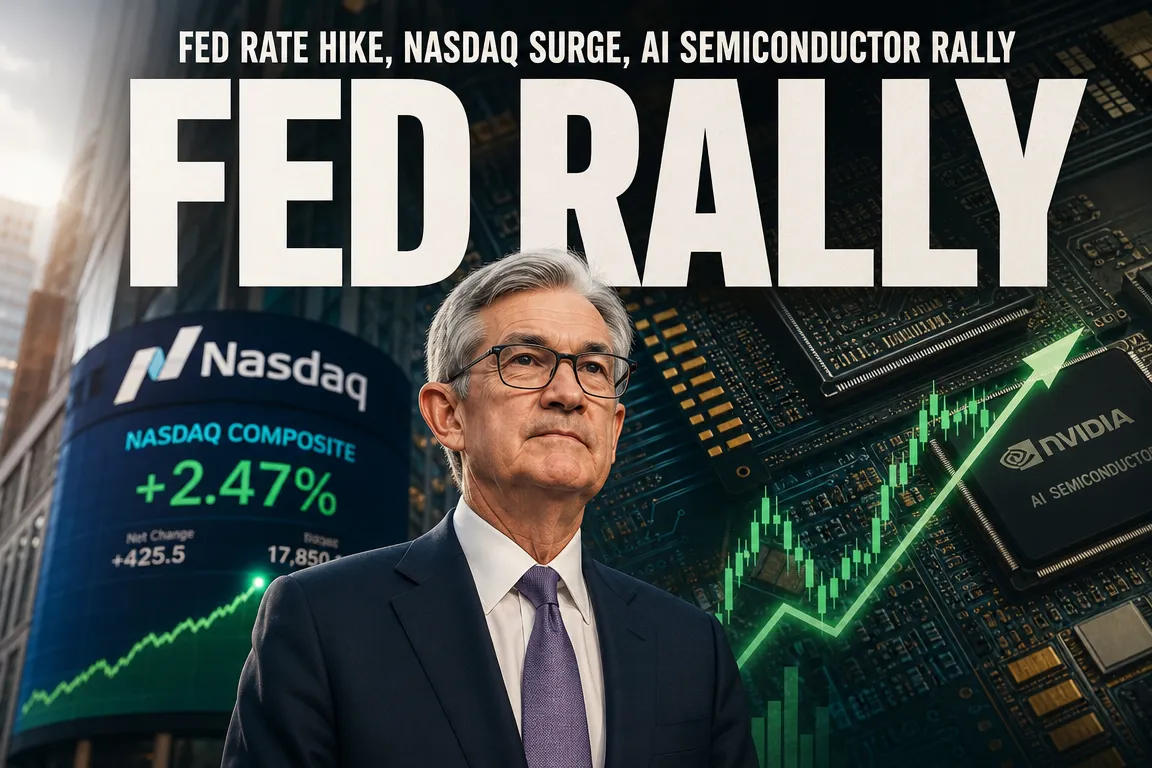
Nasdaq’s strength reflected not the policy rate increase itself, but the market’s interpretation that the Fed may be able to preempt inflation, which pushed long-term Treasury yields lower.
That was reinforced by easing Saudi oil transport risk, renewed enthusiasm for Nvidia-led AI semiconductors, and intensified competition in AI agents from OpenAI and Google, all of which supported risk appetite across U.S. equities.
1. Market backdrop: Why Nasdaq rose more sharply immediately after the rate hike
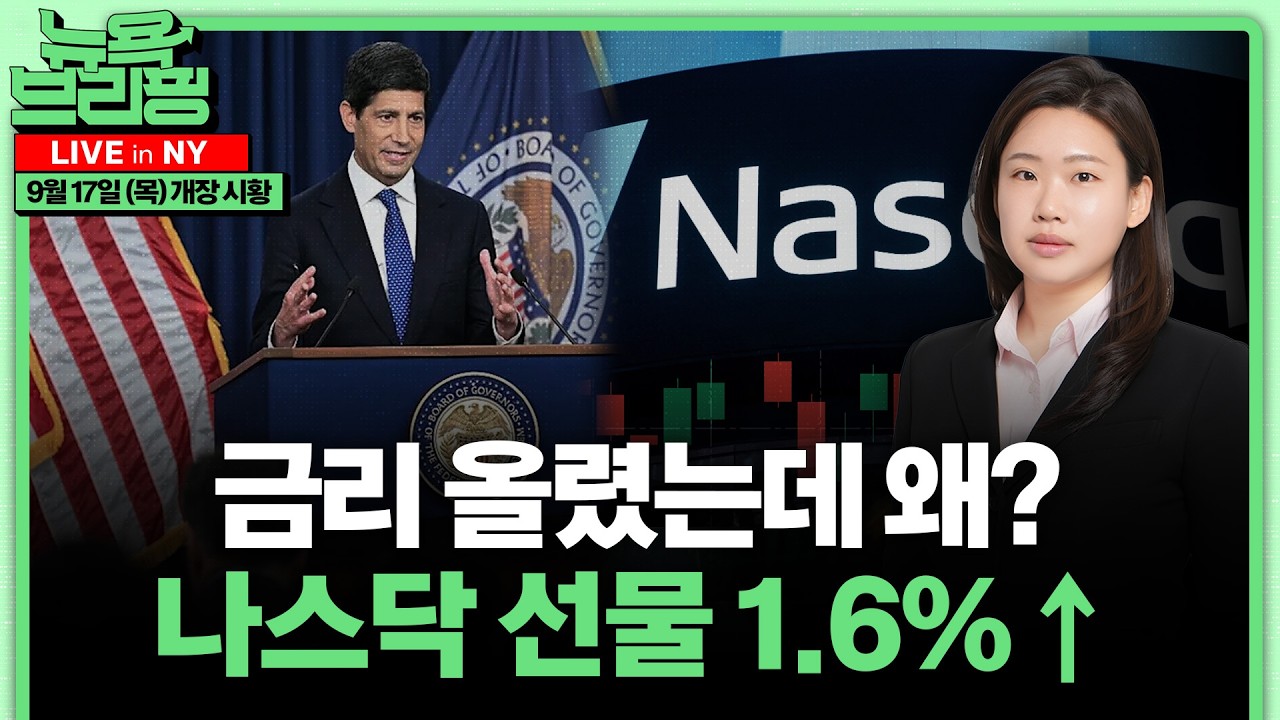
According to the source material, Nasdaq gained about 1.6% intraday.
The Dow, the S&P 500, and the Russell 2000 also advanced, but Nasdaq showed the strongest momentum.
The reason is straightforward.
Nasdaq has a heavier weight in rate-sensitive growth and technology stocks, and AI semiconductor names tend to have higher beta.
-
Nasdaq: Highly sensitive to duration and long-term yield declines.
-
S&P 500: Broad gains supported by large-cap technology and cyclical stocks.
-
Russell 2000: Rebounded, but with less strength than large-cap AI and semiconductor names.
-
AI semiconductors: Reasserted as a high-beta leading sector in an up market.
On the surface, a rate hike should have pressured equities.
However, the market focused more on the inflation path ahead and long-term yields than on the policy rate itself.
2. FOMC summary: A 0.25 percentage point hike, followed by an initially negative reaction
At the latest FOMC meeting, the Fed raised the policy rate by 0.25 percentage point to 3.75% to 4.00%.
The decision was described in the source as the first hike in about three years, and it was approved unanimously by voting members.
The dot plot suggested a high probability of one additional hike this year.
Chair Powell’s press conference was also interpreted as hawkish.
-
Policy rate: Raised by 0.25 percentage point to 3.75% to 4.00%.
-
Vote: Unanimous approval.
-
Dot plot: Signaled the possibility of an additional hike this year.
-
Press conference: Reinforced the message that further tightening remains possible if inflation does not ease.
As a result, the market’s first reaction was negative.
Investors initially viewed the possibility of further rate hikes as a risk.
By the following day, however, sentiment had shifted.
Investors began to interpret the hawkish stance as potentially supportive of disinflation over time.
3. Market interpretation of Kevin Warsh: When a negative becomes a positive
A key figure in the source narrative is Kevin Warsh.
He had previously criticized the Fed for keeping rates too high and argued that technological change, including AI, could drive growth without inflation.
In this case, however, he supported a rate hike.
The market initially saw that as a headwind, but later interpreted it as a sign that the Fed would prioritize price stability over political pressure.
-
Earlier view: Rates were too high, and AI-driven productivity could support inflation-free growth.
-
Current stance: Inflation pressure remains sufficient to justify higher rates.
-
Market interpretation: A signal of Fed independence and commitment to price stability.
This is the critical point.
Rate hikes are typically negative for equities.
But if the market believes the Fed can contain inflation early, long-term yields may decline.
4. The bond market moved first: 2-year yields rose, 10-year yields fell
The clearest signal came from the Treasury market.
Two-year yields rose because they are closely tied to the policy rate and expectations for further hikes.
That was a natural response to the higher near-term rate outlook.
The more important move was in the 10-year yield.
Longer-dated yields reflect inflation expectations and the medium-term growth outlook.
According to the source, the 10-year Treasury yield fell from above 5% to the 4.9% range after the FOMC.
That suggests the market believed forceful policy action could help contain long-term inflation.
-
2-year yield: Rose on expectations for further policy tightening.
-
10-year yield: Fell on easing long-term inflation expectations.
-
Nasdaq: Benefited as lower long-term yields reduced valuation pressure on growth stocks.
This is one of the most important distinctions in rate-sensitive markets.
Higher short-term rates do not automatically imply weaker equities.
When long-term yields decline, Nasdaq and AI growth names can outperform.
5. Lower oil prices were another key support: Brent crude down 2%, easing inflation pressure
The second driver of the rally was lower oil prices.
According to the source, Brent crude fell about 2% to around $103 per barrel.
Lower oil prices reduce inflation concerns.
Energy costs directly affect consumer prices and corporate margins, making oil a critical variable for U.S. equities.
The decline reflected two developments.
6. Saudi east-west pipeline repairs: Reduced concerns over Strait of Hormuz risk
The first development was news that Saudi Arabia’s east-west pipeline had been repaired.
Saudi exports from the east typically depend on passage through the Strait of Hormuz.
Because the strait carries geopolitical and Iran-related risk, the western route is strategically important.
-
Partial repair: About half of the damaged section could be restored within days.
-
Full repair estimate: Around six weeks for complete restoration.
-
Market impact: Lowered supply disruption risk and supported oil price stability.
In short, one of the oil market’s main concerns, supply uncertainty, eased somewhat.
7. Saudi Aramco’s alternative export route: A more efficient crude transport strategy
The second factor was Saudi Aramco’s use of an alternative shipping route.
Instead of forcing Asian refiners to send vessels directly to Saudi Arabia and through the Strait of Hormuz, the company shifted part of the logistics burden.
Saudi Aramco reportedly transported crude through the riskier segment itself and arranged delivery or transshipment in safer waters.
-
Traditional approach: Asian refiners sailed directly to Saudi Arabia and then through Hormuz.
-
New approach: Saudi Arabia handled the high-risk segment and transferred cargo in safer waters.
-
Effect: Lower transport and insurance costs for refiners.
-
Saudi incentive: Protect export flows, which are central to national revenue.
The source also mentioned the use of AIS-off shipping tactics.
Turning off vessel identification makes route tracking more difficult and can complicate direct attribution.
The result was improved confidence that Saudi export flows could be maintained.
That supported oil price stability and reduced inflation concerns, which in turn helped equities.
8. AI semiconductor rally: Why Nvidia, Micron, and SK Hynix strengthened
Semiconductor stocks were strong in this move.
According to the source, Nvidia rose about 2%, Micron about 5%, and SK Hynix about 4%.
The catalyst was comments from Nvidia CEO Jensen Huang.
He indicated that AI adoption across industries could lead to a doubling of semiconductor sales next year.
While not formal guidance, the remarks were constructive for the sector.
-
Nvidia: Renewed expectations for AI GPU demand.
-
Micron: Stronger data center and AI server demand supported memory expectations.
-
SK Hynix: Benefited from expectations for HBM and AI memory demand.
AI semiconductors are no longer just a thematic trade.
They now influence capital expenditures, cloud pricing, GPU residual value, depreciation assumptions, and broader infrastructure investment.
9. GPU depreciation debate: The real core of the AI investment cycle
One of the most important themes in the source is the debate over GPU depreciation.
GPU capex is the largest cost component in AI infrastructure.
Whether GPUs should be treated as assets that lose most of their value in three years or remain economically useful for five years or more has major implications for valuation.
The source also noted that Nebius raised cloud GPU prices in response to strong AI compute demand.
Higher rental prices suggest that GPUs may retain economic value longer than expected.
-
A-series GPUs: Still reported to retain roughly 25% of their value after five to six years.
-
H-series GPUs: Reported to retain about 58% of their value after roughly four years.
-
B-series GPUs: Reported to trade at a premium, reaching about 158% of original pricing.
This matters beyond semiconductor earnings.
It affects cloud providers, data center REITs, big tech capex plans, and even power infrastructure investment.
If GPUs hold value longer than expected, AI infrastructure investment is easier to justify.
If not, the current AI capex cycle could face a stronger profitability debate.
10. OpenAI’s personal agent rumor: The next phase of AI competition
The source also discussed rumors that OpenAI may launch a personal AI agent.
A personal agent is not merely a chatbot.
It is designed to interact with a user’s computer, execute tasks, and automate repetitive work.
Examples cited in the source included Meta’s Muse, xAI’s Grokbot, and OpenCl.
Peter Steinberger, founder of OpenCl, was also mentioned as having joined OpenAI, which added to market expectations.
-
Meta Muse: Cited as an early positive example in personal AI agents.
-
xAI Grokbot: Described as useful in practice, but still limited in computer control.
-
OpenAI agent: Could become more capable if paired with stronger computer-use models.
The next AI competition is less about answer quality alone.
It is increasingly about which system can complete real work more effectively.
11. OpenAI’s math problem claims: How far has AI reasoning progressed?
The source also referenced claims that OpenAI had solved notable mathematical problems.
These included discussions related to Millennium Prize problems and the Hodge conjecture.
Such claims require careful academic verification and should be treated cautiously.
The key point is that AI systems are increasingly being tested on more complex reasoning tasks.
This suggests a transition from search-oriented AI to research-oriented, development-oriented, and discovery-oriented systems.
12. JP Morgan’s Claude deployment: A practical enterprise AI issue
In a Business Insider-related context, the source discussed JP Morgan’s use of Claude.
The bank reportedly granted access to about 80,000 employees.
Some employees then reportedly generated AI usage costs that exceeded their own salaries.
JP Morgan ultimately limited some developers’ Claude Code spending to around $2,000 per month.
-
Scale of deployment: A large financial institution rolling out generative AI across the organization.
-
Cost issue: Token usage can quickly become expensive.
-
Security issue: Sensitive financial data must be protected from exposure to external models.
-
Mitigation: Use restricted development environments for Claude Code access.
This is a practical challenge for enterprise AI adoption.
Productivity improves, but cost control and data security become more difficult.
Over time, on-premise AI, private models, and data-loss prevention systems may become more important.
13. Google Gemini 4 Pro rumor: Competitive pressure in AI models continues to intensify
The source also mentioned rumors around Gemini 4 Pro.
According to model comparison platforms such as Arena.ai, a new Google model appeared to show strong performance.
AI companies often benchmark new models on such platforms before launch.
These results are used to signal relative strength ahead of release.
-
Google: Rising expectations for the next Gemini model.
-
OpenAI: Competing through personal agents and stronger reasoning models.
-
Meta and xAI: Expanding their presence in consumer AI agents.
Model competition is expanding beyond text generation into coding, reasoning, browser control, data analysis, and workflow automation.
14. Z.ai in China and recursive self-improvement: AI improving AI
One of the more forward-looking items in the source was Z.ai’s recursive self-improvement concept.
Recursive self-improvement refers to AI systems improving other AI systems, which then improve the next generation again.
If AI can code effectively, it can contribute directly to AI development.
That includes infrastructure engineering, training optimization, security testing, and data pipeline improvements.
-
Recursive: A process that loops back on itself repeatedly.
-
Self-improvement: AI participating in its own performance enhancement.
-
Z.ai GLM: Cited as participating in next-generation model training improvements.
-
Market significance: Potential acceleration in AI development speed relative to human-only workflows.
The source noted that while some Western firms argue for slowing AI development, voices in China and France are pushing for acceleration.
In practice, the competitive dynamics around AI make a broad slowdown unlikely.
National security, industrial competitiveness, cloud infrastructure, and semiconductor leadership are all at stake.
15. The real takeaway: Confidence and residual value matter more than headline rates
The most important conclusion from the source is not the rate hike itself.
Most observers may reduce the move to a simple paradox: rates up, stocks up.
But the deeper issue is twofold.
-
First, restored Fed credibility can make rate hikes constructive.
The market focused less on the policy rate increase and more on the decline in long-term inflation expectations.
Lower long-term yields reduce valuation pressure on growth stocks and support Nasdaq performance.
-
Second, the key question for AI semiconductors is GPU residual value, not just revenue growth.
Whether GPUs become obsolete in three years or remain productive for five to seven years will shape the economics of the AI cycle.
Nebius’s price increases and GPU premiums suggest that AI infrastructure demand remains firm.
In that sense, the Nasdaq move reflected more than a short-term event.
It reflected a combination of lower long-term yields, reduced oil-related inflation risk, and a reassessment of AI infrastructure profitability.
16. Key indicators for investors to monitor
To assess whether this trend can continue, investors should monitor the following:
-
U.S. 10-year Treasury yield: A move back above 5% would pressure Nasdaq and growth stocks.
-
2-year Treasury yield: A key indicator of expectations for further policy tightening.
-
Brent crude prices: A renewed oil spike could revive inflation concerns.
-
Strait of Hormuz risk: Any disruption could quickly affect energy prices and inflation.
-
GPU cloud pricing: A real-time measure of AI compute demand.
-
Earnings from Nvidia, Micron, and SK Hynix: A test of whether the AI semiconductor rally is translating into fundamentals.
-
AI agent launches from OpenAI, Google, and Meta: Indicators of the next phase of platform competition.
-
Enterprise AI cost control: Cases like JP Morgan show how usage growth can turn into cost pressure.
Current market behavior is not being driven solely by rate-cut expectations.
It is being shaped by inflation credibility, energy supply stability, AI productivity gains, and the semiconductor investment cycle.
< Summary >
The core reason Nasdaq rose despite the rate hike was that long-term yields fell.
The market interpreted the Fed’s move as a signal that inflation could be contained, easing pressure on growth stocks.
Saudi pipeline repairs and alternative export routes helped stabilize oil prices and reduce inflation fears.
Nvidia’s remarks, GPU cloud price increases, and the debate over GPU residual value supported the AI semiconductor rally.
OpenAI’s personal agent plans, Google’s Gemini 4 Pro rumors, and China’s Z.ai self-improvement efforts point to faster AI competition.
Key indicators to watch include the U.S. 10-year yield, oil prices, GPU pricing, AI agent launches, and enterprise AI cost control.
[Related Articles…]
*Source: [ 내일은 투자왕 – 김단테 ]
– 금리인상에도 나스닥이 떡상한 진짜 이유
● Oil Crash, Tech Bounce, AI Surge
The Real Reasons Technology Stocks Rebounded Despite Rate Hikes: Oil Declines, Stable Treasury Yields, and AI Data Center Power Plays
The key issue in this market was not simply that U.S. stocks rose despite a Federal Reserve rate hike.
The main drivers were a sharp decline in international oil prices, which temporarily eased inflation fears, and a pullback in long-term Treasury yields, which helped technology and semiconductor stocks recover.
In addition, Amazon’s large contract for data center generators, the Bank of England’s rate hold, expectations for a Bank of Japan rate hike, and comments from Fed Chair Wash at the press conference added complexity to the market interpretation.
One particularly important point that is often overlooked in other coverage is that AI investment was explicitly cited as a factor behind the rise in long-term Treasury yields.
This suggests that investors now need to assess AI infrastructure spending, the bond market, and technology valuations together.
1. Pre-market U.S. equity trading: oil declines offset rate hike concerns
The Federal Reserve raised the policy rate by 0.25 percentage points.
The target range moved from 3.50% to 3.75% to 3.75% to 4.00%.
This was the first rate hike of the year and the first in approximately 3 years and 2 months, which heightened market sensitivity.
U.S. equities fell immediately after the announcement.
However, sentiment shifted sharply the following morning.
The primary reason was the decline in international oil prices.
Expectations of Saudi pipeline repairs and improved crude supply triggered a drop in oil prices, easing concerns about inflation.
At the same time, long-term Treasury yields moved lower, supporting U.S. equity markets.
- Nasdaq 100 futures: up as much as about 1.61% pre-market
- S&P 500 futures: up about 1.26%
- Dow Jones futures: up about 1.23%
- Russell 2000 futures: up about 1.43%
The Nasdaq, led by technology stocks, was the strongest.
Technology shares rebounded despite the rate hike because long-term Treasury yields declined.
For growth and technology stocks, lower bond yields reduce valuation pressure because a larger share of their value depends on future earnings.
2. Bond, dollar, and commodity markets: investors focused on oil before rates
In the bond market, Treasury futures rose.
Because bond prices and yields move inversely, higher bond prices indicate lower Treasury yields.
- U.S. 10-year Treasury futures: up about 0.37%
- U.S. 30-year Treasury futures: up about 0.61%
As long-term yields moved lower, U.S. equities gained support.
The dollar index fell about 0.15% to around 99.83.
As the dollar weakened, the euro, yen, and pound posted modest gains against the dollar.
In commodities, energy and metals diverged.
- Brent crude: down about 3.35% to the $102 range per barrel
- WTI: down about 2.32%, after trading near $99 pre-market
- Diesel: down in the low-3% range
- Gasoline: down in the low-2% range
- Gold futures: up about 0.45%
- Silver futures: up about 1.57%
- Copper: up about 1.7%
Energy prices declined while gold, silver, and copper rose.
The market appeared to be easing concerns about an energy supply shock while maintaining a defensive allocation to metals.
3. The main driver of the oil decline: expectations of Saudi pipeline repairs
The biggest factor behind the move was a report regarding Saudi pipeline conditions.
A disruption to a crude transport pipeline crossing Saudi Arabia had previously been priced in as a supply risk.
The pipeline was described as a critical energy transport link associated with routes toward the Red Sea and the Strait of Hormuz.
If the pipeline is blocked or operating at reduced capacity, crude transport becomes less reliable and oil prices react quickly.
However, reports that roughly half of the pipeline could be restored within days pushed prices lower.
Additional reports that Saudi Arabia was increasing deliverable sales outside the Strait of Hormuz also weighed on prices.
In Libya, crude production that had been disrupted was also reported to be normalizing.
In short, the market interpreted the news as an improvement in global crude supply conditions.
This offset part of the pressure from the rate hike.
At this stage, the market is reacting more to oil than to the rate decision itself.
That is because a renewed oil surge could feed into consumer prices, business costs, transportation costs, and food prices.
4. Technology and semiconductor rebound: Treasury yield declines mattered more than the policy rate
In individual stocks, large-cap technology and semiconductor names were strong.
NVIDIA, Broadcom, Micron, AMD, and Intel all traded higher.
- NVIDIA: up about 2% pre-market before trimming gains
- Broadcom: up about 2%
- Micron: rose sharply
- AMD: up about 4%
- Intel: up about 5%
- SK hynix: also reported to be up about 3%
Amazon, Tesla, Alphabet, and Microsoft also generally advanced.
Apple weakened, while Meta showed relatively limited strength.
By contrast, energy stocks that are directly affected by lower oil prices underperformed.
- Exxon Mobil: weaker
- Chevron: weaker
Lower oil prices benefit consumers and technology stocks, but they can weigh on energy company revenue expectations.
Capital rotated away from energy and into technology and semiconductors.
5. Amazon and Generac contract: AI data center power infrastructure emerges as a new theme
One of the most active pre-market names was Generac.
Generac supplies backup generators for data centers.
The stock surged more than 30% intraday pre-market after news of a large generator supply contract with Amazon.
The contract is significant.
- Initial supply volume for 2027-2028: about $2.4 billion
- Potential expanded purchase volume: up to about $8.0 billion
- Amazon: also secured the right to buy Generac shares
The importance of this deal extends beyond Generac itself.
AI data centers require extremely large amounts of electricity.
Backup power is essential because servers cannot stop operating during outages.
As a result, backup generators, power grids, transformers, cooling systems, batteries, and gas turbines are becoming increasingly important.
This indicates that the AI investment theme is expanding from semiconductors into data center power infrastructure.
Investors evaluating AI exposure now need to look beyond chipmakers such as NVIDIA.
Power equipment, generators, grid infrastructure, cooling systems, and industrial electrical equipment are also becoming relevant.
6. Fed rate hike: unanimous 12-0 vote and its meaning
The Federal Reserve raised the policy rate by 0.25 percentage points at the FOMC meeting.
The target range moved to 3.75% to 4.00%.
The vote was unanimous at 12-0.
At the previous meeting in July, only some members favored a hike, but this time all voting members supported the increase.
This suggests a stronger internal consensus at the Fed that inflation needed to be addressed.
The Fed described the U.S. economy as expanding at a solid pace.
It said consumption remained resilient, productivity was improving, and capital spending was strong.
Unemployment was assessed at around 4.1%, close to full employment.
At the same time, inflation was still viewed as too high.
In practical terms, the Fed’s view was simple:
the economy can withstand tighter policy, so reducing inflation is the priority.
7. Fed economic projections: growth and employment revised up, inflation revised higher
The September economic projections showed a stronger view of the U.S. economy than in June.
The Fed raised its growth outlook.
- 2025 growth forecast: raised from 2.2% to 2.3%
- 2026 growth forecast: raised from 2.3% to 2.4%
- Unemployment forecast: lowered from 4.3% to 4.1%
- Inflation forecast: both headline and core raised by 0.1 percentage point
Growth was revised higher and unemployment lower.
That means the Fed became more constructive on the labor market and the broader economy.
Inflation was also revised higher.
This combination supports the case for additional tightening.
The Fed is less likely to raise rates when growth is weak.
But when growth and employment remain resilient, it has room to tighten policy in order to contain inflation.
8. Dot plot: one more hike this year, lower expectations for rate cuts next year
The key market focus in the dot plot was the year-end policy rate projection.
The September median year-end rate projection was 4.1%.
That is 0.25 percentage points above the current midpoint of the target range.
In other words, Fed officials indicated the possibility of one additional hike this year.
Of the 18 participants who submitted projections, 16 projected a higher rate than the current level.
Chair Wash did not submit a projection, consistent with his position that the dot plot can give markets a false sense of certainty.
He did, however, vote for the rate hike.
The more important shift was in the outlook for next year.
In the June dot plot, some rate cuts were implied for next year. In the September version, rates were shown staying around 4.1% for longer.
This pushes the expected timing of rate cuts further out.
The projected path then gradually declines to 3.9% in 2028 and 3.6% in 2029.
The market had expected the Fed to begin easing earlier next year, but this projection reduced those expectations.
9. Trump reaction: pressure for rates below 1%
Following the Fed’s decision, President Trump said on social media that rates should fall below 1%.
He called for faster rate cuts.
He also raised the issue of the trade deficit.
He argued that the United States could generate at least $1.5 trillion annually if it stopped trading with countries that run trade deficits with the U.S.
He did not name specific countries, but South Korea could also be included among countries with a U.S. merchandise trade deficit.
From January through July this year, the U.S. merchandise trade deficit with South Korea was cited at about $46.2 billion.
As a result, the remarks were also interpreted as pressure on countries that run trade surpluses with the United States, including South Korea.
The New York Times described Trump as increasingly isolated on the issue of interest rates.
The president is calling for cuts, while the Fed unanimously raised rates.
The decision was interpreted as prioritizing price stability over political pressure.
10. Key Q&A from Chair Wash’s press conference
Chair Wash said the U.S. economy and labor market remain very strong.
He said rate hikes were necessary because inflation has not declined enough.
10-1. Can a rate hike resolve an oil supply shock?
Journalists asked whether higher rates could solve a supply-side oil shock such as pipeline or Strait of Hormuz disruptions.
Wash acknowledged that the Fed cannot directly lower oil or food prices.
He added, however, that higher rates can help prevent oil price increases from spreading into other goods and services.
That is the key point.
The Fed is not the institution that repairs crude supply chains.
Its logic is that higher rates can limit second-round effects from energy prices, such as wage pressure, transport costs, and broad price increases.
10-2. How many more hikes are likely?
Wash did not provide a specific number of additional hikes.
He said future decisions would depend on inflation and economic data.
Based on the press conference alone, no explicit commitment was made to consecutive hikes.
However, the dot plot still implied a high probability of at least one more hike this year.
10-3. Why was there unanimous support for a hike after a hold in July?
Wash said the data received over the past seven weeks changed the picture.
He said the economy, including employment, had become stronger, while inflation had not improved enough.
He also said the assessment of geopolitical risk had changed.
In July, the view was to wait and see. By September, the committee concluded that a hike was appropriate.
10-4. Is policy already sufficiently restrictive?
Wash suggested that financial conditions are not clearly restrictive enough.
He said capital continues to flow into businesses and investment remains strong.
He characterized the move not as a shift into tighter policy, but as a reduction in the degree of accommodation.
That implies room for additional tightening remains.
10-5. Did the Fed raise rates because the market expected it?
Before the decision, markets were pricing in a hike with a probability above 90%.
Journalists asked whether the Fed was following the market rather than leading it.
Wash rejected that view.
He said the decision was based on the Fed’s assessment of the economy and inflation, not on market expectations.
10-6. How should the CPI be interpreted?
Wash said individual data points can be noisy.
One weak monthly CPI reading would not be enough to conclude that the trend has changed.
The Fed is looking for consistent evidence of disinflation across multiple indicators.
As a result, one softer CPI release is unlikely to quickly revive expectations for rate cuts.
10-7. Why did long-term Treasury yields rise so sharply?
Wash cited three reasons for the rise in long-term yields:
- Strong economic activity
- Large-scale demand for investment funding
- Geopolitical risk
The most important factor here is AI investment.
Hyperscalers are raising large amounts of capital to finance AI data center spending.
Bond issuance is increasing as well.
When companies increase their borrowing needs, they compete with Treasury issuance, which can put upward pressure on long-term yields.
In other words, AI investment supports equity valuations through growth expectations while also creating upward pressure on rates in the bond market.
10-8. Is the Fed independent from presidential pressure?
Wash said he could not disclose private conversations with the president.
He emphasized that the government and the Fed should respect each other’s roles.
The Fed’s mandate is employment and inflation.
Trade and fiscal policy are the responsibility of the administration and the Treasury.
The unanimous hike was seen as a demonstration of Fed independence.
10-9. Why is the 2% inflation target now projected for 2029?
Wash said that projection was not his own.
He noted again that he did not submit his own forecast to the economic projections or dot plot.
The later date for reaching the 2% target therefore reflects the views of the other 18 Fed participants.
10-10. What is the Fed’s stance on AI slowdown concerns?
Wash said the Fed is closely examining both demand and supply effects from AI.
AI investment creates large near-term spending, while potentially improving productivity over time.
Higher productivity can increase the economy’s capacity to produce goods and services and may also affect longer-term inflation.
The Fed has established a task force to analyze AI’s impact on the economy and inflation.
He said the task force is expected to report by year-end.
He also noted that AI regulation and safety are matters for other government agencies, not the Fed.
11. The Bank of England held rates, but tightening bias remains
The Bank of England kept its policy rate unchanged at 3.75%.
Of the 9 committee members, 6 supported holding rates and 3 supported a 0.25 percentage point increase.
This means the decision was a hold, but rate hike pressure remained within the committee.
Some members remained concerned that higher energy prices could spill over into broader inflation.
Another important decision was the suspension of long-term government bond sales.
Reducing the supply of bonds the central bank offers to the market can ease upward pressure on long-term yields.
This measure may help stabilize UK long-term rates.
12. Bank of Japan expected to hike: watch yen volatility
The Bank of Japan is scheduled to announce its decision on Friday.
The market is pricing in a high probability that the deposit rate will be raised from 1.00% to 1.25%.
The key issue is not only whether the BOJ raises rates by 0.25 percentage points.
More important is how strongly it signals the possibility of further tightening.
If it adopts a hawkish tone similar to the Fed, the yen could move sharply.
If it raises rates but remains cautious on further hikes, market reaction may be limited.
Investors should therefore monitor the yen, Japanese government bond yields, and the Nikkei together after the decision.
13. Market probability: a further hike in October is roughly a coin toss
The market is assigning about a 53% probability to another rate hike at the October FOMC meeting.
That is close to a coin toss.
Whether the Fed hikes again depends on incoming inflation and labor data.
In particular, CPI, PCE inflation, employment data, wage growth, and oil prices will matter.
If oil prices rise again, the probability of another hike could increase.
If oil stabilizes and inflation data soften, the case for a hold in October strengthens.
14. Intraday move: early gains narrowed
Pre-market gains were strong, with the Nasdaq futures rising more than 1.6%.
After the open, however, gains moderated.
- Nasdaq: gains narrowed to about 1.29%
- Dow Jones: up about 0.51%
- S&P 500: up about 0.94%
- VIX index: down about 3.61% to the 18 level
Oil remained under pressure, though WTI briefly moved back above $100 intraday.
Technology and semiconductor shares remained relatively strong.
Still, the early surge did not fully hold.
This suggests the market has not completely eliminated concerns about the rate hike.
15. The most important point not emphasized elsewhere
The real story in this market was not simply that technology stocks rose despite rate hikes. It was that AI investment is beginning to alter the structure of interest rates themselves.
Wash cited hyperscaler demand for capital as one of the reasons long-term Treasury yields rose.
That matters.
As AI companies borrow heavily to build data centers, corporate bond issuance increases.
Investors must then allocate capital between Treasuries and corporate debt.
This competition can keep long-term Treasury yields elevated.
In short, AI investment supports earnings expectations for technology stocks, but it can also create upward pressure on yields.
That means investors cannot assume that AI growth is automatically positive for tech stocks.
They need to assess how much AI investment improves earnings versus how much higher yields compress valuation multiples.
Another key point is data center power infrastructure.
The Amazon-Generac deal shows that the AI infrastructure cycle is expanding beyond semiconductors into power equipment.
Going forward, the AI theme may extend into semiconductors, cloud platforms, grid infrastructure, generators, cooling systems, nuclear power, natural gas, and copper.
That is the most important structural shift in this market.
16. Key investor watch items: what to monitor next
- International oil prices: monitor whether Brent and WTI rise again.
- U.S. 10-year Treasury yield: directly affects technology valuations.
- CPI and PCE inflation: the multi-month trend matters more than a single reading.
- Employment reports: strong labor data could support further tightening.
- Fed communications: look for clues on the timing of another hike and possible cuts.
- Bank of Japan decision: may affect the yen and global capital flows.
- AI infrastructure contracts: data center power-related names could emerge as new leaders.
< Summary >
The Federal Reserve raised the policy rate by 0.25 percentage points to 3.75% to 4.00%.
The dot plot indicated the possibility of one more hike this year and a longer period of elevated rates next year.
Even so, U.S. equities rebounded, led by technology stocks, as oil prices fell and long-term Treasury yields stabilized.
Expectations of Saudi pipeline repairs, increased Saudi oil sales, and normalization of Libyan production pushed oil prices lower.
The Amazon-Generac contract highlighted the emergence of AI data center power infrastructure as a new investment theme.
The Bank of England held rates, though some members supported a hike, and the Bank of Japan is widely expected to raise rates to 1.25%.
The most important underlying point is that AI investment was identified as a driver of higher long-term Treasury yields.
Going forward, technology stock investors need to monitor AI growth and Treasury yield pressure together.
[Related Articles…]
- Fed Rate Outlook and U.S. Equity Strategy
- AI Data Center Power Infrastructure and the Global Investment Cycle
*Source: [ Maeil Business Newspaper ]
– 금리 인상도 뚫었다! 기술주 반등ㅣ유가 끌어내린 사우디 송유관 복구 기대ㅣ워시 기자회견 완전분석ㅣ영란은행 동결·일본은행 인상 전망ㅣ홍혜진의 뉴욕브리핑