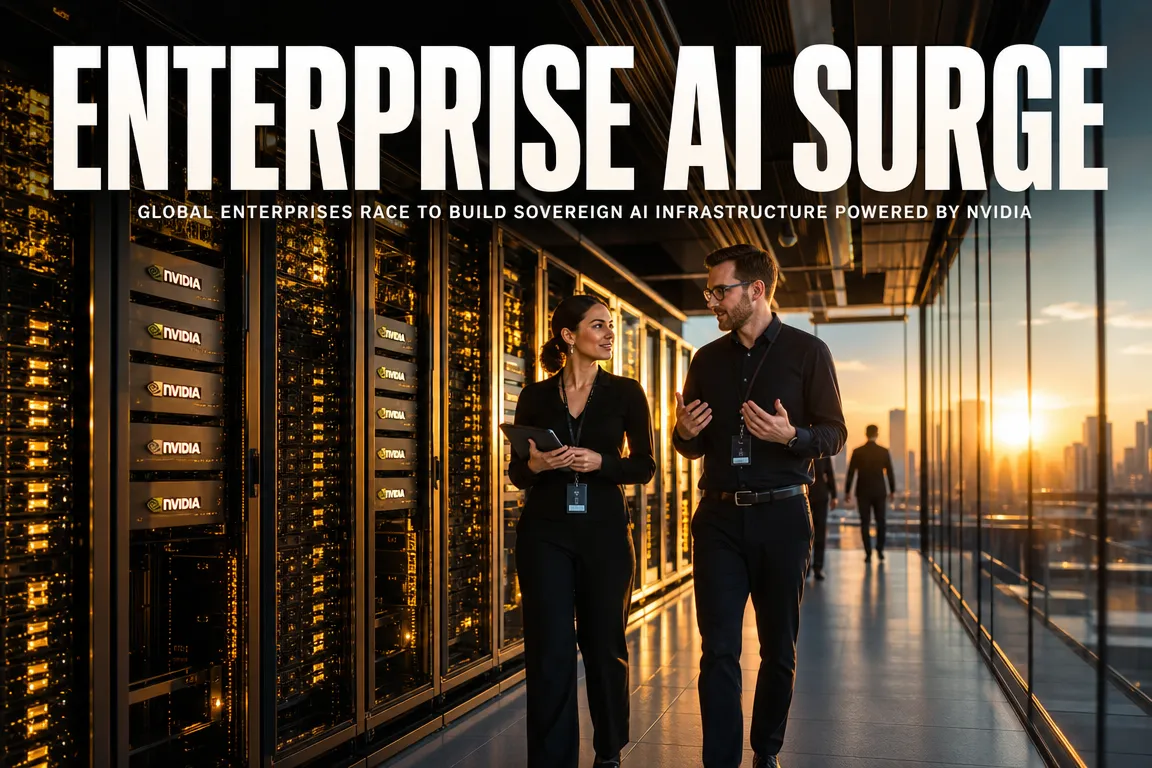
● AI Sovereignty Boom, Corporate Data Centers Surge
The Real Reason Companies Are Building Their Own AI Data Centers — Not Because They Do Not Trust ChatGPT or Claude
The key point in this development is not simply that demand for AI servers is rising.
What matters is that even highly conservative firms, including major global law firms, are now moving to build their own AI data centers.
This signals that the AI investment cycle, which had been led by Big Tech, is expanding into a sovereign AI cycle led by enterprises and governments.
This also helps explain renewed interest in companies such as Nvidia, Dell, Palantir, and Nebius.
A point often missed in other coverage is that, beyond data security, corporate decision-making itself is becoming an AI training asset.
1. Why the Move by a Major Law Firm Matters
A leading U.S. law firm recently announced plans to build its own AI data center, drawing renewed attention to the AI infrastructure market.
The firm is known as one of the highest-revenue law firms in the United States.
Legal services is a traditionally conservative industry.
The decision to build an in-house AI system rather than rely solely on external AI services is therefore significant for the market.
- Key shift:
Companies are moving beyond simply using external generative AI tools such as ChatGPT or Claude and are beginning to operate their own servers and models. - Investment view:
Demand may broaden across AI data centers, semiconductors, servers, cooling systems, power infrastructure, memory, and networking equipment. - Industry view:
Similar adoption may follow in sectors handling sensitive data, including legal services, financial services, healthcare, biotechnology, defense, and manufacturing.
2. What Enterprise Sovereign AI Means
The term sovereign AI was originally used to describe governments building AI infrastructure and models without dependence on external platforms.
That concept is now moving into the enterprise domain.
In practical terms, enterprise sovereign AI means building a dedicated internal AI factory within the company.
Historically, companies used AI services from OpenAI, Anthropic, Google, and Microsoft through the cloud.
Going forward, some large enterprises may build their own Nvidia GPU-based servers and customize open-weight or proprietary models for internal use.
This allows them to use AI without sending internal documents, contracts, litigation materials, research data, customer information, or decision workflows to outside providers.
- Legacy model:
Using external AI services such as ChatGPT, Claude, or Copilot through API or SaaS. - New model:
Building a dedicated internal AI data center based on Nvidia AI chips and server systems. - Objective:
Improve data control, cost management, workflow optimization, and reduce dependence on external AI vendors.
3. Why Companies See External AI Alone as Insufficient
This trend should not be interpreted only as a lack of trust in ChatGPT or Claude.
The core issue involves security, cost, control, and protection of process-related intellectual property.
3-1. Sensitive documents are difficult to place into external AI systems
Law firms handle litigation materials, contracts, M&A documents, and due diligence files.
Financial institutions manage transaction data, risk models, client asset information, and investment strategies.
Hospitals and pharmaceutical companies work with patient data, clinical records, and drug-development data.
Defense companies handle information directly linked to national security.
These data types can create material risk if entered into external AI systems.
3-2. The more important issue is decision-making methodology
Most reporting focuses on data security.
However, the more important point is that a company’s decision-making process is itself a competitive asset.
For example, in M&A advisory, the sequence used to review materials, the order in which risks are assessed, and how partners and associates collaborate are all forms of know-how.
In manufacturing, how a company responds to supply chain disruptions, secures critical components, and reallocates production is also core competitive capability.
If such workflows are repeatedly outsourced to external AI systems, the company’s operational know-how may gradually leave the firm’s internal environment.
3-3. Dependence on external AI vendors creates pricing and policy risk
When a company becomes heavily dependent on a single AI platform, later price increases or policy changes can create operational risk.
Rising API costs, changes in data-use policies, or service outages can affect enterprise workflows at scale.
For this reason, large enterprises may find it more stable over the long term to build their own AI infrastructure once a certain size threshold is reached.
4. Nvidia’s Next Growth Driver Is Not Just Big Tech, but Enterprise and Sovereign AI
Nvidia has long benefited from large-scale AI investment by Microsoft, Amazon, Google, and Meta.
More recently, however, Nvidia has repeatedly emphasized a different growth driver.
That driver is enterprise AI factories and sovereign AI at the national level.
For Nvidia, the expansion of enterprise and national AI data centers increases demand for GPUs, networking equipment, server systems, and AI software.
Where the initial AI infrastructure cycle was centered on Big Tech cloud buildouts, the next phase may include large law firms, financial institutions, pharmaceutical companies, manufacturers, defense contractors, and governments as new customer groups.
This is why the addressable market for AI infrastructure is being reassessed.
- Phase 1:
Big Tech built large cloud data centers. - Phase 2:
Companies tested cloud-based AI in business workflows. - Phase 3:
Sensitive-data enterprises began building their own AI servers and dedicated models. - Phase 4:
National sovereign AI projects and enterprise AI factories expand in parallel.
5. Why Dell Is Gaining Attention Again
Dell is one of the companies most directly associated with this trend.
Although it is still widely perceived as a PC company, Dell also plays an important role in AI servers.
Building an AI data center requires more than purchasing Nvidia GPUs.
It also requires integrated configuration of GPUs, server racks, cooling systems, power architecture, networking, and storage for enterprise use.
Dell is a major supplier of this type of AI server infrastructure to corporate clients.
The original report highlights Dell as a primary beneficiary of demand for in-house AI data centers.
The key point is that enterprise customers are moving beyond cloud-only AI usage and starting to build their own AI server environments.
This allows them to maintain control over security and data while operating models optimized for internal workflows.
- Dell’s role:
Supplies AI servers built around Nvidia AI chips to enterprise customers. - Demand driver:
Law firms, financial institutions, pharmaceutical companies, healthcare providers, and manufacturers are beginning to seek their own AI infrastructure. - Investment point:
If AI server demand expands from Big Tech to large enterprises, companies such as Dell may see improved growth visibility.
6. The Significance of the Palantir-Nvidia Partnership
Another important development in this trend is the collaboration between Palantir and Nvidia.
Palantir has outlined a direction toward what is effectively an operating system for enterprise sovereign AI.
In simple terms, Nvidia provides the hardware and model ecosystem for AI infrastructure, while Palantir supplies the software layer that allows enterprise workflows to operate in practice.
A key point raised by Palantir is Nvidia’s complex supply chain.
Nvidia relies on a global network spanning semiconductors, packaging, memory, servers, power systems, cooling, and logistics.
Palantir argues that if this complexity can be managed through sovereign AI systems, the same approach can be extended to manufacturing, energy, defense, pharmaceuticals, and financial services.
- Benefit to Nvidia:
As enterprises build their own AI factories, opportunities for GPU and infrastructure sales increase. - Benefit to Palantir:
It can supply the software and operating layer that runs enterprise AI data centers and workflows. - Benefit to customers:
Companies can automate workflows and improve decision-making without transferring internal data to external platforms.
7. Nebius and Demand for Customized AI Data Centers
Nebius is also referenced in this context.
As data center capacity remains constrained, the ability to design and deliver customized AI infrastructure for each client is becoming more important.
The partnership between Palantir and Nebius to design and sell customer-specific AI infrastructure from the ground up indicates that the enterprise AI buildout is evolving beyond simple server sales into bundled solutions.
Going forward, companies are likely to demand not only GPUs but also AI data centers, models, operating software, and security frameworks tailored to their industries.
This could broaden the value chain for AI infrastructure providers.
8. Companies to Watch Across the AI Infrastructure Value Chain
The enterprise AI buildout is not limited to a single company or segment.
A single AI data center depends on multiple industries working together.
Investors therefore need to track semiconductors, servers, memory, power, cooling, networking, and software in parallel.
- AI semiconductors:
Nvidia GPUs remain central, but CPUs, DPUs, ASICs, and HBM memory are also important. - Servers and systems integration:
Companies such as Dell assemble AI server systems that can be deployed in enterprise environments. - Memory semiconductors:
High-performance memory is essential for AI workloads. - Power infrastructure:
AI data centers consume substantial electricity, increasing the importance of power equipment and management solutions. - Cooling systems:
High-performance GPU servers generate significant heat, supporting demand for liquid cooling and immersion cooling technologies. - Networking and optical communications:
High-speed data transfer between AI servers increases demand for networking gear and optical components. - AI operations software:
Companies such as Palantir may become more important as enterprise data is linked to operational decision-making.
9. The Most Important Point Often Missed in Other Coverage
The real issue is no longer whether companies use AI.
It is increasingly about who controls AI.
First, the value of corporate data is being re-rated.
In the past, having more data was considered an advantage.
Now the competitive edge depends on how that data is trained, deployed, and managed within the AI infrastructure.
Second, business workflows are becoming a new form of intellectual property.
Decision rules, risk assessment frameworks, customer response patterns, and supply chain coordination methods built over decades are more than documents; they are strategic assets.
Third, the AI cost structure may shift from SaaS-style usage to long-duration infrastructure investment.
Companies may move from paying for external AI services to making capital expenditures on proprietary AI data centers.
This shift could affect valuations across AI infrastructure-related equities.
Fourth, the concentrated dominance of Big Tech may become somewhat less complete.
While Big Tech remains highly influential, the spread of enterprise sovereign AI may lead large customers to keep less data in external cloud environments.
That could create new opportunities for server, software, and data center operators.
Fifth, the AI cycle is moving from a thematic trade toward core industrial infrastructure investment.
Short-term volatility may still arise from rates, energy prices, recession concerns, and slower AI capex.
However, the broader direction remains toward AI infrastructure becoming a standard layer of enterprise operations.
10. Key Risks for Investors
Even if this trend remains strong, not all AI-related stocks will continue to rise.
AI infrastructure investment is capital intensive and remains sensitive to macro conditions such as interest rates and the business cycle.
It is also necessary to verify how quickly enterprises actually adopt internal AI data centers.
- Interest rate risk:
In a high-rate environment, large-scale capex such as data centers and server buildouts can become more burdensome. - AI spending moderation:
If Big Tech or large enterprises slow AI investment, related stocks may correct in the short term. - Proof of monetization:
It remains necessary to confirm whether enterprise AI leads to measurable productivity gains and cost savings. - Rising competition:
Increased competition in servers, data centers, and AI software may pressure margins. - Valuation risk:
AI-related stocks that have already risen sharply are vulnerable to higher volatility if earnings disappoint.
11. What to Monitor Going Forward
Investors should not focus only on Nvidia earnings.
They should also watch the extent to which enterprise and government customers contribute to growth.
Dell’s AI server orders, Palantir’s enterprise AI platform contracts, and customer expansion at companies such as Nebius should also be monitored.
It is also important to track whether industries such as legal services, financial services, healthcare, manufacturing, and defense continue to adopt their own AI infrastructure.
- Checkpoint 1:
Determine whether AI server demand from non-Big Tech customers is translating into actual revenue. - Checkpoint 2:
Assess how quickly sovereign AI projects are expanding at the national level. - Checkpoint 3:
Monitor the mix between external AI services and internal AI infrastructure usage. - Checkpoint 4:
Track whether power, cooling, and networking constraints at AI data centers are being resolved quickly enough. - Checkpoint 5:
Watch for enterprise case studies showing measurable productivity gains from AI infrastructure investment.
< Summary >
The construction of a proprietary AI data center by a major law firm is a signal that the enterprise sovereign AI era is beginning.
The central issue is not simply data security, but the need to protect decision-making processes and operational workflows.
Nvidia is highlighting enterprise and national AI infrastructure demand as the next growth driver beyond Big Tech.
Dell is gaining attention on the server supply side, while Palantir is becoming more relevant on the enterprise AI software and operating layer.
Nebius may also benefit from increasing demand for customized AI infrastructure.
Although short-term volatility remains likely, AI infrastructure investment is increasingly positioned as a core component of enterprise operations.
[Related Articles…]
- Nvidia AI Infrastructure Growth Cycle Analysis
- AI Data Centers and Power Infrastructure Investment Trends
*Source: [ 소수몽키 ]
– 챗GPT, 끌로드 더 이상 못믿겠다? 자체 AI 구축 열풍의 새로운 수혜주들
● Dollar Crash, Rate War, Trade Shock
The Next Phase of the Tariff War Is a Currency War: The Real U.S. Calculation Behind Dollar Suppression Before the Midterms
The key issue in this exchange-rate outlook is not simply whether KRW/USD will rise or fall.
The core point is that the United States, after using tariffs to pressure foreign companies into investing in the U.S., is now likely seeking a weaker-dollar environment to convert that investment pressure into actual capital flows.
In particular, through the U.S. midterm elections, dollar exchange rates, policy rates, Treasury yields, money supply, and hyperscalers’ AI capex are likely to move in the same direction.
Although the subject appears to be exchange rates, the underlying issue connects U.S. manufacturing reshoring, Korea’s investment burden in the U.S., AI data center spending, U.S. third-quarter GDP, and the political calendar.
1. Current FX trend: from fear of KRW 1,550 to a stabilization scenario near KRW 1,300
At one point, the KRW/USD exchange rate approached 1,550, raising strong market concern.
At the time, a move above 1,600 was also discussed, reflecting broad dollar-strength anxiety.
However, Professor Kim Kwang-seok’s view is relatively clear.
Over the long term, the exchange rate is likely to stabilize around the 1,300 level.
The important point is that too many variables affect exchange rates.
Trade balance, foreign capital flows, geopolitical risk, interest rates, money supply, political events, and global dollar demand all matter.
Trying to assess every variable at once can obscure the overall picture.
The main variables to focus on in this outlook are three:
- A potential narrowing of the Korea-U.S. interest-rate differential
- A faster expansion of U.S. money supply relative to Korea
- A political incentive in the U.S. to reduce the dollar’s value
If these three factors move together, the exchange rate is more likely to stabilize than to accelerate upward.
2. First factor: if the Korea-U.S. rate gap narrows, upward pressure on the exchange rate eases
The first indicator to monitor in KRW/USD is the Korea-U.S. interest-rate differential.
One of the main drivers of recent exchange-rate pressure has been the U.S. maintaining a tighter policy stance than Korea.
When U.S. policy rates rise, global capital tends to move toward dollar assets.
That weakens the won and lifts the dollar exchange rate.
Going forward, however, this trend may reverse.
Korea is strengthening its restrictive stance, with policy rates potentially moving from 2.5% to 2.75% and even 3.0%.
By contrast, the United States faces growing constraints on keeping rates elevated.
The reason is straightforward.
For the U.S. government, excessively high Treasury yields can slow corporate investment, raise fiscal interest costs, and pressure equities and real estate.
Ahead of the midterms in particular, signs of economic slowdown are politically costly.
As a result, Korea’s policy stance may appear relatively tighter than the U.S. stance in the next phase.
In that case, the Korea-U.S. rate gap is more likely to narrow than widen.
If the rate gap narrows, dollar concentration eases and pressure on the won declines.
That makes further sharp appreciation of the dollar less likely and supports stabilization.
3. Second factor: if U.S. money supply expands faster than Korea’s, the dollar weakens
Money supply is as important as interest rates in exchange-rate analysis.
In simple terms, when more money is created, the value of that money declines.
If the U.S. expands dollar liquidity more aggressively, the dollar weakens; if Korea expands won liquidity more aggressively, the won weakens.
Ultimately, exchange rates reflect a competition over who is creating money faster.
In the first half of the year, Korea’s liquidity expansion appears to have been relatively faster.
The U.S. also increased dollar supply, but the won weakened more sharply, adding to exchange-rate pressure.
In the second half, however, U.S. money supply growth may exceed Korea’s.
During 2020 and 2021, U.S. money supply growth peaked at around 26%.
Korea’s current money supply growth is estimated at roughly 11% to 12%.
If U.S. money supply growth returns to around 15%, the situation could change.
Korea will continue to provide liquidity, but if the U.S. expands dollar supply more quickly, the dollar may weaken relative to the won.
In that case, KRW/USD could face more stabilization pressure to the downside than upside.
4. The tariff war is not ending; it is shifting into a currency war
The most important perspective in this discussion is that the tariff war is a tool, not the end goal.
The purpose of higher tariffs is not simply to raise the price of imported goods.
The real objective is to push foreign companies to invest in the United States.
From the U.S. perspective, the message is essentially:
“If you do not want tariffs, build factories in the United States.”
“Produce in the U.S., invest in the U.S., and create U.S. jobs.”
This applies across most industrial value chains, including automobiles, home appliances, IT, semiconductors, batteries, defense, shipbuilding, and AI infrastructure.
In effect, the U.S. is trying to pull global manufacturing capacity into its own territory.
However, this creates a key issue.
For foreign companies to relocate factories to the U.S. and then export from there, a weaker dollar is more favorable than a stronger dollar.
If the dollar is too strong, the export competitiveness of goods produced in the U.S. deteriorates.
Conversely, a weaker dollar improves the price competitiveness of U.S.-made products.
In other words, a weaker dollar is beneficial if the U.S. wants manufacturing reshoring to succeed.
This is why the next phase after the tariff war can be interpreted as a currency war.
5. First reason the U.S. wants a weaker dollar: to support manufacturing reshoring
The U.S. objective is clear.
It does not want Korean firms to produce in Korea and export to the U.S.; it wants them to produce in the U.S. and export globally from there.
To build that structure, foreign firms must expand U.S.-based production capacity.
But in a strong-dollar environment, products made in the U.S. become less competitive in global export markets.
That can reduce the price competitiveness of companies that relocate production to the U.S.
Accordingly, if the U.S. truly wants manufacturing reshoring, some degree of dollar depreciation is advantageous.
A weaker dollar improves the export competitiveness of firms producing in the U.S.
It also creates a more favorable environment for foreign companies generating dollar revenue inside the U.S.
That is the first reason behind dollar suppression.
6. Second reason the U.S. wants a weaker dollar: to make direct investment inflows appear larger
When the exchange rate falls, Korean firms can deploy more dollar investment with the same won-based burden.
This is a critical point.
For example, when KRW/USD is high, a $20 billion investment represents a major burden.
But when the exchange rate falls, the same won capital can support a larger dollar-denominated investment.
That is politically beneficial for the U.S.
Ahead of the midterms, Washington can claim that tariff policy has attracted substantial foreign direct investment.
In the Korea-U.S. trade negotiation process, Korean investment in the U.S. has been used as a key bargaining tool.
The video refers to a structure in which Korea invests roughly $350 billion over 10 years, with an annual cap of about $20 billion.
Initial expectations were for the first round to be about $19.5 billion, but if the exchange rate falls, that may appear closer to $21 billion.
From the corporate or national perspective, the burden may not have changed materially, but the U.S. can present the investment outcome as larger.
This is why dollar weakness can align with a midterm-election strategy.
7. Third reason the U.S. wants a weaker dollar: to support third-quarter GDP and the midterm election
If the U.S. midterm election is held in early November, then third-quarter GDP, typically released in late October, becomes highly important.
It is the economic scorecard released immediately before the election.
If third-quarter GDP is strong, the administration can argue that its economic policy has succeeded.
If GDP is weak, it becomes a target for the opposition.
In particular, if tariffs are tightened but do not lead to greater investment and instead simply burden U.S. importers, the political cost rises sharply.
Accordingly, the U.S. government has an incentive to improve investment, exports, manufacturing, and capital expenditure data before the midterms.
Lower interest rates and a weaker dollar help support that objective.
Lower Treasury yields make financing easier for companies, while a weaker dollar improves the export competitiveness of U.S. products.
In that sense, exchange-rate policy is not just an FX issue; it is part of election strategy.
8. Possible tools for dollar suppression: buybacks, TGA, and stablecoins
The U.S. may use several tools to lower the dollar and stabilize rates.
The video highlights three in particular:
- Buyback programs
- Use of the TGA balance
- Use of stablecoins
Buyback programs can help stabilize market yields by allowing the U.S. government to repurchase Treasury securities.
TGA refers to the Treasury General Account.
In simple terms, it is the U.S. government’s cash account.
Using the TGA balance can inject liquidity into markets.
Stablecoins are connected to the dollar-based digital asset ecosystem.
If the U.S. brings stablecoins further into the regulatory framework, it may diversify the channels through which dollar liquidity is supplied.
All three mechanisms can be linked to lower rates, higher liquidity, and a weaker dollar.
Ultimately, the U.S. has a strong incentive to ease financial conditions before the midterms.
9. Why AI investment matters for FX: hyperscaler capex cannot stall
One of the most overlooked elements in this currency-war framework is AI investment.
When assessing the U.S. economic outlook, AI data centers and hyperscaler capex have become key variables.
Google, Microsoft, Amazon, and Meta are all increasing AI infrastructure spending at a rapid pace.
The problem is that their free cash flow is declining quickly.
The video notes that Alphabet, or Google, has seen free cash flow turn negative.
When free cash flow declines, companies must issue corporate bonds to maintain large-scale capex.
However, if Treasury yields remain high, investors have less incentive to buy corporate bonds.
They can earn attractive returns from government bonds alone.
As a result, companies must offer higher yields, which raises financing costs.
That can slow the pace of AI data center investment.
The U.S. government does not want that outcome.
AI infrastructure investment is a major pillar supporting U.S. growth.
Therefore, Treasury yields need to be lower and bond-financing costs reduced so that hyperscaler capex can continue.
This is the point at which FX, rates, and the AI investment cycle intersect.
10. A de facto second Plaza Accord? Pressure on Japan to raise rates and cooperate on FX
For the U.S. to weaken the dollar, it cannot rely on domestic policy alone.
The dollar index is measured against major currencies.
These include the euro, yen, pound sterling, Swiss franc, and Swedish krona.
In other words, if the yen and euro strengthen, the dollar index falls.
That is why the U.S. may pressure Japan and other major economies toward tighter monetary policy.
If Japan raises rates, the yen strengthens and the dollar index can decline.
Formally, this is not a renewed Plaza Accord.
But the directional effect of encouraging major currencies to strengthen and the dollar to weaken can be viewed as broadly similar.
This is a key point that is often not emphasized in mainstream coverage.
11. Implications for Korea: exchange-rate stability is positive, but U.S. investment pressure may increase
For Korea, a more stable KRW/USD rate is positive in the near term.
It reduces import-price pressure and may ease energy costs.
It also lowers the burden on dollar-denominated corporate liabilities.
Consumers may also feel some relief in overseas travel and education expenses.
However, the picture is not entirely positive.
If the exchange rate falls, Korean companies may face stronger pressure to invest more in the U.S.
From the U.S. perspective, the argument becomes: “If the exchange rate has fallen, you can invest more with the same burden.”
In that sense, exchange-rate stability is a short-term positive for Korea, but it may translate into a longer-term burden through expanded U.S. investment commitments.
This pressure is likely to be more pronounced for companies in semiconductors, batteries, automobiles, and AI infrastructure.
12. Key indicators for investors
To assess the FX market and global assets going forward, investors should not focus only on the exchange rate itself.
The following indicators should be monitored together:
- Whether the Korea-U.S. policy-rate gap actually narrows
- Whether U.S. money supply growth accelerates faster than Korea’s
- Whether U.S. Treasury yields stabilize lower
- Whether the U.S. Treasury increases use of the TGA balance
- Whether U.S. Treasury buyback programs expand
- Whether pressure on the Bank of Japan to raise rates increases
- Whether the dollar index continues its downtrend
- Whether hyperscaler AI capex remains intact
- Whether U.S. third-quarter GDP, due in late October, comes in strong
- Whether pre-midterm announcements of U.S.-bound investment increase
If these indicators move in the same direction, dollar weakness may persist through the midterm period.
By contrast, if U.S. inflation reaccelerates, Treasury yields rise sharply, or geopolitical risk intensifies, dollar strength could return.
13. The most important point that many other outlets do not emphasize
Most FX commentary stops at U.S. rate cuts, Korea’s policy rate, or foreign capital flows.
But in this cycle, U.S. political timing and industrial policy are more important.
The U.S. needs to show results from tariff policy before the midterms.
Those results will be reflected in foreign investment into the U.S., manufacturing recovery, export competitiveness, third-quarter GDP, and continued AI investment.
To improve those outcomes, a weaker dollar is more useful than a stronger dollar.
Viewed this way, the current currency war is not merely about FX stability.
It is a broader strategy in which the U.S. uses tariffs to pressure companies, exchange rates to ease investment burdens, rates to support AI capex, and GDP to generate electoral results.
This framework helps explain why KRW/USD is less likely to continue sharply above 1,550 and more likely to move toward a 1,300-range stabilization scenario.
14. Conclusion: before the midterms, the emphasis is on dollar suppression rather than dollar strength
The central point of this FX outlook is that the U.S. cannot afford to tolerate a persistently strong dollar.
A strong dollar may help restrain import prices, but it works against manufacturing reshoring and export competitiveness.
It is also less favorable for expanding direct investment inflows into the U.S.
Maintaining AI data center investment and hyperscaler capex also requires more stable Treasury yields.
In the end, the U.S. has a strong incentive to suppress both dollar strength and rate levels before the midterms.
For Korea, this creates a possibility of exchange-rate stabilization, but also a higher likelihood of greater pressure to expand U.S.-bound investment.
Accordingly, the outlook should not be based on the exchange rate alone, but on U.S. politics, money supply, policy rates, Treasury yields, and the AI investment cycle together.
< Summary >
The next stage after the tariff war can be interpreted as a currency war.
Before the midterms, the U.S. may seek a weaker dollar to support manufacturing reshoring, expand foreign investment inflows, improve third-quarter GDP, and sustain AI capex.
Narrowing Korea-U.S. rate gaps, faster U.S. money supply growth, lower Treasury yields, and FX coordination with major economies such as Japan are key factors behind dollar weakness.
KRW/USD is more likely to stabilize near the 1,300 range than to extend sharply beyond 1,550.
However, for Korean companies, exchange-rate stability may also mean stronger pressure to expand investment in the U.S.
[Related Articles…]
- KRW/USD Outlook and the Dollar Weakness Scenario
- AI Data Center Investment and the Key Drivers of U.S. Growth
*Source: [ 경제 읽어주는 남자(김광석TV) ]
– 관세 전쟁 다음은 중간선거 전까지 환율 전쟁입니다 | 경제 한 접시 | 환율 [1편]