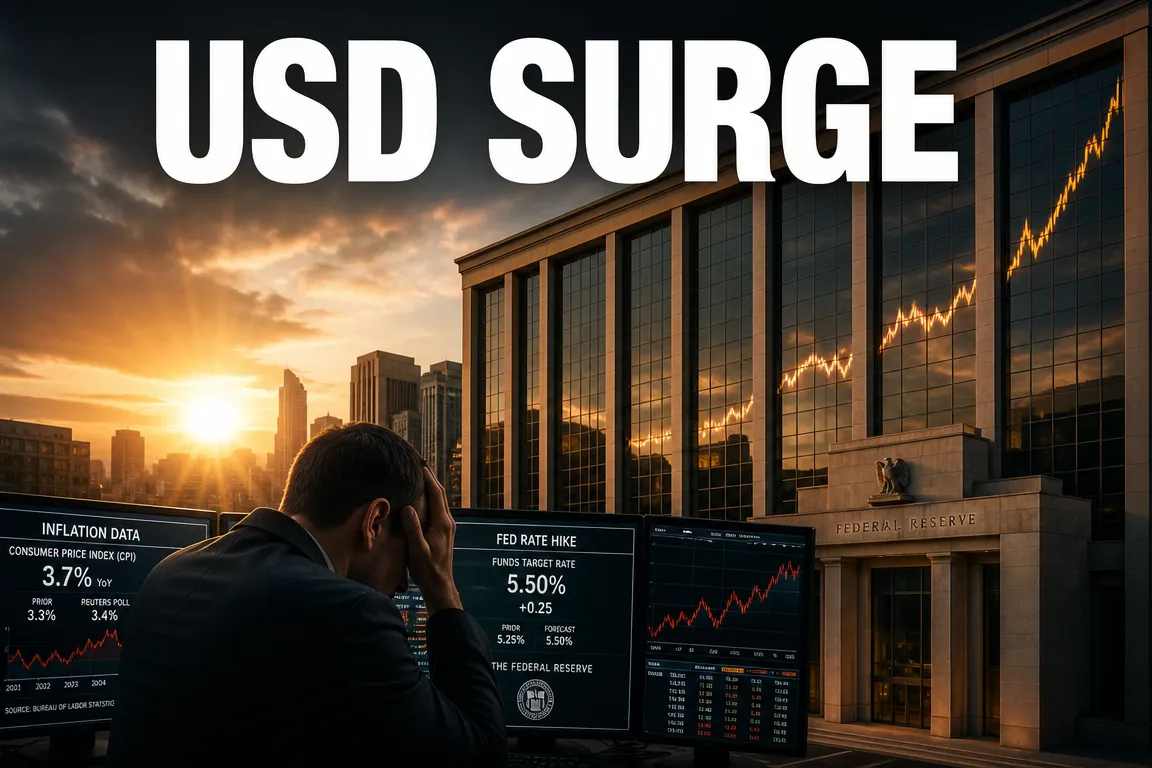
● Fed Shock, Rates Up, Inflation Returns, Dollar Surges
September FOMC Immediate Analysis: U.S. Policy Rate Raised by 0.25%p, with the Key Focus on “Reacceleration in Inflation” and “Further Rate Hikes”
The most important point from this September FOMC meeting is not simply that the U.S. policy rate was raised.
The key issue is why the Federal Reserve chose to reintroduce a rate hike now, and why markets reacted immediately through Treasury yields and the dollar index.
In particular, the decision appears to reflect a combination of prolonged conflict in the Middle East, a sharp rise in crude oil prices, a rebound in inflation expectations, resilience in the U.S. labor market, and changes in the Fed’s dot plot.
On the surface, this was only a 0.25%p increase, but the underlying message is closer to: if inflation reaccelerates, the Fed will not hesitate to raise rates further.
This article reviews the September FOMC outcome, changes in the policy statement, the SEP economic projections, the dot plot, developments in crude oil and inflation, and implications for monetary policy in both Korea and the United States.
1. September FOMC Outcome: The Fed Raises Rates for the First Time in 3 Years and 2 Months
The U.S. Federal Reserve raised the policy rate by 0.25%p at the September FOMC meeting.
As a result, the target range for the U.S. policy rate moved from 3.50~3.75% to 3.75~4.00%.
This was the first rate hike in approximately 3 years and 2 months since July 2023.
The vote was unanimous, with 12 votes in favor and 0 against.
Because markets had already priced in a high probability of a rate hike, the move itself was not a full surprise.
The key question was whether this would be a one-time action or whether additional hikes would follow.
In effect, this FOMC was more hawkish than a standard rate hike.
2. The Fed’s Core Message: “Employment Remains Solid, and Inflation Is Still Elevated”
The statement emphasized two main points.
First, the U.S. economy is still expanding at a solid pace.
Second, inflation remains at an elevated level.
The Fed said economic activity continues to expand at a solid pace, with strong productivity and investment.
The labor market was also described as remaining near maximum employment, with unemployment at low levels.
On inflation, the Fed retained the phrase “inflation remains elevated.”
This indicates that the Fed currently sees the risk of renewed inflation as more important than the risk of recession.
In practical terms, the Fed appears to view the labor market as largely secured, while price stability remains the main objective.
3. SEP Economic Projections: Growth Up, Unemployment Down, Inflation Up
The SEP, or Summary of Economic Projections, released alongside the September FOMC, was also important.
The Fed revised up its U.S. growth forecast.
This suggests that the economy is more resilient than previously expected and can absorb higher rates.
The unemployment forecast was also lowered from 4.3% to around 4.1%.
The Fed expects low unemployment to persist into 2027 and 2028.
This implies that the Fed does not see a major labor-market shock from tighter policy.
By contrast, the inflation outlook was revised higher.
The projected inflation rate rose from 3.6% to 3.7%.
The core inflation forecast also increased from 3.3% to 3.4%.
The combination of stronger growth, solid employment, and firmer inflation creates a setting in which rate hikes become easier to justify.
4. Dot Plot Analysis: The Possibility of Additional Rate Hikes Remains Alive
The most notable point in the dot plot is that 16 of the 18 FOMC participants left open the possibility of at least one more rate hike this year.
Specifically, 12 participants expected one additional hike.
Four participants projected as many as two additional hikes.
Only two participants expected no further change.
This structure is clearly hawkish from the market’s perspective.
It implies that the September hike may not be the last, and that the Fed could move again at the October or December meeting.
The projected longer-run rate also appears likely to remain at a relatively elevated level.
This suggests that the U.S. economy may not return easily to the low-rate environment seen in the past.
For global markets, the more relevant theme may now be prolonged high rates rather than the timing of cuts.
5. The Real Background: Middle East Conflict and the Surge in Crude Oil Prices
To understand this September FOMC decision, crude oil trends must be considered.
Following the Middle East conflict, crude oil prices once rose above $100 per barrel.
They later stabilized somewhat in July and August on hopes of a ceasefire.
However, sentiment shifted again in September as the conflict intensified and showed signs of becoming prolonged.
Concerns deepened as not only the Strait of Hormuz but also Saudi oil pipelines came under threat.
The Strait of Hormuz is a critical route for global oil transport.
If both this route and Saudi pipeline alternatives are destabilized, supply shock risks rise significantly.
WTI, Brent, and Dubai crude all faced upward pressure.
From the Fed’s perspective, even if August inflation data were stable, the risk of a pickup in September and October inflation could not be ignored.
This rate hike appears more like a preemptive move to contain future inflation than a reaction to past inflation.
6. Rebounding Inflation Expectations: The Fed’s Most Sensitive Variable
One of the variables the Fed watches most closely is inflation expectations.
Actual inflation is a concern, but the situation becomes more difficult if households and firms begin to expect further price increases.
Businesses raise prices in advance, workers demand higher wages, and consumers accelerate purchases before prices rise further.
This creates a self-reinforcing inflation dynamic.
Recent inflation expectations have rebounded from around 2.4% to 2.6%.
While the change appears modest, it is material for the Fed.
When this rebound occurs alongside higher crude oil prices, the Fed has a stronger rationale for preemptive action.
That appears to be the central logic of this FOMC meeting.
7. Why Some Expected No Change: The Disinflation Trend Was Still Evident
There was also a reasonable case for keeping rates unchanged at this meeting.
U.S. CPI inflation has fallen steadily from the 9.1% peak in September 2022.
This is known as disinflation.
It does not mean prices are falling, but that the pace of increase is slowing.
Although inflation rebounded after the Middle East conflict, it had shown signs of stabilization again since May.
Core inflation has also been trending down from its peak.
From this perspective, one could argue that the Fed had not raised rates even when inflation was higher in April and May, so the timing of this hike may appear late.
Some real-time data also suggested that September inflation could come in lower than expected.
For that reason, some argued that the Fed could wait for the October CPI, PPI, and PCE data before acting.
However, the Fed appears to have placed greater weight on future risks from crude oil and inflation expectations than on backward-looking data.
8. This FOMC Should Be Viewed as a “Insurance Rate Hike”
This hike is better characterized as an insurance move to prevent a renewed inflation surge than as a standard tightening cycle aimed at cooling an overheated economy.
In simple terms, the Fed appears to be acting early to avoid a larger problem later.
Inflation is not fully out of control at present, but if crude oil and inflation expectations rise together, conditions could deteriorate quickly.
The Fed sought to reduce that risk in advance.
Because the U.S. economy is still firm and the labor market remains strong, the Fed has less reason to delay action out of concern for growth.
The decision also serves as a signal that the Fed remains committed to restoring price stability.
If markets begin to doubt the Fed’s inflation-fighting resolve, long-term Treasury yields and inflation expectations could become more volatile.
The Fed appears to have acted before that happened.
9. Market Reaction: Treasury Yields Rise, Dollar Index Strengthens Sharply
U.S. Treasury yields rose sharply after the FOMC announcement.
This was not only because the policy rate increased.
The more important market signal was the possibility of additional hikes.
If this had been a one-time move, Treasury yields might have stabilized.
Instead, the statement and dot plot kept the door open for further tightening, putting upward pressure on longer-term yields as well.
The dollar index also rebounded strongly.
Expectations of a higher U.S. policy rate increase the appeal of dollar assets.
For global investors, higher Treasury yields and a stronger dollar can attract additional demand for dollar-denominated assets.
This creates pressure for emerging-market currencies and risk assets.
It also weighs on the Korean won, domestic bond markets, the KOSPI, and growth-stock valuations.
10. Political Interpretation Is Possible, But the Main Driver Is Monetary Policy Mechanics
Some may interpret this rate hike through a political lens.
That view arises because President Trump strongly preferred lower rates, yet the Fed moved in the opposite direction.
Some had also expected Kevin Warsh, as Fed chair, to align with the president’s preference.
However, this decision was unanimous.
That suggests the move reflected a broad judgment by the Fed that inflation risks are serious, rather than the preference of a single individual.
Political considerations may exist in the background, including electoral dynamics and limits on fiscal support.
Still, the rate decision itself is more appropriately understood through standard monetary policy logic.
When inflation is firm, expectations are rising, and crude oil is increasing, the Fed’s response is usually to tighten policy.
Ultimately, the lower-rate environment President Trump wanted depended on price stability.
The Middle East conflict and crude oil surge have made that outcome less likely for now.
11. Outlook: Another Hike in October or December Remains Possible
Given the hawkish tone of the September FOMC, markets will now focus on the October and December meetings.
The next CPI, PPI, and PCE releases will be critical.
If inflation data for late September and early October accelerates again, another hike could come as early as the October meeting.
If inflation and oil prices stabilize, the Fed may wait until December or beyond.
At present, one additional hike this year appears to be the most plausible base case.
A second additional hike would likely require another sharp rise in crude oil and a further increase in inflation expectations.
A pause scenario would require both inflation and oil prices to stabilize quickly.
In the near term, the Fed’s path will depend on the Middle East conflict, crude oil prices, inflation expectations, the labor market, and consumption data.
12. Implications for the Korean Economy and the Bank of Korea
With the U.S. policy rate at 4.00%, the Bank of Korea faces greater policy constraints.
Korea is already dealing with inflation pressure and exchange-rate risk.
If the Fed raises rates further, concerns about a wider Korea-U.S. rate differential could return.
This may place upward pressure on USD/KRW.
A weaker won would raise import costs and could feed back into domestic inflation.
This effect is particularly important for Korea, given its high dependence on energy imports.
Even if growth concerns persist, the Bank of Korea may find it difficult to cut rates quickly.
If the Fed maintains a hawkish stance for longer, Korea may also need to preserve a relatively tight policy stance for an extended period.
13. Key Points Investors Should Monitor
First, monitor whether crude oil remains above $100 per barrel.
If oil prices do not stabilize, inflation concerns will remain elevated.
Second, watch whether inflation expectations continue to rise.
Inflation expectations are a key driver of the Fed’s policy stance.
Third, track CPI, PPI, and PCE together.
Consumer inflation alone is not enough; producer prices and PCE inflation also matter.
Fourth, monitor U.S. Treasury yields.
Rising yields can pressure equity valuations.
Fifth, track the dollar index and USD/KRW.
Dollar strength can affect emerging markets and domestic asset prices.
Sixth, follow remarks from FOMC members.
Post-meeting comments often provide clues about the next policy decision.
14. The Most Important Point Not Fully Emphasized in Other Coverage
The true significance of this FOMC is not simply the rate hike itself, but the fact that the Fed’s inflation time horizon has shifted.
Many reports focus on the 0.25%p rate hike, the dot plot, and the immediate Treasury market reaction.
More important is that the Fed has begun to focus more on future inflation risks than on current inflation data alone.
Based on August data, a pause could have been justified.
But in September, the Fed placed greater weight on crude oil, geopolitical risk, and the rebound in inflation expectations.
This suggests a shift from a backward-looking to a more forward-looking policy reaction function.
Going forward, investors should not rely only on the latest CPI reading when assessing the Fed’s stance.
Instead, they should also consider crude oil, logistics, war risk, inflation expectations, and dollar strength.
That is the most important change signaled by this September FOMC.
15. Overall Assessment: Rate-Cut Expectations Have Been Pushed Back, and Prolonged High Rates Look More Likely
This September FOMC marks an important turning point for the global outlook.
Markets had still retained some expectation that the Fed would eventually move toward rate cuts.
However, this decision has pushed those expectations back significantly.
Prolonged high rates and the possibility of another hike this year are now more realistic scenarios.
The strength of the U.S. economy and the resilience of the labor market are positive factors.
But for investors, higher Treasury yields and a stronger dollar are clear headwinds.
Growth stocks, technology shares, real estate, and emerging-market assets are especially sensitive to rate changes.
By contrast, companies with stable cash flow, strong pricing power, and energy exposure may attract relatively more attention.
Going forward, the key variable is not the Fed alone, but inflation.
And the main driver of inflation over the near term is likely to remain crude oil and the Middle East conflict.
< Summary >
At the September FOMC, the Fed raised the U.S. policy rate by 0.25%p to 3.75~4.00%.
This was the first hike in 3 years and 2 months and was approved unanimously.
The Fed judged that the U.S. economy and labor market remain strong, while inflation is still elevated.
The dot plot leaves room for additional hikes this year.
The main drivers are the prolonged Middle East conflict, higher crude oil prices, and a rebound in inflation expectations.
Markets responded in a hawkish manner, with higher Treasury yields and a stronger dollar index.
Investors should now monitor CPI, PPI, PCE, crude oil, inflation expectations, and FOMC member remarks.
Rate-cut expectations have been pushed back, and the case for prolonged high rates has strengthened.
[Related Articles…]
*Source: [ 경제 읽어주는 남자(김광석TV) ]
– [속보] 9월 FOMC 3년 만의 금리인상, “인플레 반드시 잡을 것” [즉시분석]
● Fed Pivot Alert
September FOMC Key Takeaways: What Markets Should Focus On Is Not the Rate Decision, But the Fed’s Next Sentence
The key issue at this September FOMC meeting is not simply whether rates were cut or held steady.
Markets will actually react to three points.
First, whether the Federal Reserve has begun to worry more about labor-market weakness than about disinflation.
Second, how strongly Kevin Warsh signals the future U.S. rate path during the press conference.
Third, whether the statement includes a single sentence that could move the New York stock market, the foreign-exchange market, and even the Korean equity market.
In particular, this meeting is important for both short-term and long-term investors because the FOMC statement, press conference, rate outlook, inflation assessment, and labor-market evaluation are all released at once.
According to the source material, the schedule is Thursday, September 17, 2026 at 2:30 a.m., based on the Federal Reserve announcement and a simultaneous interpretation format from Maeil Business News.
However, because the provided source does not include the full statement or the actual rate decision, the analysis below focuses on the key checkpoints investors should monitor when interpreting the September FOMC.
1. The most important issue at the September FOMC is not the rate level, but the shift in policy priority
Many investors focus only on the policy rate number when reading the FOMC.
In practice, markets often price in some degree of rate cut or hold in advance.
As a result, what moves U.S. equities, Treasury yields, and the dollar is often not the decision itself, but the change in language.
The first issue to watch in this September FOMC is whether the Fed still sees inflation as the main risk, or whether it has started to treat labor-market weakness as more serious.
If the statement keeps language such as “inflation remains elevated” while strengthening references to slower payroll growth, markets may interpret that as a stronger signal of future easing.
By contrast, if the Fed continues to emphasize inflation risks without meaningful concern about employment, it would suggest no near-term shift toward easier policy.
2. Five phrases to check in the statement
The FOMC statement is short, but one word can move markets materially.
The key phrases to monitor in this September statement are as follows.
-
Inflation assessment: Whether the Fed says inflation is “moderating” or still “elevated.”
-
Labor-market assessment: Whether the statement strengthens references to slower job growth, rising unemployment, or labor-market balance.
-
Growth assessment: Whether the U.S. economy is described as resilient or showing signs of slowdown.
-
Future rate path: Whether the Fed leaves room for further policy adjustment or emphasizes caution.
-
Risk balance: Whether inflation and employment risks are presented as more balanced, which would raise the probability of a policy pivot.
In particular, any change in the wording around “risks to achieving its employment and inflation goals” is important.
If the Fed begins to place more weight on labor-market risks than on inflation, markets may price in a more likely rate-cut cycle.
3. Key questions for the press conference
The press conference can provide more direct guidance than the statement.
Markets will focus on the following questions.
-
Whether this move is a one-time adjustment or the start of a rate-cut cycle
-
How strongly the Fed sees the risk of inflation reacceleration
-
Whether labor-market weakness is being viewed as a recession signal
-
Whether the Fed continues to rely on data dependence at each meeting
-
Whether the Fed is uncomfortable with easier financial conditions, including higher equity prices and lower yields
If the press conference repeats that policy will remain data dependent, markets may find it difficult to establish a clear near-term direction.
By contrast, if the Fed says policy remains sufficiently restrictive or that downside labor-market risks are rising, expectations for easing may strengthen.
In that case, U.S. Treasury yields could decline, and Nasdaq-linked growth stocks may respond positively.
4. Market implications: U.S. equities, FX, and Korea equities
The FOMC outcome is not only a U.S. market event.
The direction of U.S. rates affects the dollar, the won, foreign capital flows, the KOSPI, and growth-stock valuations.
U.S. equity market
If the Fed delivers a more accommodative signal, U.S. equities may react positively in the short term.
Technology, AI semiconductors, and Tesla-like growth names are likely to be especially sensitive to lower rate expectations.
However, if rate-cut expectations rise because of slowing growth, the picture changes.
Markets may initially rally, but gains could fade if investors begin to worry about weaker earnings.
U.S. Treasury yields
If the statement and press conference are interpreted as dovish, the 10-year Treasury yield may decline.
If inflation concerns are emphasized, longer-term yields could move higher again.
For investors, the direction of long-term yields matters more than the policy rate itself.
Equity valuations are often more closely linked to long-term yields than to the policy rate.
Dollar and exchange rates
If the Fed strongly opens the door to rate cuts, the dollar may face downward pressure.
That could support won strength and lower USD/KRW.
If the Fed is more hawkish than expected, the dollar could strengthen again, and USD/KRW could rise.
Exchange rates are especially important for Korean investors.
Returns on U.S. equity investments are affected not only by stock prices, but also by FX movements.
KOSPI and the Korean market
If lower U.S. rates coincide with a weaker dollar, foreign capital may flow into Korean equities.
In that case, semiconductors, secondary batteries, internet, and biotech stocks may benefit.
However, if the rate-cut expectation is driven by recession risk, exporters may face pressure.
Ultimately, the Korean market will depend on whether investors interpret the move as a rate cut or as a sign of economic slowdown.
5. The real key that is easy to miss in this FOMC
Most headlines will focus on whether the Fed cuts rates or holds them steady.
For investors, the more important issue is how actively the Fed tries to manage expectations.
The Fed may be concerned if equities rise too quickly and financial conditions loosen too much.
That is because higher equity prices, tighter credit spreads, and lower yields can reinforce consumption and investment, slowing disinflation.
In other words, even if the Fed leaves room for easing, it may still try to prevent markets from getting ahead of themselves.
That is the most important point to watch in the press conference.
If Kevin Warsh says that further adjustments depend on data, or that there is still a long way to go to the inflation target, that may be intended to restrain market exuberance.
By contrast, strong acknowledgement of labor-market weakness would suggest the Fed is shifting into defense mode.
In that case, markets may interpret the Fed as prioritizing growth support.
Ultimately, the key issue is not the rate level itself, but how strongly the Fed tells markets not to expect too much too soon.
6. Practical checkpoints for investors
Markets often overreact immediately after an FOMC announcement.
Making buy or sell decisions based only on the first reaction can leave investors exposed to volatility.
It is better to review the sequence below.
-
Step 1: Check whether the policy rate decision matched market expectations.
-
Step 2: Compare how the statement changed in its inflation and labor-market language versus the previous meeting.
-
Step 3: Look for hints in the press conference about the pace of future easing.
-
Step 4: Review the reaction in the 10-year Treasury yield and the dollar index.
-
Step 5: Observe whether Nasdaq, the S&P 500, or the Russell 2000 responds most strongly.
-
Step 6: Check the next day’s reaction in KOSPI and USD/KRW across Asian markets.
If Nasdaq rises while small caps and cyclical stocks remain weak, the market may be treating the move as a liquidity event rather than a growth improvement.
If small caps and financials also rally, the market may be pricing a stronger soft-landing scenario.
7. September FOMC from the perspective of AI stocks and growth equities
The meeting also matters for investors focused on AI trends.
AI semiconductors, cloud providers, data-center firms, and power-infrastructure names often trade at elevated valuations.
These stocks tend to benefit when rates decline, because the present value of future earnings rises.
However, if lower rates reflect slower growth, there may also be concern that corporate IT spending will decelerate.
In other words, AI stocks do not automatically benefit from rate cuts alone.
The key question is whether lower rates can coexist with stable earnings expectations.
If the Fed supports a soft landing while easing rate pressure, that would be the most favorable combination for AI growth stocks.
If recession concerns intensify, high-valuation growth names may come under profit-taking pressure first.
8. One-sentence summary of this FOMC
The core issue in this September FOMC is not how much the Fed moves rates, but whether it is shifting its focus from inflation toward labor-market weakness.
If the statement shows greater concern about labor-market deterioration and the press conference leaves room for further easing, markets may increase expectations for a rate-cut cycle.
However, if the Fed pushes back against overly optimistic market expectations, U.S. equities and KOSPI could see early gains followed by higher volatility.
Investors should focus not only on the immediate headline, but also on the statement wording, press-conference tone, Treasury yields, and FX reaction.
< Summary >
The key issue in the September FOMC is policy priority, not the policy-rate number.
The most important question is whether concern about labor-market weakness is becoming more prominent than concern about inflation.
During Kevin Warsh’s press conference, investors should determine whether any easing signal implies a one-time move or the start of a broader cycle.
A dovish message would support lower Treasury yields, a weaker dollar, and stronger growth stocks.
However, if easing expectations are driven by recession risk, equity markets may become more volatile.
AI stocks and technology names may benefit from lower rates, but earnings stability remains the more important factor.
Investors should evaluate the post-FOMC response through statement wording, press-conference remarks, exchange rates, long-term yields, and Nasdaq performance.
[Related Articles…]
*Source: [ Maeil Business Newspaper ]
– 9월 FOMC 성명서 해설 l 케빈 워시 기자회견 동시통역