● Boxed-Up KOSPI AI Surge, SK Hynix US Move, HBM Limits
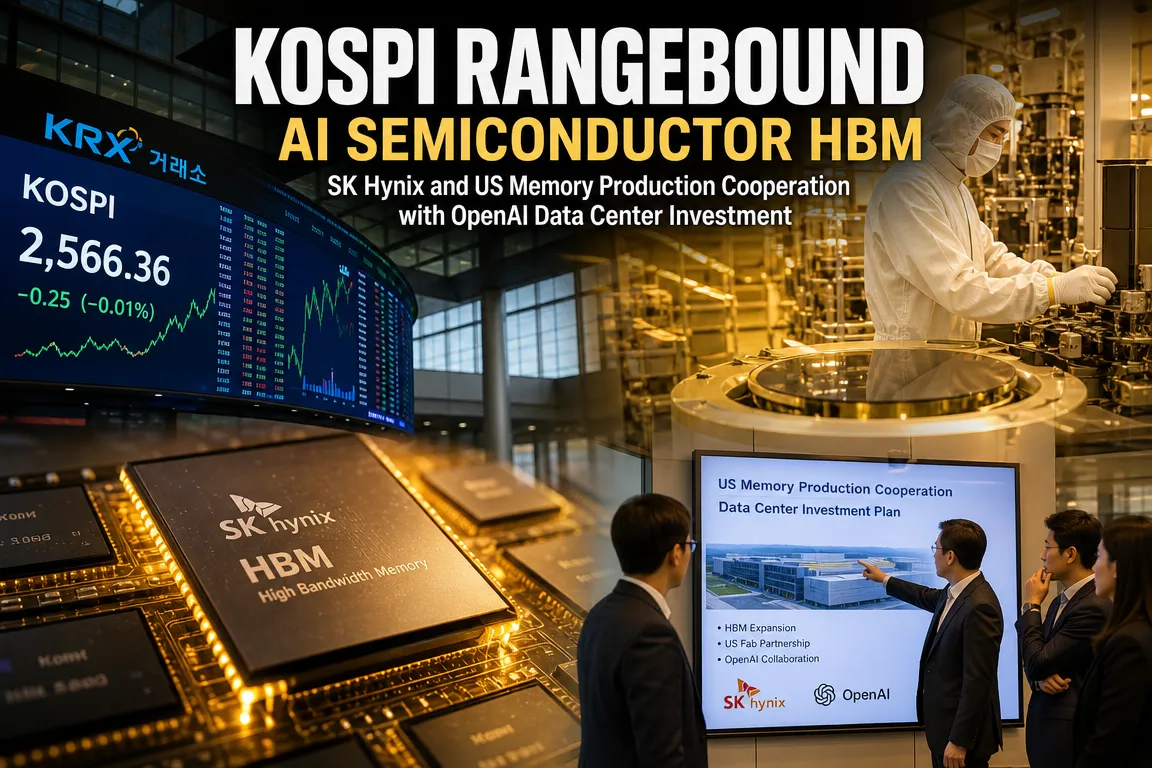
The Real Reasons the KOSPI Is Stuck in a Range: OpenAI Product Launches, SK Hynix U.S. Production, and the Limits of the Semiconductor Rally
The key issue in the recent KOSPI trend is not simply whether the index rose or fell.
Several forces are moving at once: AI semiconductor expectations, the possibility of SK Hynix U.S. production, global supply chain restructuring, expanded shareholder returns, and the structural limits of the KOSPI outlook.
At first glance, semiconductors appear to be regaining momentum. In practice, however, the market is in an ambiguous phase: upside is limited by the lack of a decisive new catalyst, while downside is constrained by solid earnings.
As a result, the more important question is not the OpenAI event itself, but this:
How quickly can AI expectations translate into actual memory demand and corporate earnings?
1. Why the KOSPI Stabilized Today: Renewed AI Expectations in Semiconductors
The KOSPI has been moving in a typical range-bound pattern.
The index has not broken down materially, but neither has it posted a strong breakout.
This time, however, a set of developments helped improve sentiment around semiconductors.
- OpenAI CEO Sam Altman signaled a major product launch this week.
- He also referred to the possible unveiling of six new products at next week’s developer conference.
- Expectations for more advanced AI services revived demand hopes for AI semiconductors and memory.
- Reports regarding possible U.S.-based memory production involving SK Hynix also supported sentiment.
The market tends to rotate back into semiconductors whenever AI-related events emerge.
In particular, moves by OpenAI, Nvidia, and cloud-service providers often have direct implications for Samsung Electronics and SK Hynix in the Korean market.
As AI models become larger, usage expands, and services become more complex, the underlying requirements remain the same: GPUs, HBM, server DRAM, and data-center infrastructure.
2. Why OpenAI Product Launches Matter for the KOSPI
A new OpenAI product is not simply an IT hardware or software headline.
In the current market, such announcements are interpreted as signals of increased AI infrastructure investment.
More AI services require more data centers.
More data centers require more GPUs.
Higher GPU demand also lifts demand for HBM, the high-performance memory used in AI systems.
SK Hynix is one of the leading companies in the HBM market.
For that reason, OpenAI-related events affect not only U.S. technology stocks, but also Korean semiconductor names.
As with past AI model announcements from companies such as Google and OpenAI, the market is again pricing in the possibility that new AI services will further increase memory demand.
3. The Significance of Reports on SK Hynix U.S. Memory Production
According to Reuters, SK Hynix is pursuing cooperation options related to memory production in the United States.
This matters for more than just the construction of another facility.
The key issue is the global supply chain.
The United States has continued to intensify pressure to reconfigure semiconductor supply chains around domestic production.
This trend applies to advanced semiconductors, AI chips, and memory products alike.
If SK Hynix secures a U.S. production base, several advantages may follow.
- Cooperation with U.S. customers may become easier.
- Tariff and regulatory risks may decline.
- Access to U.S. semiconductor support policies may improve.
- Response speed for AI data-center clients may increase.
- Geopolitical and China-related risks may be partially diversified.
For SK Hynix, strong leadership in HBM combined with localized U.S. production or packaging capabilities could further strengthen relationships with global hyperscale customers.
This is the main reason the market viewed the report positively.
4. Why the KOSPI Still Fails to Break Higher
The problem is that even with positive news, the KOSPI has not been able to break meaningfully above its range.
This is the central point of the current market.
Markets are reacting to favorable headlines, but the response has not translated into a sustained upward trend.
There are four main reasons.
4-1. There Is No New Catalyst Strong Enough to Overwhelm the Market
AI semiconductor expectations are already largely embedded in prices.
Investors are already aware of HBM growth, AI server demand, and expanded data-center spending.
As a result, news that a new AI product is coming is not enough by itself to drive the entire KOSPI sharply higher.
Further upside requires numbers, not just expectations.
What the market needs is concrete evidence such as stronger orders, earnings upgrades, profit expansion, and improved cash flow.
4-2. The Rally Is Too Concentrated in Semiconductors
The current weakness in the KOSPI is that the upside driver is overly concentrated in semiconductors.
If Samsung Electronics and SK Hynix remain strong, the index can avoid a sharp decline.
But unless sectors such as batteries, biotech, consumer goods, financials, and domestic demand names also improve, a broad-based index rally remains limited.
The KOSPI is range-bound not because semiconductors are weak, but because non-semiconductor sectors are not strong enough.
4-3. Rate-Cut Expectations Are Not Yet Fully Confirmed
Interest rates remain one of the most important variables for global equities.
The market expects rate cuts, but inflation has not yet clearly and decisively cooled.
Until the Federal Reserve’s policy direction becomes more certain, foreign investors are unlikely to push the KOSPI aggressively higher.
Lower-rate expectations are supportive for growth stocks and semiconductors.
By contrast, delays in rate cuts can bring valuation pressure back into focus.
4-4. USD/KRW Volatility and Foreign Flows Remain a Headwind
The Korean market is highly sensitive to foreign capital flows.
For foreign investors, exchange rates matter as much as equity returns.
When the won-dollar rate becomes unstable, the appeal of Korean equities can weaken.
Even if semiconductor earnings remain strong, unstable FX, rates, or U.S. market conditions can limit foreign buying.
5. Why the KOSPI Has Not Fallen Sharply Either
At the same time, there is a clear reason why the KOSPI has not broken down below the range.
The main support is still the earnings strength of semiconductor companies.
SK Hynix is benefiting from strong demand for high-value memory products centered on HBM.
Samsung Electronics is also supported by expectations for a recovery in the memory cycle and potential inclusion in the AI semiconductor supply chain.
In addition, domestic shareholder-return policies are helping provide a floor under the index.
- Expectations for share buybacks remain in place.
- Dividend expansion expectations remain in place.
- The corporate value-up policy remains a supporting factor.
- Improving semiconductor earnings continue to support the index floor.
In short, the KOSPI currently lacks the strength for a decisive breakout, but market conditions are not weak enough to justify a sharp decline.
That is the essence of the range-bound market.
6. The Real Point Most Coverage Misses
Most reports focus only on OpenAI’s product launch or the possibility of SK Hynix U.S. production.
The more important issue is different.
How long can AI expectations sustain the memory pricing cycle?
Semiconductor stocks do not rise simply because technology improves.
Ultimately, memory prices must rise, shipments must increase, and operating margins must improve.
If AI demand does not translate into higher HBM and server DRAM prices, the stock rally will eventually pause.
Conversely, if major technology companies such as OpenAI, Microsoft, Amazon, Google, and Meta continue to increase AI infrastructure spending, the outlook changes materially.
In that case, HBM supply shortages could persist longer, and SK Hynix earnings estimates could be revised further upward.
For investors, the key issue is not simply what OpenAI launched, but how much computing power and memory the new products require.
7. Conditions for the KOSPI to Break Out of Its Range
Several conditions are needed for the KOSPI to move beyond the current range.
- Expanded AI spending by OpenAI and other major technology firms must translate into actual semiconductor orders.
- Further earnings upgrades must be seen at SK Hynix and Samsung Electronics.
- The timing of rate cuts must become clearer.
- USD/KRW stability is needed.
- Uptrend participation must broaden beyond semiconductors.
- Corporate value-up and shareholder-return measures must be confirmed in actual numbers.
The most important factor is broader sector participation.
Semiconductors alone can support the KOSPI.
But semiconductors alone are unlikely to drive a sustained long-term bull market.
Financials, autos, shipbuilding, defense, biotech, and platform stocks would need to join the move for the index to show stronger breadth.
8. How Investors Should Read the Market Now
At this stage, chasing the market aggressively appears premature.
Semiconductors remain the core driver of the Korean market.
However, after recent gains, the gap between expectations and earnings needs to be monitored carefully.
If AI semiconductor demand remains strong, pullbacks may present opportunities.
But if OpenAI-related events remain at the level of sentiment and do not lead to earnings upgrades, the market is likely to continue fluctuating within a range.
Accordingly, three points should be monitored closely:
- Whether AI product launches lead to stronger data-center investment guidance.
- Whether SK Hynix’s HBM supply contracts and U.S. production strategy become more concrete.
- Whether gains in the KOSPI extend beyond semiconductors into other sectors.
9. Market Interpretation: Not a Weak Market, but One That Requires Confirmation
The KOSPI should not be viewed too negatively at present.
Semiconductor companies are generating strong earnings, AI infrastructure investment remains in place, and shareholder-return expectations continue to provide support.
However, much of the optimism has already been priced in.
For that reason, the current KOSPI outlook is closer to a limited range-bound market than to a strong rally.
Upside requires new earnings momentum, while downside is supported by semiconductor profits and shareholder returns.
In one sentence, the current market can be summarized as follows:
AI expectations remain intact, but the KOSPI will need earnings confirmation rather than sentiment alone to break out of its range.
< Summary >
The KOSPI is currently trading in a typical range-bound pattern.
OpenAI’s signal of an upcoming product launch and the developer conference has revived expectations for AI semiconductors and memory demand.
Reports on possible SK Hynix cooperation for U.S.-based memory production have been interpreted positively in terms of supply chain restructuring and lower tariff risk.
However, the KOSPI has not rallied strongly because AI expectations are already largely reflected in prices, while non-semiconductor sectors remain weak.
At the same time, the index has not broken down because semiconductor earnings and shareholder-return expectations continue to support the downside.
The key issue now is not the OpenAI event itself, but whether AI service expansion translates into higher HBM and server memory demand.
For the KOSPI to break out of its range, confirmation of rate cuts, FX stability, further earnings upgrades in semiconductors, and broader sector participation will be required.
[Related Articles…]
*Source: [ 내일은 투자왕 – 김단테 ]
– 코스피가 박스권에 있는 진짜 이유 #코스피 #하이닉스 #OpenAI
● AI-Driven Capital War, Rates Rise, Stocks Hold
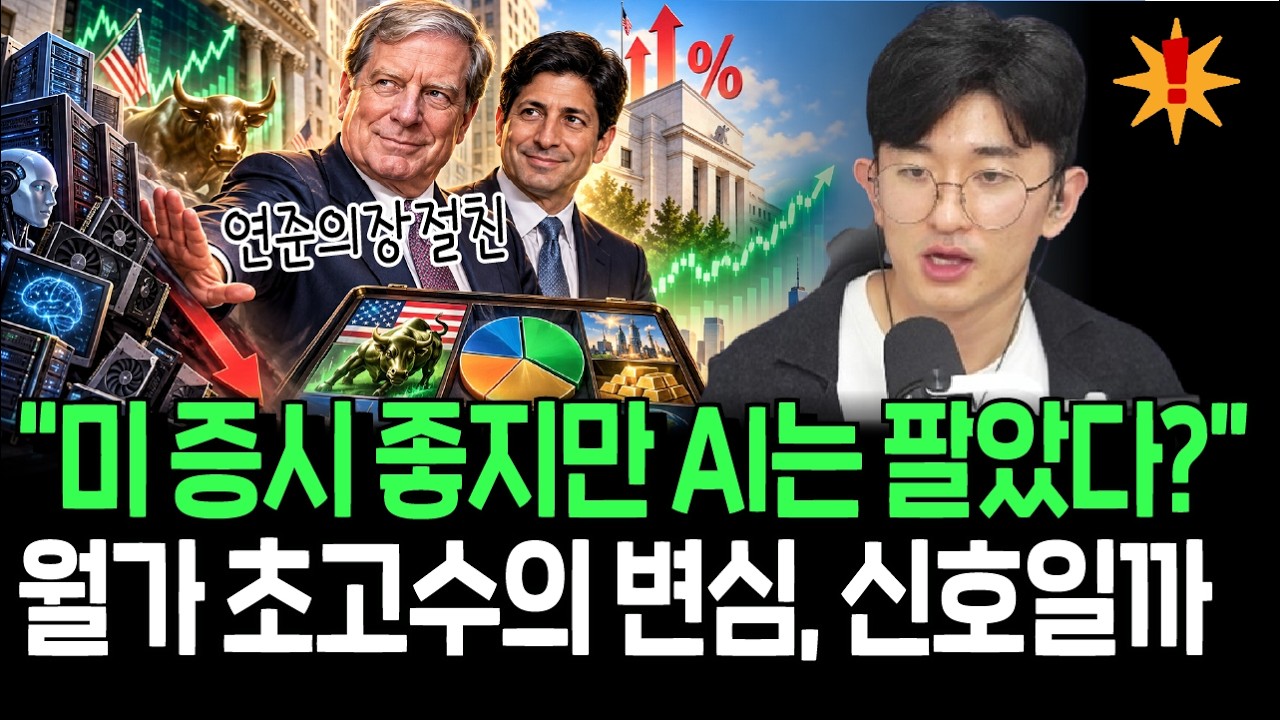
Will U.S. Equities Hold Up if Rates Rise Further? Druckenmiller on the AI Infrastructure Cycle and the Big Tech Capital Battle
The key issue is not simply whether higher rates are acceptable.
Stanley Druckenmiller’s core message can be summarized in three points.
First, the U.S. economy remains strong enough that rising bond yields may not be materially negative for U.S. equities.
Second, the competition among major technology companies to fund AI infrastructure is a central driver of higher rates.
Third, despite that view, Druckenmiller has significantly reduced exposure to AI infrastructure-related stocks.
In other words, he is simultaneously signaling that the U.S. remains resilient while AI infrastructure equities warrant caution.
1. Druckenmiller’s Main Conclusion: Rising Rates Are Not Yet a Problem
In the interview, Stanley Druckenmiller said the current rise in rates should not be viewed as a major concern.
His view is based on the continued strength of the U.S. economy.
He sees no clear sign of a recession, employment has not deteriorated materially, and asset markets remain too strong to be described as operating under a restrictive environment.
- He assessed current U.S. economic conditions as solid.
- He indicated that further rate cuts are no longer urgently needed.
- He suggested that a higher U.S. 10-year Treasury yield is not necessarily a crisis.
- He argued that if yields are rising because of robust real activity and capital demand rather than renewed inflation, markets may absorb the move.
The key issue is not the level of rates, but the reason rates are rising.
If yields rise because inflation is accelerating uncontrollably, the pressure on equities would be significant.
However, if rates are being pushed higher by AI infrastructure investment, data center construction, and increased Big Tech capital spending, the interpretation is different.
2. The Driver Behind Higher Rates: Big Tech’s AI Infrastructure Capital Race
Druckenmiller placed particular emphasis on the competition for capital among major technology firms.
Microsoft, Amazon, and Alphabet all require substantial funding for AI infrastructure investment.
Building data centers, securing GPUs, expanding power access, and scaling cloud infrastructure require significant capital.
This has created a de facto race for capital across the market.
In the interview, he described the dynamic as a form of “war for capital.”
- Microsoft is advancing aggressive data center expansion plans.
- Amazon has moved to raise funds through bond issuance, including in overseas markets such as the U.K.
- Alphabet is also expanding AI-related data center investment globally, including in Europe.
- Rising capital demand from Big Tech is putting pressure on bond markets and long-term yields.
Put simply, rates are rising because too much capital is being sought at once.
AI infrastructure investment is not a short-term theme; it has become a strategic competition among major firms.
That is why Druckenmiller does not interpret higher rates as an automatic warning signal.
3. U.S. Corporate Bond Yields and the Extension of the AI Funding Race into Europe
One notable point in the interview was that U.S. technology firms are also tapping European markets for funding.
In the U.S. bond market, large technology companies now appear to need to offer yields in the mid-5% range to attract investor capital.
By contrast, some European markets have offered relatively lower funding costs.
As a result, some Big Tech firms are looking to Europe’s corporate bond market.
The issue is that this can affect funding conditions for European companies as well.
- U.S. Big Tech may absorb substantial investor capital in European bond markets.
- This could make it harder for European corporates to raise funding.
- Global bond yields may face upward pressure.
- AI infrastructure investment is increasingly influencing global capital markets.
This aspect is often reduced in headlines to a simple “AI investment expansion” narrative.
In practice, the AI infrastructure race is drawing liquidity out of the global capital system.
That is likely to become an increasingly important macro variable.
4. The Contradiction: Druckenmiller Has Cut AI Infrastructure Exposure Sharply
The most important reversal in the interview is that Druckenmiller reduced his exposure to AI infrastructure stocks materially.
He remains constructive on the U.S. economy and on AI competitiveness, but he has significantly lowered his holdings in AI infrastructure-related names.
Based on the interview, his exposure appears to have been reduced to roughly 20% of the level seen six months ago.
In other words, he has cut exposure by close to 80%.
This does not mean he believes the broader AI cycle has ended.
Rather, he appears to be concerned that the AI infrastructure buildout is entering a later phase.
- He continues to recognize AI’s long-term growth potential.
- However, he sees the data center, semiconductor, power, and optical network investment boom as vulnerable to cyclical slowdown.
- He warned that the market may be projecting future earnings too far into the future.
- He also referred to the possibility of an “earnings bubble.”
An earnings bubble is different from a simple valuation bubble.
It implies that earnings expectations themselves may be overly optimistic.
If the market is assuming that AI infrastructure spending will continue to grow at an exceptional pace for years, even a modest slowdown could materially reduce forward estimates.
5. The AI Cycle Is Not the Same as the AI Infrastructure Cycle
One of the most important distinctions in the interview is between the AI cycle and the AI infrastructure cycle.
Many investors treat them as the same thing, but they are not.
- The AI cycle refers to the long-term adoption of artificial intelligence across industries and the associated productivity gains.
- The AI infrastructure cycle refers to concentrated capital spending on data centers, GPUs, power systems, cooling equipment, and network infrastructure.
- The AI cycle can remain durable over time, while the infrastructure cycle can experience periods of overheating and slowdown.
In practical terms, the internet kept growing, but telecom equipment stocks still corrected sharply after the dot-com bubble.
Smartphones continued to expand as a market, but certain component suppliers still faced excess supply and pricing pressure.
AI may follow a similar pattern.
AI as a technology can continue to scale, but that does not guarantee uninterrupted earnings growth for AI infrastructure companies.
6. Why He Still Advises Against Shorting the U.S. Market Aggressively
Although Druckenmiller is cautious on AI infrastructure stocks, he is not advocating a broad bearish position on U.S. equities.
His reason is that the U.S. retains a dominant position in AI.
- The U.S. leads globally in cloud infrastructure, semiconductor design, AI models, and platform companies.
- Big Tech firms have both strong cash flow and access to capital markets.
- Returns from AI investment are likely to accrue primarily to U.S. companies.
- Global capital may continue to flow toward U.S. assets seeking higher returns on capital.
In this context, some AI infrastructure stocks may consolidate, but there is no clear basis for a blanket bearish view on the U.S. equity market.
Leadership may rotate from infrastructure into AI services, AI software, AI platforms, and productivity beneficiaries.
7. Why a Bearish Dollar Bet Also Requires Caution
Druckenmiller also suggested that betting on dollar weakness may be premature.
His argument is that if the U.S. maintains its AI investment lead, global capital could eventually flow back into U.S. assets.
Once the AI infrastructure buildout matures, the focus shifts to monetization.
If U.S. Big Tech continues generating substantial cash flow, international capital may again move toward U.S. equities and U.S. fixed income.
That could support the dollar.
- AI investment returns may remain concentrated in U.S. companies.
- Global investors may seek higher capital returns in U.S. stocks and bonds.
- This could strengthen dollar demand.
- Therefore, a simple rate-cut-driven dollar weakness thesis may be too one-sided.
8. Why the Fed Angle Matters: The Kevin Warsh Connection
The remarks drew additional attention because Druckenmiller is known to have ties to Kevin Warsh.
Warsh, a former Federal Reserve governor, is frequently mentioned as a potential future Fed chair candidate.
Druckenmiller and Warsh are understood to have worked together in the past, and Druckenmiller has spoken positively about him.
While direct policy communication would naturally be limited, Druckenmiller’s views can still be read as a useful reference point for the likely policy environment.
In particular, the interview implies that rate cuts may not be urgently required.
That is more cautious than the market’s expectation for a rapid easing cycle.
If the U.S. economy stays firm and AI-related capital demand remains elevated, both policy rates and long-term yields could stay higher for longer than the market expects.
9. What Investors Should Watch Closely: Earnings Expectations, Not Just Rates
Many investors focus primarily on interest rates when assessing U.S. equities.
However, the more important variable in this interview is earnings expectations.
In particular, investors should assess whether forward estimates for AI infrastructure companies have become too optimistic.
- Monitor whether revenue growth begins to slow.
- Track whether new order growth starts to weaken.
- Check whether data center investment plans are delayed or scaled back.
- Assess whether capital spending is translating into monetization at an adequate pace.
- Watch whether higher corporate bond yields are constraining investment capacity outside Big Tech as well.
This does not imply that AI infrastructure stocks are unattractive.
It means the focus should shift from “AI stocks always rise” to whether earnings can continue to exceed market expectations.
10. A Less Visible Point: AI Infrastructure Is Effectively a Form of Private-Sector Tightening
One of the more important macro interpretations is that AI infrastructure spending can create a private-sector tightening effect.
Normally, tightening is associated with higher policy rates from central banks.
In this case, however, Big Tech is absorbing so much capital that it is pushing market rates higher on its own.
This means that even without further aggressive Fed tightening, capital markets can generate a form of effective tightening.
Large technology firms can still access funding, but smaller companies and lower-quality borrowers may face tighter conditions.
- Big Tech absorbs global capital to finance AI infrastructure.
- Bond investors demand higher yields.
- Funding costs rise for other companies as well.
- This creates a selective tightening effect across the economy.
- As a result, the gap between AI winners and non-AI companies may widen further.
This is the part many headlines miss.
AI investment is both a growth driver and a liquidity drain on the capital system.
Going forward, the key question is not just whether AI grows, but whether the capital it absorbs generates sufficient returns.
11. The Investment Approach for a Volatile September and October
The interview also referred to seasonal volatility in September and October.
Historically, U.S. equities have often been weaker in September, and volatility can rise when election-related uncertainty becomes more visible.
Seasonality alone should not drive investment decisions.
However, when higher rates, AI infrastructure concerns, Big Tech funding needs, and dollar dynamics are all interacting, risk management becomes more important.
- Portfolios concentrated in AI infrastructure names should be reviewed.
- Long-duration growth stocks can be maintained, but names with stretched earnings expectations may require staged adjustments.
- Rather than turning broadly bearish on U.S. equities, investors should consider the possibility of sector leadership rotation.
- Rate-cut expectations should be assessed alongside Treasury yields and the corporate bond market.
- One-sided bets on dollar weakness should be treated cautiously.
12. Key Indicators Investors Should Monitor
The following indicators are relevant for assessing U.S. equities and AI-related stocks:
- U.S. 10-year Treasury yield: the significance of any move toward or above 5% depends on the underlying driver.
- U.S. corporate bond yields: these reflect funding costs and credit-market stress for Big Tech and beyond.
- Big Tech capital expenditure: this is a key indicator of the sustainability of the AI infrastructure cycle.
- Data center orders and power demand: these serve as forward indicators for AI infrastructure earnings.
- Semiconductor inventories and supply agreements: these help assess overheating in GPUs, memory, and network equipment.
- Dollar index: this indicates whether global capital is flowing back into U.S. assets.
- Federal Reserve commentary: this helps gauge whether rate-cut expectations are realistic.
< Summary >
Druckenmiller argued that rising rates are not necessarily a major problem for U.S. equities as long as the U.S. economy remains strong.
He sees Big Tech’s AI infrastructure spending and capital competition as the main source of upward pressure on yields.
At the same time, he has sharply reduced exposure to AI infrastructure stocks because he sees the buildout cycle as potentially late-stage.
He remains constructive on AI’s long-term potential, but believes expectations for data centers, semiconductors, power systems, and optical networks may be too aggressive.
He also does not see a strong basis for shorting the broader U.S. market, given America’s dominant position in AI.
He is similarly cautious on bearish dollar positioning, since global capital may ultimately flow back into the U.S.
The main implication is that investors should not become broadly negative on U.S. equities, but they should closely monitor overheating in the AI infrastructure segment and the possibility of leadership rotation.
[Related Articles…]
- AI Infrastructure Investment Cycle and Big Tech Capital Competition
- U.S. Rate Outlook and Global Asset Market Shifts
*Source: [ 소수몽키 ]
– 금리 더 올라도 미 증시 끄떡없다? 월가 초고수의 베팅, 적중할까