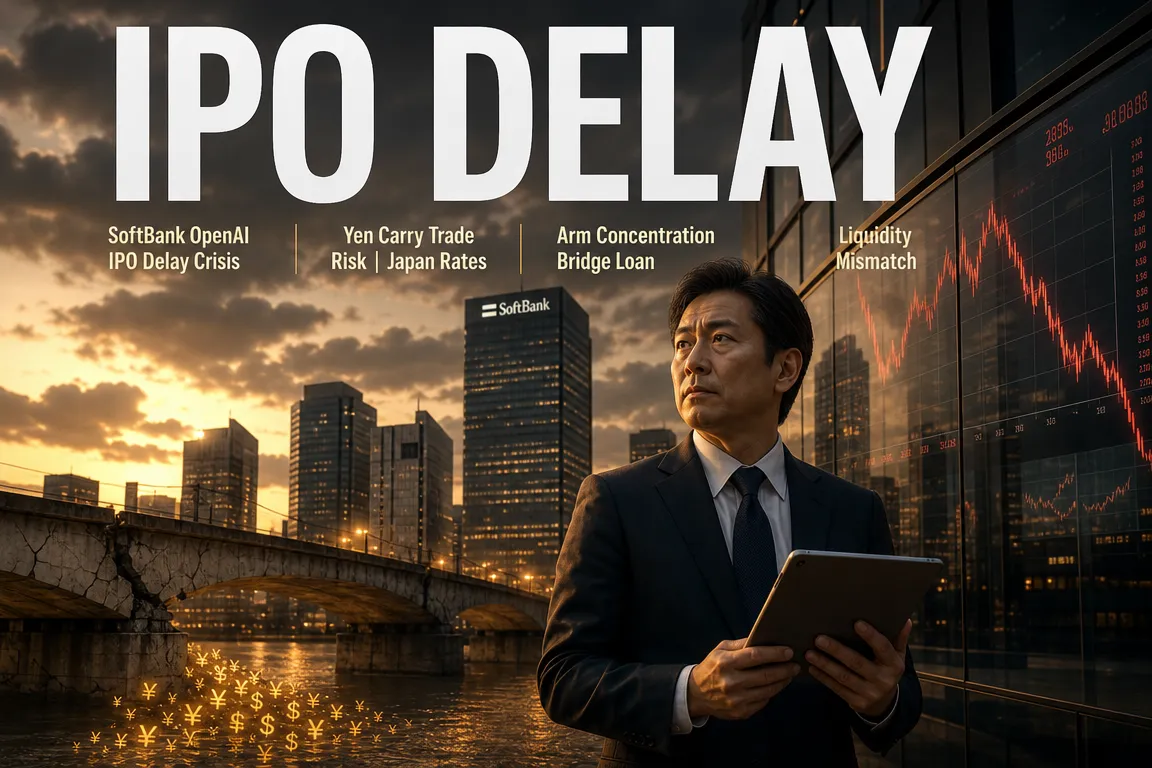
● SoftBank Crisis, OpenAI Delay, Debt Risk, AI Gamble
Is SoftBank Facing a Historic Crisis? The Real Risks Created by OpenAI IPO Delay, Bridge Loans, and the Yen Carry Trade
The core issue is not simply that SoftBank has too much debt.
The key point is that SoftBank deployed large-scale AI investments using short-term borrowings while waiting for an OpenAI listing, and the delay in the OpenAI IPO has disrupted the funding timeline.
At a superficial level, this may look like a SoftBank crisis. In substance, however, it is a global macro risk tied to OpenAI’s growth trajectory, the AI agent market, rising Japanese rates, and the unwinding risk in the yen carry trade.
This report reviews SoftBank’s bridge-loan structure, interest burden, concentration in Arm and OpenAI, recent signs of a revenue rebound at OpenAI, and the often overlooked reason this crisis may also represent a significant opportunity.
1. Key takeaway: the crisis began with the delay of the OpenAI IPO
The main reason SoftBank has recently been viewed as facing a historic crisis is its OpenAI investment.
Under Chairman Masayoshi Son, SoftBank is again making a large-scale bet in the AI cycle.
The issue is that this investment was not funded entirely from cash, but to a significant extent through leverage.
SoftBank assumed OpenAI would list relatively quickly and borrowed short-term funds to proceed with the investment.
In simple terms, the strategy was to borrow first, invest in OpenAI, and repay part of the debt after monetizing shares in the IPO.
However, after Sam Altman indicated that the OpenAI IPO would likely be delayed until next year, the situation changed.
For SoftBank, the equity monetization timetable moved back, while short-term debt maturities and additional investment commitments remained unchanged.
The issue, therefore, is not a lack of assets, but a liquidity mismatch between debt maturity and investment realization.
2. SoftBank’s bridge-loan structure: unsecured $40 billion capacity, about $26 billion used
The main financing tool SoftBank used for OpenAI investment is a bridge loan.
A bridge loan is a temporary financing tool that connects to longer-term funding.
A notable feature of this facility is that it is unsecured.
This suggests that major global banks continue to place some confidence in SoftBank’s asset base and Masayoshi Son’s capital allocation track record.
- Purpose: OpenAI investment
- Total capacity: about $40 billion
- Current drawdown: about $26 billion
- Maturity: end-March 2027
- Structure: unsecured bridge loan
- Lenders: major global investment banks and financial institutions
The issue is that this bridge loan may need to be refinanced into longer-term debt before the OpenAI IPO.
SoftBank must refinance the existing $26 billion bridge loan while also funding an additional $10 billion investment commitment to OpenAI.
In effect, the company needs new debt to repay old debt and additional capital for new AI investment.
This structure has prompted the market to reprice SoftBank’s credit risk.
3. Market reaction: CDS at a three-year high, dollar bond yields near 9%
One of the fastest indicators of SoftBank’s credit risk is its CDS.
CDS is effectively the insurance premium the market assigns to the risk of default.
SoftBank’s CDS has recently risen to its highest level in about three years.
This does not imply that investors expect an immediate default, but it does indicate a materially higher risk premium.
In addition, SoftBank’s dollar bonds are being priced at roughly 9% yields in the market.
That level is closer to high-yield or speculative-grade debt than to investment-grade credit.
AI investment expectations remain strong, but debt markets are taking a much more cautious view of SoftBank’s leverage structure.
4. On paper, SoftBank is not an immediately distressed company
SoftBank’s debt burden looks substantial in nominal terms.
On a recent quarterly basis, consolidated interest-bearing debt was about 27.8 trillion yen.
Using a simple conversion of 100 yen to 1,000 won, that is roughly KRW 278 trillion.
By comparison, SoftBank’s equity holdings are valued at about 83.1 trillion yen.
That is close to KRW 830 trillion in asset value.
SoftBank’s stated LTV, or net debt divided by equity holdings value, is about 13%.
By this measure alone, the company does not appear highly leveraged.
For example, this is similar to a person with KRW 100 million in assets carrying about KRW 13 million in debt.
Accordingly, the SoftBank issue should not be reduced to a simple debt problem.
The key variables are asset quality, liquidity, interest expense, and asset price volatility.
5. Structural risk 1: excessive concentration in Arm and OpenAI
SoftBank’s most significant structural risk is portfolio concentration.
A large share of its equity value is effectively concentrated in two companies.
- Arm: about 60% of SoftBank’s equity holdings value
- OpenAI: about 17%
- Arm + OpenAI combined: about 77%
In other words, SoftBank’s fate is largely tied to Arm’s share price and OpenAI’s valuation.
Arm is publicly listed, so it offers relatively better liquidity.
SoftBank can potentially sell part of its stake or use it as collateral.
OpenAI, by contrast, remains private.
Even if the stake is highly valued on paper, it cannot be readily monetized when cash is needed.
This is SoftBank’s main constraint.
The balance sheet may look strong, but the assets that can be converted into cash quickly are limited.
6. Structural risk 2: high interest expense and insufficient operating cash flow
SoftBank’s annual interest expense is estimated at about JPY 1.2 trillion.
That is roughly KRW 11 trillion per year.
In other words, annual interest alone is close to KRW 11 trillion.
The problem is that Arm and OpenAI, the company’s core holdings, pay little to no dividends.
Growth assets typically reinvest capital rather than distribute cash.
As a result, SoftBank may face a cash flow shortfall even if the value of its holdings rises.
Including Vision Fund distributions, dividend income, and proceeds from other asset sales, it remains difficult to fully cover interest expense.
Based on the original analysis, existing cash flow appears sufficient to cover only about 50% of annual interest expense.
SoftBank has therefore continued to sell assets such as T-Mobile and Intel to raise funds.
At the same time, it continues to increase its OpenAI exposure.
This creates a structure in which cash generation remains weak while investment concentration increases.
7. Structural risk 3: rising Japanese rates and the yen carry trade risk
SoftBank can be viewed as a major participant in the yen carry trade.
The yen carry trade involves borrowing yen at low rates and investing in dollar assets or higher-yielding assets.
This strategy benefited from Japan’s prolonged ultra-low-rate environment.
SoftBank also built its model on borrowing at low Japanese rates and investing in U.S. technology and global AI companies.
However, rising Japanese bond yields and renewed yen appreciation pressure are changing the environment.
When yen liabilities are used to fund dollar assets, yen strength increases the burden.
Rising Japanese rates increase refinancing costs, while yen appreciation can weaken the economics of overseas investment.
As a result, SoftBank’s issue is not just a company-specific matter but also one tied to global macro conditions and Japan’s monetary policy shift.
8. Why this should not be framed simply as a bankruptcy risk
SoftBank is clearly under pressure, but the situation is not straightforwardly a bankruptcy concern.
First, SoftBank still has assets that can be sold.
Arm is listed and can potentially be partially sold or pledged.
Second, OpenAI’s recent growth remains strong.
If OpenAI continues to increase its valuation, SoftBank’s investment returns could outweigh the debt burden.
Third, the current issue is primarily a timing problem.
The delay in the OpenAI IPO is the immediate problem; the investment itself has not failed.
Indeed, if OpenAI goes public after further progress, SoftBank could realize a materially higher return.
9. OpenAI valuation is the key variable: from $852 billion to a $2 trillion scenario
Based on the original analysis, OpenAI’s most recently referenced valuation is about $852 billion.
SoftBank’s OpenAI stake is cited as roughly 13% after accounting for the additional $10 billion investment.
If OpenAI were to list at a $2 trillion valuation, the economics would change significantly.
Thirteen percent of $2 trillion is about $260 billion.
That would imply a much higher value for SoftBank’s OpenAI stake than today.
Admittedly, a $2 trillion listing is an aggressive assumption.
However, AI investors are rapidly repricing the sector as companies such as Anthropic, OpenAI, Google Gemini, Meta AI, and xAI compete across AI infrastructure and AI agents.
For SoftBank, OpenAI is both the source of the current risk and the main option for reversing that risk.
10. Sign that OpenAI is strengthening again 1: OpenRouter overtakes Anthropic
There has recently been an interesting shift in the AI model market.
OpenRouter is a platform that allows developers to use multiple AI models through API access.
This market tends to reflect preferences among individual developers, startups, and smaller enterprise teams more quickly than the large corporate market.
Earlier this year, Anthropic held a clear lead in OpenRouter revenue share.
- January: Anthropic about 80%, OpenAI about 20%
- Week of September 7: OpenAI about 51%, Anthropic about 49%
The original analysis attributes OpenAI’s reversal partly to the success of its Astra model.
Astra is said to account for nearly 20% of OpenRouter revenue.
By contrast, newer Claude models have shown relatively lower revenue contributions.
This matters because changes in developer preferences may later spread into enterprise demand.
Corporate adoption is slower and more contract-driven.
However, developers and startups switch quickly when better models emerge.
The reversal at OpenRouter may therefore serve as an early indicator of a broader recovery in OpenAI’s ARR.
11. Sign that OpenAI is strengthening again 2: ChatGPT traffic and ad revenue
According to Similarweb, ChatGPT showed strong growth among the top websites in August.
ChatGPT already has substantial brand power in consumer AI services.
Advertising revenue has also begun to contribute.
The original analysis notes that ChatGPT advertising revenue has exceeded a $1 billion annualized run rate.
More notably, this level was reached in roughly 200 days after the start of meaningful ad testing.
One of OpenAI’s historical weaknesses has been its large base of free users.
Free users create infrastructure costs without proportionate revenue contribution.
However, once advertising becomes a meaningful revenue stream, the equation changes.
Free users can shift from being a cost burden to a monetization base.
This will be a critical variable in any OpenAI IPO valuation framework.
12. Sign that OpenAI is strengthening again 3: coding usage is about three times higher than Claude
In AI competition, coding performance is a key metric.
Developer usage of models in real workflows is closely linked to the industry’s profitability.
The original analysis references the number of code lines generated or assisted by AI in public GitHub repositories.
- Anthropic Claude-related code lines: about 1.3 million
- OpenAI Codex or ChatGPT-related code lines: about 3.9 million
On a simple basis, OpenAI-related models were used for roughly three times as much code work as Anthropic.
This does not represent a perfect market-share measure, but it does indicate that OpenAI is again showing strong traction in the developer ecosystem.
From an AI investment perspective, coding model usage is linked to future enterprise AI spending, cloud infrastructure demand, and productivity software adoption.
13. The core of Astra: AI that uses computers directly
The original analysis places special emphasis on Astra’s ability to use computers.
AI is moving beyond chat interfaces toward systems that can open browsers, navigate websites, and execute tasks that users previously handled manually.
For example, when booking a hotel, users may no longer need to check Booking.com, Marriott’s site, and review platforms one by one.
Instead, they can instruct AI to find hotels in Lisbon for November 7 to 9, and the system can compare prices, ratings, reviews, and advantages directly.
It may also calculate whether points or cash payment is more advantageous.
This matters because it can significantly increase usage frequency.
Search was a tool for finding information.
An AI agent can become a tool for completing tasks.
If this transition succeeds, OpenAI’s valuation could move well beyond a conventional generative AI model company framework.
14. OpenAI’s unusual paradox: talent has left, but the product has improved
In Silicon Valley, companies that retain strong talent usually strengthen over time.
By contrast, companies that lose core talent often weaken.
OpenAI is unusual in this regard.
Reports indicate that several co-founders, early members, and C-level executives have left.
At the same time, Anthropic is widely viewed as attracting top AI talent.
Yet recent product quality and market response suggest that OpenAI continues to deliver strong results.
The original analysis cites chief scientist Jakub Pachocki as a key factor.
He is described as a researcher with academic training at the University of Warsaw, Carnegie Mellon University, and Harvard, and as a long-time leader of OpenAI research.
He is also viewed as having become central to OpenAI’s research organization after Ilya Sutskever.
In that sense, OpenAI’s competitiveness may stem less from a single founder figure and more from its internal research system and product execution.
15. Forward-looking issue 1: competition in computer-use capability
One of the most important future battlegrounds in AI is computer-use capability.
The key question is how reliably models can operate browsers, document tools, productivity software, booking sites, shopping platforms, and internal enterprise systems.
If OpenAI is ahead in this area through Astra, Anthropic and Google Gemini are likely to respond quickly.
Gemini, in particular, has long been viewed as strong in multimodal capabilities.
Image, video, audio, and screen-understanding performance are important for computer-use tasks.
Accordingly, whether OpenAI can maintain a meaningful lead will also affect the value of SoftBank’s investment.
16. Forward-looking issue 2: the personal AI agent race
The first major AI use case was the ChatGPT-style conversational service.
The next major use case is likely to be the personal AI agent.
A personal agent is an AI assistant that handles scheduling, search, reservations, email, document work, shopping, coding, and research on behalf of the user.
Several companies are targeting this market.
- Meta: personal agents and stronger virtual-machine infrastructure
- xAI: expansion of Grok-based agents
- OpenAI: potential launch of its own personal agent
- Anthropic: enterprise safety and workflow automation
- Google Gemini: integration with search, Android, and Workspace
The original analysis also suggests that OpenAI may unveil its own personal agent around its developer event.
If OpenAI launches a strong personal agent, this could materially affect its IPO valuation.
17. Three requirements for personal AI agents to succeed
For personal AI agents to become mainstream, three conditions are required.
First, strong computer-use capability.
The AI must understand the screen, click buttons, navigate websites, and correct errors.
Second, robust virtual-machine infrastructure for agents.
The AI should work in a separate environment rather than directly on a user’s PC.
Meta’s approach of offering virtual machines and large volumes of free tokens reflects this trend.
Third, the ability to maintain long context.
The AI must remember and continue complex workflows, not just answer short prompts.
For example, planning a business trip involves flights, hotels, schedules, budgets, preferences, meeting locations, and transportation.
An agent must retain all of this context to function effectively.
If OpenAI can deliver on all three dimensions, its valuation could rise beyond current debt concerns.
18. The most important point often missed in other coverage
Four points are especially important and often underemphasized.
First, SoftBank’s problem is timing of monetization, not just leverage size.
SoftBank is not an assetless company.
The issue is that a larger share of its assets is now tied up in private holdings such as OpenAI, while short-term debt maturities are approaching.
Second, the delay in the OpenAI IPO may be both a negative and a value-maximization strategy.
From Sam Altman’s perspective, waiting may be preferable to listing before ARR, advertising revenue, agent products, and developer share improve further.
In other words, the delay is a short-term liquidity negative for SoftBank but may support a higher long-term valuation for OpenAI.
Third, SoftBank is behaving less like a pure AI company and more like a highly leveraged macro investment platform.
Arm, OpenAI, yen-denominated debt, dollar assets, Japanese rates, and U.S. technology stocks are all linked.
Accordingly, SoftBank must be assessed not only through company fundamentals but also through rates, FX, and global liquidity conditions.
Fourth, if OpenAI successfully monetizes its free users, the valuation framework changes materially.
Free users are typically a cost center.
However, with advertising and personal-agent subscriptions, they can become a large monetization pool.
This is a key variable that many headlines have not yet fully captured.
19. Investor checklist: key indicators to monitor
To assess SoftBank’s risk and upside, the following indicators should be monitored closely.
- Bridge-loan refinancing terms: maturity, pricing, and collateral status are critical.
- Timing of the additional OpenAI investment: how the $10 billion commitment is financed matters.
- SoftBank CDS and dollar bond yields: these are the fastest market signals of credit risk.
- Arm share price and collateral value: this is SoftBank’s main liquidity backstop.
- OpenAI ARR growth rate: whether it continues to outpace Anthropic is important.
- OpenRouter share: a leading indicator of developer preference.
- ChatGPT ad revenue: a measure of free-user monetization.
- AI agent launch and user response: a key driver of OpenAI valuation re-rating.
- Japanese rates and the yen exchange rate: these affect the carry-trade structure.
20. Conclusion: SoftBank’s risk and opportunity sit in the same place
SoftBank is clearly entering a more difficult phase.
Its short-term debt load is large, and interest expense is heavy.
Its assets are concentrated in Arm and OpenAI, while OpenAI remains private and therefore relatively illiquid.
Rising Japanese rates and yen strength may also pressure the carry-trade structure.
At the same time, SoftBank remains one of the companies with the greatest upside in the AI cycle.
If OpenAI continues to advance in AI agents, advertising, the developer ecosystem, and coding applications, the situation could change materially.
The delay in the OpenAI IPO is a short-term negative for SoftBank, but it may also provide time to build a higher valuation.
Ultimately, SoftBank’s future depends on whether it can withstand the debt burden and how much OpenAI can raise its value in the interim.
For now, “crisis” is an appropriate description. At the same time, this may also be the moment when Masayoshi Son is making one of the largest AI-era bets in the market.
< Summary >
The central issue for SoftBank is a liquidity-timing mismatch caused by the delay in the OpenAI IPO.
SoftBank used about $26 billion in bridge financing for OpenAI investment and also faces an additional $10 billion funding commitment.
Debt and interest expense are large, but the value of holdings in Arm and OpenAI remains substantial.
The main risk is that assets are concentrated in Arm and OpenAI, while OpenAI is private and difficult to monetize quickly.
Rising Japanese rates and yen carry-trade risk are additional pressures.
On the other hand, if OpenAI continues to grow in AI agents, advertising revenue, and the developer market, SoftBank could still be positioned for significant upside.
Key indicators to watch include bridge-loan refinancing terms, OpenAI ARR, Arm share price, Japanese rates, and AI agent execution.
[Related Articles…]
- OpenAI IPO, Valuation, and the Next AI Investment Cycle
- Yen Carry Trade Risk and the Impact of Rising Japanese Rates
*Source: [ 내일은 투자왕 – 김단테 ]
– 소프트뱅크가 역대급 위기라고??
● AI Boom or Bubble, Korea Divided
Is AI a Revolution or a Bubble: The Real Reason South Korea Is Splitting Under the Semiconductor Supercycle
The core message of this forum was not simply that “AI is booming.”
The key point was that the AI revolution is affecting Korea’s growth rate, semiconductor exports, U.S. equities, Treasury yields, and capital flows at the same time.
Within Samsung Electronics, the gap between the semiconductor division and the non-semiconductor division is widening, while the divide between companies inside the AI value chain and those outside it is also expanding.
This article summarizes the presentations and discussion by Professors Kim Kwang-seok and Kim Young-ik, and Chairman Jeong Joo-yong, in a news-style format focused on whether the AI revolution is truly reshaping the economy or creating a bubble in asset markets.
1. Professor Kim Kwang-seok’s View: The AI-Driven “Reversal of Capital Flows” Is Reshaping the Korean Economy
Professor Kim Kwang-seok identified “capital flow reversal” as a key theme for the 2027 economic outlook.
Normally, capital and economic flows move in a defined direction, but major shocks such as COVID-19, the Middle East war, or a surge in global oil prices can reverse those flows.
He argued that the most important reversal in the global economy today is the AI revolution.
AI separates countries that are inside the value chain from those that are not
AI does not refer only to services such as ChatGPT, Gemini, or Claude.
Behind AI services is a broad value chain that includes models, data centers, GPUs, HBM, power infrastructure, telecommunications infrastructure, cooling systems, semiconductor equipment, and materials.
The issue is that only around 10 out of more than 200 countries are meaningfully participating in this AI value chain.
The United States has the big tech firms and AI models.
Taiwan has foundry competitiveness led by TSMC.
The Netherlands has semiconductor equipment leadership, Japan has materials, and Korea plays a critical role in memory semiconductors and HBM.
For economic forecasting, the key question is no longer only national growth rates, but whether a country is positioned inside the AI value chain.
Why the Korean economy withstood the Middle East war shock
Korea has traditionally been viewed as highly vulnerable to Middle East conflicts and oil-price shocks.
Its energy intensity is high, it depends heavily on imported energy, and it relies significantly on Middle Eastern crude.
For that reason, forecasts earlier this year suggested Korea’s growth could fall below 1%.
However, those expectations changed materially.
The main reason was semiconductor exports and AI hardware demand.
The Middle East conflict did weigh on the Korean economy, but demand for AI semiconductors and HBM offset much of that pressure.
Semiconductors now account for a sharply larger share of Korean exports
The presentation highlighted that semiconductors have risen from about 9% of Korea’s total exports to the 40% range recently.
Professor Kim Young-ik noted in the discussion that, in some monthly data, the semiconductor share of exports reached as high as 48%.
In practical terms, semiconductors are now responsible for nearly half of Korea’s exports.
However, this has two sides.
The semiconductor supercycle is supporting Korea’s economy, but if the AI investment cycle weakens, Korea’s exposure will also rise.
Why conditions differ even within Samsung Electronics
One of the most notable points in the forum was that “conditions are diverging even within Samsung Electronics.”
Within Samsung, the DS division focused on semiconductors and the DX division centered on smartphones and consumer electronics are experiencing different business environments.
Divisions directly linked to the AI value chain are seeing stronger demand, while other units are benefiting less from the recovery, even within the same company.
This indicates that AI-driven divergence is now taking place not only across countries and industries, but also within firms.
2. Data Centers and Power: The Real Bottleneck in the AI Era Is Not Only Semiconductors
In the AI era, GPUs and HBM are the most frequently discussed components.
However, Professor Kim Kwang-seok emphasized data centers and power infrastructure as the key variables.
There are about 12,500 data centers worldwide, increasing by about 20 per day
According to the presentation, the number of data centers worldwide is estimated at about 12,500.
That number is increasing by roughly 20 per day.
As AI models expand and data processing volumes surge, data center demand is likely to keep rising.
One large data center can consume as much electricity as a city of 1 million people
It was also noted that one large domestic data center can consume electricity comparable to the residential power use of a city of 1 million people.
Competition in data centers is no longer simply about securing land and installing servers.
The critical issue is whether sufficient electricity can be supplied reliably.
For that reason, AI investment is also power investment.
Next-generation power semiconductors, SMRs, ESS, transmission networks, and cooling technologies are all part of the AI infrastructure race.
3. From 2027 Onward, AI Will Shift from Services to Products
Professor Kim Kwang-seok presented physical AI as the next stage of the AI value chain.
Until now, the emphasis has been on using AI services such as ChatGPT, but the next stage will be purchasing products equipped with AI.
Physical AI is not limited to humanoid robots
Many people associate physical AI with humanoid robots such as Tesla Optimus.
However, physical AI is a much broader concept.
An AI refrigerator could track egg consumption patterns and place and pay for orders automatically.
An AI microphone could adjust the user’s voice tone in real time.
AI PCs, AI smartphones, AI appliances, and AI vehicles all fall within the scope of physical AI.
From an economic perspective, AI can be divided into AI services and AI products, and the next growth phase is likely to expand toward AI products.
4. Professor Kim Young-ik’s View: AI Technology Is a Revolution, but the Stock Market May Be in a Bubble
Professor Kim Young-ik acknowledged that AI technology itself is a revolution.
However, he argued that capital markets, especially U.S. equities and AI-related stocks, may already be in bubble territory.
Technology may endure, but invested capital can be destroyed
He noted that historically, transformative technologies have changed economies over the long term, but stock market bubbles have repeatedly ended in severe declines.
The spread of automobiles and electricity in the 1920s was a major revolution, yet the Dow Jones Industrial Average later fell by about 90% from its peak.
The internet revolution in the 1990s also improved productivity, but the Nasdaq fell by about 80% after the dot-com bubble burst in 2000.
In other words, technological revolutions and equity returns do not always move in the same direction.
The main risks behind an AI bubble: private credit and excessive investment
Professor Kim said AI companies are making large investments in data centers and equipment, financing them through private credit and the corporate bond market.
The problem emerges if U.S. Treasury yields move close to 5% or if credit spreads widen.
Higher financing costs could reduce AI firms’ ability to keep investing.
In particular, whether large tech companies with weakening free cash flow can continue buying GPUs and HBM is a major variable.
Warning signals cited by Professor Kim Young-ik
Professor Kim Young-ik identified credit spreads, the U.S. 10-year Treasury yield, and slowing U.S. consumption as key warning signals.
He noted that when the U.S. 10-year yield approaches 5%, financial stress or economic shocks have often followed in the past.
He also argued that if consumption, which accounts for roughly 70% of U.S. GDP, slows, corporate sales and profits weaken and investment is eventually cut back.
In that case, AI-related stocks are likely to correct first.
5. Chairman Jeong Joo-yong’s View: AI Bubble Has Not Arrived Yet; the Tracks Are Not Even Built
Chairman Jeong Joo-yong presented a view that contrasted with Professor Kim Young-ik’s position.
He argued that AI data center investment is not a bubble, but rather an early-stage phase in which the core infrastructure is still being built.
Data centers today are like railroads in the 19th century
He compared the current phase to the railroad era of the 19th century.
If AI models are the trains, data centers are the railroads.
It is too early to talk about a railroad bubble before the tracks are even laid.
For AI models to function properly, large-scale data centers and GPU infrastructure are necessary, and that infrastructure is still being constructed.
As long as GPU spot prices do not fall, it is difficult to argue for an AI bubble collapse
He said investors should watch GPU spot prices to assess the macro outlook.
Unlike ordinary electronics, which become cheaper over time, some GPUs have not declined in price even several years after launch and, in some cases, trade at a premium.
That reflects demand exceeding supply.
He argued that as long as GPU spot prices remain firm, it is difficult to claim that the AI bubble is about to burst.
Palantir and the Korean version: Industrial data is a core asset
Chairman Jeong cited Palantir as a key company in the physical AI era.
Palantir is not merely a software company; it connects manufacturing, defense, and industrial data so that AI can function in real-world environments.
He argued that Korea’s advanced manufacturing data is highly attractive to global AI companies.
He added that the tacit knowledge accumulated across semiconductors, automobiles, shipbuilding, batteries, defense, and robotics could become a major resource in the AI era.
However, if Korea fails to build its own Korean-style Palantir, ontology platforms, and manufacturing AX companies, control over manufacturing data could shift to overseas platforms.
6. The Core Debate Among the Three Experts: Supercycle in the Real Economy, Volatility in Capital Markets
The most important distinction in the discussion was between the real economy and capital markets.
Professor Kim Kwang-seok said the semiconductor real economy is entering the early phase of a supercycle, while stock markets may still form a bubble.
Professor Kim Young-ik agreed that the technology revolution is real, but warned that equity markets tend to be distorted by excessive expectations and liquidity concentration.
Chairman Jeong Joo-yong argued that AI infrastructure and physical AI are only beginning, and that Korea should be more aggressive in capturing the opportunity.
A falling share price does not necessarily mean deteriorating earnings
Professor Kim Kwang-seok explained that semiconductor earnings and share prices should be evaluated separately.
Even if Samsung Electronics and SK Hynix are expected to deliver strong earnings, share prices can still correct due to rising U.S. Treasury yields, PPI/CPI shocks, or renewed concerns about Federal Reserve tightening.
In other words, semiconductors may see their share prices decline either because real demand weakens or because macroeconomic uncertainty increases first.
As a leading sector, AI semiconductors are often the first to be sold during market stress.
7. Will AI Increase Inflation or Reduce It?
One audience question addressed whether AI is inflationary or disinflationary.
In the short term, AI can add inflationary pressure
As AI data center investment rises, prices for GPUs, HBM, power, cooling equipment, and servers may increase.
Higher semiconductor prices can also affect the cost of AI devices and services.
This can create so-called “chipflation.”
Rising electricity demand can also put pressure on energy prices and utility rates.
As a result, AI investment may exert inflationary pressure in the near term.
In the medium to long term, AI can be disinflationary
Over time, broad AI adoption should raise productivity across industries.
Law, accounting, finance, manufacturing, logistics, and content creation can all produce more output with the same labor input.
As robotics and physical AI expand, labor costs may also decline.
For that reason, AI is likely to act as a disinflationary force over the medium to long term.
In short, AI may be inflationary initially, but disinflationary later through productivity gains.
8. The Most Important Point Often Missed in Other Media
The key point that receives too little attention in public coverage is that AI is not just about big tech stocks or chatbot services.
First, countries that are not inside the AI value chain may see weaker growth
In the AI era, national growth rates are likely to diverge based on technological sovereignty and participation in the value chain.
As Korea’s growth outlook has improved thanks to semiconductors, countries inside the AI value chain gain a buffer against shocks.
By contrast, countries exposed only to energy shocks and not to AI-related benefits may face stronger low-growth pressure.
Second, the real bottleneck in the AI era is power
Most coverage focuses only on GPUs and HBM.
However, as data centers expand, power infrastructure becomes the bigger bottleneck.
SMRs, power semiconductors, transmission networks, ESS, and cooling technologies may become central to AI competitiveness.
Looking ahead, investors should consider power infrastructure companies alongside semiconductor firms.
Third, Korea’s manufacturing data is becoming a target for global AI companies
This was one of the main points emphasized by Chairman Jeong Joo-yong.
Korea is a manufacturing powerhouse with decades of accumulated tacit knowledge in factories and industrial operations.
When that data is combined with AI, it can create significant competitive advantage.
However, if Korea fails to build its own domestic AI and manufacturing AX ecosystem, control over this data could shift to overseas platforms.
Fourth, sovereign AI is a national security issue, not just a policy choice
If AI models are entirely dependent on platforms from the United States or China, economic and industrial strategy may also become dependent on those platforms.
As with the urea shortage episode or Japan’s semiconductor materials export restrictions, reliance on external providers of critical technologies creates vulnerability during crises.
Sovereign AI is not merely about building a domestic chatbot; it is about protecting Korea’s digital security and industrial sovereignty.
Fifth, a correction in the stock market could also create opportunity
Professor Kim Young-ik said U.S. equities and AI stocks may correct.
At the same time, he argued that crises can also create opportunities to build wealth.
The key is not to deny the AI technology trend, but to avoid entering at inflated prices.
Investors with cash and patience may be able to buy core assets at better valuations after an increase in Treasury yields or credit risk.
9. A Checklist for Investors and Companies
To evaluate the AI revolution and the AI bubble debate from an investment perspective, several indicators should be monitored together.
Key indicators for investors
- Whether the U.S. 10-year Treasury yield approaches 5%
- Whether credit spreads are widening
- Whether U.S. consumption and real wages are slowing
- Whether big tech free cash flow can sustain data center investment
- Whether GPU spot prices are falling
- Trends in HBM and memory semiconductor prices
- The pace of progress by Chinese AI models and Chinese memory companies
- Approval speed for power infrastructure and data centers
Key strategies for companies
- View AI not only as automation, but as a business model transition.
- Manufacturing companies should organize factory data and convert it into ontologies.
- Startups should look for opportunities in physical AI, manufacturing AX, robotics, and power infrastructure.
- Large companies should collaborate with domestic AI ecosystems rather than keeping internal data entirely closed.
- Government policy should maintain a long-term technology roadmap regardless of political cycles.
10. Conclusion: AI Is a Revolution, but Asset Markets May Be in a Bubble
The conclusion of the forum can be summarized in one sentence.
AI is clearly a revolution.
But that does not mean AI-related stocks are always fairly priced.
In the real economy, the semiconductor supercycle and physical AI adoption are beginning.
In capital markets, however, major corrections may occur depending on U.S. Treasury yields, credit risk, consumption trends, and liquidity conditions.
The appropriate stance is therefore neither unconditional optimism nor unconditional pessimism.
Investors should distinguish between companies that are actually generating profits within the AI value chain and those whose valuations are driven mainly by expectations.
Korea has significant opportunities in HBM, memory semiconductors, manufacturing data, physical AI, and power infrastructure.
At the same time, investors should continue monitoring China’s technological progress, the sustainability of U.S. big tech investment, rising Treasury yields, and the risk of an asset bubble unwind.
< Summary >
AI is a technological revolution, but the stock market is increasingly debating whether it is forming a bubble.
Korea’s growth outlook has improved partly because of the semiconductor supercycle and demand for HBM, which have offset some of the shock from Middle East conflict and higher oil prices.
However, greater dependence on semiconductors also increases Korea’s exposure if the AI investment cycle weakens.
In the short term, AI investment may raise prices for semiconductors and power, creating inflationary pressure.
Over the medium to long term, productivity gains and the spread of physical AI could create disinflationary pressure.
The key themes ahead are sovereign AI, a Korean version of Palantir, manufacturing AX, power infrastructure, and data center competitiveness.
Investors should clearly separate the long-term growth potential of AI from the short-term volatility of capital markets.
[Related Articles…]
- AI Semiconductor Supercycle and Korea’s Growth Outlook
- U.S. Treasury Yields and Global Asset Market Risk
*Source: [ 경제 읽어주는 남자(김광석TV) ]
– [풀버전] AI는 혁명인가, 거품인가? 반도체 슈퍼사이클 속 같은 삼성전자 안에서도 갈리는 이유 | 경읽남x연합뉴스TV 콜라보 | 김광석-김영익-정주용-인터뷰