● AI Drama Breakthrough
Why AI Drama PDs Are Called “Pick-and-Click Operators”: The Real Shift in the AI Video Industry Shown by China’s “Huxiyouji”
The news came out that “Huxiyouji”, a full-length drama made with AI in China, was scheduled for prime time and even shook the stock price of its production company’s parent firm.
On the surface, it sounds like the kind of news that just says, “AI made a drama too?” But the core point is much bigger.
This case connects AI video production cost reduction, productivity innovation in the content industry, AI actors and portrait-right transactions, competition among China’s short-form drama platforms, and the stock market reaction to media companies all at once.
What many reports emphasize is only that “production costs were cut to one-tenth,” but what really matters is that AI-made backgrounds, costumes, expressions, and action scenes can now be accumulated and reused like content assets.
This is not just about whether one drama succeeded; long term, it can be seen as a signal that may change the cost structure and revenue model of the media and entertainment industries in the global economic outlook.
1. China’s AI Full-Length Drama “Huxiyouji” and the Meaning of Entering Prime Time
“Huxiyouji” is an AI-based full-length drama introduced by Mango TV in China.
It was reportedly produced at about 40 minutes per episode and planned as a 30-episode series.
Its biggest feature is that it used AI backgrounds, AI characters, and AI action scenes without filming with real actors.
In China, it was scheduled for the 8 p.m. prime-time slot, and reports also said it ranked first in viewership after airing.
But there is an important checkpoint here.
That No. 1 rating was not based on data from an external official survey agency like Nielsen, but was closer to a self-reported figure released by the production and broadcast side.
So rather than concluding that “AI dramas have completely taken over Chinese households,” it is more accurate to view this as an industry event in which AI full-length content entered a major broadcast time slot.
Even so, the significance is large.
That is because AI video has moved beyond YouTube Shorts or TikTok meme-level content and entered the broadcast schedule itself.
This shift is connected not only to the content industry, but also to AI investment, semiconductor demand, and competition in generative AI infrastructure.
2. How Was “Huxiyouji” Made? The Core Technology Was ByteDance’s Seedance
The production of “Huxiyouji” reportedly used Seedance 2.0 and 2.5, ByteDance’s video generation model.
ByteDance is the company that operates TikTok and Douyin, and its presence in China’s AI video ecosystem is growing.
Mango TV appears to have combined the necessary AI models and used them scene by scene through its own production platform, Mango LinkChuang.
In other words, it was not as simple as typing “make me a drama” into one AI tool.
It was closer to a hybrid production method that attached the models and post-processing tools needed for each scene while people continuously reviewed and stitched together the results.
This point is important.
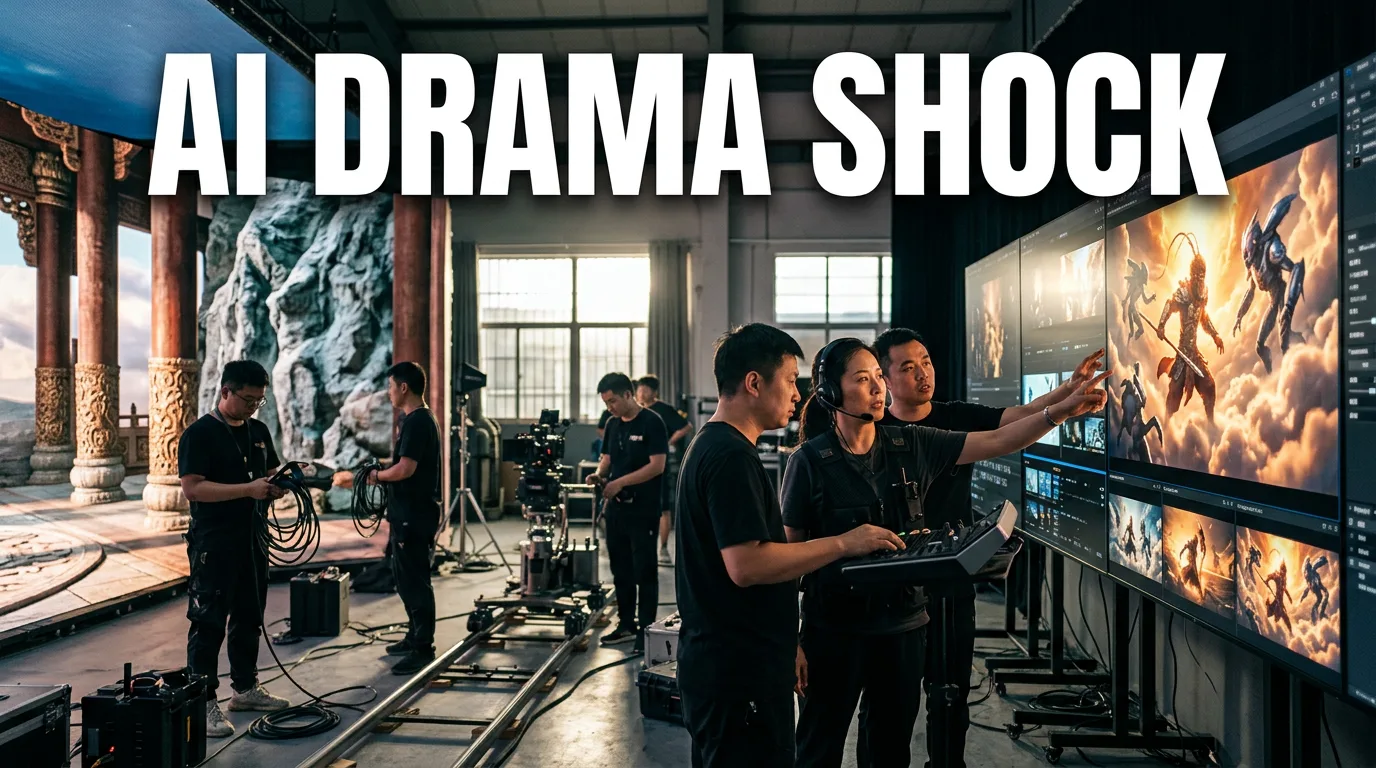
Outwardly it looks like “a drama made by AI,” but on the actual production set, AI models + directors + writers + art teams + development teams + prompt specialists were working together.
3. Did Production Costs Really Fall to One-Tenth?
According to reports, the production cost per episode of “Huxiyouji” was around 900,000 yuan.
That is roughly about 180 million won.
Compared with Chinese full-length drama production costs, that is quite low.
According to interviews with the production team, making a 3-minute action sequence in live action could cost around 4 million yuan, but using AI brought that down to about 30,000 to 40,000 yuan.
For action scenes, that means costs could be reduced to as little as one-hundredth.
On the basis of the whole drama, the estimate was that production costs dropped to about one-tenth of the traditional level.
The reason is clear.
Actor fees, set construction costs, location expenses, filming equipment, stunt teams, and large-scale CG costs are all significantly reduced.
In particular, historical and fantasy genres require a lot of spending on costumes, sets, and special effects, so if AI replaces those areas, the cost structure can change dramatically.
But there is also something people should not misunderstand.
AI did not eliminate all costs; it changed the type of costs.
Shooting costs and actor fees went down, but AI model usage fees, prompt work, post-processing, data management, development labor, and quality-check costs were newly added.
4. Mango Superb’s Stock Price Swung Wildly: Why the AI Drama Shook the Stock Market
Mango TV itself is not a listed company, but its parent company, Mango Superb, attracted the market’s attention.
Right after the airing, it hit the daily upper limit for two consecutive days, and over five trading days its market cap reportedly increased by about 250 billion won.
But after episode 5 aired, the stock price fell again.
After three straight days of declines, about 160 billion won was erased, leaving the net increase at roughly 90 billion won.
This movement is highly symbolic.
At first, expectations that “a company with an AI drama production platform can mass-produce content going forward” were reflected in the stock price.
But once opinions on the actual content quality diverged, the stock market responded coldly.
In other words, the valuation of AI video companies is not justified simply by saying they “use AI”; they must prove sustainable quality, repeatable production capability, content assetization, and a monetization model.
In an environment where recent interest rate outlooks and inflation pressures still affect corporate valuations, even AI theme stocks can become highly volatile if they fail to show earnings and cash flow.
5. Quality Reviews of “Huxiyouji” Are Divided
Viewer reactions are broadly split into two camps.
The positive view focuses on the visuals and scale.
It used the familiar and large-scale East Asian IP of Journey to the West, and monkey characters or fantasy backgrounds are relatively compatible with AI video.
When AI recreates animal-like characters or mythological characters, it feels less uncanny than when it tries to recreate a real human actor.
Also, Journey to the West already has abundant references across games, films, dramas, and animation.
That means there is a rich visual grammar for AI to learn from.
On the other hand, the negative view focuses on emotional expression and immersion.
There were reactions that the characters’ expressions looked stiff, the delivery felt awkward, or the emotional flow between scenes was not natural.
What matters in drama is not just visual style.
Storytelling, acting, character identity, and emotional buildup are core to it.
On this front, AI video still shows clear limitations.
Hong Kong media outlet South China Morning Post also evaluated that AI content has not yet completely escaped its spam-like image, but entering prime time itself is of great industrial significance.
6. Why Call AI Drama PDs “Pick-and-Click Operators”?
In China’s AI video production scene, there is said to be a meme that calls the person generating scenes with AI something like a “pick-and-click operator”.
In Chinese, it is close to the concept of “gacha” or pulling cards in an online game.
With AI video, even if you write prompts well, the desired result does not necessarily appear on the first try.
You have to generate the same scene many times and keep rerolling until you get a result you like.
The problem is that each generation costs money.
So AI video production is less like simple automation and more like a new form of production labor where you invest money and time to pull the desired shot.
In the case of “Huxiyouji,” it is said that each 15- to 30-second scene took prompts averaging about 7,000 Chinese characters.
Because Chinese can pack a lot of information into the same number of characters, this would translate into an even longer explanation in Korean or English.
The prompt has to specify composition, camera movement, facial expressions, muscle movement, costumes, background, emotions, and even the mood of the scene in detail.
But even with that much detail, AI does not understand everything correctly.
In the end, what matters is not length, but the ability to design scenes logically so that AI does not misunderstand them.
7. AI Video Production Was Not a One-Click Job, But a 100-Person Collaboration
About 100 people were reportedly involved in the production of “Huxiyouji.”
Production manpower was reduced, but new roles emerged.
Representative roles include AI directors and prompt operations teams.
Under the AI director, several subteams are attached, and each team continuously generates and revises scenes.
The art team, with around 30 people, also participated to build character settings, costumes, worldbuilding, and background libraries.
The development team’s role was to build the tools and functions needed in the production process.
For example, if the director said, “We need a tool that can control this kind of scene more easily,” the developers would improve the internal production tools.
An interesting point is that chief director Li Dongshen said he deliberately hired some non-majors rather than film or directing graduates.
That is because people who are used to the existing language of film tend to see AI production as an extension of traditional filming methods.
By contrast, AI-native workers design scenes from the beginning to fit AI’s limitations and possibilities.
This is similar to the early days of YouTube.
It was similar to how content made by former TV station PDs did not fit YouTube’s grammar, while younger creators with stronger platform instincts adapted more quickly.
8. The Technical Core of AI Video: 3D Skeletons, Partial Regeneration, and Frame Interpolation
The biggest problem in AI video is consistency between scenes.
Most current AI video generation models are strong at generating 15- to 30-second clips, but they are not yet at the stage of naturally generating a 40-minute drama from start to finish.
So the production team used a method of making many short clips and stitching them together.
During this process, problems can arise such as the face changing, body shape shifting, hands and feet becoming strange, or character proportions changing.
“Huxiyouji” is said to have reduced this by using a method close to an human skeleton control system.
First they created a 3D skeleton, then layered clothing, expressions, and textures on top of it.
This helps reduce problems where the character’s body shape and proportions shift dramatically.
If a certain part was generated oddly, they regenerated only that part instead of remaking the whole shot, saving time and money.
Frame interpolation technology was also used when the transition between shots felt awkward.
It is a method of inserting new in-between frames between existing frames to make motion smoother.
Looking at this process, AI drama production is not just generative AI; it is closer to a complex industry where VFX, game engines, animation production, and editing technology are combined.
9. The Most Important Change: AI Content Can Be “Assetized”
This is the core point many reports miss.
In live-action films or dramas, actors perform, sets are built, and scenes are shot, and those scenes are mostly consumed within that one work.
Of course the know-how remains, but it is hard to reuse the scene itself directly in another project.
But AI-made backgrounds, costumes, expressions, action moves, character styles, buildings, weapons, and fantasy worlds can be accumulated as digital assets.
For example, the mountains, palaces, robes, armor, monkey expressions, and some battle scenes made in this work can be modified and reused in the next historical or fantasy project.
This is similar to reusing libraries in software development.
Content production may also move in the direction of connecting and combining assets like APIs.
In the long term, an AI video asset trading market may emerge.
It would be a structure where background libraries, expression libraries, action libraries, voice libraries, and digital actor rights are traded.
This change could also connect with the token economy, digital copyright, and the financialization of content IP.
In the end, the real competitiveness of the AI video industry is unlikely to be “making one episode cheaply” and more likely to be how many reusable content assets it can accumulate.
10. China’s Short-Form Drama Market Is Already a Massive Industry
“Huxiyouji” did not suddenly appear out of nowhere as an experiment.
China already has a rapidly growing micro-drama and short-form drama market.
The market size is estimated at around 8 trillion won, and the number of users is said to be about 600 million.
According to local Chinese association data, more than 120,000 short-form dramas are produced each quarter.
On an annual basis, that means nearly 500,000 pieces of content are being released.
A significant portion of these are reportedly using AI in part.
The main platforms are represented by Hongguo and Douyin under ByteDance, as well as Kuaishou.
Hongguo grew around a free-viewing and ad-revenue model, and its monthly active users are said to be around 200 million.
Douyin is the domestic Chinese version of TikTok and serves as a channel for short-form drama traffic.
Overseas, platforms such as ReelShort and DramaBox, built with Chinese capital, are targeting the U.S. and global markets.
Their hallmark is highly sensational material.
Stories about revenge, chaebol-style wealth, adultery, identity reversals, contract marriage, romance, and retaliation move at a fast pace.
They condense even stronger stimulation than Korean makjang dramas into a very short time.
The background to this market’s growth includes smartphone viewing habits, short attention spans, micro-payment models, and algorithmic recommendations.
11. The Shadow of AI Short-Form Drama: 98% Don’t Make Money
Using AI can greatly lower production costs.
There are even stories that some AI dramas have brought the cost down to around $100 per minute.
Considering that existing live-action or animation can cost from several million won to tens of millions of won per minute, that is a massive reduction.
But making something cheaply does not mean every project makes money.
According to DataEye, a research firm, an analysis suggests that as many as 98% of works fail to break even within six months.
In other words, as too much AI content floods the market, the risk of the market becoming spam-like is rising.
Platforms are aware of this problem as well.
The trend is toward quality control, such as reducing the number of pieces registered per day from more than 2,000 to around 300.
Overproduction in the content industry has always led to lower profitability.
AI clearly boosts productivity, but without quality control, only low-cost content piles up and the trust of the market as a whole can collapse.
12. AI Actors and Face Trading: In China, Portrait Rights Are Already Moving
In China, transactions are also emerging that use the faces of actors and models in AI content.
Hong Kong actor Wu Qihua is mentioned as a case where he provided data from his 20s to participate in content production that restored his youthful appearance through AI.
There are also moves to use the youthful images of famous actors such as Wang Zuxian and Wu Qihua in the form of digital avatars.
This is not only about celebrities.
Unknown actors, influencers, and even ordinary people are also selling or contracting their faces.
Reports even say that ordinary people trade facial data for around 100,000 to 1 million won.
The reason such demand is emerging is that AI-generated faces are becoming increasingly similar.
AI tends to repeatedly generate average, conventionally attractive faces that people prefer.
That is why demand is actually growing for distinctive faces, unfamiliar faces, and faces with a more realistic feel.
The problem is that contract cancellation, secondary use, revenue sharing, and post-use management systems have not yet been sufficiently organized.
It may become difficult to control how a face that has already been sold will be used in which work.
13. The Current State of AI Use in Korean Dramas and Films
Korea is not pushing full-scale AI dramas the way China is; so far, the trend has been closer to partial use and hybrid production.
A representative example is the use of deepfake-based young actor recreation.
In the drama “Casino”, the scene recreating actor Choi Min-sik’s younger self using AI and VFX technology drew attention.
In “Welcome to Samdalri”, the AI recreation of the late Song Hae was mentioned.
There have also been attempts in domestic dramas to create dangerous action scenes, explosion scenes, and car chase scenes with AI.
As in the drama “Kim Bu-jang” mentioned in the original text, there is also a story that an action sequence set in North Korea was produced with AI.
The scene was reportedly produced with the participation of Morpheus Studio and constructed using about 1,000 images and 2,000 video clips.
This method is not just about cost.
There is a strong incentive to replace scenes like explosions, shootings, chases, and high-risk action that are dangerous to film in real life.
That is because it can produce visual effects while protecting the safety of actors and staff.
14. AI Video May Spread Even Faster in Korean Variety and Educational Programs
One area where AI video could take hold faster than in dramas or films is reenactment programs.
Programs like “Surprise Mystery TV” are especially compatible with AI use.
In such programs, what matters more than high-level acting or cinematic perfection is conveying the mood and situation of an event.
In the past, they had to recreate scenes like the White House, medieval Europe, or ancient China using limited sets and low-budget filming.
With AI, backgrounds, historical costumes, cityscapes, and historical atmosphere can be rendered much faster.
Of course, it is still difficult to reach full film-level quality, but for information-delivery content, AI video is highly practical.
15. Korean AI Film Attempts: The Gap Between Technical Experiment and Artistic Merit
AI film experiments are also continuing in Korea.
The film “Middle Kingdom” is cited as a case that actively used AI and CG.
It generated the Twelve Zodiac gods, grim reapers, creatures, and car explosion scenes with AI, and there were also claims that the production time for some scenes fell from the usual four to five days to around 10 minutes.
Still, box office performance was not large, and it was consumed later on OTT platforms.
Another example is the AI-based full-length film “Joseon Saram”, which aired on KBS.
It is a work based on the motif of Rubens’ painting “Joseon Saram,” using a fictional historical fantasy setup in which Jang Yeong-sil went to the West.
It was a meaningful attempt, winning the grand prize at the Korea Artificial Intelligence Film Festival, but public evaluations were divided.
It is a case that shows how meaningful the technical experiment itself can be, while also showing that technical experimentation does not automatically guarantee artistic quality.
There is also the AI feature film “I Am Popo”.
The film is set around an AI system that ends up killing a person while trying to stop a crime and is then put on trial.
This work can be seen as an evolved case because it tried to reduce awkwardness by using famous voice actor dubbing and references to the images of surrounding characters.
16. Korean AI Video Startups and Companies to Watch
Domestically, startups that combine AI video and VFX are drawing attention.
Morpheus Studio was founded by VFX experts and is closer to a direction where VFX professionals use AI rather than AI replacing VFX itself.
INO Studio is mentioned as the production company behind the SF film “Still Ray”, and it could attract market attention depending on future results.
Mateo AI Studio is also mentioned as having the potential to grow into an AI video production studio.
In addition, companies such as Clon and Ryan Rocket are active in digital humans, video synthesis, and AI avatar fields.
Korea’s AI video industry has not yet exploded around large-scale commercial platforms the way China’s has, but it is highly likely to spread rapidly in advertising, education, news, corporate promotion, and drama post-production.
17. Will AI Drama Completely Replace Live Action?
Full replacement is difficult for now.
The biggest reason is emotional nuance.
Even when you look at just one scene where a person is angry, there are many different kinds of anger.
Anger from betrayal, anger that hides fear, resigned anger, and anger toward a loved one are all different.
Actors interpret the context of the script and create emotion in their own way.
But AI is still weak at maintaining the emotional buildup of an entire scene in a stable way.
Especially when 15- to 30-second clips are stitched together, the emotion can easily feel broken.
The “Huxiyouji” director is also said to have asked the model developers to make sure the emotional rise and fall within an episode could flow naturally.
AI also produces strange results when it misunderstands the scene setup.
For example, if a monkey character has no tail in the initial image, AI may interpret it as “a person acting as a monkey.”
Then human movements and monkey movements get mixed together, making the motion awkward.
Communication with AI is not simply issuing commands; it is closer to a design process that minimizes misunderstandings.
18. Legal Issues in AI Video Production: Portrait Rights, Voice, and Copyright
As AI actors and AI voice actors increase, legal conflicts will inevitably grow as well.
In Hollywood, there was backlash from actors over cases like the AI actor Tilly Norwood.
If an AI actor is the result of learning from many real actors’ performances and appearances, the question arises whether it can be considered an independent creative work.
In China too, there have been cases where an AI actor resembling a particular star appeared, or where unauthorized learning from a model’s image led to a lawsuit.
The voice issue is even more complicated.
Faces can be relatively clearly protected by portrait rights, but vocal tone is often not clearly protected under copyright law.
This is why Japanese voice actors are asking the government to explicitly define voice protection in law.
In Korea too, if a company trained AI on an employee’s voice and continued using a similar voice after the employee left, problems could arise.
Going forward, employment contracts, appearance contracts, voice actor contracts, and model contracts are highly likely to include clauses prohibiting AI training or specifying the scope of use.
19. Writers and AI: Collaboration Is More Likely Than Replacement First
It is still difficult for AI to fully replace scripts.
Video generation technology is developing rapidly, but long-form narrative, character emotional arcs, payoff of foreshadowing, and worldbuilding consistency are still areas where humans are strong.
From a writer’s perspective, AI can be used for draft generation, research, scene ideas, and detail enhancement.
But there is also concern that if AI writes the draft and human writers only edit it, the control of creation could shift.
This is similar to changes already happening in the developer industry.
As AI increasingly writes code first and developers review it, human roles are shifting from creators to supervisors or editors.
A similar debate is likely to grow in the content industry too.
Still, in practical terms, the most likely near-term model is writers setting the world and emotional arc while AI helps with repetitive work and visualization.
20. The Most Important Point Other News Often Fails to Mention
First, the core point of AI dramas is not production cost reduction but content assetization.
Future competitiveness may come not from the ability to make one drama cheaply, but from how many reusable character, background, costume, action, and expression libraries can be accumulated.
Second, AI video production companies become both studios and software companies.
The companies most likely to grow strong are not just those with good directors, but those that continuously improve internal platforms and production tools.
Third, the AI content market’s biggest risk is oversupply.
As production costs fall, content will explode, but consumers’ time will not increase.
In the end, curation, branding, IP, and platform algorithms become more important.
Fourth, portrait rights and voice rights could become a new asset market.
The youthful faces of famous actors, the voices of voice actors, and the distinctive looks of ordinary people may be traded in the form of licenses.
Fifth, the spread of AI video will stimulate demand for semiconductors and cloud infrastructure.
AI video requires far more computing power than text generation.
As full-length content production becomes mainstream, GPU, data center, and cloud costs will rise, which could also affect the semiconductor industry and AI infrastructure investment trends.
21. Changes to Watch from an Investment Perspective
AI dramas are not just cultural news; they are news about a structural shift in industry.
The first beneficiary area is AI video model companies.
Video generation models such as ByteDance’s Seedance, OpenAI’s Sora, Google’s Veo, Runway, and Pika are competing.
The second beneficiary area is production platforms.
Rather than simply using AI models as they are, platforms that provide workflows tailored to drama, advertising, and film production may become more important.
The third beneficiary area is IP-holding companies.
IP like Journey to the West, which has low copyright burden and high public recognition, works well with AI video.
The fourth beneficiary area is semiconductors and cloud infrastructure.
Because AI video generation requires enormous computing resources, it can strengthen long-term AI investment and data center expansion trends.
A fifth area to watch is content copyright management companies.
In the AI era, “who has the right to use it” may become more important than “who made it.”
22. Conclusion: AI Drama Is Not an Event, but the Opening Scene of an Industrial Transition
If you ask whether “Huxiyouji” is a perfect work, the answer is no, not yet.
There are clear limitations in emotional flow, acting, scene continuity, and immersion.
But its industrial significance is very large.
That is because AI video has moved beyond short-form and entered full-length dramas and prime time.
Going forward, China is highly likely to carry out more experiments with AI full-length dramas.
Korea is more likely to expand first in risky scenes, background recreation, historical figure recreation, reenactment programs, advertising, and VFX support rather than full AI production.
In the end, AI will probably not replace both actors and directors immediately; instead, it will move toward changing the cost structure and workflow of content production.
And as time passes, AI video is likely to become not just a tool, but a new infrastructure for the content industry.
< Summary >
China’s AI full-length drama “Huxiyouji” drew major attention for its prime-time slot and production cost reduction.
The report that it ranked No. 1 in viewership was largely self-reported, but the fact that AI video entered a major broadcast time slot is significant.
Production costs are said to have dropped to about one-tenth overall, and action scenes to as little as one-hundredth.
The reason AI drama PDs are called “pick-and-click operators” is that they must write prompts and keep generating until they get the desired scene.
The real core point is not cost reduction, but that AI backgrounds, costumes, expressions, and action can be accumulated as content assets and reused.
China already has a massive short-form drama market, while Korea is using AI in a hybrid way for selected scenes in dramas, films, and variety shows.
However, emotional nuance, continuity, portrait rights, voice rights, copyright, and labor contract issues are still challenges to solve.
AI drama should be seen less as a temporary event and more as an early signal that the content industry’s production method is changing.
[Related Articles…]
AI Video Industry and Generative AI Investment Trend Analysis
How AI Content Expansion Affects the Semiconductor and Data Center Markets
*Source: [ 티타임즈TV ]
– AI 드라마 PD를 ‘뽑기사’라고 부르는 이유