● Rate Hike Shock, Nasdaq Rallies, Tesla, Bitcoin, Gold, Chips
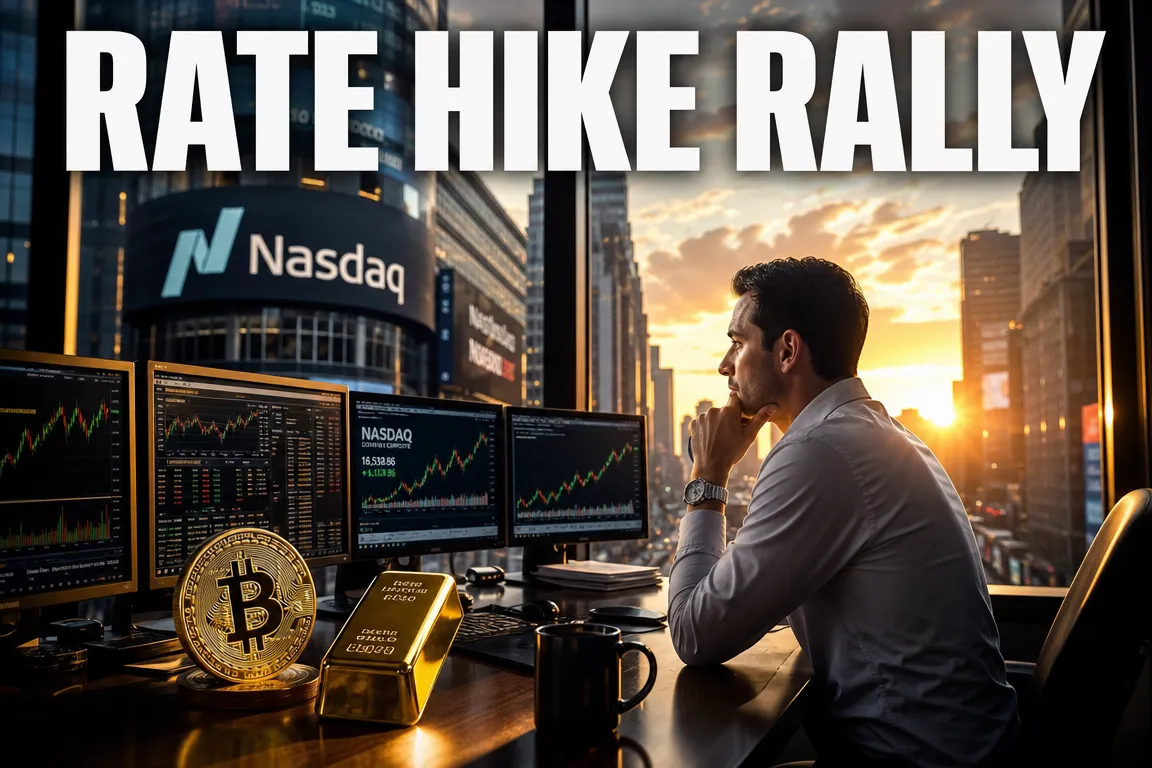
Why Nasdaq Rose Despite Rate Hikes: Tesla, Bitcoin, FX, Gold, and Semiconductors at a Glance
The key point to focus on in this article is the following.
Why did U.S. equities and the Nasdaq hold up, even after a rate hike?
Why should Bitcoin be viewed differently from gold?
Why should investors be cautious about headlines on gold prices?
Why was the 1,300 to 1,350 KRW/USD range important?
When analyzing growth stocks such as Tesla, semiconductors, and Broadcom, why should investors look at the index first rather than individual catalysts?
And, most importantly, why does the market move on standards and sentiment rather than headlines?
1. The central market question: Why did equities rise despite a rate hike?
The most confusing issue for investors in this market was the following:
“Rate hikes are usually negative, so why did the Nasdaq and U.S. equities not break down materially?”
Standard media interpretation typically offered the following explanations.
“The hike had already been priced in, so uncertainty was removed.”
“The hike was already reflected in valuations.”
“Oil declined, and the 10-year Treasury yield fell, which supported equities.”
These explanations may be partially correct.
However, they are not sufficient to explain the market.
The more important issue was whether the Federal Reserve was recognizing inflation pressure appropriately.
Investors were not simply focused on whether rates were raised or held steady.
They were focused on whether the Fed understood the current inflation trend.
Whether it recognized the risk of broader inflation in a strong economic environment.
Whether it was assessing supply-side pressures such as oil, food, tariffs, and AI data center investment correctly.
Markets can rebound after a rate hike if they regain confidence that the Fed is serious about controlling inflation.
Conversely, markets can weaken even when rates are unchanged if the Fed is perceived as detached from reality.
Accordingly, the core issue in this phase was not the rate hike itself, but restored confidence in the Fed and its commitment to inflation control.
2. Why relying on “already priced in” can be costly
One of the most overused terms in market interpretation is “priced in.”
When stocks rise, investors say the negative news was already priced in.
When stocks fall, they say the same negative news was newly priced in.
The same event is interpreted as bullish if prices rise and bearish if prices fall.
This approach does not provide a practical framework for investors.
The key issue is not whether the market should rise or fall because of a news event.
What matters is which price levels hold after the news.
Where buying interest emerges.
How the 10-year Treasury yield, the dollar, Nasdaq futures, and the semiconductor index behave.
Investors need a framework, not just interpretation.
Without a framework, they remain reactive to headlines.
With a framework, events such as rate hikes, CPI, and FOMC become more manageable.
3. Bitcoin: It should not be treated like gold
Recent discussions around Bitcoin have included the Clarity Act, regulation, 24-hour trading, ETFs, and institutional flows.
The key point is that Bitcoin should not be viewed in the same way as gold.
Gold has traditionally been classified as a safe-haven asset.
It tends to attract attention during war, financial stress, dollar weakness, and inflation.
Bitcoin, by contrast, still behaves more like a risk asset than a safe haven.
It does not report earnings like a company.
It also lacks a clear framework based on revenue, operating income, or cash flow.
As a result, Bitcoin is far more sensitive to flows, sentiment, liquidity, regulatory expectations, and market tone.
Therefore, treating Bitcoin as if it were gold is risky.
It is more realistic to view Bitcoin alongside Nasdaq, technology stocks, and broader risk appetite.
When risk appetite in U.S. equities improves, Bitcoin can rebound in tandem.
When the Nasdaq weakens and liquidity tightens, Bitcoin can also come under pressure.
In other words, Bitcoin is best understood as an asset that moves within the global liquidity environment rather than as a separate market.
4. Bitcoin investing: Understanding the volatility range is essential
Bitcoin can move by thousands of dollars in a single day.
If investors do not understand this, the asset becomes difficult to manage.
Traditional stocks may be assessed in terms of $1 or $5 moves.
Bitcoin, however, may see a $3,000 or $4,000 decline and still remain within a normal trading range.
For that reason, Bitcoin investors should not focus on absolute price movement.
They should focus on percentage moves relative to price.
Whether the asset is trading within a major accumulation zone.
Whether risk sentiment remains intact.
If an investor does not rule out Bitcoin as a long-term asset, a staged approach around major support zones is possible.
However, if the volatility is too difficult to tolerate, Bitcoin may be less suitable than an ETF or high-quality growth stocks.
Investing begins with understanding one’s own risk profile.
5. Gold investing: Do not overreact to headlines that “the world is buying gold”
Gold price rallies often generate the same headlines.
“Central banks are buying gold.”
“The world is accumulating gold.”
“Gold could reach $5,000 per ounce.”
These headlines are effective at attracting attention.
However, investors should not rely on them alone.
Gold does not simply rise because of war.
It also does not necessarily rise whenever equities are weak.
Nor does it always strengthen whenever the dollar falls.
Gold is influenced by inflation, real yields, the dollar, central bank demand, market sentiment, and valuation levels.
The important point in the original text is the following:
Gold is closely related to inflation, but that does not mean every investor should be aggressively positioned in it at all times.
When gold has declined significantly and begins to recover, buying interest may naturally return.
However, that does not automatically indicate a long-term structural uptrend.
Gold should be assessed by cycle, not by headlines.
Investors should first decide whether they are using gold for short-term trading or for long-term inflation hedging.
6. KRW/USD: Why the 1,300 to 1,350 range matters
The KRW/USD exchange rate is highly important for Korean investors.
This applies to U.S. equities, Tesla, Nvidia, Bitcoin, and gold.
The original text focused on the 1,400, 1,350, and 1,300 levels.
These levels matter for a simple reason.
When the exchange rate declines significantly, demand for dollars may increase again.
For Korean investors, dollars near 1,300 KRW may appear relatively attractive.
In addition, if the U.S. maintains a tightening bias or inflationary pressure remains, the dollar could strengthen again.
Of course, the exchange rate does not move in one direction.
It is influenced by rates, the trade balance, foreign capital flows, Bank of Korea policy, U.S. Treasury yields, and geopolitical risk.
From an investment standpoint, however, it is important not to panic when the exchange rate falls, but to establish a phased conversion framework for dollars.
For long-term U.S. equity investors, both stock prices and exchange rates must be monitored to manage effective returns.
7. The 5% level in the 10-year Treasury yield should not be treated as an immediate crash signal
A 5% yield on the U.S. 10-year Treasury is an important psychological level in the market.
When yields rise above 5%, growth stocks face pressure.
In particular, small caps, unprofitable growth stocks, and high-valuation technology stocks may weaken.
However, crossing 5% does not automatically mean a sharp market collapse.
Markets do not break down on a single number alone.
The more important question is whether investors can absorb that yield level.
Even if the 10-year yield approaches 5%, equities may hold up if corporate earnings remain resilient, the AI investment cycle continues, and consumption does not deteriorate sharply.
Conversely, even if yields decline slightly, equities may still fall if recession concerns intensify.
Accordingly, the 10-year yield should be viewed together with the Nasdaq, S&P 500, Russell 2000, and the semiconductor index.
It is especially important to determine whether small-cap stocks are simply moving sideways or breaking below their lower range.
If small caps weaken sharply, large-cap technology stocks may later come under pressure as well.
8. Why Nasdaq futures and S&P 500 E-mini futures should be monitored
Investors in U.S. equities should not focus only on individual stocks.
Tesla, Nvidia, AMD, Broadcom, and Meta are all influenced by broader index direction.
To assess pre-market and after-hours conditions, investors should regularly monitor Nasdaq futures and S&P 500 E-mini futures.
In the U.S., traders often track /ES and /NQ on TD platforms or other trading systems.
/ES refers to S&P 500 E-mini futures.
/NQ refers to Nasdaq-100 E-mini futures.
Korean investors can also follow these movements through TradingView, MarketWatch, or Yahoo Finance.
However, timing can vary by platform, so real-time accuracy should be confirmed.
The reason to watch futures is straightforward.
Market sentiment often appears there before it shows up in individual stocks.
Even if semiconductors are under pressure, maintaining key support levels in Nasdaq futures can help sentiment recover.
Conversely, even strong company-specific news may have limited impact if the index is weakening.
9. Semiconductors and the AI investment cycle: What to monitor before Nvidia
The AI semiconductor market remains a central driver of global equities.
Nvidia, AMD, Broadcom, Micron, SK Hynix, and Samsung Electronics are all tied to AI data center investment.
However, semiconductor stocks should not be analyzed only through company-specific catalysts.
Investors should also monitor the flow across the broader semiconductor sector.
Key variables include AI data center spending, HBM demand, cloud capex, memory pricing, and server investment cycles.
SK Hynix, in particular, is widely viewed as a core HBM company, which is why many investors track it alongside demand for Nvidia’s AI chips.
That said, equity prices do not move solely on earnings.
When expectations are already elevated, even good news can lead to consolidation.
Conversely, after a pullback, the same news can trigger a stronger move.
Accordingly, semiconductor investors should combine company analysis with price structure, index direction, and the interest rate and dollar environment.
10. Tesla: More important than Cybercab is the index and the price level
Tesla is always surrounded by news flow.
Electric vehicle sales, autonomous driving, robotaxis, Cybercab, energy storage, batteries, and China sales all remain active themes.
However, the main risk in Tesla investing is relying too heavily on a single positive catalyst.
Cybercab and robotaxi remain important long-term businesses.
But the market is already aware of much of that potential.
Amazon, Waymo, and other autonomous vehicle companies are also entering the robotaxi market.
Therefore, for Tesla to continue rising on autonomous-driving expectations alone, actual business expansion and measurable results are needed, not just announcements.
In the short term, price levels may matter more.
For example, the original text referred to key levels such as $380, $360, and $330.
This is a framework for identifying resistance above and support below.
The core idea is simple.
If $360 is held, the trend may remain intact.
If it breaks below $360, the next support level should be monitored.
Tesla should also be viewed in the context of the Nasdaq, growth-stock sentiment, and the interest rate environment.
11. SpaceX-related investing: Indirect exposure is required before any direct listing
SpaceX is a private company, so direct investment is not available to most investors.
As a result, the market often looks at adjacent sectors such as space technology, satellite internet, rocket launches, and defense-related space infrastructure.
The original text also referred to price levels and trading ranges related to SpaceX-linked themes.
The main point is that space-related themes are also risky if investors rely only on short-term excitement.
The sector has long-term growth potential, but commercialization is slow and capital expenditure is high.
Higher rates can increase volatility in long-duration growth themes.
Accordingly, investors should focus on industry structure rather than short-term hype when evaluating space-related equities.
What matters is whether satellite communications, defense demand, reusable launch systems, and space data infrastructure are actually becoming revenue-generating businesses.
12. Broadcom: A key AI infrastructure stock, but price discipline comes first
Broadcom is a core company tied to AI infrastructure, networking chips, custom semiconductors, and data center demand.
If Nvidia represents the leading GPU name, Broadcom is closely associated with AI data center networking and ASIC exposure.
The original text referred to key levels around $360, $340, and $320.
For this type of stock, investors should not buy simply because the company is strong.
Even if AI growth remains attractive, the stock can still correct if it becomes overextended in the short term.
Conversely, when a strong company pulls back to major support, it may become more attractive for long-term investors.
Broadcom and similar AI infrastructure names should be evaluated together with the Nasdaq, the semiconductor index, and interest rate trends.
13. Why small caps matter: They may signal weakness before large-cap technology stocks
When markets are strong, investors may feel that monitoring large-cap technology stocks is sufficient.
However, during corrections, small-cap performance becomes important.
Small caps are highly sensitive to rates.
As funding costs rise, small-cap growth stocks typically come under pressure before large-cap technology names do.
Accordingly, in a high-rate environment, small caps may move sideways or show relative weakness.
The key distinction is between sideways movement and breakdown.
If small caps are merely consolidating within a range, the market can still hold up.
But if they break below support and decline sharply, large-cap technology stocks may follow.
In other words, the Russell 2000 is a useful secondary indicator of market health.
Long-term U.S. equity investors should monitor it alongside the Nasdaq.
14. The most important points that are often overlooked in media and video commentary
First, markets look at whether prices hold before they look at the news.
Whether FOMC is bullish or bearish should not be judged only after the headline is published.
Investors should first confirm whether Nasdaq futures hold key support levels after the event.
Second, the Fed’s credibility can matter more than the rate hike itself.
Markets care more about whether the Fed is seeing the real economy correctly than about the rate number alone.
Third, Bitcoin moves more like a risk asset than like gold.
Misclassifying Bitcoin as a safe haven can lead investors to miss the broader market structure.
Fourth, gold is not a simple war-trade asset.
Gold strength depends on inflation, real yields, the dollar, and valuation levels.
Fifth, long-term investing is not a game of calling the top.
Even strong stocks can fall 30% or 50%.
The key is preserving discipline and responding according to a framework.
Sixth, the AI investment cycle may not be over, but rate pressure still needs to be monitored.
Nvidia, SK Hynix, Broadcom, and AMD should all be evaluated together with AI capex and rate trends.
15. The standards investors should establish now
What the market needs now is not prediction.
It needs standards.
The first standard is the key support level in Nasdaq futures.
If the index holds, individual stocks are more likely to recover as well.
The second standard is the 10-year Treasury yield.
Investors should monitor how the market reacts near 5%.
The third standard is the KRW/USD exchange rate.
For U.S. equity investors, FX directly affects returns.
The fourth standard is the semiconductor index.
It is one of the fastest indicators of AI sentiment.
The fifth standard is small-cap performance.
Whether small caps are merely consolidating or entering a deeper decline changes the market interpretation.
The sixth standard is the investor’s own risk tolerance.
Even strong stocks will not translate into returns if the investor cannot tolerate volatility.
16. A practical response strategy for individual investors
Step 1: Do not react immediately to headlines.
Even when rate hikes, CPI, FOMC, war, or oil headlines appear, avoid instant buying or selling.
First observe the index and price reaction.
Step 2: Define staged entry zones.
For names such as Tesla, Nvidia, SK Hynix, and Broadcom, it is better to scale in at defined price levels rather than buy all at once.
Step 3: Establish an FX framework.
For U.S. equity investors, even cheap stocks may not be attractive if the exchange rate is too high.
Step 4: Only allocate to Bitcoin if you can absorb the volatility.
Bitcoin has large daily swings.
If an investor cannot tolerate that volatility, the stress may outweigh the return.
Step 5: Evaluate gold by cycle, not by short-term news.
Buying gold simply because of bullish headlines is risky.
Step 6: Separate long-term investing from swing trading.
Using short-term news to sell long-term holdings, or treating trading positions as long-term investments, can create strategy drift.
17. Important caution for investment decisions
This article does not constitute a recommendation to buy or sell any specific asset.
U.S. equities, Korean equities, Bitcoin, gold, and FX investments all involve the risk of capital loss.
Growth stocks such as Tesla, Nvidia, SK Hynix, Broadcom, and AMD can be highly volatile.
In particular, during rate-hike cycles, growth stock valuations can be materially affected.
Investment decisions should be made based on personal financial circumstances, investment horizon, and risk tolerance.
The key issue is not whether an investor is right, but how they respond when they are wrong.
< Summary >
The reason equities rose despite a rate hike was not simply pricing in, but renewed confidence in the Fed’s commitment to controlling inflation.
Bitcoin should be viewed as a risk asset rather than a safe-haven asset like gold.
Gold should be analyzed through inflation, real yields, and dollar trends, not only through war-related headlines or central bank buying.
The 1,300 to 1,350 KRW/USD range can serve as an important dollar accumulation zone for Korean investors.
For Tesla, Nvidia, SK Hynix, and Broadcom, broader Nasdaq and semiconductor index trends matter more than individual headlines.
In the current market, standards are more important than forecasts.
Investors should track the index, rates, FX, support levels, and risk management rather than reacting to headlines.
[Related Articles…]
U.S. Equity Strategy After Rate Hikes
AI Semiconductors and Nasdaq Growth Stock Trends
*Source: [ 미국주식은 훌륭하다-미국주식대장 ]
– 이걸 모르면 계속 손해 보실 겁니다. 테슬라 SK 하이닉스 스페이스X 한국주식