● Liquidity Shock, Fed Pressure, AI Surge, Treasury Pivot
September Liquidity Pressure, Potential Re-Expansion in October: Why U.S. Rates, the Fed, AI Semiconductors, and Treasury Yields Must Be Viewed Together
The core issue in this debate is not simply whether the Fed will raise or cut rates.
The key point is that in September, tax payments and Treasury issuance may temporarily drain market liquidity, while from October onward liquidity could be replenished through fiscal spending, short-term Treasury issuance, stablecoins, and commercial bank lending.
This also intersects with the U.S. midterm elections, political tension around the Fed, Treasury yields, the AI semiconductor investment cycle, and stablecoin liquidity.
For that reason, this market cannot be assessed by focusing only on rate-cut expectations.
September volatility, October liquidity re-supply, U.S. debt debates, and AI value-chain investment trends must all be analyzed together.
1. Key Takeaway: Liquidity May Drain in September and Rebuild After October
The market’s main question is whether a renewed liquidity-driven rally is approaching.
The discussion reached different conclusions in detail, but there was broad agreement that a liquidity inflection point is near.
- Moon Hong-cheol’s view: AI and semiconductor stocks may enter a pause through early October, with a broader liquidity-driven rally potentially emerging after the midterm elections.
- Sung Sang-hyun’s view: The next liquidity expansion is more likely to come from commercial banks, short-term Treasuries, stablecoins, and private credit rather than from Fed balance sheet expansion.
- Kim Kwang-seok’s view: Fiscal policy may continue to support liquidity in September and October, and fiscal dominance is becoming more established.
In short, liquidity is no longer driven primarily by the Fed.
This cycle may be shaped more by the U.S. Treasury, commercial banks, stablecoins, and AI-related capital flows than by monetary policy alone.
2. Three Drivers of Liquidity: Rate Policy Alone Is Insufficient
Many investors assess liquidity mainly through the Fed’s policy rate.
However, the discussion emphasized that liquidity must be divided into three components.
① Monetary Policy Liquidity: Fed Rates and the Balance Sheet
The Fed continues to sound hawkish.
Inflation has not been fully contained, and the labor market has not clearly weakened in official data.
At the same time, the discussion suggested that the Fed’s hawkish tone may reflect political tension as well as economic data.
In other words, the Fed may appear more restrictive than the underlying economy would require.
② Fiscal Liquidity: The U.S. Treasury as a Market Driver
In this cycle, fiscal policy is a more important source of liquidity.
When the U.S. government increases spending, that money flows into private income and corporate revenue.
Conversely, when taxes are collected but spending is restrained, private liquidity contracts.
From this perspective, the fiscal deficit acts as a source of liquidity for the private sector.
Rising U.S. debt should therefore be seen not only as a risk signal, but also as a channel through which money enters the real economy.
③ Private Liquidity: Commercial Banks, Stablecoins, and Private Credit
The most distinctive point in the discussion was the importance of private liquidity.
Even if the Fed reduces its balance sheet, aggregate liquidity may not decline if commercial banks expand lending, stablecoin issuers absorb short-term Treasuries, and private credit funds finance AI companies.
If the Treasury shifts issuance away from long-duration bonds and toward short-term bills, stablecoins and money market funds can absorb that supply.
In that case, long-term Treasury yields may remain contained, and corporate financing conditions could ease.
3. Why Liquidity May Tighten in September: Tax Payments and the TGA
The main source of September liquidity pressure is U.S. tax payments.
In September, tax receipts flow into the Treasury General Account, or TGA.
In effect, money that was circulating in the market is pulled into the government account, reducing system liquidity temporarily.
The discussion noted that this absorption may average around $400 billion in September historically.
This year, however, stronger corporate earnings and improved profitability in the AI value chain could increase tax receipts further.
Higher tax inflows would reduce market liquidity in the short term.
But when that money is later spent by the Treasury, liquidity may re-enter the system in October and beyond.
4. Why Liquidity Could Rebuild After October
The potential for renewed liquidity after October rests on four factors.
① Expansion of TGA Spending
Funds that enter the Treasury account through taxes are eventually redeployed through government spending.
Higher spending supports corporate revenue, household income, and market liquidity.
Spending may also increase ahead of the midterm elections.
② Greater Reliance on Short-Term Treasury Issuance
If the Treasury reduces long-duration issuance and increases short-term bill issuance, upward pressure on long-term yields may ease.
More stable long-term yields would support growth stocks, AI semiconductors, big tech, and data center investment.
Lower financing costs would also help corporations maintain large-scale capital expenditure.
③ Buyback Policy
U.S. Treasury buybacks may matter more for market psychology than for immediate scale.
They signal that the Treasury may not allow long-term yields to rise unchecked.
That signal alone could pressure crowded short positions in Treasuries.
④ Stablecoin and Money Market Fund Demand for Short-Term Treasuries
If stablecoin issuers hold larger volumes of short-term Treasuries, the U.S. Treasury gains a stable source of demand for bills.
This structure can support continued government borrowing while helping contain long-term yields.
Stablecoins should therefore be viewed not only as a crypto theme, but also as part of the U.S. liquidity infrastructure linked to the Treasury market.
5. Fed and Jackson Hole: The Market Read It as Hawkish, but There Were Also Dovish Signals
The market interpreted the Jackson Hole meeting as hawkish.
However, the discussion argued that Powell was outlining principles rather than issuing a clearly hawkish signal.
The key issue is not inflation itself, but inflation expectations.
The Fed’s main objective is to prevent inflation expectations from becoming unanchored.
If expectations remain stable, the case for further aggressive tightening weakens.
Another important point is real-time data.
If the Fed places greater weight on current inflation data rather than lagging indicators, it may conclude that disinflation is already underway.
In that case, the market may increasingly price in a pause or eventual cuts rather than further hikes.
6. U.S. Debt Concerns: Political Framing Matters More Than the Headline Number
News that U.S. debt has exceeded $40 trillion naturally raises concern.
However, the discussion concluded that an immediate debt crisis is unlikely.
The more relevant measures are debt-to-GDP and deficit-to-GDP ratios rather than nominal debt alone.
A large debt burden is manageable if economic output is also large enough.
For the United States, sovereign scale and the dollar’s reserve currency status must be considered together.
Moreover, fiscal deficits supply liquidity to the private economy.
An abrupt move to fiscal surplus would have the opposite effect and drain liquidity from the private sector.
The discussion also suggested that the fiscal surplus during the dot-com era may have contributed to the contraction in private liquidity that preceded the downturn.
7. The AI Semiconductor Cycle: Not Just a Bubble, but a Strategic Competition
AI and semiconductor stocks have recently corrected, but the discussion did not view the AI cycle as over.
The main reason is that AI is not merely a thematic trade; it is part of the strategic competition between the United States and China.
The U.S. cannot easily reduce spending on AI infrastructure, data centers, semiconductors, or cloud capacity.
If AI investment slows materially, the U.S. risks losing ground in the technology race.
As a result, hyperscaler firms are likely to continue capital expenditure even if near-term cash flow weakens.
The challenge is that such investment cannot be financed entirely from internal cash flow.
That is why corporate bond issuance and financial market liquidity remain critical.
Long-term yields must remain contained for companies to fund AI data centers and semiconductor expansion at reasonable cost.
8. Excess Tax Revenues in the AI Value Chain: A Market Point Often Overlooked
One of the most important points in the discussion was the role of excess tax revenue in AI-linked economies.
Countries embedded in the AI semiconductor value chain include the United States, Korea, Taiwan, Japan, and the Netherlands.
The U.S. leads in design and cloud services, Korea in memory, Taiwan in foundry operations, Japan in materials, and the Netherlands in equipment.
Firms in these markets are benefiting directly from the AI investment cycle.
Stronger corporate earnings translate into higher corporate and income tax revenue.
In other words, the AI cycle affects not only stock prices, but also government revenues.
Governments can then redeploy that higher revenue into further spending.
If this process continues, AI investment can feed into real activity, tax receipts, fiscal spending, and liquidity in a recurring loop.
9. The Most Important Point Rarely Emphasized in Mainstream Coverage
The most important point is that the U.S. Treasury, not the Fed, may now be the primary force shaping markets.
Most market commentary focuses on the policy rate and CPI.
In this cycle, however, Treasury issuance strategy, the TGA balance, buybacks, short-term bill demand, and stablecoin regulation may matter more.
Long-term Treasury yields may appear market-driven, but supply also matters.
If the Treasury reduces long-duration issuance, long-term supply falls and yields can be contained.
Short-term bills can be absorbed by stablecoins, money market funds, banks, and central-bank-like liquidity pools.
Under that structure, aggregate liquidity may remain firm even with quantitative tightening.
This explains why markets can rise despite QT.
The answer lies in fiscal and private-sector liquidity.
10. Key Indicators for Investors
- U.S. 10-year Treasury yield: A move toward 5% may increase market volatility.
- Short positions in 30-year Treasuries: Excessive positioning could trigger sharp short covering if Treasury policy changes.
- TGA balance: Monitor liquidity absorption in September and potential spending in October.
- CPI, PPI, and PCE: Track whether disinflation remains intact.
- Inflation expectations: A key variable for Fed policy.
- Labor force participation: Should be reviewed alongside unemployment data.
- AI hyperscaler capex: Critical for assessing the durability of the AI semiconductor and data center cycle.
- Stablecoin-related legislation: Could directly affect short-term Treasury demand and dollar liquidity.
11. Second-Half Market Scenarios
Base Case: September Volatility, Liquidity Re-Supply After October
September may bring higher volatility due to tax payments, Fed uncertainty, and Treasury yield pressure.
After October, however, fiscal spending, short-term issuance, stablecoin demand, and continued AI investment may support a new liquidity phase.
In that case, AI semiconductors, big tech, data centers, power infrastructure, and stablecoin-related sectors could regain attention.
Risk Case: Fed Tightens and Long-Term Yields Spike
If the Fed raises rates for political reasons or to defend inflation expectations, near-term market stress could follow.
If the 10-year yield moves close to 5%, growth stocks and AI names may face renewed pressure.
Even then, the Treasury could respond by reducing long-duration issuance, increasing buybacks, or shifting further toward bills.
Bull Case: Inflation Cools and Rate-Hike Concerns Fade
If CPI and PPI continue to moderate, markets may reduce expectations for further hikes.
That would help stabilize long-term yields and revive risk appetite.
AI semiconductors and growth stocks would likely benefit most.
12. Investment Implication: This May Not Be a Broad-Based Rally
Even if a liquidity-driven rally returns, not all assets are likely to rise equally.
Companies with resilient margins, strong profitability, and direct exposure to AI productivity may outperform.
By contrast, weak growth businesses that require low rates to survive may remain vulnerable.
If earlier liquidity rallies rewarded almost any asset, this cycle may instead favor companies that can demonstrate AI-related productivity and cash flow.
The key is to monitor U.S. rates, liquidity, AI semiconductors, Treasury yields, and stablecoin flows together.
< Summary >
In September, U.S. tax payments and TGA absorption may temporarily reduce liquidity.
From October onward, fiscal spending, short-term Treasury issuance, stablecoin demand, and expanded bank lending may help liquidity recover.
In this market, the U.S. Treasury’s issuance strategy and fiscal policy may matter more than the Fed’s policy rate.
U.S. debt concerns should be assessed using debt-to-GDP and growth dynamics rather than nominal debt alone.
The AI semiconductor and data center cycle is unlikely to end quickly because it is tied to strategic competition between the United States and China.
The main downside risks are an unexpected Fed tightening move and a sharp rise in long-term Treasury yields.
Investors should focus on CPI, PPI, inflation expectations, the TGA balance, the U.S. 10-year yield, and AI capex.
[Related Articles…]
- Global Liquidity Turning Point and the U.S. Rate Outlook
- AI Semiconductor Cycle and the 2026 Economic Outlook
*Source: [ 경제 읽어주는 남자(김광석TV) ]
– [통합 풀버전] 9월 돈이 빠지고 10월 다시 풀린다… 지금부터 봐야 할 ‘유동성의 변곡점’ | 경읽남과 토론합시다 | 3자토론 문홍철x성상현x김광석
● Power-Hungry AI Data Centers
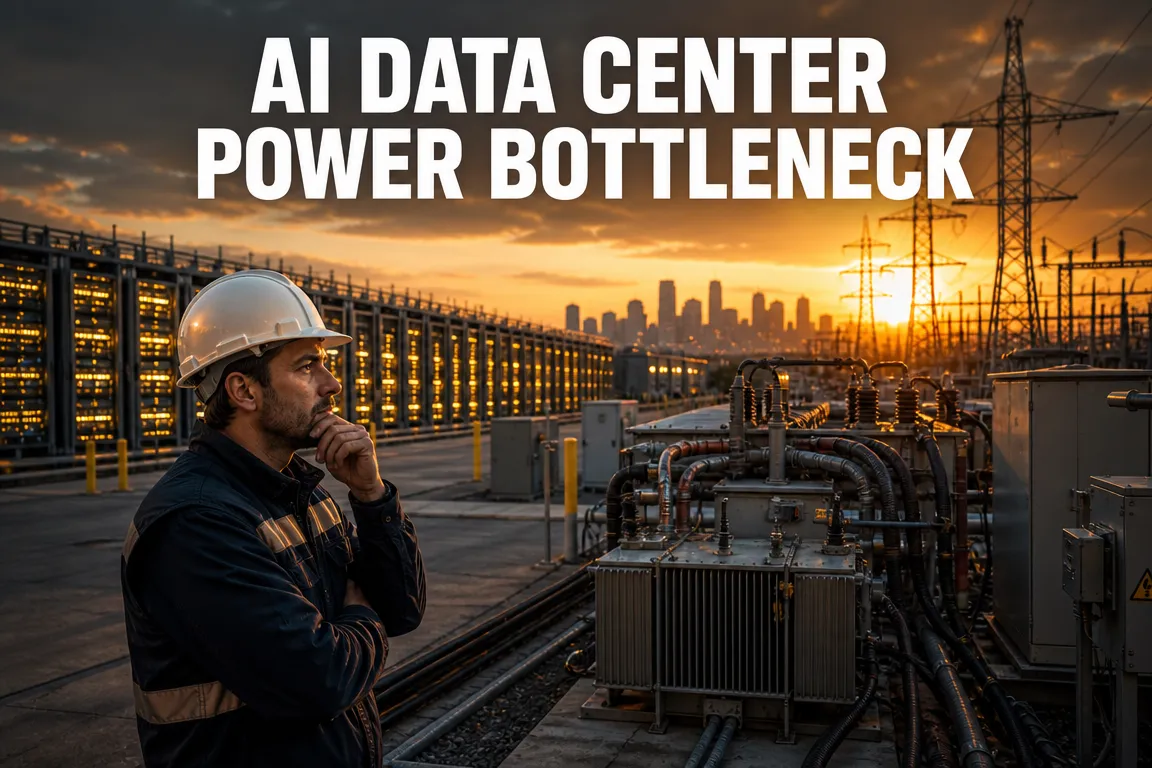
The Real Bottleneck in the AI Data Center Race Is Power, Not GPUs
The key point of this article is not simply that more AI data centers are being built.
What is changing on the ground in Silicon Valley is more concrete.
The performance race around a single AI server is reshaping data center architecture, cooling systems, power grid investment, electricity pricing, and the valuation of Big Tech in U.S. equities.
In particular, the winners in the AI industry are increasingly likely to be not those that buy the most GPUs, but those that secure power and cooling infrastructure first.
1. The Reality of AI Infrastructure Inside Silicon Valley Data Centers
Equinix’s data center in San Jose, California, may appear to be a standard industrial facility from the outside.
Inside, however, it serves as critical infrastructure supporting services from Google, Microsoft, OpenAI, Amazon, and Meta around the clock.
The process of querying ChatGPT, uploading files to the cloud, and generating AI images and video all passes through data centers of this kind.
- Security level:
Access requires identity verification, controlled entry, and multiple security checkpoints.
Server rooms are not simple equipment storage areas; they are the core of corporate data and internet services. - Server room structure:
Rows of black server cabinets are connected by extensive fiber-optic and power cabling across the ceiling.
These connections support data movement between companies and cloud network interconnection. - Most important change:
Traditional data centers relied on strong airflow for cooling.
AI servers now generate heat levels that exceed what air cooling alone can handle.
2. Core AI Data Center Technology: Direct Chip Cooling
The most visible change in new AI data centers is the thick cooling-water piping running down from the ceiling.
These pipes extend into server racks and deliver coolant directly to GPUs and CPUs.
This is Direct-to-Chip Liquid Cooling.
In practical terms, the old method was to cool an entire room with powerful air conditioning.
The new method is to attach cooling directly to the hot chips themselves.
As AI semiconductors generate more heat, cooling architecture is shifting accordingly.
- Legacy approach:
Cold air is circulated throughout the server room to lower temperatures.
This was sufficient for conventional cloud servers and earlier internet-service data centers. - AI-era approach:
Metal cooling blocks are attached to GPUs and CPUs, with coolant flowing through them to remove heat directly.
Continuous high-performance AI workloads require chip-level thermal management. - Investment focus:
Cooling technology is no longer only a facility issue; it is a strategic industry addressing a core AI bottleneck.
Data center cooling equipment, power management systems, liquid cooling, and water-treatment technologies may gain importance.
3. Server Rack Power Consumption Has Increased More Than 60-Fold in 20 Years
The most important change in the data center industry is density.
Here, density refers to how much power a server rack consumes and how much computation it can deliver.
Twenty years ago, a single data center rack typically consumed about 2 kW.
By contrast, a modern AI rack can draw up to 135 kW.
That represents an increase of more than 60 times over two decades.
If AI semiconductor performance continues to advance, systems exceeding 200 kW per rack may become more common.
At this level of power density, traditional data center design no longer works.
Building structure, wiring, cooling-water piping, power delivery systems, and fire-safety design all have to be redesigned.
- Past data centers:
They functioned mainly as storage and delivery facilities for data. - Current AI data centers:
They are closer to factories that take in data, run it through GPUs, and generate new output. - Future AI data centers:
AI agents may automate more workflows, driving a further surge in compute demand.
4. Why Data Center Construction Competition Has Intensified in the United States
Competition in AI models is increasingly translating into competition in data centers.
Building better AI models requires large GPU clusters, and operating those clusters requires hyperscale data centers.
Google, Microsoft, Amazon, and Meta are all increasing investment in AI infrastructure aggressively.
Cloud providers, AI startups, infrastructure funds, and real estate investors are all allocating capital to the data center market.
This trend is also affecting U.S. equity valuations across semiconductors, power infrastructure, data center REITs, and industrial real estate.
- AI model competition:
Larger models, faster inference, and lower costs require substantial compute capacity. - Rising cloud demand:
As companies shift from their own servers to cloud-based AI services, data center demand rises. - Expansion of AI agents:
As use cases expand from Q&A to workflow automation, coding, research, and video generation, compute demand rises further. - Capital market linkage:
Increased Big Tech investment supports expectations for semiconductors, grid infrastructure, transformers, power generation, renewables, and transmission assets.
5. The Real Bottleneck Is Power, Not GPUs
Many market participants still view GPUs as the main constraint in AI.
GPU supply remains important.
However, a larger issue is becoming visible in the field.
That issue is electricity.
Even with capital available, a data center cannot be built instantly.
It requires GPUs, a facility, transmission access, cooling systems, and, above all, a stable power supply agreement.
According to major projections, data centers could account for as much as 9% of total U.S. electricity consumption by 2030.
Under a higher-demand scenario, the figure could exceed 10%.
That would mean data centers could consume nearly one-tenth of all electricity produced in the United States.
- Key shift:
AI competitiveness is expanding from GPU access to power access. - Operational constraint:
Some data centers are completed but cannot begin operations because sufficient power has not been secured. - Investment angle:
Power infrastructure, transmission networks, transformers, generation assets, storage systems, nuclear power, and natural gas generation are becoming more important.
6. Why AI Data Centers Have Become a Political Issue
AI data centers are no longer only a technology-sector issue.
They are now tied to electricity bills, local resident burdens, and grid expansion costs.
If ratepayers end up bearing part of the cost after billions of dollars are spent expanding the grid for Big Tech data centers, public opposition is likely to increase.
In the U.S. House, legislation requiring state regulators to review cost allocation for large power-consuming facilities passed by a wide margin.
Local communities are no longer automatically welcoming data centers.
They are now asking whether electricity costs will rise, whether water consumption is manageable, and whether additional transmission lines and power plants will be required.
- Electricity pricing issue:
There is concern that grid expansion costs for data centers could be passed on to ordinary consumers. - Water scarcity issue:
Cooling systems require water, raising concerns about local resource constraints. - Local political risk:
Permitting, transmission construction, and power plant expansion may trigger conflicts with residents and local governments. - Regulatory risk:
Future data center approvals may increasingly require review of environmental impact, power burden, and tariff structure.
7. The Most Important Point Often Missed in Other Coverage
Many reports stop at the statement that AI data centers consume large amounts of electricity.
The more important issue is that power access is becoming an entry barrier for the AI industry.
- First, AI competitiveness is not determined by model quality alone.
Even if a company develops an advanced AI model, high inference costs and unstable power access can limit scaling.
Companies that combine model development capability with infrastructure procurement capacity will have an advantage. - Second, data centers are becoming an energy industry, not just a real estate category.
Location and network connectivity used to matter most; now long-term access to low-cost, reliable electricity is more important. - Third, countries with slow grid expansion may fall behind in AI competition.
Even if GPUs are imported, large-scale AI services are difficult to operate without adequate transmission networks, substations, and cooling infrastructure.
This applies not only to the U.S. but also to South Korea, Japan, and Europe. - Fourth, the Big Tech investment cycle is extending into the power sector.
Investors who focus only on semiconductors are seeing only part of the AI infrastructure cycle.
Transformers, power cables, power plants, batteries, cooling systems, and data center REITs must also be considered. - Fifth, the key to AI cost competition is electricity pricing.
Even with the same GPUs, differences in power rates and cooling efficiency can significantly affect AI service costs.
Companies with cheaper power will be better positioned to offer AI services at lower prices.
8. Sector Implications for Investors
AI data center expansion is not just a technology trend; it is a large capital expenditure cycle.
Interest rates, cost of capital, power grid investment, and semiconductor supply chains are all connected.
When evaluating AI-related stocks in the U.S. equity market, investors should consider not only revenue growth at Big Tech firms but also the burden of infrastructure spending.
- Semiconductors:
Demand for Nvidia GPUs, HBM memory, networking chips, and high-speed interconnects is likely to remain strong.
However, if power supply becomes the greater bottleneck, growth may be constrained by infrastructure limits. - Power infrastructure:
Demand for transformers, transmission lines, substations, and power management equipment may increase structurally.
AI data centers are becoming a major source of demand for grid expansion. - Energy:
Nuclear power, natural gas generation, renewables, and battery storage are all emerging as options for data center power supply.
Interest is increasing in sources capable of providing 24/7 reliable electricity. - Cooling technology:
Direct-to-chip cooling, liquid immersion cooling, high-efficiency HVAC, and water-treatment technologies are becoming core data center equipment. - Real estate and REITs:
Data center REITs may benefit from AI infrastructure growth, but power access and regulatory risk are now more important. - Big Tech:
Microsoft, Google, Amazon, and Meta are continuing large capital spending programs to expand AI services.
Investors should monitor not only revenue growth but also depreciation, power costs, and monetization speed.
9. Implications for Korean Companies and the Korean Economy
The AI data center race is not limited to the United States.
South Korea is entering a phase in which AI semiconductors, cloud infrastructure, data centers, power grids, and nuclear power are becoming interconnected.
- Korean semiconductor companies:
They may benefit from rising demand for HBM, high-performance memory, and power-efficient semiconductors.
As AI servers expand, memory bandwidth and power efficiency become even more important. - Power grid investment:
If domestic data centers remain concentrated in the Seoul metropolitan area, grid and transmission constraints may intensify.
Distributed data centers and power infrastructure investment may become important policy issues. - Nuclear power and energy policy:
Stable baseload power may regain attention in the AI era.
Because data centers require electricity around the clock, nuclear power, gas generation, renewables, and ESS combinations may be discussed more frequently. - Corporate investment strategy:
As companies adopt AI services, they will need to consider data processing costs, cloud costs, and power consumption, not just model performance.
10. The Most Important Questions for the AI Industry Going Forward
When assessing the AI industry, the questions should be straightforward.
The issue is not only who can build the smartest AI.
- Who can secure electricity first?
Large-scale AI operations require long-term power contracts and access to transmission networks. - Who can cool GPU heat most efficiently?
Cooling efficiency determines both operating costs and data center stability. - Who can absorb infrastructure costs?
Large capital spending is a source of competitiveness, but it also creates pressure on profitability. - How will costs be shared with local communities?
Whether grid expansion costs are borne by companies or consumers will influence the pace of new data center development.
< Summary >
AI data centers are no longer simple server storage facilities; they are massive compute factories.
Server rack power consumption has increased from about 2 kW historically to as much as 135 kW in current systems, with 200 kW or more appearing increasingly plausible.
This is driving a shift from air cooling to direct-to-chip cooling.
In the United States, data centers could account for 9% to 10% of total electricity consumption by 2030.
As a result, the center of AI competition is shifting beyond GPU supply to power access, cooling, transmission networks, and regulatory response capability.
Investors should evaluate not only semiconductors but also power infrastructure, energy, cooling technology, and data center REITs.
[Related Articles…]
- AI Infrastructure Investment Cycle and Big Tech Capital Spending Outlook
- How Power Infrastructure Is Reshaping the Global Economy and Data Center Competition
*Source: [ Maeil Business Newspaper ]
– [실리콘밸리뷰] 실리콘밸리 데이터센터 가보니